The Pattern Room · a measuring pattern
Striped cushions: which way the stripes run, and why
A stripe is a line of light laid across a cushion, and the roll it comes from has opinions. Here is how to choose the direction, the width and the piping so the stripes fall where your eye expects them.
 Save
The quick answer
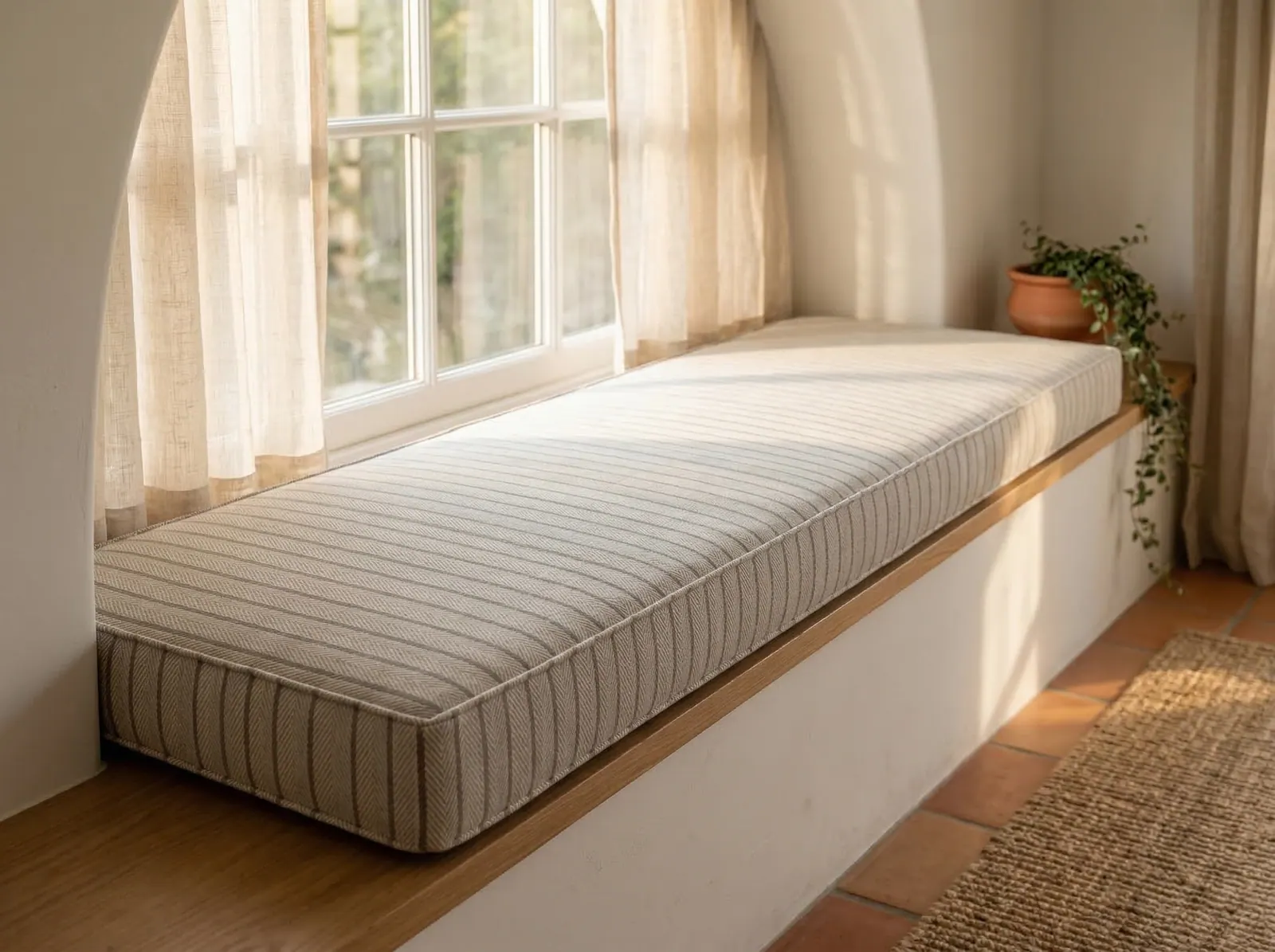
On a long bench cushion, stripes run front to back by default, because the fabric roll is only about 55 in (140 cm) wide and front-to-back stripes let the top be cut in one piece. Stripes running the full length of a cushion longer than about 54 in (138 cm) need a seam. You can request either direction before production.
The roll decides before you do
A roll of striped cotton is about 55 in (140 cm) wide, and that one number decides which way your stripes can run without a seam.
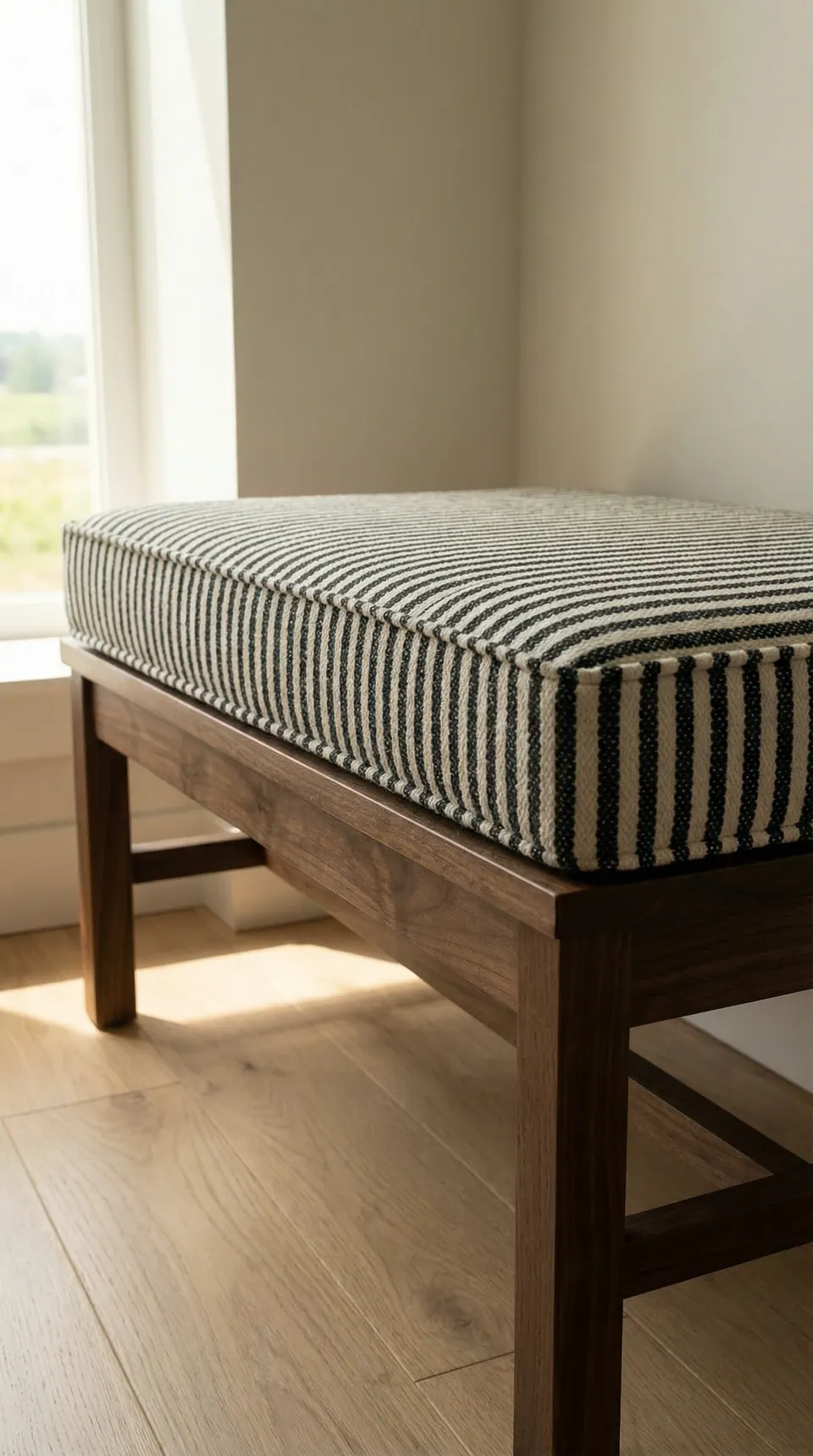
Here is the part that surprises people, my friends. By default, the workshop sets the stripe direction on a bench cushion front to back, across the depth, so the top comes out in one piece at any length. Ask for stripes running end to end on a long cushion, and past about 54 in (138 cm) the top needs a seam. The rule holds on bench cushions and long window seat cushions alike.
Some mills turn the pattern on the roll, which the trade calls railroaded fabric, so long pieces can be cut whole. Either way, the roll width chooses which direction is seamless, and you choose whether a seam is worth it.
Daylight never lies; your screen sometimes does. Keep a swatch in your hand for everything that follows.
Front to back or end to end: what each choice costs
| Choice | What the eye sees | Seam in the top? | Best for |
|---|---|---|---|
| Stripes front to back (the default) | Short bars marching down the bench | No, at any length | Long benches, window seats, banquettes |
| End to end, cushion under about 54 in (138 cm) | Long lines that stretch the seat | No | Chair pads, short benches, a small window seat |
| End to end, cushion over about 54 in (138 cm) | Long lines, interrupted once by a join | Yes | Only when the long line matters more than the seam |
| Side bands (the boxing) | Stripes turning the corners, with a slight shift | No; the band is cut without joins | Every box cushion; put the matched face out |
Ordering a striped cushion that reads right
Measure, then compare the length with 54 in
Write down length, depth and thickness. If the length is over about 54 in (138 cm) and you want stripes running end to end, expect a seam, or accept the front-to-back default. The Pattern on one long cushion or two shows where a split can sit gracefully.
Name the direction for every cushion
Say whether the stripes run parallel to the long edge or the short edge, for each cushion separately, on the top and on the side bands, with a reference photo. The production team checks the technical limits and, if a direction isn't possible, picks the best-looking option.
Choose the stripe width from a real swatch
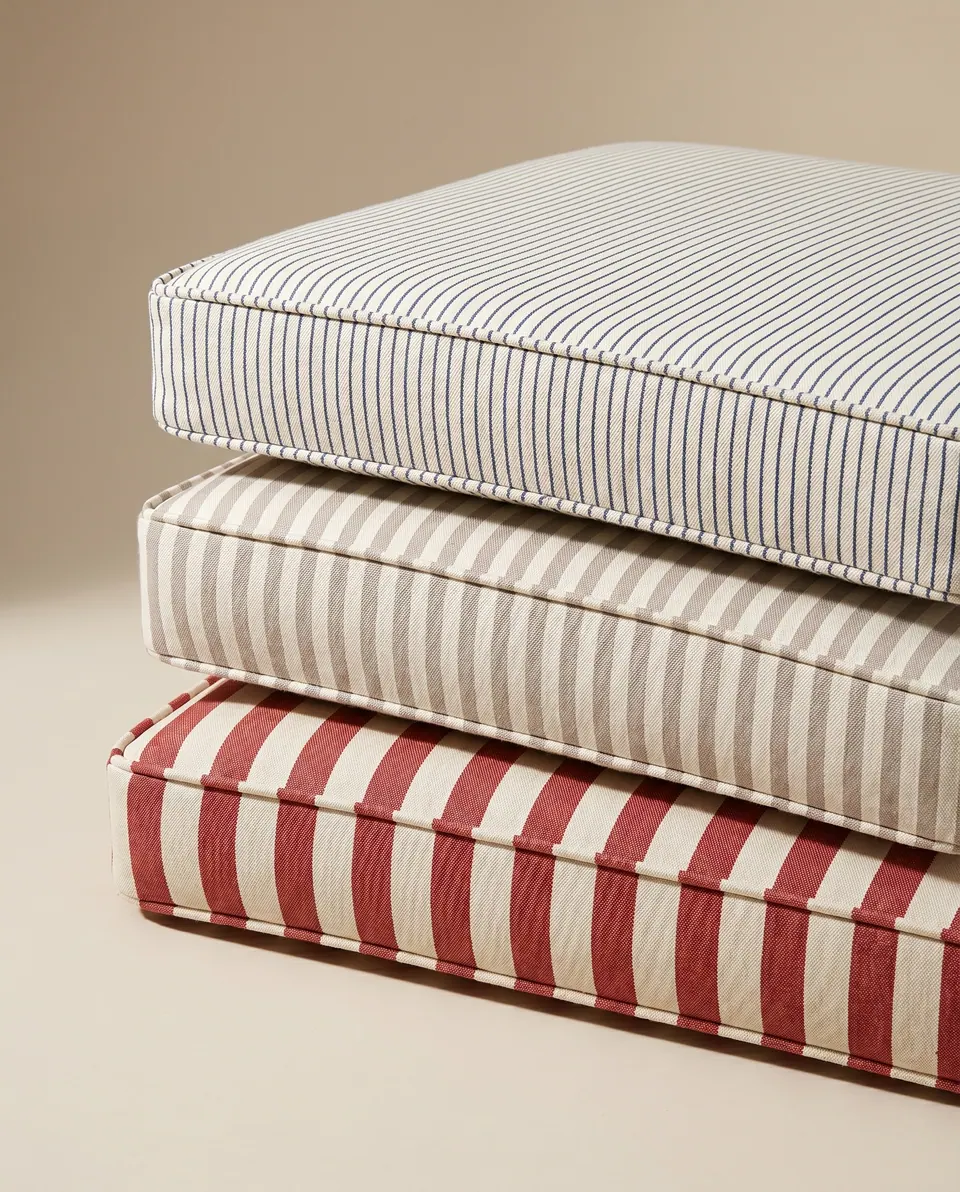
Widths vary by code, from a fine 0.28 in (0.7 cm) stripe to a bolder 0.55 in (1.4 cm) and wide stripes of about 2 to 2.4 in (5 to 6 cm). Stock can differ from an older photo, so order a physical sample and judge width and ratio, not only color.
Read the dark stripe in daylight
The darker stripes read as deep navy, not charcoal or black, though across a room they pass for black. N-08 is a very deep navy on a natural cream, not a bright white; N09 is the true black. Look at the swatch by a window at noon and again under evening lamps, and see screen color versus daylight.
Decide the piping for a striped cushion before anyone cuts
Self-piping cut from the same stripe is the only guaranteed color match, and you can ask for the stripes to run vertically on the piping. A solid piping comes from another chart, such as velvet or the soft fabric, and may differ slightly in tone; the workshop picks the closest shade under natural light, as with linen L-43 for stripe N23. Very thin stripes can't be cut into a solid strip. More in matching, contrast or no piping.
Ask which face is matched
Stripes are matched on one face of the cushion. As the fabric turns the corners onto the sides, a slight shift is unavoidable, so ask which face is aligned and put that face out.
Approve a finished photo
Before production, ask for a photo of a finished cushion in your exact stripe code. It is the cheapest moment to catch a direction note that went missing.
Keep the cottons indoors
The striped cushion fabric in the striped cotton and ticking family is 100% cotton, with one chart at 98% cotton and 2% polyester. It is indoor-only, stains more easily than the performance fabrics, and washes at 86°F (30°C) on a gentle cycle. The stripes are woven in, so custom stripe colors aren't possible.
Have it made
Measured it? Have Élodie’s workshop make it
A fabric reads one way at noon and another at dusk. Mention your light, and the workshop will weigh it with you. — Élodie
Leave your details and the workshop will call you to confirm measurements, fabric, foam and piping. No prices, dates or payment on this page: it is a request, not an order.
Three bench covers with the stripe turned onto the piping
A buyer in the US wanted three bench covers tied together by a red stripe. Two were 16.5 x 46 in (42 x 117 cm) and 16.5 x 29.5 in (42 x 75 cm), in a solid terracotta, 113, with piping cut from stripe N15 so the stripes ran vertically on the cord.
The third, 11.25 x 45 in (29 x 114 cm), reversed the idea: N15 stripe for the body, terracotta 113 for the piping, and ties set 6 in (15 cm) in from each short end. Zippers and ties cost nothing extra.
She ordered covers only, sized for a 3 in (7.5 cm) insert. Keep that detail: when you order covers without foam, give the insert thickness, or the cover is sewn to a guess.
The same baked terracotta and the same red stripe, swapped between body and trim, let three benches speak to one another without matching like uniforms.
- What it taught
- When ordering covers only, always give the insert thickness.
Why the designer's stripes came back front to back
An interior designer in the US ordered a bench cushion 32 x 57.5 in (81 x 146 cm) and 4 in (10 cm) thick, in a black-and-white stripe, N8, 98% cotton, with piping. The note asked for stripes running side to side.
They arrived front to back. The workshop explained the roll: the fabric is about 55 in (140 cm) wide, and running the stripes side to side on that cushion would have forced a seam across the top. The designer looked again and agreed that a seamless top made the better cushion.
I tell this without blame. The request was reasonable; the roll simply had the last word. Ask before cutting, not after delivery. A cover made the wrong way has been replaced, cover only, within 1 to 2 weeks, but better that it never needs to be.
Wedges, corners and the face that matches
Stripes behave like light: they change with where you stand.
On a wedge cushion, the same stripe can read vertical from one side and horizontal from another, because the sloped face tilts it toward you. Decide which view matters most, usually the one from the doorway, and set the direction for that.
The piping frames it all. A cotton ticking body with velvet piping works beautifully: one buyer in the US chose a black ticking stripe cushion in N29 with a brown velvet, 110, as the trim, after asking to see finished cushions in N29 and the wider-striped N33. The navy ticking stripe cushions sketch follows the same thread. Which stripe would you choose for the room where you read every evening?
Stripe regrets we have seen at the cutting table
- One direction note for several cushions: say it for each piece, top and sides.
- Assuming every side lines up: stripes are matched on one face, so the corners shift them.
- Choosing stripe width from an old photo: stock proportions change, so order a sample.
- Calling the stripe black from a screen: most dark stripes are deep navy, and N09 is the true black.
- Asking for 'the blue in the stripe' as piping: stripe collections have no matching solids, so choose piping by exact code or use self-piping.
- Putting striped cotton on the patio: it is indoor-only and stains more easily.
- Losing the piping spec on a remake: write 'piping: yes/no' and its code every time.
Stripes are matched on one face of a box cushion. As the fabric turns each corner onto the sides, a slight shift is normal, so put the matched face out.
Élodie
Stripes on long seat-and-back banquette sets
Long banquette sets raise two stripe questions at once: will there be a seam, and will the back line up with the seat? Upholstery fabric comes off a roll about 55 in (140 cm) wide, and the workshop runs stripes front to back by default, so a striped cushion longer than the roll is wide needs a seam along its length. Some workrooms railroad the fabric, turning it so the stripes run the long way, which avoided a seam on one long back cushion; whether that's possible depends on the fabric, so ask. Stripes are matched on one face of each cushion; because the seat and back are separate pieces, ask in the order note for the stripes to line up where the back meets the seat, and ask for a photo of the finished set before it ships.
Buyer questions: stripes and piping
- A common question
Why don't the stripes line up on every side of my cushion?
The workshop's answerStriped covers are matched on one face. As the fabric turns the corners onto the sides, a slight shift is unavoidable. Check which face is aligned and place that side facing out.
- A common question
Which way will the stripes run on my bench cushion, and do I get a say?
The workshop's answerBy default they run front to back across the depth. Most rolls are about 55 in (140 cm) wide, so running stripes lengthwise on a long cushion, such as a 92 in (234 cm) one, would need two pieces joined with a seam; front to back gives a seamless, durable top. You can ask for another direction on the top and side bands before production, ideally with a reference photo.
- A common question
How wide are the stripes on your striped fabrics?
The workshop's answerIt depends on the code. N01 has a bolder 0.55 in (1.4 cm) stripe and N02 a finer 0.28 in (0.7 cm) stripe, while N30 and the codes after it have wide stripes of roughly 2 to 2.4 in (5 to 6 cm). The red stripes share one color in different widths, and N14 is the darkest red.
- A common question
Can I get a solid piping that matches one of the colors in my stripe?
The workshop's answerSometimes. The stripe collections have no solid in the same tone, so solid piping comes from another chart, such as velvet or the soft fabric, and may differ slightly. The workshop compares shades under natural light, for example linen L-43 for stripe N23. Thin stripes can't be cut into a solid strip. Self-piping from the same stripe is the guaranteed match, and the workshop asks before production if you haven't chosen.
- A common question
Is the dark stripe black, charcoal or navy?
The workshop's answerMostly navy. The darker stripes, such as N28 and HM-23, read dark blue, though they look black from a distance, and N-08 is a very deep navy on a natural cream with a slightly braided texture. For a true black stripe, choose N09. N29 is a deep navy-black with thinner stripes, so the pattern looks denser. Order a sample if the tone must be certain.
Stripe questions, answered in daylight
What does railroaded fabric mean for a striped cushion?
Railroaded fabric has its pattern turned to run across the width of the roll, so long cushions and benches can be cut without a seam. On a roll about 54 to 55 in wide, it is the trade's answer to long pieces that must stay whole.
Should the stripes on a window seat run front to back or along the length?
Front to back keeps a long top in one piece and reads as calm, even bars. Along the length stretches the seat visually but needs a seam past about 54 in (138 cm). On a window seat shorter than that, either direction can be cut whole.
Can I use striped ticking on an outdoor bench?
Not the cotton stripes. The striped and ticking fabrics are 100% cotton, or 98% cotton with 2% polyester, indoor-only and quicker to stain. A fully covered porch can take regular fabric, but anywhere rain or damp reaches needs outdoor-rated cloth.
Can I choose my own stripe colors?
No. The stripes are woven into the cloth, so custom stripe color combinations aren't possible. You can change everything around them: the piping color, the stripe direction, and which cushions in a set are striped and which are solid.
Will the stripes line up from a banquette's back cushion down to its seat?
Ask for it, then check. Stripes are matched on one face of each cushion, and the back and seat are separate pieces, so alignment between them is something to request in the order note. Long pieces default to stripes running front to back because the roll is about 55 in (140 cm) wide. Ask for a photo of the finished set before it ships.