The Pattern Room · a side-by-side pattern
Online maker, local upholsterer or your own sewing machine?
Three roads to one new cushion, tallied on the porch table: who measures, who sews, and who makes it right when it doesn't sit right.
 Save
The quick answer
Order from an online maker when your seat is a rectangle, trapezoid or L you can measure and draw. Call a local upholsterer when a curve can't be traced, when you're supplying your own fabric, or when the job is fixed upholstery, a skirted slipcover or a board-backed headboard. Sew it yourself if a box gusset, piping, a zipper and matched stripes don't scare you.
Three roads, one porch table
Pull up a chair. Every spring somebody on my street decides to make their own window seat cushion, and every June I hear about the zipper.
That's the honest heart of custom cushion vs upholsterer vs DIY: the foam is the easy part. The hard parts are the side band that keeps a box cushion square, the piping that keeps its edge straight, the zipper that lets you wash it, and the stripes that have to line up on every face. Whoever handles those four things well should make your cushion.
Plenty of custom orders begin with a buyer wondering whether somebody local should just do it. Sometimes the right answer is yes. Here's how the three compare, with no prices in it, because prices change by town and by season, and the reasons don't.
The tally: three routes side by side
| Sew it yourself | Local upholsterer | Online custom maker | |
|---|---|---|---|
| Who measures | You | Often the upholsterer, at your house | You, with a drawing or a paper template and photos |
| Who makes the pattern | You, on kraft paper | The upholsterer, from the real seat | The maker, redrawn to scale from your numbers and sent back for approval |
| Fabric | Anything you can buy by the yard | Their sample books, or your own fabric | The maker's range; the workshop's is mostly plain colors, with stripes, plaids and patterned velvets on extra charts |
| Foam | Cut to size by a foam shop or an online cutter | Chosen and cut in the shop | Included; the workshop uses about 2.0 lb/ft³ (32 kg/m³) foam |
| The hard part | Box gusset, piping, zipper, matched stripes | Finding a free spot in their schedule | Measuring accurately from a distance |
| Best for | Simple rectangles and a free weekend | Curves nobody can trace flat, fixed upholstery, your own fabric | Rectangles, trapezoids, notched benches, L shapes and long one-piece cushions |
| When it goes wrong | You unpick it | You sort it out with someone you can meet | Maker errors: get the fix in writing; measuring errors are yours |
Sewing it yourself: where weekend projects stall
I love a home-sewn cushion. My first had a zipper you could see from the street, and it still earned its keep on the swing. Here's where the trouble hides:
- The foam. A foam shop or an online cutter will cut it to size. Foam cutters' own fitting advice is to cut the foam slightly larger than the cover, so the cover looks full instead of baggy.
- The box gusset. That side band is what makes a box cushion a box. Let its height wander by a little and the whole cushion leans like an old fence post.
- The piping. It has to be sewn in evenly all the way around, corners included. A wobble shows on every edge.
- The zipper. On a bench cushion it should run a couple of inches around the back corners, or the foam fights you every wash day.
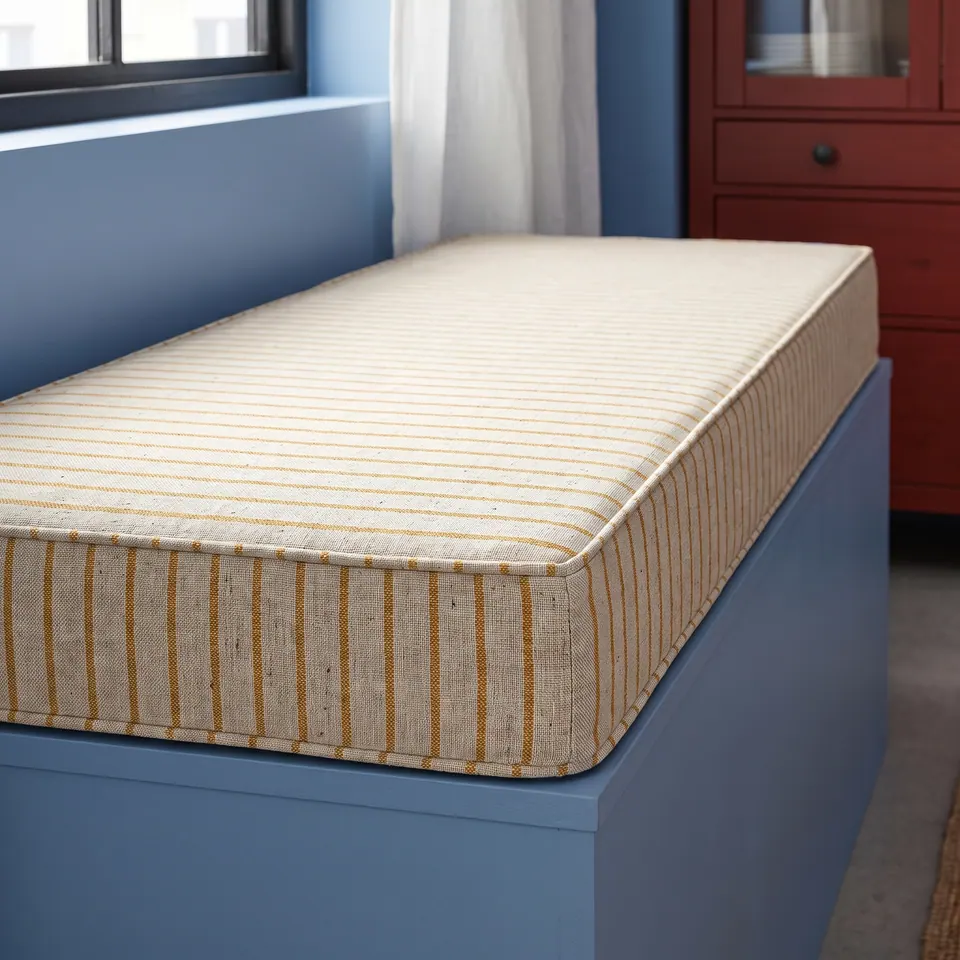
- The stripes. A boxed cushion needs the pattern matched from the top down through the side band. A bullnose edge, one piece of fabric wrapped over the front, skips that seam.
Work out the fabric before you shop. Fabric yardage for cushions and the yardage calculator do the arithmetic, roll width included. The workshop's rolls run about 55 in (140 cm) wide, which is why stripes on its long cushions usually run front to back.
What a local upholsterer can do that nobody can from afar
A good local workroom owns one tool no online maker has: your actual furniture. They can lay paper on the seat and trace the curve while you stand right there arguing about the corners.
That's the road for:
- Curves you can't trace flat. The workshop has turned down round bay windows and kidney-shaped benches, because a fit like that can't be promised from a distance.
- Your own fabric. The workshop takes customer fabric only case by case and usually steers buyers to its own range, offering the closest match from a photo instead.
- Fixed upholstery. Re-covering an upholstered sofa or chair, skirted slipcovers, and board-backed or French-cleat headboards are upholstery and joinery. The workshop doesn't make them, and says plainly that a local upholsterer or joiner will do them better.
- Shortening a cushion. Foam can be cut down, but not well by hand at the kitchen table. An upholsterer can shorten foam and cover; get a price first, since a new cushion sometimes costs less.
Is there a curve in your house, neighbor, that nobody has ever measured properly?
What an online maker does well
An online maker earns its keep on shapes you can put numbers on. Rectangles, trapezoids, notched benches, L-shaped runs: measure them, draw them, and the workshop cuts to the drawing, not to a stock size. It redraws the shape to scale, flags any edge that can't be right, and waits for your yes before cutting.
Remote templating works better than folks expect. Lay kraft paper or brown wrapping paper on the seat, trace it, cut it out, fold it in half to check the two sides match, and photograph it flat beside a tape measure. The paper template Pattern has the routine, measuring a bench covers the plain ones, and drawing a custom shape covers everything in between.
Long pieces are another strength. One buyer wanted a 111.5 x 34 in (283 x 86 cm) window-bench cushion in one continuous piece after other makers had suggested two. The workshop made it in white velvet at 4 in (10 cm) thick, and it traveled compressed in a box about 24 x 20 x 8 in (60 x 50 x 20 cm). Foam like that rises again in 48 to 72 hours. Finished examples live in the bench cushion atlas.
Pick by situation, not by price
| Your situation | The route I'd take | Why |
|---|---|---|
| A curve you can't trace flat, like a round bay | Local upholsterer | The fit needs someone standing at the seat |
| A rectangle, trapezoid or L you can measure | Online maker | A drawing with every edge carries all the information |
| An S-curve or odd edge you can trace on paper | Online maker, with a full-size template | A template turns a risky curve into a buildable one |
| A shaped rocking-chair seat | Local upholsterer | Too exact to fit from afar; the chair belongs in the room |
| Fabric you already own | Local upholsterer or DIY | The workshop usually steers buyers to its own range and looks for a close match |
| Re-covering a sofa, a skirted slipcover, a board-backed headboard | Local upholsterer | Fixed upholstery and rigid panels are joinery, not cushions |
| One simple chair pad and a free Saturday | DIY | A knife-edge pad with ties needs no gusset; tutorials cut the ties about 2 x 10 in (5 x 25 cm) |
| A bench over 9 ft (2.7 m) that should be one piece | Online maker | A 111.5 in cushion has been made in one piece and shipped compressed |
The S-curve bench that got a yes, and the rocker that got an honest no
A homeowner sent the workshop a careful spec for a study bench whose edge ran in an S-curve, the shape cabinetmakers call an ogee. The first answer was no: too much risk of a poor fit from a distance.
The homeowner didn't argue. They made a full-size template. With the real curve on paper, the most experienced craftsman took the job: firm foam wrapped in polyester wadding, piping, and a zipper hidden on the back. It went out by express in time for a magazine photo shoot, and the owner loved it.
Another buyer asked for a seat pad for a rocking chair and offered to send a template too. The craftsmen studied the photos and the drawing and still said no. Without the chair in the workshop, the fit was too uncertain. The buyer thanked them for the honesty and came back later for two rectangular bench cushions in a sturdy sage fabric.
Both answers were right. A maker who says no to the wrong job is the one you want for the right one. The limits are spelled out in which curved shapes get declined.
The foam is the easy part of a cushion. The side band, the piping, the zipper and the stripes are where a weekend project turns into a month.
Rosa
Buyer questions: shapes, fabric and what sets the price
- A common question
How do I measure a curved cushion, or a bench with one rounded end?
The workshop's answerCurved, rounded-end and asymmetrical cushions can be made, but a curve won't be guessed from numbers alone. Either sketch it with the total width and depth, the straight length before each curve, where each curve starts and ends and how deep it runs, or, for tricky curves, trace the seat onto wrapping paper, cut it out and photograph it flat beside a tape measure. Each cushion needs its own drawing.
- A common question
How do I order a cushion that isn't a rectangle?
The workshop's answerThrough the separate custom-shape listing. Choose the size range by the longest length and the deepest depth, which only sets the price bracket, then upload a drawing with a measurement on every edge, plus a photo of the seat if you have one, and write the thickness and fabric code in the personalization box. The cushion is cut exactly to the drawing. Unsure? Message the drawing first and the makers will review it.
- A common question
Can I buy your fabric by the yard to sew something that matches?
The workshop's answerYes. Small samples and cut lengths are sold through the fabric-samples listing, and larger pieces through a custom order link; send the fabric code and how much you need. Extra fabric can ship with your cushions, and buyers have used it to re-cover an ottoman or make valances, which the workshop doesn't sew. Most rolls are about 55 in (140 cm) wide, a few about 79 in (2 m).
- A common question
Is your linen fabric 100% linen?
The workshop's answerUsually not. The linen-look codes are polyester, the natural linen chart is described as half linen and half polyester, and another range is half cotton, half linen. Those blends are chosen because they're durable and easy to clean. If you want pure fiber, ask for the separate 100% linen chart or the 100% cotton fabrics.
- A common question
What decides the price of a custom window seat cushion?
The workshop's answerSize first: length times depth, then thickness. An 8 to 9 in (20 to 23 cm) cushion sits well above a standard 3 to 4 in one, and angled ends cost a little more than a plain rectangle. The fabric makes little difference. Standard thickness is 4 in (10 cm), and the quote states the shipping cost alongside the cushion.

Have it made
Measured it? Have Rosa’s workshop make it
Tell the workshop who sits there: grandkids, the dog, a cup of coffee at six. The right fabric and foam follow from the people. — Rosa
Leave your details and the workshop will call you to confirm measurements, fabric, foam and piping. No prices, dates or payment on this page: it is a request, not an order.
Porch-step questions
Can the workshop re-cover my upholstered sofa or armchair?
No. For fixed upholstery the craftsmen don't make drape-over slipcovers with skirts, and they won't attempt a fit that may not work. They make custom cushions and removable cushion covers. For re-covering the frame itself, a local upholsterer is the right call.
Can I send my own fabric to be made up?
Only case by case. The workshop usually steers buyers to its own range, because shipped-in fabric tends to add delays and cost. Send a photo of the fabric you love instead, and it will name its closest codes or try to source a look-alike, at a higher price than its standard fabrics.
My cushion came out too long. Can a local upholsterer shorten it?
Yes. An upholsterer can cut the foam down and shorten the cover, which is hard to do cleanly by hand at home. Get a price first, though. When one buyer's own measurement made a cushion too long, the workshop offered a discount on a correctly sized reorder, and that was the better deal.
What paper works best for a cushion template?
Kraft paper or brown wrapping paper; newspaper will do in a pinch. Press it into the seat edges, trace, cut with a little margin, then fold it in half to check the two sides match. Mark the top, the front and the zipper side, and photograph it flat beside a tape measure.