The Pattern Room · a measuring pattern
How to measure a bench for a custom cushion (the bench, not the old pad)
The squashed pad on your entry bench has been lying to you for years. Measure the wood, write down exact numbers, and let the workshop worry about allowances.

 Save
The quick answer
To measure a bench cushion, measure the bench seat itself, wood to wood: the length at the front and the back, the depth at both ends, and anything that rises above the seat. Send those exact numbers with nothing subtracted. The maker adds its own allowances, and a handmade cushion lands within about 1/2 to 1 in of your size.
Why the old pad can't be trusted
The old cushion is the worst ruler in the house. It has been sat on, sunned and squashed, and each of those took a little off an edge or pushed a bulge into one. So the first rule of how to measure a bench cushion is to set the old one aside. Copy it and you get a faithful replica of a tired cushion.
I learned that the hard way, early on, copying a pad that had been sat on for twenty years. The new one reproduced the sag beautifully. Measure the bench, not the cushion you used to have.
The workshop allows one exception. If your current cushions fit well and you only want the same again, their sizes will do. If they fit poorly, or you want a different thickness, measure the bench. This Pattern does that on a mudroom or entry bench. The bench cushions hub has the wider family, and mudroom and entryway bench cushions the boot-and-backpack kind.
Measuring an entry bench in eight steps
Measure it built and in place
Built-ins get measured after they are installed, not from the plans. Finished benches rarely match their drawings. If the carpenter is still sawing, the workshop can hold an order until you send final sizes.
Take the length at the front and the back
Tape along the front edge, wood to wood, then along the back against the wall. Walls are rarely square; one can be 1/2 in out of line over 32 in (81 cm) and still pass residential tolerance. If the two numbers differ, send both.
Take the depth at both ends
Measure front edge to wall at the left end and at the right end. Depth means the seat, not the cushion's thickness; buyers use the word for both, and the workshop then has to ask which was meant.
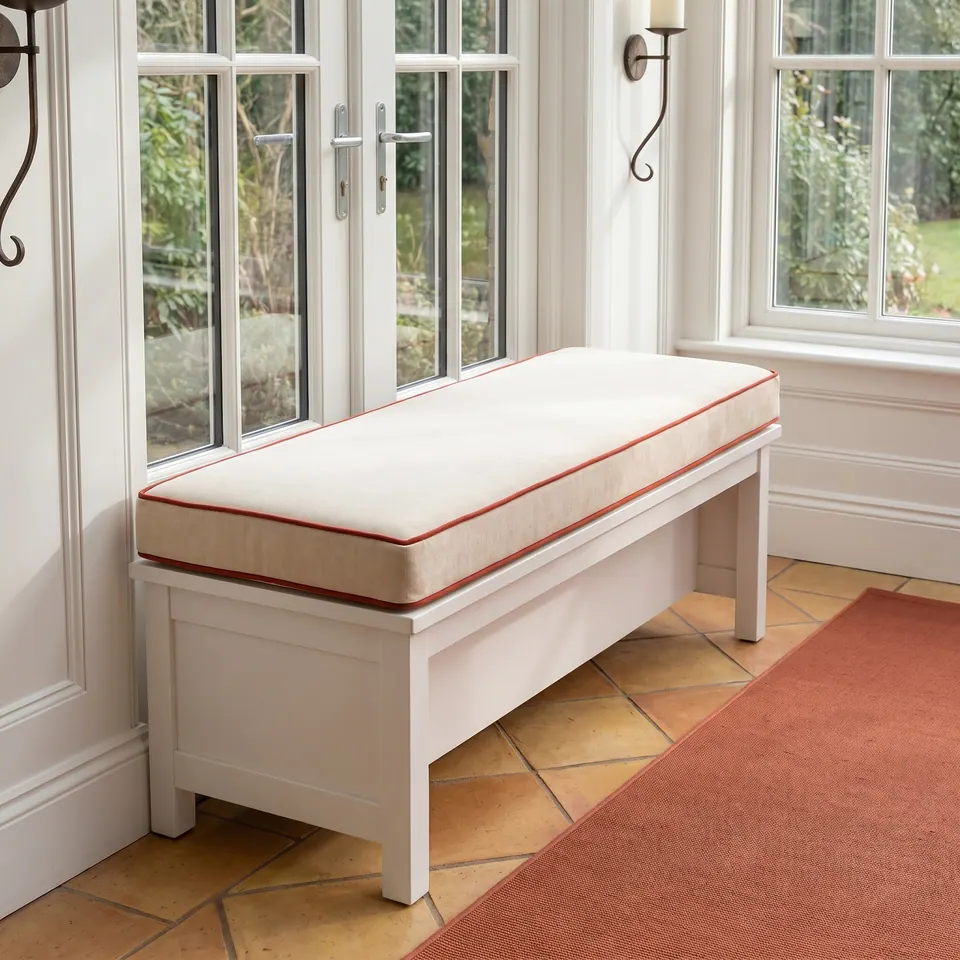
Pattern sheet Plan: the cushion fills the inside of the frame, 48 by 21 in, measured wood to wood. Front view: 4 in thick. Note what encloses it
Arms at both ends, a wall on one side, cubbies below: write down which edges are enclosed and which are free. An enclosed bench wants its exact inside size. A free edge gives you a choice, laid out in the table below.
Mark anything that rises above the seat
Trim, a post, a leg that stands proud of the top, a window casing: each one needs a notch, and a notch needs its width, its depth and its position along the edge. See notched cushion cutouts.
Choose the thickness last
Standard is 4 in (10 cm), and most buyers keep it. Go thinner if the bench already sits high; bench cushion thickness and seat height does the sum for you.
Write it down twice, in one unit
Measure to the nearest 1/8 in, repeat every measurement, and put the unit after every number. Fractions such as 57 5/8 x 15 3/8 in are fine. Photograph the tape, then type the numbers out too; tape photos get misread.
Order the range, type the real size
On a listing, the size dropdown only sets the price. Pick the range your bench falls into, or the next size up, and type the exact size, thickness, fabric code and piping code in the personalization box. A 17 x 52 in cushion has been ordered through the 18 x 52 in option; it was made to the 17.
Exact size or a little smaller? Settled.
| Your bench | What to write | Why |
|---|---|---|
| Enclosed by arms or walls | The exact inside size, wood to wood | The workshop adds sewing and fit allowance; subtract as well and you've paid for a gap |
| Wood trim you want to show | A slightly smaller size, written as the size you want | The workshop never shortens your numbers itself, so any reveal has to be in the numbers you send |
| Two cushions side by side | Each piece a touch shorter | Only if you want a visible gap between them |
| A lift-up lid | The exact size, and ask to round down | Down, never up, so the lid still opens |
| A dining bench | The seat surface, exactly | A close match looks cleaner than an overhang |
| Piping | Nothing extra | Piping sits on the seams: a 48 x 21 in bench still gets a 48 x 21 in cushion |
Web guides disagree, from 1/2 in off per side to 1/4 in off per free edge. The workshop's default is simpler: exact sizes in, allowances handled in production.
The last half inch belongs to the hands
Every cushion here is cut and sewn by hand, and hands are honest but they are not lasers. A finished cushion lands within about 1/2 to 1 in (1 to 2.5 cm) of the ordered size; the listings say about 1 in either way, and long cushions vary the most. Inch orders are converted to the nearest centimeter for production, which can add a whisker.
If a number is a hard limit, say so in writing. For a 73 in (185 cm) cushion going into a 77 1/2 in (197 cm) space, the workshop promised to stay close to 73 and to take responsibility if the cushion came out longer than the space.
And measure the delivered cushion only after the foam has fully recovered from its vacuum pack. The custom cushion size tolerance Pattern has the rest, and the tolerance entry in the glossary has the short version.
A 77 in quilt box and four hinges
A returning buyer in the US, happy with an earlier patio swing cushion, wrote in about a long wooden quilt box with a hinged lid, 77 in (196 cm) long. The cushion had to stay on the lid when it lifted.
The workshop suggested ties on the hinge side only and waived the small charge that usually comes with them. The buyer sent the four hinge positions: 8 5/8, 29, 48 and 68 1/4 in (22, 74, 122 and 173 cm).
Good numbers, and still not enough. The workshop wrote back asking which end they were measured from, for photos, and for the width of each hinge, so every tie would land beside the hardware instead of on top of it. A position without a starting point, dear, is a guess written in fractions.
More on lids in cushions on hinged storage lids.
- What it taught
- For hinged lids, record hinge positions from a named end so ties clear the hardware.
Measuring mistakes I've watched (and one I made)
- Copying the old cushion. Unless it fit perfectly, it is the wrong ruler. Measure the seat surface.
- Measuring the outside of the frame. The cushion sits inside the arms. Measure inside, wood to wood.
- Trusting the catalog. Flat-pack tops don't always match their listed size. Measure the actual top.
- Swapping width and length. Write the long side as length, and mark each number on a photo of the bench.
- Subtracting 'just in case'. The workshop adds allowances already. Take off another 1/2 in and the gap is yours.
- Letting someone else measure, unchecked. Have a second person read the tape, and retype handwritten figures before ordering.
- Forgetting ties or a non-slip base. A cushion cut exactly to a narrow bench has nothing to grip. Ask in writing, then check the pre-dispatch photo; see stopping a bench cushion sliding.
Check your numbers in the bench builder
Once you have length, depth and thickness, enter them in the bench cushion builder. It draws the cushion in 3D and writes a cutting ticket with every edge in inches and centimeters, which is a fine thing to send with one photo of the bench taken from above.
If the bench runs long, read one long cushion or two before you order. For entry benches that take boots and wet coats, the mudroom bench cushions sketches show what others chose.
So: what does your bench measure, wood to wood?
Order a bench cushion at the bench's exact size: 48 x 21 in wood to wood means a 48 x 21 in cushion, with the piping sitting on the seams.
Maggie
Widths at three points, inside the arms, and the back cushion rule
Measure inside, not across
Between arms or side panels, measure from inside face to inside face at seat level. The arms' outer size doesn't matter.
Take three widths
Front, middle and back. Benches and built-ins drift; send all three and label them.
Take the depth at both ends
From the back wall or rail to the front edge, on the left and on the right.
Write it down exactly
Record to the nearest 1/4 or 1/2 in and add nothing for seams; that allowance is the workshop's job.
Planning a back cushion too?
Measure the back height from the top of the seat cushion, not from the bare bench: a 21 in back area over a 4 in seat takes a 17 in back.

Have it made
Measured it? Have Maggie’s workshop make it
Have the tape measure handy when they call. Old cushions shrink and sag; the seat underneath does not. — Maggie
Leave your details and the workshop will call you to confirm measurements, fabric, foam and piping. No prices, dates or payment on this page: it is a request, not an order.
Buyer questions: old pads, exact sizes and dropdowns
- A common question
Do you want the size of my old cushion, or the size of the bench?
The workshop's answerIf you're happy with how the current cushions fit, their sizes work. If they fit poorly, or you want a different thickness, send the bench dimensions instead. For new covers on foam you're keeping, measure the bare foam, not the old cover, and draw it with every side labeled and the thickness noted.
- A common question
Should I take a little off my measurements so the cushion slides in easily?
The workshop's answerNo. Give the exact end-to-end size and don't subtract anything, not half an inch and not a centimeter. The shop makes the cushion to the numbers you write, and its production team handles any fitting allowance. Piping sits on the seams, so a 48 x 21 in bench still gets a 48 x 21 in cushion.
- A common question
My bench size isn't in the dropdown. Which option do I pick?
The workshop's answerPick the range your size falls into, usually the next size up, because the dropdown only sets the price. Then type your exact dimensions, thickness, fabric code and piping code in the personalization box. The cushion is cut to what you type, and fractions such as 57 5/8 x 15 3/8 in are fine.
- A common question
How close to my numbers will a handmade cushion actually come out?
The workshop's answerWithin about 1 in (2.5 cm) either way, as the listings state, and long cushions vary the most. Inch orders are converted to the nearest centimeter for production. If a size is a hard maximum, say so: when 24 in (61 cm) was the absolute limit, the cushion was made at 23 in (58 cm).
- A common question
Can you add my exact bench size to the listing so I can check out normally?
The workshop's answerYes. Message the exact size and the shop can add it as a new size option; refresh the page to see it. Sizes added this way include 20 x 38 in and 36 x 72 in. Quoted or multi-part orders get a personal custom option or private listing instead. A 'Custom for...' option already in the menu belongs to a past customer.
Bench measuring, answered short
Should a bench cushion be smaller than the bench?
Not by default. Order the exact size of the seat and the workshop adds its own sewing allowance. Go smaller only on purpose: to show a wood edge, to leave a gap between two cushions, or to round down so a lift-up lid can still open.
How thick should an entryway bench cushion be?
4 in (10 cm) is the standard for bench and window-seat cushions, and most buyers keep it. Go thinner if the bench already sits high; designers have ordered 2 in (5 cm) pads for long benches of 60 1/2 and 68 in, each with a slim 4 in bolster.
What if the front and back of my bench measure differently?
Send both numbers. Walls are rarely square, and a wall 1/2 in out of line over 32 in still meets residential tolerance. If the difference is bigger, draw the bench from above with every edge labeled, and the cushion can be cut as a slight taper to your drawing.
Can I measure a bench that hasn't been built yet?
Better not. Measure after built-ins and furniture are installed, because finished benches rarely match their plans. If you want to get the order in early, the workshop can hold it until you send the final sizes.
Which number is length and which is depth?
Length is the long side, left to right. Depth is front edge to wall. Thickness is how tall the cushion stands. Write them in that order with the unit after each number, such as 48 x 21 x 4 in, and mark each one on a photo.
Do I need to add a seam allowance when I measure my bench?
No. Seam allowance is the sewer's job, not yours. Measure the finished space you want covered, write it down to the nearest 1/4 or 1/2 in, and send it unchanged. The workshop adds its own seam and fit allowances when it cuts and makes the cushion to the full size you give, so adding or subtracting a margin of your own only throws the fit off.
How do I measure a bench that has arms or side panels?
Measure inside them, at seat level: from the inside face of one arm or panel to the other, across the front, the middle and the back. Arms and panels are rarely perfectly parallel, so the three widths often differ; send all of them and label which is which. The depth runs from the back wall or rail to the front edge of the seat.