The Pattern Room · a side-by-side pattern
Bullnose and waterfall-front cushions, explained by the edge
Right, then. Most of what you like about a cushion, you see from the side, and nobody measures from the side. Let's fix that.

- Box edge
- Knife edge
- Wrapped and crowned
- Bullnose front
 Save
The quick answer
A bullnose cushion has its top, front and bottom cut from one continuous piece of fabric, so the front edge rolls over with no seam. A waterfall front is similar: the top fabric drops over the front onto a flat base. Names vary by maker, so ask for the look with a side-view sketch and the thickness, and confirm the construction before ordering.
Nobody asks for a bullnose by name
Almost nobody writes to the workshop asking for a bullnose cushion. They ask for "the soft front", "no seam along the edge" or "rounded, like the one in the photo". Same wish, no vocabulary, and that is exactly how orders go astray.
So here is the vocabulary. A cushion's edge is decided in profile, looking at it from the end of the bench. That is a different question from rounded corners seen from above, which are measured from the corner to where the curve starts and have their own Pattern.
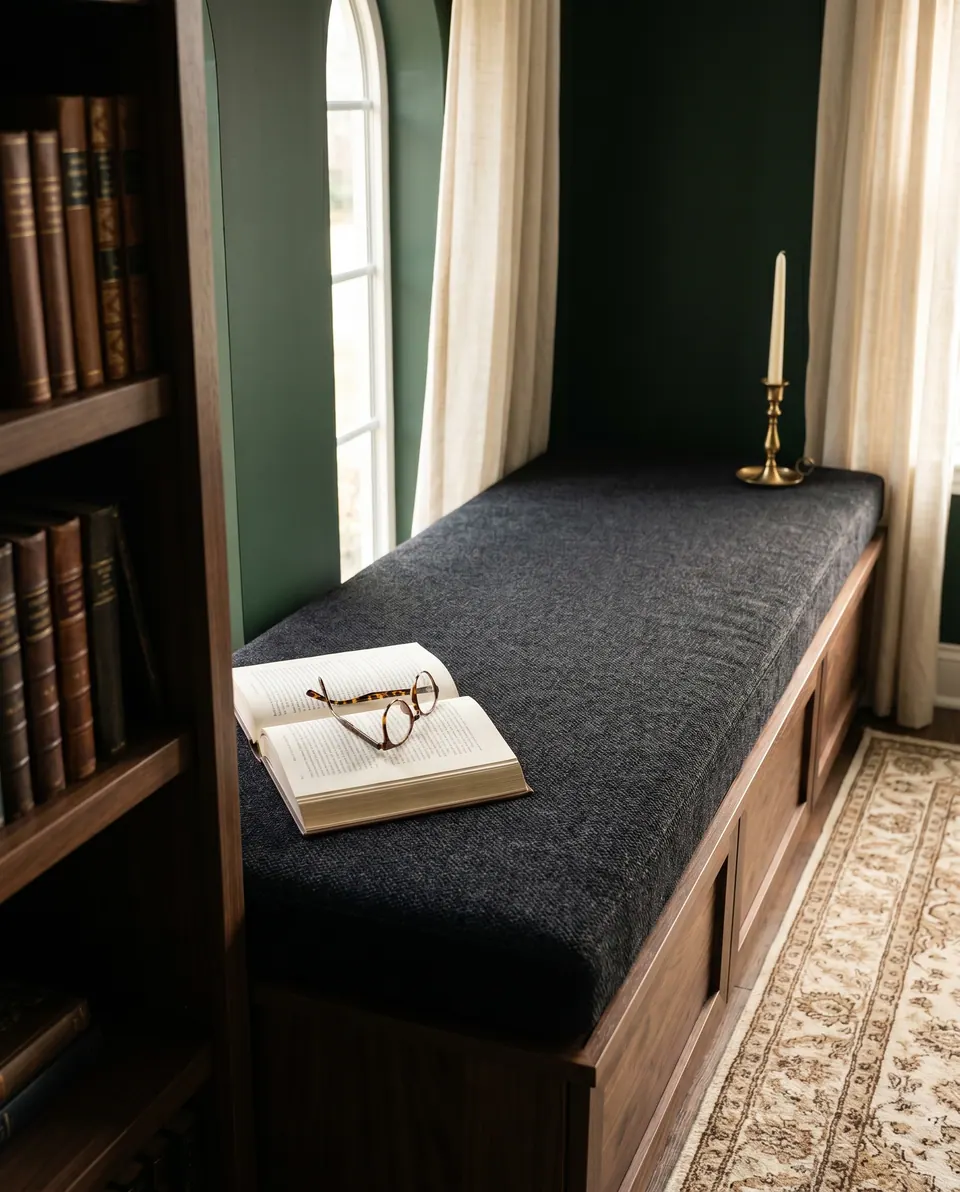
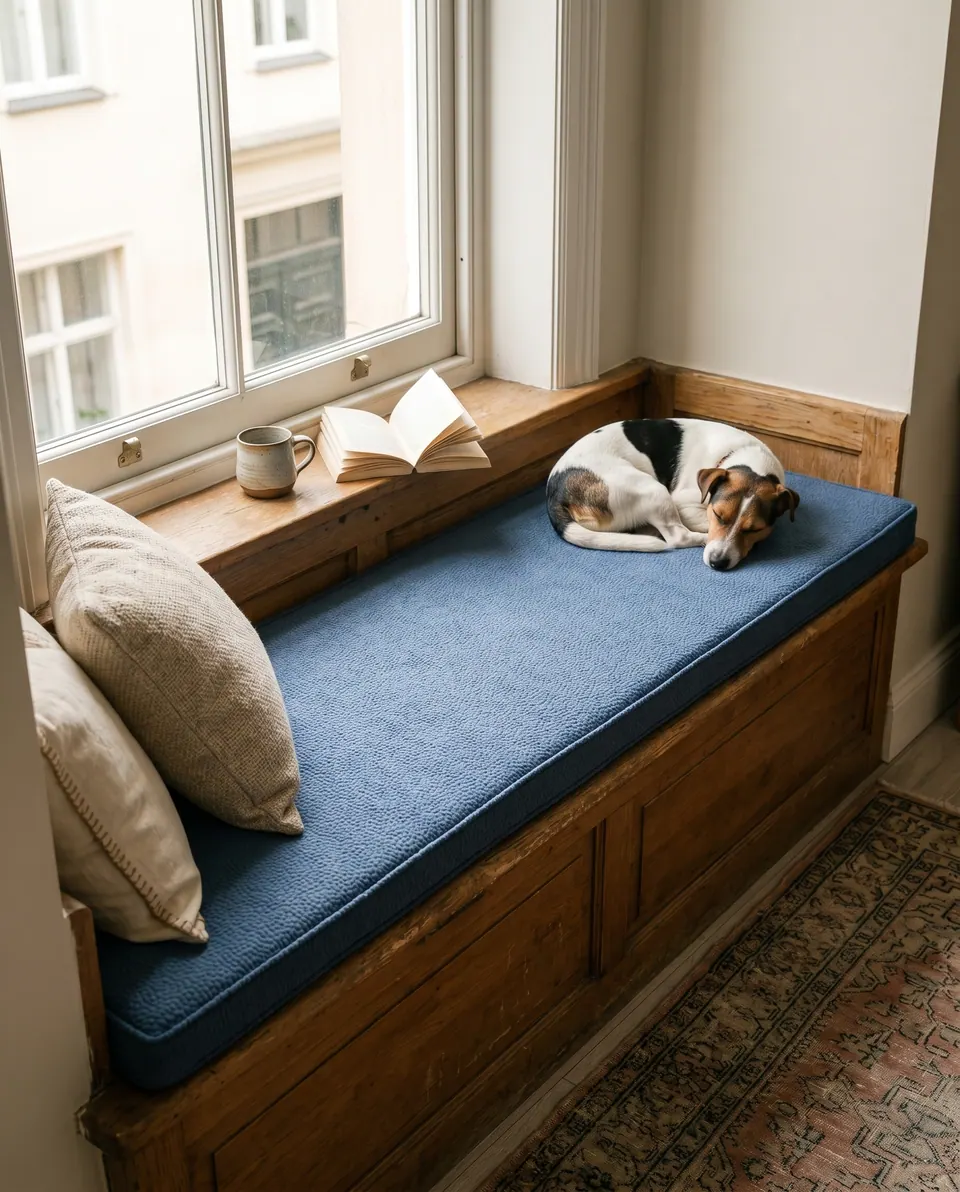
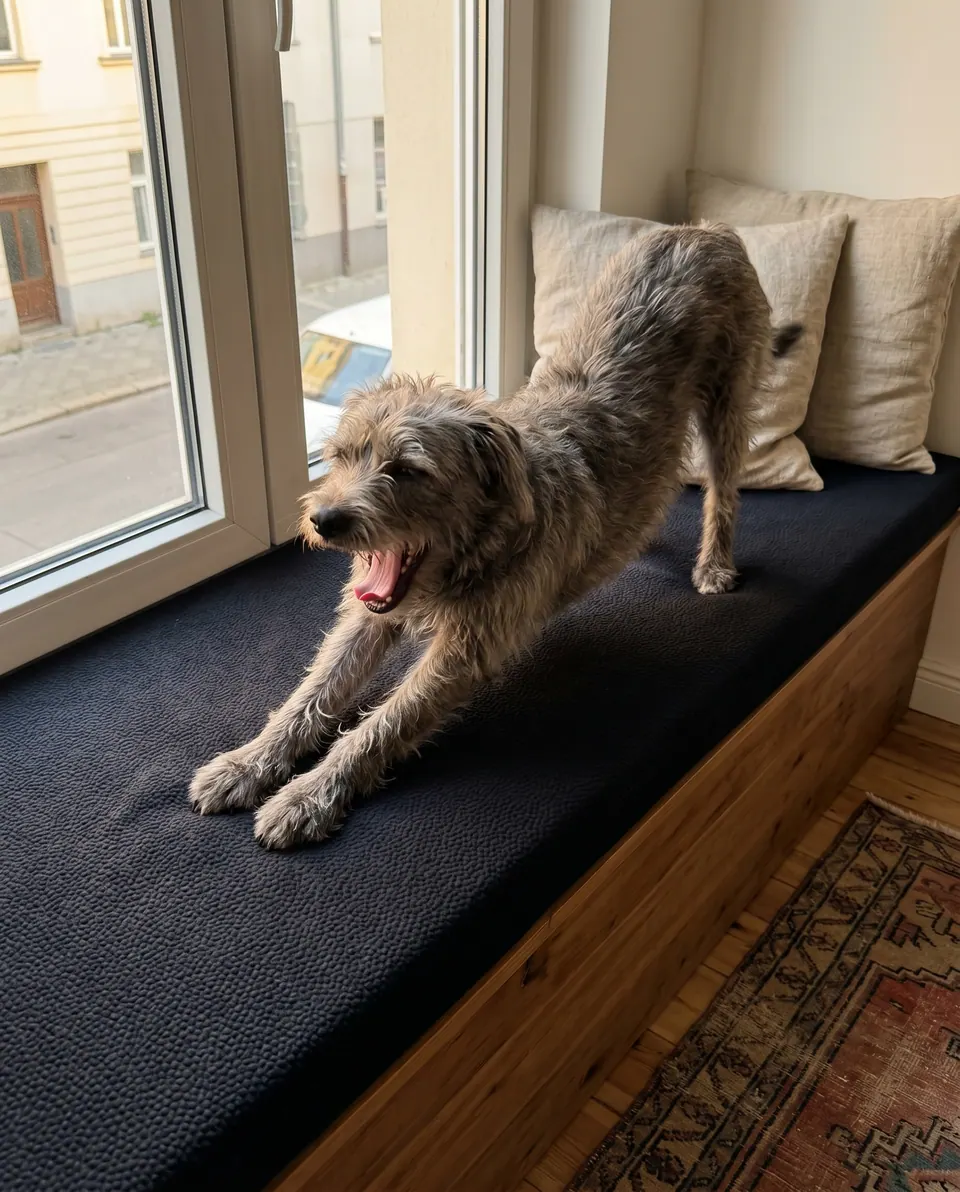
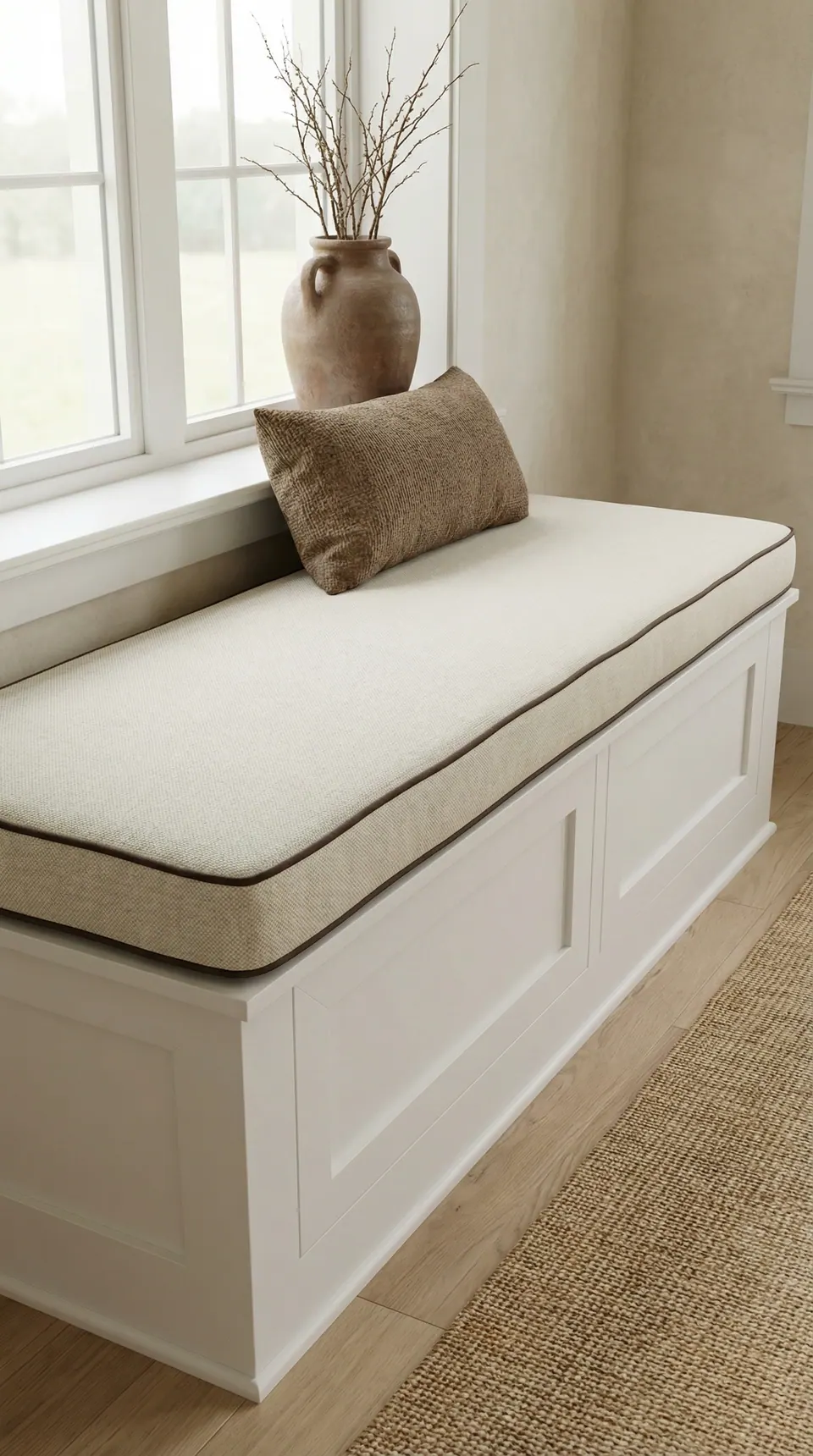
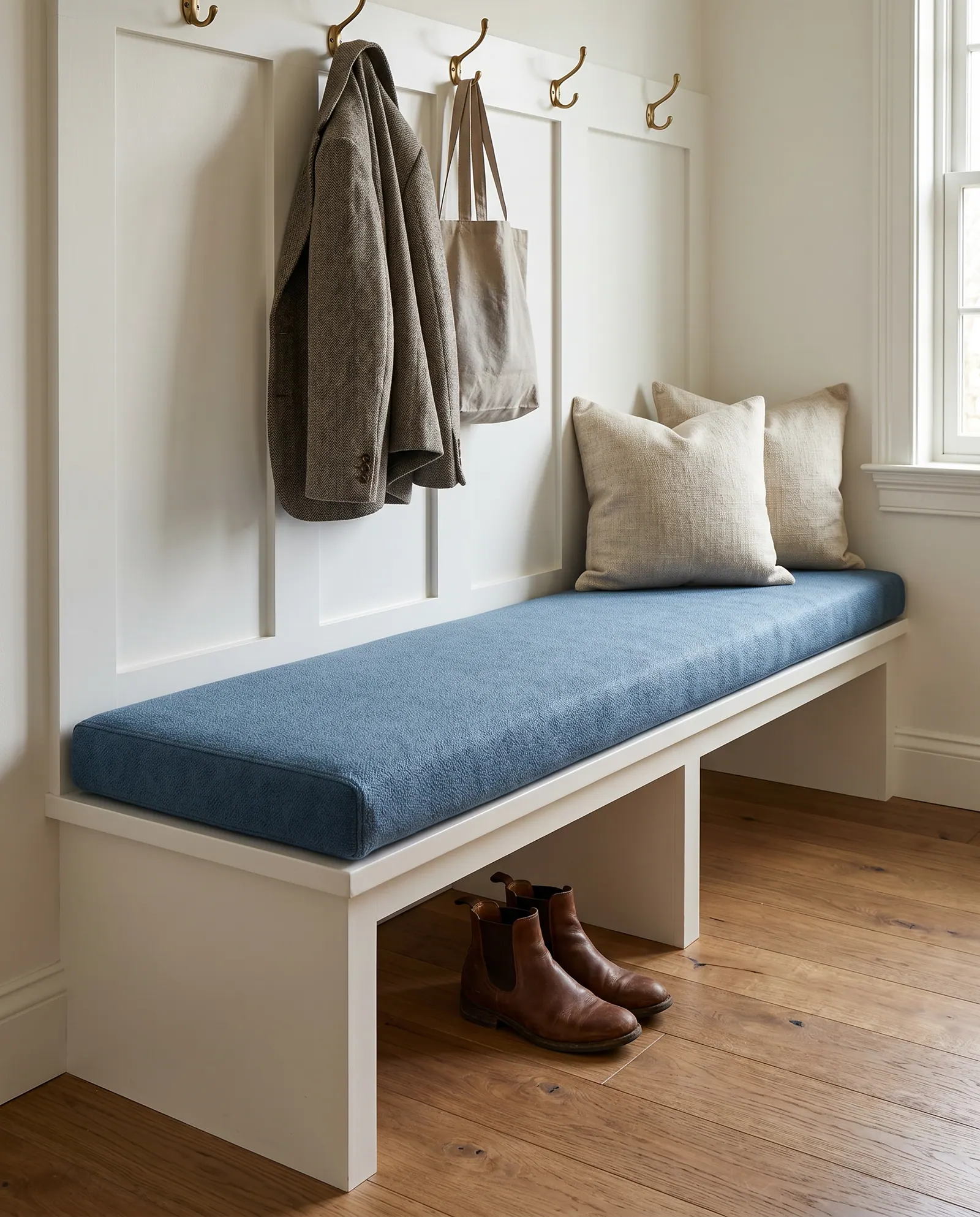
The hero photo is the thing itself: a denim blue cushion on a white mudroom bench, no piping, the front rolling over instead of meeting a seam. The other photos show ordinary box edges, and that is useful too. You only see what a bullnose changes once you have looked hard at a box.
Four edges, seen from the end of the bench
Stand at one end and look along the front edge. This is what each build shows you from there. The box and knife edge Pattern goes deeper on the first two.
| Box edge | Knife edge | Wrapped and crowned | Bullnose front | |
|---|---|---|---|---|
| How it's sewn | Top, bottom and a side band; two seams | Top and bottom sewn straight together; one seam at mid-edge | A box cover over foam wrapped in polyester fiber | Top, front and bottom from one piece; no front seam |
| From the side | Square shoulders, flat front | Full in the middle, thin at the seam | Square box with a gently domed top and softened shoulders | A rounded roll across the whole front |
| Seams on the front | Two, top and bottom | One, around the middle | Two, softened by the wrap | None |
| Piping | Top and bottom edges | One line at mid-edge | Top and bottom edges | Only where seams remain, or none |
| Stripes and prints | Matched down through the side band | One seam to match | Matched down through the side band | Roll over the front with no break |
| At the workshop | Standard, zipper on the back edge | Made, for example as a flat back pillow | The everyday seat build | Ask the workshop, and confirm the profile before ordering |
Makers use bullnose and waterfall loosely, sometimes for the same edge. Describe the look as well as the name; the glossary has bullnose and waterfall side by side.
When a soft front earns its keep
A rounded front is kinder behind the knees than a square box edge, and that matters most on seats you perch on. Three places I'd consider one:
- Mudroom and entry benches. You sit for thirty seconds to pull on boots, legs hanging, and the front edge takes all of it. See mudroom and entryway bench cushions.
- Deep window seats. Sit forward on a deep seat and your knees fold right over the edge. More under window seat cushions.
- Kids' seats. Small legs dangle off everything. Pair the soft front with a tight, washable mid-tone weave and a zip-off cover, as in performance and pet-friendly fabrics.
Where it earns less: a dining banquette, where most people want the crisp line of a box, and any cushion where a contrast piping color along the front is half the point.
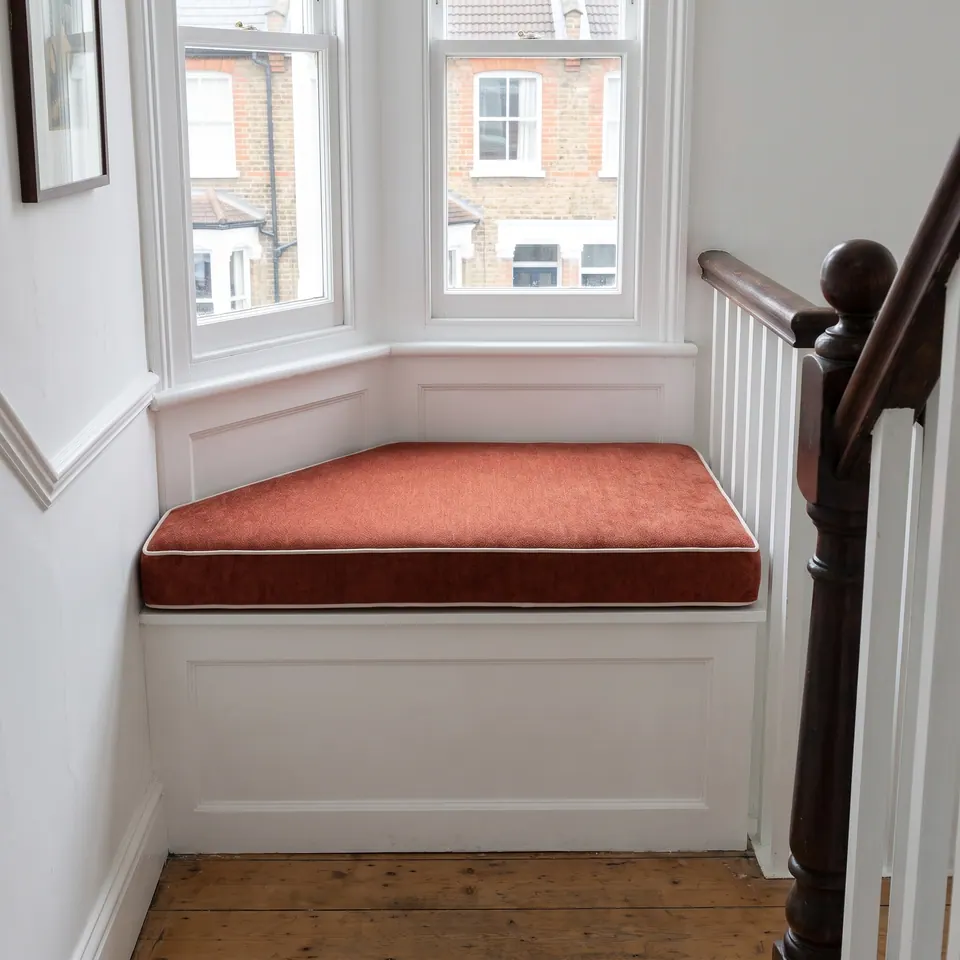
A word on "waterfall". Search for a waterfall bench cushion and you'll find oak benches whose slab legs pour to the floor like water. The mauve striped pad and the turquoise cushion on the two oak benches here are plain box edges with self piping. A waterfall bench is not a waterfall cushion, dear, and the order note should say which one you mean.
What a rounded front does to piping and pattern
Piping lives in seams. Take away the front seam and the welt has nowhere to run across the front. On a bullnose it can follow the seams that remain, around the two ends and along the back, or it can be left off. The hero cushion has none, and it looks the better for it.
Leaving piping off doesn't lower the price: piping is already included, so the quote stays the same. If you'd like a quiet line rather than none, ask for self welt, which is piping cut from the cushion's own fabric. Light linens look especially clean with no piping at all. The piping Pattern has the full argument.
Pattern is where a bullnose shines. On a box edge, a stripe has to be matched from the top panel down through the side band, which takes care and extra cloth. A bullnose front has no seam to line up, so the stripe simply rolls over. Ask how yours will run before you order.
How to ask for a rounded front
There is no bullnose button on an order form, so the request goes in writing. My checklist, in order:
Name the edge
Say which long edge gets the rounded front. The front is the room side, the one your legs hang over; the back is the wall side, where the zipper usually runs.
Draw it from the side
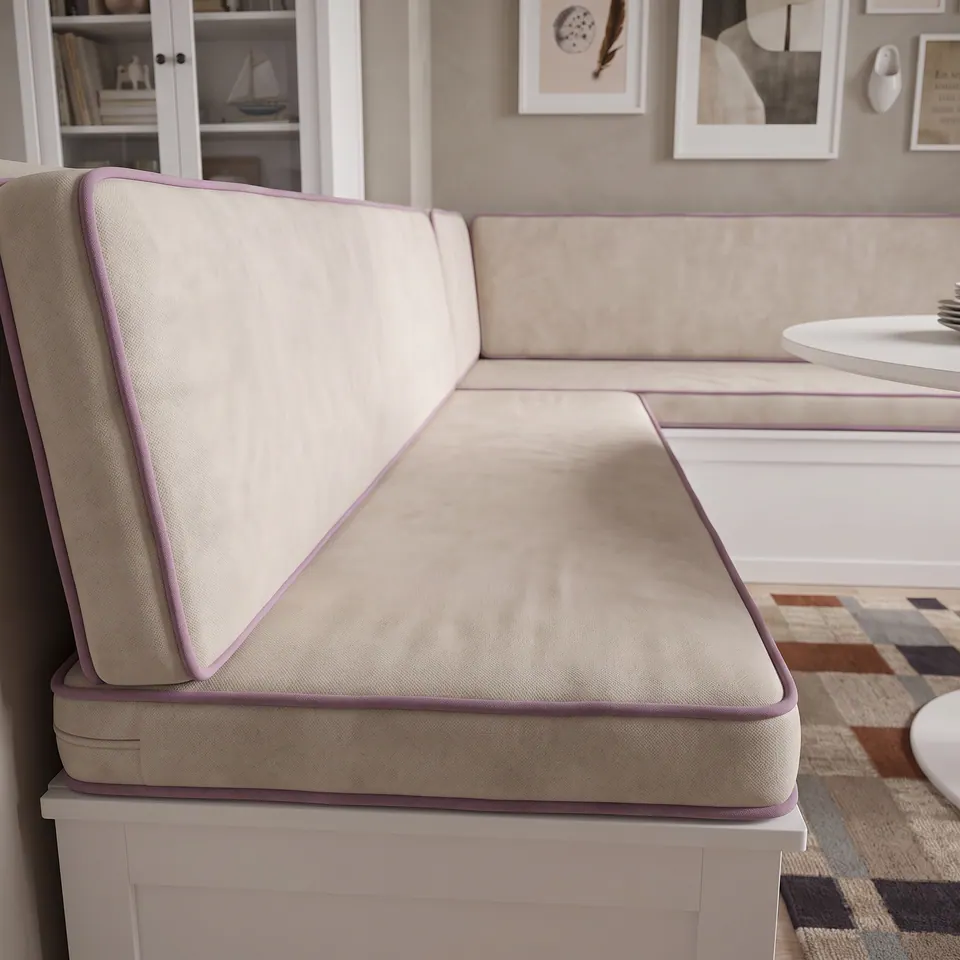
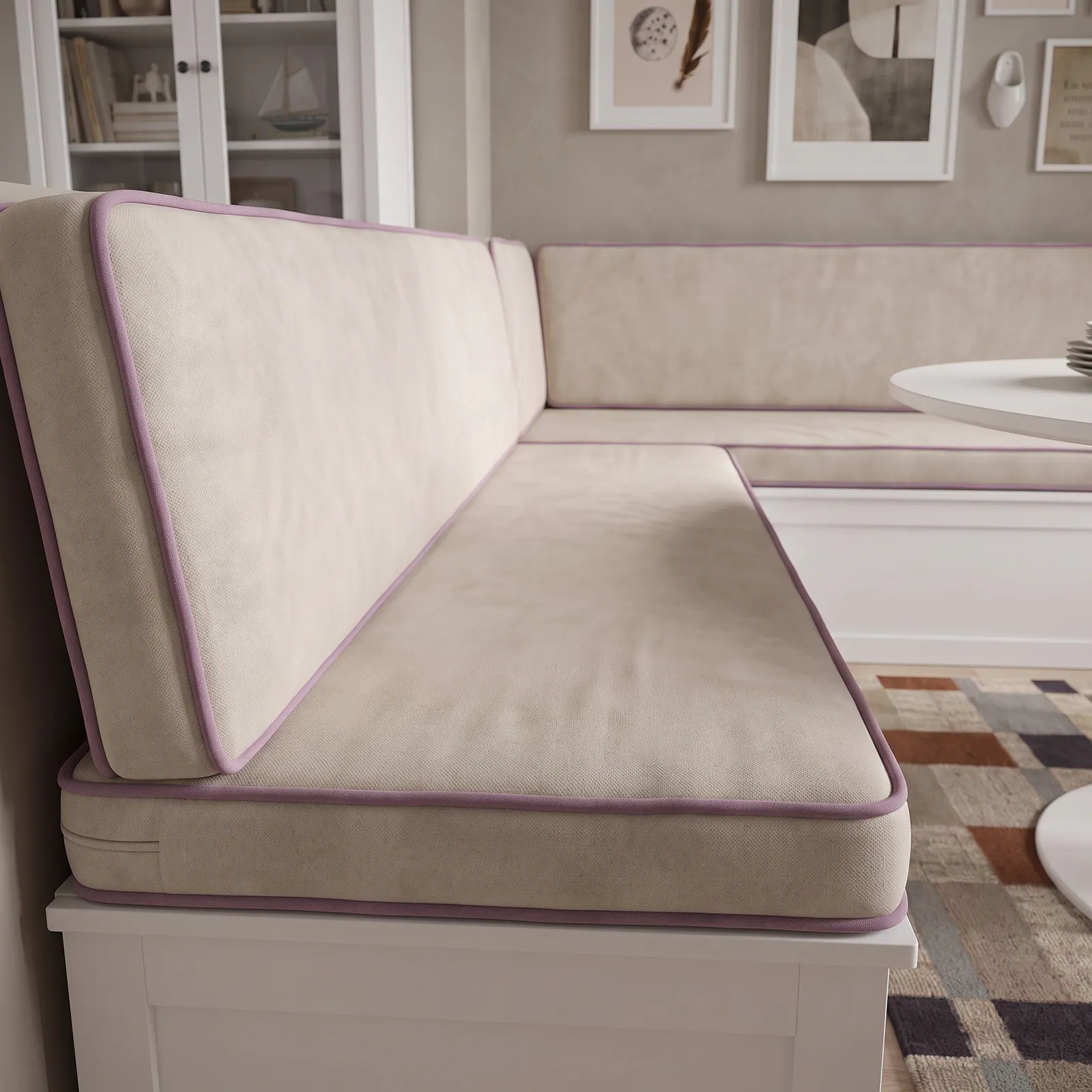
Sketch the profile with the thickness written on it, and show whether the roll runs from the top all the way under (bullnose) or drops from the top onto a flat base (waterfall). Curves are never read from numbers alone, so the drawing does the talking. The side view in this photo is a box edge, piped top and bottom, for comparison.
 Save
The side view shows the box depth, the leaning back pad and the zipper tab of a velvet banquette set. Draw it from above
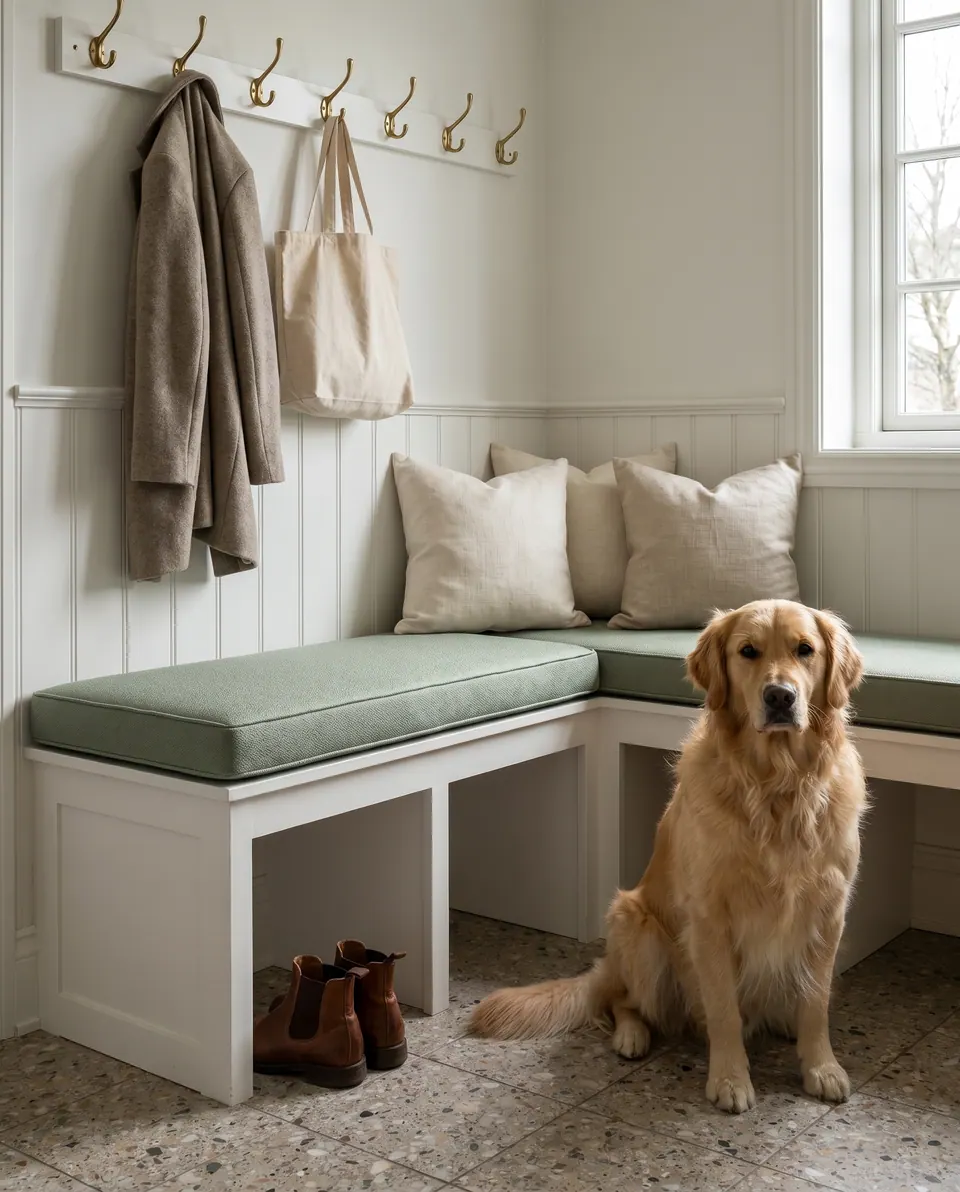
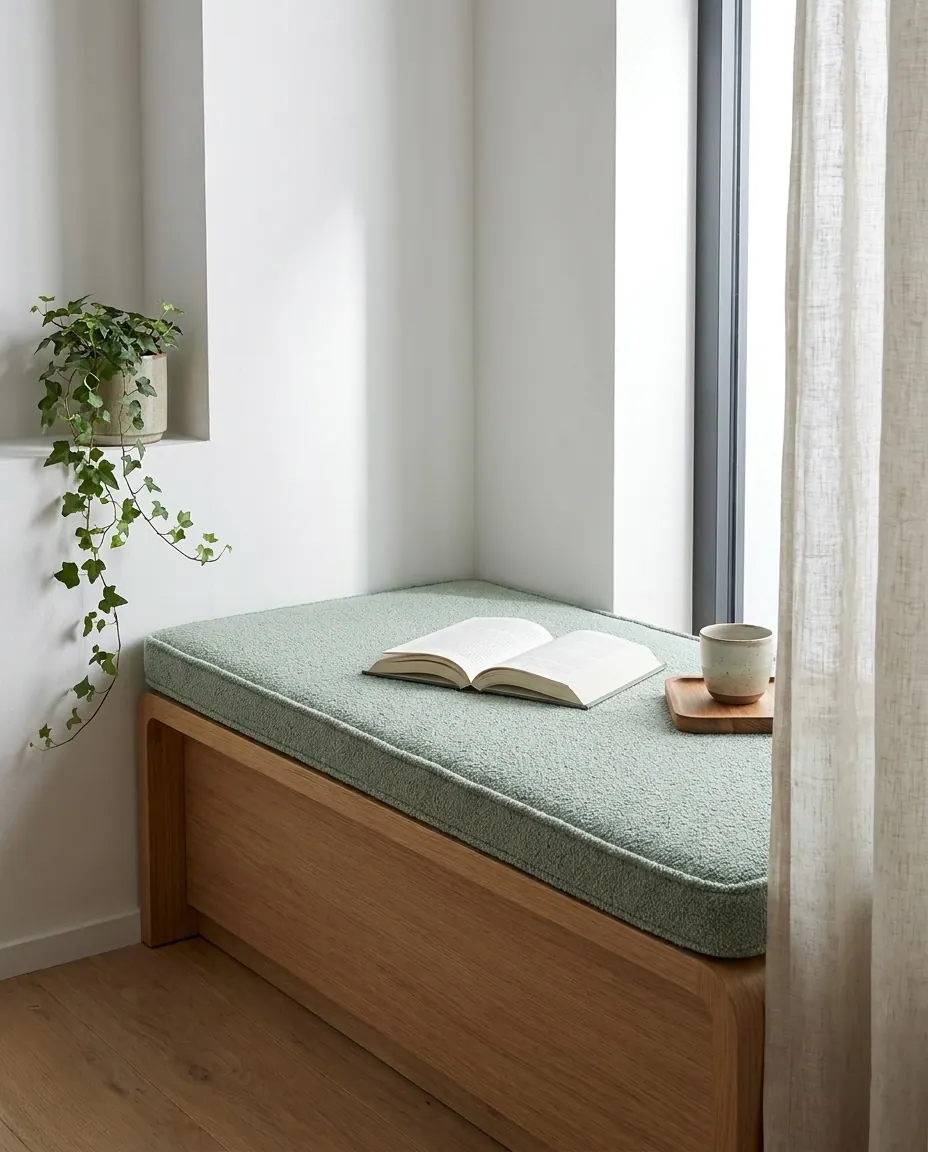
Then the plan view, with a measurement on every edge. If a corner is rounded too, mark where each curve starts. In the sage bouclé photo the oak built-in has a rounded front corner and the cushion corner is softened to follow it, while the edge in profile stays a box with tonal piping. Rounded or clipped outlines go on the custom-shape listing.
 Save
Sage bouclé, trailing ivy and warm oak: a small window seat set up for reading. Give the thickness and the depth limit
Four inches (10 cm) is the standard seat; 3 in gives a neater, lower profile on window seats and bench seats. If the cushion sits inside a frame, say the depth is a hard maximum: full cushions spread, and ordering about 1 in under a fixed frame is the usual fix.
Decide the piping
Ends and back, self welt, or none. Write it next to your fabric code so nobody has to guess.
Message first, then order
Send both sketches and a photo of the bench before you pay, and ask the workshop to confirm how the front will be built. Don't assume a particular radius; a rounded profile is agreed from your sketch, not guessed from a photo. Nothing is cut until you approve the drawing.

Have it made
Measured it? Have Maggie’s workshop make it
Have the tape measure handy when they call. Old cushions shrink and sag; the seat underneath does not. — Maggie
Leave your details and the workshop will call you to confirm measurements, fabric, foam and piping. No prices, dates or payment on this page: it is a request, not an order.
A long bench, stepped returns and two curved front corners
One buyer wrote in with a CAD-style plan: a bench about 104 3/4 in (2,660 mm) long and 19 7/8 to 20 in (505 to 510 mm) deep, with stepped returns at the ends and curved front corners. They wanted it in one piece.
The workshop was straight about it. One cushion that long, with steps and curves, would be harder to make and might cost more than sections. The buyer still wanted one piece, which is their right. So the workshop asked for a hand drawing marking exactly where each curve started, redrew its own diagram from the CAD plan, and sent it back for confirmation before quoting.
I'd have argued a little longer for sections, I admit. Sections sit snugger and come off to wash, as the one piece or sections Answer explains. But a clear drawing made either choice possible.
- Measured
- About 104 3/4 in (2,660 mm) long, 19 7/8-20 in (505-510 mm) deep, stepped returns, curved front corners
- What it taught
- Mark where every curve starts on a hand drawing, and approve the maker's diagram before a long shaped piece is quoted.
Edge requests that go sideways
- "Waterfall" meaning the bench. Say whether you mean the cushion's front or the bench's legs.
- A radius taken for granted. A rounded profile is confirmed with the workshop from your sketch, not assumed from someone else's photo.
- Numbers without a drawing. Subtle curves get read as square. Draw every curve and mark where it starts and ends.
- Expecting no piping to save money. It doesn't; piping is already in the price.
- A snug frame and a full front. Plump cushions spread past their nominal size. Say when the depth is a hard maximum.
- A shaped outline on the rectangle listing. Curved corners and rounded ends belong on the custom-shape listing, each shape with its own drawing.
A bullnose front has no seam across it, so piping can only follow the ends and the back, and a stripe rolls straight over the edge.
Maggie Holloway
Buyer questions: piping, corners and odd shapes
- A common question
If I leave the piping off, is the cushion cheaper?
The workshop's answerNo. Any cushion can be made without piping, but the price stays the same because piping is already included. Write 'no piping' next to your fabric code and the edges are sewn plain. You can mix within a set, and self welt gives a subtle edge if you'd rather not go bare.
- A common question
Can the front corners be cut at an angle instead of left square?
The workshop's answerYes. Clipped corners, both front corners angled or a back corner removed are routine. Order on the custom-shape listing using the widest depth and longest length, and draw how far each corner cuts in along both sides. They're cut exactly to the drawing.
- A common question
My window seat is stepped at one end and rounded at the other. Can you still make it?
The workshop's answerYes, any size and shape: six-sided seats, stepped benches, curved nooks, rounded-end benches. Draw it with every side measured, including rounded corners and cut-outs, and photograph the drawing and the space. The shop redraws it as a clean diagram to confirm before quoting.
- A common question
How do I measure a bench that curves along its whole length?
The workshop's answerMeasure the inner curve along the front and the outer curve along the back with a flexible tape or a string, then the straight end-to-end distance and the depth at both ends and the middle. The shop redraws the curve for approval and makes very long curves as matching segments.
Rounded-front questions, briefly
Is a rounded front the same as rounded corners?
No. Rounded corners are seen from above and measured from the corner to where the curve starts along each edge. A rounded front is seen from the side: it is how the top fabric turns down over the front edge. A cushion can have one, both or neither.
How thick should a soft-front mudroom bench cushion be?
Four inches (10 cm) is the standard seat and suits everyday sitting; 3 in gives a neater, lower profile on a bench you perch on to pull on boots. Measure the bench height first, because the cushion adds straight onto it.
Can a bullnose cushion still have a removable cover?
Every foam cushion the workshop makes has a zippered, removable cover, with the zipper on the back edge or underneath. How that works with a one-piece rounded front is part of what you confirm with the workshop before ordering.
Will wrapped foam give me a softer front without a bullnose?
Often, yes. Foam wrapped in polyester fiber inside a box cover softens the shoulders and domes the top a little, so the front feels less sharp. It keeps the box's seams and piping lines. The wrapped foam Pattern explains the build.