 Save
- Charcoal cushion
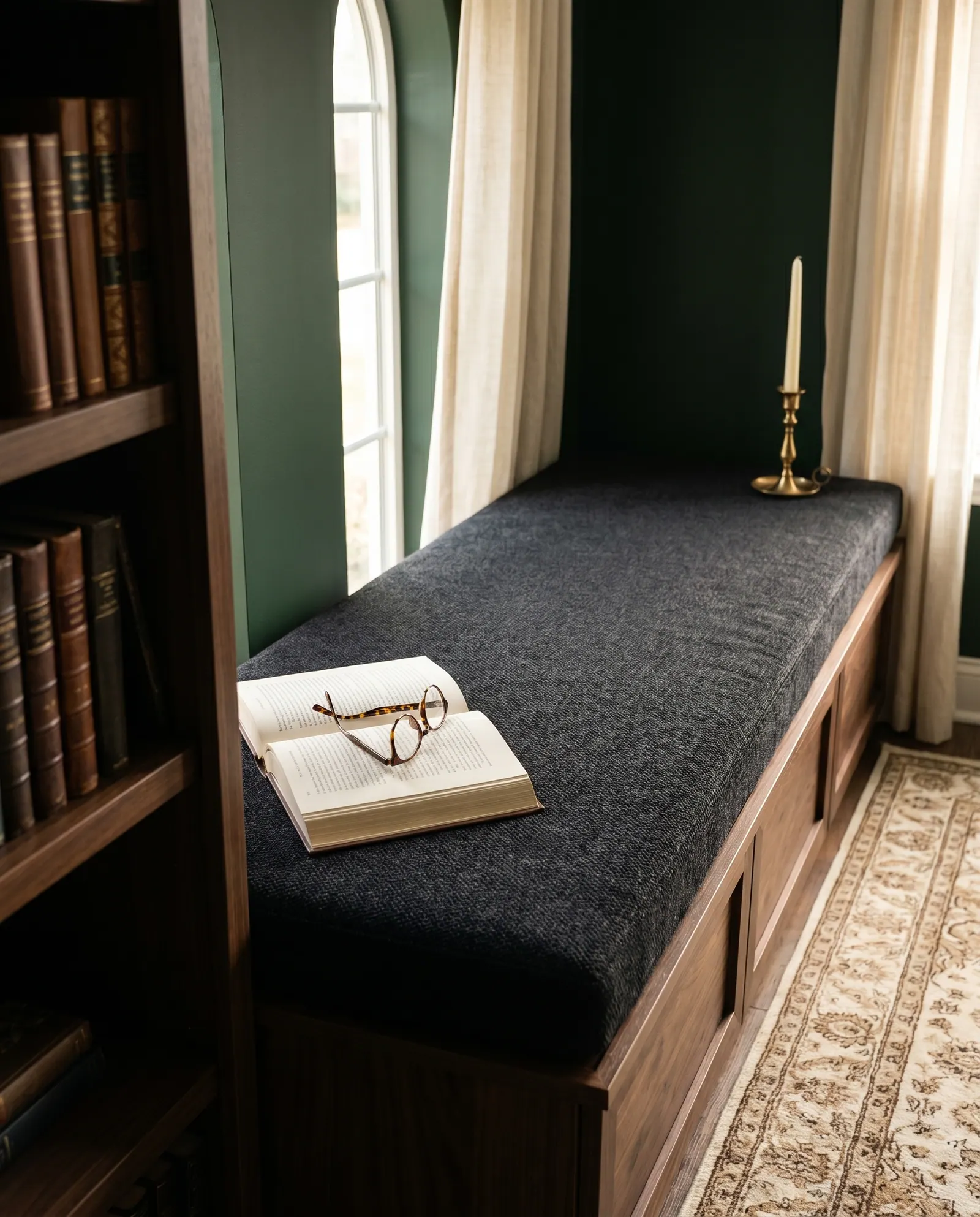
A dark neutral lets walls, walnut and brass carry the color.
- Book and glasses
Placed on the diagonal leading into the nook.
- Brass candlestick
Metal adds warmth to a cool, dark palette.
- Leather-bound books
The bookcase closes the recess and frames the seat.
- Walnut storage base
The cushion is cut to the full recess above the drawers.
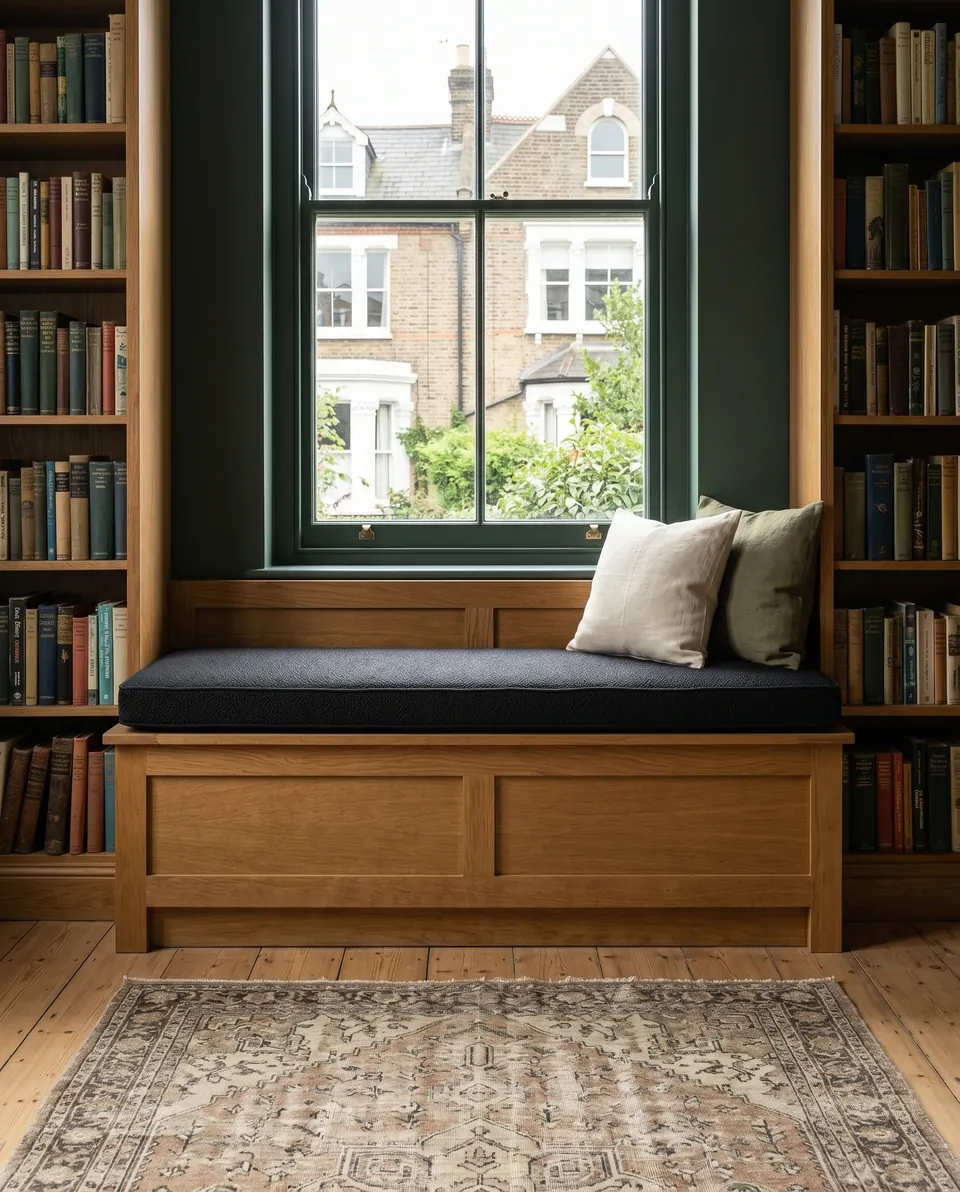
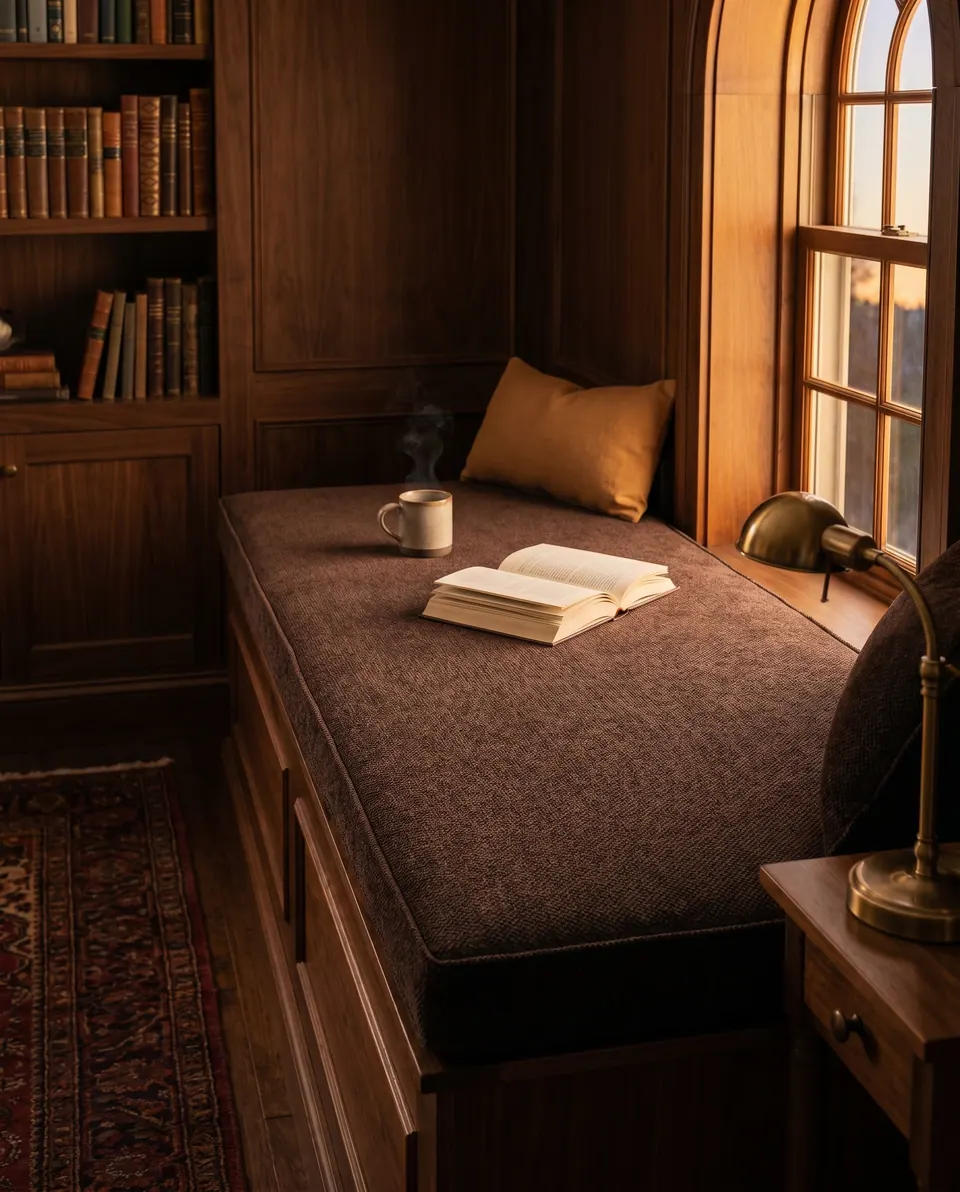
Plate Charcoal Window Seat Cushion in a Green-Walled Library
A charcoal cushion sits on a walnut storage seat between bookcases, set against deep green walls.
A Reading by RosaWindow Seat Cushions
Charcoal window seat cushion in a green library: choosing the edge and the corners
My grandmother judged a cushion by its edge before she ever sat on it. This one, tucked between two bookcases, would have passed.

The quick answer
A window seat cushion for a built-in nook should fill the whole recess and use a box edge, so the front stays square and the seat looks built in. This charcoal cushion adds softly rounded corners to ease the hard walnut joinery. For an angled seat, measure depth at 90 degrees and each slanted side corner to corner.
Pinned by Rosa: the edge, the brass and the books
Five pins follow one diagonal, from the open book at the front of the seat to the brass candlestick by the glass.
The numbers match the pins on the plate.
- Charcoal cushionA dark neutral lets walls, walnut and brass carry the color.
- Book and glassesPlaced on the diagonal leading into the nook.
- Brass candlestickMetal adds warmth to a cool, dark palette.
- Leather-bound booksThe bookcase closes the recess and frames the seat.
- Walnut storage baseThe cushion is cut to the full recess above the drawers.
Reading the nook: the edge comes first
Grandmother could size up a cushion from the front steps. She looked at the edge, and so will we.
This window seat cushion is charcoal, a textured performance weave with self piping and a box edge. It's cut long and deep to fill the whole recess between the bookcase and the arched window, right over the walnut drawers. The corners are softly rounded, and that small curve is what eases all the hard joinery around it. Square corners here would look like one more board.
Charcoal is a brave pick for a room with deep green walls, and it works because the cushion steps back. The walls, the walnut and the brass carry the color, so the nook feels calm instead of gloomy. Cream linen curtains bounce the cool window light onto the seat.
The props are few, and they follow one line: an open book with tortoiseshell glasses near the front, a brass candlestick with an ivory taper up by the glass. Leather-bound books close the recess on the left, and a Persian runner leads you in. Nothing sits where you'd sit. That's the whole trick of a reading nook, neighbor: leave the seat for the reader.
More built-ins live in window seat cushions and reading nook cushions, and the edge question has its own page in box edge vs knife edge.
Box, knife, rounded or angled: what each edge does
| Edge or corner | What it looks like | Where it earns its keep |
|---|---|---|
| Box edge | A straight side wall between top and bottom, square front | Built-in window seats that should look carpentered |
| Knife edge | Top and bottom meet in one seam, thinner at the rim | Chair pads and loose, casual seats |
| Rounded corners | A box edge with a soft curve at each corner | Recesses full of hard joinery, like this walnut nook |
| Angled ends | A trapezoid: front and back of different lengths | Angled and bay window benches |
The angled bench whose numbers didn't agree
A buyer wrote in about an angled window bench, a gentle trapezoid. The numbers came in as 40 in (102 cm) across the front, 30 in (76 cm) across the back, 17 in (43 cm) deep and 22 in (56 cm) on each angled side.
The workshop drew it to scale before cutting a thing, and the drawing wouldn't close. With that front, back and depth, the sides had to be about 17.5 in (44 cm), not 22. So the shop explained two habits: measure depth square, at 90 degrees from the back, and measure each side corner to corner.
New numbers came back, with photos this time: 48.5 in (123 cm) front, 41.5 in (105 cm) back, 13 in (33 cm) sides and 12.5 in (32 cm) deep. Those agree with each other, and a piping color was picked to finish it. If your seat has an angle, run it through the trapezoid cushion calculator first.
Buyer questions: a warm beige, three thicknesses and piping colors
- A common question
Is the linen in code L-02 gray or beige? I'm after a warm off-white or a natural neutral.
The workshop's answerL-02 is the best-selling fabric: a warm cream or light natural beige with no gray undertone, and not a dark beige. For something whiter, L-01 is lighter. L-02, L-03 and L-04 are the beige tones on the linen chart.
- A common question
What's the real difference between a 2, 3 and 4 inch cushion? I want it firm.
The workshop's answer2 in (5 cm) is a slim, low-profile pad; 3 in (7.5 cm) adds cushioning and a fuller look while still sitting neatly; 4 in (10 cm) is noticeably plumper, and 5 in (12.5 cm) is offered too. Every thickness uses firm, long-lasting 32-density foam, and 3 in is a solid middle ground for benches and window seats.
- A common question
Is there a piping color chart somewhere, and can I choose a different piping color?
The workshop's answerThere's no separate piping chart. Any fabric from any chart can be the piping, either matching the cushion for a clean look or a different code so the edges stand out. Write both codes when you order, for example 'Body: code, Piping: code'. A plain color such as solid black can go straight in the color box.
On the cutting table: the walnut library seat
| Product | Window seat cushion cut to the full recess |
|---|---|
| Fabric | Charcoal textured performance weave |
| Piping | Self piping |
| Edge | Box edge with softly rounded corners |
| Base | Walnut storage seat with drawers |
| Frame | Bookcase on one side, arched window behind |
| Light | Cool window light through cream linen curtains |
| Best for | Library nooks and built-in reading seats |

Have it made
Have this made — ask Rosa’s workshop
Every good cushion I know started with a long porch chat. This is the short version: leave your number and the workshop will call. — Rosa
Leave your details and the workshop will call you to confirm measurements, fabric, foam and piping. No prices, dates or payment on this page: it is a request, not an order.
A trapezoid window seat's sides are decided by its front, back and depth. If the four numbers don't agree, measure depth square at 90 degrees.
Rosa
Questions buyers ask next
Should a built-in window seat cushion have a box edge or a knife edge?
A box edge suits most built-ins. Its straight side wall keeps the front square, so the cushion looks made for the recess. A knife edge tapers to one seam at the rim and reads more casual, which suits chair pads better.
Why round the corners on a cushion that sits in a square recess?
A slight curve softens the look of the hard joinery around it, as in this walnut nook, and keeps the cushion from reading as one more board. Measure the corners before ordering so the curve is cut on purpose, not guessed.
How should I measure an angled window bench?
Measure front and back along their edges, depth at 90 degrees from the back, and each slanted side corner to corner. Then check that the numbers agree, the way the workshop does with a scale drawing before any fabric is cut.
Porch light's on — Rosa
More photographs to read
 Save