The Pattern Room · a measuring pattern
Reading nook bolsters, back pillows and a seat depth that invites a nap
My favorite seat in any house has a window, a pillow at each end and a child who won't give it up. Here is how to build one on purpose.
 Save
The quick answer
A reading nook cushion should be thicker and deeper than a dining bench cushion: about 4 in of foam, a round bolster about 8 in across at each end, and back pillows about 16 in tall against the wall. For a kids' floor nook where a parent lies down too, choose the largest kids' size, about 47 in square.
Why a nook wants a different recipe
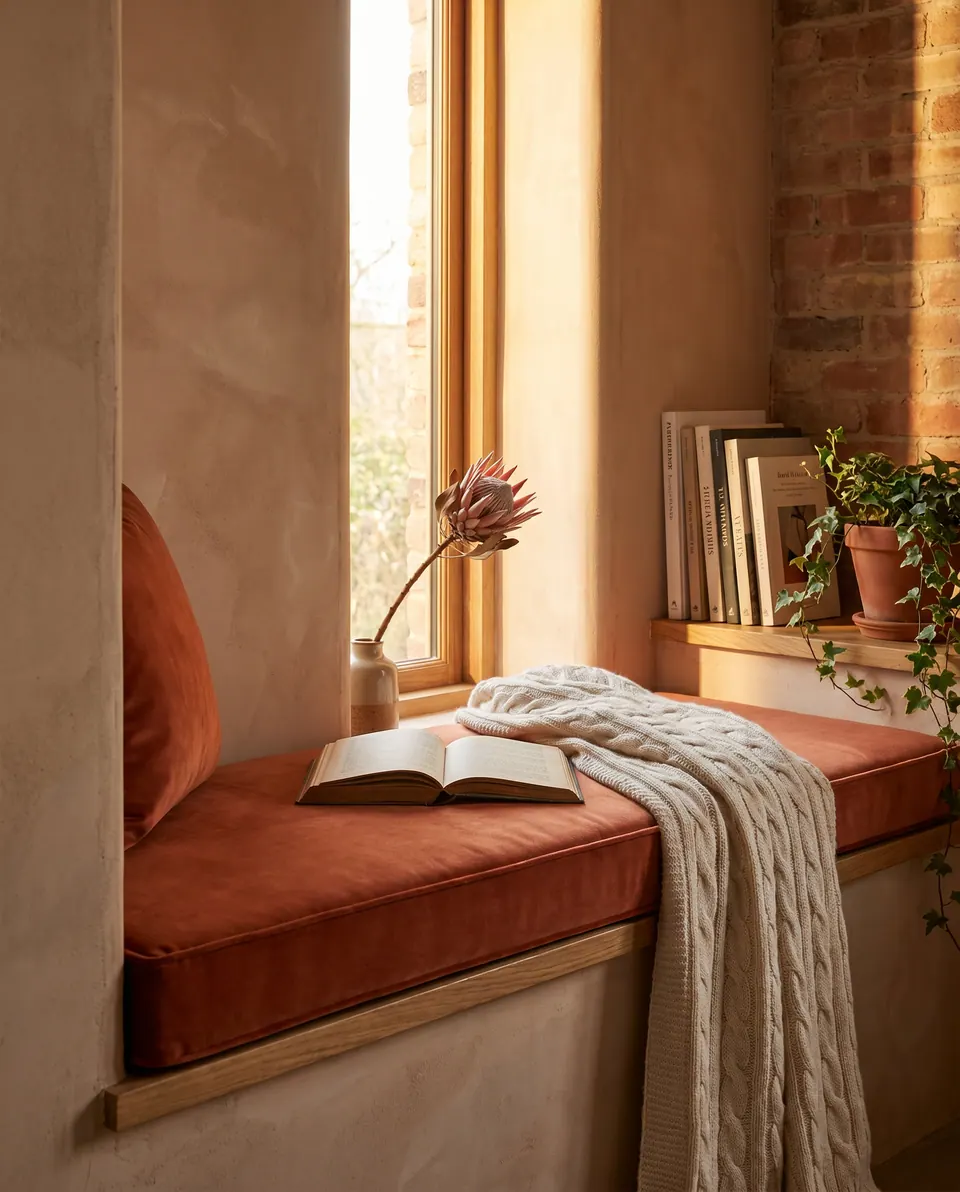
The seat nobody in the house will give up is usually about 4 in thick, deeper than it strictly needs to be, with a pillow at each end. That is no accident. A reading nook cushion is built for lounging, and lounging asks for something different than supper does.
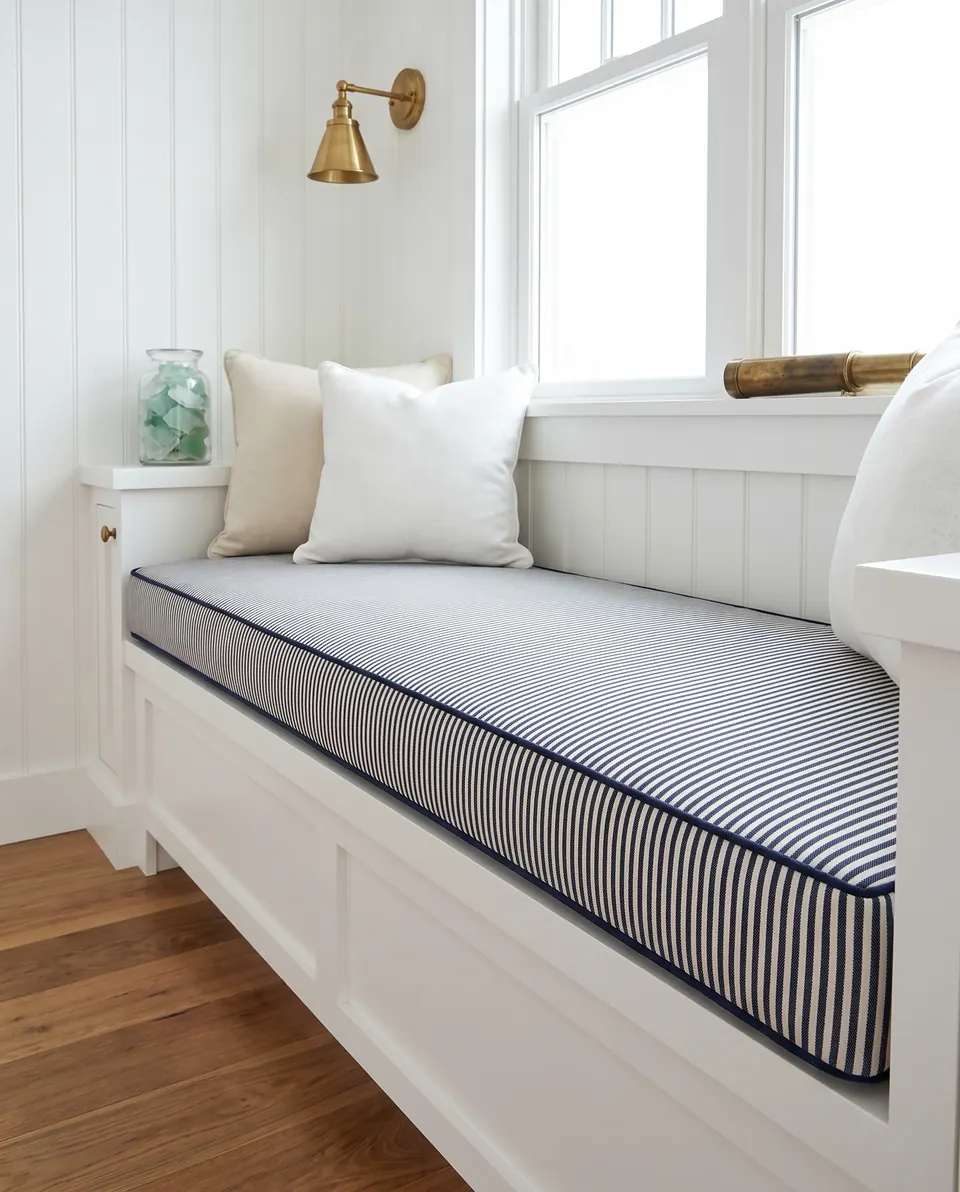
A dining bench keeps you upright at a table, so the seat runs 16 to 18 in deep and the foam 2 to 3 in when a table sits alongside. A nook wants you half lying down, shoulder on something soft, feet tucked up. That means a deep window seat cushion, a bolster at each end and back pillows against the wall. Pull up a chair, and I'll show you how one goes together for reading nook cushions and window seat cushions alike.
Dining bench vs reading nook, side by side
| Detail | Dining bench | Reading nook |
|---|---|---|
| Seat depth | 16 to 18 in for upright dining | 22 to 24 in for lounging; a back cushion takes about 3 in of that |
| Foam thickness | 2 to 3 in when a table sits alongside | 3 in for a neat, low line; 4 in for plush |
| Ends | Open, or ties to stop sliding | A round bolster at each end, about 8 in across |
| Back | The wall or a chair back | Back pillows about 16 in tall and 4 in thick, as long as the seat |
| Finish | Piping and a zippered cover | Untufted with a zippered cover, so naps and kids don't loosen buttons |
Building a nook set, from tape measure to bolsters
Measure every side and the depth
For a rectangle, take the length and depth. For a bay or angled seat, measure every side plus the depth, then draw the shape on paper with each number written on its edge. A photo of the space lets the workshop check the drawing against the room.
Pattern sheet Front edge measured wall to wall, back edge along the window, and the depth at both the left and right ends. Leave room for handmade tolerance
In a wall-to-wall nook, don't order the full wall length. Leave at least 2 in on the length and order the depth about 1 in under a fixed frame, because a plump cushion crowns and spreads a little.
Pick the seat thickness
3 in keeps a window seat neat and low; 4 in is plusher and the one I'd choose for reading. Most buyers land on 3 or 4 in, and 5 in is on the menu when the platform sits low.
Size the bolsters
A standard bolster is about 8 in (20 cm) in diameter, with 10 in for a big, deep seat. Make it as long as the seat is deep, or about 4 in shorter. Standard bolsters come filled and without straps.
Add back pillows against the wall
Back pillows are about 16 in (40 cm) tall and 4 in (10 cm) thick, made the same length as the seat, with height measured from the top of the seat cushion. Long soft pillows sag, so split a long run: an 88 in back reads better as two 44 in pillows.
Choose round or flat for the back
A round bolster along the back gives you something to lean into; a flat knife-edge lumbar pillow sits slimmer against the wall. Name the one you want in the order note, because they are different pieces.
Skip the buttons if children climb on it
Tufting buttons are hand-sewn through the cushion, and daily use by kids and pets loosens the thread. An untufted cushion with a zippered cover keeps the clean line and comes off for washing.
Send the drawing before you order
Write every dimension on the drawing, mark length and width on a photo of the nook, and list each bolster's diameter, length and quantity. Odd shapes are redrawn as a clean diagram for you to confirm before anything is cut.
Have it made
Measured it? Have Rosa’s workshop make it
Tell the workshop who sits there: grandkids, the dog, a cup of coffee at six. The right fabric and foam follow from the people. — Rosa
Leave your details and the workshop will call you to confirm measurements, fabric, foam and piping. No prices, dates or payment on this page: it is a request, not an order.
A three-sided bay with clean lines and two bolsters
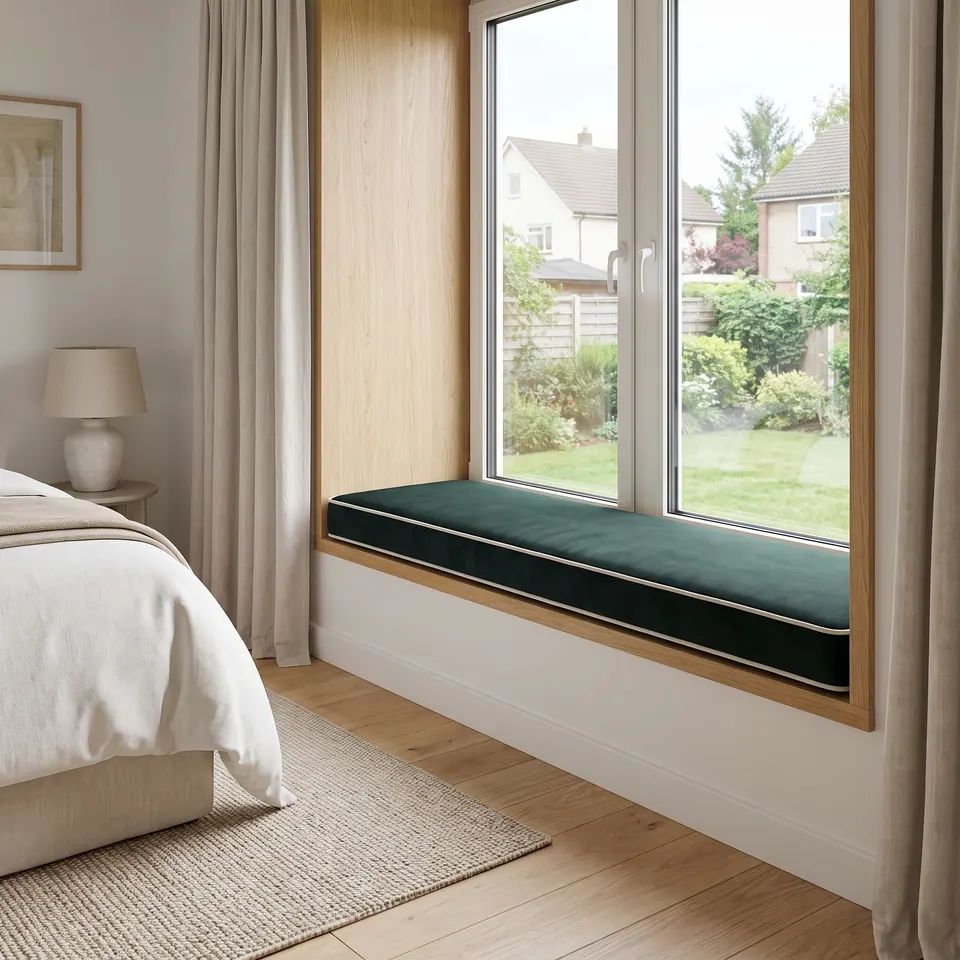
A buyer in the US sent the workshop a trapezoid window seat: 117 in along the back, 68.5 in along the window, two diagonal sides of 34 in and a depth of 25.5 in. She wanted a window seat cushion with bolsters, clean lines and no tufting.
The workshop made the seat 4 in thick and set 10 in bolsters along the two diagonal sides, so the angled ends became armrests. She ordered swatches first and chose a mushroom velvet after checking it would stand up to stains. Look at those numbers again: 25.5 in deep is lounging depth, not dining depth, and the bigger 10 in bolsters suit a seat that generous.
The lesson I took from her bay: for a trapezoid, measure every side plus the depth, and decide early which sides get bolsters. The trapezoid cushions in the Atlas show more shapes like it.
Floor nooks big enough for a parent and a child
Not every nook has a window. Plenty of families build one on the floor, in a corner or under a loft bed, and the usual mistake is buying a child-sized cushion for a grown-up job.
A parent in the US wrote to the workshop with a wooden toddler floor bed, the platform 53.5 x 29.5 in, that they wanted to turn into a little loveseat for reading together. They weighed a five-piece set, with a seat, two back cushions and two side bolsters, against a simpler seat with one back bolster, in linen with contrast piping. Both fit. The five-piece set costs about twice as much and looks fuller. The workshop told them the 21 in frame height didn't matter; only the cushions' own dimensions did. They chose a 4 in seat in the firm 32 kg/m³ foam.
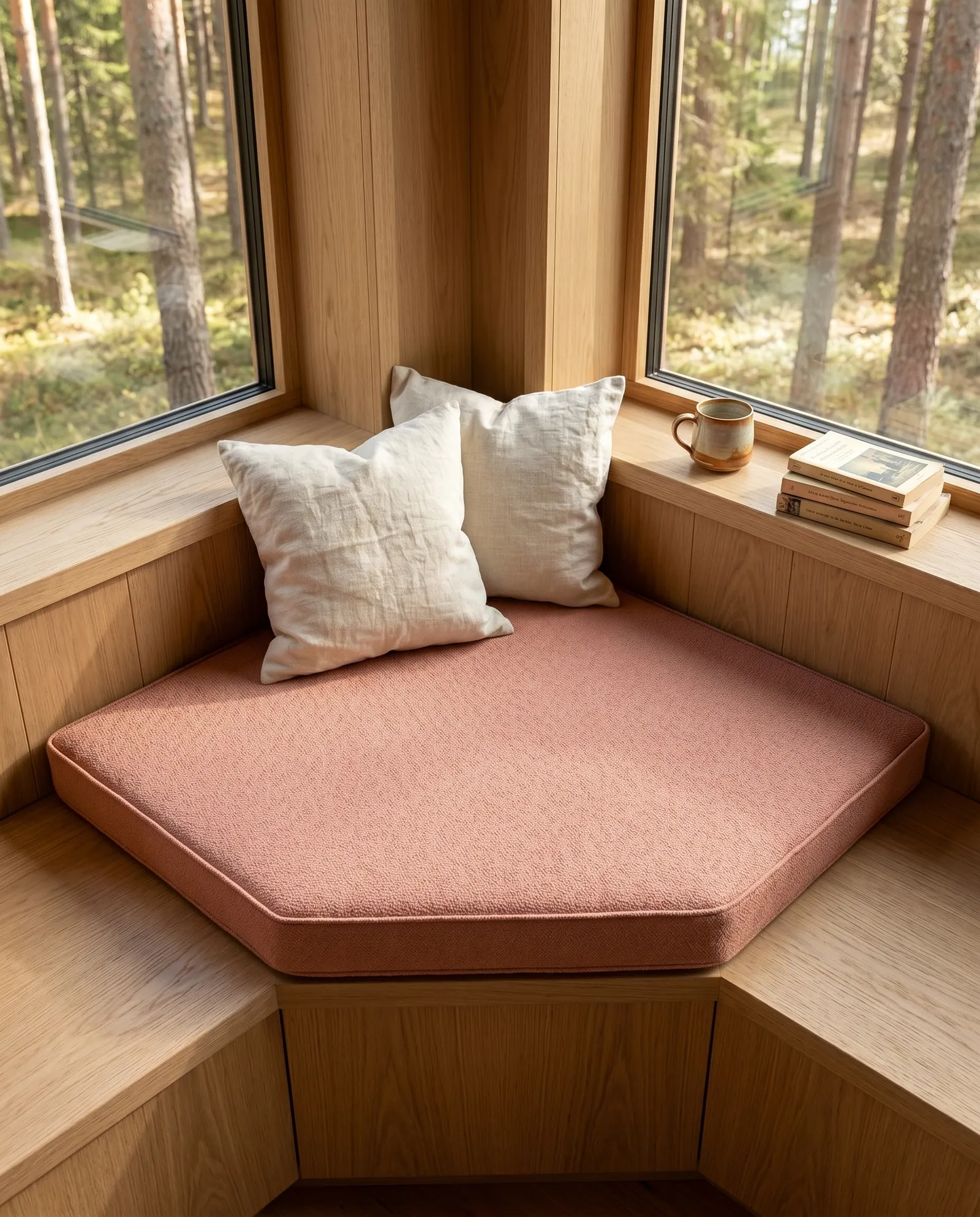
For a kids reading nook cushion on the floor, about 40 x 40 in suits a toddler's corner and 32 x 32 in is cozy for a 4-year-old. If you'll lie down and read with your child, pick the largest kids' size, about 47 in, or a 48 x 48 in reading nook floor cushion, the size suggested for an adult of about 5 ft 2 in to 5 ft 7 in. Mark the size on the floor with painter's tape and lie down on it before you order. Soft microfiber is the fabric the workshop recommends for children. The kids' floor sofas and the corner reading nook sketches show the shapes.
Try the proportions in the Studio first
Before you write to the workshop, try your nook in the bench cushion builder: put in the length, depth and thickness and compare a 3 in seat with a 4 in one. For an angled bay, the trapezoid cushion calculator helps you work through the sides. Then send the drawing with each bolster's diameter and length, and the workshop quotes the set. There is more on proportions in the Pattern on bolster sizes, and the bolster pillows page shows them finished.
What's the nook in your house that everybody fights over, neighbor? That is the one to measure first.
Where nook orders go sideways
- Ordering the full wall-to-wall length. Leave at least 2 in for handmade tolerance.
- Sending the frame height instead of the cushion sizes. Only the cushion's own dimensions matter to the maker.
- One long, soft back pillow. At 88 in it sags; split it into two equal pillows.
- Not saying round bolster or flat back pillow. They are different pieces, so name the one you want.
- Leaving a hard limit out of the quote. If the platform can't take more than 43 in, the quote should say 43 in.
- Tufting a cushion that kids climb on daily. Buttons loosen; keep the spares that come with the order, or choose untufted.
A kids' reading nook floor cushion that a parent will lie on too should be the largest size, about 47 in, because kids' sizes are made to a child's scale.
Rosa
Buyer questions: bolsters, long seats and odd corners
- A common question
Can you make bolsters to match the window seat cushion I'm ordering?
The workshop's answerYes. Bolsters are made regularly in the same fabric and piping as the seat, and a seat with two bolsters is one of the most common custom sets. They are sized by diameter x length, in any size; one past pair was 8 in across and 26 in long in corduroy. Send the cushion's width x length x thickness, each bolster's diameter x length, the quantity and your fabric for a quote.
- A common question
I bought my seat cushion last year. Can I still get bolsters in the same fabric?
The workshop's answerOften, yes. Matching bolsters, backrests or neck pillows have been made later in the original fabric and color, as long as that code is still in stock. Send the diameter and length, the quantity and the fabric code from your first order, and a custom link is set up. Slim seats pair well with bolsters: one 2 x 70 in cushion got an 8 in and a 6 in bolster, both 70 in long.
- A common question
I want a floor cushion big enough for me to lie down and read with my kids. What size should I get?
The workshop's answerKids' cushions are child-scaled, so choose the largest size; the large kids' corner is 47 in. For a big bedtime reading area, a 28 x 64 in couch works well, and any size can be made. Corner and bay-window reading cushions are made from your measurements and a photo, and soft microfiber is recommended for children.
- A common question
Our window seat is about 92 in long. Should the cushion be one piece or two?
The workshop's answerFor very long seats the workshop recommends equal pieces for fit, durability and easier handling, so 92 in would be two 46 in cushions. Soft back pillows sag when they are too long, so an 88 in back is better as two 44 in pillows. One piece can still be made if you prefer.
- A common question
Can you make a custom-shaped cushion for a corner reading nook?
The workshop's answerYes. Send the shape and measurements before ordering, with a few room photos taken from a distance and a sketch if you have one; any size-based customization fee is confirmed up front. For a quarter-round or curved space, the two straight sides are needed to work out the curve, one end can be widened for an open corner, and matching back pillows can be added.
Quick nook questions
How deep should a window seat be for lounging with a book?
Lounge-style seats run about 22 to 24 in deep, against 16 to 18 in for upright dining. A back cushion takes about 3 in off the usable depth, so a 25.5 in bay with back pillows still leaves room to curl up.
Do nook bolsters need ties to stay in place?
Standard bolsters come filled and without straps, and in a nook with walls at both ends the walls hold them. If one end is open, ask about ties before ordering; fabric ties can be sewn into cushion seams on request, at the corners or the back.
Can a corner reading nook cushion be rounded?
Yes. Quarter-round corner cushions are sized by their two straight sides, up to 48 in as standard; a 48 in corner has an arc of about 75.4 in. Send both straight sides and a photo, and the curve is worked out from those.
How thick is a kids' corner floor cushion?
The kids' corner floor cushion is foam-filled, about 8 in (20 cm) thick, with a removable cover. It comes in squares of about 32, 40 and 47 in (80, 100 and 120 cm), and the 40 in square is the best seller.
How tall should back pillows be in a window nook?
About 16 in (40 cm), measured from the top of the seat cushion, and 4 in (10 cm) thick. The workshop recommends 16 in over 12 in for proper support and doesn't go lower. Daybed sets use taller backrests, about 20 in (50 cm).