The Pattern Room · a measuring pattern
Bolster pillow sizes: choosing diameter and length for a seat or daybed
Most bolsters are ordered by length, my friend, and the diameter is left to chance. Here is how the workshop proportions a round bolster to the seat it serves, with sizes taken from real benches, window seats and daybeds.
 Save
The quick answer
A standard bolster pillow is 8 in (20 cm) in diameter, with a length that matches the seat depth or runs about 4 in (10 cm) shorter. Choose 10 in (25 cm) for a deep seat or a fuller look, and go slimmer, down to 4 in (10 cm), beside thin 2 in cushions. Very long back bolsters are made in two pieces.
Eight inches, and why nobody asks about it
Eight inches. That is the diameter the workshop cut most bolsters to, and it is the one number buyers almost never send. They write in with a length, a color and a photograph, and leave the girth of the roll to the workshop.
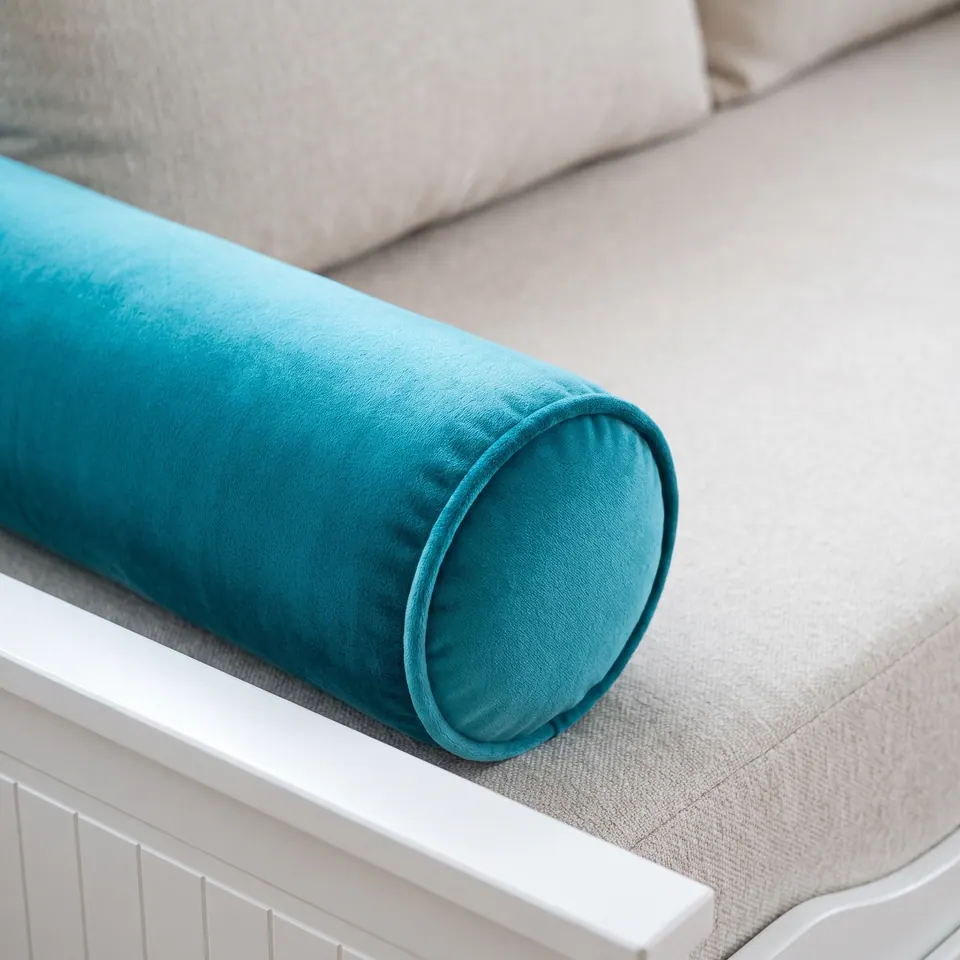
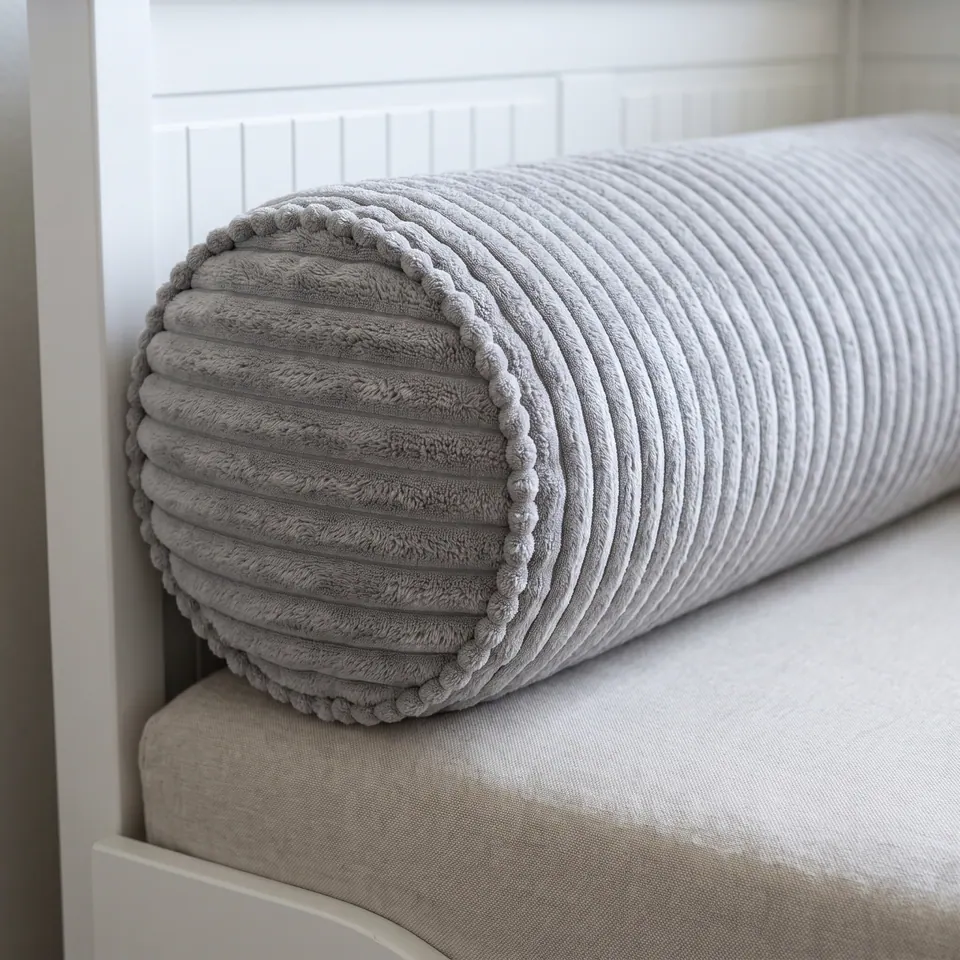
A bolster is a long, filled cylinder sized by two numbers: diameter x length. On a window seat or a daybed it serves as an arm, along a mattress it is a neck roll, and behind a bench it can be the whole back. The job sets the size, so settle the job first. The bolster pillows collection shows the family.
At 8 in (20 cm) a round armrest looks in proportion on most seats. From there, the numbers follow the seat.
Sizing a bolster pillow, step by step
Name the job: arm, neck roll or back
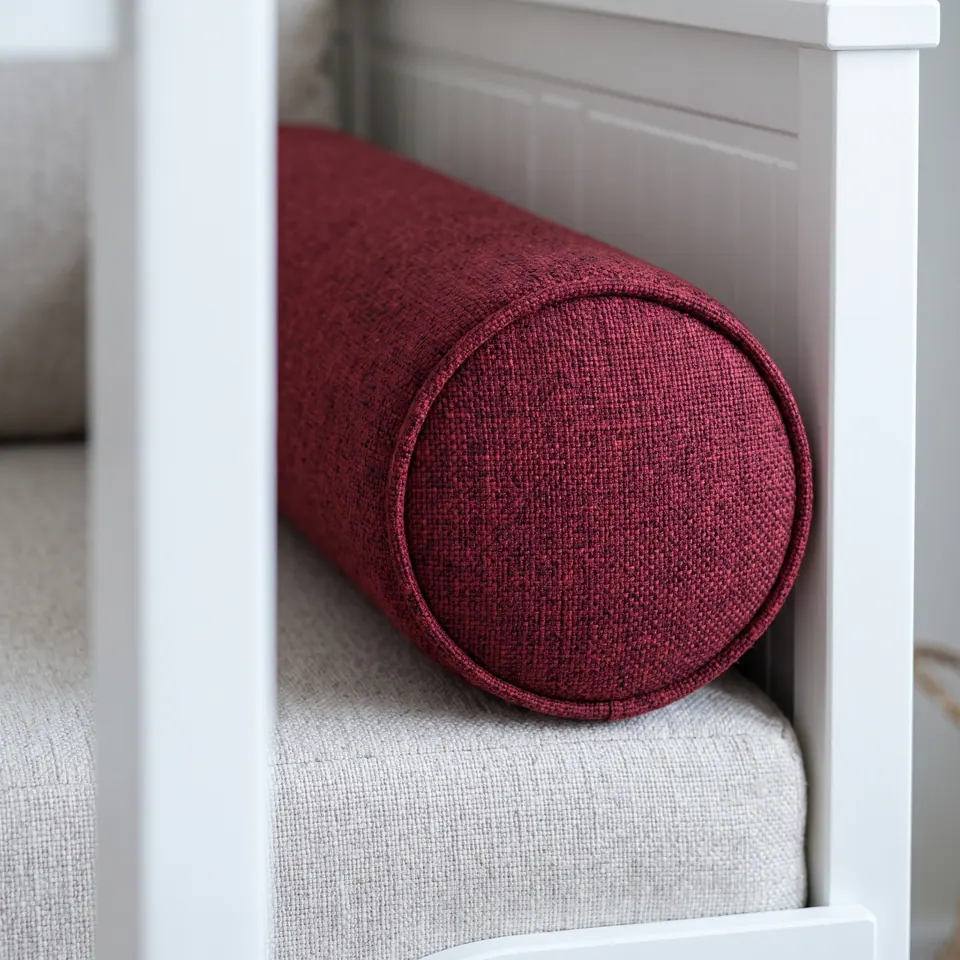
An armrest bolster lies across the end of a window seat or a daybed. A neck roll lies along a mattress. A back bolster runs along the wall behind a bench seat. Each takes its length from a different line, so write the job beside the size when you order.
Start the diameter at 8 in (20 cm)
The standard is 8 in (20 cm) across. Ask for 10 in (25 cm) on a bigger, deeper seat or when you want a fuller roll. Thin seats want a slimmer bolster: an interior designer ordered 4 in (10 cm) bolsters to sit with 2 in (5 cm) bench cushions. A 20 in (51 cm) cylinder would be unusually large.
Size an armrest to the seat depth
An armrest runs as long as the seat is deep, or about 4 in (10 cm) shorter so its end stays behind the front edge. A 21 in (53 cm) deep seat takes a 21 in bolster; a 32 in (81 cm) deep seat took one about 27 1/2 in (70 cm) long. On a daybed with back cushions, measure the space in front of the backs, not the full mattress.
Run a back bolster the length of the bench
A bolster along the wall matches the bench, and it takes seat depth with it. For 31 1/2 in (80 cm) of sitting depth, the workshop recommends about 39 1/2 in (100 cm) in total so an 8 in back bolster has room. Very long ones are split: a 142 in (360 cm) bolster was made as two pieces of 71 in (180 cm).
Pick a fill that stays round
Every bolster ships filled. Silicone ball fiber, the cluster fiber that rolls past itself instead of matting, suits round arm bolsters. A neck roll can be shredded foam or solid firm foam; the workshop leans to shredded foam, which is not very soft. Perfectly flat ends are close to impossible with any filling, so expect them to round a little.
Choose the finish: piping, stripe or button
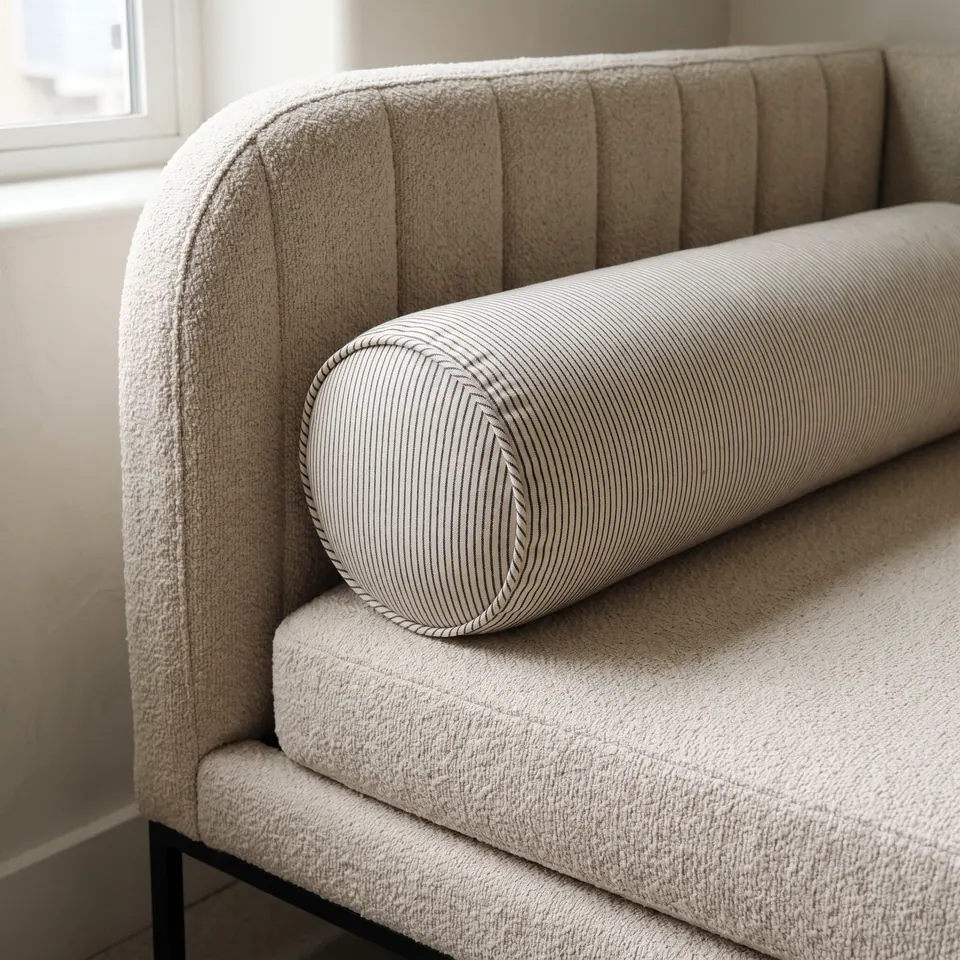
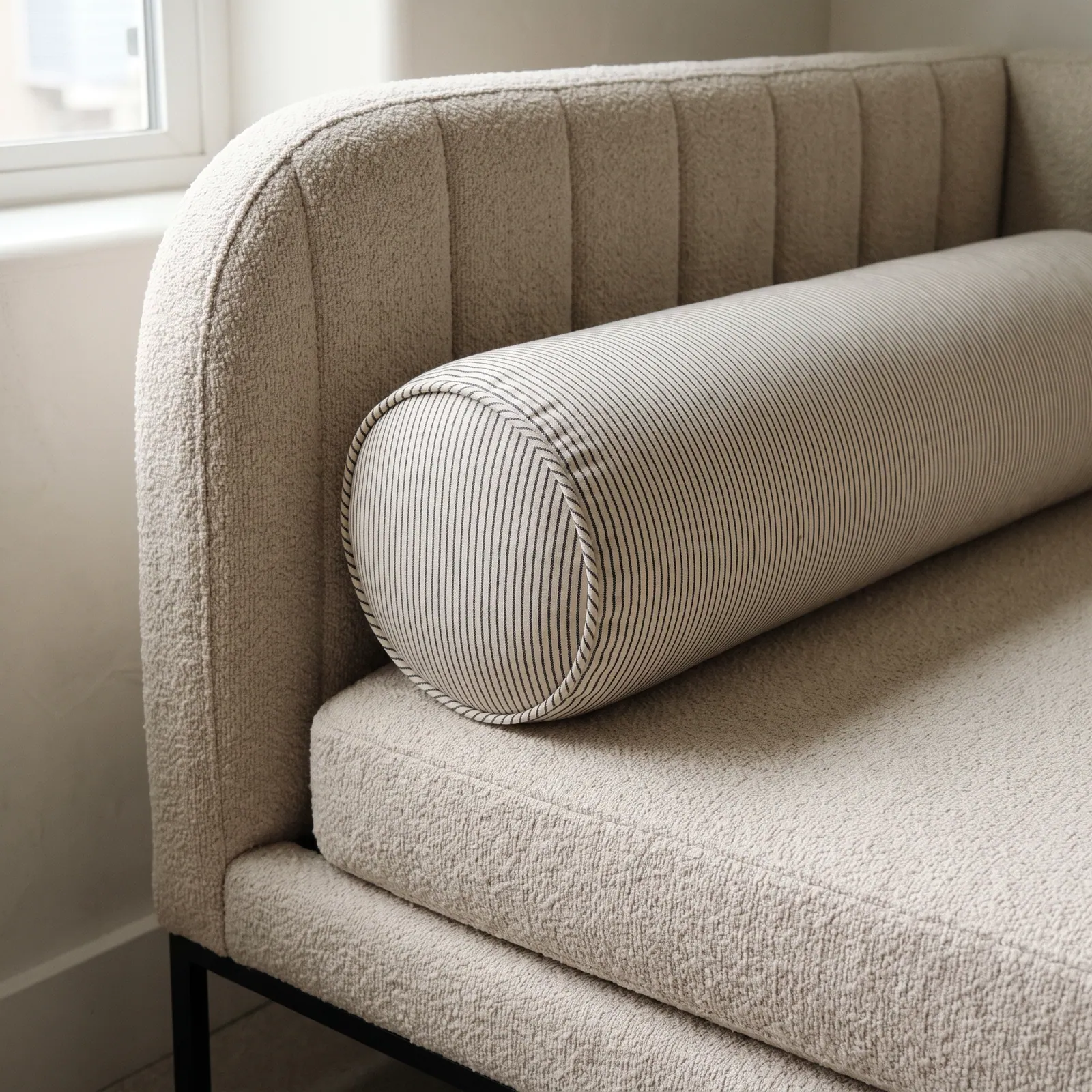
A bolster can wear the seat's own fabric with self piping, take contrast piping in a second fabric, or be cut entirely from a stripe. The ivory and navy pinstripe bolster at the top of this page has piping cut from the same striped cotton. Plain straight piping with a button in the center of each end looks tailored. A seam is a promise, and on a bolster you read it at the ends.
Decide whether it should stay put
Bolsters come loose, with no straps, as standard. If yours has to stay on a mattress or a narrow seat, ask for a strap, or for hook-and-loop to hold the armrests to the base, and write it into the order. A strap remembered after delivery means a new bolster.
Order the bolsters with the seat
Send the cushion's width x length x thickness, each bolster's diameter x length, the quantity and the fabric. Bolsters cut from the same roll as the seat match it. They can be added later from the fabric code on your first order, but a newer roll can sit a shade apart; the reasons are in dye lots.
Have it made
Measured it? Have Harlan’s workshop make it
The best cushions I have known began with somebody asking one more question. Ask yours here. — Harlan
Leave your details and the workshop will call you to confirm measurements, fabric, foam and piping. No prices, dates or payment on this page: it is a request, not an order.
Bolster sizes by job, from real orders
| Job | Diameter | Length | Past order example |
|---|---|---|---|
| Window seat armrest | 7 to 8 in (18 to 20 cm) | Seat depth, or about 4 in (10 cm) less | Two 7 x 20 in (18 x 51 cm) bolsters on a 20 x 73 in (51 x 185 cm) seat |
| Daybed armrest | 8 in (20 cm), or 10 in (25 cm) for a fuller roll | The space in front of the back cushions | 8 x 37 1/2 in (20 x 95 cm) bolsters on a 79 in (200 cm) daybed |
| Neck roll | About 8 3/4 in (22 cm) | The mattress width | 31 1/2 in (80 cm) long for a 31 1/2 x 79 in (80 x 200 cm) mattress |
| Back along a bench | 6 to 8 in (15 to 20 cm) | The bench length, split when very long | 44 x 6 in (112 x 15 cm) bolsters on 53 1/2 and 54 in benches |
| Beside a slim seat | 4 to 6 in (10 to 15 cm) | To suit the seat | 4 in (10 cm) bolsters with 2 in (5 cm) bench cushions |
Two benches, two bolsters, then a bench twice the length
A buyer in the US wrote to the workshop wanting cushions for two benches that were sturdy and would not sag. The benches ran 53 1/2 and 54 in (136 and 137 cm) long and 20 in (51 cm) deep, a figure later corrected to 19 3/4 in (50 cm). Each was to carry a bolster 44 in (112 cm) long and 6 in (15 cm) across, in white performance fabric with no piping.
The workshop told them plainly that its standard 32 kg/m³ foam, about 2.0 lb/ft³, already does not sag, and priced it at 6 and 7 in. They chose 7 in (18 cm). A second set followed for a long outdoor bench, 97 1/2 x 21 in (248 x 53 cm). One piece that long is hard to make, ship and lift, so it became two seat cushions 8 in (20 cm) thick and two bolsters 48 3/4 in (124 cm) long and 7 in (18 cm) across, white with black piping.
When a bolster arrived looking flat, the workshop explained the vacuum pack and asked for a photograph once it had breathed. A bolster rides the truck squeezed like everything else; give it its first 72 hours before you judge it.
- What it taught
- Long benches can be split into two cushions and two bolsters for easier handling without losing the look.
The strap nobody wrote down
Another buyer in the US sent reference pictures of a tufted daybed mattress with a round bolster strapped to it. The workshop made the mattress 75.9 x 35 x 4 1/2 in (193 x 89 x 11.5 cm) and the bolster 6 1/4 in (16 cm) across and 35 in (89 cm) long, in linen. The bolster arrived without a strap. Straps are not standard, and this one had never been written on the order.
The workshop made a replacement with a strap, which took a week or two because the part had to be sourced, and said honestly that perfectly flat ends are near impossible with the filling inside. A reference photo shows everything and promises nothing. Put what you want from it in words: the strap, the button, the flat end.
So look at your own reference photo once more. What does it show that your order note does not?
Bolster mistakes that come back to the workshop
- Sizing a daybed armrest to the full mattress depth when back cushions stand behind it. It bulges; give its length as the space in front of the backs.
- Expecting a strap or a center button because the photo had one. Neither is standard; write it in.
- Adding bolsters a year later from a newer roll. Order the set together, or send a photo of the original and ask for a batch match.
- A round bolster where a flat back fits better. Under a low sill or on a kitchen window seat, a knife-edge back pillow such as 14 x 63 1/2 in (36 x 161 cm) can serve better.
- Measuring a bolster the day it arrives. Allow 48 to 72 hours, sometimes 3 to 4 days, then measure.
- Loose bolsters on a shallow seat. They roll; ask for ties or a strap, and see stopping a bench cushion from sliding.
Bolster straps are not standard. If the reference photo shows a strapped bolster, write the strap into the order note, or the bolster arrives loose.
Harlan
Diameter, not circumference
A bolster is described by two numbers: its length, from one end seam to the other, and its diameter, measured straight across the flat round end. Measuring guides warn buyers not to send the circumference, the distance around the bolster, because the two are easy to confuse and the difference is large: an 8 in bolster measures about 25 in around. If all you have is a tape wrapped around an old bolster, divide that number by 3.14 to get the diameter. Standard armrest bolsters here are 8 in (20 cm) across, 10 in is possible, and any diameter and length can be made.
Buyer questions
- A common question
I know how long I want my bolster, but what diameter should it be?
The workshop's answerThe standard is 8 in (20 cm), which the workshop's craftsmen say looks best on a typical bolster about 20 in (50 cm) long. 10 in (25 cm) has been made for a fuller look, or go slim: 4 in (10 cm) bolsters were made for 2 in (5 cm) bench cushions. Armrest length normally follows the seat depth.
- A common question
Can you make two bolsters in the same fabric and piping as my bench cushion?
The workshop's answerYes, and a seat cushion with two bolsters is one of the sets the workshop makes most often. Send the cushion's width x length x thickness, each bolster's diameter x length, the quantity and your fabric. The bench cushion is ordered from its listing and the bolsters are added through a custom link.
- A common question
Will the bolster stay on my daybed, or can you fix it in place somehow?
The workshop's answerBolsters and the other set pieces come loose, with no straps, as standard. Ask on the order and the workshop can add a strap to hold a bolster to a mattress, or hook-and-loop to attach armrests to the base. Perfectly flat bolster ends are close to impossible because of the filling inside.
- A common question
I bought a window seat cushion from you last year. Can I still get bolsters that match it?
The workshop's answerYes. The workshop keeps fabric stock, so bolsters, round armrests or neck pillows can be made later in your original fabric and color. Send the diameter, length, quantity and the fabric code from your first order; a single bolster is fine. One slim 2 in (5 cm) seat, 70 in (178 cm) long, took an 8 in (20 cm) and a 6 in (15 cm) bolster, both 70 in long.
- A common question
Can you make a neck roll to match the cover on my daybed mattress?
The workshop's answerYes. Neck rolls and bolsters are made to any length and diameter in the mattress cover's fabric, with the filling included. One was 31 1/2 in (80 cm) long and about 8 3/4 in (22 cm) across for a 31 1/2 x 79 in (80 x 200 cm) mattress. Back pillows and bolsters can also be ordered without the cover.
Bolster questions, answered short
Where should a window seat bolster end: at the front edge or short of it?
Either works. An armrest bolster is made as long as the seat is deep, or about 4 in (10 cm) shorter so the end stays behind the front edge. A 20 in (51 cm) deep window seat took two bolsters 20 in long and 7 in (18 cm) across, one at each end.
Is a neck roll just a smaller bolster?
Near enough. Both are filled cylinders sized by diameter x length. A neck roll lies along the head of a bed or daybed; a bolster usually works as an arm or a back. Neck rolls suit shredded foam, which is not very soft, while round arm bolsters suit silicone ball fiber.
Can a round bolster stand in for a bench back?
Yes. A long bolster with rounded ends can run the full length of a bench or banquette in the seat fabric. Allow for its depth: with 31 1/2 in (80 cm) of sitting depth, plan about 39 1/2 in (100 cm) in total. Very long bolsters are made in two pieces.
Does a fatter bolster make a seat more comfortable?
Not by itself. 8 in (20 cm) suits most seats, and 10 in (25 cm) gives a fuller look on a big, deep one. A 20 in (51 cm) cylinder would be unusually large, and slim 2 in (5 cm) cushions look better with bolsters of 4 to 6 in (10 to 15 cm).