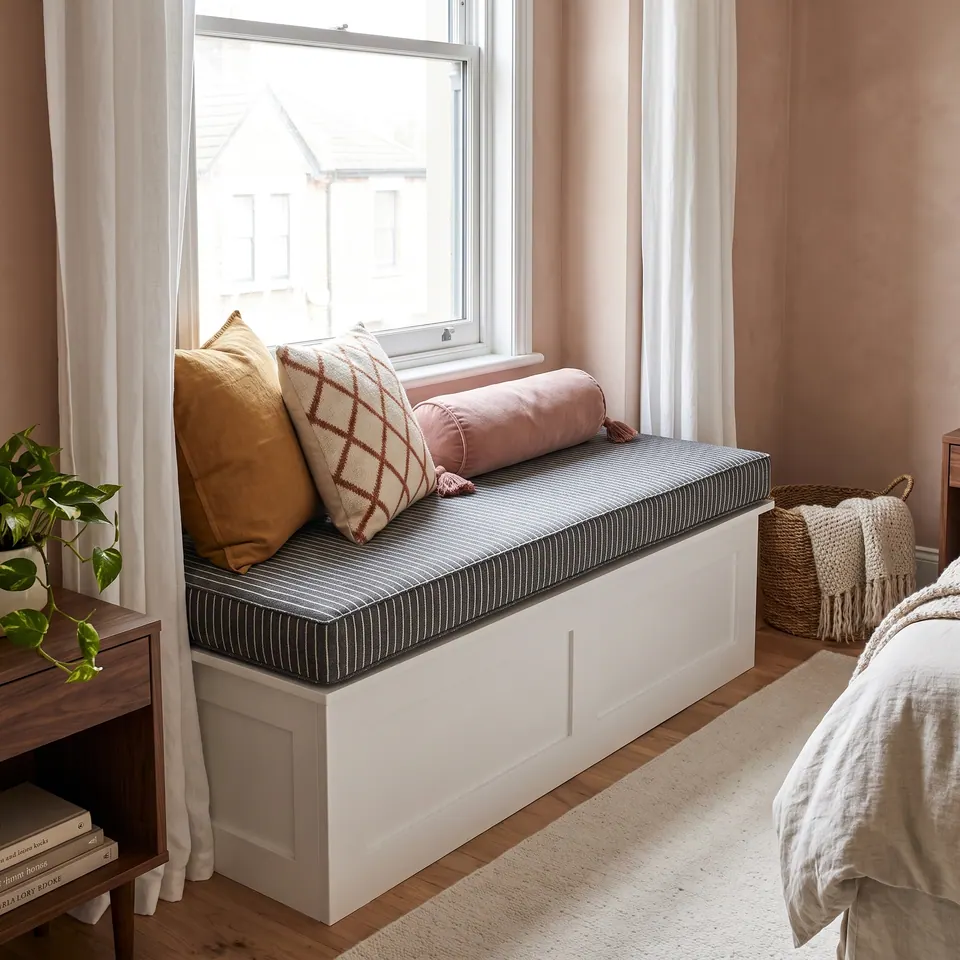
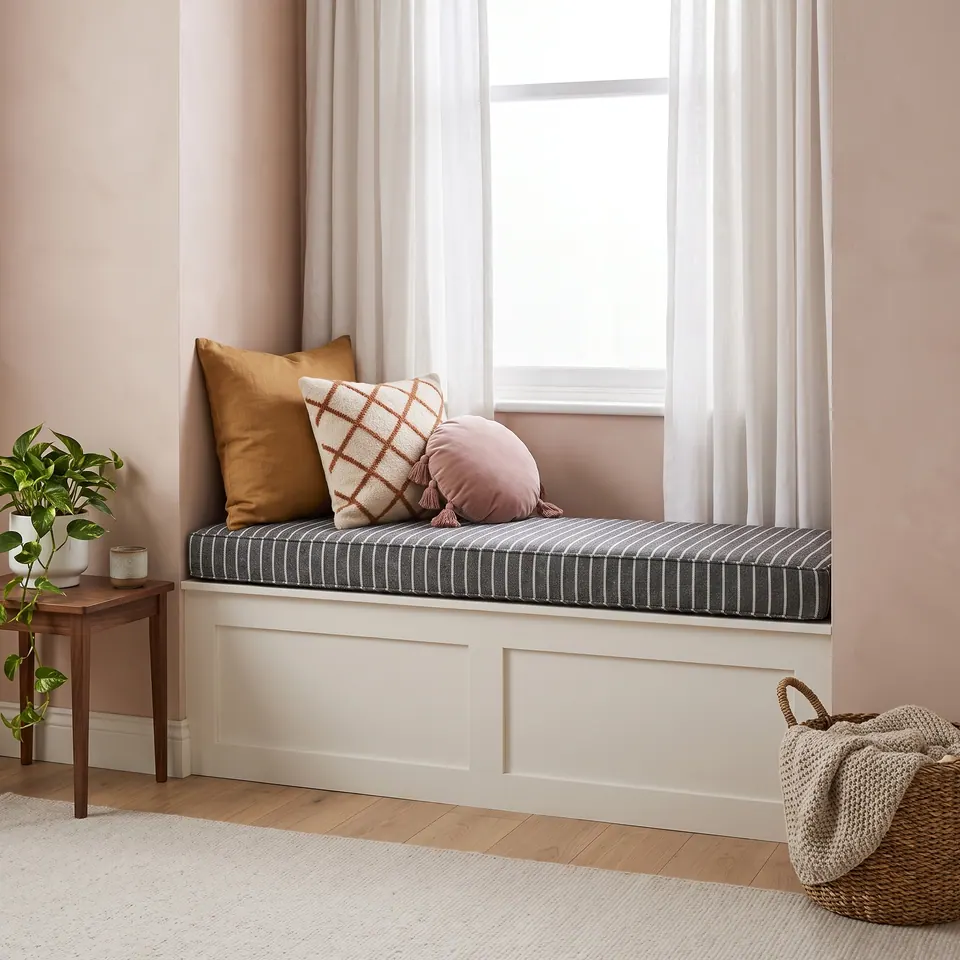
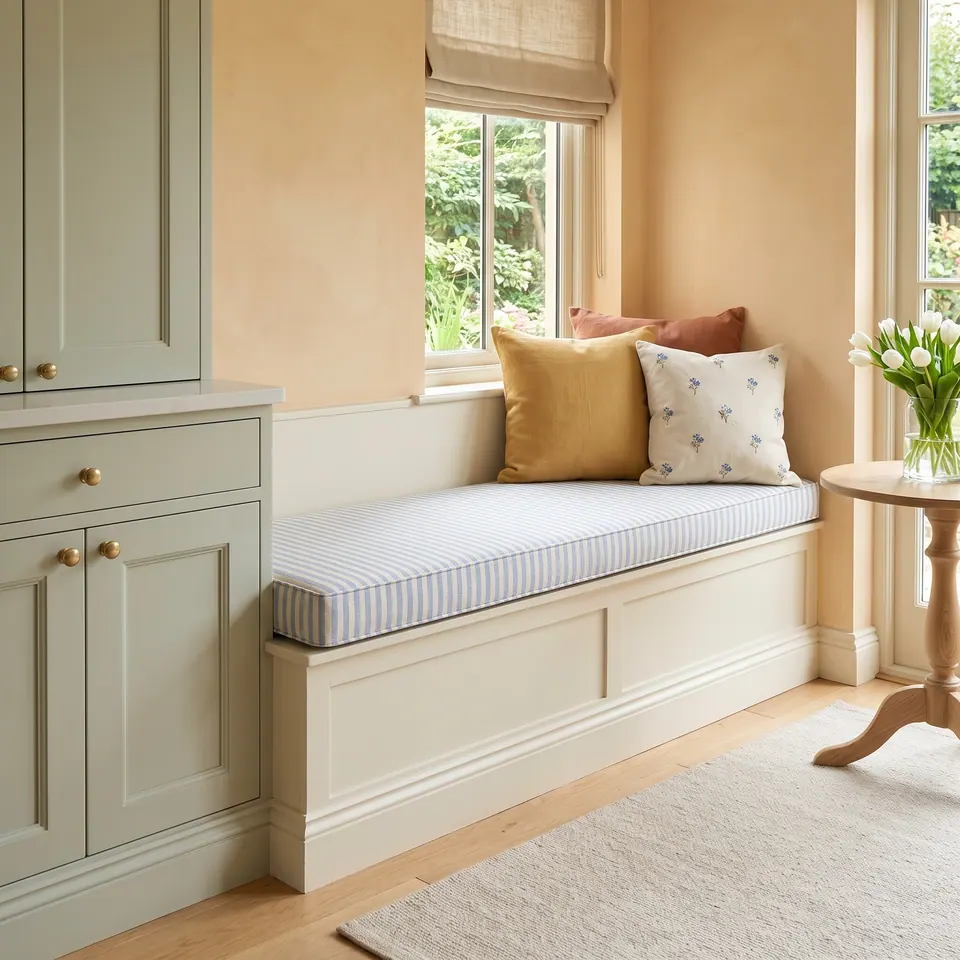
The Pattern Room · a side-by-side pattern
Window seat dimensions and the cushion sizes that fit them
Three numbers and a sill. Take them in the right order and the cushion is the easy part.

- Ready-made 36 x 16 in
- Ready-made 48 x 18 in
- Ready-made 60 x 20 in
- Measured to fit
 Save
The quick answer
Typical window seat dimensions are 18 to 24 in (46 to 61 cm) deep, 36 to 72 in (91 to 183 cm) wide and 16 to 21 in (41 to 53 cm) high to the top of the cushion, about 18 in on average. Allow 32 in of width to sit facing forward, 48 in to sit sideways, and keep the seat top 6 in below the window.
Three numbers and a sill
One inch too long, and a window seat cushion will not go in. It has two walls to argue with and nowhere to put the extra. Most window seat dimensions I see go wrong that way: good measuring, done in the wrong order, then matched to a size a store happened to stock.
Here is the order. Depth first, because it decides how you sit. Width second, because it decides how many sit. Height last, because the sill has already decided most of it. Then the cushion, cut to what you measured.
The chart carries the published ranges beside the workshop's numbers. And one question keeps returning: why doesn't the ready-made size fit? The second table answers it with real seats. For the tape work edge by edge, see the window seat measuring Pattern; for shapes and fabrics, window seat cushions.
Window seat dimensions chart
| Dimension | Typical | Minimum or rule | Measure from |
|---|---|---|---|
| Depth | 18 to 24 in (46 to 61 cm) | 16 in (41 cm) to sit facing forward; about 39 in (99 cm) for a daybed-style seat | Wall or window face to the front edge: left, middle and right |
| Width | 36 to 72 in (91 to 183 cm) | 32 in (81 cm) facing forward; 48 in (122 cm) sideways; 60 in (152 cm) or more for company | Wall to wall, at the front edge and again at the back |
| Finished seat height | 16 to 21 in (41 to 53 cm), about 18 in (46 cm) on average | Bench height plus cushion thickness | Floor to the top of the cushion |
| Seat top to window | About 6 in (15 cm) | Keep at least that below the window's lower edge | Top of the cushion to the sill or frame |
| Sill above the seat | 8 to 10 in (20 to 25 cm) deep | Room for books and a plant | Glass to the front of the sill |
| Cushion thickness | 3 in (7.5 cm) on most seats | 2 in (5 cm) minimum for sitting; 4 in (10 cm) is the workshop standard | Uncompressed, cover on |
| Back pillows | 16 in (40 cm) tall, 4 in (10 cm) thick | They take about 4 in of seat depth | From the top of the seat cushion |
Ranges from published window seat guides (see sources); workshop figures from its replies to buyers.
Ready-made sizes against real seats
Stock window seat cushions come in a handful of sizes, and 36 x 16, 48 x 18 and 60 x 20 in are the common ones. Here they are laid against seats measured by buyers in the US. Length is wall to wall; depth is front to back.
| Ready-made | Measured seat from past orders | Length | Depth | What happens |
|---|---|---|---|---|
| 36 x 16 in | 25 x 17 in small window seat | 11 in too long | 1 in short | Does not go in |
| 36 x 16 in | 35 x 17 3/4 in window bench | 1 in too long | 1 3/4 in short | Will not drop between the walls |
| 48 x 18 in | 46 x 22 in window bench | 2 in too long | 4 in short | Will not fit, and 4 in of bench shows |
| 60 x 20 in | 59 x 17 3/4 in window bench | 1 in too long | 2 1/4 in over | Will not fit between the walls |
| 60 x 20 in | 63 1/2 x 19 in kitchen window seat | 3 1/2 in short | 1 in over | Gaps at the ends, a 1 in lip at the front |
| 60 x 20 in | 64 x 18 3/4 in bedroom window bench | 4 in short | 1 1/4 in over | About 2 in of gap at each end |
A front overhang of up to about 2 in is fine on firm foam; a cushion 1 in longer than the gap between two walls is not. Six seats, six misses: the case for made to measure.
Height: the sill sets the ceiling
Finished seat height is bench plus cushion. A 14 in (36 cm) bench under a 4 in (10 cm) cushion sits at 18 in (46 cm), the middle of the 16 to 21 in range. Now look up: the published rule keeps the top of the cushion about 6 in below the window's lower edge.
Where the sill is low, the back pays. A buyer in the US had a window only 11 in (28 cm) off the floor and wanted nothing above it. Her floor cushion was 4 in thick, which left 7 in for a back, so the workshop made a low flat back instead of a round bolster. Floor to sill, minus seat, is the tallest back you can have.
Where the window must open over the seat, the cushion pays. Cushions exactly 2 in (5 cm) thick have been made so a window above could still close. Give your maximum height with the cover on. The thickness Pattern covers the range, and thin cushions under a windowsill the low end.
Measure a window seat in seven moves
Width at the front, wall to wall
Rigid tape, straight line, to the nearest 1/8 in (3 mm). Measure the seat surface, not the floor below it.
Pattern sheet A real seat from a past order: 63 1/2 in at the front and the back, 19 in deep at both ends. Width at the back, along the window
Often shorter than the front. If the two differ, it's a trapezoid: send both, or use the bay window calculator. Angled seats live under bay window cushions; the three-sided bay Pattern walks one through.
Depth at left, middle and right
Wall or window face to the front edge. 20 in is not 20 1/4 in. Old walls wander, and three numbers show which way.
Bench height, then up to the sill
Floor to the top of the bare bench. Then bench to the lowest point above it: sill, frame, handle or crank. That is your height budget, back pillows included.
Mark the obstacles
Handles, casings, radiators and outlets go on the drawing with width, depth and position. They become notches, not surprises; the notches and cutouts Pattern shows how.
Take the back pillows off the depth
A standard back pillow is 16 in (40 cm) tall and 4 in (10 cm) thick, and takes about 4 in of depth. On an 18 in seat that leaves about 14 in, under the 16 in minimum for facing forward. So the seat goes deeper, the back goes thinner, or you sit sideways.
Send the true numbers
Don't shave anything off for fit. The workshop adds its own allowances and cuts to the full size you give, halves and quarters welcome. Put every number, thickness included, in the order itself: production reads the order, not the chat. Tolerance is kindness to your future self; guessing is not.

Have it made
Measured it? Have Nate’s workshop make it
Every edge and both diagonals, to the nearest 1/4 in. If the numbers do not close, the workshop will say so on the call. — Nate
Leave your details and the workshop will call you to confirm measurements, fabric, foam and piping. No prices, dates or payment on this page: it is a request, not an order.
On the cutting table: window seat cushion sizes by use
| Most window seats | 3 in (7.5 cm): the neater, lower profile |
|---|---|
| Lounging and napping | 4 in (10 cm), the workshop standard; 5 in on the menu, 6 to 8 in made to order |
| Nook seat at a table | 2 to 2 1/2 in (5 to 6.5 cm), so the tabletop stays in reach |
| Under a sill that must clear | 2 in (5 cm); thinner can be cut but stops being a seat |
| Back pillows | 16 in (40 cm) tall, 4 in (10 cm) thick, made to the seat's length |
| Front overhang | Up to about 2 in (5 cm) on firm foam, with a supporting inner wrap if needed |
| Finished size | Cut as written and checked before shipping; handmade foam can vary by about 1/2 to 1 in (1 to 2 cm) |
Twenty-six inches deep, and a back added later
A couple in the US had a window seat in a new house, about 98 in (249 cm) long and 26 in (66 cm) deep, past the usual 18 to 24 in and on the way to daybed depth. They chose 6 in (15 cm) of orange corduroy over 8 in, plus two end bolsters 8 in (20 cm) across and 26 in long, matched to the seat depth.
Later they came back for a back cushion: 90 in (229 cm) long, 11 in (28 cm) high, 3 in (7.5 cm) deep. Run the subtraction, partner. 26 in of seat minus 3 in of back leaves 23 in to sit on. They wanted the corduroy wales vertical, and the workshop checked that with production before promising it.
What I take from it: a deep seat can carry a back later if you quote the same fabric code, and a thin back keeps the depth you paid for. For pillows and bolsters, see reading nook cushions.
Where window seat numbers go wrong
- Buying the nearest stock size. A cushion 1 in longer than the gap between two walls has nowhere to go.
- Forgetting the back pillows. A standard back takes about 4 in of seat depth.
- Checking the sill and forgetting the cushion. What is left above the seat is all the back gets.
- Typing a thickness into a message instead of the order. One reorder arrived 2 in thick instead of 4 in.
- Swapping length and width. Length is the long side; width is front to back.
- Shaving off a fit allowance yourself. Send true measurements.
A window seat cushion is cut to the seat you measured, not to the size a store stocks. One inch too long between two walls is one inch with nowhere to go.
Nate Kowalski
Buyer questions: window seat sizes
- A common question
The window opens over our seat. How thin can the cushion be?
The workshop's answer2 or 3 in suits most low-profile window seats, and cushions of exactly 2 in (5 cm) have been made so the window above could still close. Thinner can be cut, but it is too thin to sit on well, so the workshop recommends at least 2 in (5 cm). Slim foam must be cut evenly to the cover or it bulges, so give your absolute maximum height with the cover on; thickness is confirmed with you before production.
- A common question
One end of our window seat is curved. How do I send the shape?
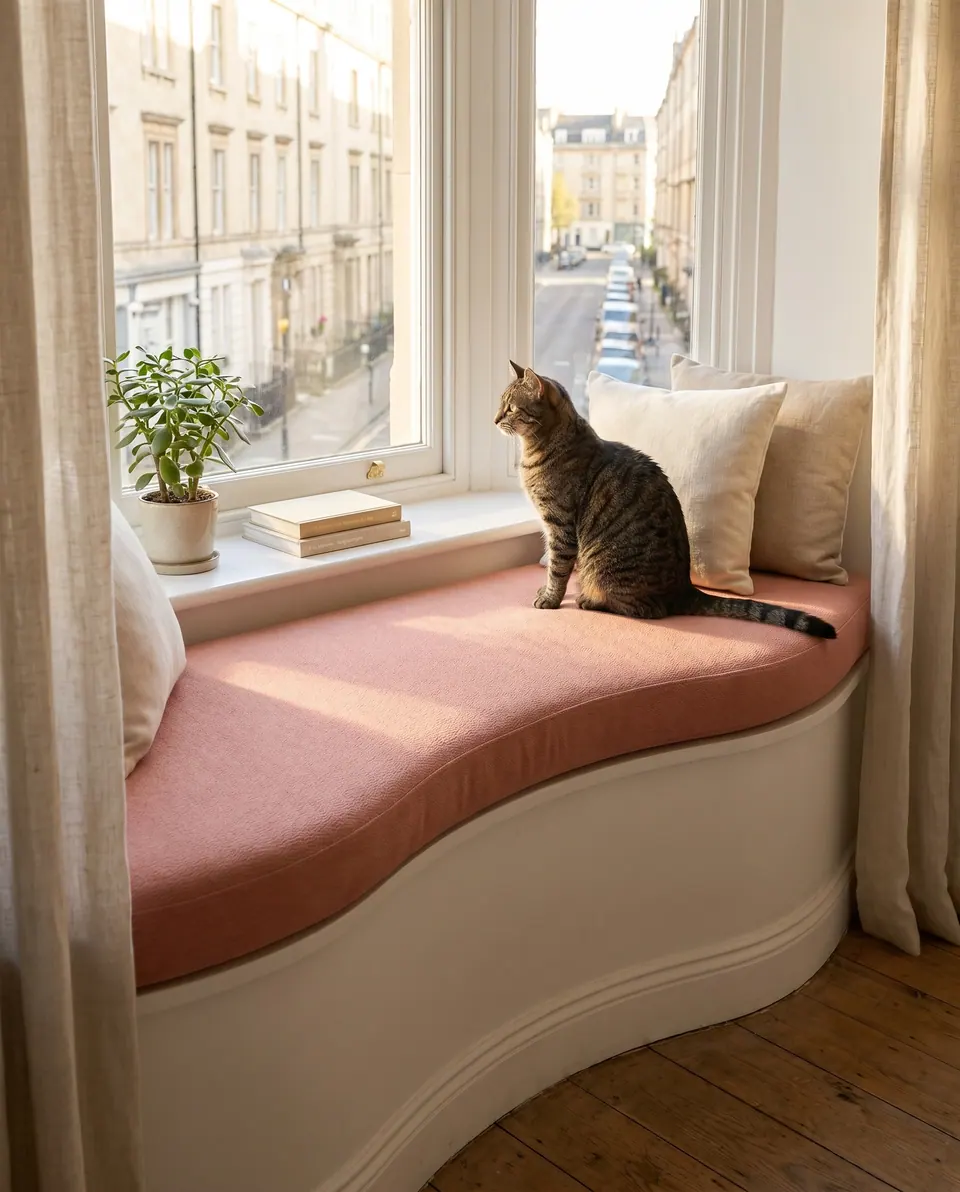
The workshop's answerCurved and arched seats are made, but a curve isn't guessed from numbers alone. Sketch it with the total width and depth, the straight length of each edge before the curve, and how deep the curve runs; or trace the seat on wrapping paper, cut it out and photograph it flat beside a tape measure. An arched window seat has been made as a rectangle plus an arc of a circle.
- A common question
I just ordered and noticed one dimension is wrong. Can it still be changed?
The workshop's answerUsually, if you message quickly. Dimensions have been corrected after checkout, for example a mattress updated to 75 x 38 x 8 in, and the workshop checks with its production team before confirming. A finished custom piece generally can't be altered, so send final sizes and a drawing as early as you can.
- A common question
Can a window seat cushion hang over the front edge without breaking down?
The workshop's answerYes, by up to about 2 in. High-density foam keeps the front edge structured under daily use, and the workshop can make the foam slightly firmer and add a supporting inner wrap. One buyer in the US with a wooden box seat 12 in deep was told a 14 in cushion would hold its front edge.
Window seat dimensions, answered
How wide should a window seat be for two people?
Plan on 60 in (152 cm) or more. Published guides put 32 in as the minimum for one person facing forward and 48 in for one person sitting sideways with their back to the wall. Two side by side want the extra foot.
Can a window seat be deep enough to sleep on?
Yes, if it is built for it. Published guides put a daybed-style window seat at about 39 in (99 cm) deep, and a twin mattress is about 38 in wide. At 24 in or less, the seat is for sitting and curling up, not for a night's sleep.
What size cushion should I order for a 36 in window seat?
Order 36 in, the true measurement, with the depth you measured. Don't subtract for fit; the workshop adds its own allowances, cuts to the size you give and checks it before shipping so it doesn't come out larger. Measure to the nearest 1/8 in.
Should a very long window seat cushion be split into pieces?
Usually, yes. The workshop recommends splitting very long seats into equal pieces for fit, handling and shipping: a seat 154.5 in long became two 77.25 x 22 in cushions. One piece can still be made on request.