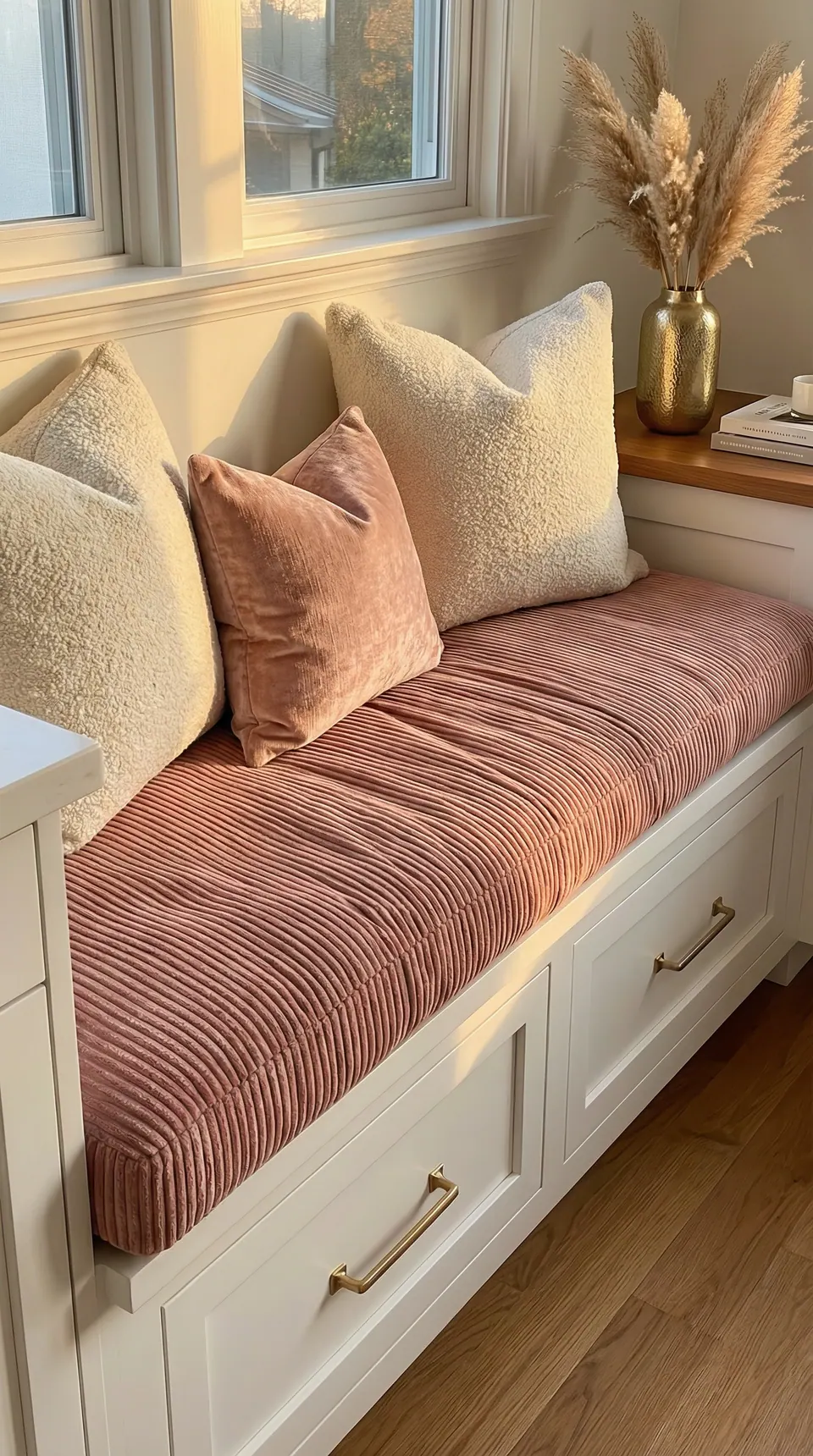
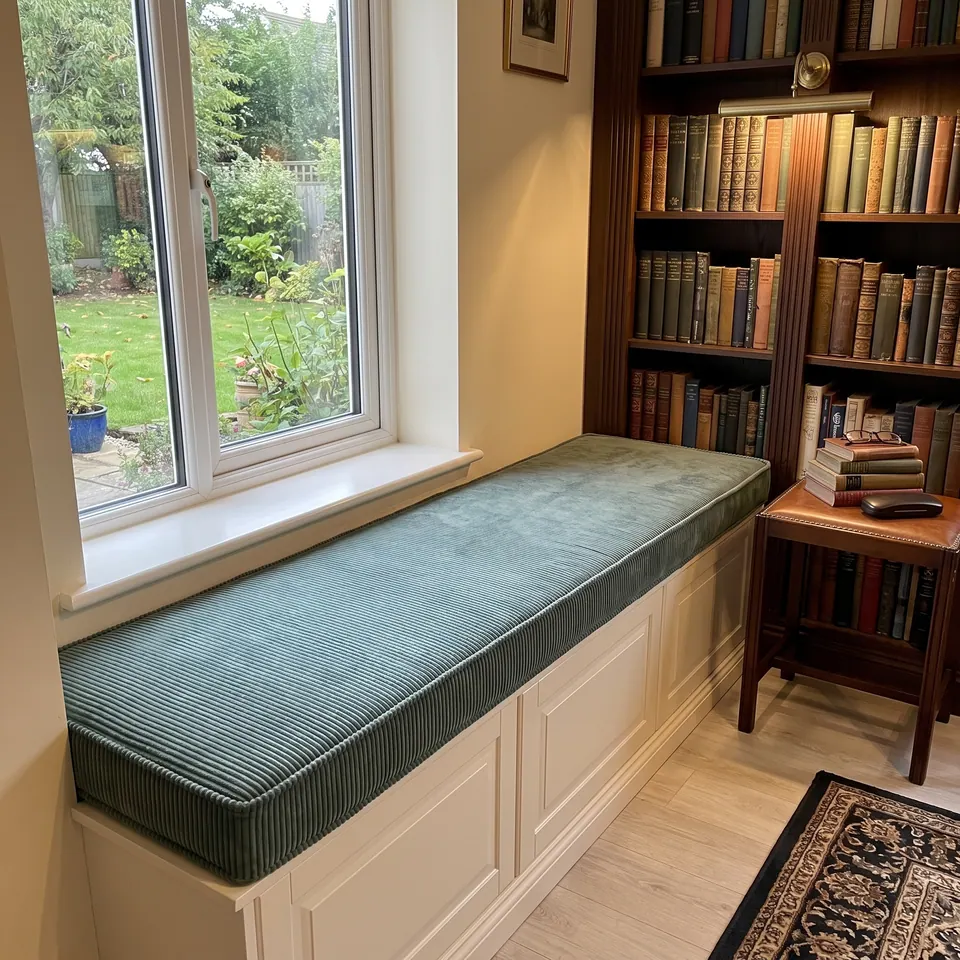
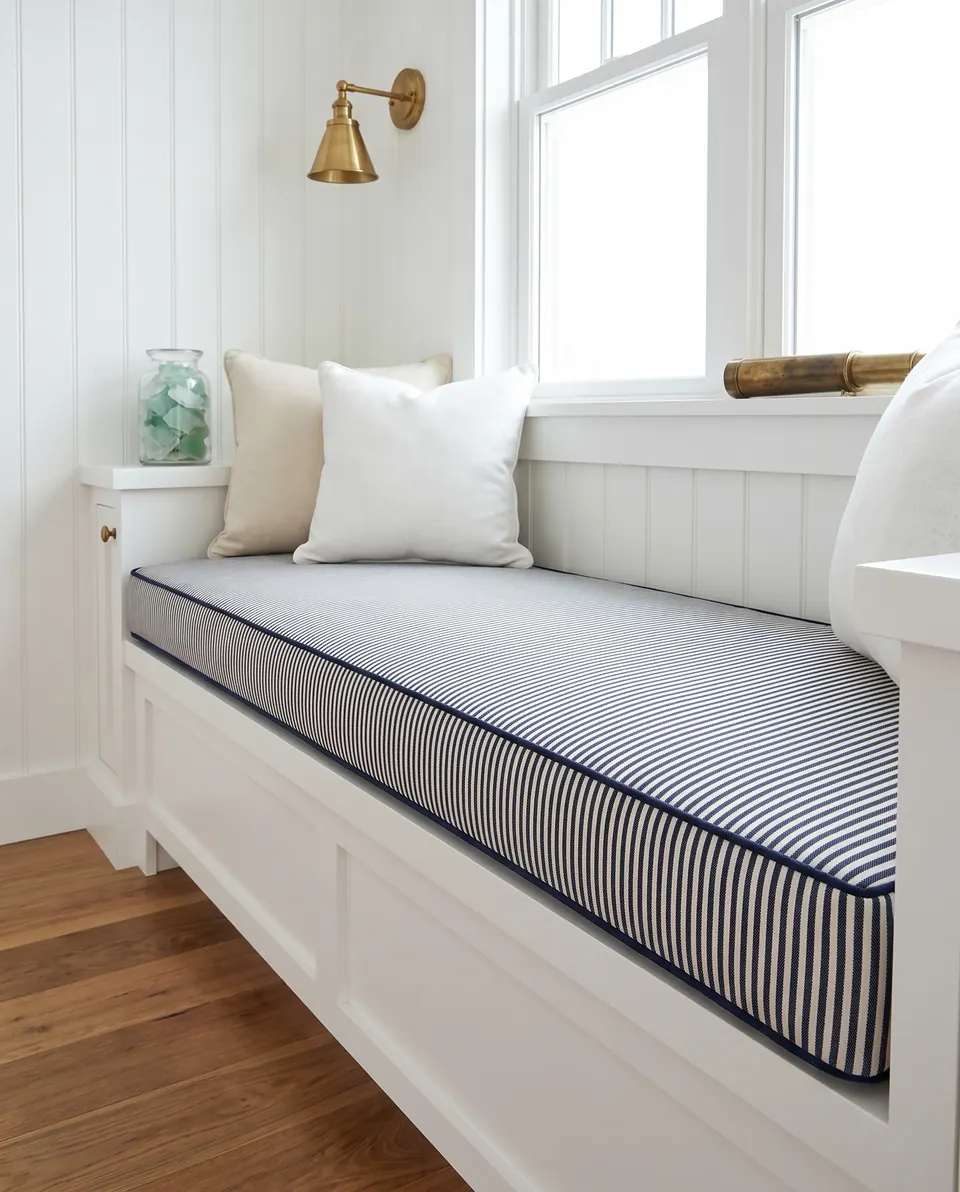
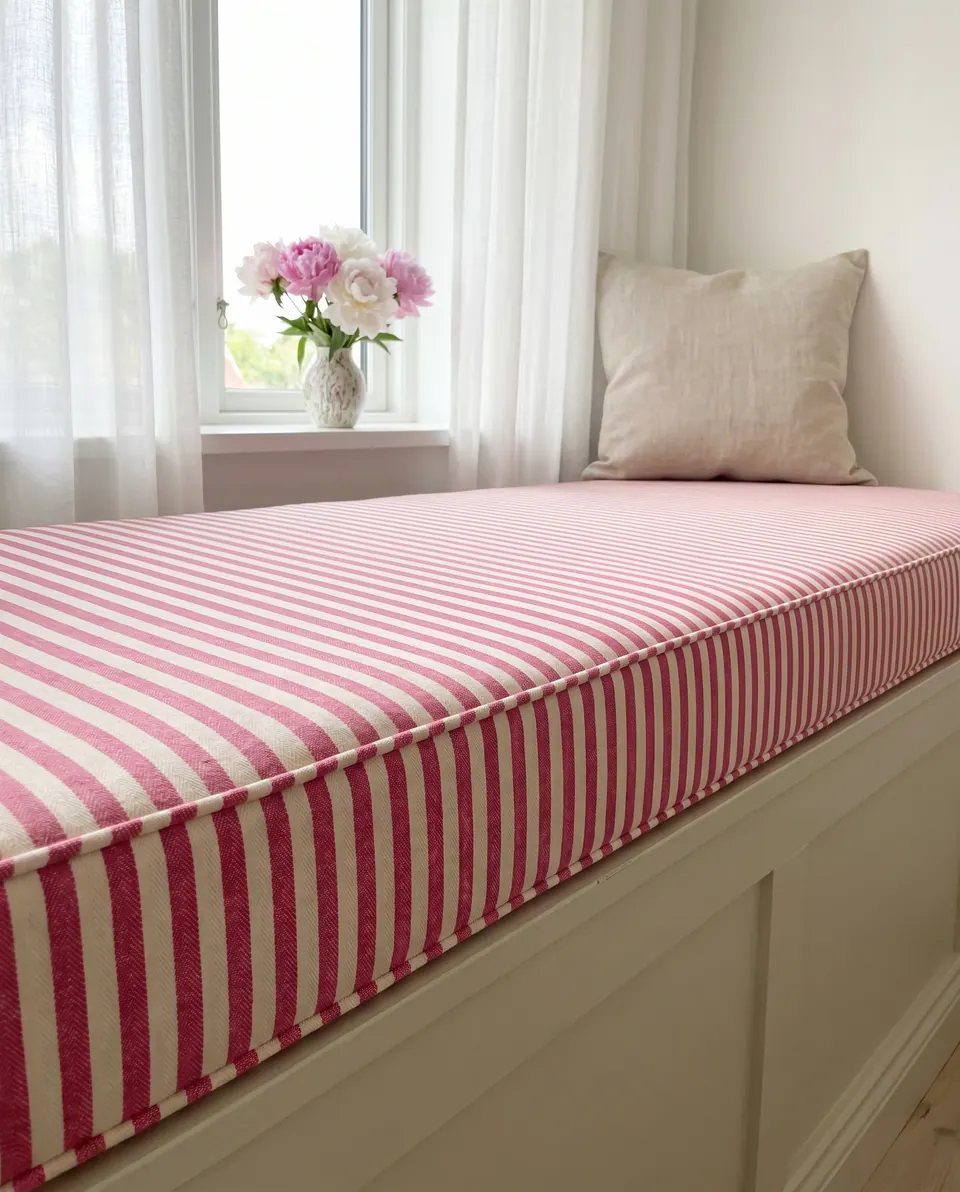
The Pattern Room · a side-by-side pattern
Window seat cushion thickness compared: 2, 3, 4 and 5 inches
Thickness is the one window seat number you choose instead of measure. So choose it against the things you can measure: the sill above, the floor below and the foam's own limits.

 Save
The quick answer
Most window seat cushions should be 3 or 4 in (7.5 or 10 cm) thick. 4 in is the standard and gives a plush, built-in look; 3 in sits neater under a low sill or window. 2 in (5 cm) is the thinnest standard option and the recommended minimum for sitting, while 5 in, or 6 to 8 in made to order, suits lounging.
No free inches on a window seat
A 1 in (2.5 cm) window seat pad can be made, but only without piping, and it's thinner than the workshop recommends for sitting. At the other end, 6 to 8 in (15 to 20 cm) starts to behave like a daybed.
Every inch of window seat cushion thickness comes from somewhere: the gap under the sill above, or the legroom below. The standard is 4 in (10 cm), what most listing photos show. The menu runs 2, 3, 4 and 5 in (5, 7.5, 10 and 12.5 cm), in-between figures like 2.5 in can be written into the order, and most buyers land on 3 or 4 in.
Measuring the seat itself is in how to measure a window seat cushion; the family lives under window seat cushions.
How thick should a window seat cushion be? Six options side by side
| Thickness | How it reads | Best for | Watch for |
|---|---|---|---|
| 1 to 1.5 in (2.5 to 4 cm), custom | A flat pad | Seats already high, or a pad slipping under a sill lip | Below the 2 in sitting minimum; 1 in comes without piping or tufting |
| 2 in (5 cm) | Slim; the thinnest standard option | High seats, dining nooks, an AC unit close above | Pairs with slim 4 in bolsters, not the standard 8 in |
| 3 in (7.5 cm) | Neat and low; a bench best seller | Tight spots, like a 15 in (38 cm) gap below a sill | For long lounging, 4 in is plusher |
| 4 in (10 cm), standard | Plush and built-in; what most photos show | Everyday seating and reading nooks | One more inch of window than 3 in |
| 5 in (12.5 cm) | Deep and soft-looking | Lounging on a low platform | Top of the standard menu |
| 6 to 8 in (15 to 20 cm), custom | Close to a mattress | Seats built for lying down | Costs extra; eats window height fast |
Standard options are 2, 3, 4 and 5 in; any other figure is written into the order as an exact thickness.
Why 3 and 4 in win most orders
Two reasons: money and foam.
Within the standard 2 to 5 in range, most workshop replies price every thickness the same, so the choice comes down to fit and looks. Past 5 in, foam volume drives the quote.
Seat cushions are cut from firm high-density foam at 32 kg/m³, about 2.0 lb/ft³, which keeps even a 2 to 2.5 in pad supportive in a dining nook. A thin window seat cushion doesn't mean sitting on the board.
So 4 in wins where the seat is the destination: a reading nook, a built-in that should look upholstered. 3 in wins where the seat shares space with a sill, a swinging sash or a table. Pick by the tape, not the photo.
Five measurements that choose the thickness for you
Measure the clear height above the seat
Seat board to the lowest thing above it: sill lip, inward sash, handle or AC unit. That gap is your ceiling; 3 in has been the pick for a 15 in (38 cm) gap below a sill.
Decide what the window still has to do
If the window opens over the seat, the cushion stays below its path; exact 2 in (5 cm) cushions have been made so a window could still close. Give the maximum height including the cover.
Measure the platform to the floor
Platform height plus cushion thickness is the finished seat height. For a seat that doubles as dining seating, aim for about 18 in (46 cm) to the top of the cushion.
Measure the seat itself, wall to wall
Front edge, back edge along the window, depth at both ends. Shape can change the menu: one trapezoid listing started at 3 in, and 2 in was opened on request.
Pattern sheet Front edge 79.25 in measured wall to wall, back edge 79.25 in along the window, depth 23.25 in on the left and 23.25 in on the right. Put the exact thickness in the order
Pick the nearest option, then type the exact figure, such as '2.5 in', in the personalization box. Production reads the order, not the chat; see the personalization note.

Have it made
Measured it? Have Nate’s workshop make it
Precision starts on the phone. Give the workshop your measurements and they will read them back to you, edge by edge. — Nate
Leave your details and the workshop will call you to confirm measurements, fabric, foam and piping. No prices, dates or payment on this page: it is a request, not an order.
A 1 inch seat cushion meets a 2 in minimum
A buyer in the US measured a trapezoid window seat with real care: 70 in (178 cm) across the front, 44 in (112 cm) along the back, 20.5 in (52 cm) deep, with 2.5 in (6.5 cm) notches at the back corners. Every edge had a number.
The number that didn't fit was the thickness. They wanted a 1 inch seat cushion, a pad really. The workshop's thinnest standard option is 2 in (5 cm), and that's what it quoted, through the custom-shape listing with the drawing attached.
The buyer felt 2 in would sit too high. A fair call, and better made at the quote than on delivery day. The note for everyone else: check the minimum foam thickness before you design a sill detail or a notched seat around a thin pad. Foam has a floor, and it's 2 in.
- Measured
- Front 70 in, back 44 in, depth 20.5 in, notches 2.5 in; 1 in thick requested
- What it taught
- Check the minimum foam thickness (2 in) before designing around a thin pad.
Try the heights before any foam is cut
The seat height calculator takes your platform height, seat depth and own height, plus the sill or obstacle above the seat. It suggests a thickness and draws you sitting there, so 3 in and 4 in can argue it out on screen. The sum behind it is in cushion thickness and seat height.
Then the low-tech check, partner: stack hardcover books on the seat to your chosen thickness and open the window over them. What's left between the sash and the stack?
Thickness mistakes
- Settling thickness in a chat message. A 79.25 x 23.25 in (201 x 59 cm) window seat was confirmed at 4 in by message and arrived at 2 in, because production followed the order.
- Measuring on day one. Cushions travel vacuum-packed; wait 3 to 4 days before measuring. See the first 72 hours.
- A height limit without the cover. Thin foam not cut to its cover bulges above the number.
- Expecting piping on a 1 in pad. Piping works down to about 1 1/4 in (3 cm); 1 in pads are made plain.
- No grip on a narrow seat. A cushion cut exactly to a shallow seat has nothing to hold it; ask for a non-slip base or ties.
Most window seat cushions are ordered 3 or 4 in thick: 3 in (7.5 cm) under a low sill, 4 in (10 cm) for a plush built-in look.
Nate Kowalski
Buyer questions: window seat thickness
- A common question
Is 4 inches the standard thickness for window seat and bench cushions?
The workshop's answerYes. 4 in (10 cm) is the standard for bench, window seat and floor cushions, and what most listing photos show; most buyers keep it. Other thicknesses from 2 in up to 8 in are made to order, and thicker than standard costs more.
- A common question
I need something really thin. Can you make a 1 inch window seat pad?
The workshop's answer2 in (5 cm) is the thinnest option and the minimum recommended for sitting. Thinner pads are custom: 1.5 in has been made with contrast piping, but ¾ in (2 cm) and 1 in pads are made without it. Photos of ¾ in (2 cm) and 2 in (5 cm) cushions can be sent to compare.
- A common question
Can you make a 6 inch bench cushion for a deep window seat?
The workshop's answerYes. 6 in (15 cm) is made, and 7, 7.5 and 8 in too, with a charge for the extra foam. 6 in is usually settled with a small extra payment link after ordering; 7 in and up are quoted from your length and width.
- A common question
The window above my seat has to open. How thin can the cushion go?
The workshop's answer2 or 3 in is the usual suggestion, and exact 2 in (5 cm) cushions have been made so a window above can still close. Around 1 in is possible but too thin to be supportive. Give your absolute maximum height including the cover; thickness is confirmed before production.
Thickness questions, briefly
Does a thicker window seat cushion cost more?
Not inside the standard range: most workshop replies price 2, 3, 4 and 5 in the same. Beyond 5 in, foam volume drives the price, so 6 in and up are quoted from your length and width.
What thickness suits a window seat reading nook?
4 in (10 cm) gives the upholstered, built-in look most nooks want. For lying down more than sitting, 5 in or a custom 6 to 8 in gets closer to a daybed. Ideas in built-in reading nook cushions.
Is a 2 in window seat cushion firm enough to sit on?
Yes. 2 in (5 cm) is the recommended minimum for seating, and firm 32 kg/m³ seat foam keeps a 2 to 2.5 in pad supportive. It reads slim rather than plush, so it suits high or tight seats.
Should a thin window seat pad have a non-slip base?
On a narrow seat it helps. The optional base swaps the bottom panel for a grippy fabric that holds by friction, isn't adhesive and is safe on wood; it costs extra. Ties are the other route: stopping a cushion sliding.
Is 4 inches too thick for a bay window seat?
Only if it lifts you too high or crowds the sill. Add the bare seat height to 4 in: on a 14 in platform that makes an 18 in seat, which is ideal. Then check the space up to the sill; in one worked example a 20 in sill still left 2 in to spare. If the numbers don't fit, drop to 3 in rather than squeezing.
Should a deeper window seat get a thicker cushion?
Not automatically, because depth and thickness answer different questions. Thickness sets the seat height, while depth decides whether you sit upright or lounge. Deep, daybed-style seats that people stretch out on often get 4 to 6 in, and everyday reading nooks usually 3 to 4 in. Check the finished height first, then let the lounging decide.
What finished seat height should a window seat have?
Most guides land between 16 and 21 in with the cushion on, and about 18 in is a good average, close to a dining chair. Finished height is simply the bare seat plus the cushion thickness, so a 15 in platform with a 3 in cushion gives 18 in. Seats that double as dining benches work best near that 18 in mark.