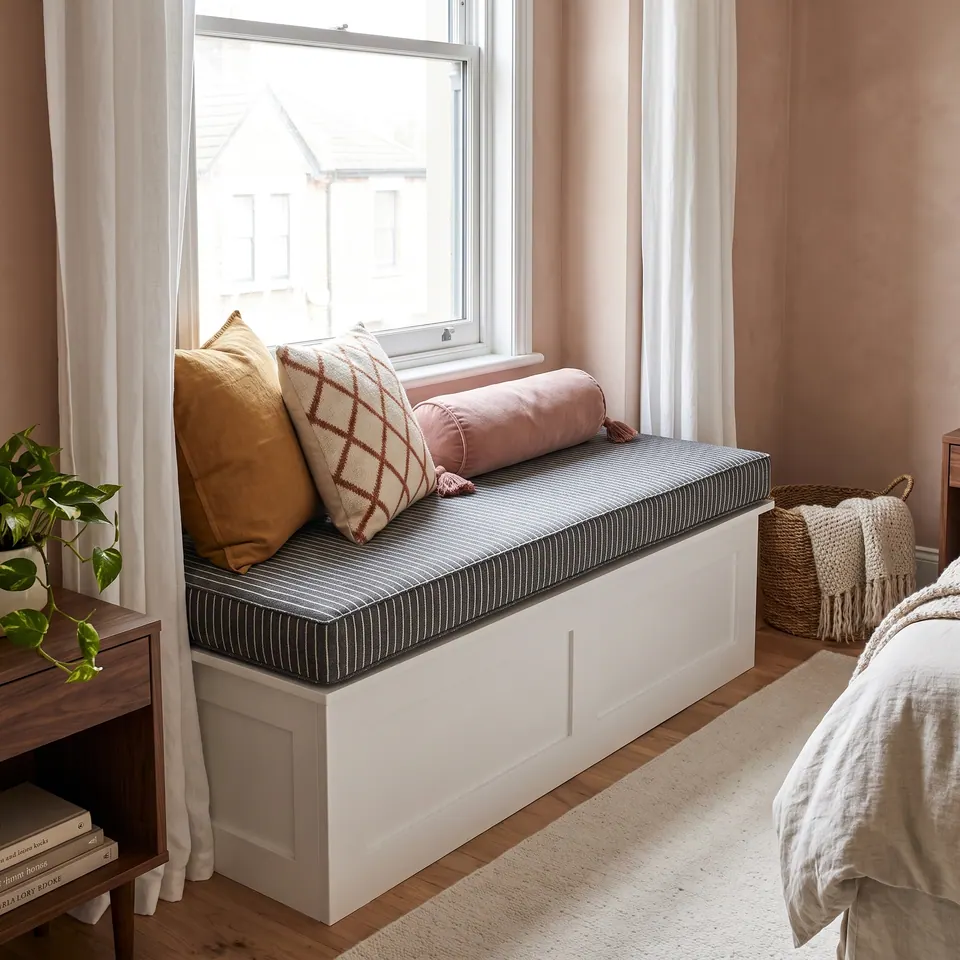
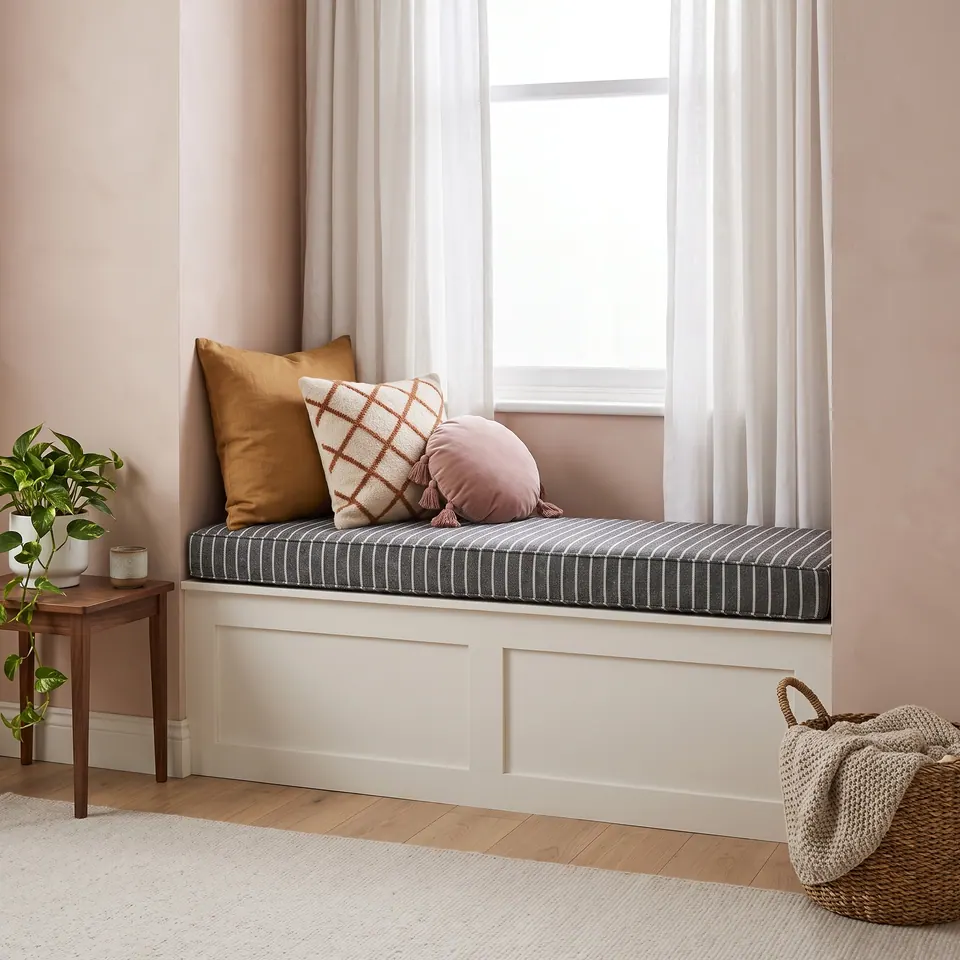
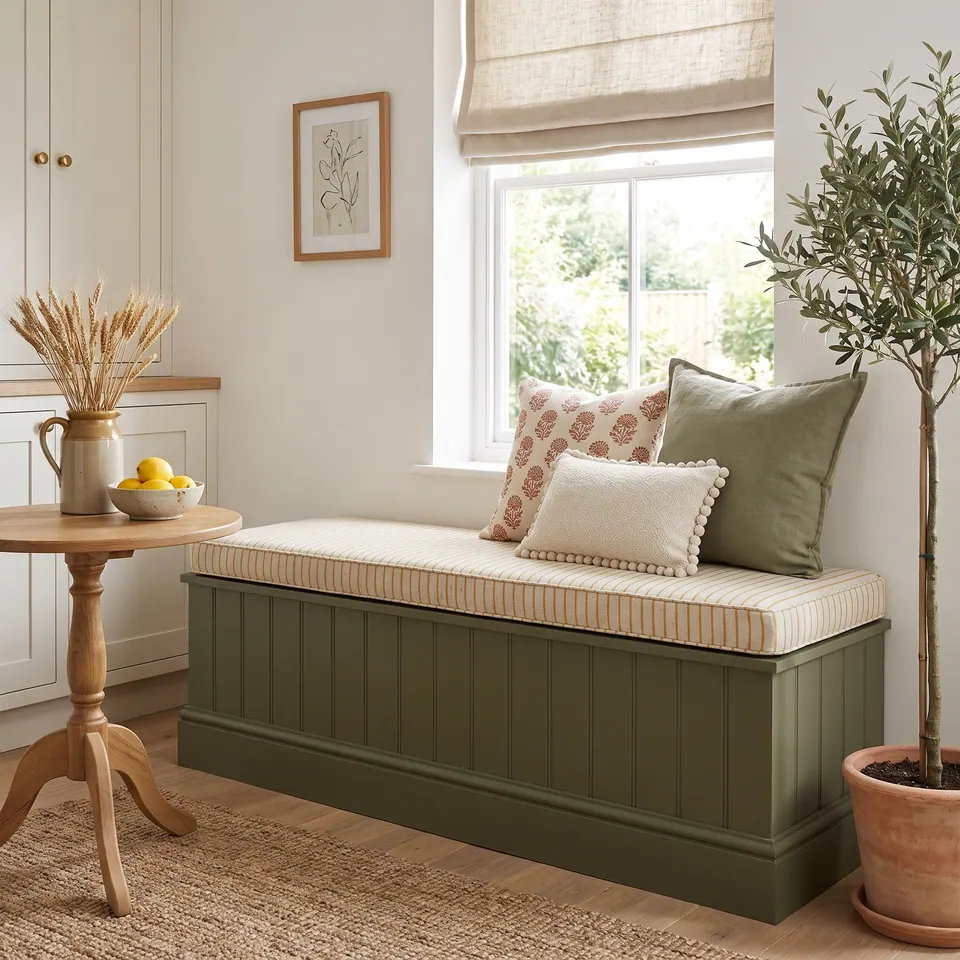
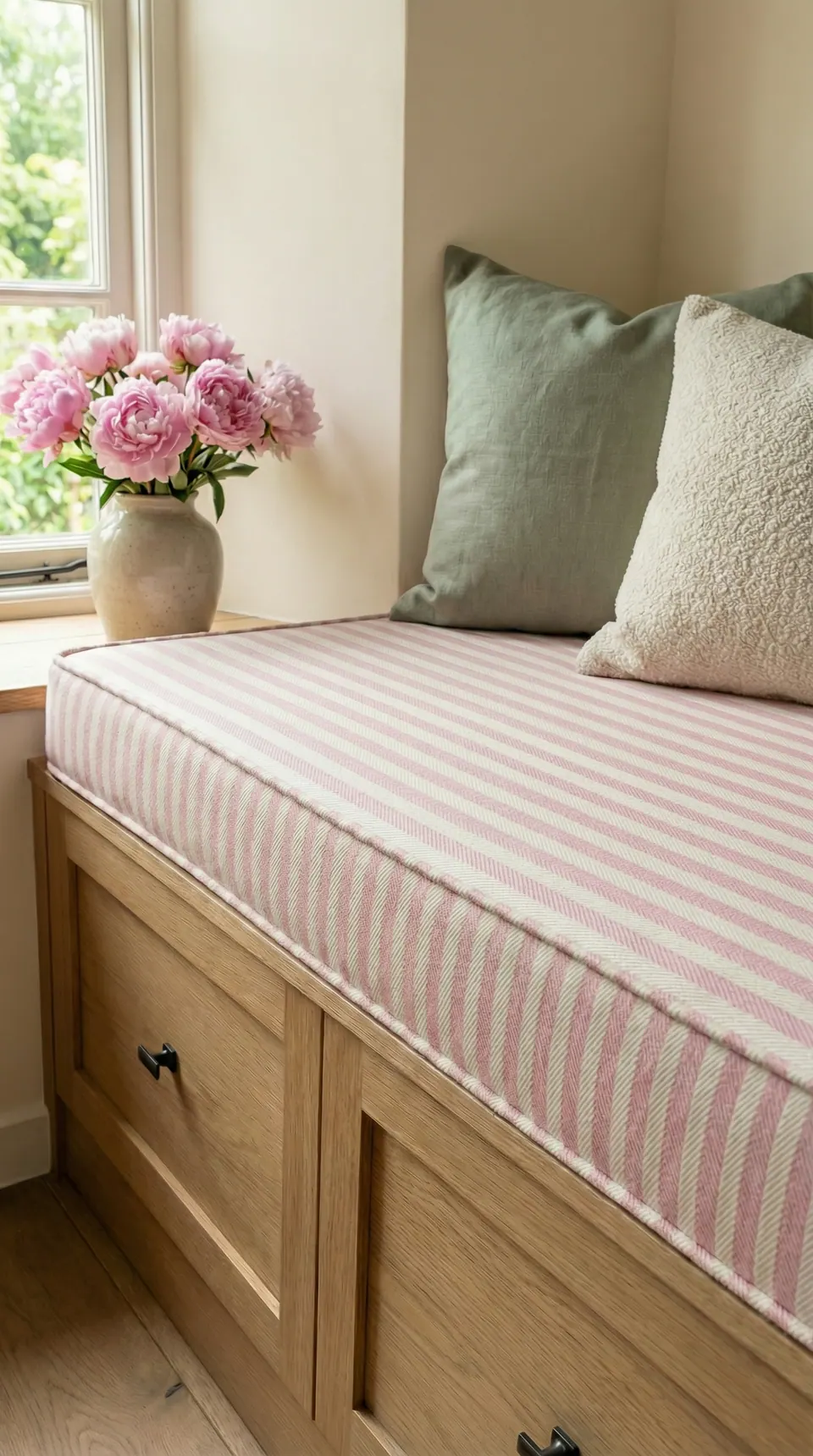
Concept Sketches · 9 scenes
Dormer window seats in Cape Cods and finished attics
Up under the roof, a window seat has to share its room with slanted walls, swinging sashes and a staircase built for somebody skinny. These are attic stories from past orders, and what each one taught us.

 Save
The quick answer
A dormer window seat cushion is cut to the seat between the dormer's side walls and sized so an opening window and its handle clear the top. Measure every edge and the height under the open sash, draw handles as cut-outs, keep the foam at 2 in (5 cm) or more, and split long pieces so they climb narrow attic stairs.
Upstairs, the window gets a vote
Upstairs in a Cape Cod, the window gets a vote. The seat sits in the dormer between two side walls, the casement swings in over your knees, and the handle takes a bite out of the depth you thought you had.
Porch or attic, the rule is the same: make the cushion for the way the room is really used. A dormer window seat cushion has three jobs. It has to fit an opening that is rarely square, clear a window that still has to open, and climb a staircase narrower than any hallway below it.
The stories below come from past orders, most of them from upstairs rooms: a bunk room, a clubhouse, a mezzanine bed, a pair of children's sills. The window seat cushions page in the Atlas covers the plain rectangles. When the dormer throws you an angle, the trapezoid cushion calculator and the window seat measuring Pattern do the arithmetic.
So pull up a chair, neighbor, and open the window before you pick up the tape. How far does yours swing into the room?
Up the attic stairs, one dormer at a time
01A past project
Three twin XL bunks and piping that followed the wallpaper
A family finishing an attic wrote to the workshop about mattress cushions for three twin XL bunks set into cubbies under patterned wallpaper. Against their wallpaper photo the workshop suggested a muted blue-gray soft fabric with warm ivory piping. When the paper changed to something more colorful, the workshop moved them to green with light blue piping.
The takeaway: Send a photo of the wallpaper or rug, and let the piping carry the second color.
02A past project
A clubhouse sofa that rolled up the attic stairs
A buyer in the US wanted a small couch for a daughter's attic clubhouse. The modular floor sofa comes as a 39 x 39 in (99 x 99 cm) ottoman and a 39 x 79 in (99 x 201 cm) sofa, both customizable, here in corduroy. The pieces arrive compressed in roll packs, so they pass through tight attic access.
The takeaway: For an attic, choose seating that travels rolled and opens up once it is upstairs.
03A past project
A mezzanine bed that comes apart in two
A buyer messaged the workshop wanting a floor mattress of about 50.4 x 74.8 in (128 x 190 cm) for a mezzanine nook that doubles as a spare bed. The workshop proposed two 25.2 x 74.8 in (64 x 190 cm) halves that push together into a bed and separate for storage.
The takeaway: Split any upstairs bed wider than you can carry into two halves that push together.
04A past project
The casement handle that took 5 inches of depth
One buyer wrote in about a 21 x 62 in (53 x 157.5 cm) velvet window seat cushion, then remembered the window handle would hit anything 21 in deep. They cut the depth to 16 in (41 cm) before ordering, and the 16 x 62 in cushion went ahead in velvet.
The takeaway: Open the window all the way and measure the depth to the handle, not to the wall.
05A past project
A 74 in trapezoid with the handle drawn in
A buyer in the US drew a trapezoid window seat 74 in (188 cm) long and 24 in (61 cm) deep but left the side edges blank, so the workshop asked for them. She drew the window handle in as a cut-out and uploaded the whole sketch with her order; custom shapes are cut exactly to that drawing.
The takeaway: Measure every edge and mark the handle; one blank side holds up the whole order.
06A past project
Windows that still have to open over the cushion
One buyer wrote to the workshop needing a sill cushion only 2 in (5 cm) high so the window above could close; a pad that thin comes tufted and sewn closed, with no zipper. Another went under 1 in (2 cm), and the first set bulged to about 1.6 to 2 in (4 to 5 cm) because the foam was cut unevenly. The set that finally fit was re-measured and confirmed before it shipped.
The takeaway: Measure the height under the open sash, then order foam cut under that number.
07A past project
Notched corners and the 2 in floor
A buyer in the US measured a trapezoid seat at 70 in (178 cm) front, 44 in (112 cm) back and 20.5 in (52 cm) deep, with 2.5 in (6.4 cm) notches at the back corners, and asked for a pad 1 in thick. The workshop's thinnest standard option is 2 in (5 cm), and the buyer felt that would sit too high under the window.
The takeaway: Check the 2 in minimum before you design around a thin pad.
08A past project
A casing notch instead of a gap
A buyer in the US had a 25 x 109.25 in (63.5 x 277.5 cm) window seat with a casing overhanging it by 0.75 in (1.9 cm). Rather than shrink the whole cushion, the workshop drew a notch 0.75 in deep and 96.25 in (244.5 cm) wide along the back edge so the cushion sits flush to the wall, in warm linen, 4 in (10 cm) thick.
The takeaway: Notch the back edge around trim instead of shaving depth off the whole cushion.
09A past project
Two children's sills, two cushions a little smaller
A parent wrote to the workshop about the window sills in two children's bedrooms, each about 43.3 x 15.7 in (110 x 40 cm). They planned cushions a touch smaller, about 41.3 x 13.8 in (105 x 35 cm), so each one would sit inside its sill neatly instead of bulging.
The takeaway: On a sill boxed in by walls, go a little under the opening, never over it.
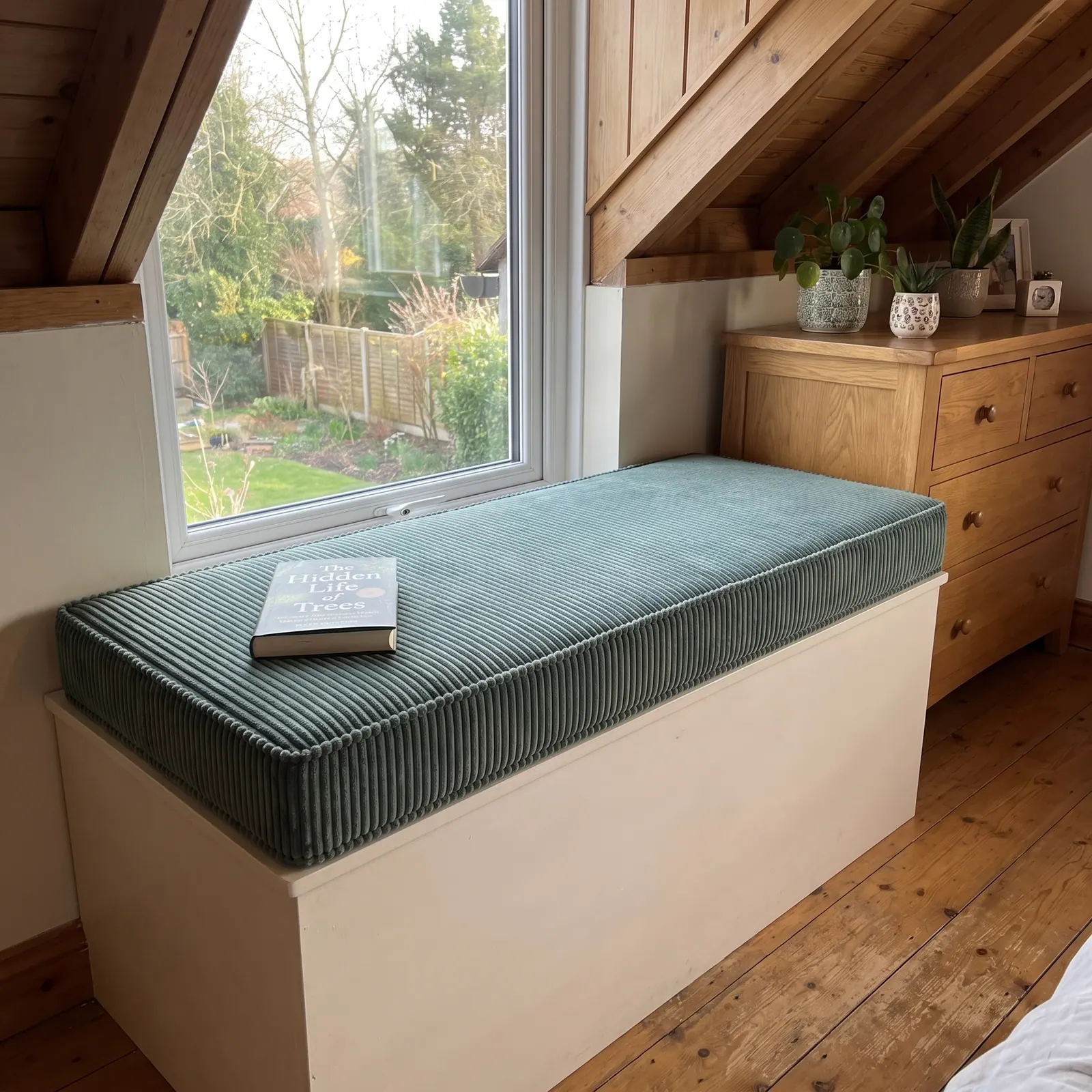
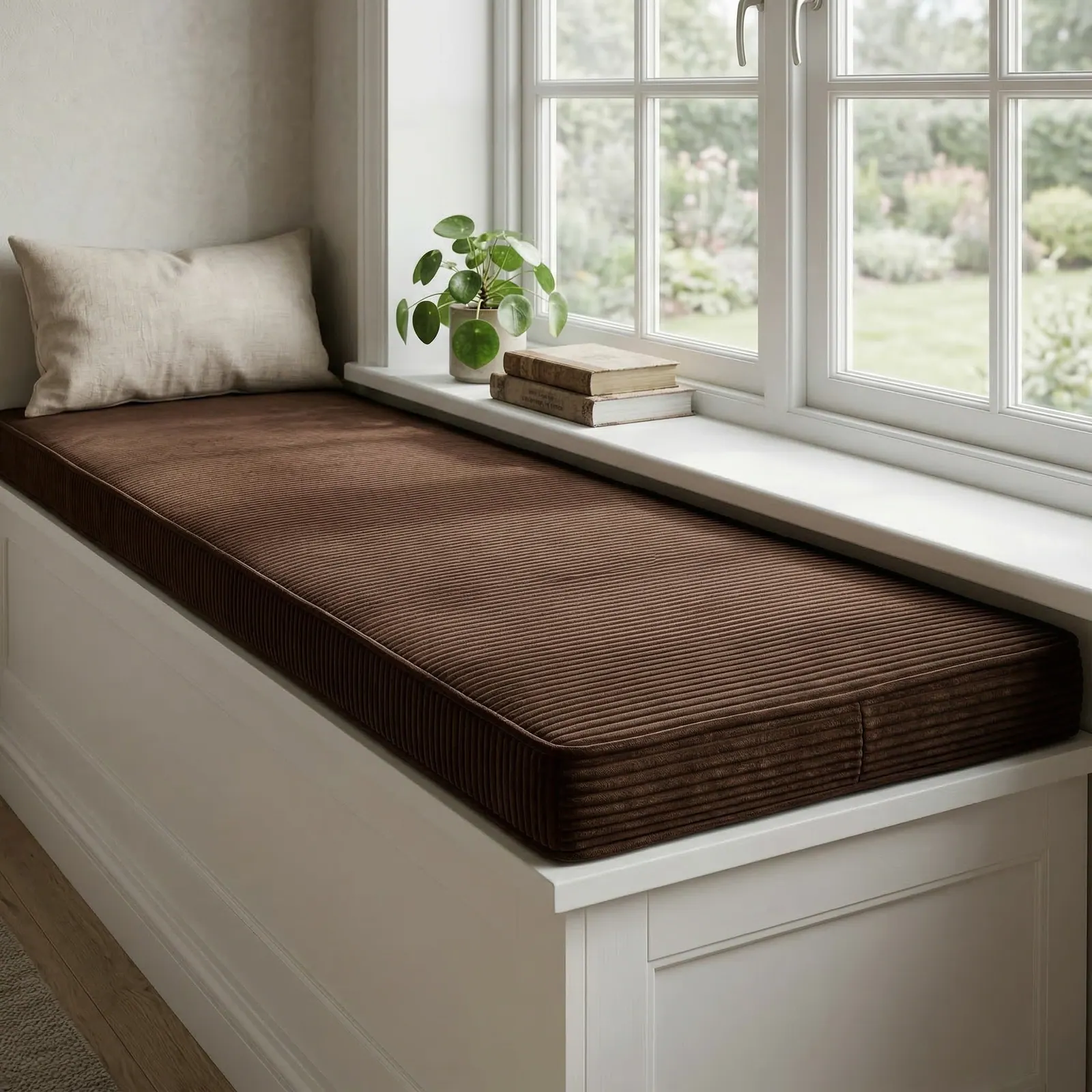
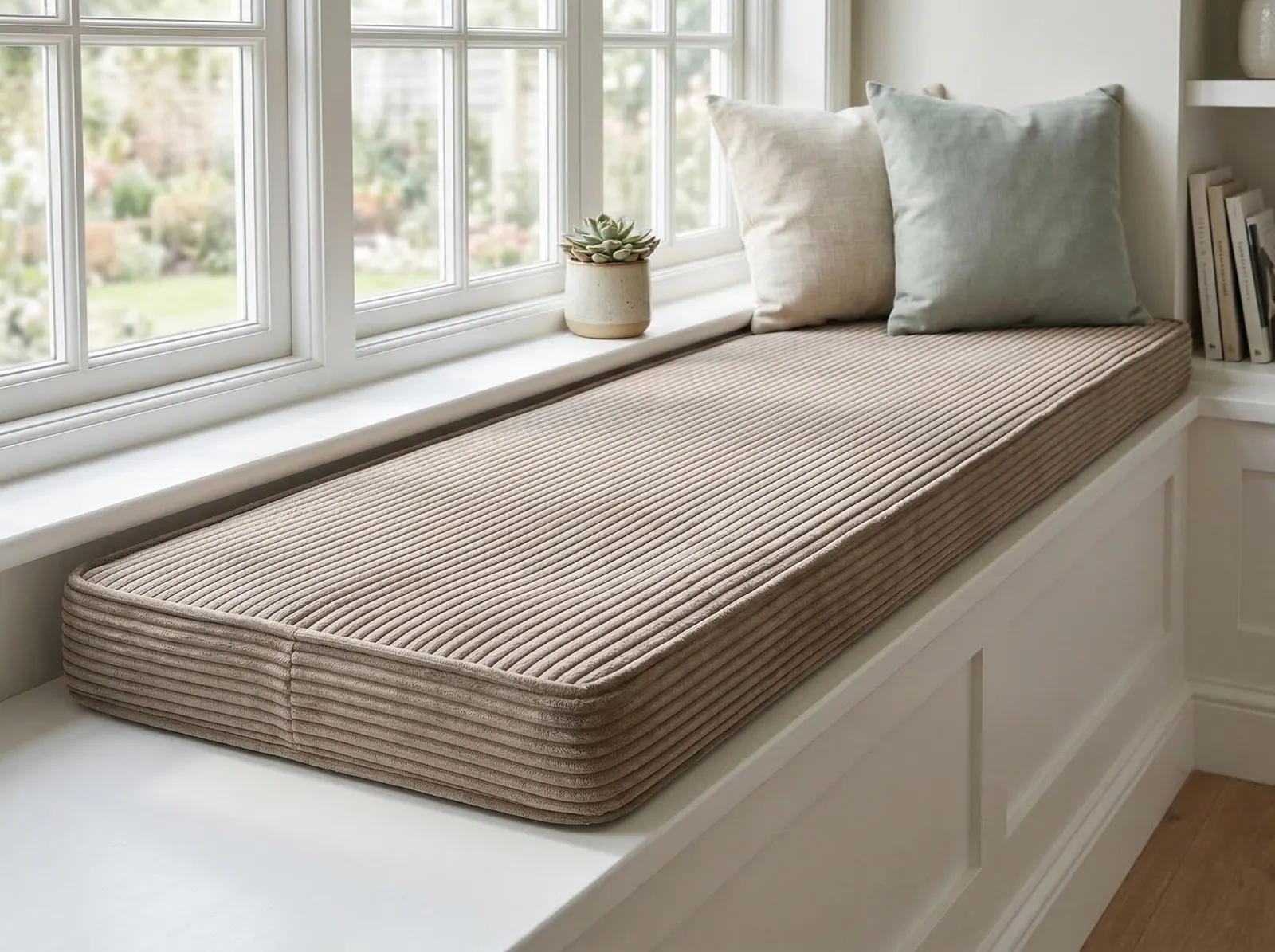
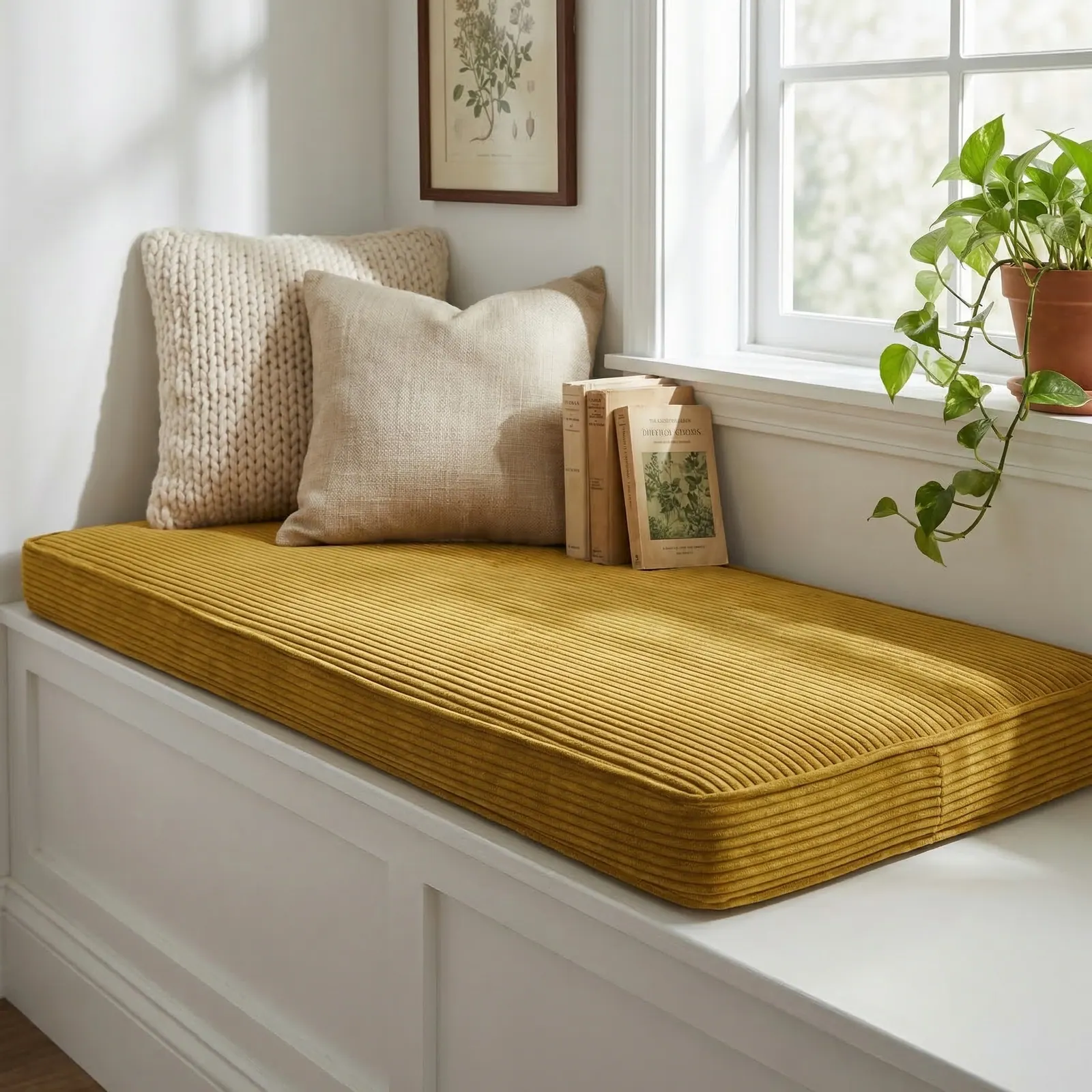
Where a dormer pinches, and what to do about it
Most attic trouble comes from five places. The notches and cut-outs Pattern shows how to draw around trim, and the window seat thickness Pattern helps when the sash leaves only a few inches. Fabric comes after fit; start with the corduroy and linen shelves of the Swatch Library.
| Where the dormer pinches | What to measure | What to ask for | from past orders |
|---|---|---|---|
| Casement handle | Depth from the back wall to the handle, window open | Less depth, or the handle drawn as a cut-out | 21 in (53 cm) deep cut to 16 in (41 cm) |
| Window swinging over the seat | Height from the seat to the open sash | Foam cut under that height, 2 in (5 cm) at the thinnest standard | A 2 in (5 cm) pad sewn closed, no zipper |
| Casing or trim overhang | Overhang depth, width and height above the seat | A notch along the back edge | A 0.75 x 96.25 in (1.9 x 244.5 cm) notch on a 109.25 in (277.5 cm) seat |
| Side walls out of square | Every edge, depth straight at 90 degrees, both diagonals | A custom-shape order with a lettered drawing | 70 in (178 cm) front, 44 in (112 cm) back, 20.5 in (52 cm) deep |
| Narrow stairs or a tight hatch | The tightest turn or opening on the way up | Roll-packed pieces, or a bed split in two | Two 25.2 x 74.8 in (64 x 190 cm) halves |
Measure a dormer window seat with the window open: if the handle or sash reaches the seat, the cushion needs a cut-out or less depth.
Rosa
Questions that came up the attic stairs
- A common question
My window seat isn't a rectangle. How do I order a cushion for it?
The workshop's answerUse the custom-shape listing, not the rectangle one. Pick the size range by the longest length and the deepest depth; that range only sets the price bracket. At checkout, upload a drawing with a measurement on every edge, plus a photo of the seat if you have one, and put the thickness and fabric code in the personalization box. The cushion is cut exactly to your drawing, and you can message the drawing first for a review.
- A common question
What do you need from me to make a trapezoid cushion for an angled window seat?
The workshop's answerEvery edge: the front, the back along the window, both angled sides and any short clipped corners, plus the straight depth and the thickness. Measure each angled side on its own, because it is always longer than the depth. Mark cut-outs such as a window handle, label the drawing A, B, C, D, and add a photo of the space. Very long trapezoids, around 79 in (2 m) on the long side, may be suggested in two pieces.
- A common question
Can the cushion be notched around trim or a post by the window?
The workshop's answerYes. Mark each notch's width, depth and position along the edge, and send a few wide-angle photos of the seat. The workshop redraws it as a clean template and asks you to confirm before anything is cut. If the notches sit on the back edge, say so, because the zipper runs along the back. Ties are an optional extra; give each one's position and length.
- A common question
How thick should the cushion be if there isn't much room under the window?
The workshop's answerMost buyers choose 3 or 4 in. 4 in (10 cm) is the standard for everyday seating and a tailored built-in look; 3 in (7.5 cm) sits trimmer and suits tight spots, like a gap of about 15 in (38 cm) under a windowsill. The foam is a firm high-density 2.0 lb/ft³ (32 kg/m³), so even 2 to 2.5 in stays supportive. The standard 2, 3, 4 and 5 in options cost the same, so choose by fit.

Have it made
Have an idea like this made — ask Rosa’s workshop
Tell the workshop who sits there: grandkids, the dog, a cup of coffee at six. The right fabric and foam follow from the people. — Rosa
Leave your details and the workshop will call you to confirm measurements, fabric, foam and piping. No prices, dates or payment on this page: it is a request, not an order.
Questions buyers ask next
What makes a dormer window seat cushion different from a regular window seat cushion?
Mostly the room around it. A dormer seat sits between side walls that are not always square to the window, often under a casement that opens inward. That means more angles to measure, a handle or sash to clear, and sometimes a shape that has to be ordered as a trapezoid.
Should I measure the window seat with the window open or closed?
Both. Closed gives you the seat's length and depth; open shows how far the handle and sash reach into the seat and how much height the cushion can have. Use the smaller numbers, and draw any handle on your sketch as a cut-out.
Can a long attic window seat cushion be made in two pieces?
Yes. Long trapezoids may be suggested in two pieces, and a large floor bed can be split into two halves that push together, like two 25.2 x 74.8 in (64 x 190 cm) pieces. Two pieces are easier to carry up narrow stairs and to store.
How much smaller than the sill should a window seat cushion be?
Only a little, and never bigger. One parent ordered cushions about 2 in (5 cm) shorter each way than two 43.3 x 15.7 in (110 x 40 cm) bedroom sills so they would sit neatly. On a seat boxed in by walls, order to your inside measurement or a touch under it.