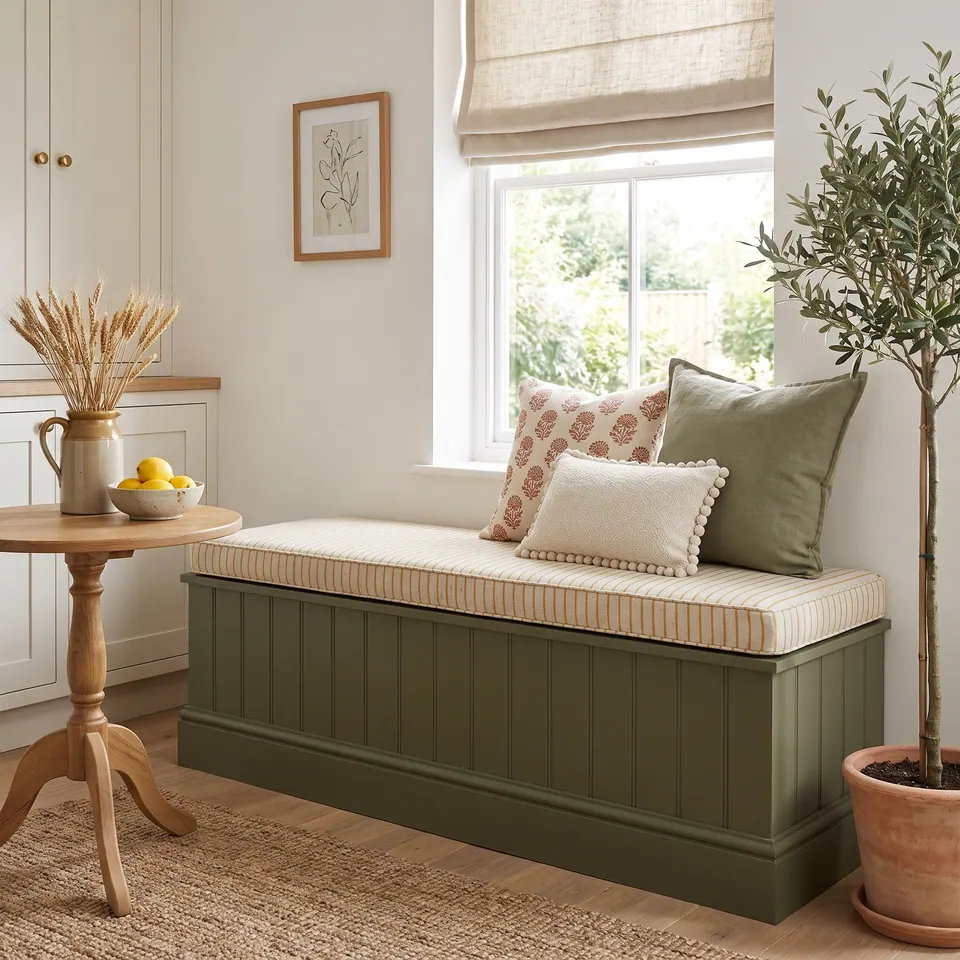
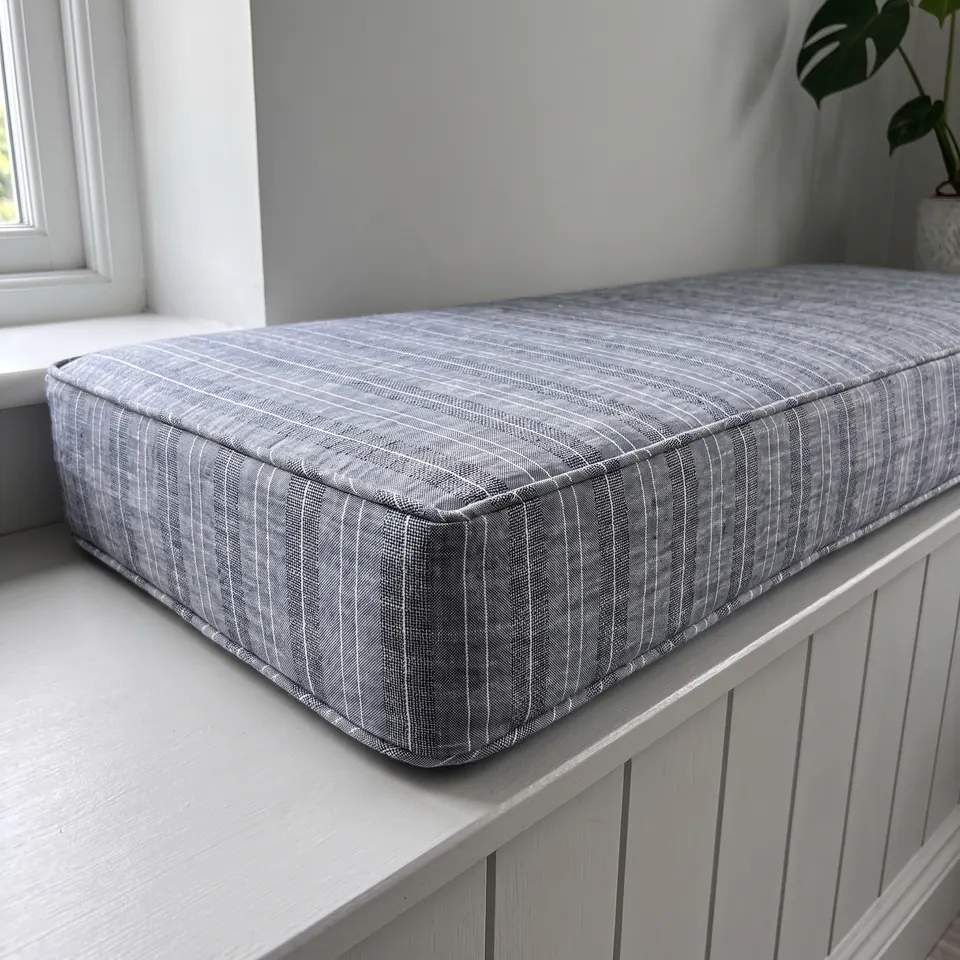
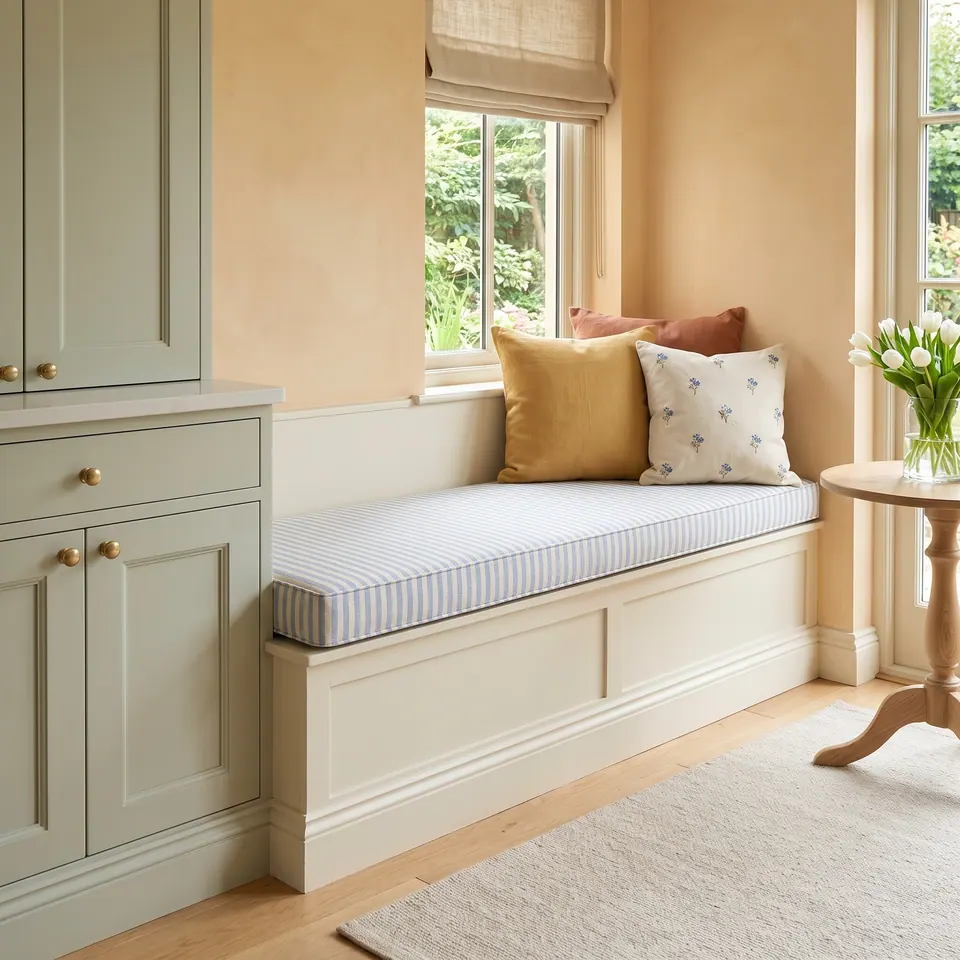
Concept Sketches · 7 scenes
Bow windows and curved window seats: how an arc becomes a cushion
A faceted bay is a list of straight lines; a smooth bow window is a different animal. Seven real orders show which numbers turn an arc into a cushion someone can cut.

 Save
The quick answer
To order a curved window seat cushion, send a drawing that marks the straight length before each curve, where every curve starts and ends, and how deep the arc runs, or a paper template photographed flat beside a tape measure. Order it on the custom-shape listing, not the rectangle one. Very pronounced curves may need an on-site template from a local upholsterer.
Corners you can point at, and curves you cannot
A five-sided bay is five straight edges and a depth. A bow window with no corners is where a curved window seat cushion, ordered from a distance, has to be honest.
Angles are just lengths in disguise; curves are not so easy. The workshop will not interpret a curve from numbers alone, so every curved order starts with a drawing or a paper template. The geometry is in chord, rise and radius.
Seven real curved seats follow, partner, one of them declined. Faceted bays can start in the bay window calculator and bay window cushions. Does your seat have a corner you can put a finger on?
Seven arcs, and the numbers that closed them
01A past project
The round bay the workshop turned down
A buyer messaged the workshop with a smooth, round bay and photos instead of a template. The craftsmen reviewed them and declined: a curve that pronounced could not be reproduced to a reliable fit at a distance.
The takeaway: No corners at all? Get a full-size template made in the room, or hire a local upholsterer.
02A past project
A D-shaped seat, drawn as a rectangle plus an arc
One buyer wrote in about a D-shaped window seat about 66.9 in (170 cm) wide and 47.2 in (120 cm) deep, with straight sides of 20.5 in (52 cm). The clean way to describe it was a rectangle plus part of a circle about 64.6 in (164 cm) across.
The takeaway: Break an arch into shapes a pattern maker knows: a rectangle, plus an arc of known diameter.
03A past project
Three 46 in windows and a curved front
A parent in the US wanted a floor pillow for a child's bedroom bay of three 46 in (117 cm) window sections, curved on the room side. The workshop asked for one drawing with every dimension marked, and quoted from it.
The takeaway: Mark where the curve leaves the wall and how far it reaches into the room.
04A past project
A willow sofa: base first, back later
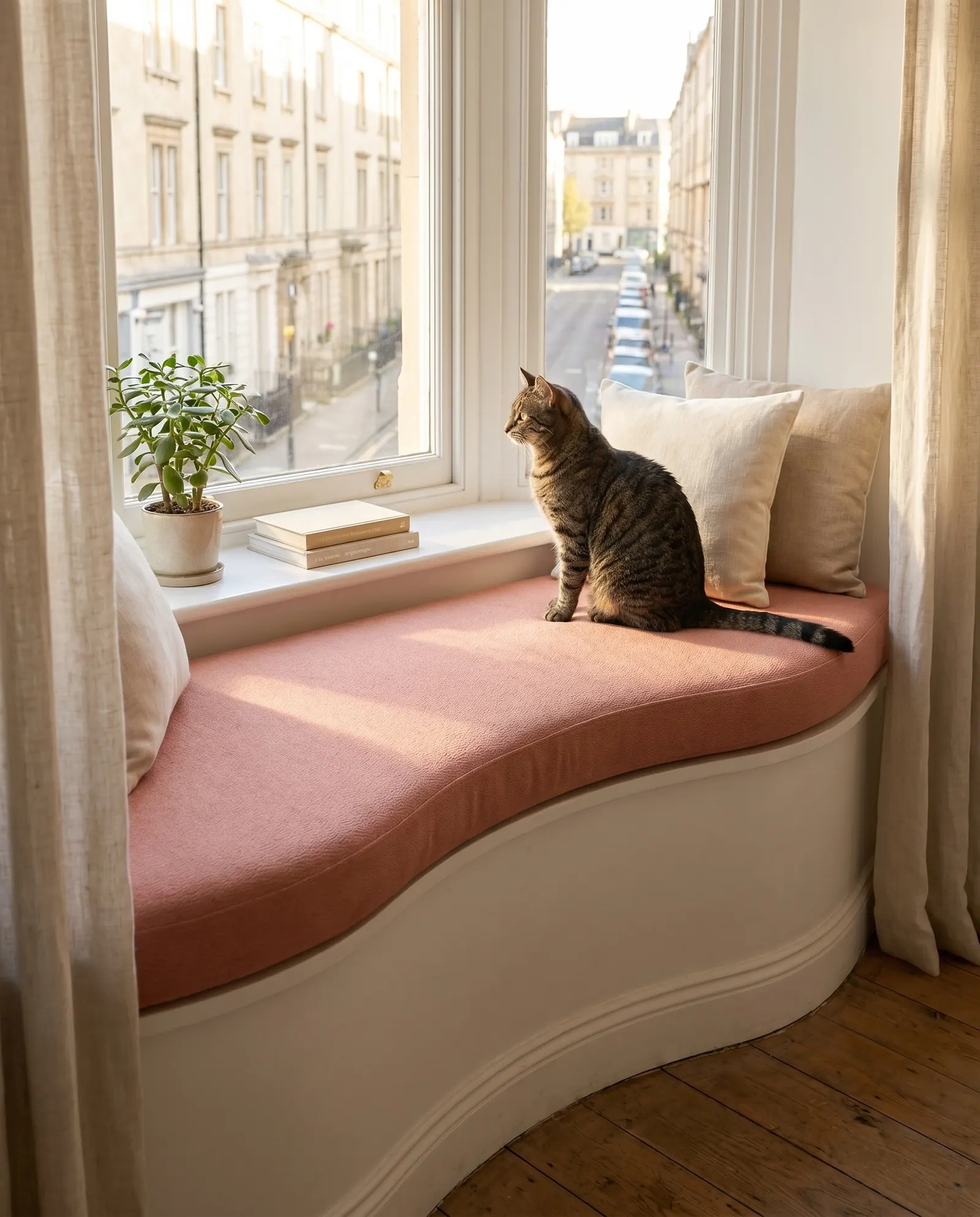
A buyer in the US wanted tufted linen cushions for a curved willow sofa: a base now, a semicircular back later. The base measured 68 in (173 cm) along the back, 63 in (160 cm) along the front and 32 in (81 cm) deep, with curved ends. She loved it, and so did her cats.
The takeaway: On curved furniture, make the seat first, then measure the back with the seat in place.
05A past project
A bench where 57.5 + 13 = 70.5
A buyer messaged the workshop with a bench cushion 70.5 in (179 cm) on the long side, 57.5 in (146 cm) on the short side and 15.4 in (39 cm) deep, with a 15.4 x 13 in (39 x 33 cm) curve at one end. The workshop asked where the curve starts and ends.
The takeaway: Check that the numbers close: 57.5 in straight plus 13 in of curve makes the 70.5 in side.
06A past project
Rounded corners that start 2.5 in in
A buyer messaged the workshop needing new covers for a corner bench's existing 2 in (5 cm) inserts: two 39 x 15.5 in (99 x 39 cm) pieces with rounded outer corners, plus a 15.5 in (39 cm) square. Each curve began 2.5 in (6.4 cm) from the corner on both edges, traced on paper.
The takeaway: A cover for an existing firm insert leaves almost no margin, so trace the insert itself.
07A past project
A two-seater with no cushions left to copy
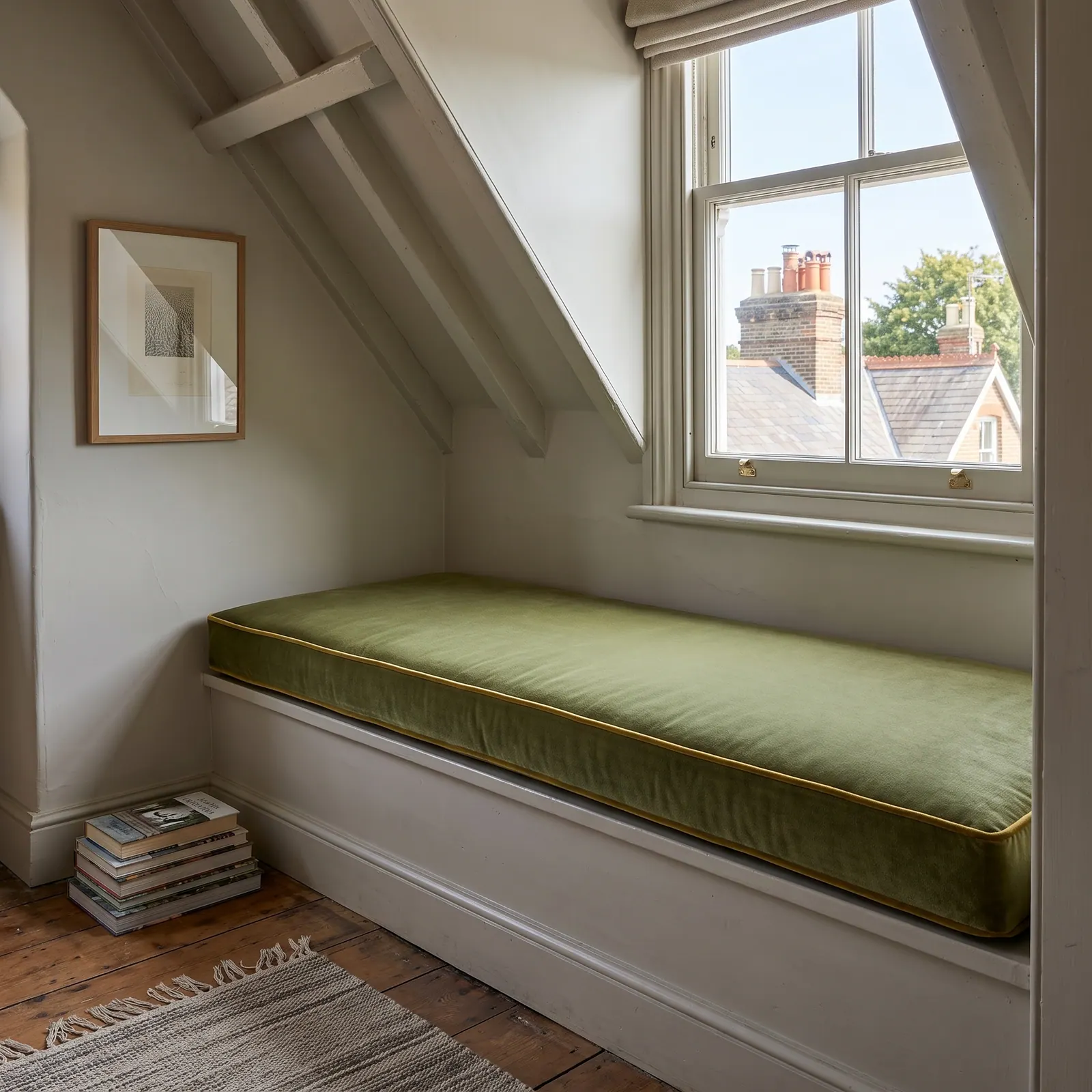
A buyer wrote to the workshop about a two-seater whose original cushions were lost, and wanted new ones in seaweed-green velvet. With nothing to copy, the curved front came from the frame itself.
The takeaway: Lost cushions are not a dead end: when the originals are gone, the team works out sizes from the furniture.
What each curve needs on paper
| Shape | Send these numbers | What happens next |
|---|---|---|
| Faceted bay | Every edge, each panel, depth square to the front | Templates easily |
| Rounded end or corner | Straight length before the curve, its start and end, depth or radius | Workshop redraws it for your approval |
| D-shape or arched seat | Width, depth, both straight sides, the arc's diameter | Drawn as a rectangle plus an arc |
| Curved bench (pew, fire pit) | Inner and outer curve, end-to-end length, depth at ends and middle | Long curves split into matching segments |
| Wedge of a round sofa | Outer arc, inner arc, both sides, curve depth from chord to arc | Each segment gets its own drawing |
| Round bay, kidney or banana curve | A full-size template made on site | May be declined; go local |
Three checks before the arc is cut
- Order on the custom-shape listing; if checkout never asks for a drawing, you are on the wrong one. The trapezoid cushion calculator handles the straight parts.
- Give each cushion its own drawing, every edge measured and each curve's start and end marked. See custom-shape drawings.
- Allow handmade tolerance of about 1/2 to 1 in (1 to 2 cm); inside a frame, order the depth about 1 in (2.5 cm) under.
A curved window seat cushion needs four numbers: the straight length before each curve, where the curve starts, where it ends and how deep the arc runs.
Nate
Buyer questions: curves, templates and arcs
- A common question
How do I measure a bench cushion with one rounded end?
The workshop's answerSketch total width and depth, the straight length of each edge before the curve, where each curve starts and ends, and the curve depth or radius. For a tricky curve, trace the seat on wrapping paper and photograph the cut-out flat beside a tape measure.
- A common question
Should I mail you my full-size paper template?
The workshop's answerNo. Send photos or a digital file with measurements marked, especially where curves begin. A full-size template is the best start for a curve; the workshop redraws it as a diagram for you to confirm.
- A common question
Can you make a floor cushion that fills a curved bay nook?
The workshop's answerYes. Send the shape, measurements and a few room photos before ordering. For a quarter-round or curved space the workshop needs the two straight sides to calculate the curve.

Have it made
Have an idea like this made — ask Nate’s workshop
Precision starts on the phone. Give the workshop your measurements and they will read them back to you, edge by edge. — Nate
Leave your details and the workshop will call you to confirm measurements, fabric, foam and piping. No prices, dates or payment on this page: it is a request, not an order.
Questions buyers ask next
Why would a workshop decline a curved window seat?
Strongly curved shapes, such as a round bay or a kidney or banana curve, can be declined when a precise fit can't be guaranteed from drawings and photos. A local upholsterer who templates on site is the better route.
How exact is a made-to-measure curved cushion?
Handmade cushions land within about 1/2 to 1 in (1 to 2 cm). Plump or tufted cushions crown and spread past their nominal size. If the cushion must fit inside a frame, say so and ask for it sized under, not over.
How thick should a cushion on a curved bench be?
About 2 to 3 in (5 to 8 cm) is recommended for curved benches; flat seats and window seats default to 4 in (10 cm). Write the thickness in the personalization note with the fabric code.