The Pattern Room · a measuring pattern
Dacron-wrapped foam: why a good cushion is cut slightly oversize
Unzip a well-made cushion and you'll find the foam wearing a coat, and looking a size too big for its clothes. Both are on purpose.

 Save
The quick answer
Dacron-wrapped foam is a firm foam core jacketed in polyester fiber batting before it goes into the cover, and it is cut slightly bigger than the cover on purpose. The wrap softens the surface and rounds the edges; the extra size makes the top crown and the corners fill. Don't trim it: two people compress the foam and ease the cover on.
The foam isn't too big. It is meant to be.
Every so often a letter comes in that starts the same way: the foam insert is bigger than the cover, so somebody must have made a mistake. Nobody did. Dacron wrapped foam is cut a touch full on purpose, and that little extra is what keeps a cushion looking young.
When I was fourteen, sweeping floors in a High Point upholstery shop, the old men never put a bare block of foam in a cover. They wrapped it first in polyester batting, the stuff most folks call Dacron, and they cut it generous. The cushion that came out had a soft crown on top and corners that filled the fabric right out to the piping. That is still how the workshop's foam inserts are made.
In trade drafting, foam is cut about 1/4 in larger per side than the finished cover, 1/2 in overall, and the cover gives up about another 1/4 in to edge rounding. The old rule of thumb says: without a wrap, order foam 1/2 in bigger than the cover; with a wrap, order it at cover size. The workshop does both, wrap and a little oversize, because a taut fabric beats a tired one. Cut foam exactly to the cover and in time the fabric bags like a shirt two sizes too big. Buy the cushion once, cry once.
What the wrap does, and what it doesn't
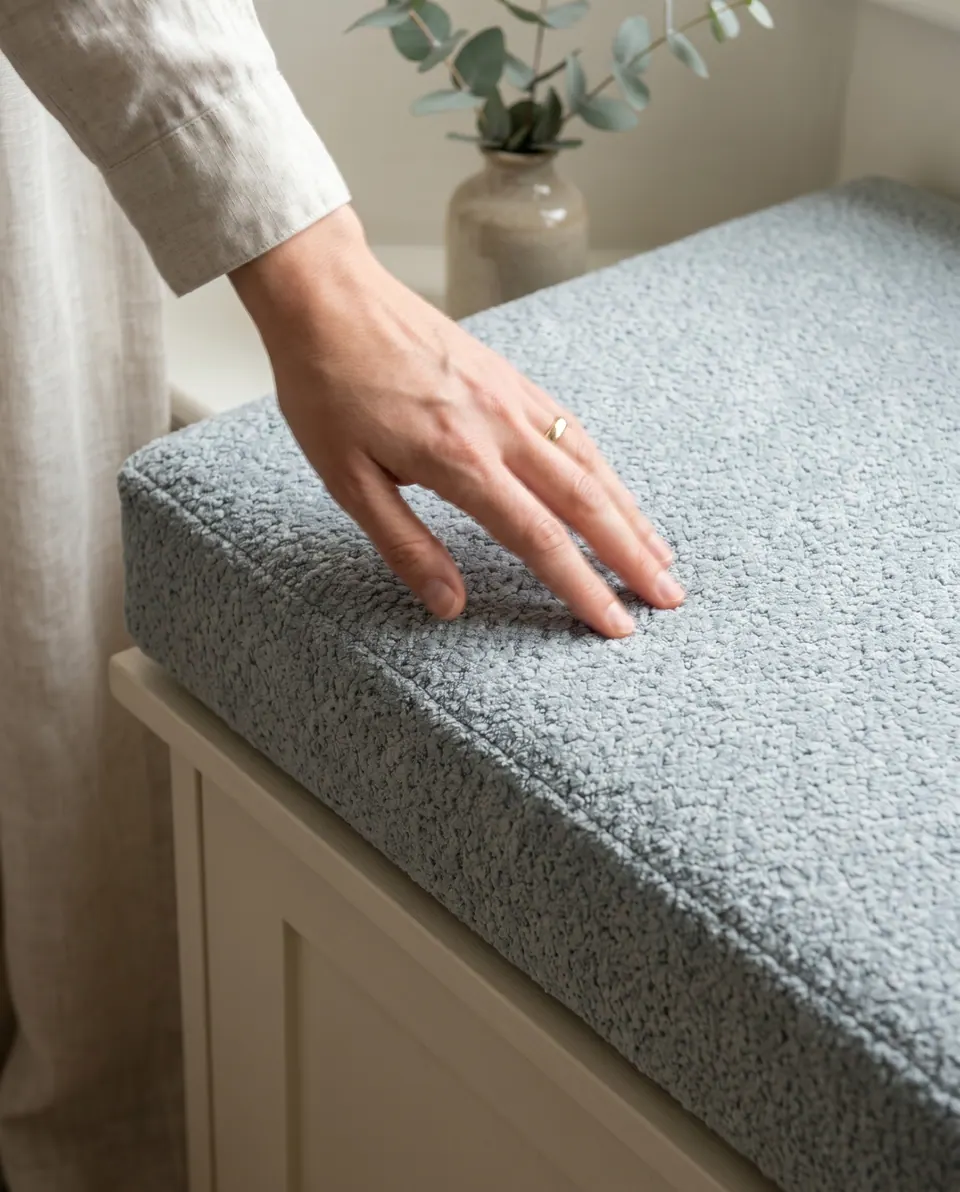
The wrap is a thin jacket of polyester fiber around a firm foam core. In the workshop's standard insert that core is about 2.0 lb/ft³ (32 kg/m³) foam, high-resilience and medium-hard. The foam wrap batting does three quiet jobs. It softens the surface, so you feel a cushion instead of a block. It rounds the edges, so the cover shows a full profile rather than hard square corners. And it lets the fabric slide over the foam instead of grabbing it as you close the zipper.
What it doesn't do is hold you up. That is the foam's work. Batting doesn't spring back the way foam does, so the plump top settles with time; trade sources put that anywhere from 1 to 2 years to 5 to 10. A settled wrap is a change in the look, not the foam giving out.
It doesn't belong in a cushion that gets soaked, either. Fiber batting holds water, so cushions meant to take the rain, like dry-fast foam outdoor cushions, leave it off and let the water run through.
Getting a firm wrapped insert into its cover
Give it time out of the bag
Vacuum-packed foam needs 48 to 72 hours to come back, 3 to 4 days to reach its ordered size and up to a week for fabric creases to fade. Unpack within a few days of delivery; foam left compressed too long can be damaged.
Put the scissors away
An insert that looks bigger than its cover is cut that way on purpose. Trimming it takes away the crown and the full corners, and there is no gluing them back.
Open the zipper all the way
On bench and mattress covers the zipper usually wraps around two corners in an L, so the insert can slide in. Open it fully and turn the cover so the zipper sits on the back edge or the underside, where it belongs.
Two people, one squeeze
One person compresses the foam firmly along its length while the other works the cover over it a little at a time. Firm foam fights one pair of hands and gives in to two.
Front corners first
Seat the two front corners, the ones the room sees, before pulling fabric toward the back. Feel for batting bunched in a corner and smooth it flat with your palm through the fabric.
Close it slowly
Close the zipper a few inches at a time and keep the batting clear of the teeth. If the zipper strains, press the foam down beside it instead of pulling harder on the tab.
Settle the crown
Press the top with flat hands from the center out and run your fingers along the piping so it sits straight. A gentle cushion crown in the middle is the goal, not a flat plank.
Measure it the right way
Start the tape at the very edge and remember that piping adds to the outer size. A plump, wrapped cushion crowns and spreads a little past its nominal size, and handmade work runs about 1/2 to 1 in either way.

Have it made
Measured it? Have Harlan’s workshop make it
Old upholsterers will tell you the real cutting happens in the conversation, long before the shears come out. Tell the workshop what you sit on, and they will talk it through with you. — Harlan
Leave your details and the workshop will call you to confirm measurements, fabric, foam and piping. No prices, dates or payment on this page: it is a request, not an order.
Bare block, wrapped, or wrapped and padded
| Build | How the top looks | How it feels | Best for |
|---|---|---|---|
| Bare foam block cut to cover size | Flat top, hard square corners; fabric can bag in time | Firm right to the surface | Rarely the right call indoors |
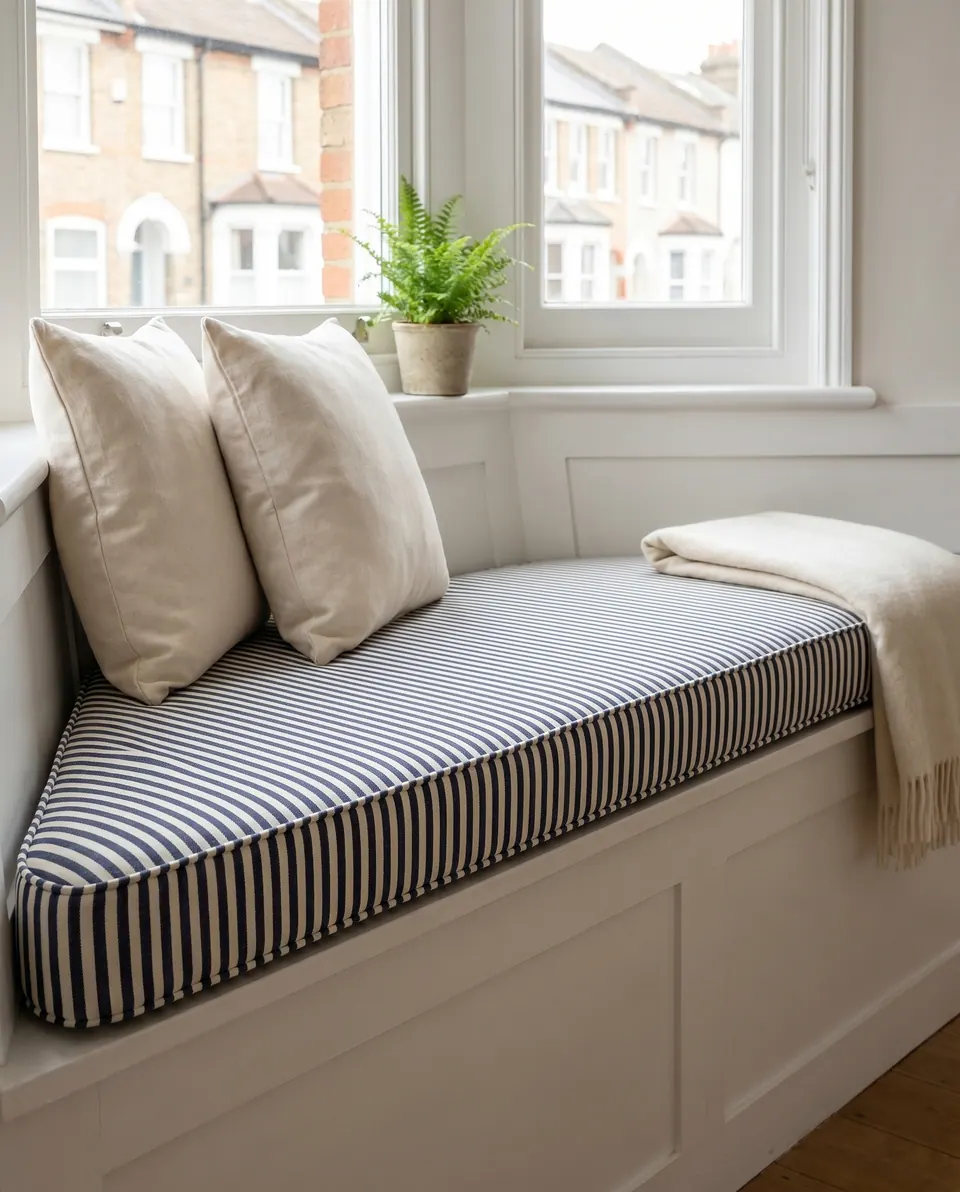
| Dacron-wrapped, cut slightly oversize (the workshop's standard) | Full, gently crowned top; corners fill out to the piping | Firm about 2.0 lb/ft³ (32 kg/m³) core under a softened surface | Benches, window seats, daybed sets |
| Wrapped, plus an extra 3/4 in (2 cm) batting layer | Plumper top | Softer first touch over the same core | Reading seats and lounging |
| Softer about 1.75 lb/ft³ (28 kg/m³) foam with the same wrap | Same crowned profile | Noticeably plusher, a slight sink-in sofa feel | Sitters who find standard foam too firm |
| Dry-fast outdoor foam, no wrap | Flatter, tailored | Drains and dries within hours | Uncovered patios and boats that get soaked |
Half an inch too wide, and the piping to blame
A buyer got in touch while fitting a cushion into a design installation. They had ordered it 19.5 in wide and measured it at about 1/2 to 3/4 in wider, with piping that looked crushed.
The workshop walked through it honestly. The tape hadn't started at the very edge. Piping adds to the outer size. And creases from vacuum packing settle within about a week. All true, and none of it helped a designer whose built-in had no room to spare.
So the cushion was remade, and this time the order read 19 in including the piping, 3 in (7.5 cm) thick. The buyer said they would rather have it a hair small than oversized. I have thought about that one since. A full, crowned cushion is the right thing on an open bench. In a tight frame, say in writing that your number is the finished size including the piping, and that it is a hard maximum.
Asking for more under the cover, or for covers alone
A dacron wrap cushion can be made fuller on request. An extra 3/4 in (2 cm) layer of batting over the foam gives a plumper top, and it is a simple note on the order. If the standard foam feels too firm, ask for the softer foam of about 1.75 lb/ft³ (28 kg/m³); it gets the same wrap. Feather-wrapped foam is one thing the workshop doesn't make.
Ordering covers for foam you already own? Measure the insert itself, wrap and all, not the old cover. Tell the workshop whether it is foam or fiber-filled, because they fit differently; a soft fiber insert wants to be about 1 in bigger than its cover. The Pattern on covers for existing foam walks through it, the glossary entry on crowning shows the shape to aim for, and the cushion covers page in the Atlas is the place to start an order.
Have you ever unzipped an old cushion to see what it's wearing underneath, my friend? The coat tells you most of what you need to know about who made it.
Mistakes that flatten a good cushion
- Trimming oversize foam to make zipping easier. You cut away the crown and the full corners.
- Measuring the old cover instead of the bare insert when ordering new covers. A tight cover won't close, and a loose one bags.
- Giving a tight frame's number without calling it a hard maximum. Wrapped cushions crown and spread, so order the depth about 1 in under a fixed frame.
- Judging the size on day one. Vacuum-packed foam needs 3 to 4 days to reach its ordered size.
- Forgetting that piping adds to the outer measurement. Say whether your size is the finished size, piping included.
- Putting a wrapped insert where rain pools. Batting holds water, and a soaked cushion needs a different build.
A Dacron wrap rounds a foam cushion's edges and softens the top, but the fiber settles with time; the firm foam core underneath does the real holding up.
Harlan
Buyer questions: foam, wrap and fit
- A common question
The replacement foam you sent looks bigger than the cover. Did we get the wrong size?
The workshop's answerNo. Firm, high-density foam is cut slightly larger than the cover on purpose, so it fills the fabric completely and doesn't look loose or wrinkled over time. Don't trim it. Insert it with two people: compress the foam firmly and work the cover over it a little at a time.
- A common question
Is the foam wrapped in Dacron, or is it just a bare block?
The workshop's answerNot a bare block. The firm 32 kg/m³ foam, about 2.0 lb/ft³, is wrapped in polyester fiber batting before it goes into the cover. The wrap fills the cover out, softens the surface and rounds the edges, while the core still gives firm support. Daybed set cushions are made the same way.
- A common question
Will the foam hold up to daily sitting, or will it flatten?
The workshop's answerThe standard foam is about 2.0 lb/ft³ (32 kg/m³) high-density, high-resilience foam with a medium-hard feel, firm enough that adults don't sink in and resilient enough to keep its shape for years. It is the same foam used in the workshop's couches, so there is no firmer upgrade to buy. The Dacron wrap softens the surface without making it saggy, and 3 in is the best-selling bench thickness.
- A common question
Can I get a plusher cushion instead of the firm foam?
The workshop's answerYes, within limits. Ask for the softer 28 kg/m³ foam in the personalization box; it sits with a slight sink-in and gets the same Dacron wrap. You can also add about 3/4 in (2 cm) of batting over the foam. Feather-wrapped foam and soft, draped seat pads aren't made.
- A common question
If I order a new cover for my own insert, will it fit snugly?
The workshop's answerYes, if the measurements are right. The fabric has a little stretch, so fitted covers are cut about 3/8 to 3/4 in (1 to 2 cm) under the measured thickness for a tight look. Photograph the tape on each dimension, measure over any cover you are keeping, and say whether the insert is foam or fiber-filled.
More about the coat under the cover
Does a Dacron wrap flatten over the years?
Some. Polyester batting doesn't rebound the way foam does, so the plump top eases down; trade sources put that anywhere from 1 to 2 years to 5 to 10 years. The foam core carries your weight, so a settled wrap changes the look more than the support.
How thick is the fiber wrap on a typical cushion?
In the upholstery trade a Dacron wrap usually runs 1/2 to 1 in: 1/2 in on an ordinary sofa seat, and 1 in or two 1/2 in layers on premium work. Some guides go up to 1 1/2 in for a very soft, rounded look.
Should an outdoor cushion have a fiber wrap?
Not one that will get soaked. Batting holds water, so cushions for uncovered patios and boats use dry-fast foam with no wrap and a breathable or mesh bottom, which lets water drain through and the cushion dry within hours.
Why does my new wrapped cushion look flat and creased?
It is still recovering from vacuum packing. Give it 48 to 72 hours to come back, 3 to 4 days to reach its ordered size and up to a week for creases to fade. Unpack it within a few days of arrival rather than leaving it sealed.