The Pattern Room · a side-by-side pattern
Down-wrapped or all-foam? Choosing the top of a seat cushion
Every seat cushion is a firm core wearing something softer. What that something is decides how the cushion feels, how it looks by Friday, and how much plumping it asks of you.

- All foam
- Foam + Dacron wrap
- Foam + extra wadding
- Down envelope
- Fiber-filled
 Save
The quick answer
A down-wrapped cushion is a foam core inside an envelope of down and feather: sink-in soft, relaxed-looking and in need of regular plumping. An all-foam cushion with a Dacron wrap stays crisp and asks for nothing. The workshop builds the second from about 2.0 lb/ft³ (32 kg/m³) foam, with a softer 28 kg/m³ core or 3/4 in (2 cm) of extra wadding on request, and no feather wraps.
Five builds hide under the same zipper
Unzip ten seat cushions and you will find five constructions, give or take a layer. From the outside they can look identical. Sit on them for a month and they stop looking identical at all.
The question of down wrapped cushions vs foam usually comes from someone who has sunk into a store sofa with envelope cushions and wants that softness on a bench, a window seat or a set of sofa and couch cushions. Fair request. First see what each build is, layer by layer, and what it costs you in plumping, sag and silhouette.
I spent ten years designing car seats, so you get the cross-section: core first, then coat, then what happens to both after a few hundred sittings. The coat on its own has a Pattern of its own, on Dacron-wrapped foam.
One question before the table. What does soft mean to you, partner: the first touch, or the sink?
Five builds in cross-section, core to cover
Read each row as if the cushion were sliced front to back. Trade figures for down come from published maker specifications; the last column comes from the workshop's own answers.
| Build | What the cut face shows | First touch | After a month of sitting | Upkeep | At the workshop |
|---|---|---|---|---|---|
| All foam, bare block | One solid slab of foam, cut to the cover | Firm right up to the fabric | Flat top, hard square corners; the cover can go slack | None | No Not used for indoor seats: every insert is wrapped |
| Foam + Dacron wrap | A high-resilience foam core in a thin polyester-fiber jacket | Medium-firm, around 6 to 7 on a 1-to-10 scale | Gently crowned top, corners filled to the piping; the fiber settles a little | None | Yes Standard: about 2.0 lb/ft³ (32 kg/m³) core |
| Foam + extra wadding | The same core with about 3/4 in (2 cm) of volume wadding over the top | Softer first inch, same support underneath | A plumper top that eases down over time | None | Yes On request |
| Down envelope | A foam core (trade makers quote 1.8 to 2.5 lb/ft³) inside a sewn casing of down and feather in down-proof ticking | Sink-in, cloud-soft | Relaxed and creased; the fill drifts toward the edges | Fluff and plump, about weekly with daily use | No Not offered |
| Fiber-filled, no foam | Polyester fiber or silicone-ball fill in an inner casing | Very soft, pillow-like | Settles and flattens; the edge softens | Plump often | Partly Quilted and tufted pieces, soft headboards |
The softer about 1.75 lb/ft³ (28 kg/m³) core isn't a sixth build. It is row two with a gentler foam inside.
Feel, look, upkeep: a three-variable problem
Engineers like problems with one variable. This one has three, and they pull against each other.
Feel. A down envelope gives way softly at the top before it hands you to the foam. A Dacron wrap softens only the surface; the 32 kg/m³ core is doing the work almost at once. The softer 28 kg/m³ core changes the deeper feel, a slight sink-in you notice in the hips more than the fingertips.
Look. Foam holds a straight line, which is why a tailored bench cushion has a piping line you could lay a level on. Down is slouchy by nature: it creases, drifts toward the front edge and wrinkles the cover. On a deep sofa some people love that lived-in look. On a long window seat it reads as unmade.
Upkeep. Down and feather shift under weight and don't spring back on their own, so the cushion wants fluffing, about weekly if the seat is used daily. Foam asks for nothing. A down cushion's dimensions come with a tolerance of whoever sat there last.
One more variable, if it applies to your house: down and feather are animal fibers. If anyone at home reacts to them, the decision is made; see cushions for allergy-prone homes. For other cores entirely, high-density foam vs memory foam and latex runs the numbers, and the 1-to-10 firmness scale gives you words for what you feel.
On the cutting table: what the workshop builds instead
| Core foam | about 2.0 lb/ft³ (32 kg/m³) high-resilience polyurethane, medium-firm |
|---|---|
| Stated firmness | ILD about 42; no official lab certificate, and it can vary slightly by batch |
| Wrap | Polyester-fiber (Dacron) batting, fitted before the cover goes on |
| Softer core | about 1.75 lb/ft³ (28 kg/m³) foam with the same wrap, on request |
| Extra top layer | About 3/4 in (2 cm) of volume wadding over the foam, on request |
| Thickness | 2, 3, 4 or 5 in (5, 7.5, 10 or 12.5 cm); 4 and 5 in sit the same |
| Feather or down wrap | Not offered |
| Soft, draped seat pads | Not made; long-life foam won't drape |
| How to order the softer core | Write "28 DNS foam" with your color code in the personalization box |
Softening a seat, one variable at a time
Change one thing, then test. Change three at once and you won't know which one you liked.
Name the soft you want
Soft to the touch and soft to sink into are two different requests. The first is a surface layer; the second is a softer core. Write down which one you mean before you write anything else.
 Save
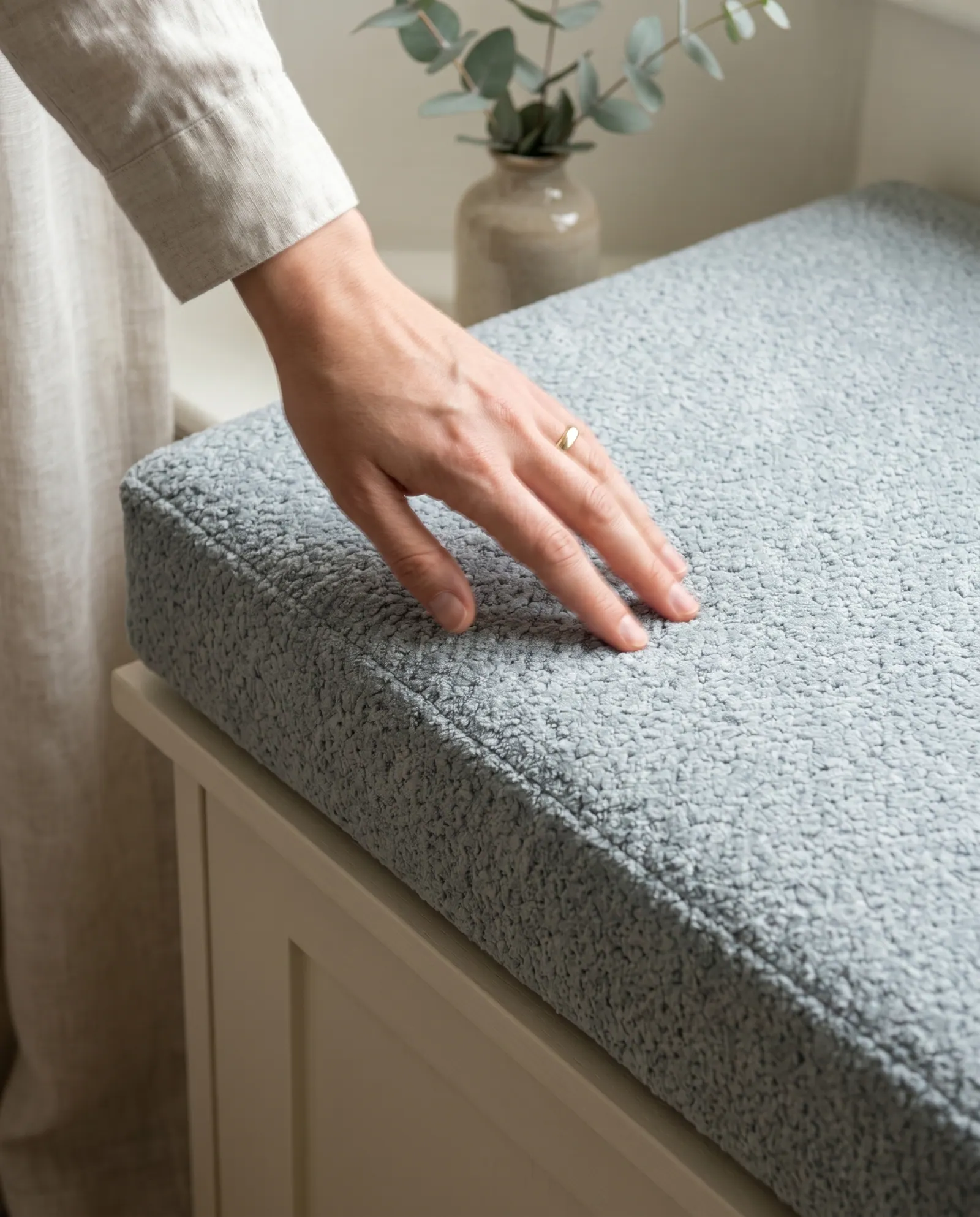
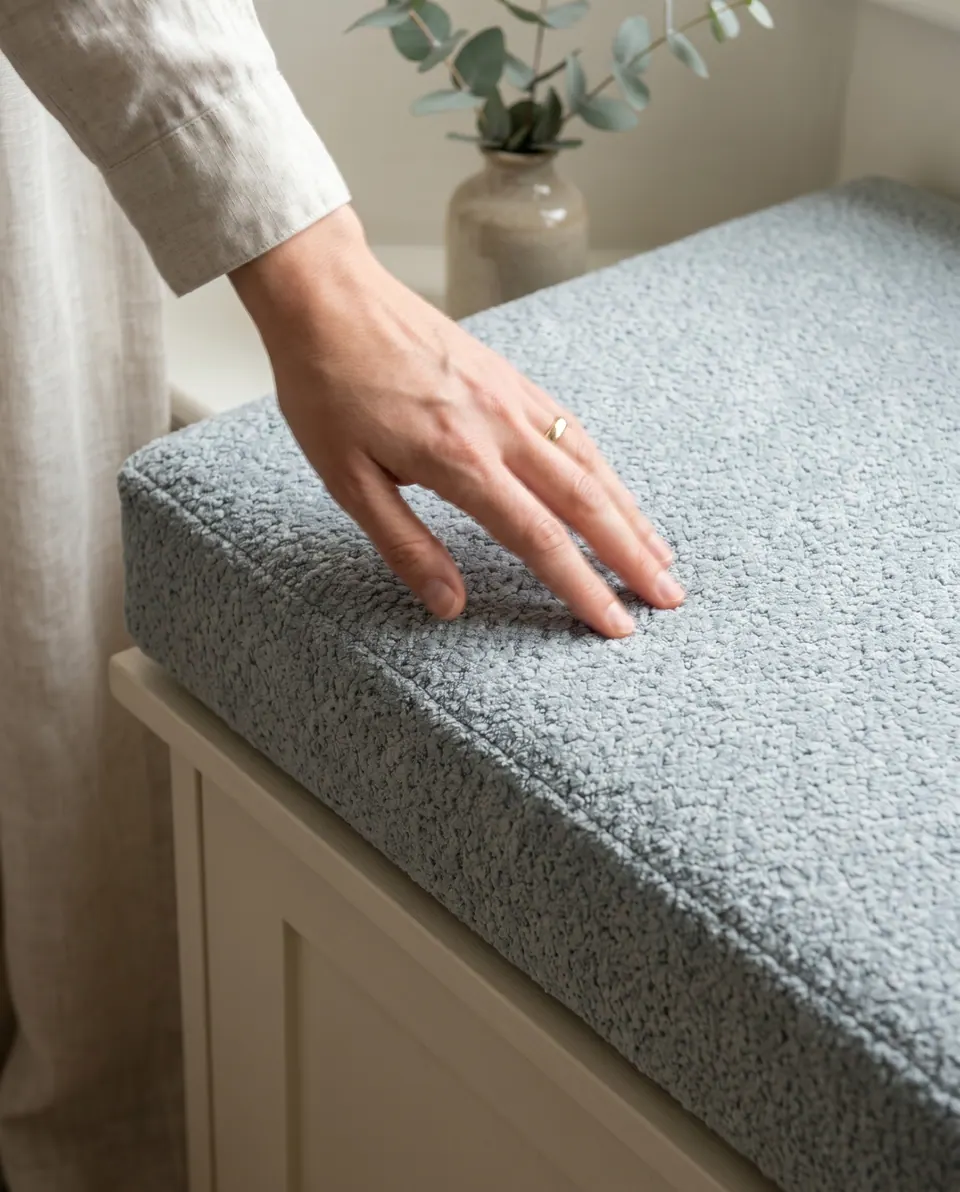
A four-finger press shows the dense foam holding its edge while the looped bouclé gives under the hand. Leave the thickness alone
More inches is not more softness. The 4 in and 5 in cushions use the same 32 kg/m³ foam and feel the same to sit on; the extra inch changes the look. On a 25 1/2 x 71 in (65 x 180 cm) bench, 4 in already reads plush and 5 in can look heavy.
 Save
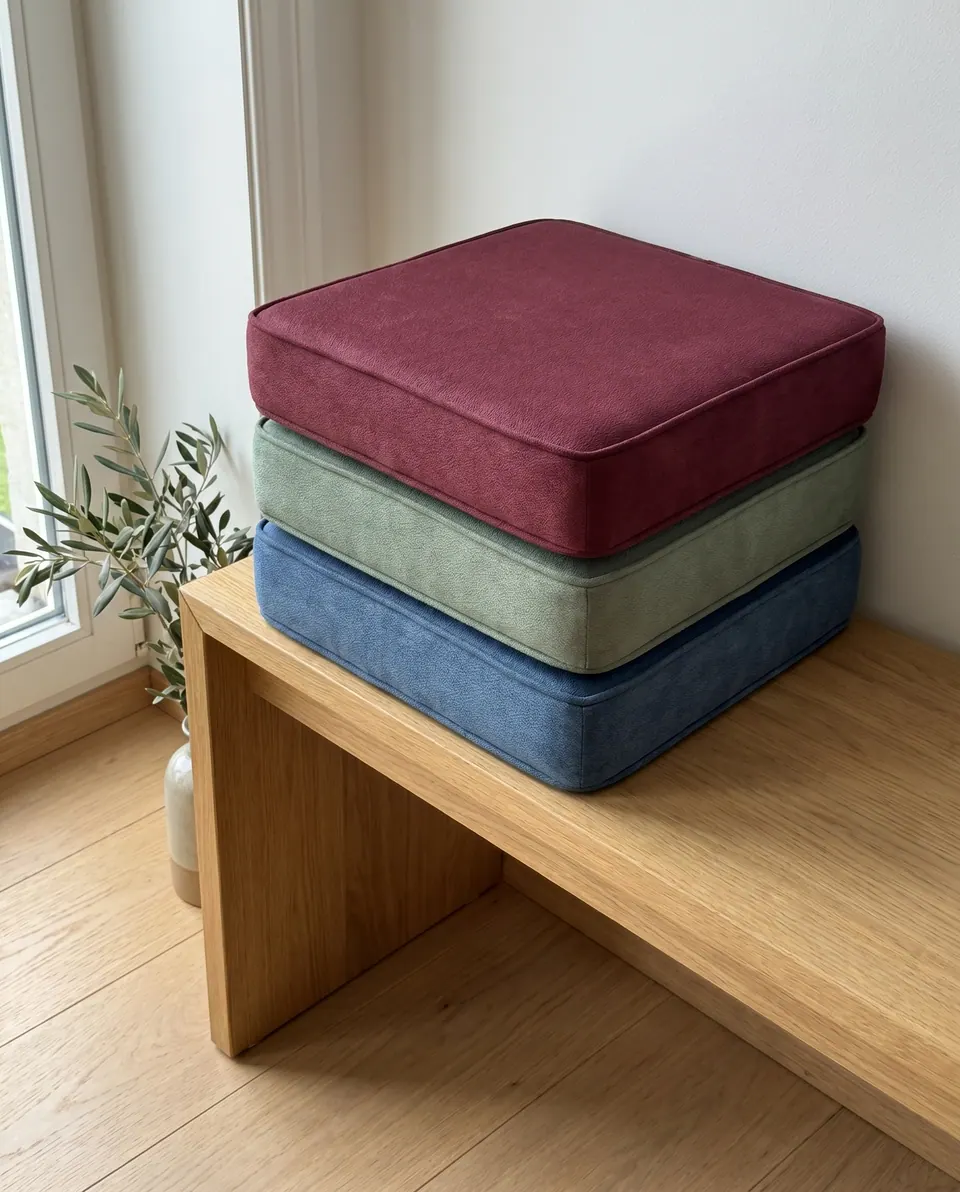
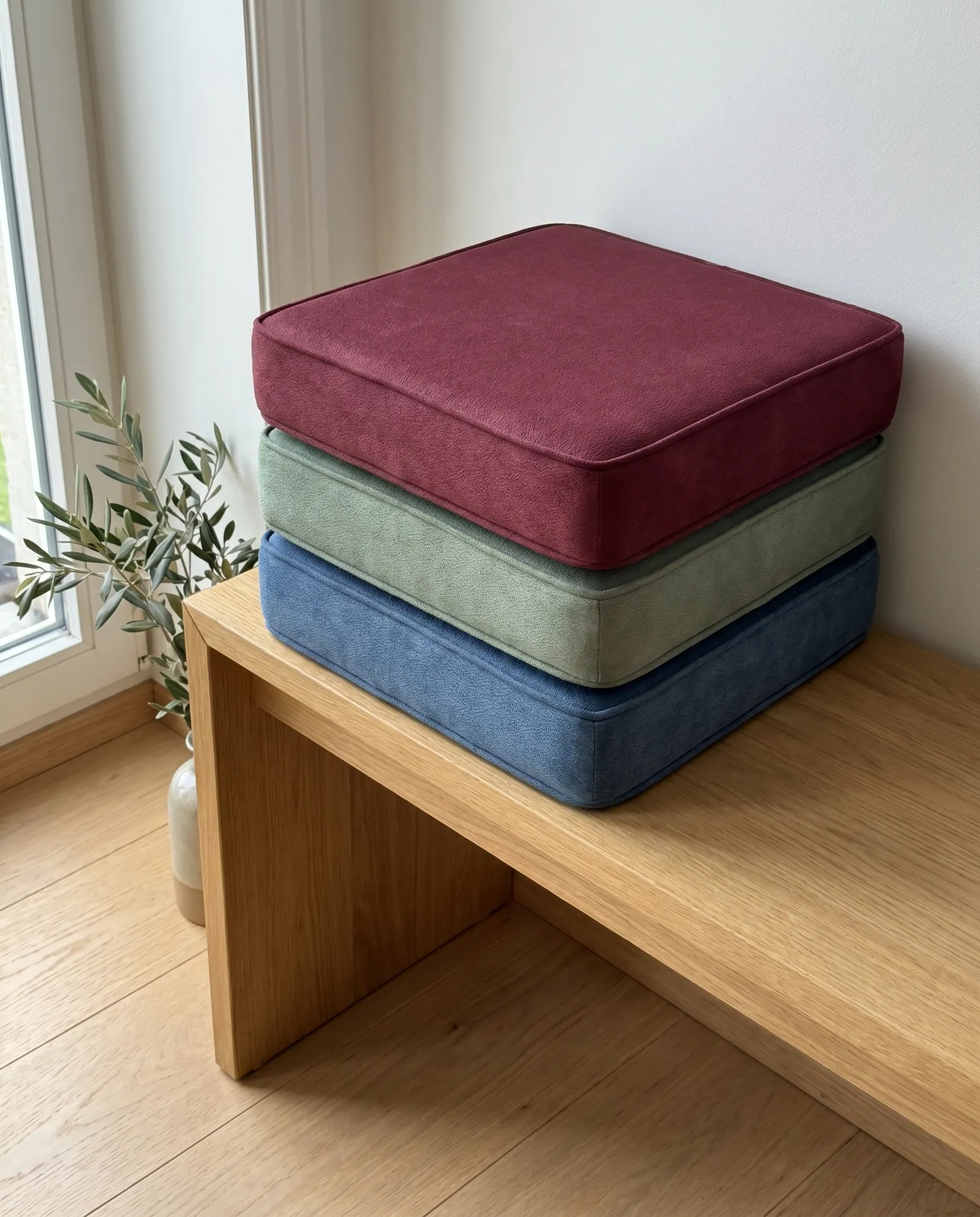
Stacking the three colorways shows how each self-piped edge stays sharp and square. Add a top layer for first-touch softness
About 3/4 in (2 cm) of volume wadding over the foam softens what your hands and legs meet first. The support underneath stays exactly where it was.
 Save
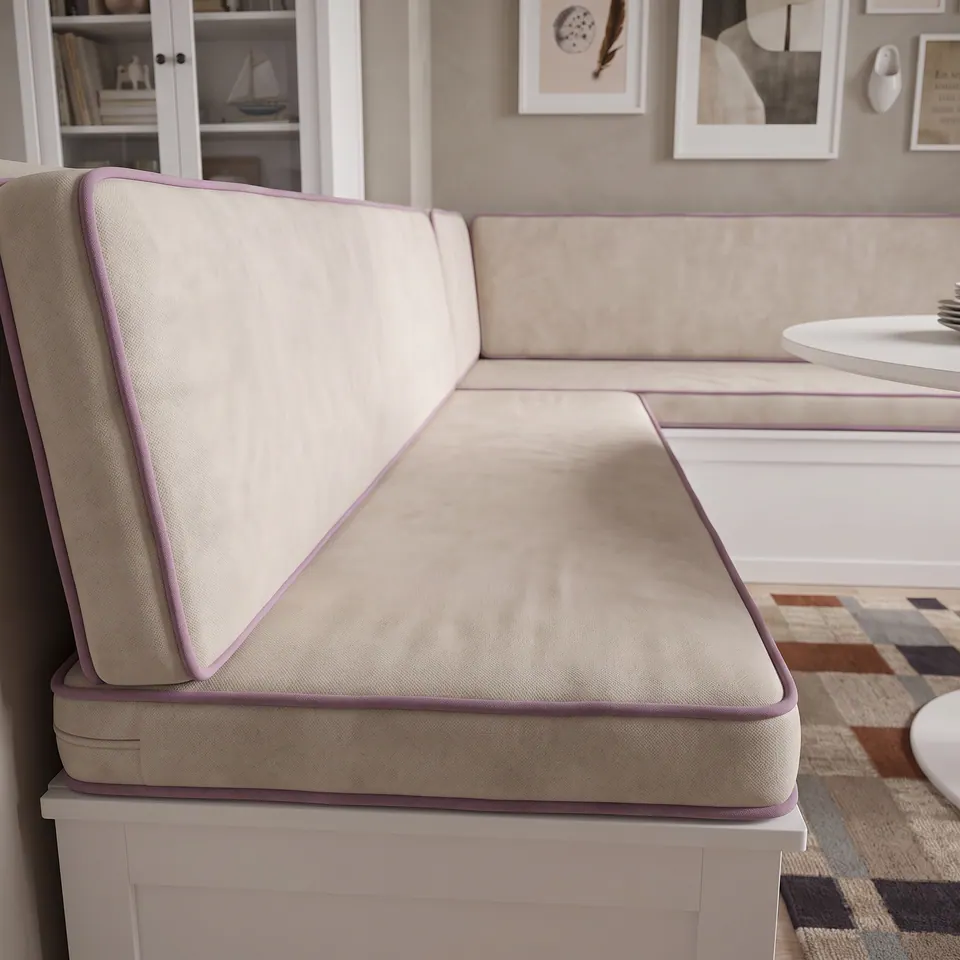
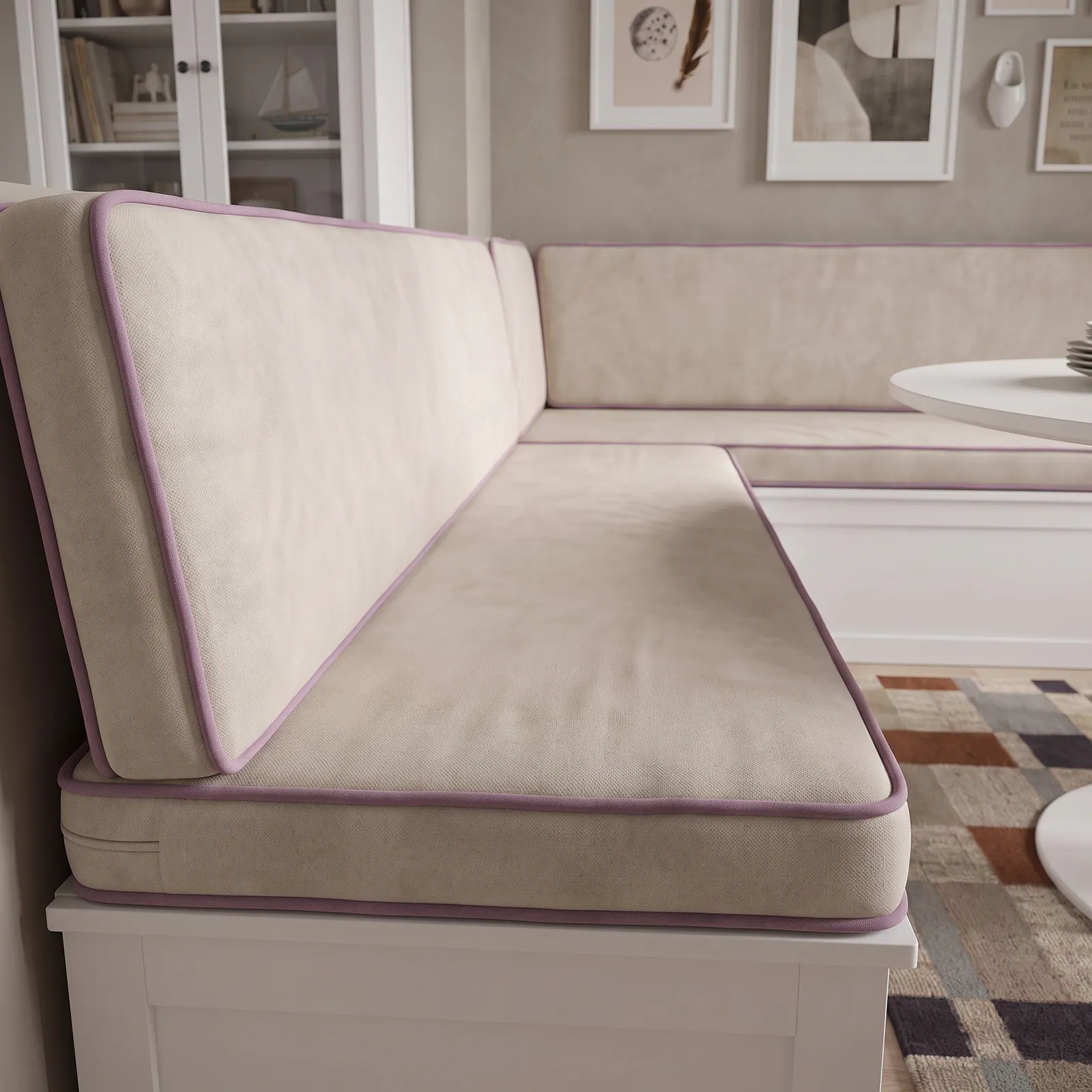
The side view shows the box depth, the leaning back pad and the zipper tab of a velvet banquette set. Swap the core for sink-in
The 28 kg/m³ foam sits noticeably plusher, with a slight sink-in sofa feel, and keeps the same Dacron wrap. The standard 32 kg/m³ is the firmer, longer-lasting grade, so make this trade on purpose. The Answer on softer foam options has the details.
Say who sits, and for how long
Give the sitter's weight and the daily hours. For older parents, thicker or firmer supports better than a thin soft pad. A deep seat that adults use every day can go to 6 in (15 cm) of firm foam, made on request.
Put the request where it gets read
Write "28 DNS foam" or "extra wadding" in the personalization box, then confirm by message. Requests typed into the dimension box are the ones that get missed.
Judge it after recovery, not on arrival
A cushion fresh out of its vacuum packing feels weaker than it will. Sit on it once it has fully risen, then run your answers through the foam firmness finder before you order the next one.

Have it made
Measured it? Have Nate’s workshop make it
Send the numbers in inches: length × depth × thickness, plus any angle. The workshop checks them with you, because foam has no undo button. — Nate
Leave your details and the workshop will call you to confirm measurements, fabric, foam and piping. No prices, dates or payment on this page: it is a request, not an order.
Twenty percent feather on a 96-inch bay
A buyer got in touch about a large trapezoid bay seat: 96 in (244 cm) along the long side, 55 1/2 in (141 cm) along the short side, 19 1/4 in (49 cm) deep. They wanted it 4 in (10 cm) thick in a pale sand color, with the foam wrapped in a 20% feather blend, the build they knew from a sofa.
The honest answer was no. The workshop doesn't make feather-wrapped foam. It offered the Dacron-wrapped core instead, which softens the top and rounds the edges of firm foam, and pointed the buyer to fabric samples so the sand could be checked in the room before anything was cut.
Another buyer asked for two old leather armchairs, and later a sofa, to be re-seated in dusky rose velvet with feather over the foam. Same answer on the feather. The interesting part was the geometry. The chair seats were 21 in (53 cm) deep, 19 in (48 cm) across the back and 20 1/2 in (52 cm) across the front, a trapezoid pretending to be a square. The sofa seat ran 40 in (102 cm) at the back and 41 in (104 cm) at the front. The sizes went by message, and the workshop drew a measurement sketch and waited for a yes before cutting.
- Measured
- Bay seat 96 / 55 1/2 in x 19 1/4 in deep x 4 in thick (244 / 141 x 49 x 10 cm)
- What it taught
- When feather isn't on the menu, a Dacron wrap softens firm foam's edge. And old chair seats are usually tapered: measure front and back separately.
Common soft-cushion mistakes
- Ordering 5 in when you meant soft. The 4 in and 5 in builds use the same foam and sit the same; the extra inch is looks.
- Judging firmness on delivery day. Foam still recovering from vacuum packing feels weaker than it will.
- Asking for a thin soft pad for an older parent. Thicker or firmer foam supports better.
- Expecting firm long-life foam to drape over a chair edge like a pillow. It won't, which is why draped pads aren't made.
- Choosing a plush core for a timber dining bench. Firm foam is the practical choice where people sit upright to eat.
- Typing the foam request into the dimension box. Put it in the personalization and confirm by message.
A down envelope is comfort you maintain. A wrapped foam cushion is comfort you install. Choose the one that matches your Saturday mornings.
Nate
Buyer questions: soft, softer, and feather
- A common question
Can I get a softer, plusher cushion instead of the firm foam?
The workshop's answerYes, within limits. The standard is a medium-firm 32 kg/m³ foam in a Dacron wrap. For the softer 28 kg/m³ foam, write "28 DNS foam" with your color in the personalization box; it sits noticeably plusher, with a slight sink-in, and gets the same wrap. You can also add about 3/4 in (2 cm) of volume wadding on top. Feather-wrapped foam isn't offered, and soft, draped seat pads aren't made.
- A common question
Is the foam wrapped, or will I feel a bare block with hard corners?
The workshop's answerIt's wrapped. The firm, about 2.0 lb/ft³ (32 kg/m³) high-resilience foam gets a polyester-fiber (Dacron) jacket before it goes into the cover. The wrap fills the cover out, softens the surface and rounds the edges, while the core still gives firm support. Daybed set cushions are made the same way.
- A common question
What's the real difference between a 2, 3, 4 and 5 inch cushion?
The workshop's answer2 in is a slim pad, 3 in adds cushioning and still sits neatly, 4 in is noticeably plumper and 5 in is the deepest standard option. All use the same firm 32-density foam in a polyester-fiber wrap, so 4 and 5 in feel alike and differ only in look. On a 25 1/2 x 71 in (65 x 180 cm) bench, 4 in already looks plush and 5 in can look heavy. For genuinely softer seating, the tufted cushions use a softer filling.
- A common question
What's your foam in pounds per cubic foot, and is there an ILD number?
The workshop's answerThe seat foam is 32 kg/m³, about 2.0 lb/ft³, so it clears a 1.8 lb high-density requirement and holds adults without sinking through. It's high-resilience foam described at an ILD of about 42, in the firm range. There's no official lab ILD certificate to quote, and ILD can vary slightly between batches. Firm seat cushions can be made 6 in (15 cm) thick on request.
- A common question
For stacked floor cushions or a headboard, which is firmer: foam or fiber fill?
The workshop's answerFoam. It makes a firmer, more solid block that stacks well, which is why stacked floor cushions are foam-filled, with a high-density insert in a zippered cover. Silicone-fiber fill is softer and pillow-like, as in quilted mattress-style cushions. On a custom headboard insert, say 60 in (152 cm) wide and 2 in (5 cm) deep, fiber gives a very soft result and foam a firm one. The workshop asks which you want before production.
Envelopes, fiber and foam, briefly
What is an envelope cushion?
An envelope cushion is a foam core sealed inside a separate casing of down and feather, so the soft layer wraps the top and sides. Makers who sell them usually offer blends such as 25/75 or 50/50 down to feather, sewn into tightly woven, down-proof cotton ticking.
Why does a down-wrapped cushion need so much plumping?
Down and feather move under weight and don't spring back the way foam does. The fill drifts toward the edges and the top creases, so with daily use it wants fluffing about once a week to hold its shape. A foam-and-wrap cushion skips that chore entirely.
Is 28-density foam less durable than 32-density?
Generally, yes. Density mostly tracks how long foam keeps its shape; firmness is a separate number. The workshop describes its 32 kg/m³ foam as firmer and longer-lasting than the 28 kg/m³ grade often specified, so choose 28 for the softer feel and accept the trade.
Can the back cushion be softer than the seat?
Yes, and by default it is. Back pillows and soft backrests are filled with shredded foam in their own inner casing, softer than solid foam but not very soft. If you'd rather have the back as firm as the seat, ask: a backrest can be made equally firm.