The Pattern Room · a measuring pattern
How long does cushion foam last, and how do you keep it in shape?
A cushion doesn't give out all at once. The soft wrap settles first, the foam core holds on a good while longer, and the way you treat it decides most of what's left.

 Save
The quick answer
Cushion foam lasts about as long as its density allows: published guides put 2.0 lb/ft³ (32 kg/m³) seat foam at several years of daily use, while 1.5 lb/ft³ budget foam can take permanent dents in 1 to 3 years. The polyester wrap flattens before the core does, and rotating, plumping and keeping foam away from heat stretch the years.
The wrap goes first, the core goes last
Nobody at our bench has ever seen a foam cushion wear out evenly. It wears in layers, and knowing the layers is most of the answer when someone asks how long does cushion foam last.
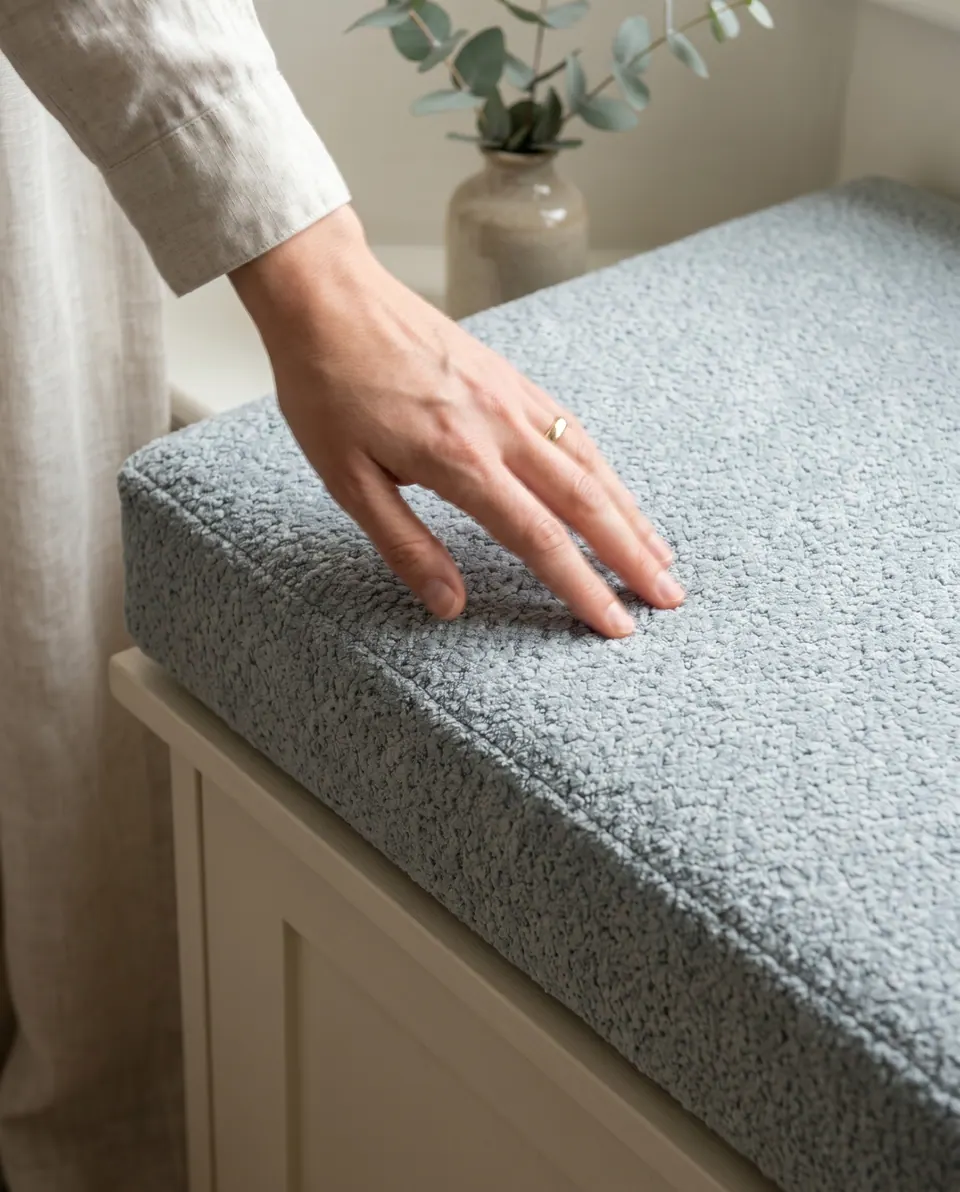
On top sits a wrap of polyester fiber, the Dacron wrap that rounds the edges and softens the first half inch you sit on. Under it sits the foam core, which does the real holding up. Published guides give the wrap anywhere from 1 to 2 years up to 5 to 10 years before it flattens, and that flattening is mostly looks: the cushion reads a little leaner, but you don't sit any lower.
The core is the part that counts. When it takes a compression set, a permanent loss of height where people sit most, the cushion has truly lost its shape. Density decides how soon that happens more than anything else you can buy.
Published foam lifespans, grade by grade
| Foam or fill | Density | Published life in daily use | Where you meet it |
|---|---|---|---|
| Budget polyurethane | 1.5 lb/ft³ (24 kg/m³) | 1 to 3 years before permanent dents | Bargain seat pads and ready-made inserts |
| Conventional seat foam | 1.8 lb/ft³ (29 kg/m³) | 1 to 2 years in one guide, about 7 in another | Stock furniture and many off-the-shelf cushions |
| Seat-grade high density | 2.0 lb/ft³ (32 kg/m³) | 2 to 7 years, depending on the guide | The workshop's standard bench, banquette and window-seat foam |
| High resilience | 2.5 to 2.8 lb/ft³ (40 to 45 kg/m³) | 5 to 12 years across guides | Premium sofa seats |
| Latex | about 5.9 lb/ft³ (95 kg/m³) for organic latex | 10 to 25 years, by type | Natural-core upgrades |
| Polyester fiber wrap | not sold by density | 1 to 2 years, up to 5 to 10, before it flattens | The soft layer around most seat foam |
These are other people's published ranges, gathered from foam sellers and guides. They disagree with each other, and none of them is a promise from our bench.
Where 32 kg/m³ foam sits on that ladder
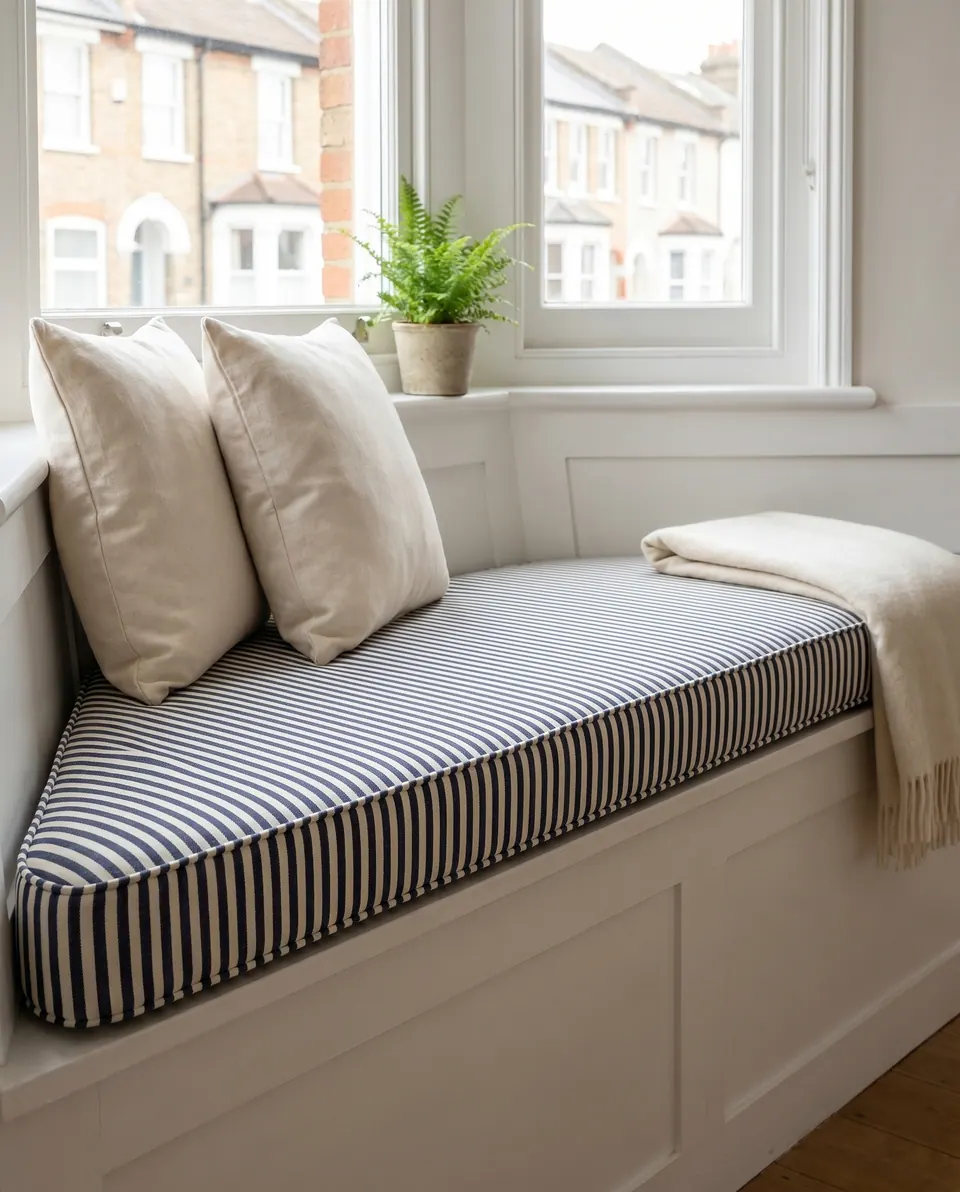
The workshop's standard seat foam for bench, banquette and window-seat cushions is 32 kg/m³, about 2.0 lb/ft³: a high-density, high-resilience cold foam with a medium-firm feel, wrapped in polyester fiber before it goes into the cover. The workshop describes it as keeping its shape for years without going lumpy, and it's the same foam that goes into its couches. There's no stiffer grade to upgrade to. The one alternative is a softer 28 kg/m³, about 1.75 lb/ft³, which you ask for in the order note.
Density is how much foam is packed into each cubic foot, and published guides tie it to years of use far more closely than they tie firmness. A dense foam can still be poured soft; feel is a separate number. If you want the unit arithmetic, Nate keeps a foam density conversion table.
Buy the cushion once, cry once. Light foam is where the second round of crying starts.
Seven habits that keep foam cushions in shape
Let a new cushion recover before you judge it
Cushions travel vacuum-packed. Unpack straight away, lay them flat and keep off them for the first 48 hours. Foam needs 48 to 72 hours to recover and 3 to 4 days to reach its ordered size; creases can take up to a week. Never leave a cushion sealed in its bag for weeks, because long compression can damage foam.
Flip and rotate
Turn seat cushions over and swap them end for end, so the same few inches don't carry every meal. On a long bench, trade the cushion by the door with the one in the corner now and then. Even wear is slow wear.
Plump the soft fillings
Shredded-foam back cushions and fiber-filled pillows lose loft sooner than a solid core. Plump and turn them regularly, the way you would a bed pillow, and shake them out from both sides after the covers come back from the wash.
Unzip before you give up on a cushion
If a seat dips on one side, open the cover and look. Loose or layered filling can drift into one corner, and working it back by hand often brings the shape back without a new insert.
Keep foam away from heat and hot sun
Radiators, heat vents and afternoon sun through glass all age foam early. Sunlight yellows polyurethane, and long UV exposure breaks it down. Air a cushion in the shade, never on a heater.
Wash the cover gently, and only the cover
Slip the insert out and machine-wash the cover at 86°F (30°C) or below on a gentle cycle, then air dry. A hot wash can weaken a cover. Keep a spare cover for the seat everyone fights over.
Spare the front edge
The front edge takes the knees, the heels and every child who uses the seat as a springboard. Choose a firmer core for children's seating. Some softness at the front of a floor-sofa seat is normal; if it keeps sinking after a few months, send the workshop clear photos of the edge.

Have it made
Measured it? Have Harlan’s workshop make it
Fabric has a temper and foam has a memory. Better to settle both in a conversation than to guess at them alone. — Harlan
Leave your details and the workshop will call you to confirm measurements, fabric, foam and piping. No prices, dates or payment on this page: it is a request, not an order.
Key facts
- Density predicts foam life better than firmness does.
- Published guides give 2.0 lb/ft³ (32 kg/m³) seat foam roughly 2 to 7 years of daily use, depending on the guide.
- 1.5 lb/ft³ (24 kg/m³) budget foam can take permanent dents in 1 to 3 years.
- The polyester fiber wrap flattens before the foam core does.
- Vacuum-packed foam needs 48 to 72 hours to recover, and creases can take up to a week.
Common mistakes that shorten a cushion's life
- Calling a cushion worn out on delivery day. When a cushion arrives flat or short, the usual answer is time: one long cushion grew from 92.5 in to its ordered 95 in once the foam recovered.
- Leaving a cushion in its vacuum bag for weeks. Unpack within a few days.
- Buying a new insert when the filling had only shifted. Unzip it and work the fill back first.
- Washing covers hot. Keep to 86°F (30°C) or below on a gentle cycle.
- Letting the children bounce on the front edge, the first place a seat flattens.
- Parking bare foam against a radiator or in a sunny bay window with the cover off.
- Choosing soft, light foam for a seat used at every meal, then blaming the fabric when it sags.
Two benches, two bolsters and a bolster that arrived flat
A buyer in the US wrote to the workshop wanting cushions that would not sag, and meant it. Two indoor benches, 53.5 in and 54 in long and 20 in deep, a depth they later corrected to 19.75 in after another pass with the tape. Two bolsters, 44 in long and 6 in across, in white performance fabric with no piping.
The workshop told them straight: the standard 32 kg/m³ foam already doesn't sag, so there was no stiffer grade to sell them. What they could choose was height. They weighed 6 in against 7 in (15 against 18 cm) and took 7.
They came back for a long outdoor bench, 97.5 x 21 in. The workshop split it into two 48.75 in seat cushions, 8 in thick, with two 7 in bolsters in white with black piping, so each piece is easier to handle without losing the long look. When one bolster arrived looking flat, the workshop explained the vacuum packing and asked for a photo once it had rested. A flat arrival is not a worn-out cushion, my friend. Give foam its days before you call it tired.
Signs it's the insert, not the cover
Some cushions need a new jacket; some need a new heart. Here is how I tell them apart:
- The middle of the seat stays lower than the corners after a full day with nobody on it.
- You can feel the bench boards where you never used to.
- The front edge folds under your knees and doesn't spring back.
- The foam has gone yellow and crumbly under the cover.
- A week of plumping, turning and redistributing changes nothing.
If the foam still springs back and the fabric is what's tired, order covers only. The workshop makes them separately, for less than a full cushion, and checks by message that you really want no filling; the pattern for covers over existing foam walks through the measuring. If the cover is sound and the foam is spent, an insert can be replaced on its own through foam inserts. Shapes and sizes for everyday seats live under bench cushions, and the arrival days are covered in the first 72 hours with a vacuum-packed cushion.
How old is the cushion you're sitting on right now, and where does it dip?
Seat foam at 2.0 lb/ft³ holds its height longer than 1.5 lb/ft³ budget foam, and the polyester wrap on top flattens before the foam core does.
Harlan Pruitt
Buyer questions: will the foam hold up?
- A common question
What density is the foam in a custom bench cushion?
The workshop's answerBench, banquette and seat cushions are all made with 32 kg/m³ foam, about 2.0 lb/ft³: a high-density, high-resilience polyurethane cold foam with a medium-firm feel. It's firmer and longer-lasting than the 28 kg/m³ foam often specified, and even at 3 in it stays comfortable and holds its shape without going lumpy. It's standard in every custom cushion, so there's no grade to choose unless you want it softer.
- A common question
Will the floor sofa feel firm or soft, and will it keep its shape?
The workshop's answerIt sits in the middle. The seat and ottoman mattresses are medium-hard 28-density foam, comfortable for sitting and for sleeping, and built for everyday living-room use. It feels on the relaxed side, holds its shape without sagging, and the foam softens slightly with use. Real customer videos of people sitting on it can be shared on request.
- A common question
How thick are the floor cushions, and will they flatten?
The workshop's answerThe standard tufted floor cushion is about 4 in (10 cm) thick, and some listings run 4 to 5 in. The velvet floor seat is about 6 in and the deep-base floor couch 12 in (30 cm). Any thickness can be made, thinner so legs fit under a low table or thicker for more loft. They're densely filled, so they take years to flatten.
- A common question
When I order a bench cushion, is the foam inside or do I only get a cover?
The workshop's answerThe standard custom cushion comes complete: a high-density foam insert inside a removable zippered cover, shipped ready to use, and the cover is machine washable. If you already have inserts, covers only is a separate, cheaper option with no filling, and the workshop messages each covers-only buyer to confirm that's what they meant.
- A common question
Could my tufted cushion be filled with foam instead of silicone balls?
The workshop's answerOften, yes. Tufted cushions are filled with silicone balls, small polyester fiber clusters, as standard, and foam is available on request; the workshop may message after purchase to ask which you'd like. Plain seat cushions use 28-density seating foam, with a 22-density budget grade. A few tufted styles can only be fiber-filled, and if that doesn't suit, the order can be cancelled.
Foam life, answered at the bench
What actually makes a foam cushion lose its shape?
Usually three things, in order: the polyester wrap compressing, loose filling drifting inside the cover, and the foam core taking a permanent set where people sit most. Light foam, heat, strong sun, hot washes of the cover and children bouncing on the front edge all speed it along.
How can I tell a defective new cushion from one that's still compressed?
Wait before you judge. Vacuum-packed foam needs 48 to 72 hours to recover and 3 to 4 days to reach its ordered size, with creases taking up to a week. Lay it flat, keep off it for two days, then measure with the tape flush against a wall and send a photo if it's still short.
Should I air a foam insert out in direct sun?
Keep it brief, or better, keep it in the shade. Sunlight yellows polyurethane foam, and prolonged UV breaks it down. Air a cushion with its cover off in a shady, breezy spot, and keep inserts away from radiators and heat vents as well.
Does a latex core outlast polyurethane foam?
Published guides say it does: Dunlop latex is quoted at about 20 to 25 years and Talalay at 10 to 15, against roughly 2 to 7 years for 2.0 lb/ft³ polyurethane. The workshop can swap natural latex into a floor sofa in place of the high-density foam, charged as the price difference for your size.