A Reading by HarlanBench Cushions
A black velvet entryway bench cushion, and the foam I'd build under it
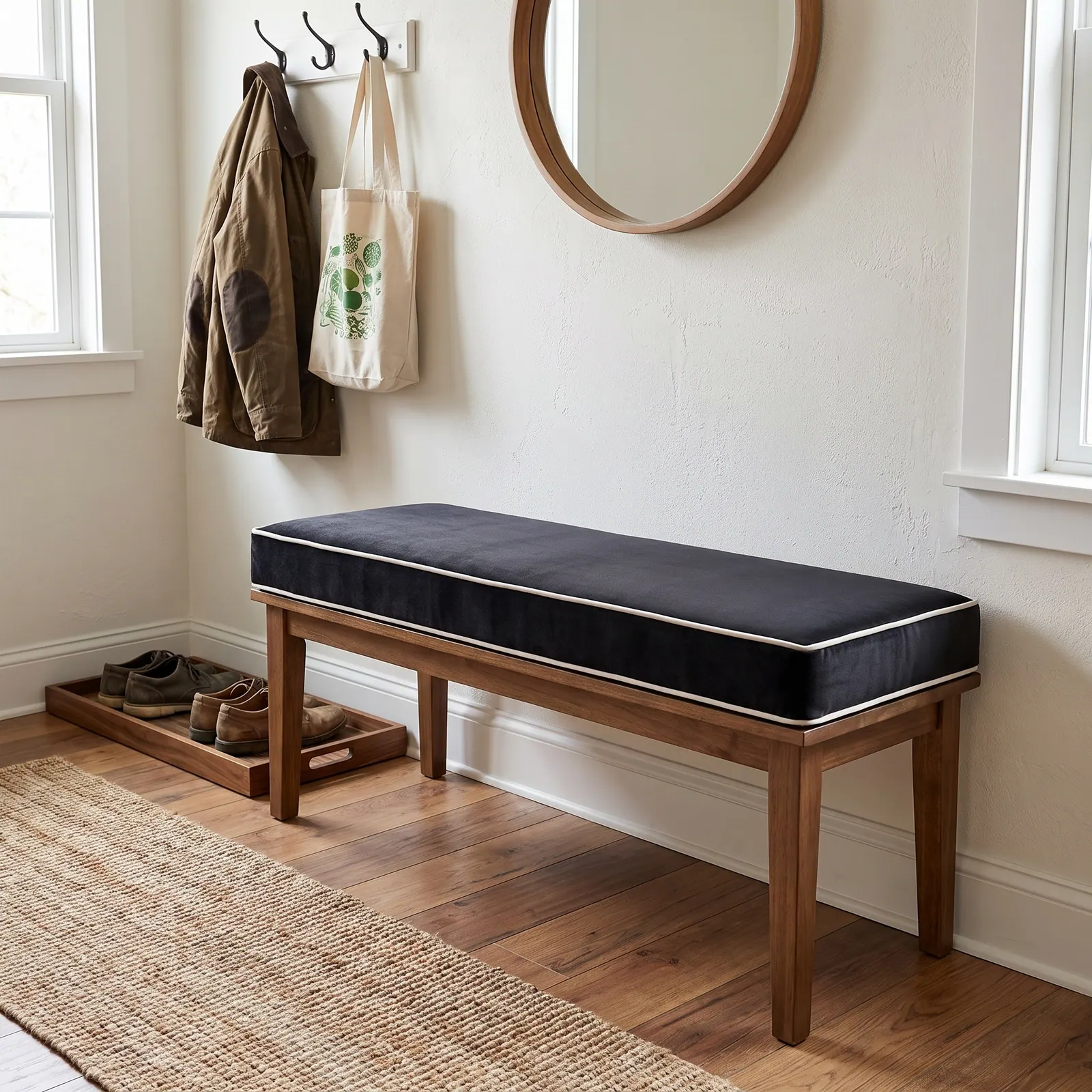
Harlan opens his notebook at a sunlit front door: a black velvet box with an ivory welt, a boot tray below it, and the question of what belongs inside.

 Save
The quick answer
For an entryway bench cushion, firm foam about 3 in (7.5 cm) thick is the working choice, giving solid support for pulling on boots without lifting the seat much. Go to 4 in (10 cm) if people linger. Ask for the density number, around 2 lb/ft³ (32 kg/m³), because density predicts how long foam lasts, not how hard it feels.
Notebook, page one: a black box by the front door
Fifty-some years in, I still start a custom bench cushion the same way. A pencil, a notebook, and one question: what will this seat be asked to do?
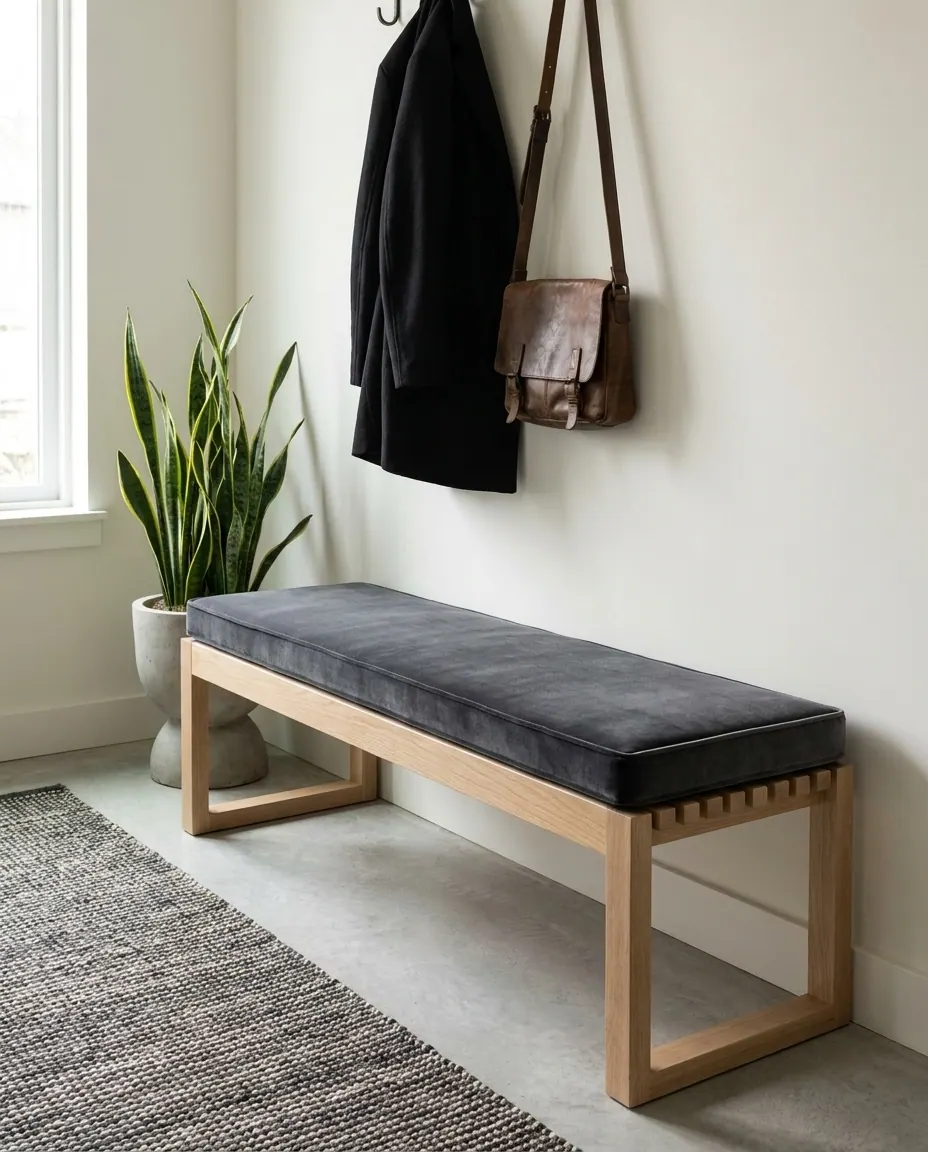
This one sits by a front door. Plaster walls, two windows throwing morning sun across a wide plank floor, a walnut-toned bench under a row of black iron hooks. On the bench, a box cushion in black velvet, edged with an ivory welt.
Black velvet at a door is a working choice dressed for Sunday. Scuffs, dust and the blue that rubs off new denim show less on it, and the pile brushes clean. Brush it one way and it forgives a great deal.
The ivory piping earns its keep too. Against white plaster, a black box with no outline reads as a hole in the wall. The pale welt draws the edge, the way a mat frames a print.
None of the props are idle. The olive waxed jacket and the botanical canvas tote on the hooks say people come and go here. The round wood mirror repeats the bench's wood and holds the wall above the seat. The jute runner takes the grit first. And the wooden boot tray with its brogues sits low beside the bench, so shoes live in the tray and never climb onto the velvet. Copy that one, my friend. A tray is cheaper than a second cover.
Now, what goes inside. Under a door bench I'd put firm seat foam, the 32-density kind, about 2 lb per cubic foot (32 kg/m³). Density is not hardness. It tells you how long the foam holds its shape. Buy the cushion once, cry once. The foam firmness finder goes further.
Pinned by Harlan: five things by the door
Five pins, from the velvet top to the round mirror, mark what each piece of this entry is there to do.
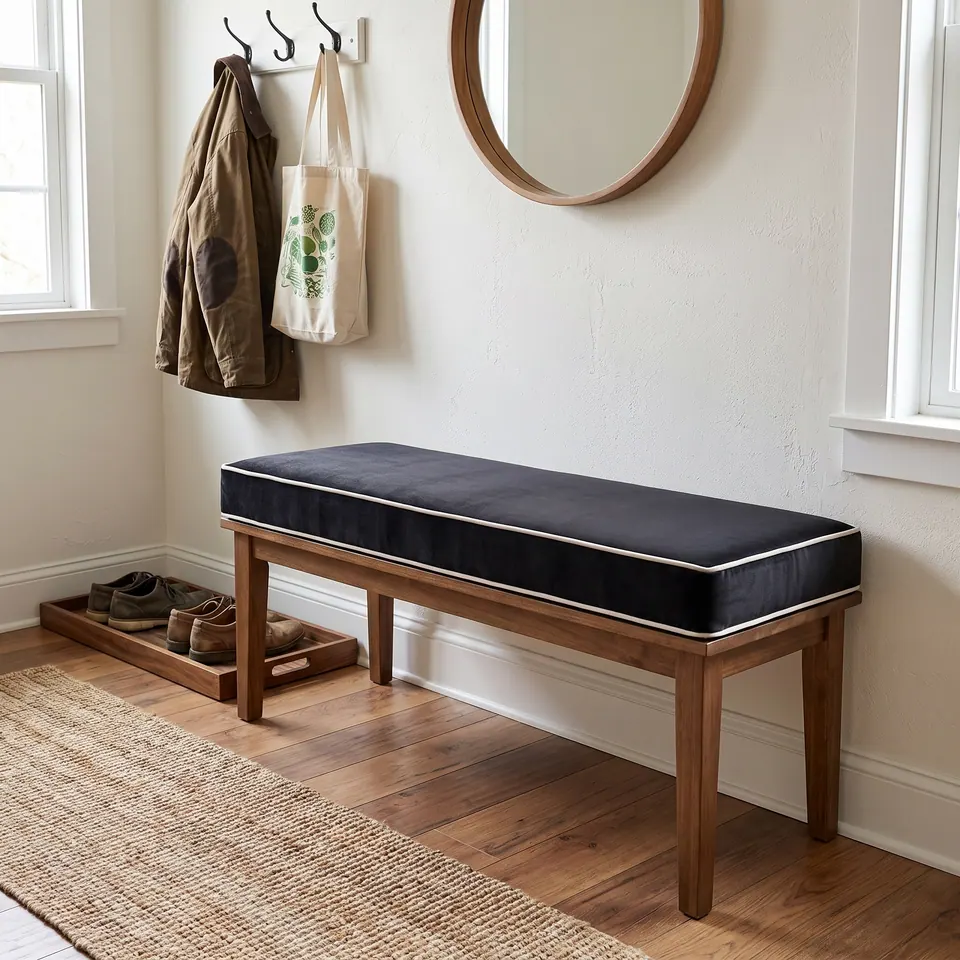
- Black velvet top
Black velvet hides scuffs and denim transfer at a busy front door.
- Ivory piping
A light welt frames the dark box so it doesn't read as a hole against the white wall.
- Walnut-tone bench
Warm wood legs connect the cushion to the plank floor.
- Wooden boot tray
Shoes live in the tray, which keeps mud off the velvet.
- Round wood mirror
Its frame repeats the bench wood and anchors the wall above the seat.
- Black velvet topBlack velvet hides scuffs and denim transfer at a busy front door.
- Ivory pipingA light welt frames the dark box so it doesn't read as a hole against the white wall.
- Walnut-tone benchWarm wood legs connect the cushion to the plank floor.
- Wooden boot trayShoes live in the tray, which keeps mud off the velvet.
- Round wood mirrorIts frame repeats the bench wood and anchors the wall above the seat.
Notebook, page two: 3 inches or 4
| Build | How it sits | Where it belongs |
|---|---|---|
| 3 in (7.5 cm), firm foam | Solid support; nearer 2½ in (6.5 cm) with someone on it | A bench you perch on to lace boots |
| 4 in (10 cm), firm foam | Looks and feels plusher; lifts the seat another inch | A bench people linger on, or a kitchen banquette |
| About 2 lb/ft³ (32 kg/m³) density | Sets how long the foam lasts, not how hard it feels | Any seat used every day |
Two blue velvet cushions and the one that came up short
A buyer wrote to the workshop while restoring an 1880 farmhouse kitchen. The bench was 16½ in (42 cm) deep, and they first asked for covers only. For that bench the shop made filled cushions, foam and velvet together, so that is what went out: two blue velvet seat cushions, 4 in (10 cm) thick, one 63⅜ in (161 cm) long and one 45½ in (116 cm), with ties where the two met and at the side.
One arrived 6 in (15 cm) short. The shop remade the 45½ x 16½ in piece, and the buyer kept the first one as well.
Two lines for my notebook. When two cushions meet on one bench, put ties at the join so they don't drift apart. And measure both lengths the day the box arrives, not the night before you need them.
How long does your household sit on the entry bench, a minute or an hour?
Buyer questions: odd numbers, swatch pairs, small sizes
- A common question
What happens if the numbers I send for an odd-shaped seat don't add up?
The workshop's answerEvery shaped cushion is drawn to scale before cutting. If the edges and depth can't fit together, the shop flags it and asks for a re-measure and a wide photo of the seat, corner to corner. One angled seat worked out to 34 in (86 cm) sides, not the 40 in (102 cm) given, because a 30 in (76 cm) and a 40 in measurement had been swapped. Nothing is cut until you confirm.
- A common question
Can I see the main fabric and the piping color side by side before I commit?
The workshop's answerYes. The shop photographs the two swatches you picked next to each other, velvet 113 beside 123 piping, for example. It can't photograph every finished pairing, since there are hundreds of colors, and photos shift with light and camera, so a fabric sample settles it.
- A common question
My bench needs a cushion smaller than your smallest size option. Can I still order it?
The workshop's answerYes. The size options only set the price. Pick the closest range, then type your exact size in the personalization box, whether that is an 8½ in (22 cm) wide pad or a 16 x 16 x 2 in (41 x 41 x 5 cm) cover. The price can't go below the smallest range, but the cushion is made to the size you write.
On the cutting table: the front-door bench
| Product | Box bench cushion for an entryway bench |
|---|---|
| Top fabric | Black velvet |
| Piping | Contrast welt in ivory |
| Foam | Firm seat foam, about 2 lb/ft³ (32 kg/m³) |
| Thickness | 3 in (7.5 cm) to perch, 4 in (10 cm) to linger |
| Two pieces | Ties at the join and at the side |
| Care | Brush the pile one way; pressure marks recover |
| Best for | Mudrooms and busy front doors with a boot tray below |

Have it made
Have this made — ask Harlan’s workshop
The best cushions I have known began with somebody asking one more question. Ask yours here. — Harlan
Leave your details and the workshop will call you to confirm measurements, fabric, foam and piping. No prices, dates or payment on this page: it is a request, not an order.
Black velvet on a front-door bench hides scuffs and denim blue. An ivory welt keeps the dark box from reading as a hole in a white plaster wall.
Harlan
Questions buyers ask next
Why does black velvet suit an entryway bench?
Its dark pile hides scuffs, dust and the dye that rubs off new denim, and a soft brush lifts most of it. A pale welt keeps its outline against light walls.
What foam density should an everyday bench cushion have?
About 2 lb per cubic foot (32 kg/m³) is a solid everyday seat foam. Density predicts durability rather than firmness, so a dense foam can still feel medium. Ask for the number instead of settling for the words high density.
Why does my velvet bench cushion show light and dark patches?
Those are pressure marks, where the pile was pressed flat by sitting or packing. They are normal for velvet and usually fade as the fibers stand back up. Brushing the pile in one direction helps it recover evenly.
Does a 3 in cushion really sit at 3 in?
No. Foam settles under weight, so a 3 in (7.5 cm) cushion sits closer to 2½ in (6.5 cm) with someone on it. Use that lower number when you check how high the seat will be for pulling on boots.
Sit well. — Harlan