 Save
A Reading by MaggieBench Cushions
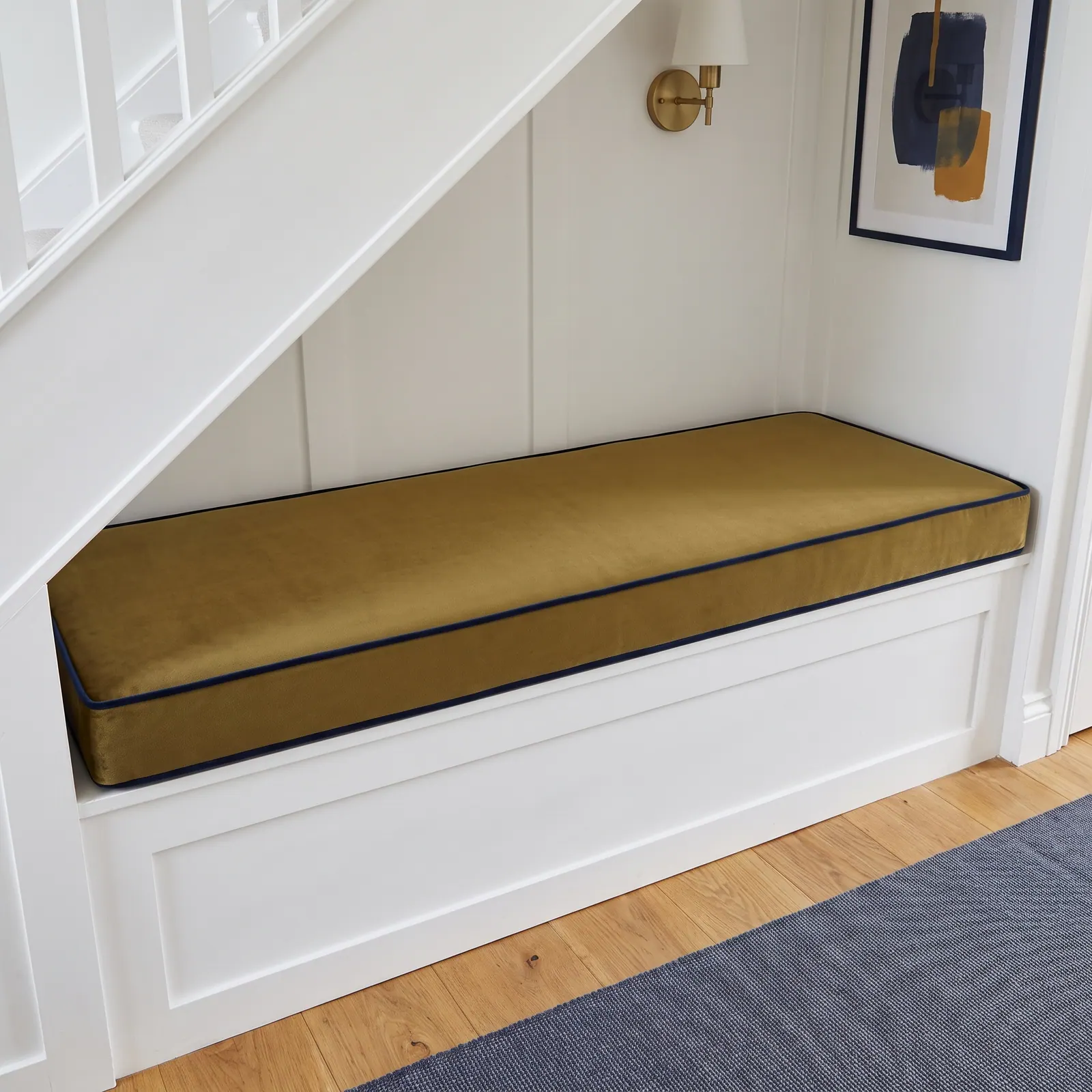
A mustard velvet under-stairs bench cushion, seen from ten feet and from ten inches
From the front door you see two colors and a line. Kneel down to pull on your boots and you see velvet. A good hallway cushion is chosen for both distances, in that order.

Swatch strip measured from the photograph
- umber#63544227%
- mist#d2d1d325%
- linen#c6c3c019%
- camel#a8967f18%
- mist#dadadb11%
The quick answer
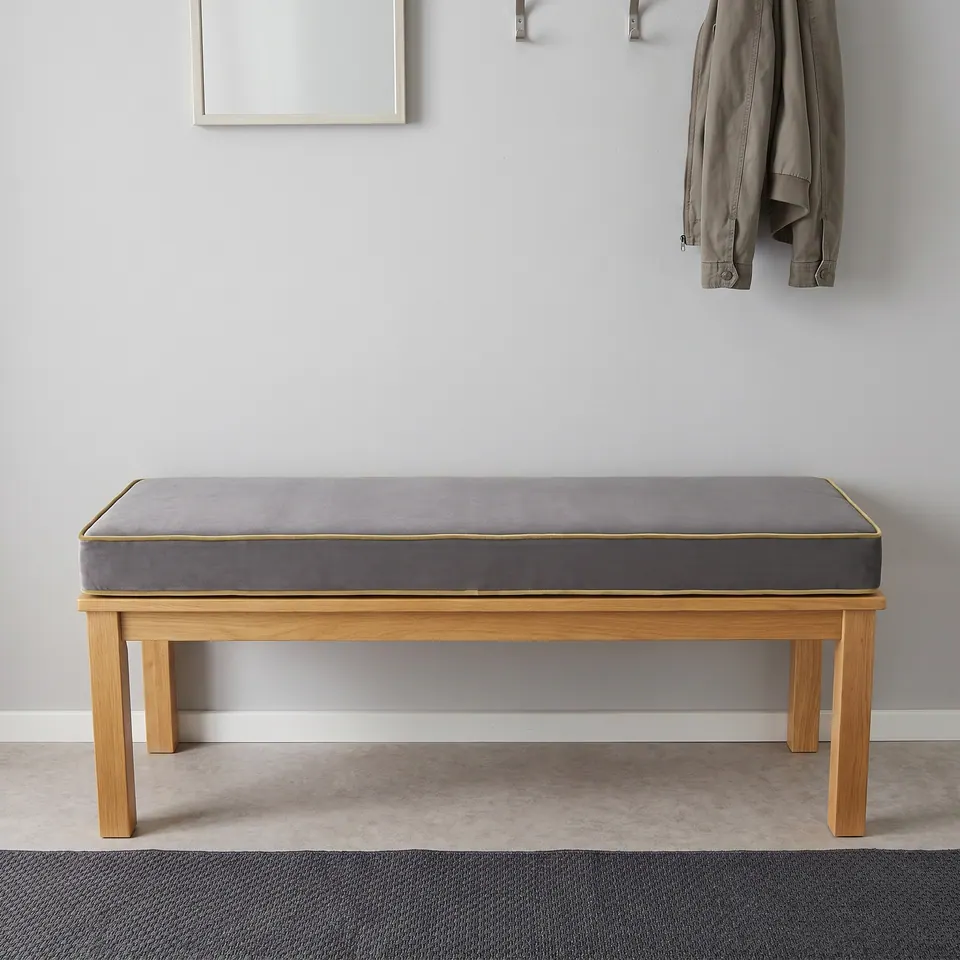
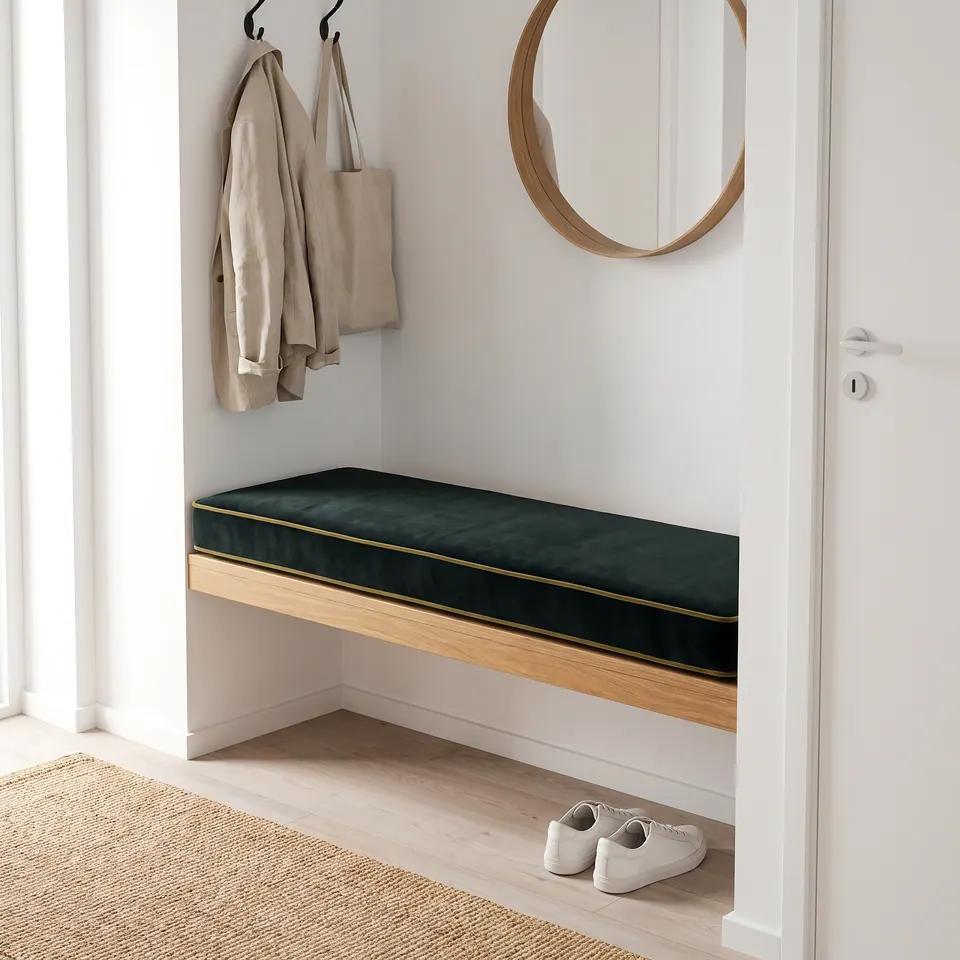
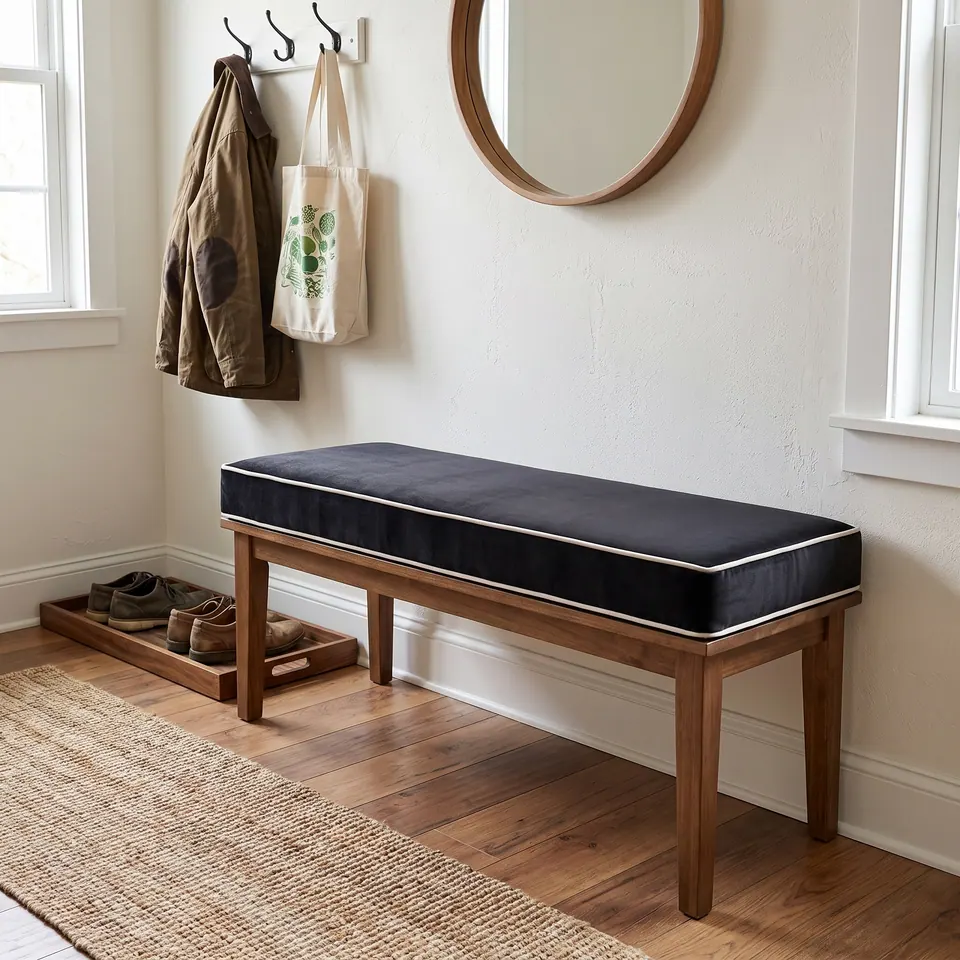
The detail that reads from ten feet away on a bench cushion is contrast piping in a complementary color, like deep navy on mustard velvet; pile and texture only show up close. For an under-stairs bench, fill the full width of the recess, use a paper template if one end is tighter, and give the nook its own light.
What survives the length of a hallway
Stand at the front door and squint. The under-stairs bench comes down to three things: a block of mustard gold, a dark line around it, and a dark stripe of runner on the oak floor below. Everything else, the velvet pile, the size of the cord, the stitching, is gone at that distance. Only color and line travel.
That is why the piping is deep navy and not a polite cream. Navy sits opposite mustard on the color wheel, so each makes the other look richer, and the line stays visible from the far end of the hall. I once chose piping a shade off the body color for a dark hallway. From the door you could not tell there was piping at all. Lesson learned, invoice paid.
The props back the line up. The navy flatweave runner carries the piping color across the floor. The framed print above repeats both colors, navy and ochre, at eye level. The brass sconce with its white shade gives the nook its own light, which is what makes a seat under the stairs usable after dark.
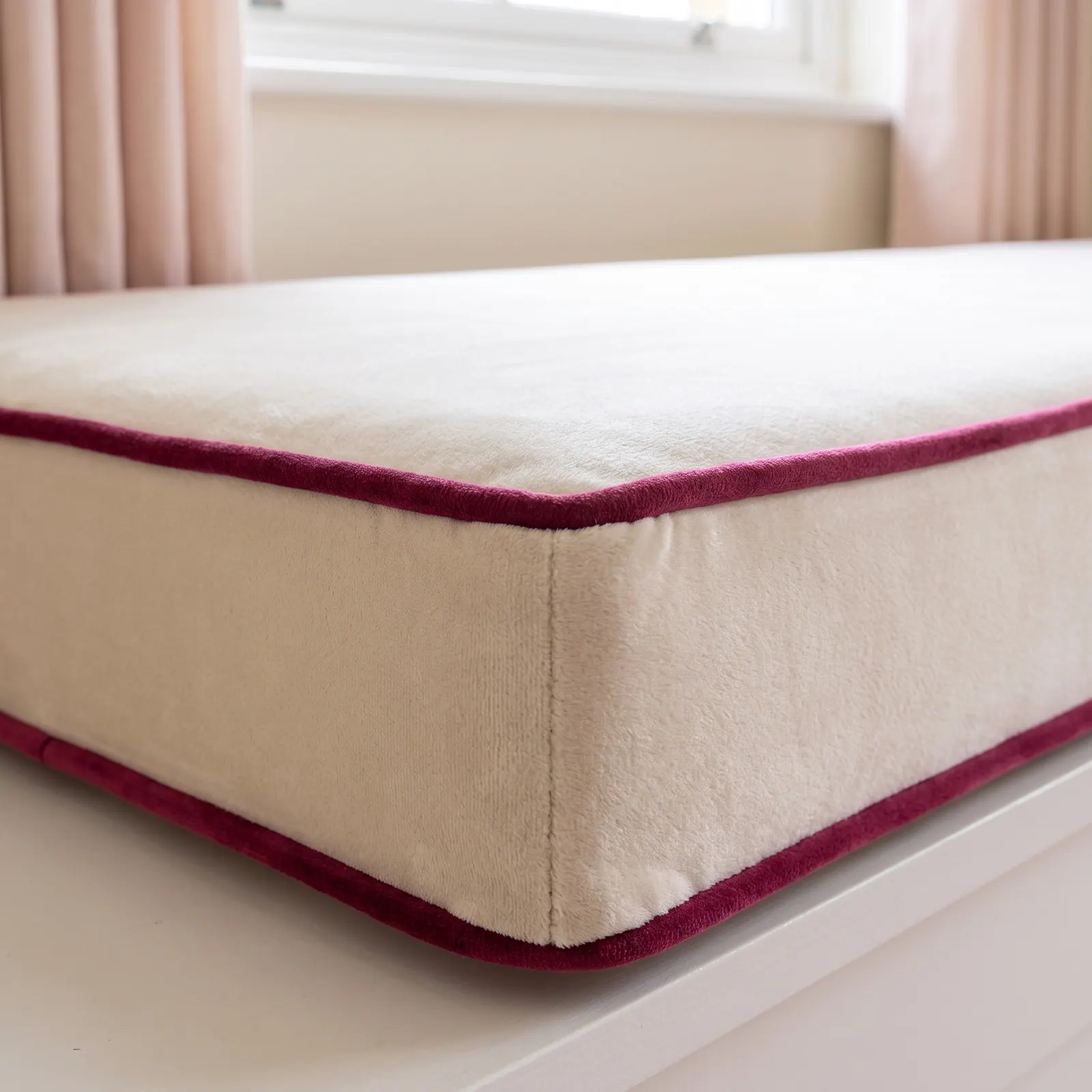
Now kneel. Up close, velvet is a different story: the pile catches the sconce light and shifts shade as you brush it, and the corner of the box edge shows how cleanly the piping was set. The close-up is the reward for sitting down. Choose the close-up fabric you love, then choose the one detail that carries across the room.
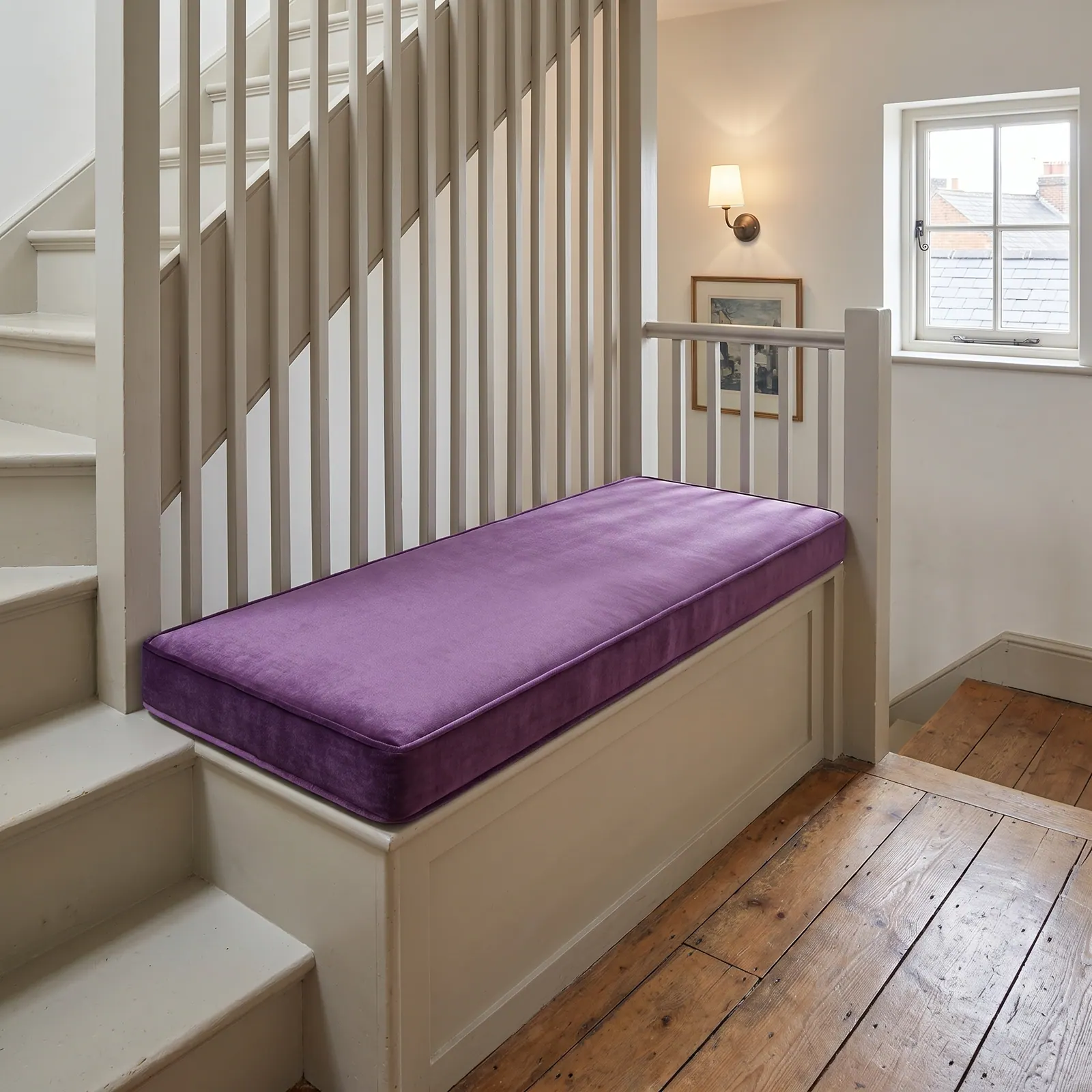
The fit matters too. The cushion runs right under the stair stringer and fills the full width of the recess, so the bench reads as built in. See the under-stairs bench notes for recesses that narrow at one end.
Pinned from the doorway
Five marks on the photograph, from the piping at seat height up to the sconce and down to the runner.
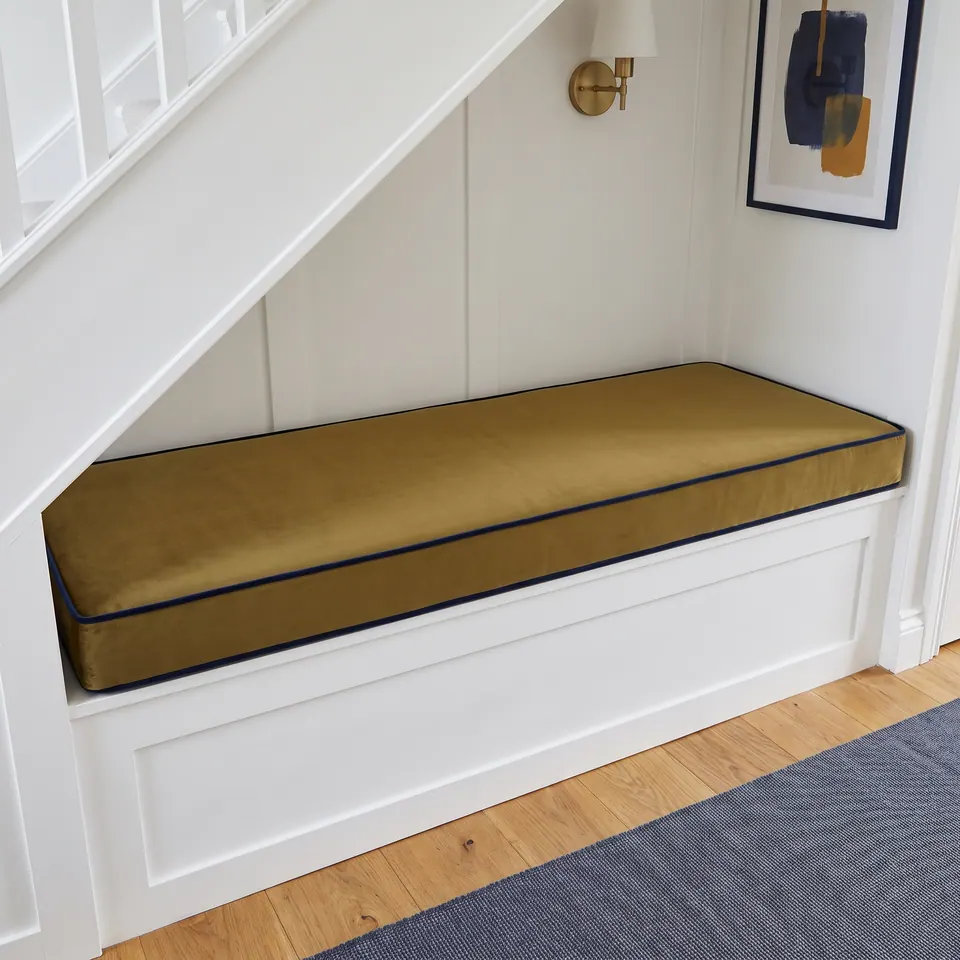
- Deep navy piping
Navy is the complement of mustard, so the gold looks richer beside it.
- Mustard gold velvet
A warm body color that lifts a dark under-stairs corner.
- Brass sconce
A dedicated light makes the nook usable in the evening.
- Navy and ochre print
The artwork repeats both cushion colors above the seat.
- Navy runner rug
The runner ties the piping color into the hallway floor.
- Deep navy pipingNavy is the complement of mustard, so the gold looks richer beside it.
- Mustard gold velvetA warm body color that lifts a dark under-stairs corner.
- Brass sconceA dedicated light makes the nook usable in the evening.
- Navy and ochre printThe artwork repeats both cushion colors above the seat.
- Navy runner rugThe runner ties the piping color into the hallway floor.
The hallway palette, six chips
- Mustard olive gold#A8862FThe body color. Warm enough to lift a dark corner, and one solid block from the door.
- Deep navy#1F2B45Piping and runner. Mustard's opposite, so each looks richer beside the other.
- Ochre#C4922EFrom the framed print. A brighter gold that repeats the cushion above eye level.
- Brass#B08D57The sconce. A metal from the gold family, and a light of the nook's own.
- Paneled white#EFEDE7Bench base and balustrade. A clean ground that lets both colors carry.
- Oak#A57C52The floorboards. Warm wood under a cool runner keeps the hall from going cold.
A 113-inch bench and a backrest that shrank
A buyer messaged the workshop about a long built-in bench and a style they had seen where the back cushion differs from the seat. Their first question was whether the back would be softer. It can be.
The seat was 23⅝ in (60 cm) deep and 113 in (287 cm) long, and they measured the wall above it at 22½ in (57 cm) for the backrest. Then they learned the seat cushion would be 4 to 5 in thick, and did the sensible thing: took the seat off the wall height. The backrest came down to 17¾ in (45 cm).
They ordered velvet with a softer back and asked for one-piece cushions wherever possible. Measure the bench, not the cushion you used to have. The backrest sizing notes show the same subtraction.
- Sizes
- Seat 23⅝ x 113 in (60 x 287 cm); backrest 17¾ x 113 in (45 x 287 cm)
- Fabric
- Velvet, softer back
The lesson: Subtract the seat cushion's thickness from the wall height when sizing a backrest.
What buyers asked before they ordered
- A common question
The order form won't let me enter my exact size, and the options start bigger than my bench. What do I do?
The workshop's answerPick the size range your measurements fall into, or the closest one, then write your exact size, fabric and piping choice in the Add Personalization box; the cushion is cut to the size written there. If one side is smaller than the smallest option, choose the dimensions the other way round. The price is the same.
- A common question
How do I pick a color that goes with the furniture or wallpaper I already have?
The workshop's answerSend a photo of the room in good light and the workshop suggests fabric codes. For one wallpaper it suggested beige, khaki green or brown, or velvets in olive, off-white, mustard or dark brown for a calm look, with a brighter mustard or burnt orange as accents. It can also send large close-ups of the fabric rolls.
- A common question
Is your linen real linen or linen-look? And what are the striped fabrics made of?
The workshop's answerOne linen range is 50% cotton and 50% linen; another is a linen-look polyester. All the striped fabrics are 100% cotton, and the K range is linen too.
The cushion, itemized
| Piece | Under-stairs bench cushion, one piece |
|---|---|
| Edge | Box edge |
| Fabric | Velvet, mustard olive gold |
| Piping | Contrast deep navy cord on the seams |
| Fit | Full width of the recess, running under the stair stringer |
| Template | Paper template when one end is tighter than the other |
| Light | Brass wall sconce above the seat |
| Tie-ins | Navy flatweave runner; navy and ochre print |
| Best for | Entryways, mudrooms and boot benches |

Have it made
Have this made — ask Maggie’s workshop
I once cut a lovely cushion two inches short, and I have not forgotten it. That is why the workshop goes over your measurements with you on the phone. — Maggie
Leave your details and the workshop will call you to confirm measurements, fabric, foam and piping. No prices, dates or payment on this page: it is a request, not an order.
Questions buyers ask next
Does contrast piping make a bench cushion bigger?
No. The piping cord sits on the seam line, so the cushion is cut to your bench size and the piping adds nothing to it. Give the bench's exact measurements, never the bench plus piping.
How tall should the backrest be on a built-in bench?
Measure from the bench top to where the back should stop, then subtract the seat cushion's thickness. One buyer's 22½ in (57 cm) wall height became a 17¾ in (45 cm) backrest over a 4 to 5 in seat.
Can a back cushion be softer than the seat cushion?
Yes. One buyer asked for exactly that on a long velvet bench: a firm seat 4 to 5 in thick with a softer back cushion above it, both in the same velvet color.
Which colors go with a mustard velvet cushion in a hallway?
Navy is the strongest partner, because it sits opposite mustard on the color wheel. Repeat it once or twice nearby, in a runner or a framed print, so the piping has company and the hallway reads as planned.
Stitch straight — Maggie
More photographs to read
 Save
 Save
 Save
 Save
 Save
 Save