Concept Sketches · 8 scenes
Cushions for understairs benches, stair landings and foyer curves
Staircases make the oddest seats in the house. Every one of them is still a list of honest measurements, and most get simple the moment the angle is on paper.

 Save
The quick answer
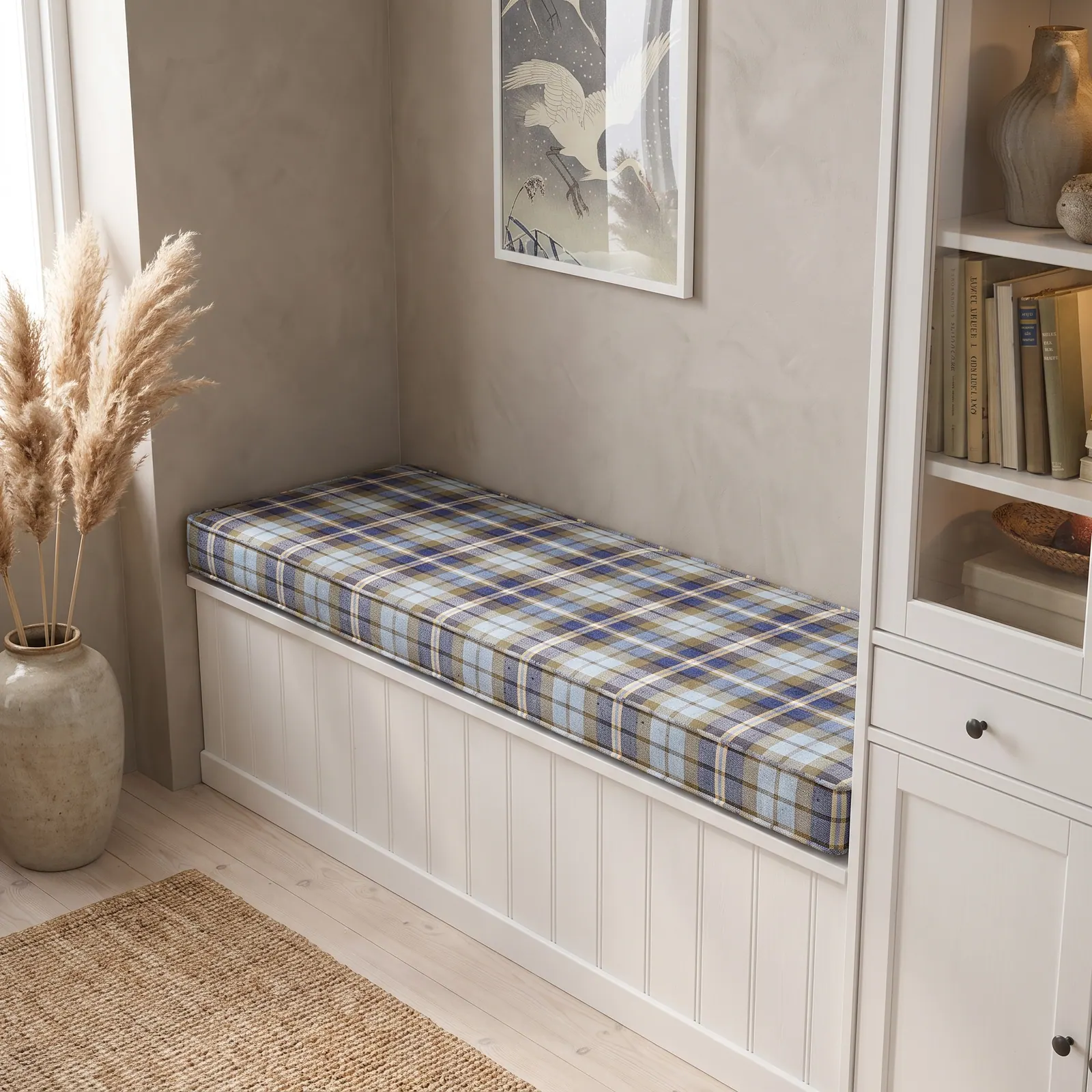
An understairs bench cushion is a trapezoid: three straight edges and one side cut to the angle of the stairs. Measure every edge on its own, take the depth straight out at 90 degrees, and mark which end is angled on a sketch. The angled side always measures longer than the depth. Order it as a custom shape with the drawing, never as a rectangle.
Three plain edges and one that meets the stairs
Most understairs bench cushions go wrong at exactly one edge: the one that meets the stairs. The other three make an ordinary rectangle.
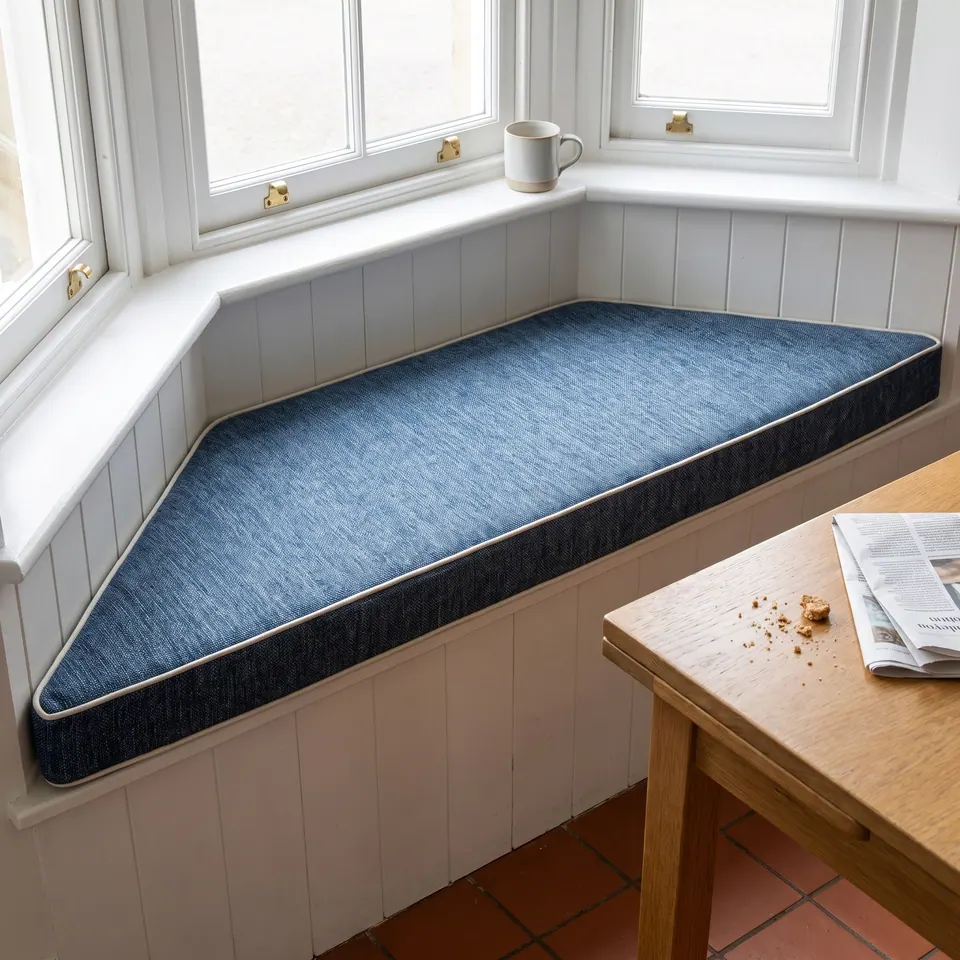
An understairs bench cushion is a trapezoid cushion in work clothes: a straight front, a straight back against the wall, one square end, and one end cut to the rake of the stringer. Angles are just lengths in disguise. Give the maker both long edges, each end corner to corner, and the depth straight out at 90 degrees, and the angle takes care of itself.
Landings and foyers bring their own geometry: a ledge only 6 in (15 cm) deep, a nook that follows a curved railing, a closet floor that runs out to a point. Below are eight real projects from the cutting table. Run your numbers through the trapezoid cushion calculator before you send them. For a plain rectangle on a mudroom or entryway bench, the bench cushion builder is quicker.
So, partner: standing in front of your bench, which end meets the stairs, left or right?
Eight stair seats, drawn to scale
01A past project
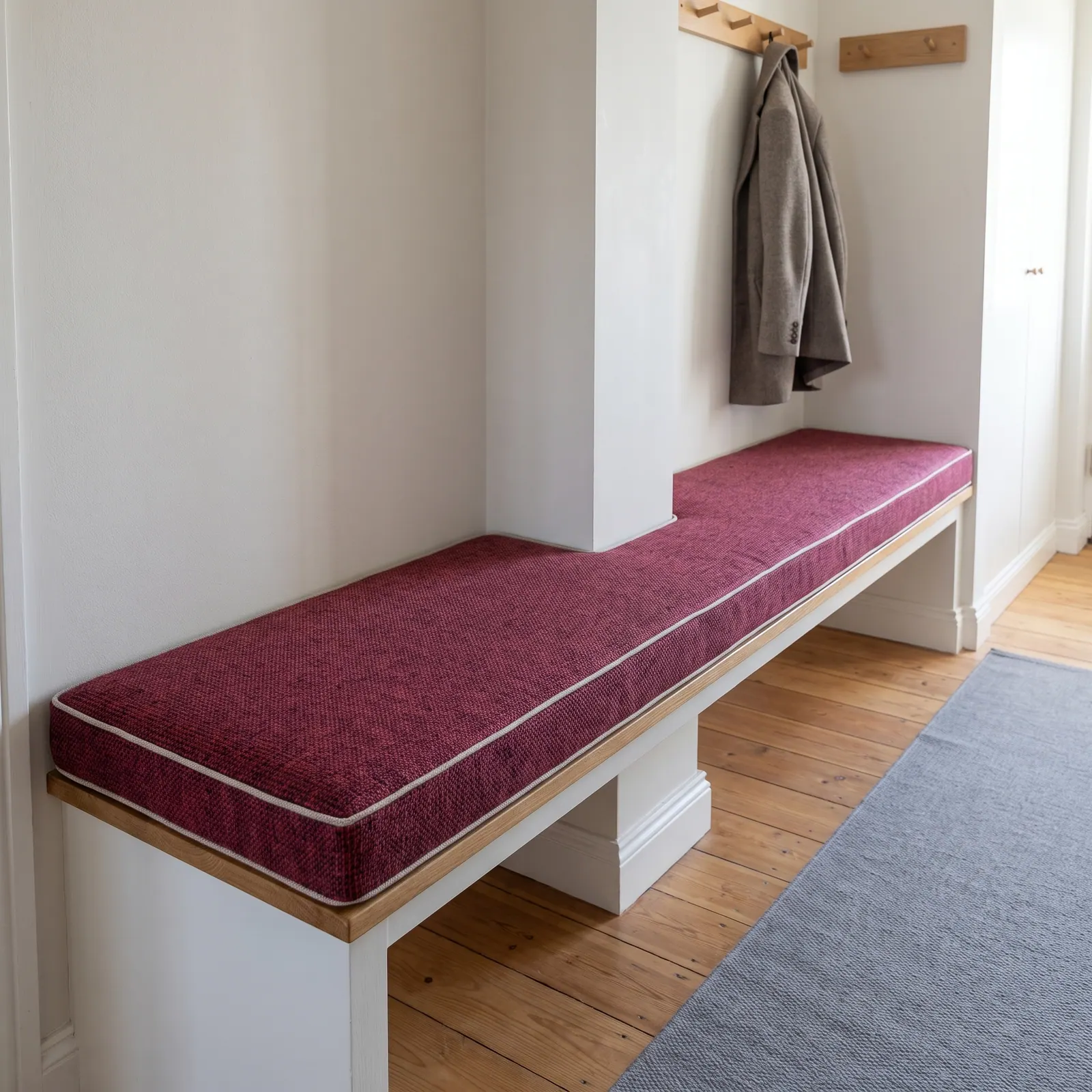
An understairs seat angled only where it meets the stairs
A buyer got in touch needing a 57 x 27 in (145 x 69 cm) seat pad for an understairs bench, angled only on the side that meets the stairs. The workshop asked for the bench sizes, then sent beige and cream velvet options. The only open question was which end carried the angle.
The takeaway: On the sketch, write which end is angled and how much shorter the back edge is than the front.
02A past project
A 34 x 6 in cushion for a narrow staircase ledge
A buyer wrote in for a 34 x 6 x 4 in (86 x 15 x 10 cm) cushion in black linen with matching piping, for a small staircase ledge. Proportions like that are rare, so the workshop asked before quoting: 34 or 36 in (91 cm), and where would it sit? Later the cushion sat unopened in its vacuum pack for a good while.
The takeaway: Open a vacuum-packed cushion the day it arrives; the longer it waits, the longer it takes to recover.
03A past project
A foyer nook that follows a curved stair railing
A buyer in the US wanted a floor cushion for a foyer nook about 74 x 24 in (188 x 61 cm), one long side curving along the stair railing. A quarter-round corner cushion came up first, but the space was not a corner. The workshop asked for a paper drawing, the two straight dimensions, and a wide photo of the whole foyer before quoting.
The takeaway: For a curve, measure the two straight sides and photograph the whole area from far back.
04A past project
A dog bed under the stairs, matched to the dining bench
A family wrote to the workshop about a corner dining bench with deep French-mattress seats. Under the stairs beside it the dog had a nook, so a 31.5 x 39.4 x 4 in (80 x 100 x 10 cm) dog bed went on the same order, in a linen picked to match the dining chairs.
The takeaway: When a pet bed sits beside a bench, order the two together and name the same fabric for both.
05A past project
Three straight edges and one angled side, 29 x 53 in
A buyer in the US sent photos and a drawing of a nook with three straight edges and one angled side. The workshop called it easy: select depth 29 in (74 cm) and length 53 in (135 cm), the longest edge. The buyer kept the standard 4 in (10 cm) thickness, with piping in the same fabric.
The takeaway: Enter the longest edge as the length and the deepest point as the depth; the drawing carries the angle.
06A past project
A closet floor cushion that ends in a sharp point
A buyer got in touch about a floor cushion for a closet nook, square at one end and a sharp triangle at the other: a long side of about 79 in (201 cm), a short side of 59 in (150 cm), 24 in (61 cm) deep. The workshop asked for a top-down drawing with every side measured, and priced it only once the sketch arrived.
The takeaway: A top-down sketch with a number on every edge is what turns an odd shape into a quote.
07A past project
A 115 in bench and a thickness note meant for the old cushion
From a buyer's sketch in the US, the workshop drew a trapezoid 115 in (292 cm) along the bottom, 82 in (208 cm) along the top and 20 in (51 cm) deep, with angled sides of about 26 in (66 cm). The sketch also said 2 to 3 in thick. That described the old cushion, so the order went ahead at the listed 4 in (10 cm).
The takeaway: Write the new thickness on its own line; a number beside an old cushion reads like an order.
08A past project
How buyers describe the shape before they draw it
The same phrases come back again and again: narrower at the back than the front; one end a rectangle, the other a sharp triangle. Every one describes a trapezoid, and the reply from the cutting table is always the same: a drawing, please, with a number on every edge.
The takeaway: If describing your seat takes the words narrower, angled or point, you are ordering a custom shape, not a rectangle.
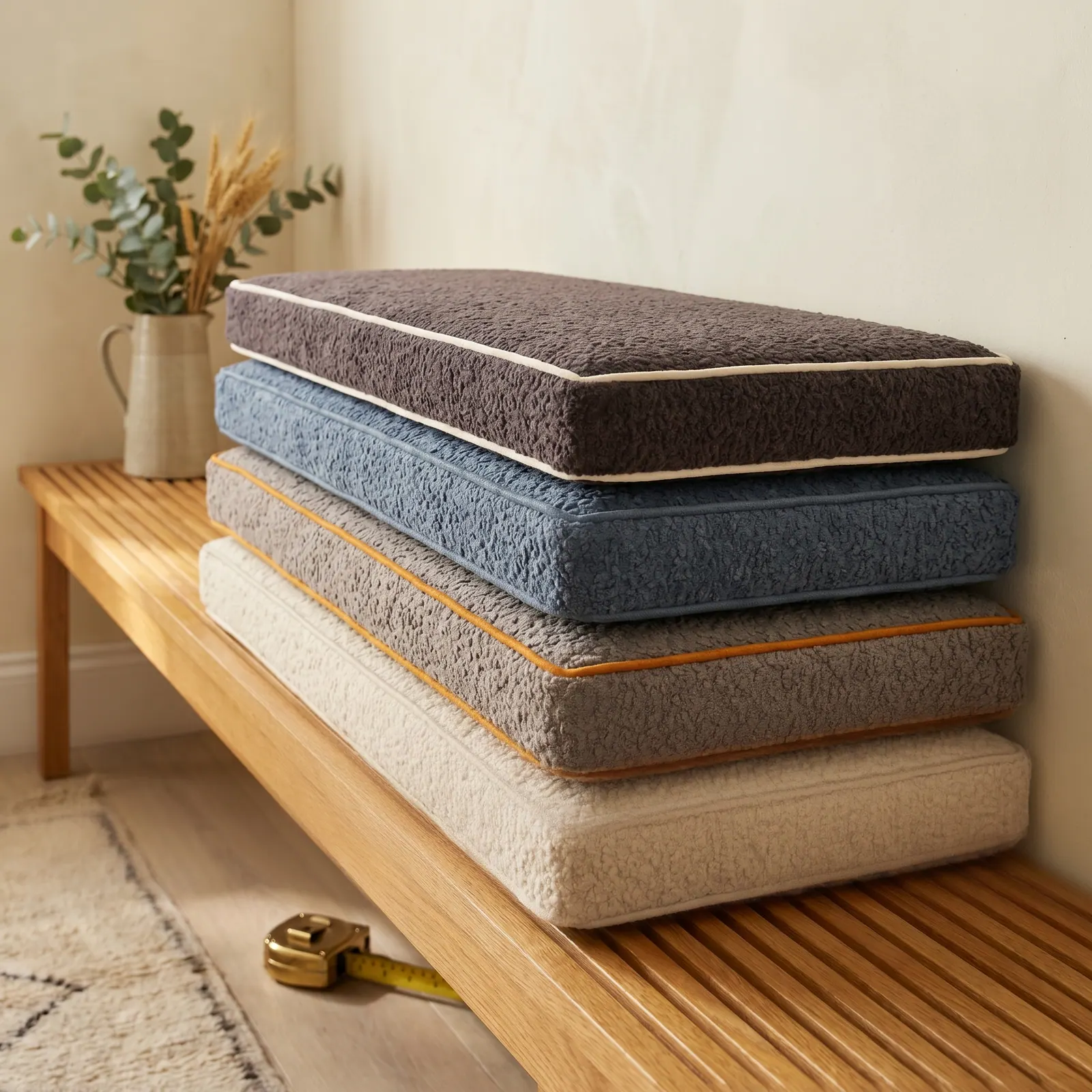
What each stair shape needs on paper
The trapezoid measuring Pattern walks each edge, and drawing a custom shape shows how to label the sketch. Fabric comes last: linen or cotton-linen for the bench, a performance weave if the dog gets the nook.
| Shape | Measure | Mark on the sketch | Order as |
|---|---|---|---|
| Understairs bench, one angled end | Front, back, square end, angled end, straight depth | Which end is angled, seen from the front | Custom shape with a drawing |
| Stair landing ledge | Length, depth, thickness | Where it sits; confirm any odd proportion | Rectangle, if all four corners are square |
| Foyer nook with a curve | The two straight sides | Which side curves, plus a wide photo | Custom shape with drawing and photo |
| Closet floor with a pointed end | Every edge, plus the depth | The square end and the pointed end | Custom shape with a drawing |
| Long trapezoid bench | Both long edges, both angled sides, depth | Thickness of the new cushion only | Custom shape; ask about two pieces past about 79 in (2 m) |
| Dog bed in the understairs nook | Length, width, thickness | Fabric to match the bench beside it | Rectangle |
Before the drawing leaves your hands
- Measure the depth straight out from the wall at 90 degrees. An angled side is always longer than the depth; if yours measures shorter, one of the two numbers is wrong.
- Measure each angled side on its own, corner to corner. On one bay seat in the US the left side ran 33.75 in (86 cm) and the right 33 in (84 cm).
- Check that the numbers close: steps plus the short edge must equal the long edge. In an older house, add both diagonals as a check on square.
- If front and back lengths differ, or there is a notch or a curve, order a custom shape and upload the drawing. If checkout never asks for one, you are on the rectangle route.
- Approve the maker's scale drawing before anything is cut. Every cushion is measured again after sewing; ask for photos that show the tape.
An understairs bench cushion is a trapezoid: three straight edges, one angled side, and that angled side always measures longer than the straight depth.
Nate
Stair and nook questions
- A common question
The cushion I need isn't a rectangle; one end is angled. How do I order it?
The workshop's answerThrough the separate custom-shape (trapezoid) option, not the rectangle one. Pick the size range by the longest length and the deepest depth; that only sets the price bracket. At checkout, upload a drawing with a measurement on every edge, plus a photo of the seat if you have one, and put the thickness and fabric code in the personalization box. The cushion is cut to the drawing, not to the totals. A plain paper sketch is fine; if it is hard to read, you will be asked to redraw it larger with each edge labeled.
- A common question
What exactly should I measure on an angled seat?
The workshop's answerEvery edge: the front, the back against the wall, both angled sides and any small clipped corners, plus the depth and the thickness. Take the depth straight from the highest point down to the base line, and measure each angled side separately, corner to corner, instead of repeating one number, because an angled side is not the depth. Mark cut-outs such as a window handle, label the drawing A, B, C, D, and send a photo of the space. Any missing side is asked for before the quote.
- A common question
One side of our entry nook follows a curved railing. Can you make a cushion for that?
The workshop's answerYes. Send the shape and measurements before ordering, with a few photos of the room taken from a distance and a sketch if you have one, so everything is agreed first. For a curved space the workshop needs the two straight sides to calculate the curve. It tells you up front whether a customization fee applies, which depends on size, and matching back pillows can be added.
- A common question
The bench under our stairs is long. Should the cushion be one piece or two?
The workshop's answerFor seats of about 98 to 118 in (2.5 to 3 m) and longer, the workshop suggests equal pieces for fit, durability and easier handling: 92 in (234 cm) as two 46 in (117 cm) cushions, for example, and a 197 in (500 cm) nook in three. Each piece is ordered at its own size. It stays your choice; one-piece seats have been made on request, and a photo with measurements gets you advice.

Have it made
Have an idea like this made — ask Nate’s workshop
Send the numbers in inches: length × depth × thickness, plus any angle. The workshop checks them with you, because foam has no undo button. — Nate
Leave your details and the workshop will call you to confirm measurements, fabric, foam and piping. No prices, dates or payment on this page: it is a request, not an order.
Questions buyers ask next
Is an understairs bench cushion a trapezoid?
Usually, yes. Most have three straight edges and one side cut to the angle of the stairs, which makes them a trapezoid in the maker's terms. If the front and back edges differ in length, or there is a notch or a curve, the cushion needs a drawing, not a rectangle order.
Why does my angled side measure longer than the depth?
Because it runs on a slant. Depth is taken straight out at 90 degrees, so any slanted edge between the same two lines has to be longer. On one 20 in (51 cm) deep bench the angled sides came out near 26 in (66 cm). If your slant measures shorter than the depth, measure again.
How thick should a stair landing or understairs cushion be?
The projects here ran 4 in (10 cm), the standard thickness, including a 34 x 6 in (86 x 15 cm) ledge cushion. A custom 4.5 in (11 cm) was offered on one angled bench, and thicker builds of 6 to 8 in (15 to 20 cm) are made on request at extra cost.
Can I see the finished cushion's size before it ships?
Yes. Every cushion is measured after sewing and every order is photographed before it ships. For a custom shape you can ask for photos that show the measurements, which is the easiest way to confirm the angled end came out as drawn.