A Reading by NateTrapezoid & Angled Cushions
An indigo trapezoid bench cushion with ivory piping, and the case for contrast
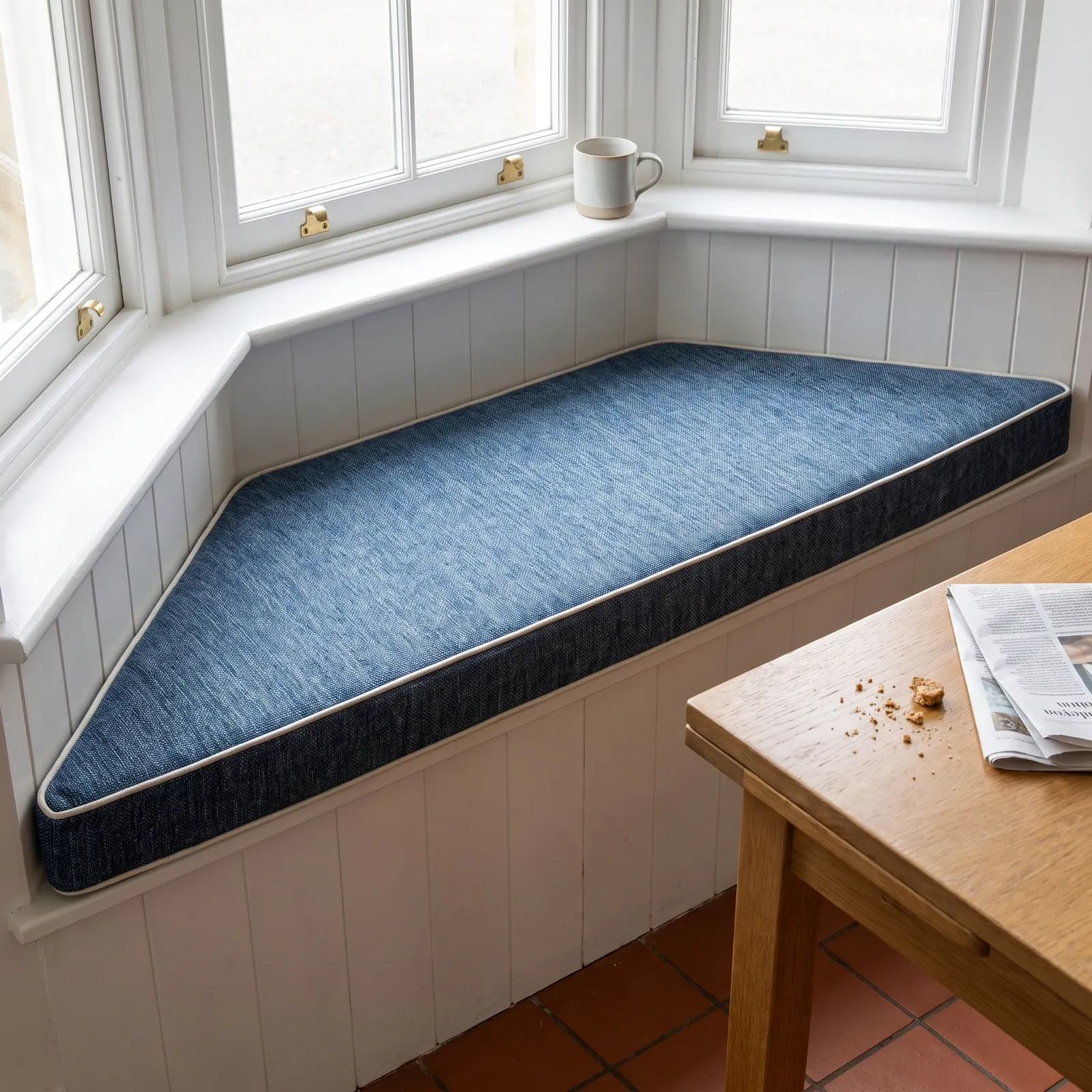
Nate answers three buyer questions first, then reads a breakfast bay where a thin ivory welt draws the geometry of a long taper.

 Save
The quick answer
On a trapezoid bench cushion, contrast piping is worth it when the shape itself is the point. A thin ivory welt on indigo traces the angled ends so the taper reads as intentional; self piping keeps the outline quiet and forgives uneven walls; no piping gives the softest edge. Measure back, front, left and right separately, because the sides are rarely identical.
Buyer questions, before the reading: tracking labels, linen shades, low backs
- A common question
Tracking says my package weighs 2 lb and measures 4 x 4 in (10 x 10 cm). Is that really my cushion?
The workshop's answerThe size and weight in the label data can be placeholder values. Ignore them and follow the tracking status instead.
- A common question
Which neutral linen colors do you carry, and can you quote three cushions together: 48 x 20 in (122 x 51 cm), 41 x 18 3/4 in (104 x 48 cm) and 14 x 9 in (36 x 23 cm)?
The workshop's answerThe workshop sent the color chart for its natural linen series and quoted all three cushions as one order. The buyer then added a fourth cushion and picked two shades from that series.
- A common question
I'm worried the back cushions will sit too low on my sofa. What can I do if they do?
The workshop's answerIf the back feels too low, extra cushion pieces can be added to raise it. The workshop couldn't estimate what returning the sofa itself would cost.
Now, the reading
Four sides, four numbers, one honest wall
A buyer in the US sent four measurements for a wide angled window seat: 68 1/4 in (173.4 cm) at the back against the wall, 113 3/4 in (288.9 cm) along the front edge, 33 3/4 in (85.7 cm) on the left side and 33 in (83.8 cm) on the right.
Look at the sides. They differ by 3/4 in (1.9 cm), which is normal for real walls. The right move is to order to the numbers as measured, not to tidy them into a symmetrical shape, and the workshop quoted the custom shape on exactly those four figures. That is 45 1/2 in (115.6 cm) of taper shared between two angled ends, and neither end has to copy the other.
The rule: measure every side of a trapezoid separately. The trapezoid cushion calculator takes all four lengths, and the same logic holds in any angled kitchen nook.
Pinned by Nate: five marks in a breakfast bay
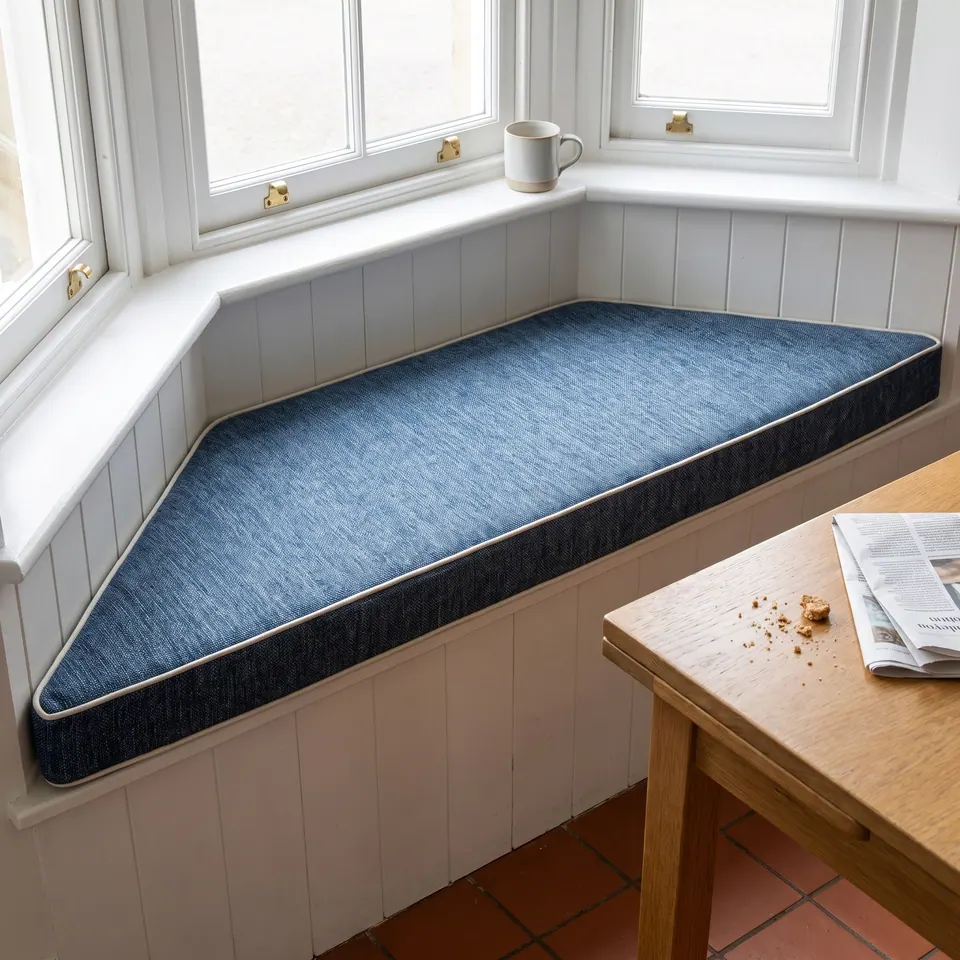
Five pins, from the mug on the sill to the long angled end where the taper meets the paneling.
- Mug on the sill
A mug left on the ledge tells you this seat is used for breakfast, not just looked at.
- Angled left end
The long taper follows the side of the bay so the cushion meets the paneling along its whole length.
- Ivory piping
A thin pale welt matches the painted paneling and outlines the unusual shape.
- Denim-look weave
Slubby indigo hides crumbs and coffee drips far better than a flat solid.
- Table and newspaper
The table sits close enough to eat from the seat, which sets the cushion thickness.
- Mug on the sillA mug left on the ledge tells you this seat is used for breakfast, not just looked at.
- Angled left endThe long taper follows the side of the bay so the cushion meets the paneling along its whole length.
- Ivory pipingA thin pale welt matches the painted paneling and outlines the unusual shape.
- Denim-look weaveSlubby indigo hides crumbs and coffee drips far better than a flat solid.
- Table and newspaperThe table sits close enough to eat from the seat, which sets the cushion thickness.
Self, contrast or none: what each does to a long taper
The reading starts with a mug, partner. Left on the sill, it says this bay is used for breakfast, not admired from the doorway. That one fact sets the rest of the spec.
Thickness first. The oak table sits close enough to eat from the seat, so the cushion is a firm, fairly thin trapezoid cushion that holds the seat at table height rather than a plump lounging pad. Measure from the tabletop down, subtract the cushion, and check that knees still fit; the banquette thickness table does the arithmetic.
Fabric second. Indigo linen-look with a slubby denim feel is a kitchen choice. The irregular weave hides crumbs and coffee drips that a flat solid would announce.
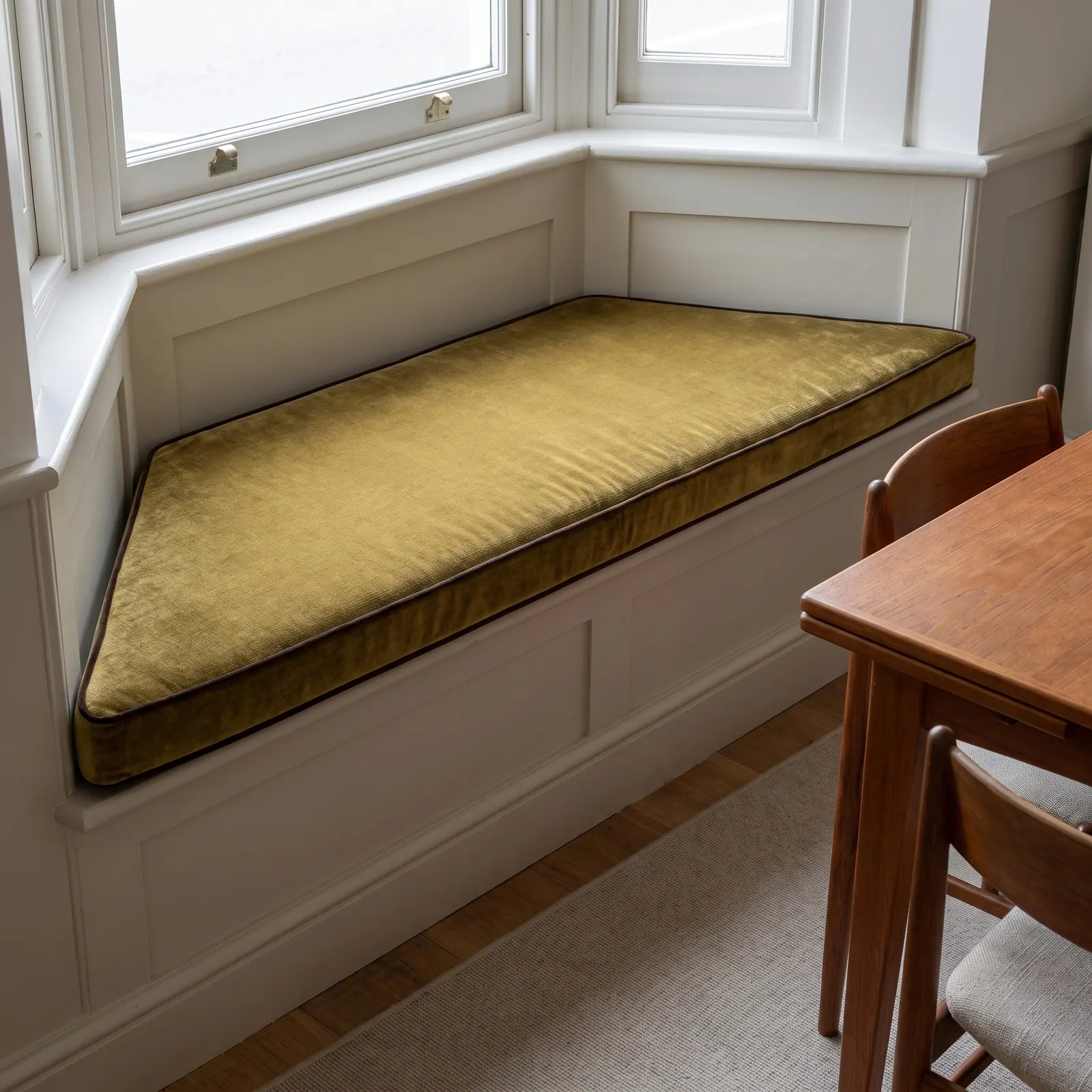
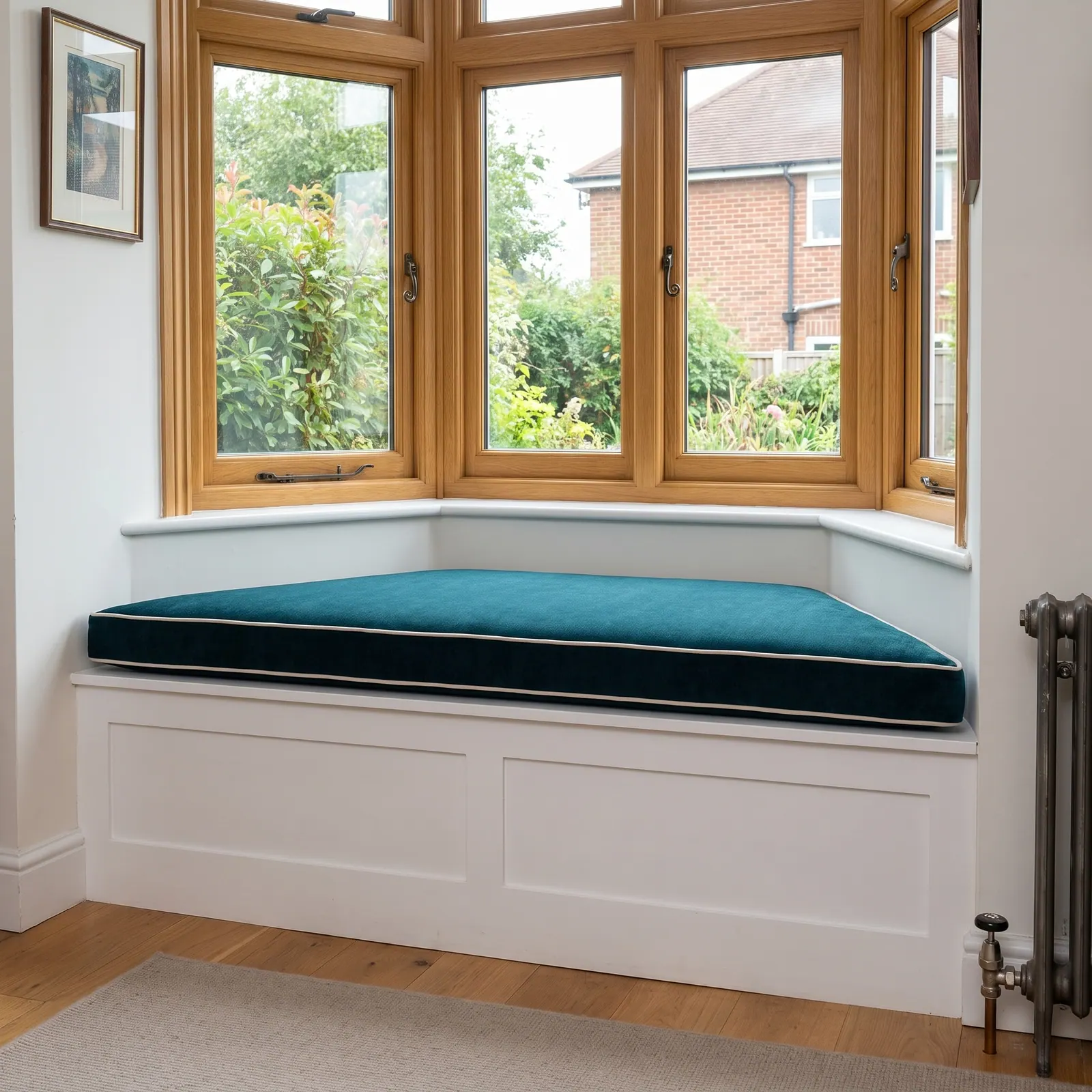
Now the piping. The long taper on the left end follows the side of the bay, so the cushion meets the tongue-and-groove paneling along its whole length. That angle is the unusual part of the shape, and the ivory welt traces it. Ivory was not a random pick: it matches the painted paneling, so the outline reads as part of the room.
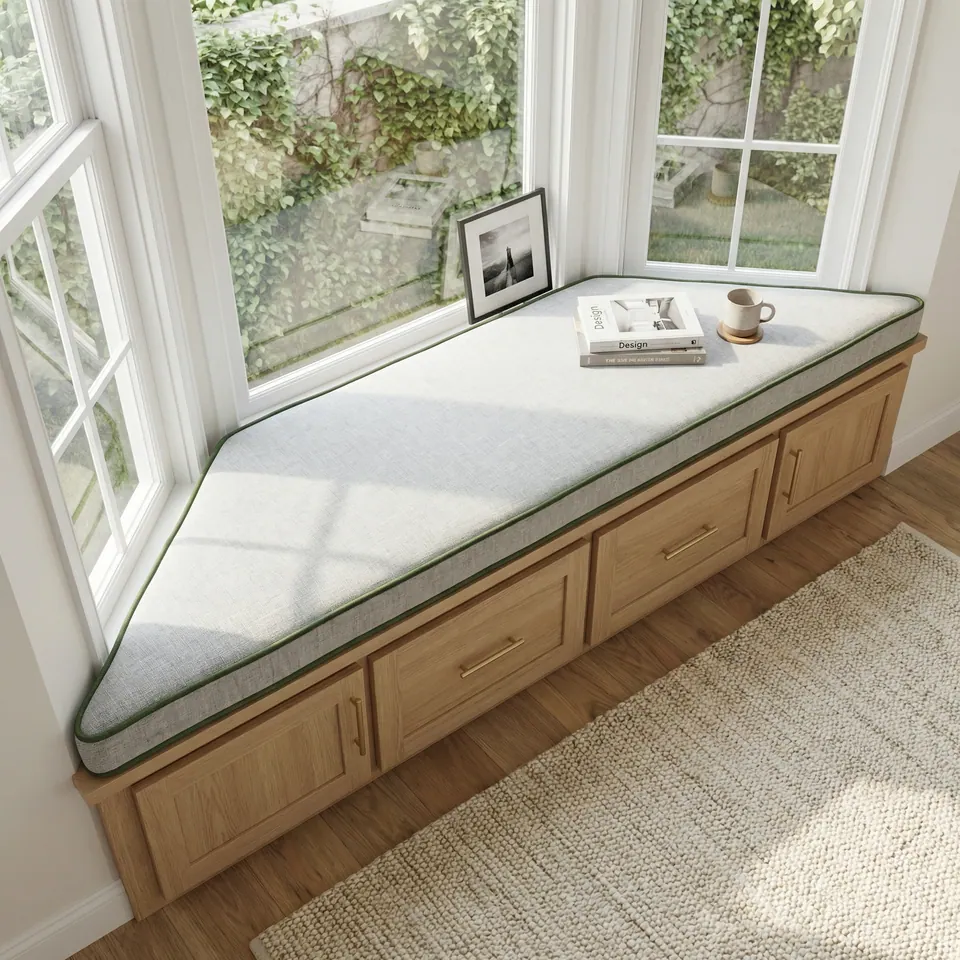
Contrast piping is a drawing tool. It shows the eye every corner cut, which is good news when the cuts are true and bad news when a wall is out of square. Self piping turns the cushion into one indigo block and forgives a wandering wall. No piping gives the softest, most relaxed edge. Angles are just lengths in disguise, and contrast piping puts those lengths on display. The piping guide sets all three side by side.
Terracotta quarry tiles and the oak table warm the blue, which is why this bay needs no pillows at all. The folded newspaper and the brass sash catches finish the morning.
Which should people notice first in your nook: the shape or the color?
Piping on an angled seat, three ways
| Piping | What the eye does | Choose it when |
|---|---|---|
| Contrast (ivory on indigo) | Follows the outline and reads every angle | The shape is the feature and the corner cuts are true |
| Self (indigo on indigo) | Sees the block of color first, the edge second | Walls are out of square or the room is already busy |
| None | Reads a soft, rounded edge | You want a relaxed look over a tailored one |
On the cutting table: the breakfast bay trapezoid
| Product | Trapezoid box cushion for an angled kitchen bay |
|---|---|
| Fabric | Indigo linen-look with a slubby denim feel |
| Piping | Contrast ivory welt, matched to the painted paneling |
| Edge | Box edge, firm and fairly thin |
| Seat height | Set by the table, not by lounging |
| Measurements | Back, front, left, right and thickness, each on its own |
| Tolerance | Sides may differ; state them as measured, ± 1/4 in |
| Pillows | None; tile and oak warm the blue |
| Best for | Breakfast bays and angled nooks used for meals |

Have it made
Have this made — ask Nate’s workshop
Every edge and both diagonals, to the nearest 1/4 in. If the numbers do not close, the workshop will say so on the call. — Nate
Leave your details and the workshop will call you to confirm measurements, fabric, foam and piping. No prices, dates or payment on this page: it is a request, not an order.
Contrast piping on a trapezoid cushion draws every angle for you, so the corner cuts must be true; self piping forgives a wall that is 3/4 in (1.9 cm) out.
Nate
Questions buyers ask next
Is contrast piping a good idea on an angled window seat cushion?
Yes, when the angles are cut true and you want the shape noticed. A pale welt on a dark cushion outlines each corner. If your walls are out of square, self piping hides small differences better.
Why are the two sides of my bay seat different lengths?
Real walls are rarely perfectly square. On one bay seat the left side measured 33 3/4 in (85.7 cm) and the right 33 in (83.8 cm). Give both numbers and order to them as measured.
How thick should a trapezoid cushion be in a breakfast nook?
Thin enough that knees still clear the table. Measure from the tabletop down to the bare seat, subtract the cushion thickness, and check the gap; a firm, fairly thin cushion keeps the seat at eating height.
± 1/4 in — Nate
More photographs to read
 Save
 Save
 Save
 Save
 Save
 Save