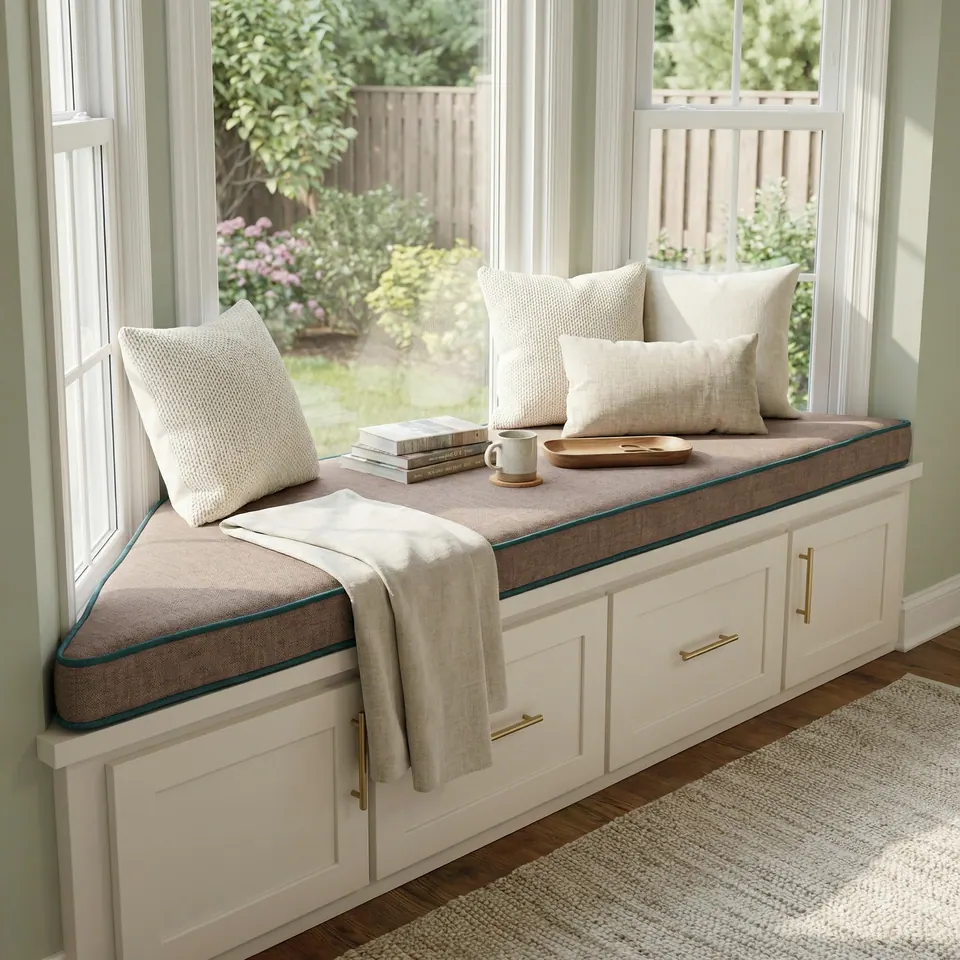
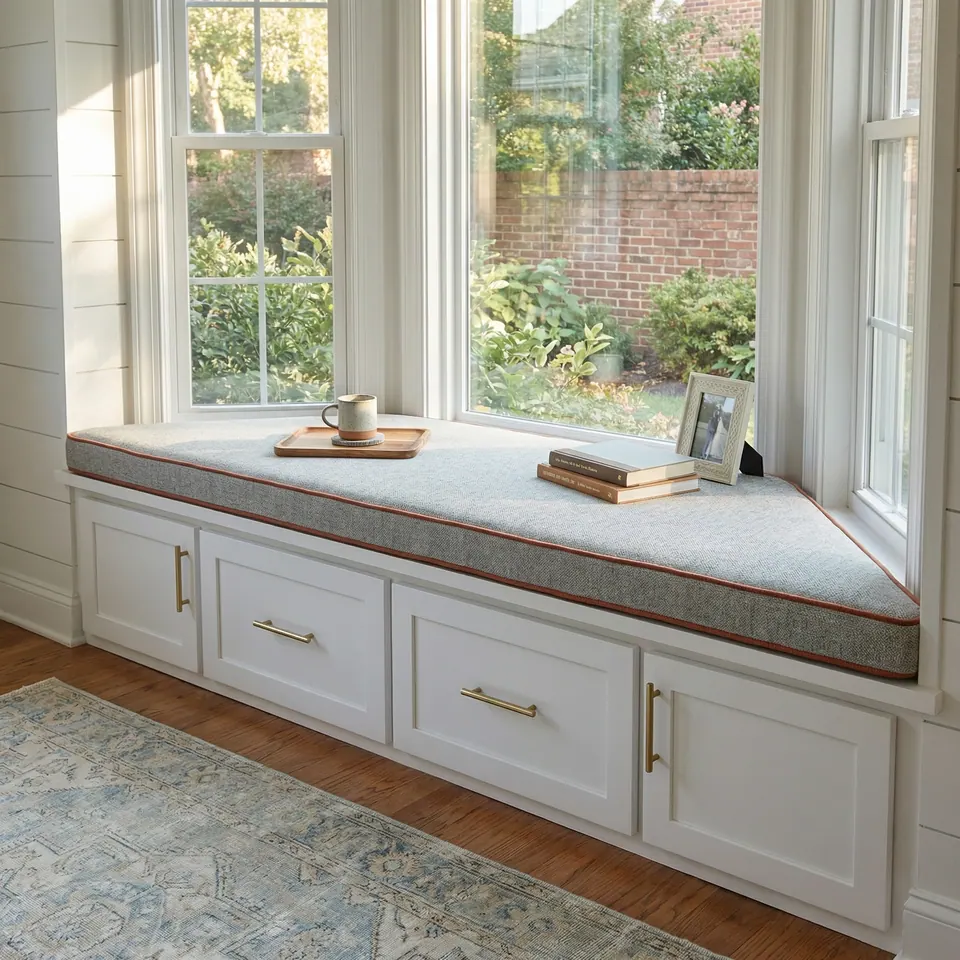
The Cutting Table · a checklist answer
What happens if the slanted sides on my trapezoid drawing don't add up?
Also asked as:Is my sketch measurement correct?Slanted side length for a trapezoid cushion?
The math gets done before the shears come out. You decide which number wins.

 Save
The quick answer
On a trapezoid cushion, the top, bottom and straight depth decide the slanted side length, so the workshop recalculates your sides before cutting. Slanted sides must always be longer than the depth. A 1 in (2.5 cm) gap between your tape and the math is common, and you choose whether your depth or your side length takes priority.
Get a quote for a trapezoid bench cushion
Key facts
- Top, bottom and depth determine the slanted side length.
- Slanted sides are always longer than the straight depth.
- Given front, back and depth, the workshop calculates the angled sides and sends a diagram.
- A 1 in (2.5 cm) discrepancy is common with hand measuring.
- You're asked whether the depth or the side length takes priority.
- Measure each angled edge directly, corner to corner.
- Upload the approved diagram in the measurement section when you order.

Have it made
Have Nate’s workshop cut this for you
Send the numbers in inches: length × depth × thickness, plus any angle. The workshop checks them with you, because foam has no undo button. — Nate
Leave your details and the workshop will call you to confirm measurements, fabric, foam and piping. No prices, dates or payment on this page: it is a request, not an order.
Four checks before you send the drawing
- Each slanted side is longer than the straight depth. If yours is shorter, re-measure.
- The depth isn't written twice, once as depth and again as a side.
- Each angled edge was measured directly, corner to corner, not worked out.
- You know which number is fixed: the depth or the side.
Three drawings, rechecked at the cutting table
| Bottom / top / depth | Sides written | Sides by the math |
|---|---|---|
| 115 / 82 / 20 in (292 / 208 / 51 cm) | Not given | About 26 in (66 cm) |
| 70¾ / 39¼ / 21¼ in (180 / 100 / 54 cm) | 25½ in (65 cm) | 26½ in (67 cm); made at 26½ in (67 cm) |
| 110 / 68 / 23 in (279 / 173 / 58 cm) | 32 in (81 cm) | About 31 in (79 cm); depth kept |
Why the math wins, and when you overrule it
On an even trapezoid cushion, each slanted side is the long side of a right triangle. One leg is the depth; the other is half the difference between bottom and top. For a 115 in bottom and 82 in top, that half is 16½ in; with a 20 in depth, the side comes to about 26 in (66 cm). No tape required, partner.
The tape still matters, because real walls aren't perfect. So the workshop asks which number is true for your seat. Usually it's the depth: it stays as written, and the sides are worked out exactly. Run your own numbers in the trapezoid cushion calculator, and see the trapezoid measurements Pattern for the full layout. Which number on your drawing are you least sure of?
On a trapezoid cushion with a 110 in bottom, 68 in top and 23 in depth, the slanted sides come to about 31 in, not the 32 in on the sketch.
Nate
Buyer questions
- A common question
My sketch says 25½ in (65 cm) for the slanted sides. What if that doesn't match?
The workshop's answerBottom, top and depth always set the slant, so the geometry is checked before cutting. With a 70¾ in (180 cm) bottom, 39¼ in (100 cm) top and 21¼ in (54 cm) depth, the sides come to 26½ in (67 cm), so they were made at 26½ in (67 cm).
- A common question
How do I know my trapezoid numbers are right before you cut?
The workshop's answerEach slanted side should be a bit longer than the depth. One buyer listed a 17 in (43 cm) depth and the same 17 in for a side: the depth had been written twice. Both sides measured 22¾ in (58 cm), for a true depth of about 16¼ in (41.5 cm).
- A common question
Do you follow my depth or my side length?
The workshop's answerYou decide. With a 68 in top, 110 in bottom and 23 in depth, the sides work out to about 31 in, not the 32 in written, a gap that's very common with hand measuring. That buyer kept the 23 in depth with the exact 31 in sides.
Questions buyers ask next
Is a trapezoid cushion priced like a rectangle of the same size?
No. It's quoted per piece from every side length, the thickness and the fabric, and it costs more than a same-size rectangle. Send a labeled drawing and a photo; mixed sets are quoted together.
My window seat isn't a trapezoid at all. Can it still get a cushion?
Yes, any size and shape. Draw the seat on paper with every side measured, photograph the drawing and the space, and the workshop redraws it for your confirmation before quoting.
Which trapezoid measurement is usually treated as fixed?
The depth, most often. The workshop typically keeps your fixed depth and uses the mathematically exact sides, but it asks first, so tell it if your side measurement is the one you trust.