A Reading by NateTrapezoid & Angled Cushions
A forest green trapezoid bench cushion with copper welt, and one family's four measurements
Nate opens his notebook to a family's newly built angled bench, works its four edge lengths into a depth and an angle, then reads a green window seat finished with a copper welt.

 Save
The quick answer
To order a trapezoid bench cushion, send all four edge lengths, not just width and depth. One family's bench measured 103 in along the back, 56 in along the front and 34 in on each angled side, for a 3 in cushion. From those four numbers the depth, about 24 5/8 in, and the corner angles follow.
The family bench: 103, 56, 34, 34
A family in the US built a new bench with an angled, trapezoid seat and wrote to the workshop for a 3 in (7.5 cm) cushion. Their numbers, exactly as sent: 103 in (262 cm) along the back, 56 in (142 cm) along the front, and 34 in (86 cm) on each angled side.
That is the right message, partner. Four edges. A width and a depth are not enough to draw a trapezoid, because the same two numbers fit a dozen different shapes. With all four edges and equal sides, the outline is fixed: there is exactly one shape it can be.
The workshop quoted it as a single shaped cushion, one piece following the whole outline. The note I wrote in the margin that day: for any angled bench, give every edge length, back, front and both sides, and let the geometry come from the edges.
Graph-paper math: what four edges give you
| Measurement | Value | Source |
|---|---|---|
| Back edge | 103 in (262 cm) | Measured by the family |
| Front edge | 56 in (142 cm) | Measured by the family |
| Each angled side | 34 in (86 cm) | Measured by the family |
| Step-in per side | (103 − 56) ÷ 2 = 23.5 in (60 cm) | Worked out |
| Seat depth | √(34² − 23.5²) ≈ 24 5/8 in (62.4 cm) | Worked out |
| Back corner angle | About 46°; front corners about 134° | Worked out |
| Thickness | 3 in (7.5 cm) | Chosen by the family |
Reading the green seat: copper, an angled end and a tray
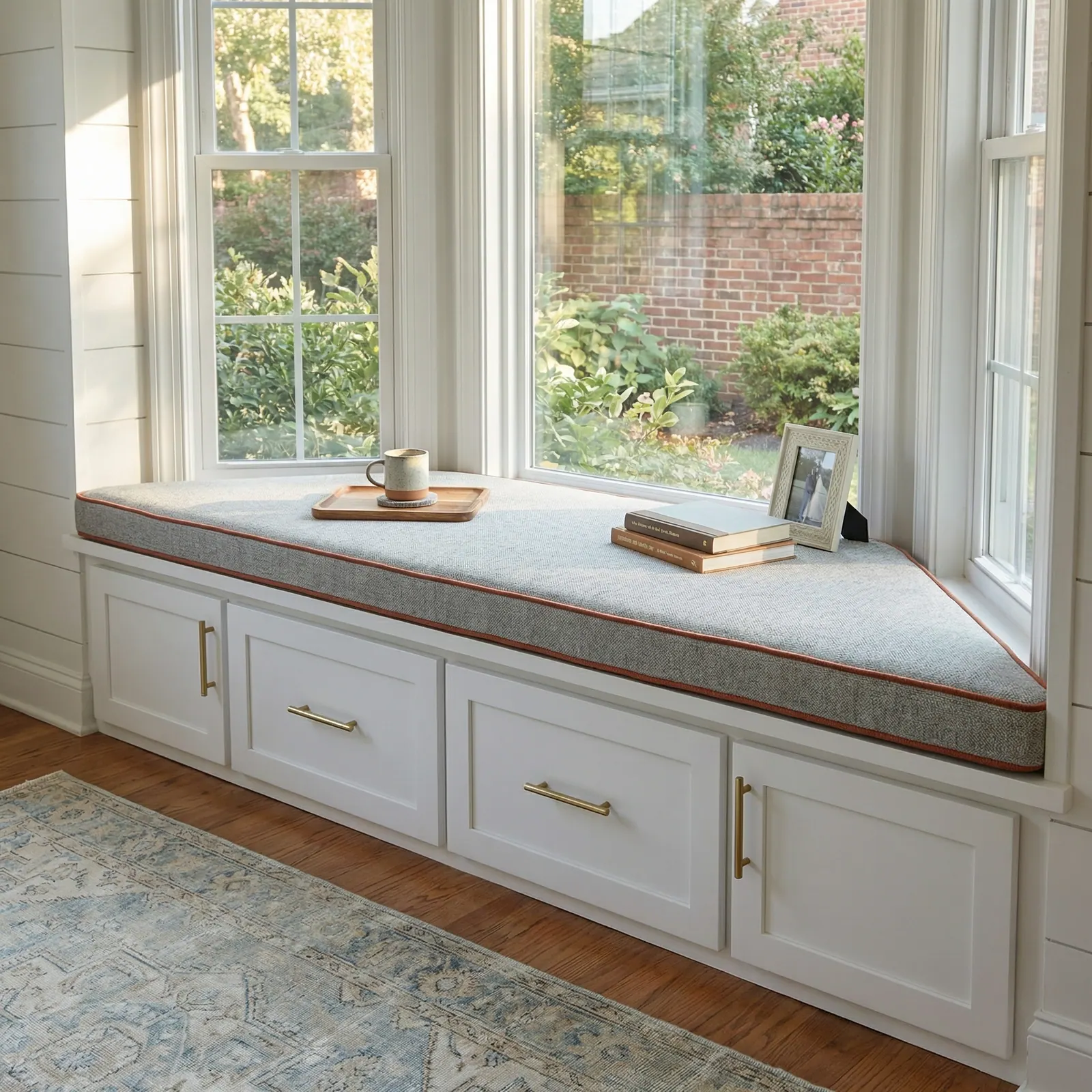
Now the photograph, which shows a different bench with the same problem solved.
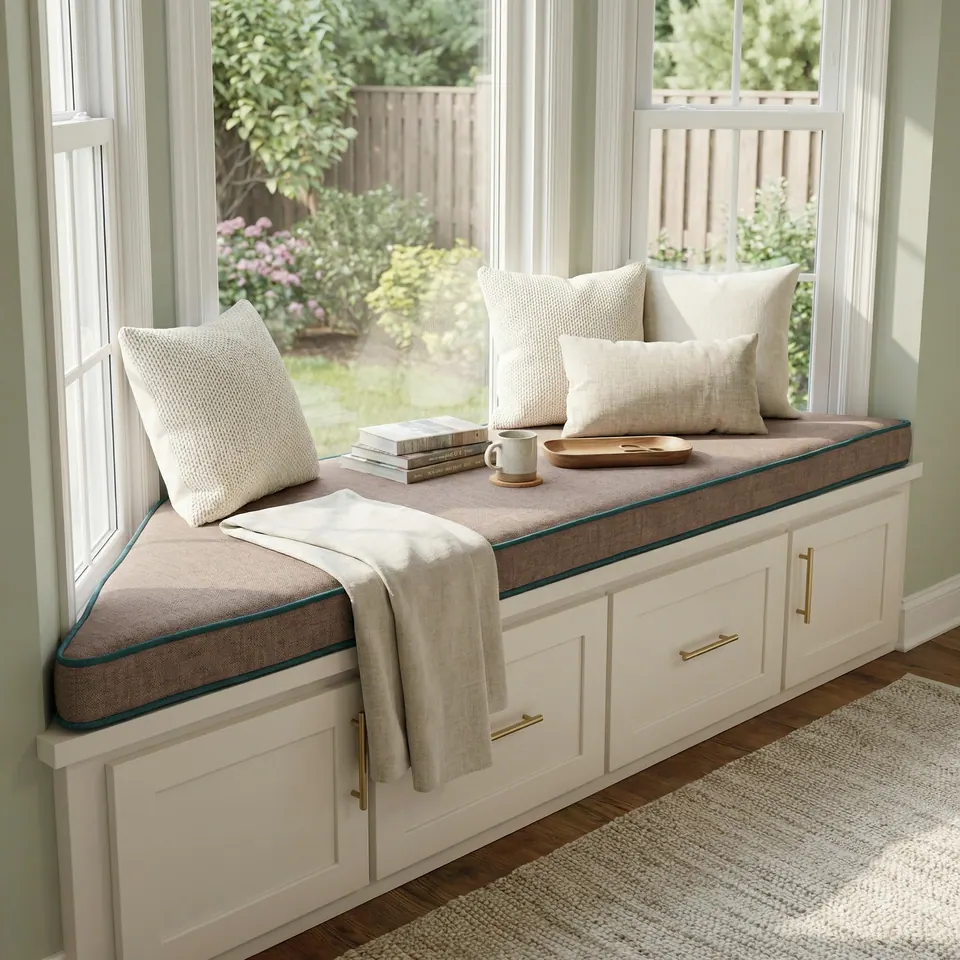
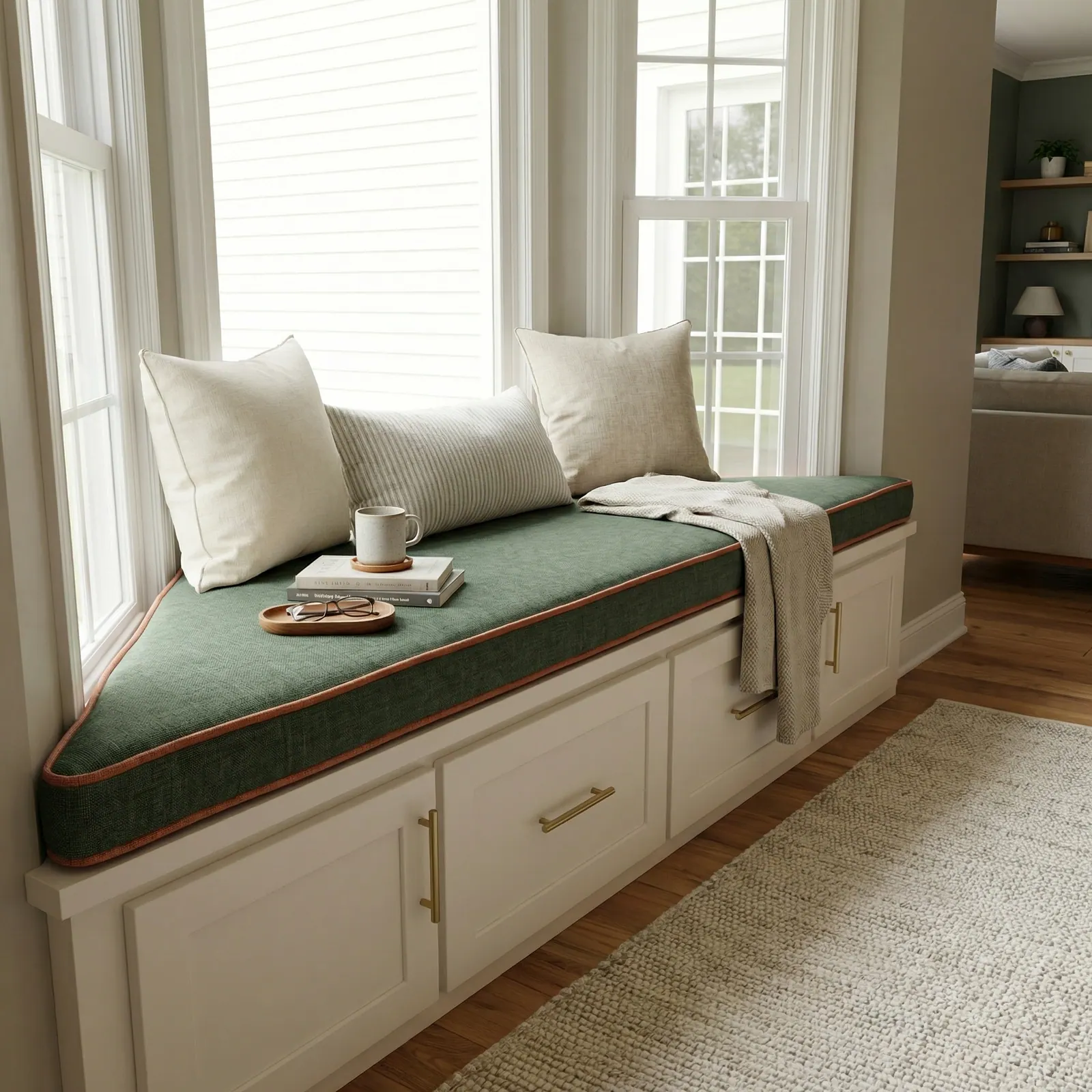
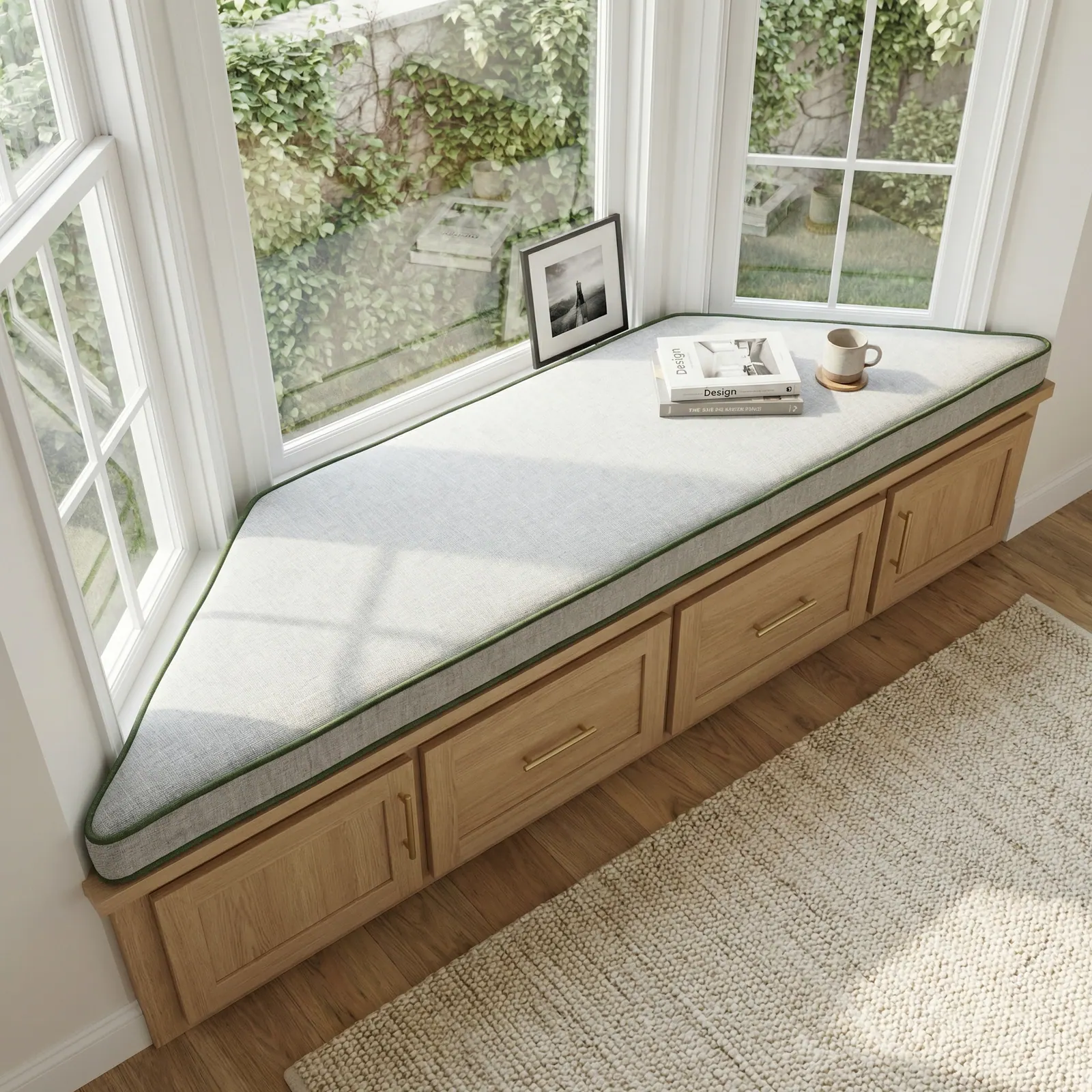
The cushion is forest green linen-look cloth, boxed, with a copper contrast welt. Look at the left end. It is cut to the bay's angle, so the green runs right into the window corner with no gap and no tuck. Angles are just lengths in disguise, and somebody measured these.
Why copper on green? It is the old library-chair pairing, and here it has a job: the welt picks up the brass bar pulls on the white Shaker cabinet below and the warm tone of the floor. Deep green also repeats the painted shelving in the room beyond, so the nook looks planned with the whole space rather than added to it.
The props, sorted by function. Two ivory linen pillows hold the back. A gray ticking lumbar sits between them, a fine stripe to break two plain shapes. A small wooden tray keeps the reading glasses from sliding into the seat. A white mug rests on two books, and an oatmeal knit throw waits for evening. The jute rug below and the table lamp in the background finish the library feel. What do your four edges measure?
For your own bench, the trapezoid cushion calculator turns four edges into a drawing, the trapezoid measuring pattern shows where to hold the tape, and finished angled seats live among our trapezoid cushions. The green cloth sits on the linen-look shelf.
Pinned by Nate
Start at the copper welt on the front edge, then follow the pins to the angled left end, the tray, the ticking lumbar and the green shelving beyond.
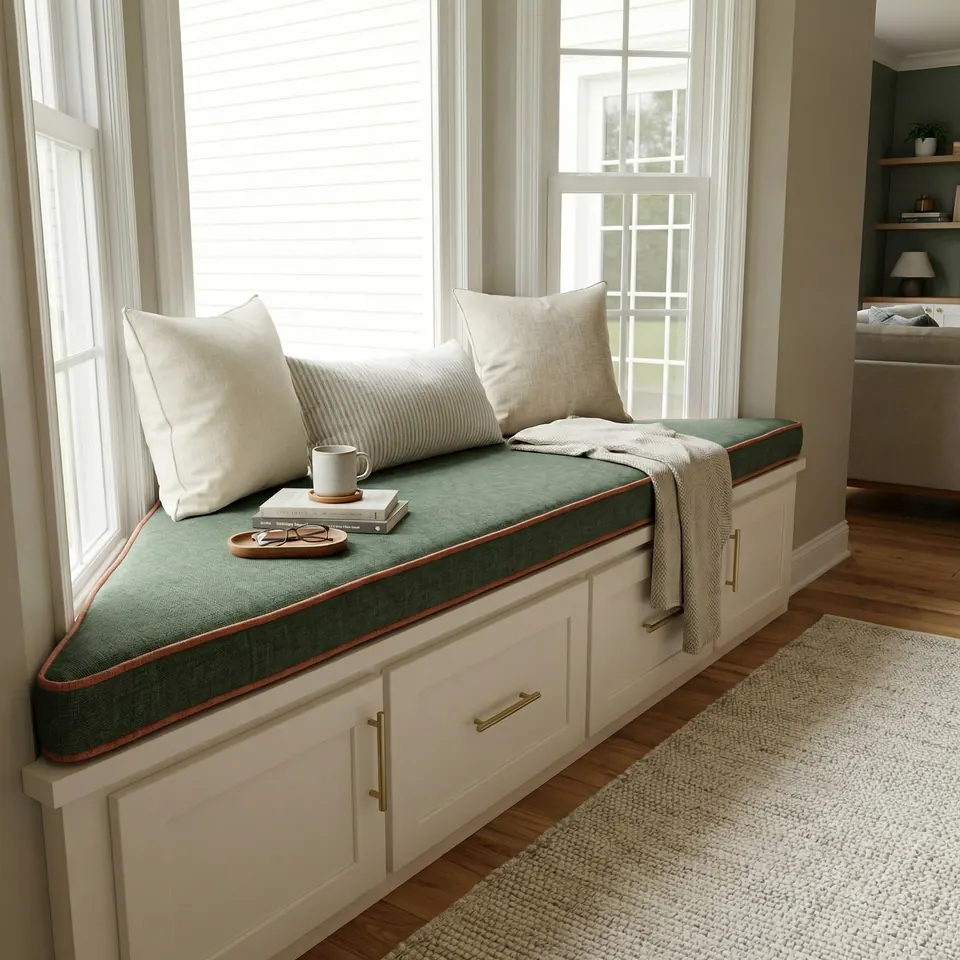
- Copper welt
Copper on deep green borrows from library chairs and matches the brass pulls.
- Ticking lumbar
A fine gray stripe sits between two plain pillows for quiet pattern.
- Tray with glasses
A small wooden tray keeps reading glasses from sliding into the seat.
- Angled left end
The end is cut to the bay angle so the green runs right into the window corner.
- Green shelving beyond
The cushion repeats the painted shelving, so the nook looks planned with the room.
- Copper weltCopper on deep green borrows from library chairs and matches the brass pulls.
- Ticking lumbarA fine gray stripe sits between two plain pillows for quiet pattern.
- Tray with glassesA small wooden tray keeps reading glasses from sliding into the seat.
- Angled left endThe end is cut to the bay angle so the green runs right into the window corner.
- Green shelving beyondThe cushion repeats the painted shelving, so the nook looks planned with the room.
Measurement table: the green bay seat
| Piece | Trapezoid window seat cushion |
|---|---|
| Fabric | Forest green linen-look |
| Piping | Copper contrast welt |
| Edge | Box |
| Ends | Cut to the bay angle; left end flush to the window corner |
| Measure | All four edges: back, front and both sides |
| Thickness | 3 in (7.5 cm) in the family's build |
| Pillows | Two ivory linen, one gray ticking lumbar |
| Best for | An angled reading nook in a living room |

Have it made
Have this made — ask Nate’s workshop
Precision starts on the phone. Give the workshop your measurements and they will read them back to you, edge by edge. — Nate
Leave your details and the workshop will call you to confirm measurements, fabric, foam and piping. No prices, dates or payment on this page: it is a request, not an order.
Buyer questions: velvet sheen, pale blue linen and tufting
- A common question
Is your deep navy velvet a performance polyester or cotton, and is it matte or shiny, short pile or long?
The workshop's answerIt is a polyester-blend velvet with more sheen than a matte finish, and a short, tight pile that feels smooth and soft rather than long.
- A common question
My linen arrived a darker blue than the listing photo. Did I get the wrong fabric?
The workshop's answerListing photos are taken in bright light, so some fabrics look paler online. L-41 is the palest blue in the linen range, and lighter blues sit in other fabric charts. Even when the correct fabric was used, the workshop asks what solution you would like. Close-up or finished-cushion photos, or swatches, are the safest way to judge before ordering.
- A common question
Why does a tufted bench cushion cost more than a plain foam one?
The workshop's answerBecause tufting is done entirely by hand. On a set of three dining bench cushions the tufted quote came in well above the plain foam-filled one, and a tufted replacement floor cushion likewise cost more than a plain one.
A trapezoid bench cushion cannot be drawn from width and depth alone; with 103 in back, 56 in front and two 34 in sides, the shape is fixed.
Nate
Questions buyers ask next
How do I work out the depth of a trapezoid bench from its four edges?
Subtract the front edge from the back edge and halve it to get the step-in on each side. The depth is then the square root of the side length squared minus the step-in squared. For 103, 56 and 34 in, that is about 24 5/8 in.
Why pair copper piping with a forest green cushion?
Copper on deep green is a classic library-upholstery pairing. The warm metal tone links the cushion to brass hardware and wood floors nearby, so the seat ties into the room instead of standing apart from it.
Can a long trapezoid seat be made as a single piece?
It can. A family's bench with a 103 in back edge was quoted as one shaped cushion following the whole outline. If you would rather have sections, ask before ordering, since the split changes the drawing.
± 1/4 in — Nate
More photographs to read
 Save
 Save
 Save
 Save
 Save
 Save