A Reading by NateTrapezoid & Angled Cushions
A trapezoid bench cushion in dusty blue bouclé, read at ten feet and at ten inches
Nate's notebook on one angled window seat: the silhouette you see from the doorway, the loops you see up close, and the numbers that make both come out right.

 Save
The quick answer
A trapezoid bench cushion reads correctly from across a room only if its angled end matches the bay wall, so measure the back length, the front length and the depth before anything else. Up close, bouclé loops and self piping add softness, but from ten feet the eye sees just two things: the silhouette and one unbroken run of color.
Page one: the doorway test
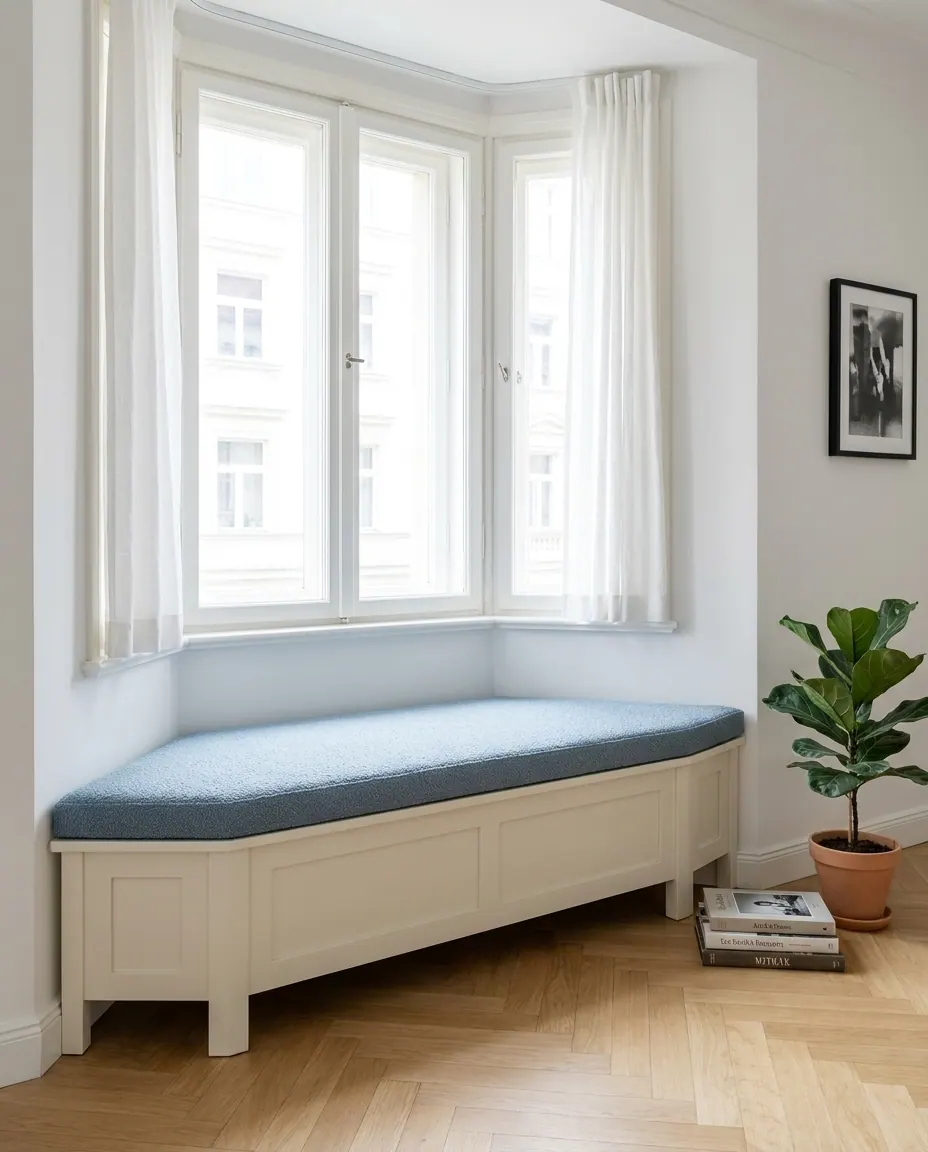
Stand in the doorway, partner. From ten feet (3 m) back, this window seat is three shapes and one color: a long dusty blue band, a square left end and an angled right end. That is all the eye takes in at that distance, so those three things have to be right.
Walk up to ten inches (25 cm) and the story changes. Now you see the bouclé loops, the self piping along the top edge, the box edge standing square. Those details make the cushion pleasant to touch. They do not rescue a wrong angle.
My notebook rule: silhouette first, surface second. A cushion with a lovely nubby texture and an end cut a few degrees off will look wrong from the doorway every single day.
Three things read from ten feet on this bay: - One run, no seam. A single cushion covers the whole bench, so the blue band is unbroken. A seam across the middle would show from the far wall. - Two different ends. Square on the left, angled on the right. Bays often need a different angle on each side. - A slim profile. The bench is shallow and the cushion kept low, so the tall casement windows and white panels stay the main event.
Three read only up close: the loop texture, the piping line, and how dusty blue drifts toward gray in cool daylight. The styling respects that split. A fiddle leaf fig in a terracotta pot gives the only warm note, and the books sit in a stack on the herringbone floor, not on the seat.
Put numbers to your own bay in the trapezoid cushion calculator, or read the trapezoid measuring pattern. More angled seats live in the trapezoid cushion atlas.
Measuring the angled end, in order
Back length
Measure along the wall where the cushion's back edge will sit, corner to corner. Write it to the nearest 1/4 in (6 mm).
Front length
Measure along the front edge of the bench. On a trapezoid this is a different number from the back. If the two match, you have a rectangle and a quiet afternoon.
Depth at both ends
Measure front to back at each end and in the middle. Shallow benches like this one leave little room for error.
Trace the angle
Press paper into the angled corner and trace it. Angles are just lengths in disguise, and a tracing records both.
Sketch plus photo
Draw the shape, write every side length on it, mark left and right, and photograph the bench. Send all of it in one message.
Measurement table: the corner bay seat
| Piece | Trapezoid window seat cushion, one piece |
|---|---|
| Ends | Left square; right cut to the bay wall angle |
| Fabric | Bouclé in dusty blue |
| Edge | Box |
| Piping | Self, same bouclé |
| Profile | Slim, to suit a shallow bench |
| Must send | Back length, front length, depth, end tracing |
| Long runs | One piece on request, no center seam |
| Best for | Corner bays and angled window benches |

Have it made
Have this made — ask Nate’s workshop
Precision starts on the phone. Give the workshop your measurements and they will read them back to you, edge by edge. — Nate
Leave your details and the workshop will call you to confirm measurements, fabric, foam and piping. No prices, dates or payment on this page: it is a request, not an order.
Pinned by Nate
Pins run left to right: the square end, the seamless seat, the angled end, then the fig and the book stack that keep the seat clear.
- Dusty blue seat
A single cushion runs the whole bench, so there are no seams across the seat.
- Angled right end
The end is cut at the same angle as the bay wall, which is what makes it a trapezoid.
- Square left end
One square end and one angled end: bays often need a different angle on each side.
- Fiddle leaf fig
A terracotta pot adds the only warm color next to cool blue and white.
- Floor stack of books
Books on the floor keep the seat clear for sitting.
- Dusty blue seatA single cushion runs the whole bench, so there are no seams across the seat.
- Angled right endThe end is cut at the same angle as the bay wall, which is what makes it a trapezoid.
- Square left endOne square end and one angled end: bays often need a different angle on each side.
- Fiddle leaf figA terracotta pot adds the only warm color next to cool blue and white.
- Floor stack of booksBooks on the floor keep the seat clear for sitting.
Every side length, before the scissors
A buyer in the US wanted two houndstooth cushions: an ordinary rectangle and an odd-shaped piece, sent as a sketch with measurements. The quote came with 10 days of processing. Before cutting, the shop asked for every side length and a photo of the space.
The buyer then tried to cancel. The shop had already started, and by then it had confirmed the odd piece was a trapezoid. Production also slipped a few days because of a family illness.
My engineering note: asking for every side was the right call. A trapezoid sketch with two numbers on it is a guess. With all four sides and a photo, it is a drawing. The angled corner bench sketches show more of these shapes.
Double rubs, corner quotes and long cushions
- A common question
Is your fabric rated above 50,000 double rubs? It's for a bench that gets daily use.
The workshop's answerThe shop has no official double-rub (Wyzenbeek) test certificates, so it can't quote a number. Its fabrics are upholstery grade and hold up well to daily use, with rare durability complaints. For heavy use the outdoor fabrics are the toughest, and velvet and soft fabrics also wear well.
- A common question
What would cushions cost for a corner banquette of roughly 8 by 7 feet?
The workshop's answerThe shop first asked for the seat depth. With sides of 85.5 in (217 cm) and 94.5 in (240 cm) and a 24 in (61 cm) depth, it sent a written quote with a first-order reduction, noting that it uses quality fabrics and high-density foam that last many years.
- A common question
Will a very long bench cushion arrive in one piece, or with a seam in the middle?
The workshop's answerFor very long cushions, around 104 in (264 cm), the shop may suggest two pieces. If you want no seam in the middle, say so: it has made a 104.5 x 18 in (265 x 46 cm) cushion in one piece.
A trapezoid bench cushion is judged from the doorway: if the angled end is off, no bouclé texture up close will save it.
Nate
Questions buyers ask next
Does self piping show on a bouclé trapezoid cushion from across the room?
Barely. From ten feet, self piping in the same bouclé reads as a soft edge line, not a stripe. It matters more up close, where it keeps the box edge neat and the corners of the angled end defined.
Can the two ends of one trapezoid cushion have different angles?
Yes. Bay benches often need a square end on one side and an angled end on the other, as on this corner bay. Trace each end separately on paper and label which is left and which is right.
Why does dusty blue bouclé look grayer in some rooms?
Cool daylight pulls dusty blue toward gray, and bouclé loops scatter light, which softens the color further. Judge a swatch in your own window at the time of day you usually sit there.
How do I avoid a seam across a long angled window seat?
Ask for one piece when you order. The workshop may suggest two sections for very long runs, but it has made a 104.5 in (265 cm) cushion in one piece when the buyer asked for no center seam.
± 1/4 in — Nate