A Reading by NateTrapezoid & Angled Cushions
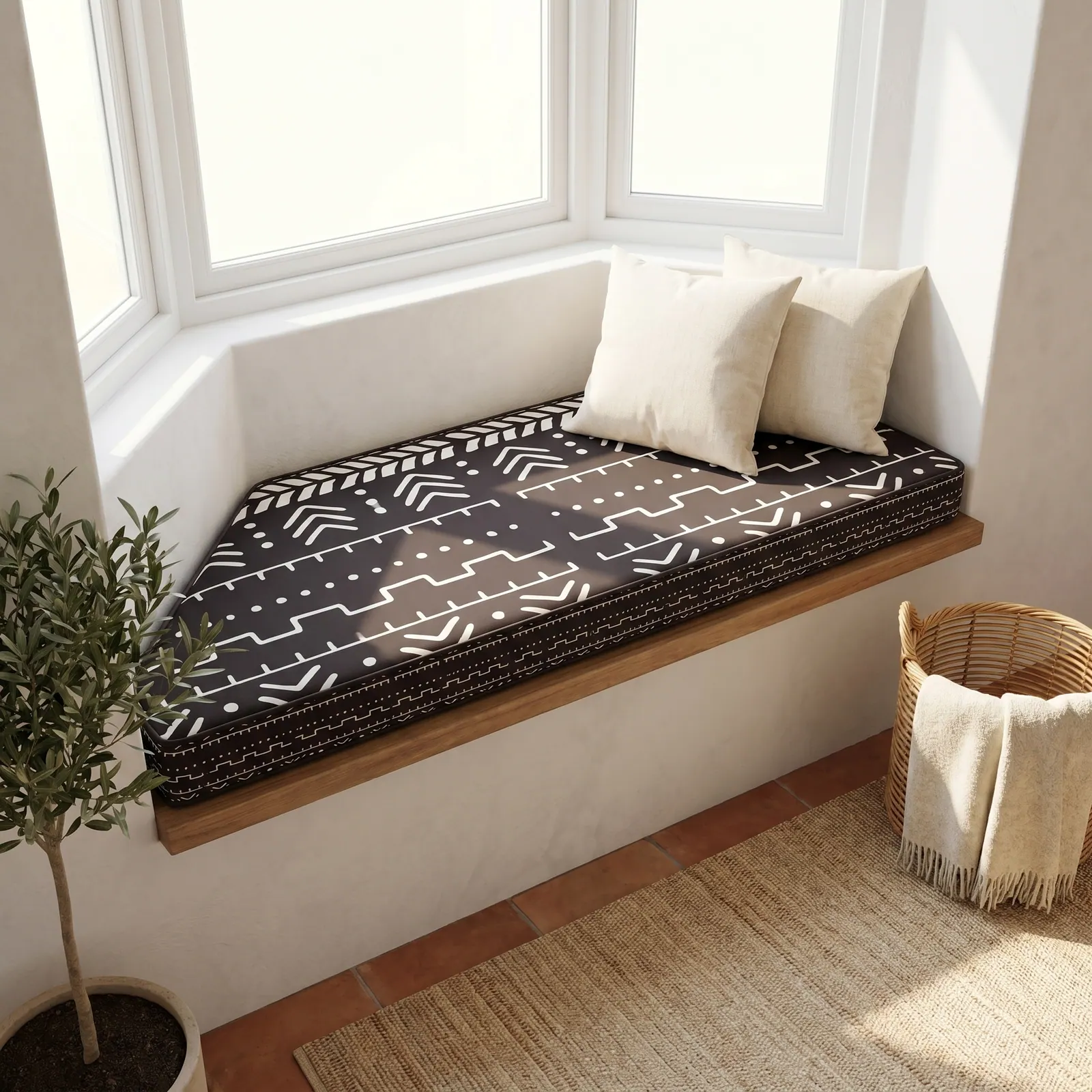
A mudcloth trapezoid bench cushion, read from ten feet and from ten inches
From the doorway this is a dark shape with two angled ends. Up close it is hand-drawn marks and a self-piped seam. Both views have to work, and each one asks for a different decision.

 Save
The quick answer
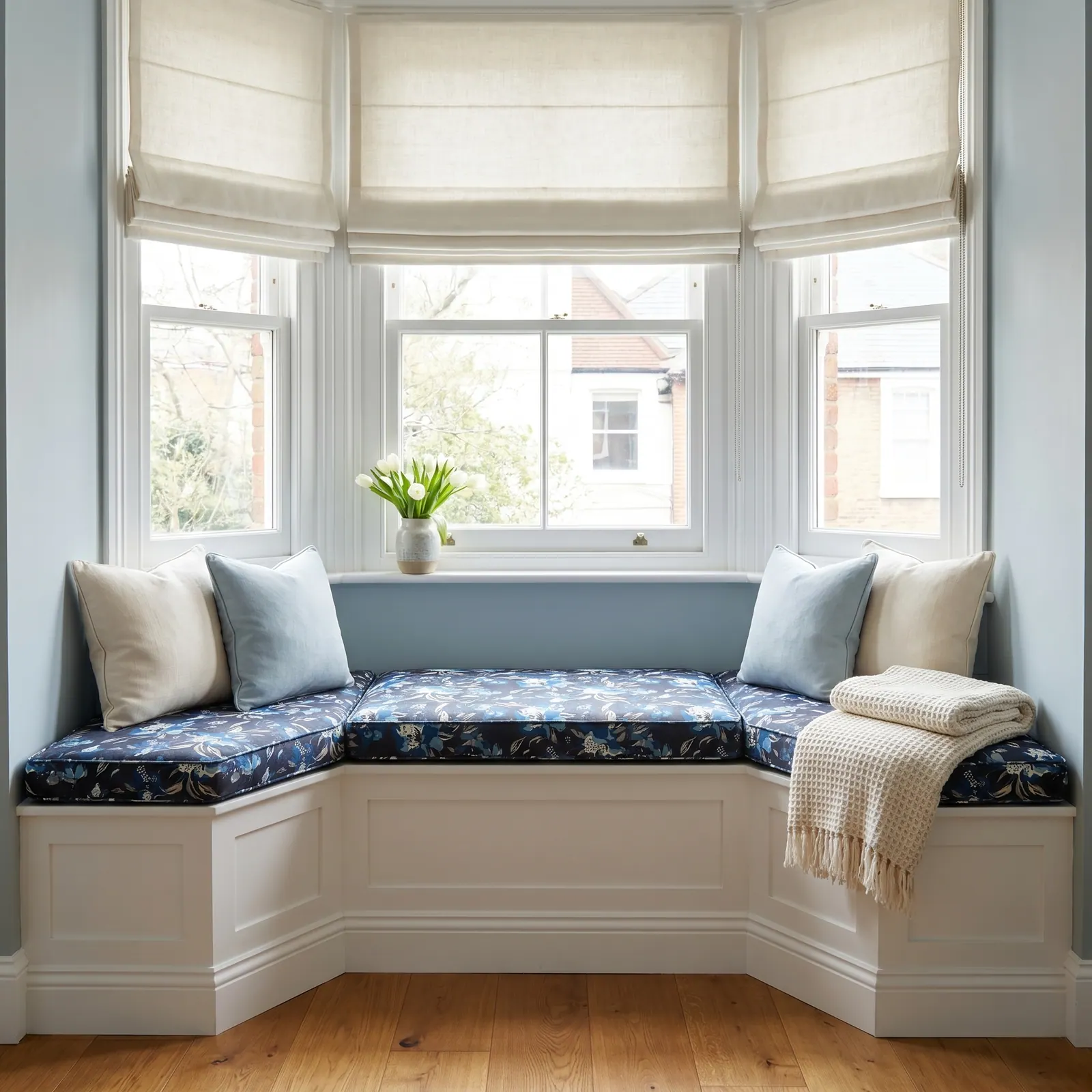
A trapezoid bench cushion in a bay reads well from across the room when its shape and contrast are right: angled ends that follow the side walls, a straight front edge, and a dark field against pale walls. Fine detail, such as a mudcloth motif or self piping, is for the close-up. Measure every side and the depth before it is cut.
Pinned by Nate: five marks, graded by distance
Five pins, sorted by how far away they still read: the angled end and the oak ledge carry across the room, the mudcloth marks only at arm's length.
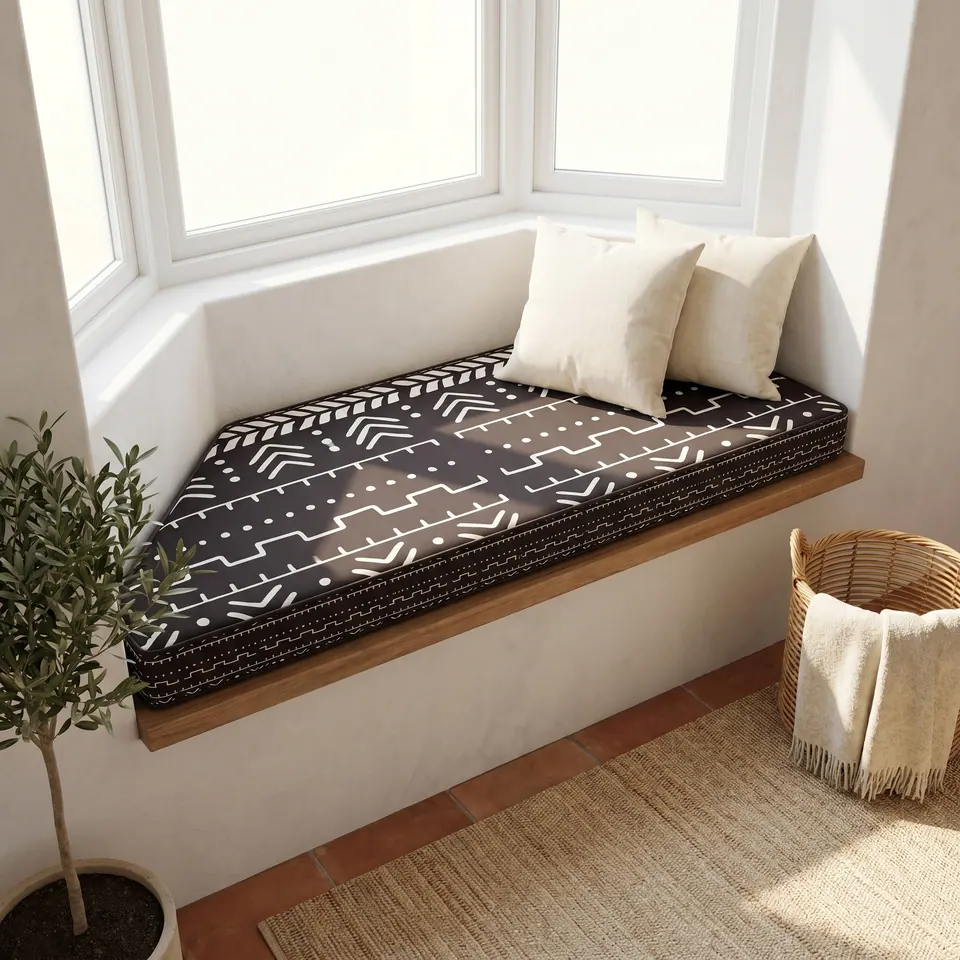
- Angled end
Cut to follow the bay's side wall while the front edge stays straight.
- Mudcloth print
Hand-drawn white motifs on charcoal suit the plaster and clay.
- Pillows in the corner
Placed where the angles meet, the most comfortable place to lean.
- Floating oak shelf
A thin ledge becomes a real seat once a thick cushion sits on it.
- Wicker basket
Holds a spare throw and repeats the jute rug's texture.
- Angled endCut to follow the bay's side wall while the front edge stays straight.
- Mudcloth printHand-drawn white motifs on charcoal suit the plaster and clay.
- Pillows in the cornerPlaced where the angles meet, the most comfortable place to lean.
- Floating oak shelfA thin ledge becomes a real seat once a thick cushion sits on it.
- Wicker basketHolds a spare throw and repeats the jute rug's texture.
The ten-foot view: a dark trapezoid on white plaster
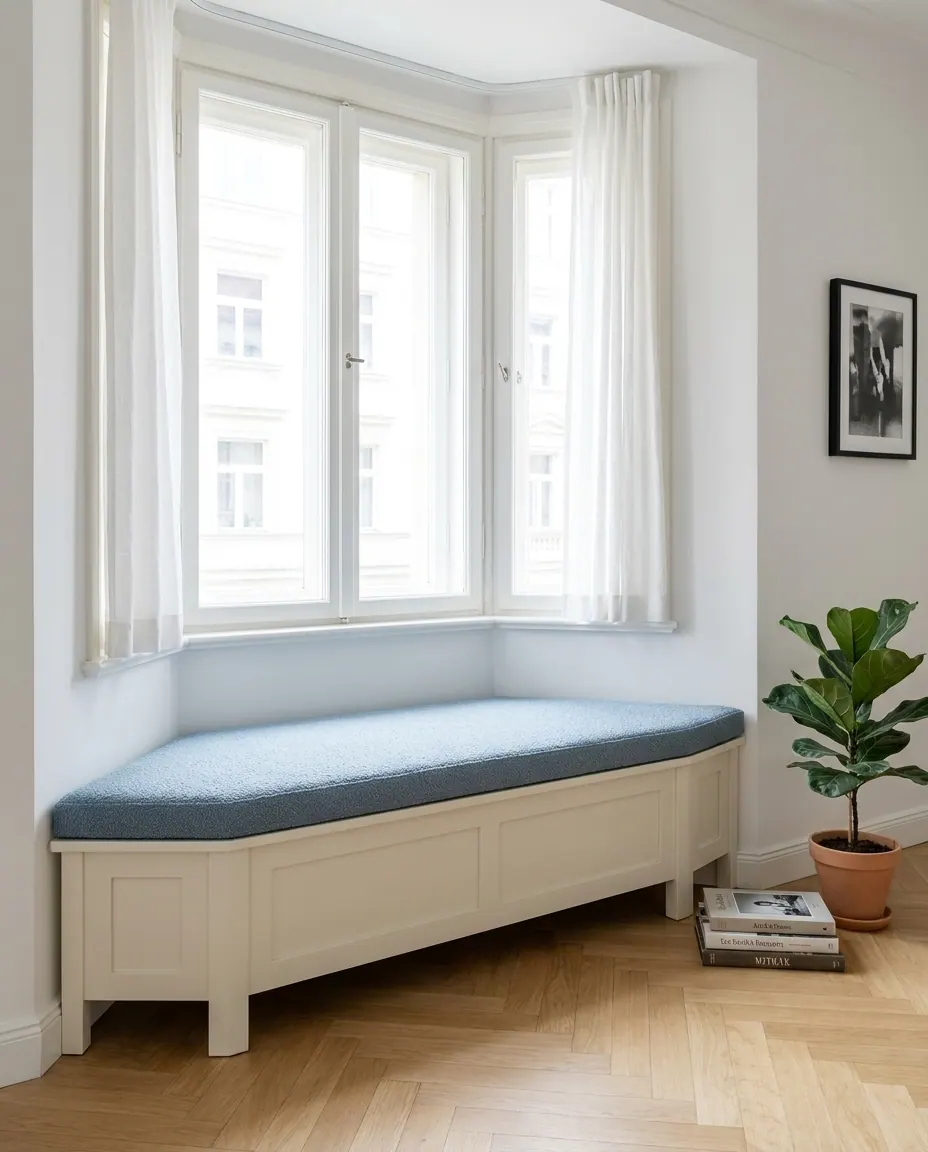
From the doorway, partner, this photo is three shapes. A white plaster bay. A thin oak shelf floating across it. A thick, dark trapezoid lying on that shelf. That is all the eye takes in at 10 ft (3 m), and it is enough.
The shelf is only a ledge, so the cushion supplies the whole seat: its thickness, its edge and its outline. Both ends are cut on an angle to follow the side walls, while the front edge runs dead straight. Angles are just lengths in disguise. Get the lengths right and the shape takes care of itself. The trapezoid cushions in the Atlas show the same logic in other bays.
Contrast is what carries across a room. Charcoal-brown against white plaster and terracotta tile is the strongest line in the picture, so the cushion reads as furniture rather than a pad. A pale cushion here would dissolve into the wall.
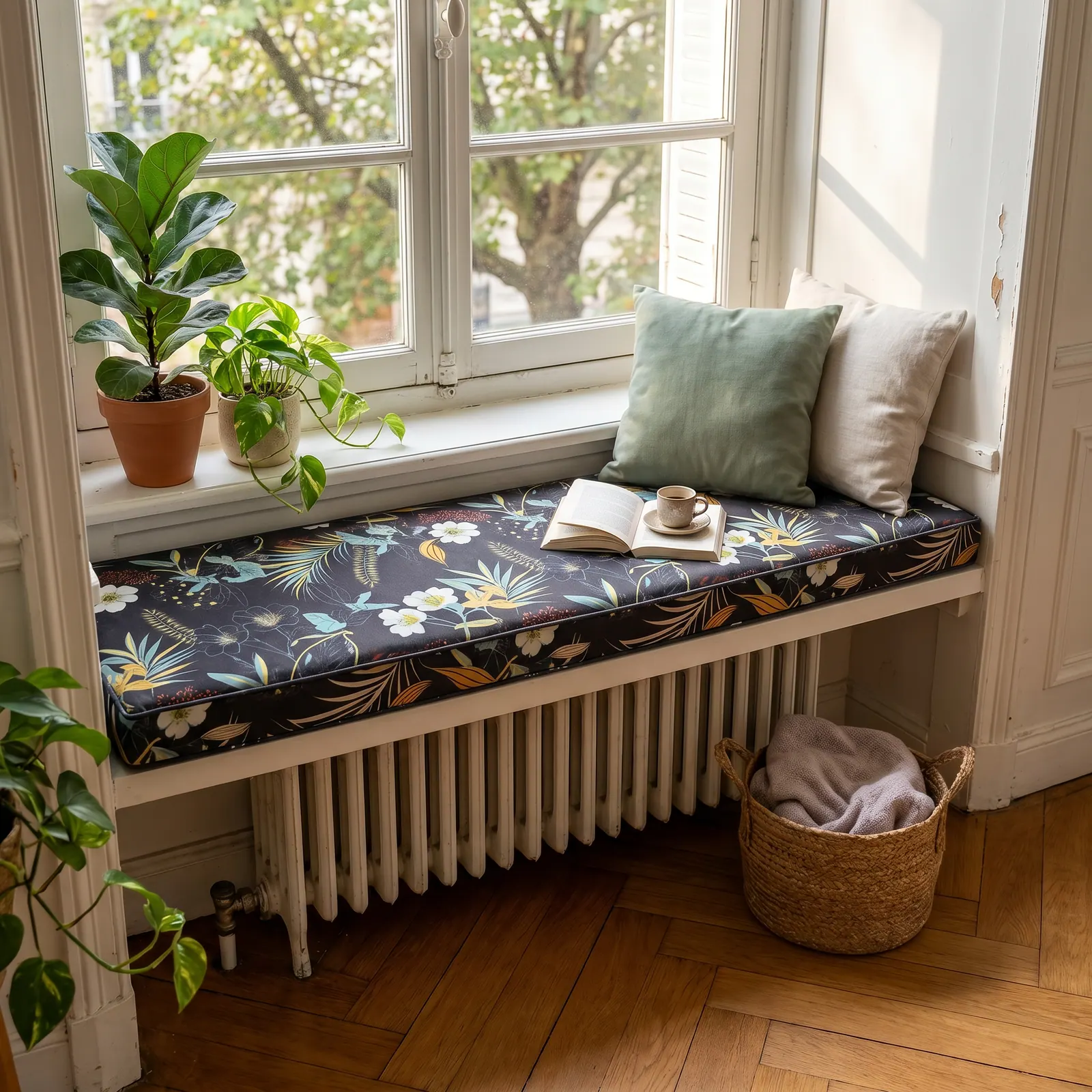
The close-up is a different job. The mudcloth-style print, white hand-drawn marks on charcoal, blurs into texture from the doorway and only shows its handwork at arm's length. The piping is self piping, and on a busy print that is the right call: a contrast welt would draw a second outline around a pattern that already has plenty to say. Our notes on matching, contrast or no piping go further.
The props hold the frame. Two cream linen pillows sit in the back corner where the angles meet, the best place to lean. An olive tree adds height, and a wicker basket with a fringed throw repeats the jute rug, so floor and seat talk to each other. It all belongs to a calm living room corner. What does your bay look like from the doorway?
Notebook page: what reads at 10 ft, what reads at 10 in
| Detail | From 10 ft (3 m) | From 10 in (25 cm) |
|---|---|---|
| Angled ends following the bay walls | Reads: it is the outline | Reads |
| Dark print on white plaster | Reads as one dark mass | Reads |
| Hand-drawn mudcloth marks | Blurs into texture | Every mark shows |
| Self piping | Melts into the print | A crisp seam line |
| Box edge thickness | Reads: it turns the ledge into a seat | Reads |
| Cream pillows in the corner | Two light blocks | The linen weave shows |
Two houndstooth cushions and a shape nobody had named yet
A buyer in the US sent the workshop a sketch for two houndstooth cushions: one plain rectangle and one odd shape for an angled seat. The workshop quoted both with 10 days of processing, then did the unglamorous part and asked for every side length and a photo of the space.
The buyer got cold feet and tried to cancel. By then the work had started, and the numbers settled the question: the odd shape was a trapezoid. A family illness in the workshop then pushed production back a few days, and the buyer was told so plainly.
The lesson is on the drawing, not in the drama. For any shape that is not a rectangle, confirm every side length and the angles before production starts. The trapezoid cushion calculator and our trapezoid measuring notes ask for exactly those numbers.
On the cutting table: the floating bay seat
| Product | Trapezoid bench cushion for a bay |
|---|---|
| Shape | Straight front, two angled ends |
| Edge | Box edge, thick enough to make a ledge a seat |
| Piping | Self piping |
| Fabric | Mudcloth-style print, white hand-drawn marks on charcoal-brown |
| Base | Floating oak shelf in a white plaster bay |
| Measure | Back, front, each angled side and the depth, separately |
| Write it to | The nearest 1/4 in (6 mm) |
| Best for | Bays with a thin ledge instead of a box seat |

Have it made
Have this made — ask Nate’s workshop
Every edge and both diagonals, to the nearest 1/4 in. If the numbers do not close, the workshop will say so on the call. — Nate
Leave your details and the workshop will call you to confirm measurements, fabric, foam and piping. No prices, dates or payment on this page: it is a request, not an order.
Buyer questions: piping on a brown stripe, a movable backrest, a long window seat
- A common question
What color piping would you put on a brown striped fabric?
The workshop's answerFor a textured brown stripe the workshop offered three routes: self piping in the same fabric for a clean, unbroken outline, cream or beige for a classic contrast, or dark brown or black for a sharper, framed look.
- A common question
Is the backrest on the ottoman detachable, and is anything holding it up from behind?
The workshop's answerYes. The backrest is a separate piece you can place wherever you like, and metal bars support it from behind, the same way as on the standard sofa backrests.
- A common question
How long does a long window bench cushion take to make and arrive?
The workshop's answerIt depends on the order, so ask the workshop to confirm production and delivery time in writing with your quote. For one cushion of 82 1/4 x 25 5/8 x 4 in (209 x 65 x 10 cm), a linen was picked as the closest match to the buyer's color before production.
A trapezoid bench cushion is judged from the doorway first: angled ends, a straight front and a dark field against pale walls. The print is for the close-up.
Nate
Questions buyers ask next
Can a cushion turn a floating shelf into a real window seat?
Yes, if the cushion is thick enough to supply the seat and cut to the shelf's exact outline. On a thin ledge the cushion does all the work, so a box edge and a straight front matter more than on a built-in box seat.
Should piping contrast on a patterned trapezoid cushion?
On a busy print, self piping is usually calmer: it keeps a crisp seam up close but disappears from across the room, so the pattern keeps a single outline. Contrast piping suits solids and simple stripes, where the extra line has room to show.
Which measurements does a trapezoid bench cushion need?
The back length, the front length, each angled side on its own, and the depth from front to back, plus the thickness you want. Bays are rarely symmetrical, so measure both angled sides even when they look the same.
± 1/4 in — Nate
More photographs to read
 Save
 Save
 Save
 Save
 Save
 Save