A Reading by NateTrapezoid & Angled Cushions
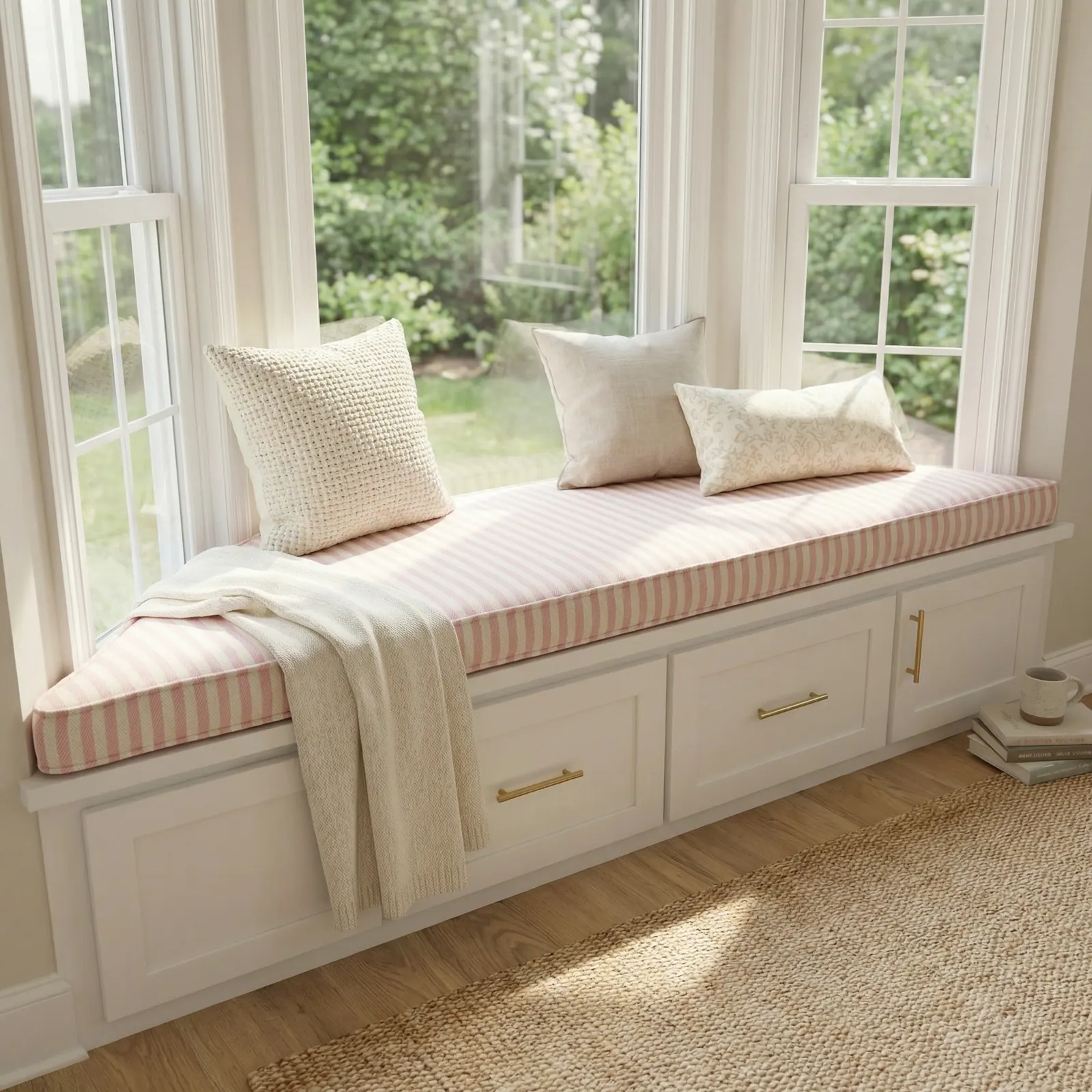
A blush-striped trapezoid bench cushion on a bay seat, read from ten feet and from ten inches
From the doorway you see one thing: pink lines running toward the window. Walk closer and the tailoring starts to talk.

 Save
The quick answer
On an angled window seat cushion, run the stripes front to back: from across the room they make a shallow seat look deeper. Up close, self piping lets each stripe wrap the box edge unbroken. To order, send the front, back, depth and both angled sides; photos plus numbers are enough, and no paper template is needed.
An angled seat, cut through: 4 in on 22 in deep
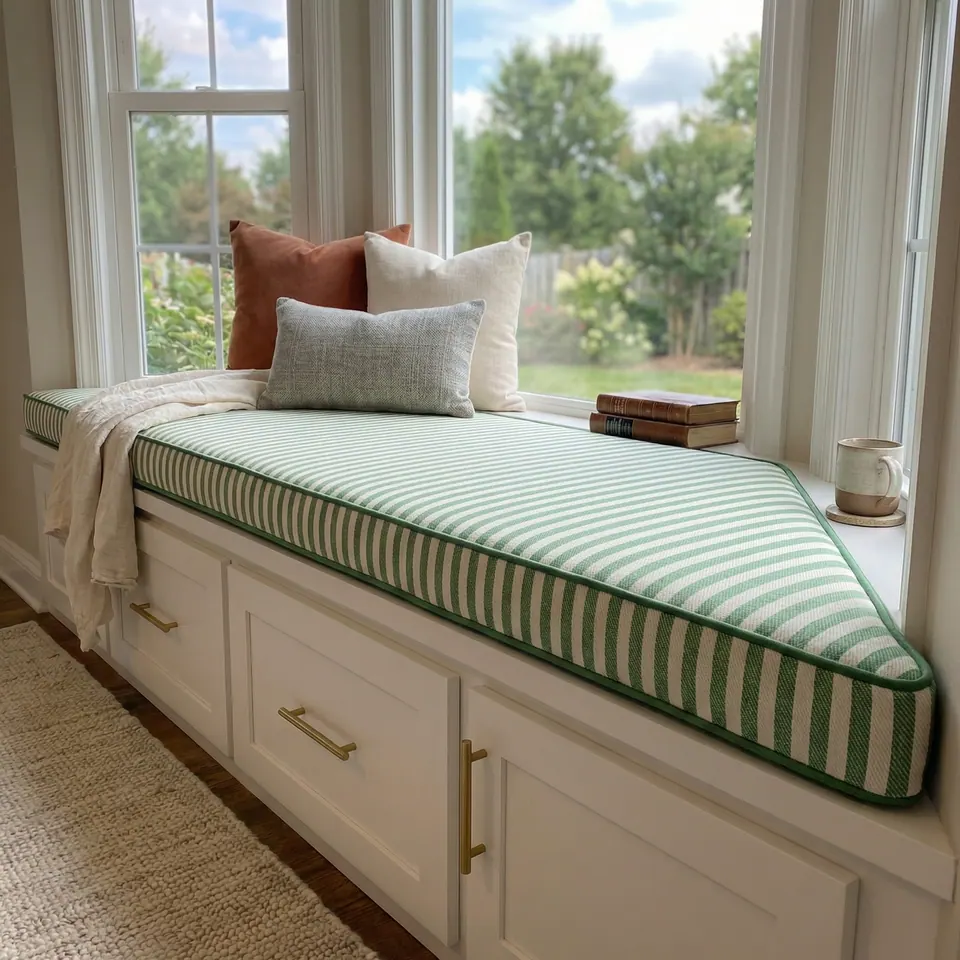
Striped cotton cover. Blush and white stripe cut to run front to back, so the lines turn over the front band like an awning.
Self piping. Cut from the same stripe, so the edge follows the pattern instead of drawing a solid line around it.
Fiber wrap. Polyester fiber (Dacron) batting around the foam: it fills the cover out and softens the edges.
Foam core. About 2.0 lb/ft³ (32 kg/m³) high-resilience foam, firm to medium-firm, cut to the ordered size.
Zipper. Along the back band, as hidden as possible. The zipper side faces down or toward the wall.
Base panel. The underside of the cover. A non-slip fabric backing can cover the whole of it instead.
From the doorway: three shapes before the pink
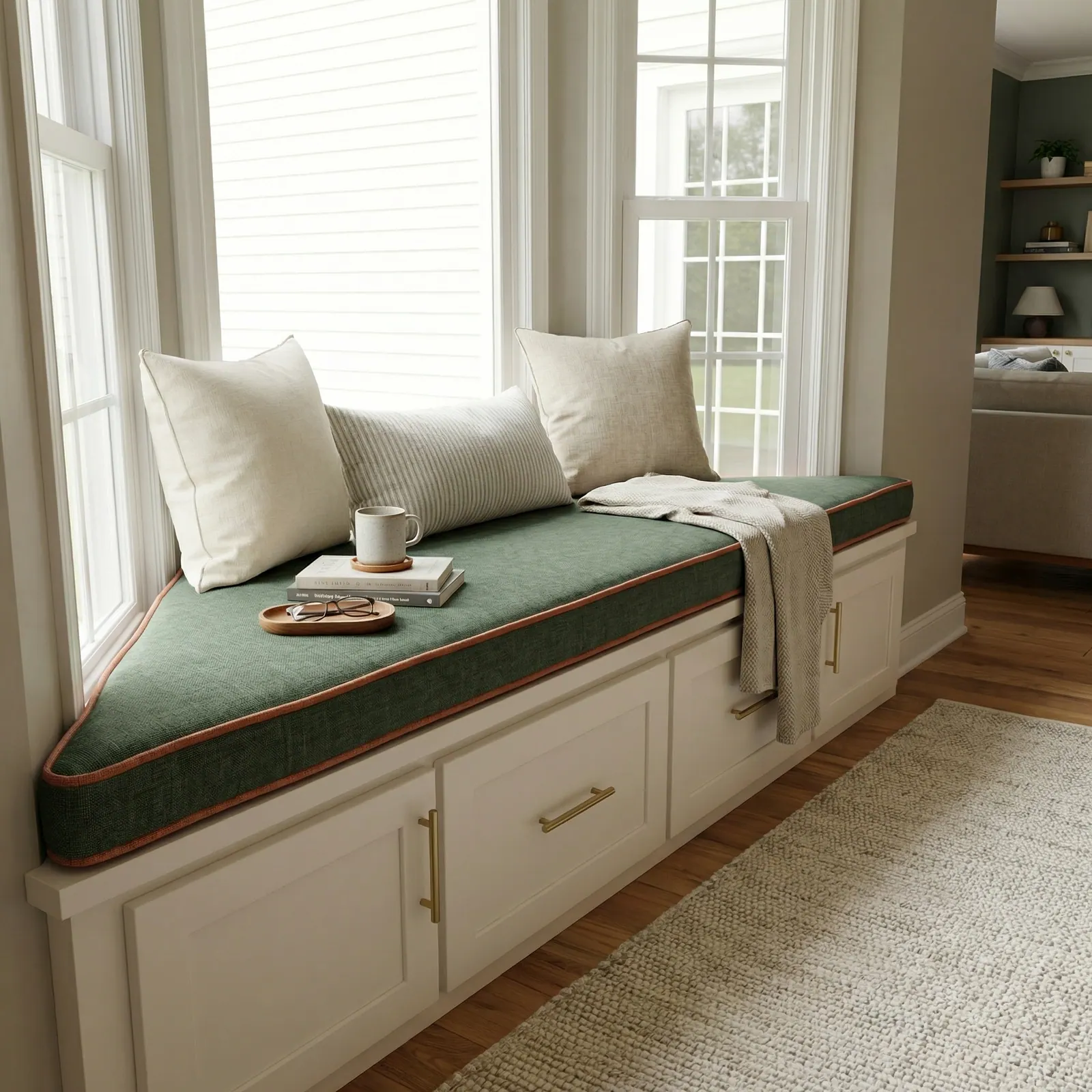
Stand at the door and squint. Before you register the color, you read three shapes: the angled end of the seat, the white cabinet base with its brass bar pulls, and a set of pink lines running from the front edge toward the glass.
Those lines are the whole trick, partner. A trapezoid cushion on a bay seat is often shallow, and stripes cut front to back pull the eye toward the window, so the seat reads deeper than its tape-measure depth. From ten feet, that matters more than any stitch.
The rest of the frame keeps quiet on purpose. A cream waffle-knit pillow, an ivory linen square, an ivory lumbar with a faint botanical print, a cream cable-knit throw over the angled end and pooling on the sisal rug. Every prop sits in one cream family, so blush is the only color in the shot. The books and a mug wait on the floor, off the seat, which keeps the stripe uncluttered.
The stripe family is filed under striped cotton and ticking, and the trapezoid cushion calculator checks an angled seat's numbers before you order. How deep is your bay seat at its shallowest point?
Five pins, farthest-reading first
Five pins, ordered from what reads at ten feet to what only shows at arm's length.
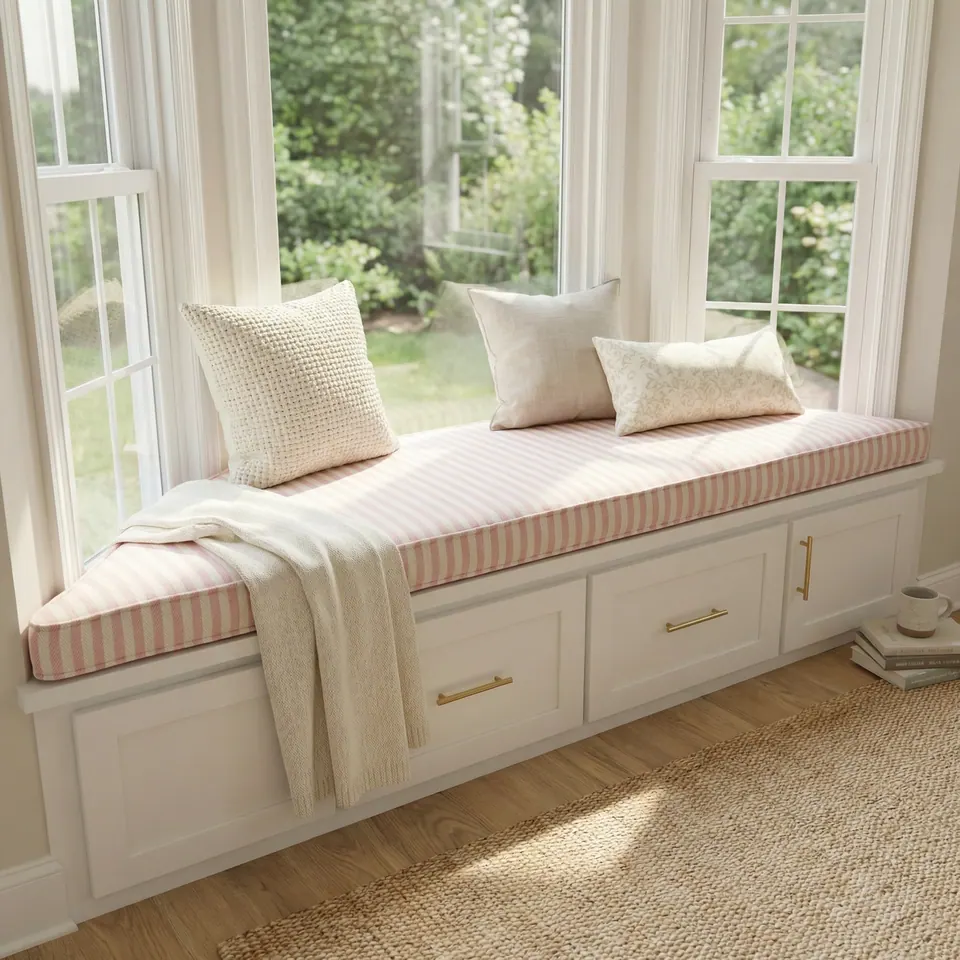
- Front-to-back stripe
The stripe runs from front edge to wall, making the seat look deeper.
- Waffle-knit pillow
A deep waffle texture balances the flat printed stripe.
- Botanical lumbar
Its faint print is the only other pattern and stays in the same cream family.
- Cable-knit throw
The throw covers the angled end and pools on the floor for a relaxed look.
- Books on the floor
Stacking books beside the bench keeps the pink stripe uncluttered.
- Front-to-back stripeThe stripe runs from front edge to wall, making the seat look deeper.
- Waffle-knit pillowA deep waffle texture balances the flat printed stripe.
- Botanical lumbarIts faint print is the only other pattern and stays in the same cream family.
- Cable-knit throwThe throw covers the angled end and pools on the floor for a relaxed look.
- Books on the floorStacking books beside the bench keeps the pink stripe uncluttered.
What carries across the room, and what waits for your knees
Angles are just lengths in disguise, and stripes are just lines. Here is which of them survive the walk across the room.
| Detail | At 10 ft (3 m) | At 10 in (25 cm) |
|---|---|---|
| Stripe direction | The seat looks deeper than it is | Lines turn over the front band like an awning |
| Self piping | Invisible; the outline stays soft | The stripe carries across the seam with no solid line |
| Angled end | A clean wedge of pink | Front-to-back stripes meet the angle most forgivingly |
| Cream props | One color family; pink stands alone | Waffle, cable and linen textures do the talking |
| Brass pulls | Two warm points on white paint | They echo the low sun on the stripe |
A reading nook drawn A to F, and pillows that measured small
A buyer in the US sent a drawing for an angled reading nook: a trapezoid floor cushion with sides labeled A 6, B 6, C 68, D 34, E 23 and F 23 in (15, 15, 173, 86, 58 and 58 cm), and 22 in (56 cm) deep in the middle. Linen, with piping in the same linen. Add a pillow-filled backrest and four 18 in (46 cm) square pillows.
The workshop confirmed 4 in (10 cm) of thickness and offered the backrest two ways, foam or pillow. She chose pillow. The cushion fit perfectly. The one surprise: once stuffed, the square pillows measured just under 16 in (41 cm) edge to edge.
That is not a cutting error. It is geometry. A pillow's size is the cut fabric, and a plump fill pulls the edges in.
- Sizes
- A 6, B 6, C 68, D 34, E 23, F 23 in; 22 in (56 cm) deep; 4 in (10 cm) thick
- Fabric
- Linen with self piping
The lesson: A pillow's nominal size is the cut fabric; a plump pillow measures smaller edge to edge.
Templates, notches and straight backs: three
- A common question
My bay window seat is irregular. Can you work from photos and measurements, or do I have to make a paper template?
The workshop's answerPhotos and measurements are enough; a template is welcome but not required, and the shape carries no surcharge. The workshop checks that the numbers agree: a 106 in (269 cm) front, a 56 in (142 cm) back and two 35 in (89 cm) angled sides give a seat about 24.5 in (62 cm) deep.
- A common question
Can I order straight backrests on their own, without the corner section?
The workshop's answerYes. A straight backrest is 39 3/8 in (100 cm) long, and the corner backrest is 39 3/8 x 39 3/8 in (100 x 100 cm). When a buyer added a second L-shaped sofa, two extra straight backrests went in with it.
- A common question
The window casing sticks out over my seat, so a cushion can't sit flat against the wall. Can you notch it?
The workshop's answerYes. For a 109.25 x 25 in (277.5 x 63.5 cm) seat under a casing 0.75 in (2 cm) deep, the notch ran 0.75 in deep and 96.25 in (244.5 cm) wide along the back edge, keeping the full 25 in depth for 6 in (15 cm) at the left and 7 in (18 cm) at the right. A diagram comes back for approval before the quote.
Run stripes front to back on an angled window seat cushion: from 10 feet away, a shallow seat reads deeper than the tape measure says.
Nate
Cutting ticket
| Cushion | Trapezoid window seat cushion, box edge |
|---|---|
| Fabric | Blush pink and white striped cotton |
| Stripe direction | Front to back, wrapping the front band |
| Piping | Self piping in the same stripe |
| Measurements to send | Front, back, depth and both angled sides |
| Template | Not required; photos plus measurements are enough |
| Casings | Notched around them, drawn for approval first |
| Styling | Cream pillows and throw, so blush is the only color |

Have it made
Have this made — ask Nate’s workshop
Precision starts on the phone. Give the workshop your measurements and they will read them back to you, edge by edge. — Nate
Leave your details and the workshop will call you to confirm measurements, fabric, foam and piping. No prices, dates or payment on this page: it is a request, not an order.
Questions buyers ask next
Which stripe direction suits an angled window seat cushion?
Front to back. The lines lead toward the window and make a shallow seat look deeper, they wrap the front band like an awning, and they meet the angled end more forgivingly than stripes running side to side.
Why pick self piping on a striped window seat cushion?
Self piping is cut from the same striped cloth, so the stripe carries across the seam instead of being interrupted by a solid line. From across a room the outline stays soft; up close, the pattern looks continuous.
How can I check an angled seat's numbers at home?
Subtract the back from the front and halve it to get each side's step-in. The step-in, the depth and the angled side form a right triangle, so depth squared plus step-in squared should equal the angled side squared.
± 1/4 in — Nate
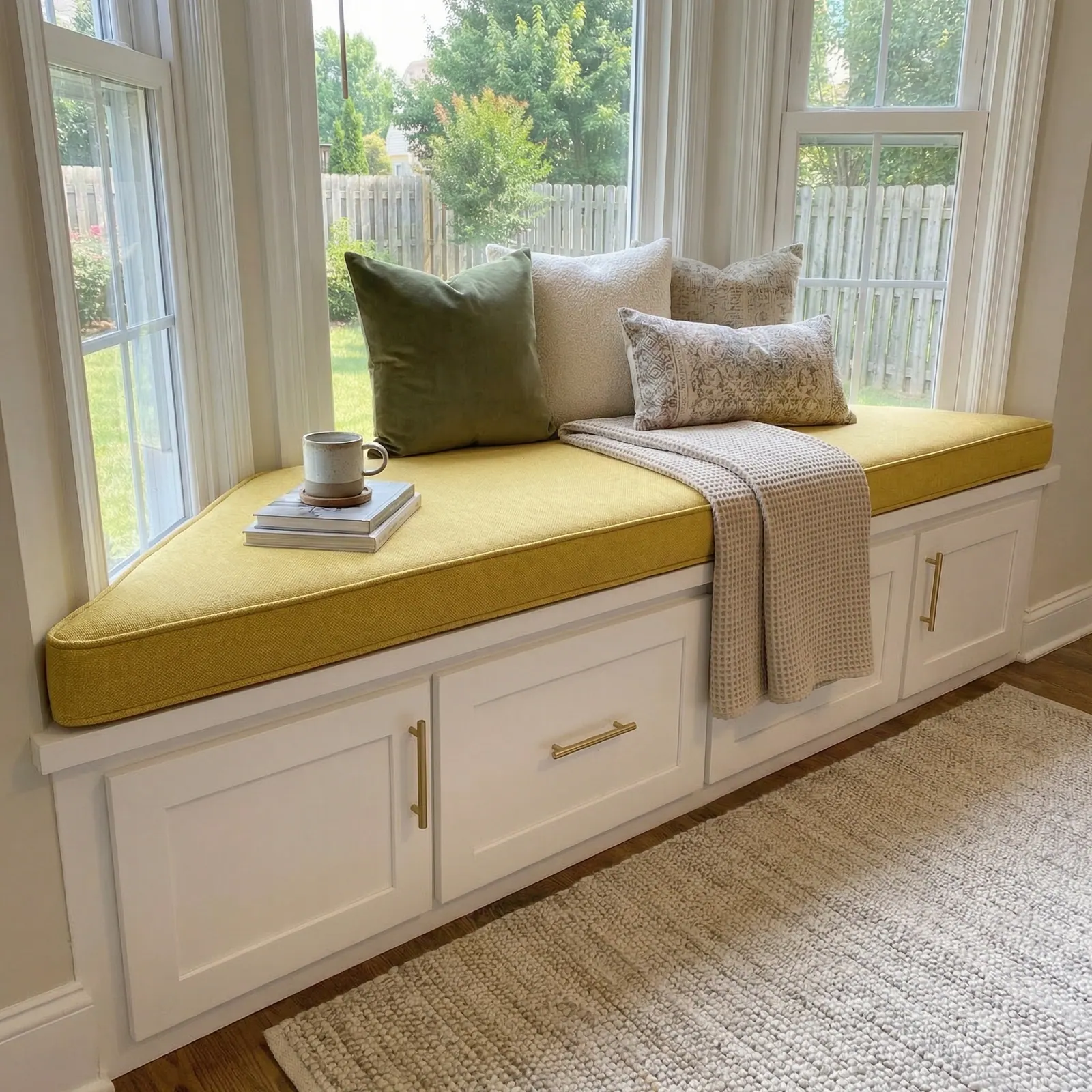
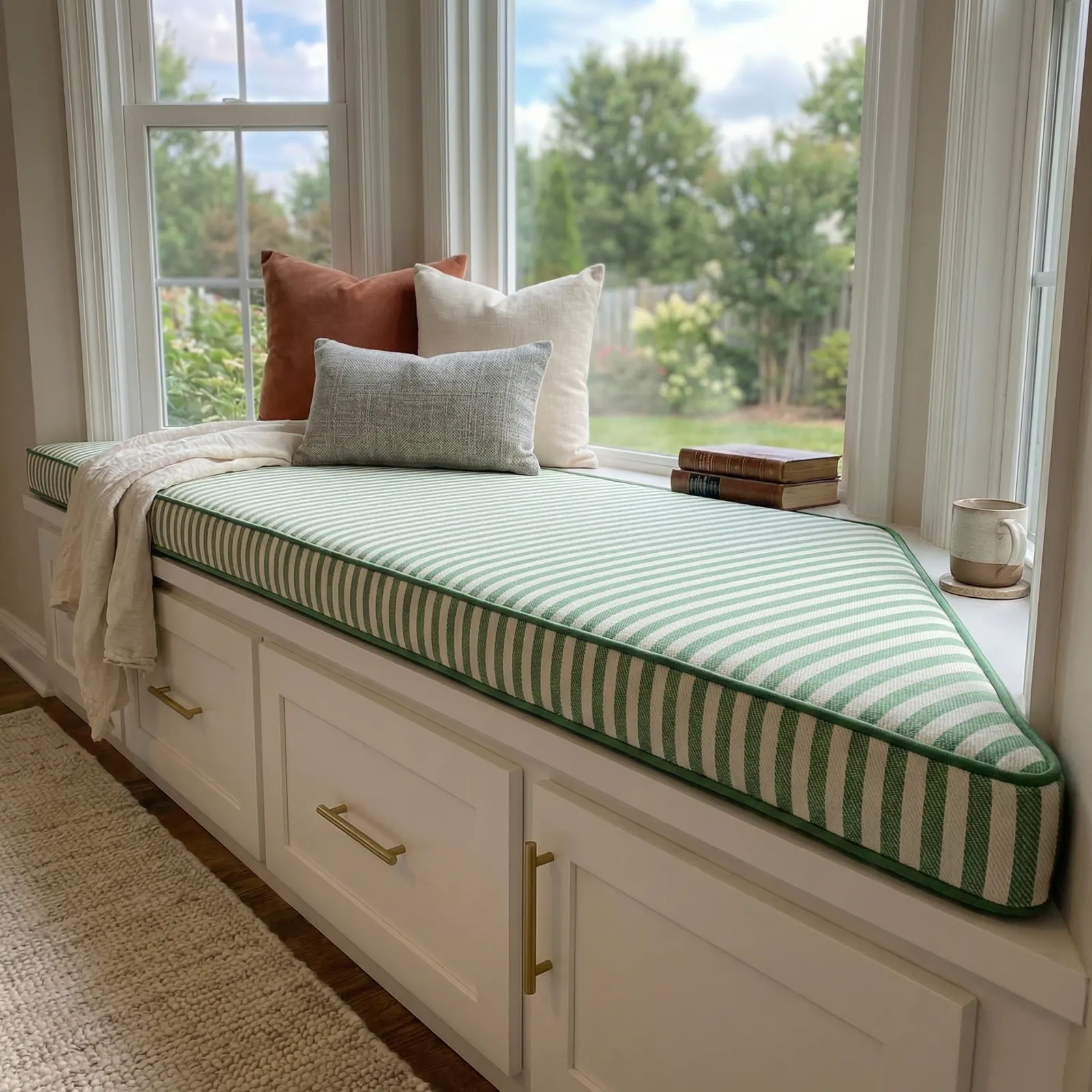
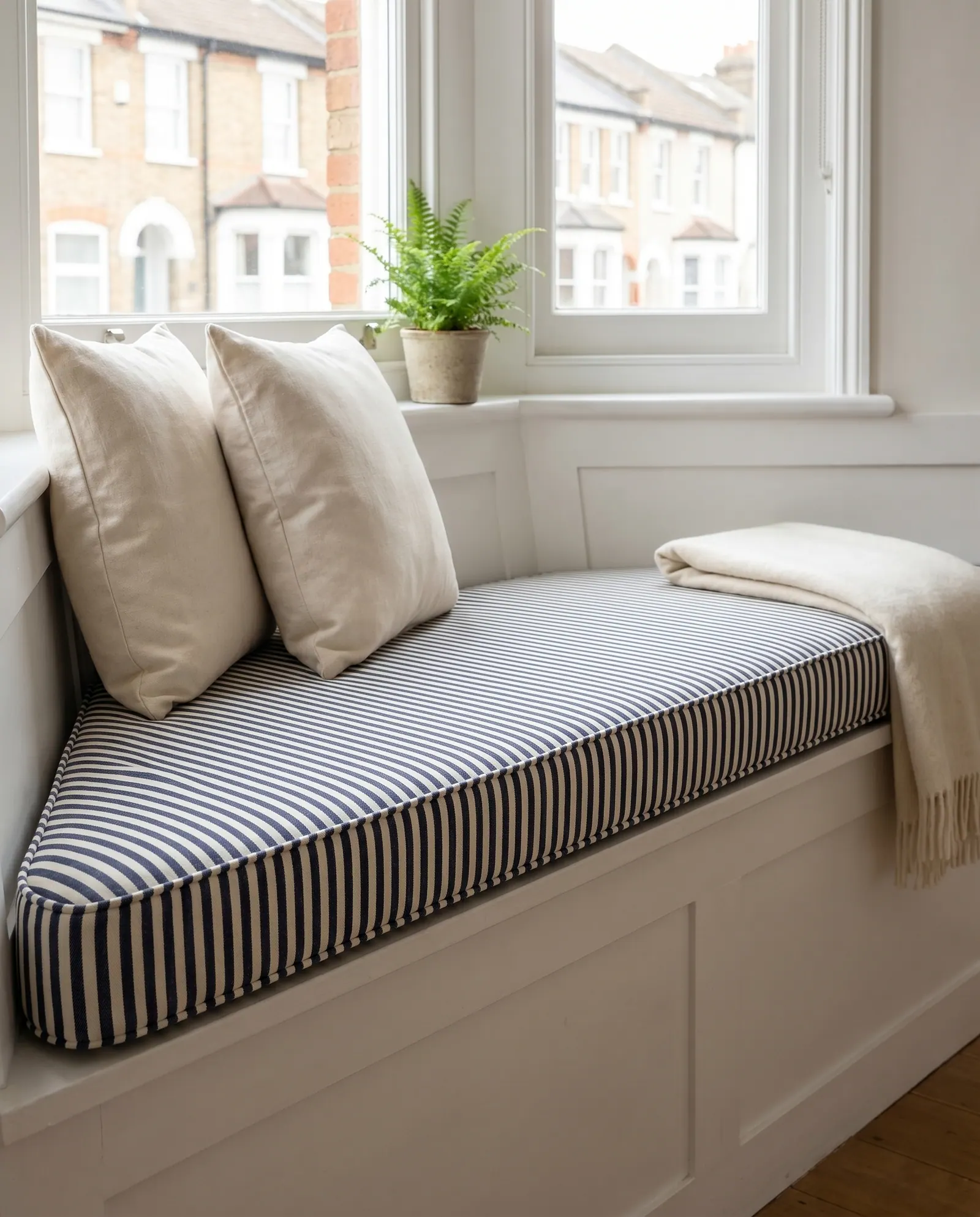
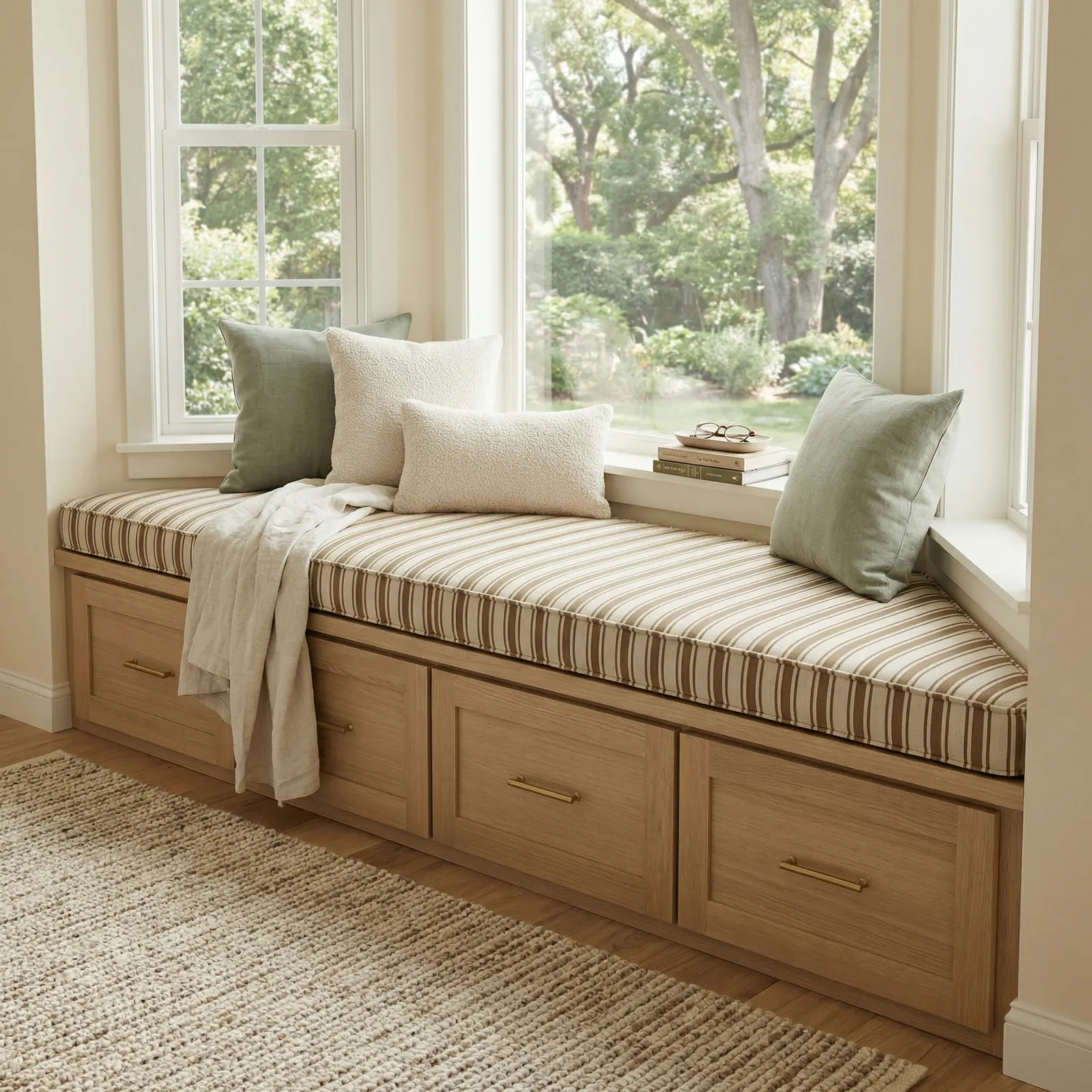
Angled and bay seats, near and far
 Save
 Save
 Save
 Save
 Save
 Save