A Reading by NateTrapezoid & Angled Cushions
A green-striped trapezoid window seat cushion, and what it borrows from the porch
Nate reads a kelly green stripe in a sunny bay the way he would read a deck chair: which outdoor habits earn a place indoors, and which stay outside.

 Save
The quick answer
An indoor striped trapezoid bench cushion borrows two habits from outdoor cushions: a solid welt in the stripe's darker color to hold the edge, and a box edge that keeps the angled end crisp. From indoor cushions it keeps the soft props, velvet, linen and knit. To order one, give the bottom, top and depth; the angled sides follow from the geometry.
Field notes: a deck-chair stripe in a living room bay
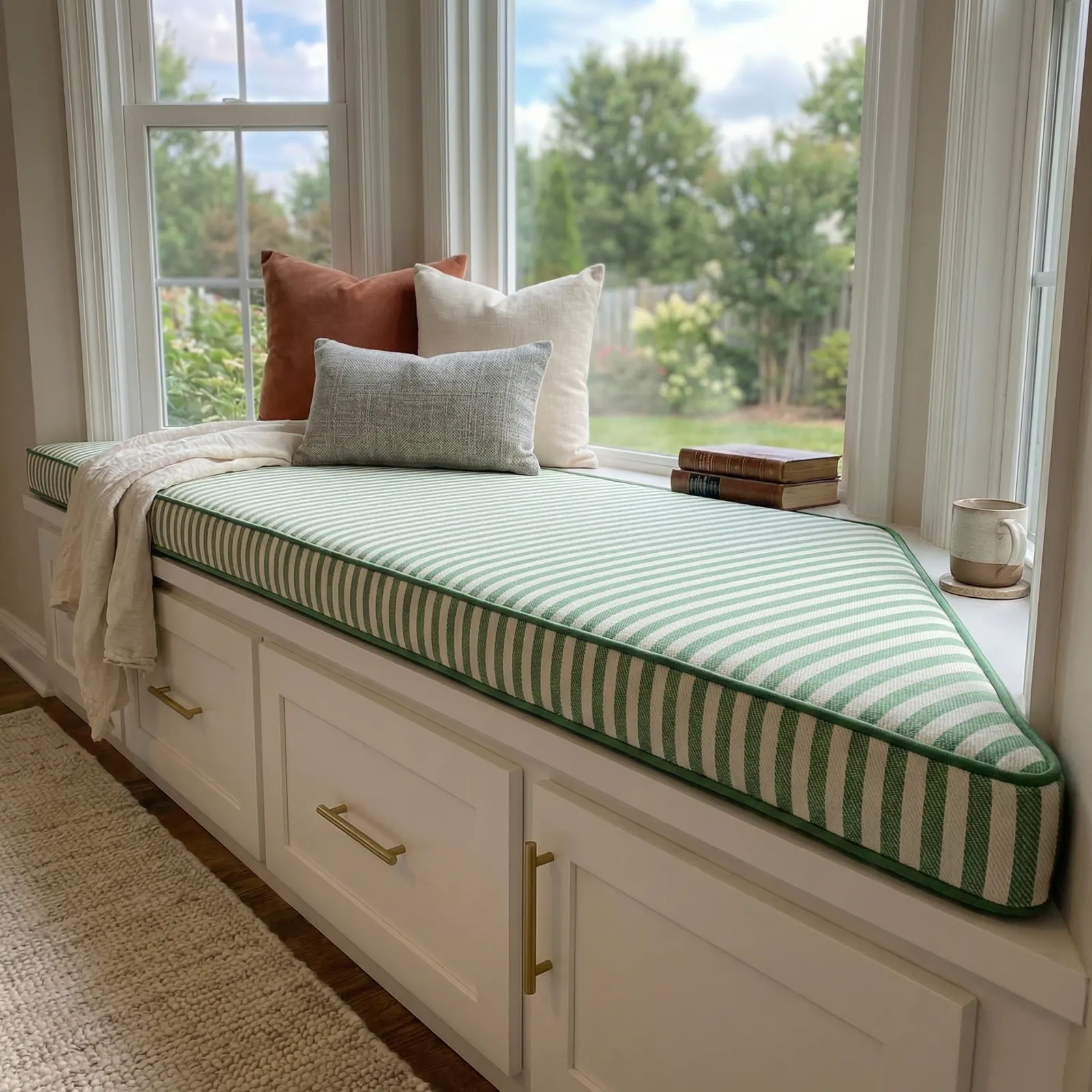
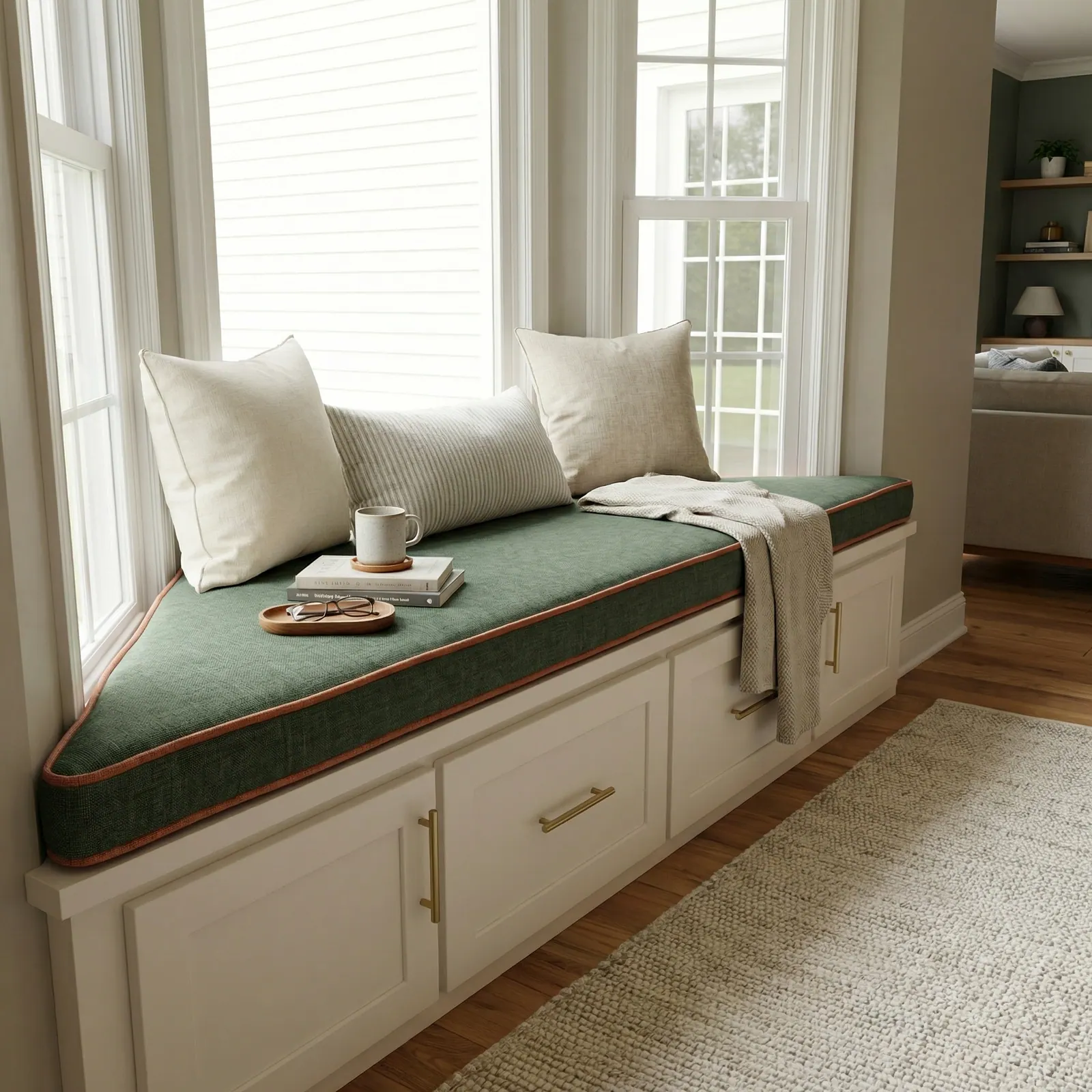
Kelly green and white is a stripe you expect on a beach umbrella. Here it sits in a white shaker bay seat beside a hydrangea garden, and that is the first note in my book: the look came in from outside, the cloth did not. This trapezoid bench cushion is striped cotton, an indoor fabric wearing a porch costume.
So the useful question is which outdoor habits to borrow and which to leave on the patio. I count two worth borrowing and one worth leaving.
Borrow the frame. Awnings and deck cushions edge a busy stripe with a solid band. Here a welt cut from solid green outlines the long taper on the right, so the stripe does not blur into the point. On a stripe, a solid piping in its darker color is the simplest sharpness you can add.
Borrow the box. A box edge with a straight side wall keeps the bands running true down the front, the way a good lounger pad holds its line. The stripe runs across the depth, front to back, which is covered in stripe direction on cushions.
Leave the bare seat. Outdoor cushions go without pillows because weather wins every argument. Indoors, the rust velvet, ivory linen and gray heathered lumbar at the back are the point. More shapes like this live under trapezoid cushions and more cloth under striped cotton and ticking. What does your bay measure along the bottom?
Pinned by Nate: five marks from the rust pillow to the taper
Five pins, each one a decision you can measure or copy in your own bay.
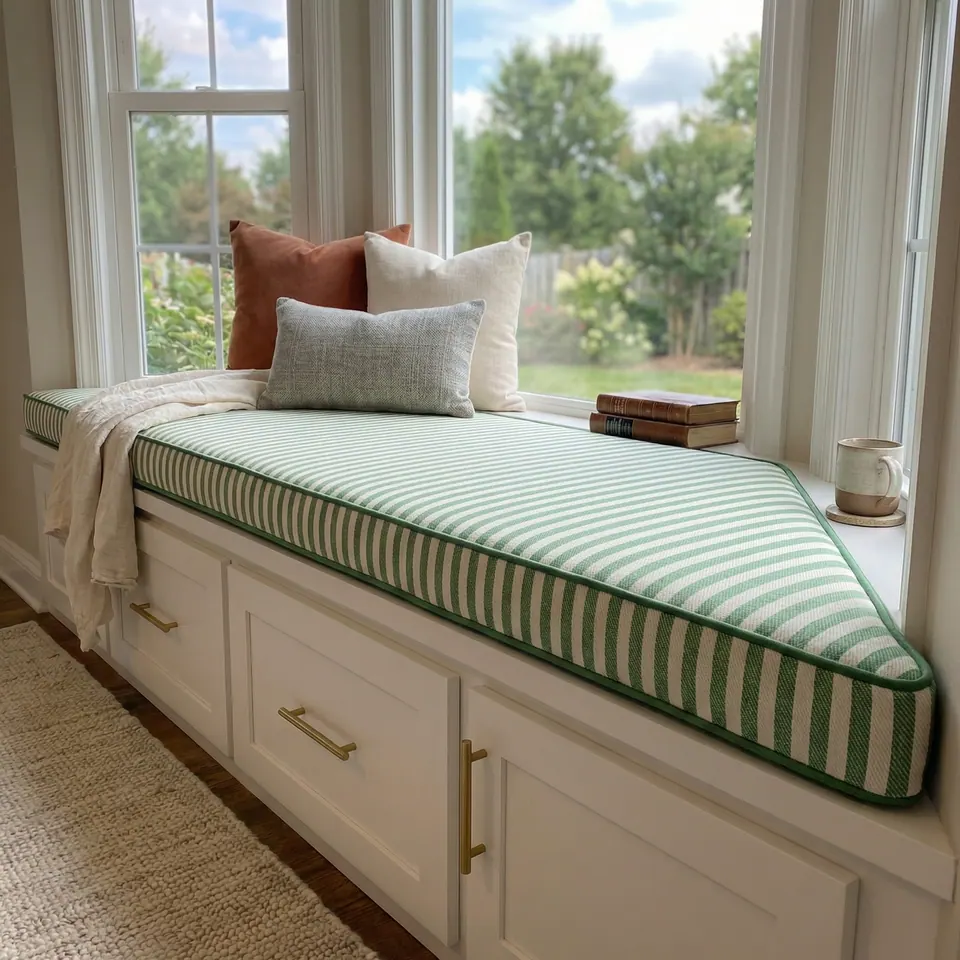
- Rust velvet pillow
The only warm accent, placed at the back to balance all the green.
- Gray lumbar
A heathered gray sits between rust and ivory to calm the row.
- Tapered corner
Solid green piping outlines the long taper so the stripe does not blur at the point.
- Antique books
Old leather books on the sill add age without covering the stripe.
- Knit throw
A cream knit hangs over the square end to soften the cabinet edge.
- Rust velvet pillowThe only warm accent, placed at the back to balance all the green.
- Gray lumbarA heathered gray sits between rust and ivory to calm the row.
- Tapered cornerSolid green piping outlines the long taper so the stripe does not blur at the point.
- Antique booksOld leather books on the sill add age without covering the stripe.
- Knit throwA cream knit hangs over the square end to soften the cabinet edge.
The ledger: outdoor habit or indoor habit
| Decision | Borrowed from | What it does in this bay |
|---|---|---|
| Solid green welt | Awnings and deck cushions | Frames the stripe so the tapered corner stays crisp |
| Box edge | Lounger pads | A straight side wall keeps the bands square along the front |
| Stripe across the depth | Deck chairs | Each band meets the front edge squarely |
| Rust velvet pillow | The living room | The one warm accent, set at the back to balance the greens |
| Cream knit throw | The living room | Softens the square end against the cabinet edge |
| Books and mug on the sill | The living room | Kept off the cushion so the stripe stays clear |
115, 82, 20: a sketch with one note too many
A buyer in the US sent a hand sketch for a long trapezoid bench, replacing an old, thin cushion. The shop drew it up at 115 in (292 cm) along the bottom, 82 in (208 cm) along the top and 20 in (51 cm) deep.
Then the angled sides. Nobody has to measure them if the other three numbers are honest. Half the difference between bottom and top is 16.5 in (42 cm). Square it, add the depth squared, take the root: about 26 in (66 cm). Angles are just lengths in disguise. The trapezoid cushion calculator runs the same sum.
The sketch also said 2-3 in thick. That turned out to describe the old cushion, not a wish for the new one, so the order went ahead at the listed 4 in (10 cm). A note for your own notebook, partner: a thickness written on a sketch may be history, not instruction. Confirm it before anyone cuts.
Buyer questions: size menus, thickness and the numbers people ask about
- A common question
Roughly what does a custom bench or window seat cushion cost?
The workshop's answerIt is quoted by size, and the quote states the shipping cost. Real quotes have run from a small 14 x 18 in pad at the low end, through a 51 x 30 in bay seat and a 78 x 21 in bench, up to an 86 x 14 in bench and a 16 x 105 in seat made in two pieces. Send the size and the shop quotes it.
- A common question
Is there a standard thickness, and can mine be thicker or thinner?
The workshop's answerThe standard is 4 in (10 cm). The shop has also quoted 2, 3, 5, 6, 7 and 8 in, and thicker foam costs more. Most buyers stay with 4 in and find it comfortable.
- A common question
Do I have to pick one of the listed sizes, or can you cut to my exact measurements?
The workshop's answerAny size can be made. The listed sizes are really price ranges: choose the range that covers your measurements, write your exact size in the Add Personalization box, and the cushion is made to those numbers. Smaller than the smallest option works too, such as 9 in wide on a listing that starts at 12.
On the cutting table: the green-stripe trapezoid
| Cushion | Trapezoid window seat cushion, box edge |
|---|---|
| Fabric | Green and white stripe in cotton |
| Stripe direction | Across the depth, front to back |
| Piping | Solid green contrast welt outlining the taper |
| Thickness | Standard 4 in (10 cm); 2 to 8 in quoted on request |
| Pillows | Rust velvet, ivory linen, gray heathered lumbar |
| Throw | Cream knit over the square end |
| Sill | Two leather-bound books and a speckled mug, kept off the seat |
| Measure | Bottom, top and depth; the shop checks the angled sides |

Have it made
Have this made — ask Nate’s workshop
Precision starts on the phone. Give the workshop your measurements and they will read them back to you, edge by edge. — Nate
Leave your details and the workshop will call you to confirm measurements, fabric, foam and piping. No prices, dates or payment on this page: it is a request, not an order.
A trapezoid cushion 115 in along the bottom, 82 in along the top and 20 in deep has angled sides of about 26 in. The geometry sets them, not the tape.
Nate
Questions buyers ask next
Why does the stripe on this bay cushion run front to back?
Running the bands across the depth means each one meets the front edge squarely, so the long seat reads as an even rhythm and the stripe stays straight where the eye lands. Run lengthwise, the bands would be cut off at a slant along the tapered end.
What color piping suits a two-color stripe?
Usually a solid in the stripe's darker color. Here a solid green welt outlines the tapered end so green and white do not blur at the point. White piping would vanish into the white bands and leave the corner looking soft.
How can I check the angled side of a trapezoid seat at home?
Take half the difference between the long and short edges, square it, add the depth squared and take the square root. For 115 in and 82 in with a 20 in depth, that gives about 26 in. If your tape disagrees by inches, measure again.
± 1/4 in — Nate
More photographs to read
 Save
 Save
 Save
 Save
 Save
 Save