 Save
A Reading by NateTrapezoid & Angled Cushions
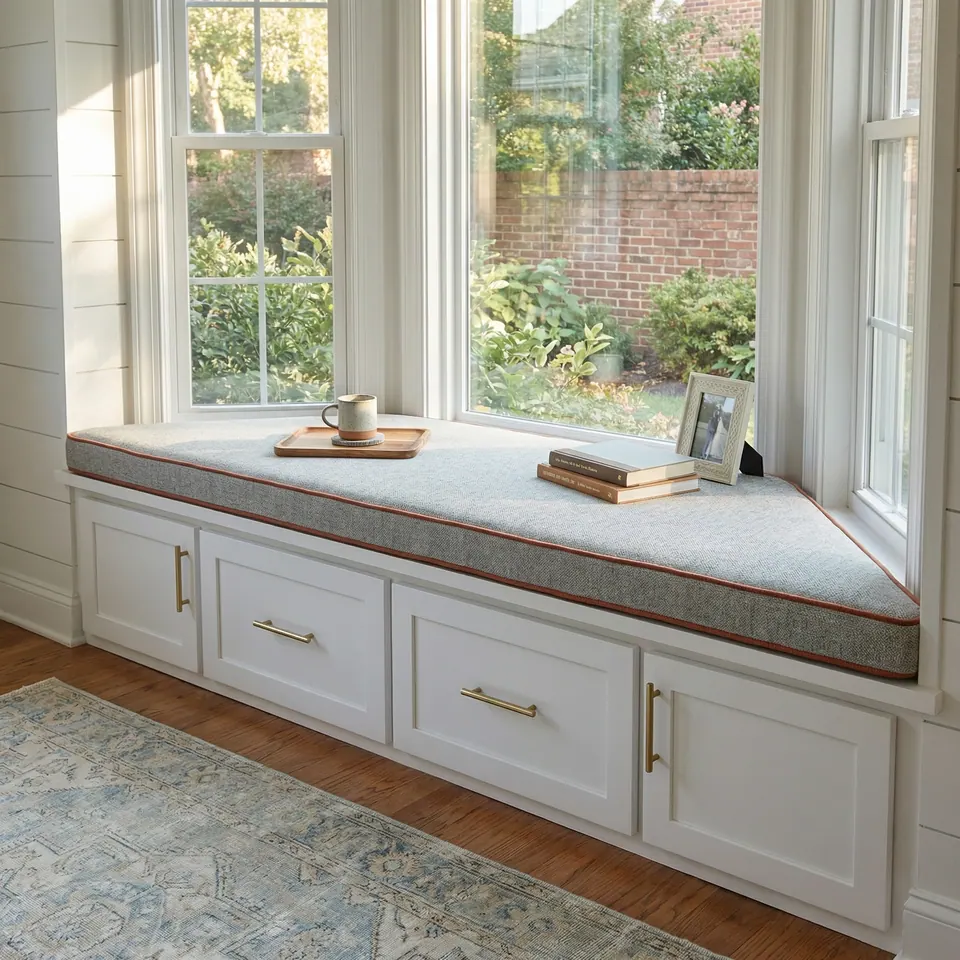
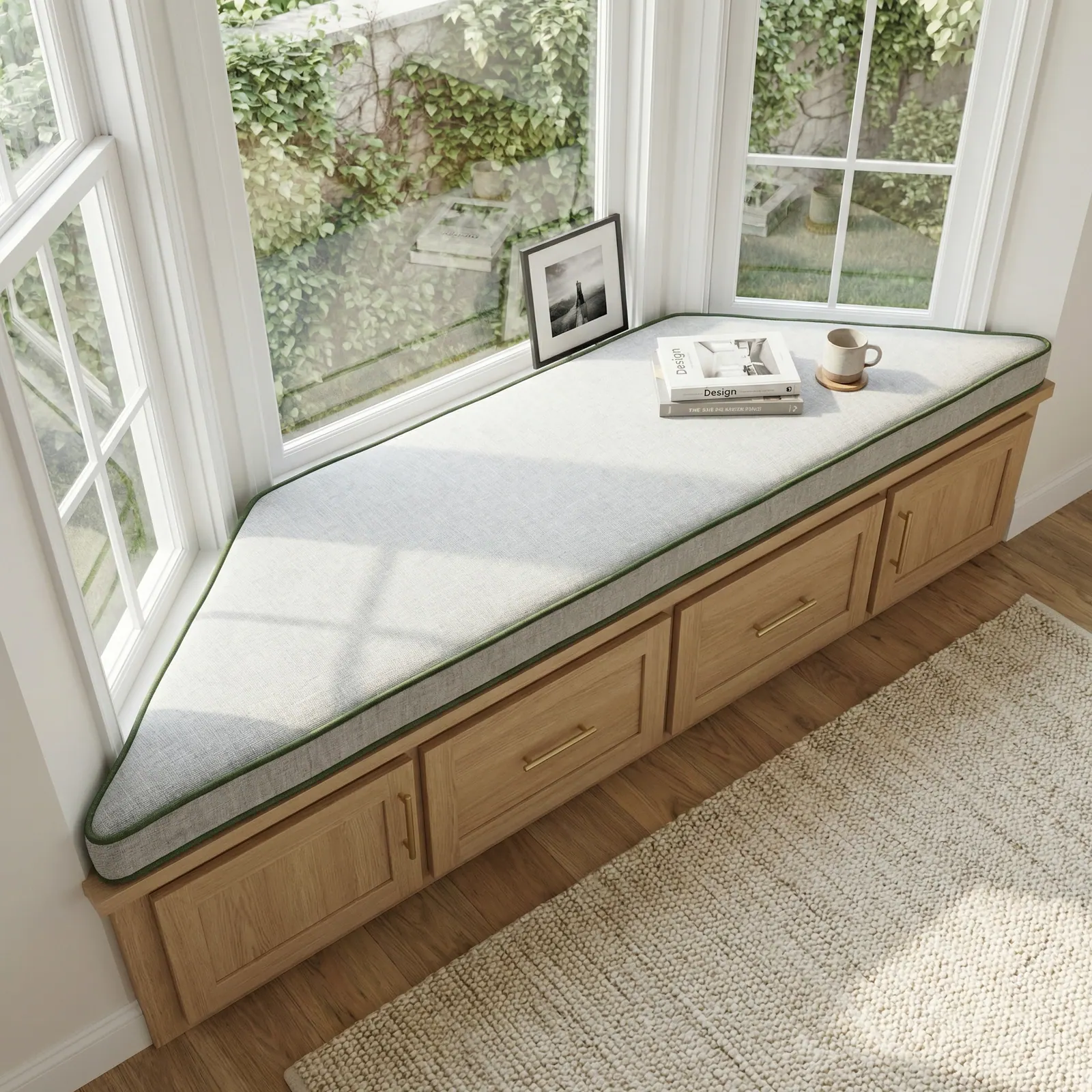
A light gray trapezoid bench cushion with olive piping, taking its color from the garden
One end of this bay seat narrows almost to a point, and the piping color comes from the ivy outside the glass. Here is what I'd borrow from the backyard, and what I'd keep indoors.
A long taper runs from the wide back to a sharp tip at the side window, a shape only a template can capture. The olive welt echoes the ivy beyond the glass.

The quick answer
A trapezoid bench cushion that tapers almost to a point should be cut from a paper template of the ledge, not from tape measurements, because the narrow tip has no room to hide an error. A contrast welt then makes the odd outline look intentional: here olive piping borrows the ivy outside, and light gray keeps the large seat quiet against honey oak.
A bay seat that ends in a point
Measure the wide end of this bay seat and you have an ordinary cushion. Walk toward the side window and the seat narrows almost to nothing. That tip is the whole problem and most of the charm.
A taper this extreme is a job for a paper template, not a tape measure. At the wide end a small error spreads over a long run; at the tip there is nowhere to hide it. The bay window calculator handles regular bays. A shape like this wants paper, traced on the ledge, with the wall edge marked.
The body is a light gray heathered weave from the linen-look family, box edge, with olive green contrast piping. Pale gray keeps a big field of fabric from shouting over the natural oak drawers and their brass pulls. The olive welt runs the full outline and pulls your eye along the taper, so the shape looks designed rather than forced. On a trapezoid cushion, the piping is a drawing of the geometry.
The props obey the geometry too. A black-framed black-and-white photograph on the sill is the one dark accent, and it stays off the cushion. Two stacked design books and a white mug on a cork coaster sit at the deep end, where there is room. Nothing lives on the narrow tip, where it would slide. The chunky jute rug below gives rough texture against the smooth weave above. It is a reading nook in the plainest sense: one seat, one book, one mug.
Where does your seat get narrow, partner, and what have you been setting down there?
Pinned by Nate: the bay with a sharp end
Five pins: the welt, the tip, and the three objects that know where to sit.
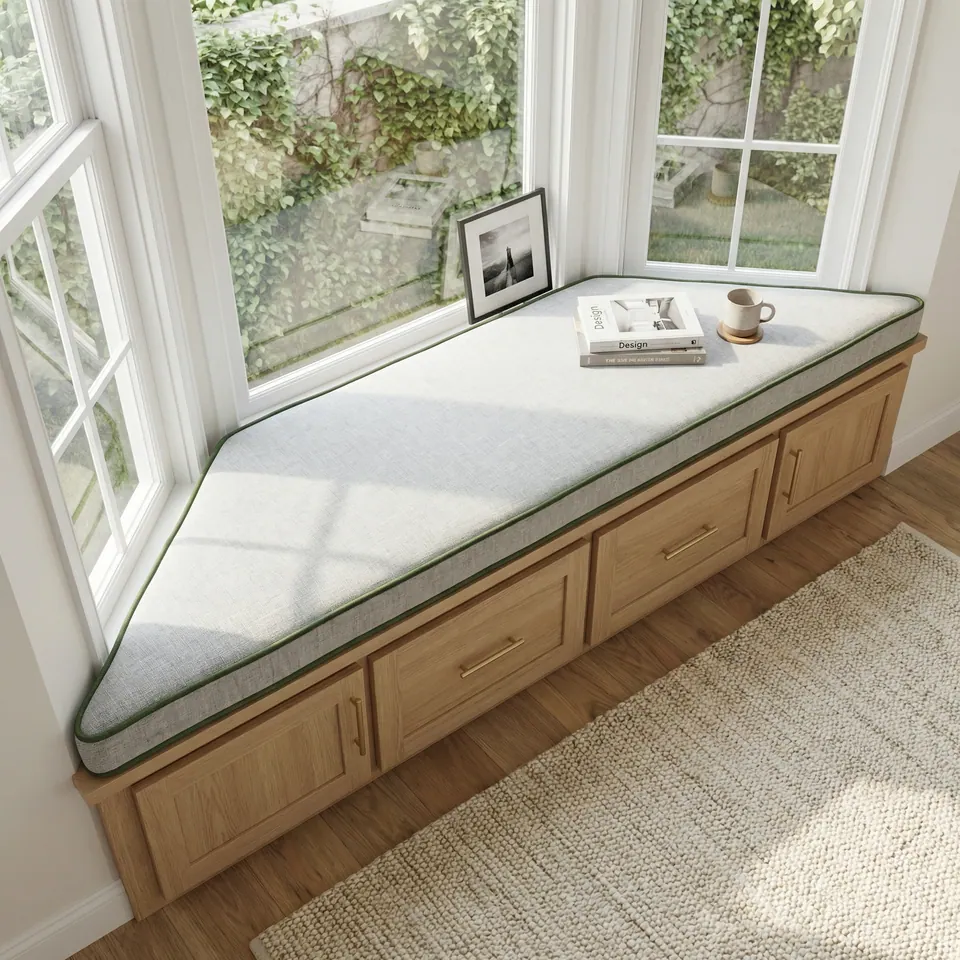
- Olive green piping
The olive welt traces the long taper and repeats the ivy on the wall outside.
- Tapered point
The seat narrows almost to a point here, so only a paper template of the ledge gives an exact fit.
- Framed photograph
A single black frame on the sill adds a dark accent without cluttering the cushion.
- Books and mug
Objects sit at the deep end where there is room, never on the narrow tip.
- Jute rug
The rough jute gives texture against the smooth heathered weave above it.
- Olive green pipingThe olive welt traces the long taper and repeats the ivy on the wall outside.
- Tapered pointThe seat narrows almost to a point here, so only a paper template of the ledge gives an exact fit.
- Framed photographA single black frame on the sill adds a dark accent without cluttering the cushion.
- Books and mugObjects sit at the deep end where there is room, never on the narrow tip.
- Jute rugThe rough jute gives texture against the smooth heathered weave above it.
What the bay borrows from outdoors, and what stays inside
| Decision | Borrowed from outside | Kept indoors |
|---|---|---|
| Accent color | Olive piping, taken from the ivy on the garden wall | One contrast welt, not a print |
| Main color | A pale gray that stays calm in full daylight | A soft linen-look hand for bare arms and a book |
| Texture | A chunky jute rug, a fiber at home on any porch | A smooth heathered weave on the seat |
| Loading | Objects at the wide end, the way you'd set a patio table | A framed photograph and design books, not planters |
The four bay measurements that wouldn't close
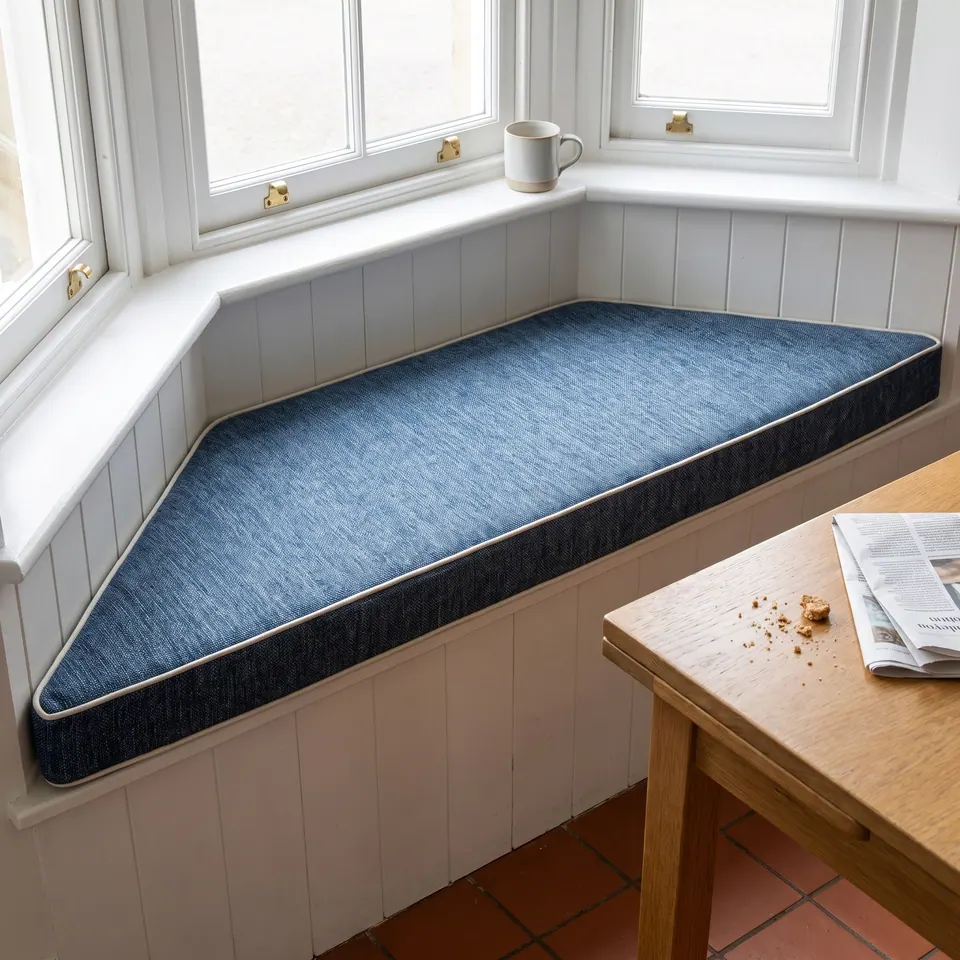
A buyer got in touch about a window seat in a vacation home: a trapezoid with a long side of 47 7/8 in (121.5 cm), a short side of 37 in (94 cm) and a depth of 16 1/8 in (41 cm), in linen L06 with L42 piping.
The workshop drew it and found the numbers did not form a closed shape, so it asked for a sketch. The sketch showed one 90-degree corner. With that, the workshop calculated one edge at 18 7/8 in (48 cm).
The buyer kept the 16 1/8 in depth on purpose: a small wood protrusion sat on the seat, and they couldn't re-measure it while away from the house. The zipper went on the 47 7/8 in side, and the order carried the workshop's handmade tolerance of about ± 3/8 in (1 cm).
A square corner and a note about the bump, drawn on the first sketch, would have saved a round of messages.
- Sizes
- 47 7/8 / 37 x 16 1/8 in (121.5 / 94 x 41 cm), one right angle
The lesson: Mark right angles and obstructions on your sketch so the maker's geometry matches reality.
Buyer questions: photos, bolsters and what a quote covers
- A common question
Could I see photos of my cushion before it ships?
The workshop's answerYes. When asked, the workshop has sent photos of the finished cushion before shipping it.
- A common question
Can you make long round bolster backrests to match my dining bench seat cushions?
The workshop's answerYes, in the same fabric, with rounded ends. One pair ran about 50 3/8 in and 41 3/8 in (128 and 105 cm) long to sit behind seats of 18 1/8 x 50 3/8 in and 18 1/8 x 41 3/8 in (46 x 128 and 46 x 105 cm). Send reference pictures or a sketch so the bolsters can be quoted accurately.
- A common question
Does the quote cover piping, filling and delivery? And can I get a plain bench cushion with no tufts?
The workshop's answerYes, piping, filling and delivery were all included for two tufted bench cushions of about 53 x 17 1/2 in, 2 in high. A plain, crease-free version is made on seating foam and costs more; a lower-density foam and a more affordable velvet bring it back down.
On the cutting table: the tapered bay seat
| Cushion | Trapezoid window seat cushion, one end tapering almost to a point |
|---|---|
| Fabric | Light gray heathered linen-look weave |
| Piping | Olive green contrast piping around the full outline |
| Edge | Box edge |
| Base | Natural oak drawers with brass pulls |
| Measuring | Paper template of the ledge, not tape alone |
| Tolerance | Handmade, about ± 3/8 in (1 cm) |
| Best for | Reading nooks and bay seats with one sharp angle |

Have it made
Have this made — ask Nate’s workshop
Precision starts on the phone. Give the workshop your measurements and they will read them back to you, edge by edge. — Nate
Leave your details and the workshop will call you to confirm measurements, fabric, foam and piping. No prices, dates or payment on this page: it is a request, not an order.
On a trapezoid bench cushion that tapers to a point, a paper template of the ledge beats any tape measurement, because the tip has nowhere to hide an error.
Nate
Questions buyers ask next
How do I measure a bay window seat that narrows almost to a point?
Make a paper template of the ledge rather than relying on a tape. Trace the whole seat, mark the wall edge and any square corner, and note bumps or trim. At the narrow tip even a small error shows, so the traced shape is the safest record.
Why pick contrast piping for an oddly shaped window seat cushion?
A contrast welt outlines the shape, so an unusual taper looks intentional. On this light gray seat the olive piping follows the full outline and repeats the ivy outside the window, which ties the cushion to the view.
What handmade tolerance applies to a custom trapezoid cushion?
The workshop notes a handmade tolerance of about ± 3/8 in (1 cm). Measure carefully, mark any right angles, and tell the workshop about obstructions such as trim or a wood protrusion before the pattern is cut.
± 1/4 in — Nate