A Reading by NateTrapezoid & Angled Cushions
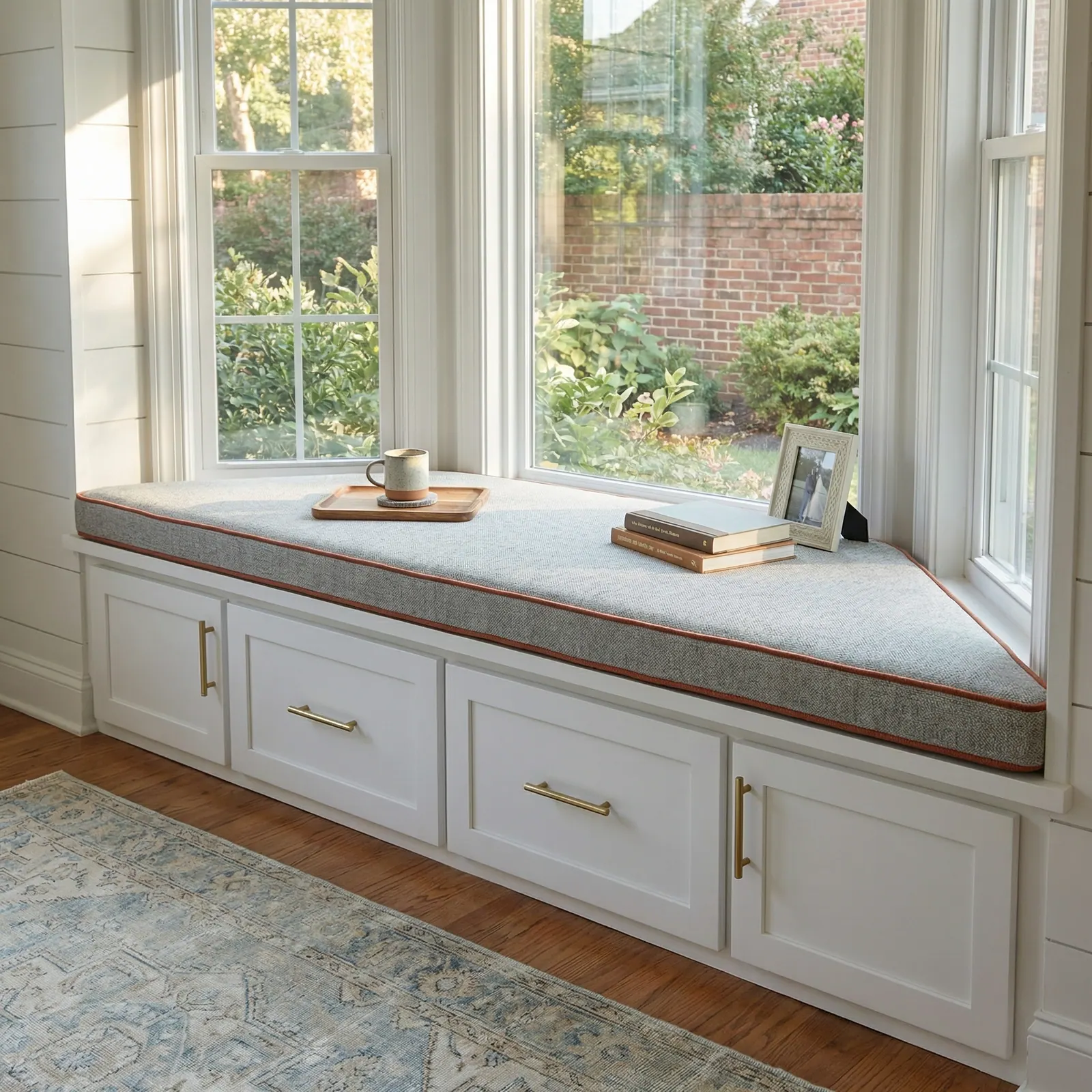
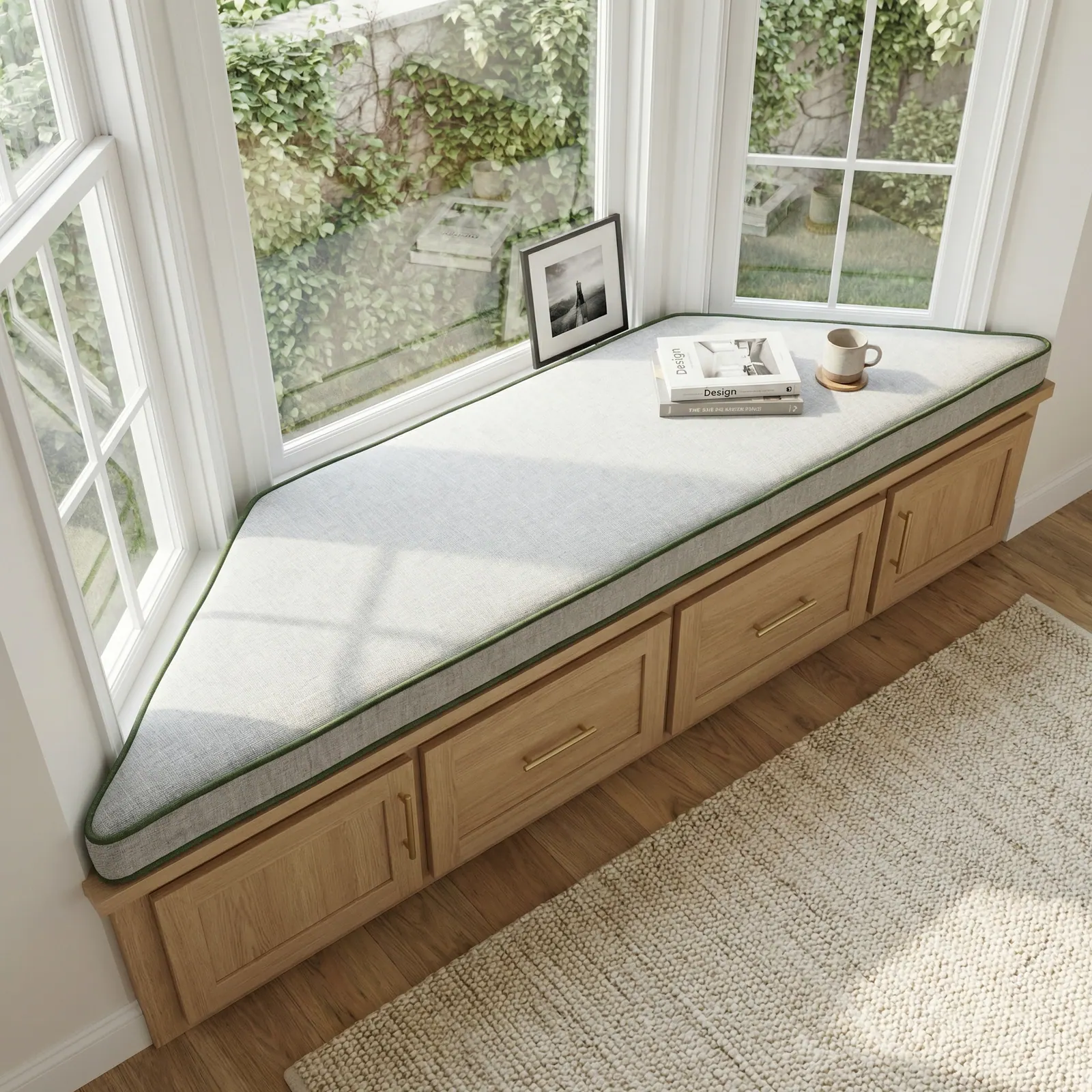
A Gray Tweed Trapezoid Bench Cushion, Read in Morning Light
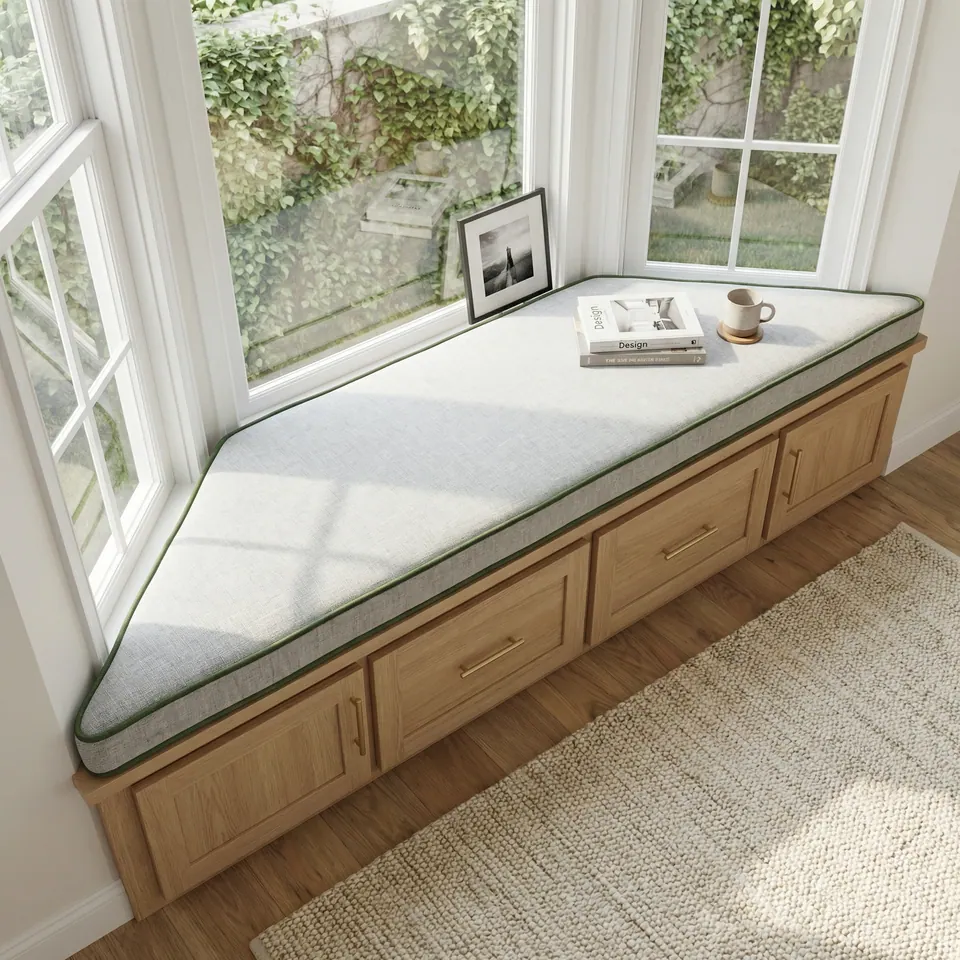
Pebble gray on a white shiplap bay, one thin rust line, and an angled end cut to the wall. The color changes three times a day. The measurements shouldn't.

 Save
The quick answer
A trapezoid bench cushion in cool gray stays warm-looking when its piping takes its color from the floor or brickwork, not from the fabric. Judge that pairing on a real swatch in morning and evening daylight, never on a screen alone. Then measure each angled side on its own: on one bay they came to 21.25 and 20.75 in (54 and 52.7 cm).
The cushion, cut open
Cover fabric. A removable, zippered cover. Machine wash at 86°F (30°C) on a gentle cycle and air dry.
Piping. A fabric-covered cord sewn into the seams. It sits on the seam line, so it does not change the size.
Fiber wrap. Polyester fiber (Dacron) batting around the foam: it fills the cover out and softens the edges.
Foam core. About 2.0 lb/ft³ (32 kg/m³) high-resilience foam, firm to medium-firm, cut to the ordered size.
Zipper. Along the back band, as hidden as possible. The zipper side faces down or toward the wall.
Base panel. The underside of the cover. A non-slip fabric backing can cover the whole of it instead.
Anatomy of a 3-inch top on a white bay
Start with the ratio. The cushion sits about 3 in (7.6 cm) deep on a wide white base of shaker drawers, roughly one part cushion to four parts cabinet. That proportion reads tailored, not puffy, and it leaves the brass bar pulls in full view.
Now the outline. Box edge, straight walls, a thin rust welt on the top seam. Follow that welt to the right and it turns with the bay: the end is cut on the wall's angle from a template, so there is no gap against the side window. That angled end is the hardest part of any trapezoid cushion to get right, and the styling leaves it in plain sight on purpose.
The fabric is a pebble gray tweed-look from the linen-look fabrics family. The props are few and each one works. A wooden tray gives a stoneware mug a flat base on a soft seat. Two stacked hardbacks and a small silver frame say reading nook, not showroom. A faded blue vintage rug keeps the gray from going flat against white shiplap. Outside, a brick garden wall; underfoot, oak boards. Remember those two. They matter in a minute.
Five pins on the shiplap bay
Five pins, from the rust welt to the washed-blue rug, trace how a cool gray cushion is fitted to the bay and kept warm.
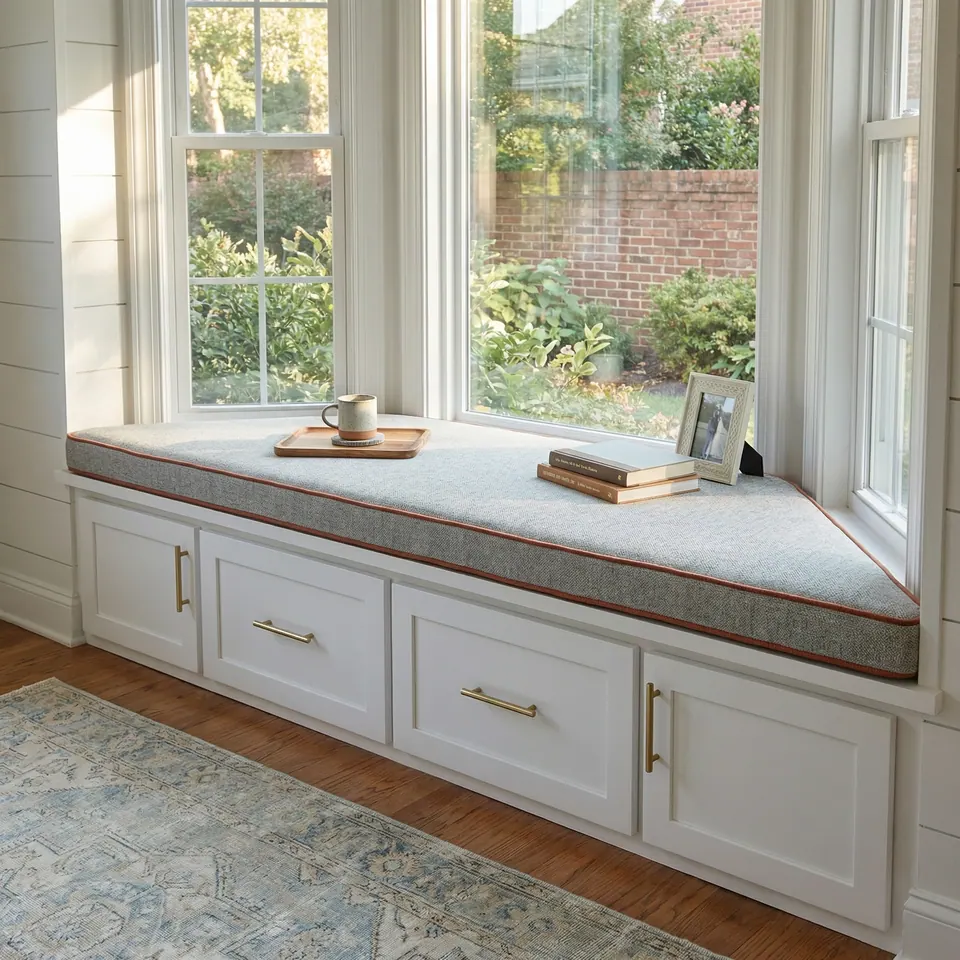
- Rust contrast piping
A thin rust welt picks up the oak floor and the brick outside, warming a cool gray fabric.
- Angled bay end
The right end is cut on the bay's angle from a template, so there is no gap against the side window.
- Tray with mug
A flat tray gives a mug a stable base on a soft seat.
- Brass drawer pulls
The cushion stays about three inches deep so the drawer fronts and pulls remain the star below it.
- Faded blue rug
The rug's washed blues keep the gray cushion from looking flat against white paint.
- Rust contrast pipingA thin rust welt picks up the oak floor and the brick outside, warming a cool gray fabric.
- Angled bay endThe right end is cut on the bay's angle from a template, so there is no gap against the side window.
- Tray with mugA flat tray gives a mug a stable base on a soft seat.
- Brass drawer pullsThe cushion stays about three inches deep so the drawer fronts and pulls remain the star below it.
- Faded blue rugThe rug's washed blues keep the gray cushion from looking flat against white paint.
Three lights on one pebble gray
The photo was taken in soft morning daylight, the kindest light gray ever gets. Side light from the glass is cool and even, so pebble gray reads as gray and the tweed texture shows. At noon, with sun straight through the bay, the same cloth can look a shade paler than the swatch. By evening, lamps push everything toward yellow: the gray drifts toward taupe and the rust welt glows almost orange.
That is why the welt is rust and not charcoal. Its color comes from the oak floor and the brick outside, and those shift with the light exactly as the piping does. Match piping to the fabric and it can go dead at night. Match it to the room and it keeps pace.
Then there is the screen. A phone sets its own white balance, and a cool gray is where that shows most, drifting blue on one device and beige on the next. So I run a three-reading test, partner: tape a physical swatch to the seat and look at it at breakfast, at noon and after the lamps come on. The screen versus daylight Pattern and swatches before ordering cover the method. Which way does your bay face, morning sun or evening sun?
43.25 inches, three times on one drawing
A buyer in the US sent the workshop a drawing of a trapezoid bay and chose a tufted velvet from the color chart: cream #13 first, then #2. The front was marked 43.25 in (109.9 cm). So, according to the drawing, was each angled side.
A trapezoid that fits that bay cannot have three equal edges like that, so the workshop asked for each side separately, plus a phone number in case a quick call was easier. The buyer measured again: 21.25 in (54 cm) on the right, 20.75 in (52.7 cm) on the left. Half an inch (1.3 cm) apart. Measure twice; the fabric remembers.
With the numbers settled, production took 5 to 7 days and delivery another 3 to 5. Bay sides are rarely twins, and the first color you pick is not always the one you keep. The trapezoid measurements Pattern and the trapezoid cushion calculator take you through all four lines.
Buyer questions: four-number quotes, designer swatch sets, the 4-inch default
- A common question
How much is a trapezoid window seat cushion, and what do you need from me to price one?
The workshop's answerA trapezoid is priced from its four measurements. One past quote was for a seat 68.25 in (173.4 cm) at the back and 113.75 in (288.9 cm) at the front, with sides of 33.75 in (85.7 cm) and 33 in (83.8 cm).
- A common question
I'm an interior designer. Can you send a sample so I can check the color and feel, or even a full swatch set for future orders?
The workshop's answerYes. Small samples go out before a custom order on request, and one designer was offered a complete swatch set of every color, so future orders can be chosen with the fabrics in hand.
- A common question
How thick are your bench cushions?
The workshop's answerThe standard bench cushion is 4 in (10 cm) thick. Other thicknesses are made to order, from 3 in (7.6 cm) up to 12 in (30 cm) for sofa seat cushions.
On the cutting table: the gray tweed trapezoid
| Piece | Trapezoid window seat cushion, angled right end |
|---|---|
| Fabric | Pebble gray tweed-look, linen-look family |
| Piping | Contrast welt in rust |
| Edge | Box edge |
| Thickness | About 3 in (7.6 cm); 4 in (10 cm) is standard |
| Base | White shaker drawers with brass bar pulls |
| Light | Soft morning daylight through the bay |
| To send | Back, front and each angled side, labeled separately |
| Best for | Reading nook bay seats |

Have it made
Have this made — ask Nate’s workshop
Send the numbers in inches: length × depth × thickness, plus any angle. The workshop checks them with you, because foam has no undo button. — Nate
Leave your details and the workshop will call you to confirm measurements, fabric, foam and piping. No prices, dates or payment on this page: it is a request, not an order.
A trapezoid bench cushion needs four numbers, not two: the back, the front and each angled side, because bay sides can differ by half an inch.
Nate
Questions buyers ask next
Why does a gray window seat cushion look blue on my phone but beige at home?
Phones and cameras set their own white balance, and a cool gray is where the shift shows most. Evening lamps then warm it again. Judge a physical swatch on the seat itself, in both morning and evening light, before you choose.
Should trapezoid cushion piping match the fabric or the room around it?
Taking the piping color from the room, such as an oak floor or a brick wall, keeps it in step with the fabric as the light changes. Here a rust welt keeps a cool pebble gray looking warm from morning to evening.
How different can the two angled sides of one bay window seat be?
Different enough to matter. On one US bay the right side measured 21.25 in (54 cm) and the left 20.75 in (52.7 cm). Copying one number to both sides would leave a gap at one end and a bulge at the other.
± 1/4 in — Nate
More photographs to read
 Save
 Save
 Save
 Save
 Save
 Save