A Reading by NateTrapezoid & Angled Cushions
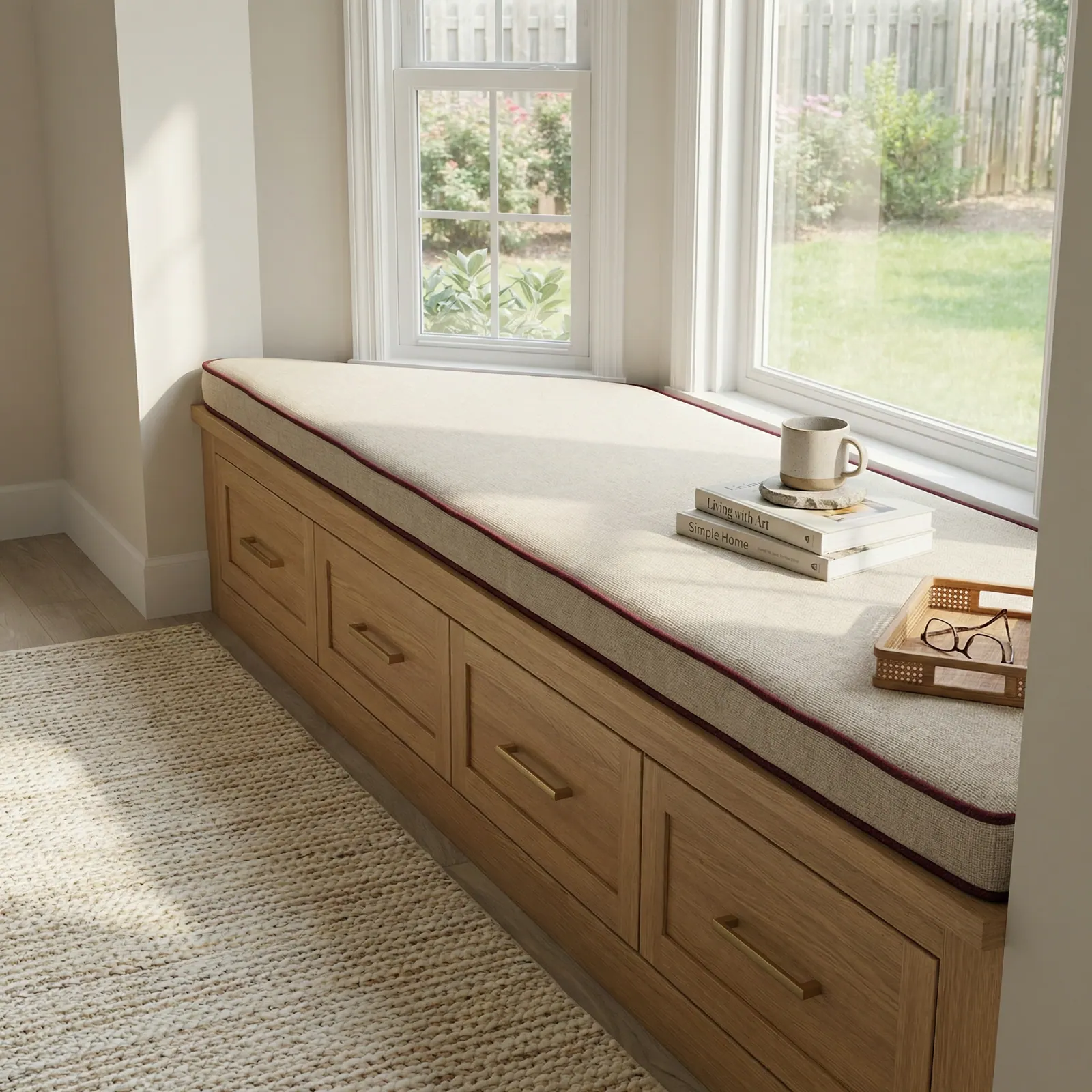
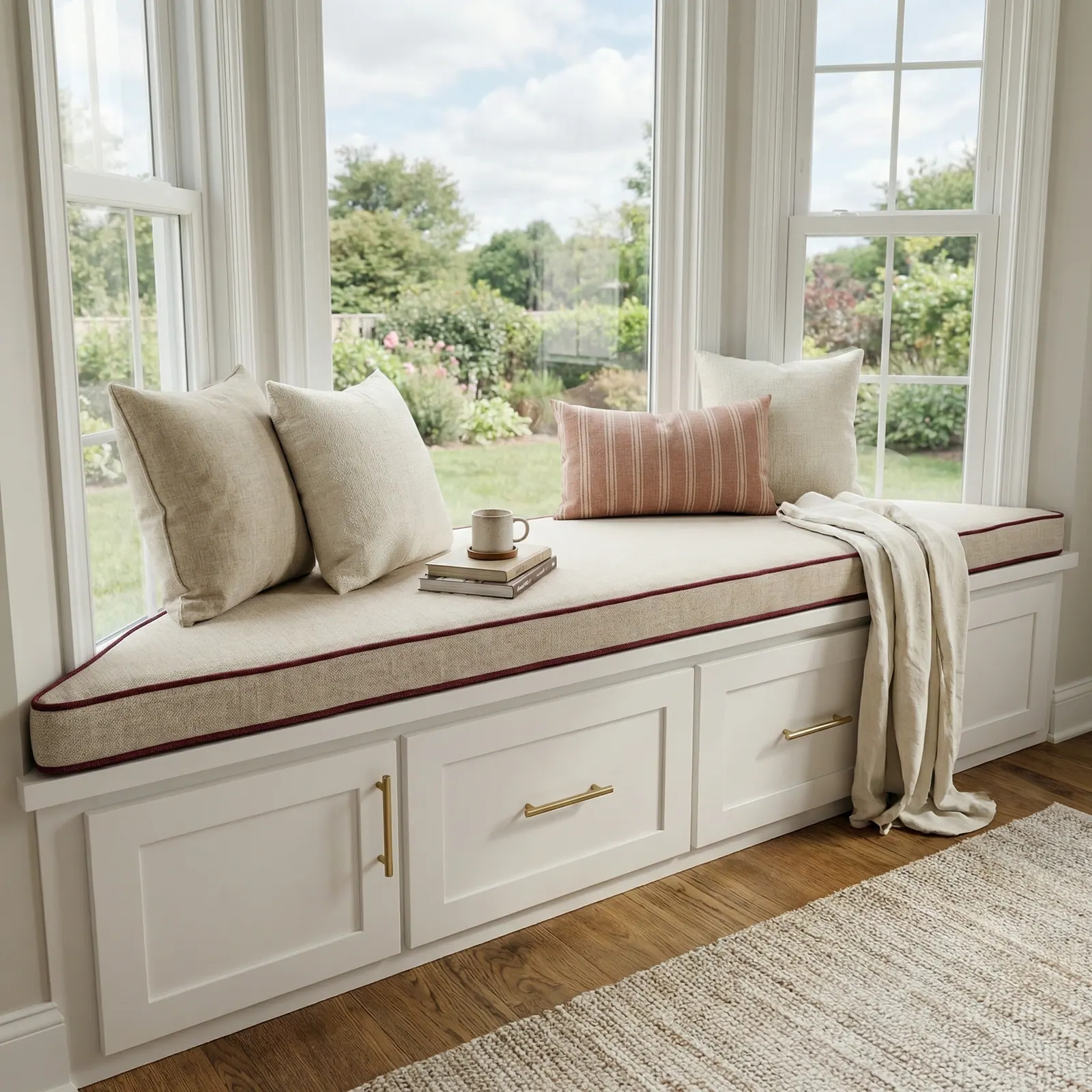
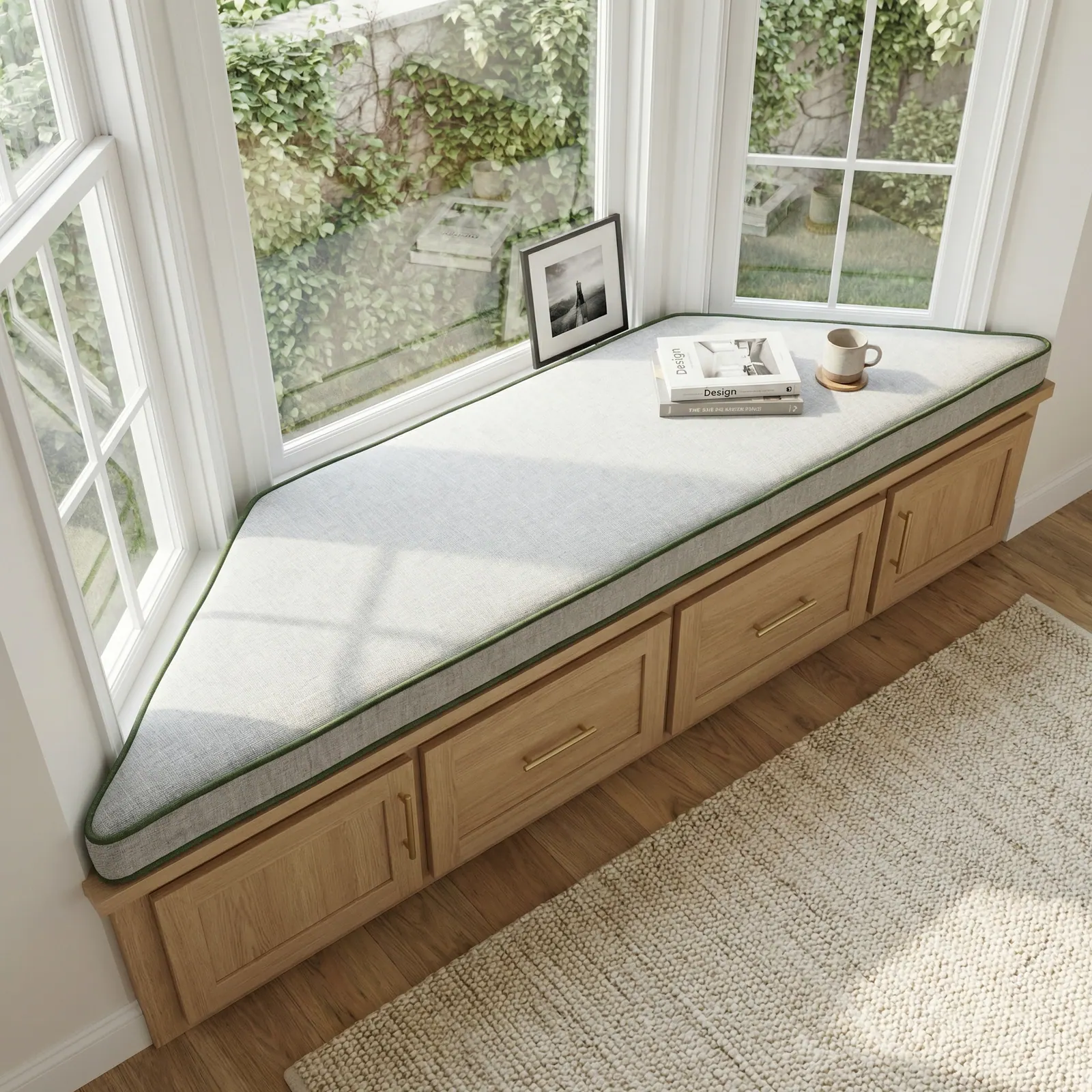
An oatmeal trapezoid bench cushion with burgundy piping, read for where the money goes
Four sides, one odd angle and a berry-colored welt. I read this bay bench the way I read a bill of materials: what earns its cost, and what can wait.

 Save
The quick answer
On a trapezoid bench cushion, spend on accurate measurements and a thickness you will keep, and save by making the seat one piece. Multi-angle bay seats are routine once you send a rough diagram with every side measured. Split long back pillows instead: a single 88 in (224 cm) pillow sags, while two 44 in (112 cm) pillows hold their shape.
The cushion, cut open
Cover fabric. A removable, zippered cover. Machine wash at 86°F (30°C) on a gentle cycle and air dry.
Piping. A fabric-covered cord sewn into the seams. It sits on the seam line, so it does not change the size.
Fiber wrap. Polyester fiber (Dacron) batting around the foam: it fills the cover out and softens the edges.
Foam core. About 2.0 lb/ft³ (32 kg/m³) high-resilience foam, firm to medium-firm, cut to the ordered size.
Zipper. Along the back band, as hidden as possible. The zipper side faces down or toward the wall.
Base panel. The underside of the cover. A non-slip fabric backing can cover the whole of it instead.
Pinned by Nate: five parts of the oak bay bench cushion
Five pins, and each one either earns its cost on this oak bay bench or quietly saves you some.
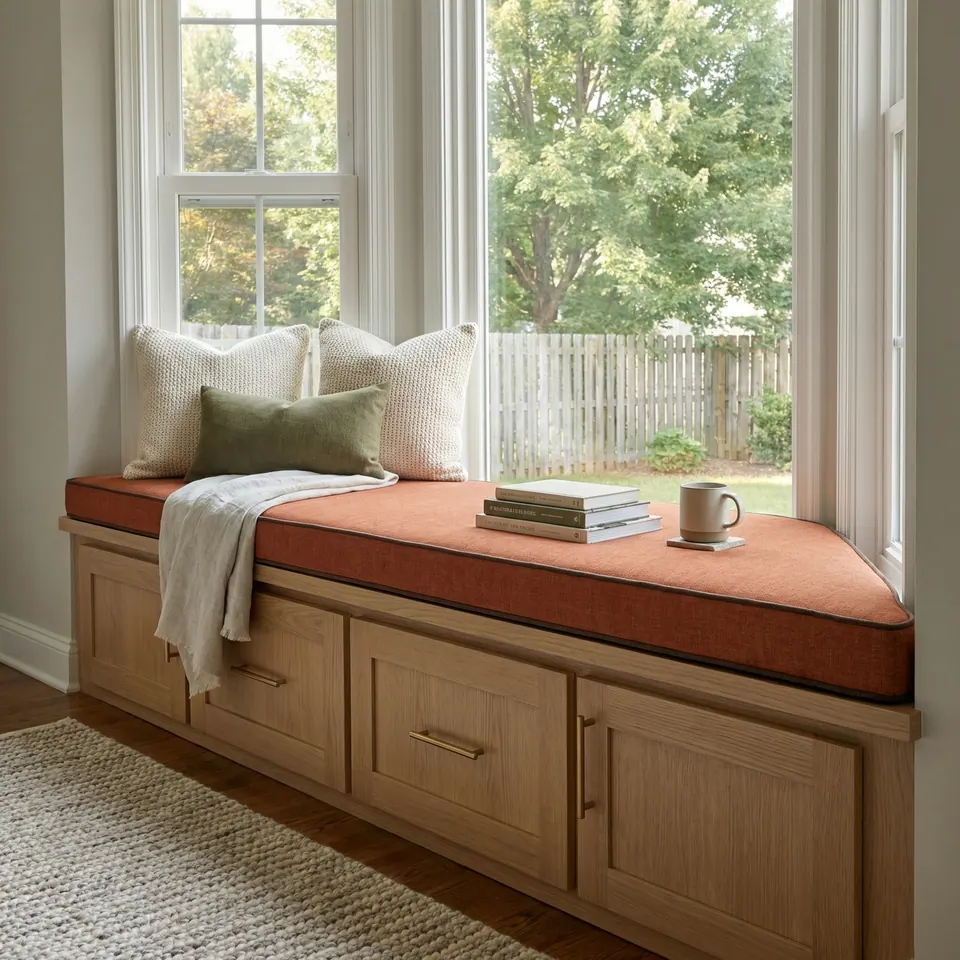
- Burgundy welt
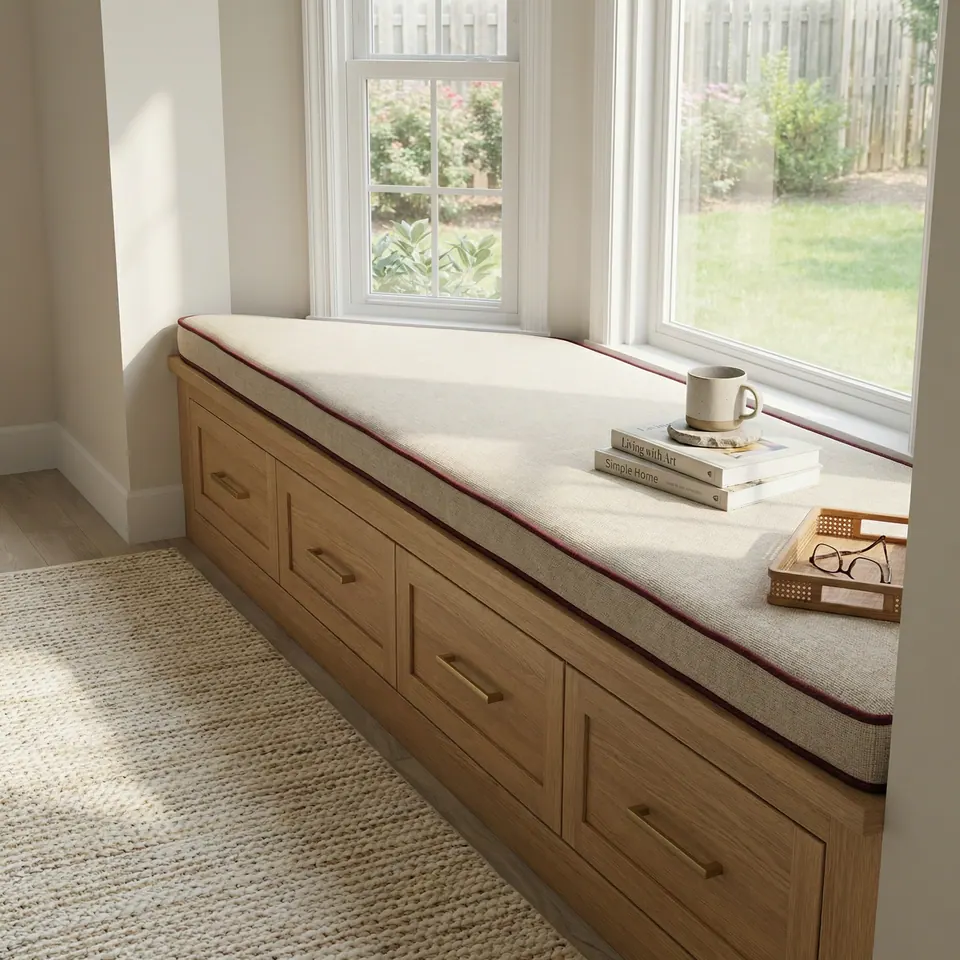
Oatmeal and honey oak are close in tone, so the berry piping draws the line between cushion and cabinet.
- Corner into the bay
The back end tucks into the bay corner, so its angle is copied from the ledge.
- Mug on books
Two paperbacks make a steady platform for a hot mug on a soft seat.
- Rattan tray
Woven rattan repeats the warm oak and holds glasses where they will not roll off.
- Oak drawer run
The cushion is about as thick as a drawer rail, so the bench still reads as built-in joinery.
- Burgundy weltOatmeal and honey oak are close in tone, so the berry piping draws the line between cushion and cabinet.
- Corner into the bayThe back end tucks into the bay corner, so its angle is copied from the ledge.
- Mug on booksTwo paperbacks make a steady platform for a hot mug on a soft seat.
- Rattan trayWoven rattan repeats the warm oak and holds glasses where they will not roll off.
- Oak drawer runThe cushion is about as thick as a drawer rail, so the bench still reads as built-in joinery.
The cross-section, from drawer rail to welt
Read a cushion from the bottom up, the way the foam sees it.
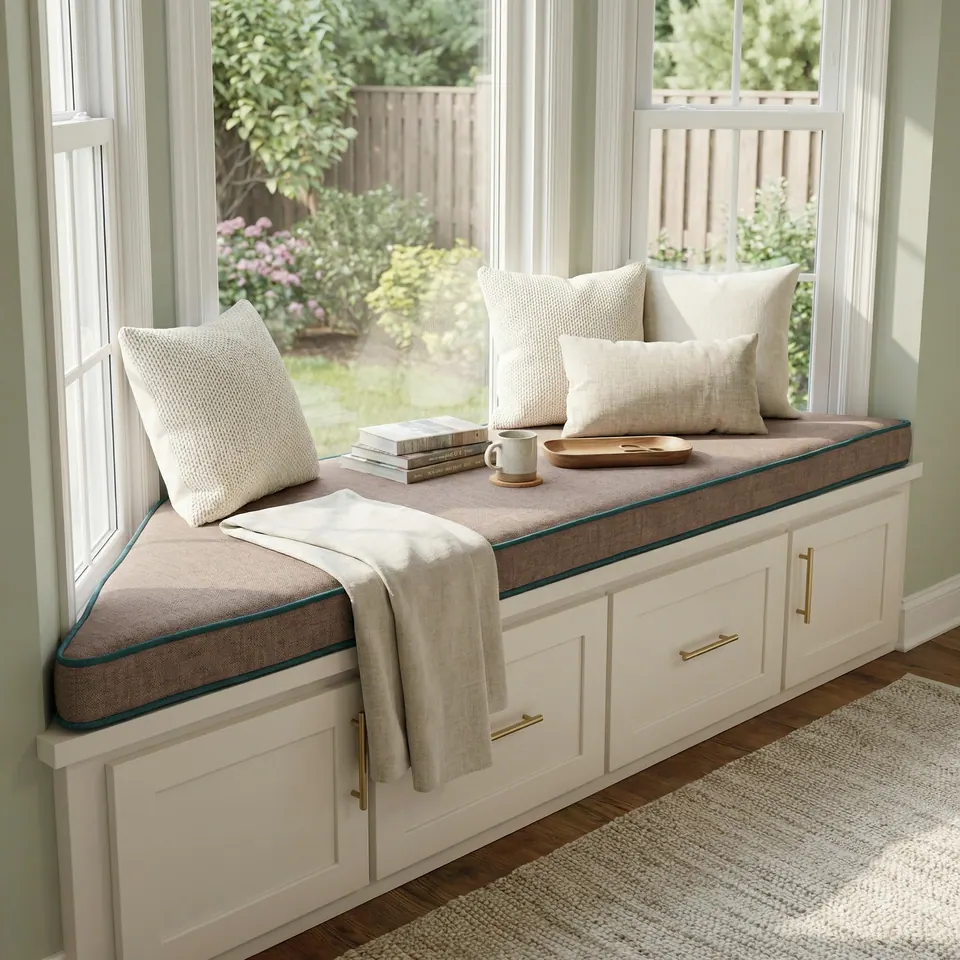
The base is an oak drawer run with brass bar handles. The cushion sits on it with a box edge about as tall as one drawer rail, so the bench still reads as built-in joinery, not a mattress on a cabinet. That ratio costs nothing. Hold a ruler against your drawer front before you settle the window seat thickness.
Next, the welt. Oatmeal linen-look and honey oak sit within a shade of each other, and without an edge the cushion would melt into the cabinet. One burgundy cord around the perimeter draws the line. Dollar for dollar, it is the hardest-working strip of fabric on the bench.
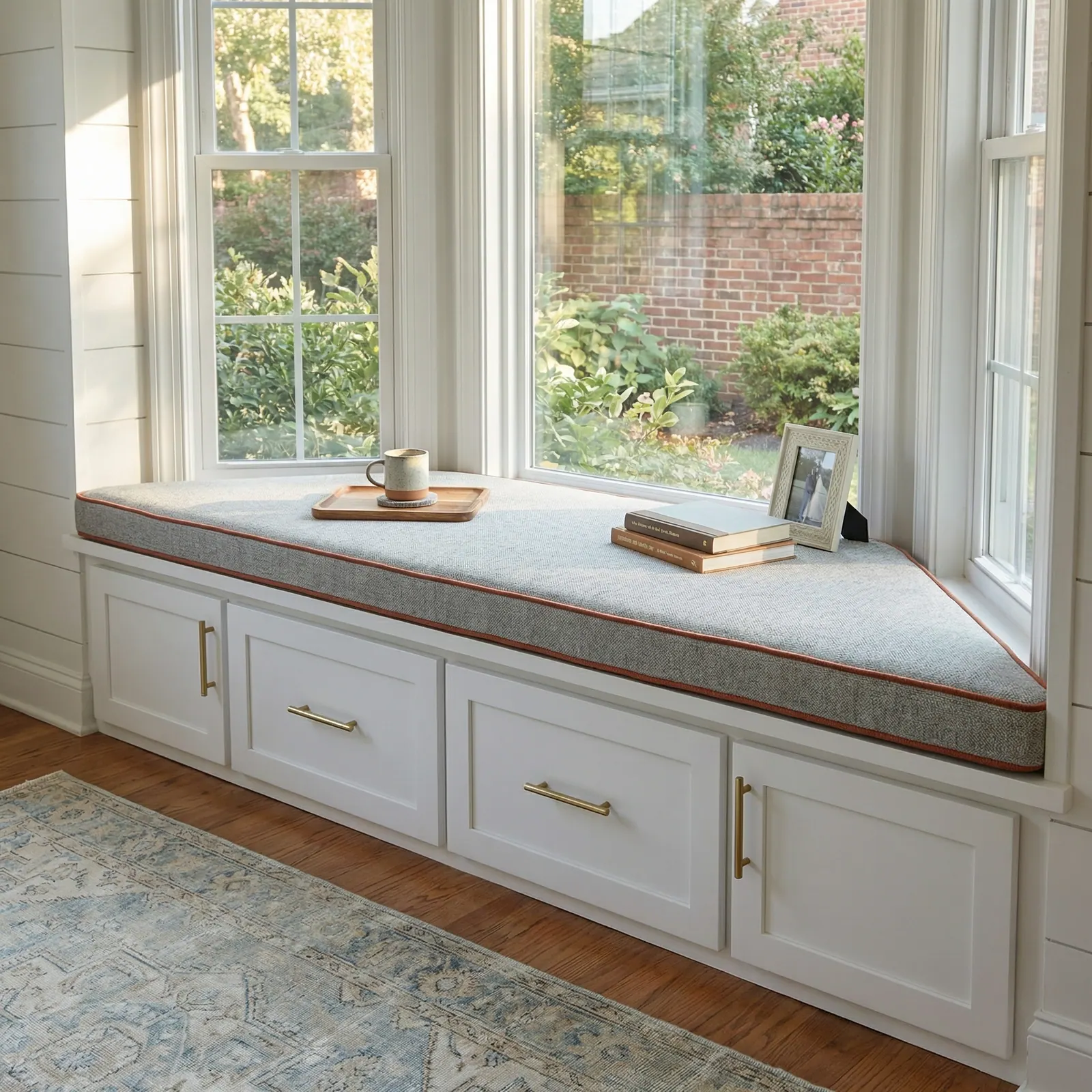
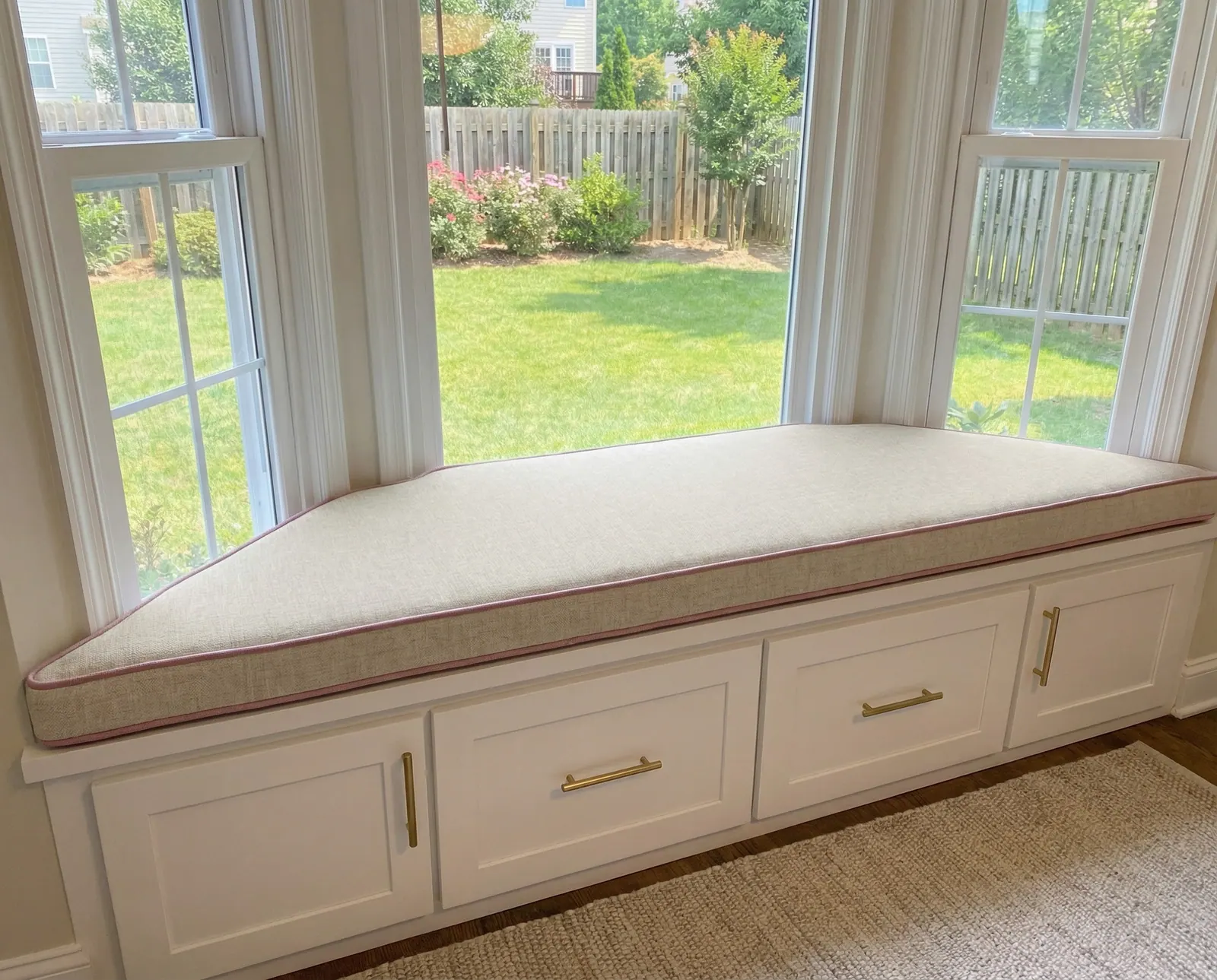
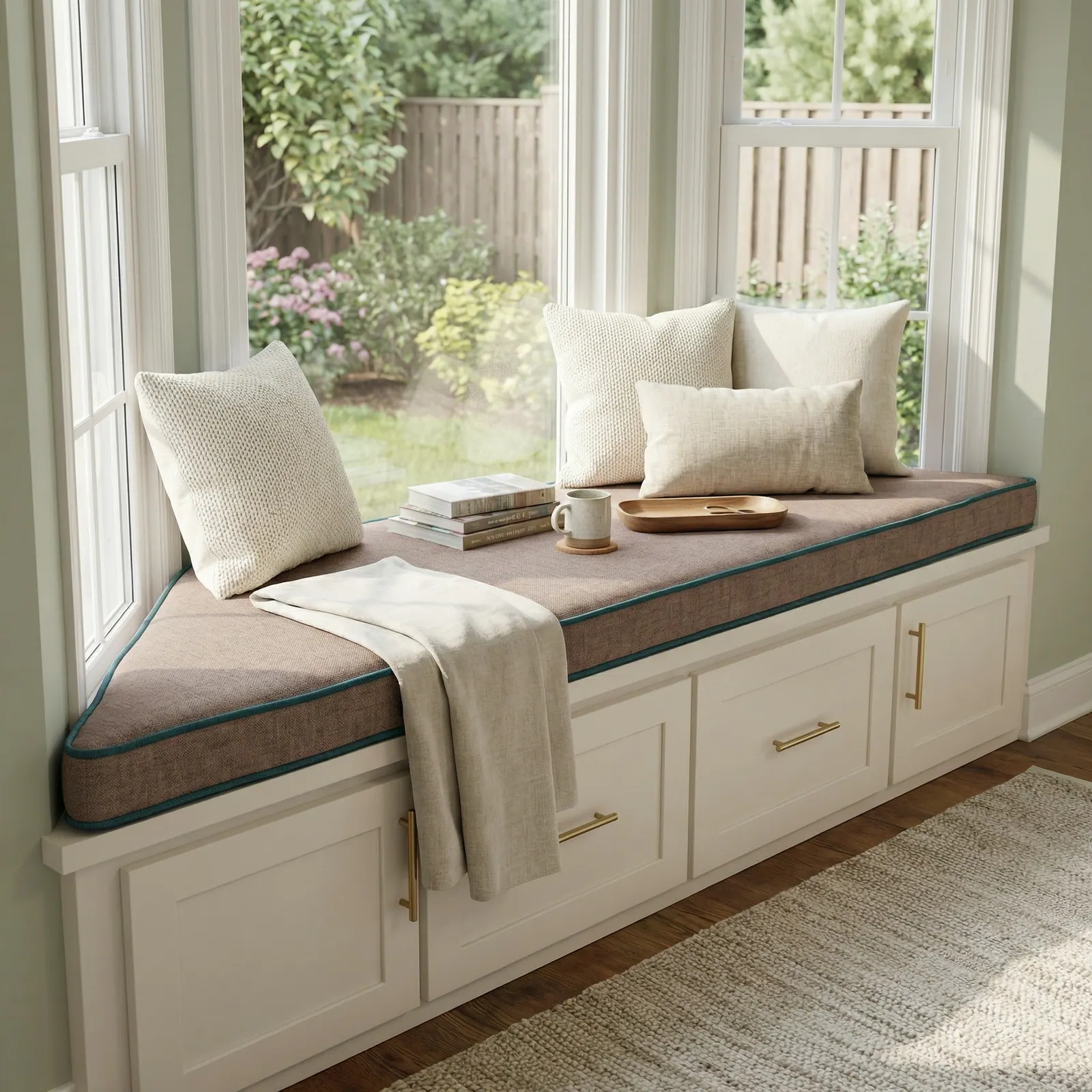
Then the angle. At the far end the seat turns into the bay corner, and the cushion's end copies the ledge, not a guess. Angles are just lengths in disguise: measure both parallel sides, both slanted sides and the depth, partner, and the trapezoid calculator does the rest.
The props are working parts too. Two paperbacks make a flat platform for a stoneware mug, because a soft seat tips a cup that a table would hold. The rattan tray keeps reading glasses from rolling into the bay gap and repeats the warm oak. The jute rug below is the fabric's beige, one texture coarser.
More shapes like this live under trapezoid cushions, and the weave belongs to the linen-look fabrics. What does the widest side of your bay measure?
Where to spend and save on a bay bench cushion
| Part | Spend or save | Why |
|---|---|---|
| Diagram and measurements | Spend (your time) | A rough sketch with every side measured makes a multi-angle bay routine. |
| Seat | Save: one piece | Separate pieces add cutting, sewing and a zipper each. |
| Back pillows | Spend: split them | One 88 in (224 cm) pillow sags; two 44 in (112 cm) pillows stay plump. |
| Thickness | Spend: decide once | Going from 4 in (10 cm) to 2 in (5 cm) later took a new cover too. |
| A wrong detail later | Save: cover only | Stripes sewn the wrong way were fixed with a new cover over the same insert. |
| Contrast piping | Spend when fabric matches wood | Burgundy separates oatmeal from honey oak. |
A 126 in banquette that was redrawn before it was quoted
A family in the US with kids and dogs wrote to the workshop about a trapezoid banquette bench: about 88.5 in (225 cm) along the top, 126 in (320 cm) at the bottom, 26.5 in (67 cm) on each slanted side and 19.25 in (49 cm) deep. They asked for performance fabric, and the workshop suggested its smooth, leather-like range.
The numbers disagreed. With 18.75 in (48 cm) of offset at each end, 26.5 in sides work out to a depth of about 18.75 in, not 19.25 in. So before any quote, the workshop redrew the shape and asked for a paper sketch. Half an inch is two tolerances.
The first cushion, in light blue velvet, was a hit. The family came back for four soft-filled back pillows: two at 44 x 12.5 in (112 x 32 cm) and two at 26 x 12.5 in (66 x 32 cm). A single 88 in pillow would have sagged. Later the 4 in (10 cm) seat felt too thick, so the workshop made a 2 in (5 cm) cushion with its own new cover in a pet-friendly fabric. Thinner foam inside the old cover would have gone baggy.
The workshop's rule from that job: split long back pillows and leave about 1.5 in (4 cm) for plumpness. The trapezoid measuring guide has the full checklist.
Buyer questions: angles, stripes and a wedge
- A common question
My bay window seat has several angles. Can you make one cushion that follows all of them?
The workshop's answerYes. Multi-angle bay cushions are routine work. Send a rough diagram with the measurements written on it, and the workshop checks the shape and confirms it before cutting.
- A common question
Can the stripes on my window seat cushion run the short way instead of the long way?
The workshop's answerYes, stripe direction can be specified on the order. When one cover came out with the stripes the wrong way, the workshop made a replacement cover only, keeping the insert, and it arrived in about 1 to 2 weeks including fabric sourcing, sewing and delivery.
- A common question
For my reading nook I'd like a flat seat cushion plus a wedge backrest. What do you need from me?
The workshop's answerThe wedge's width, its height, and its thickness at the top and at the bottom. One nook set paired a seat of about 36.5 x 25.5 x 2.75 in (93 x 65 x 7 cm) with a wedge 25.5 in (65 cm) wide, 27.5 in (70 cm) tall and about 8 in (20 cm) thick at the base, quoted together.
On the cutting table: the oak bay bench
| Cushion | Trapezoid bench cushion, one piece, cut to the bay ledge |
|---|---|
| Fabric | Oatmeal linen-look weave |
| Piping | Contrast welt in burgundy, full perimeter |
| Edge | Box edge, roughly the height of one drawer rail |
| Base | Oak drawer bench with brass bar handles |
| Measuring | Both parallel sides, both slanted sides and the depth; diagram checked before cutting |
| Thickness rule | Choose once: a thinner cushion later needs its own new cover |
| Back pillows, if added | Split long runs: 2 x 44 in (112 cm) rather than 1 x 88 in (224 cm) |
| Best for | A living-room bay bench used for reading and coffee |

Have it made
Have this made — ask Nate’s workshop
Precision starts on the phone. Give the workshop your measurements and they will read them back to you, edge by edge. — Nate
Leave your details and the workshop will call you to confirm measurements, fabric, foam and piping. No prices, dates or payment on this page: it is a request, not an order.
A trapezoid bench cushion saves money as one seat piece and keeps its shape with split back pillows: one 88 in pillow sags, two 44 in pillows hold.
Nate
Questions buyers ask next
How thick should a cushion be on a drawer-base bay bench?
Let the joinery decide. Here the cushion is about as tall as one drawer rail, which keeps the bench reading as built-in furniture. One family with a long banquette found 4 in (10 cm) too thick and switched to 2 in (5 cm).
Why put burgundy piping on a pale linen-look cushion?
Because oatmeal fabric and honey oak are almost the same warm beige. A wine or berry welt draws the edge between them. With matching piping, the cushion would read as part of the cabinet from across the room.
Can I swap thinner foam into my old cushion cover?
It will not sit neatly. When a 4 in (10 cm) seat felt too thick, the workshop made a 2 in (5 cm) cushion with its own cover, because thinner foam inside the old cover would have left loose fabric along every edge.
± 1/4 in — Nate
More photographs to read
 Save
 Save
 Save
 Save
 Save
 Save