The Pattern Room · a pattern with a calculator
Banquette cushion thickness: getting table height and knee room right
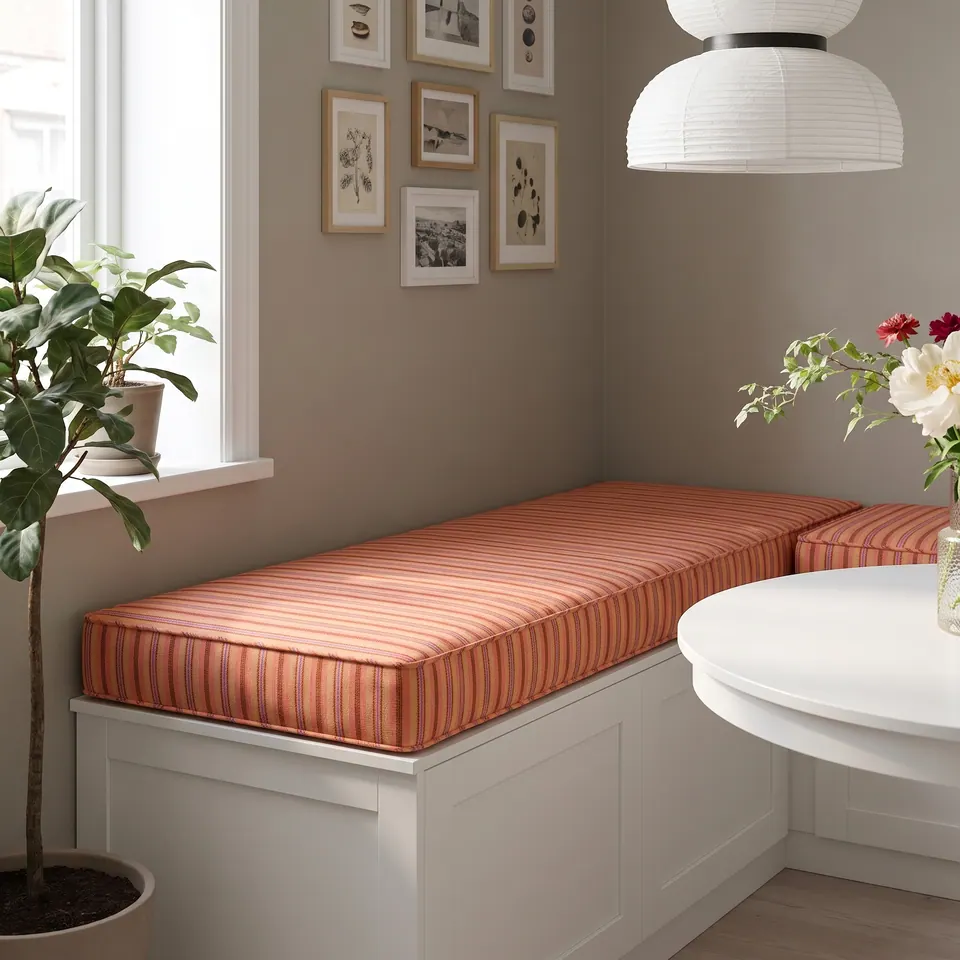
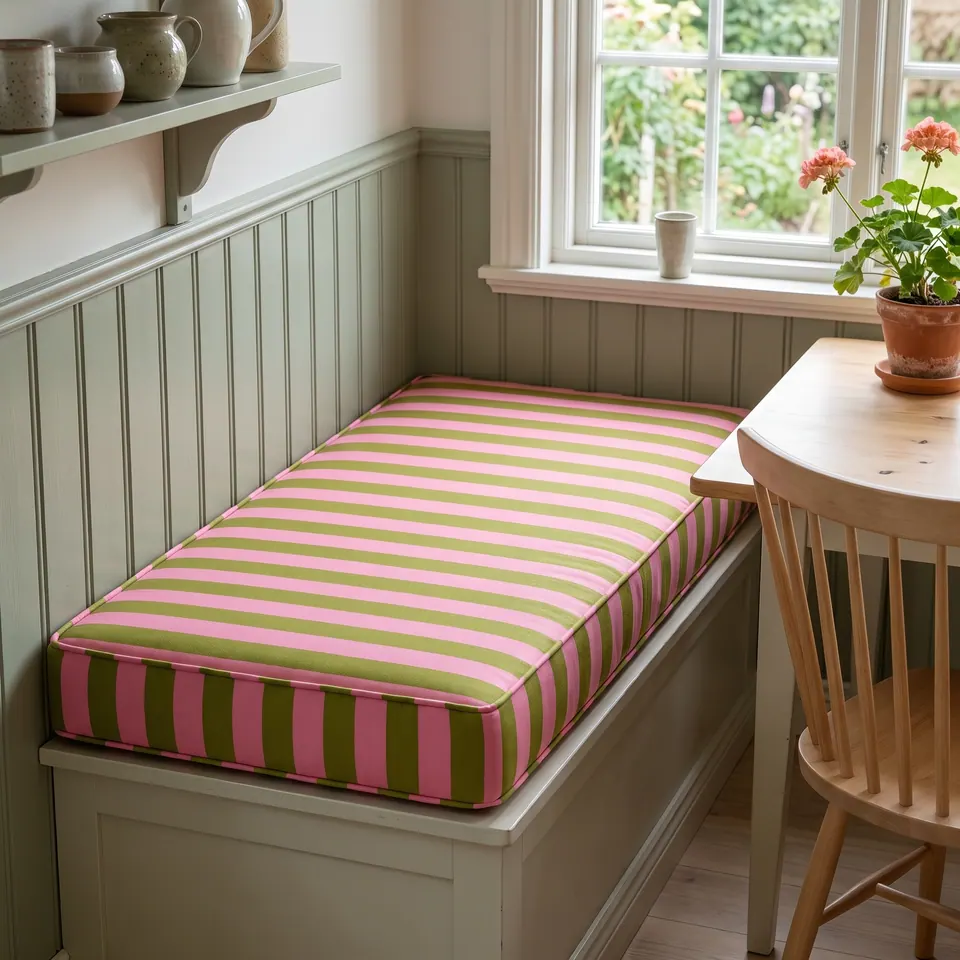
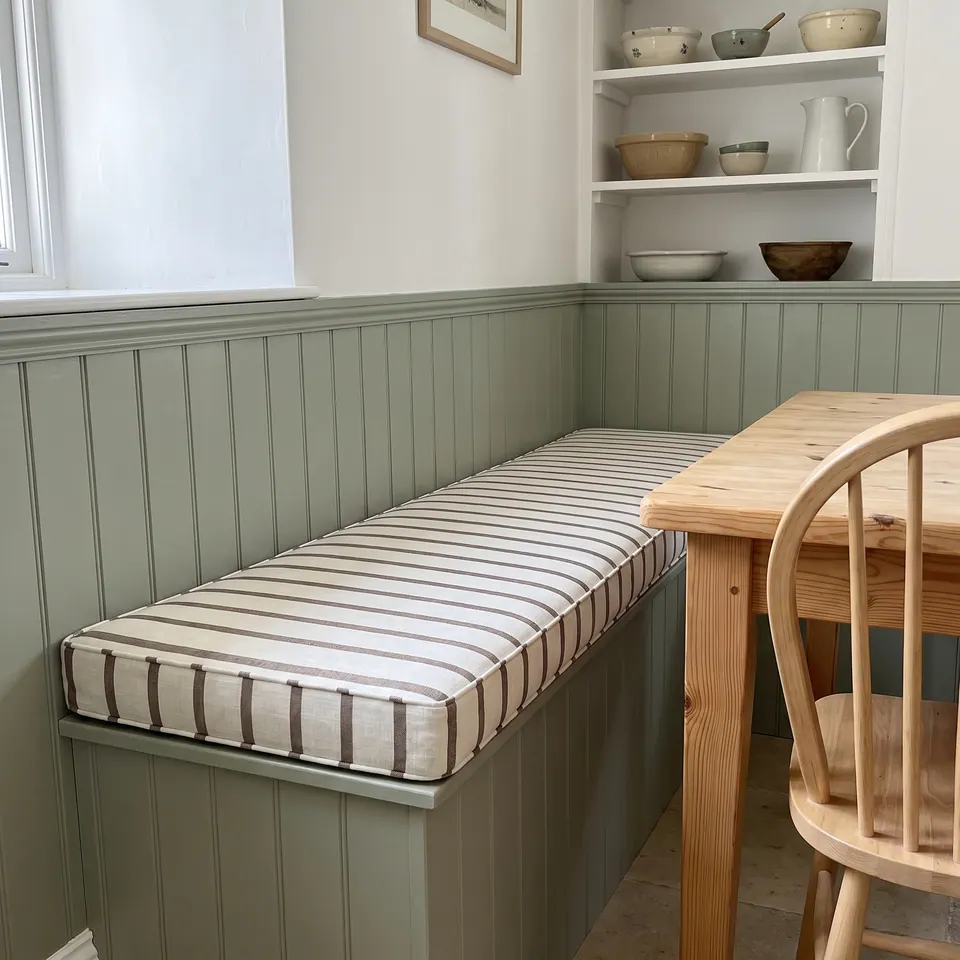
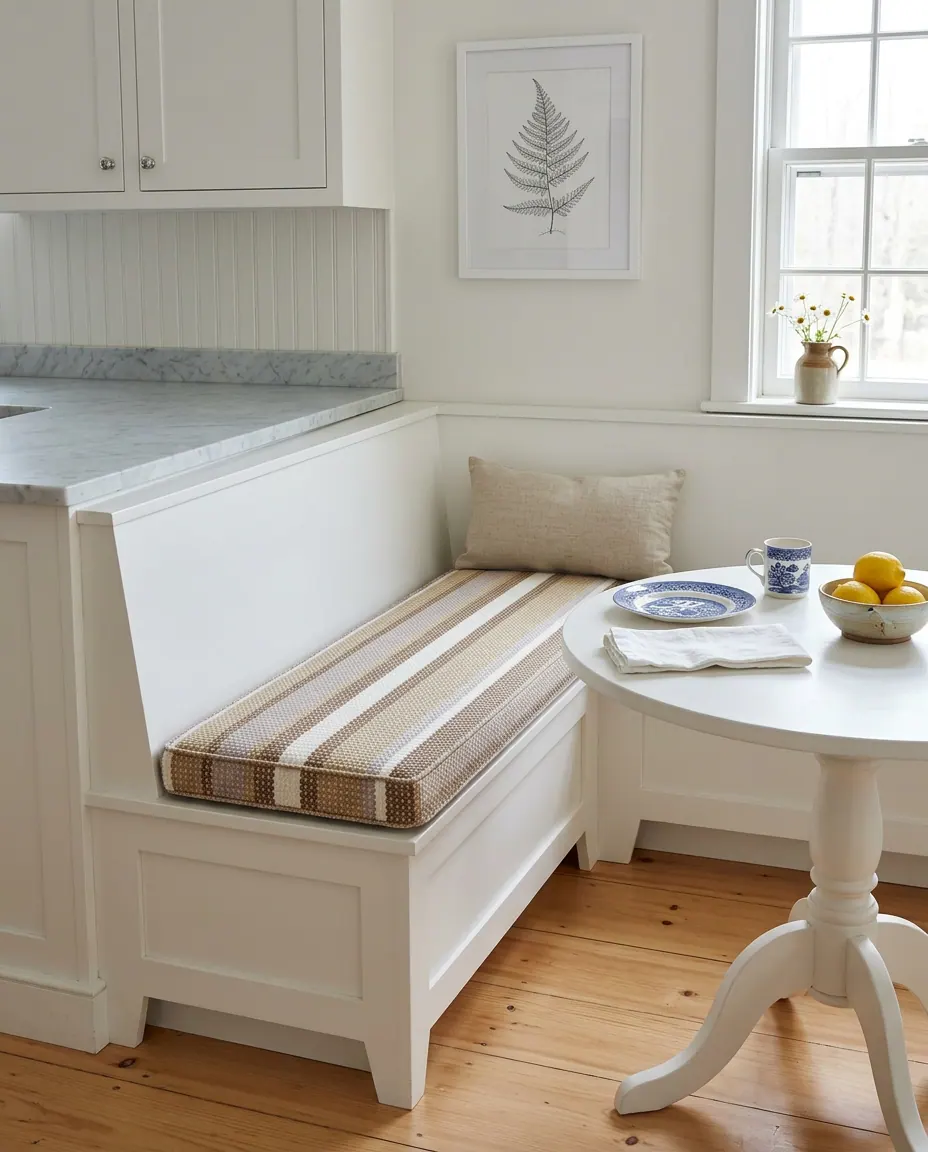
A banquette is a bench that has to get along with a table, and the table always wins the argument. Here's the arithmetic I do before anyone mentions foam.

 Save
The quick answer
Most banquette cushions should be 2 to 3 in (5 to 7.5 cm) thick, chosen so the cushion top sits 10 to 12 in below the tabletop and your thighs still clear the apron or rail underneath. Save 4 in (10 cm) for a low platform. Back cushions take about 3 in of seat depth, so plan for roughly 18 in of usable seat.
Key facts
- Keep 10 to 12 in (25 to 30 cm) from the cushion top to the tabletop.
- Check knee room separately: measure floor to the lowest point under the table (apron, rail or drawer) and sit on towels stacked to the planned height.
- A dining seat finishes at about 18 in (46 cm), within 17 to 19 in.
- Back cushions take about 3 in off usable seat depth; aim for about 18 in.
- Standard thicknesses are 2, 3, 4 and 5 in, and they cost the same within that range.
The table picks the thickness, not you
Banquette cushion thickness is the last number I choose, and the table chooses it for me. I've watched a handsome 4 in cushion turn a breakfast table into a chin rest, and I'd rather you learned that on paper.
Two sums, dear, and you're most of the way there. First: platform height plus cushion thickness equals seat height. Second: tabletop height minus seat height should come out at 10 to 12 in (25 to 30 cm). On a 30 in (76 cm) table that puts the cushion top at 18 to 20 in, and a dining seat usually finishes at 17 to 19 in, about 18 in typical. The overlap, 18 to 19 in, is your target.
Then check the knees, separately. Measure from the floor to the lowest point under the table, its apron, a drawer or a rail, and subtract your seat height; that smaller gap is what your thighs slide into, the other half of table clearance. Firm 32 kg/m³ foam compresses little, and a 3 in cushion may ride about 2 1/2 in under a sitter, so do the sums at full thickness and count the settle as a bonus.
Platform height against thickness, under a 30 in table
| Bench platform | 2 in (5 cm) cushion | 3 in (7.5 cm) cushion | 4 in (10 cm) cushion |
|---|---|---|---|
| 14 in (36 cm) | 16 in seat, 14 in to the top: too low | 17 in seat, 13 in: a touch low | 18 in seat, 12 in: right |
| 15 in (38 cm) | 17 in seat, 13 in: a touch low | 18 in seat, 12 in: right | 19 in seat, 11 in: right |
| 16 in (41 cm) | 18 in seat, 12 in: right | 19 in seat, 11 in: right | 20 in seat, 10 in: snug |
| 17 in (43 cm) | 19 in seat, 11 in: right | 20 in seat, 10 in: snug | 21 in seat, 9 in: too high |
| 18 in (46 cm) | 20 in seat, 10 in: snug | 21 in seat, 9 in: too high | 22 in seat, 8 in: too high |
Seat height at full thickness; the second figure is the gap up to a 30 in (76 cm) tabletop. Aim for 10 to 12 in. Knee room to the table's underside is a separate check.
Eight measurements before you order
Measure the platform where the knees go
Right, then. Floor to the top of the bench at its front edge, to the nearest 1/8 in, twice. Measure the finished bench, not the carpenter's drawing; a built-in that's still being built will change.
Measure the table, top and underside
Floor to tabletop, then floor to the lowest part underneath: apron, drawer, rail or pedestal collar. Most dining tables sit around 28 to 30 in (71 to 76 cm).
Find your seat window
Tabletop minus 12 in and tabletop minus 10 in give the range your cushion top should land in. Trim that to the 17 to 19 in dining band and you have a target.
Subtract the platform
Target seat height minus platform height is the thickness. A 16 in platform aiming for an 18 in seat takes a 2 in (5 cm) cushion.
Pattern sheet Side view: a 16 in platform plus a 2 in cushion gives an 18 in seat under a dining table. Check the knees
Underside of the table minus seat height is your knee gap, and no chart can promise it for you. Stack towels to the planned seat height, sit and slide your legs under; if your thighs brush the apron, go thinner before you go shopping for a new table.
Take the back cushions off the depth
A back cushion eats about 3 in of seat depth. Banquettes typically give 18 in of seat, or 18 to 22 in including the cushion, and anything under 16 in usable feels like perching. The standard back cushion is 16 in (40 cm) tall and 4 in (10 cm) thick, measured from the top of the seat cushion.
Round to the menu
Thickness comes in 2, 3, 4 and 5 in (5, 7.5, 10 and 12.5 cm), all the same price within that range. An in-between figure such as 2.5 in goes in the personalization box.
Eat one breakfast on a mock-up
Fold towels to the thickness you picked, lay them on the bench and sit through a meal. Slide in and out twice. Feet flat, elbows at the table, knees clear: order it.

Have it made
Measured it? Have Maggie’s workshop make it
Have the tape measure handy when they call. Old cushions shrink and sag; the seat underneath does not. — Maggie
Leave your details and the workshop will call you to confirm measurements, fabric, foam and piping. No prices, dates or payment on this page: it is a request, not an order.
Why 2 or 3 in wins most nooks
Most kitchen banquettes are built close to chair height already, which leaves little room for foam. The workshop's firm 32 kg/m³ foam, about 2.0 lb/ft³, is what makes a thin cushion work: even 2 to 2.5 in stays supportive for dining, and 3 in is the best-selling bench thickness for a neat, trim profile.
4 in earns its place on a low platform, 14 in or so, or where the nook is more for lounging than eating; it looks plusher and costs you legroom. 5 in is for deep, lounge-style seats, not dining. Curved benches are usually made 2 to 3 in (5 to 8 cm) as well.
Fabric matters at the table as much as foam does. The kitchen banquette fabric pattern covers spills and scrubbing, and performance fabrics are where most family nooks end up. For the same arithmetic on any bench, see bench cushion thickness by seat height.
An L-shaped nook in dusty mauve at 2 in
A buyer in the US sent the workshop an L-shaped kitchen banquette measuring 18 x 70 in on the long run and 18 x 42 in on the short one, and wanted the cushion as a single piece. They didn't guess. They sent a photo and a fresh sheet of re-measured dimensions, which is exactly what I'd have asked for.
They chose 2 in (5 cm) thick, in dusty mauve velvet with a light blush lilac piping, and the workshop set it up on a custom listing. An 18 in-deep seat at 2 in is the profile I'd sketch for a nook where the table can't move: the cushion top stays in the dining window, the knees stay under the table, and the piping reads crisp at a low height.
That project also shows a smaller L can be one piece when the sketch is clear. On a bigger corner, another buyer in the US went with two cushions meeting flush, 16.5 x 62.4 in and 16.5 x 45.5 in at about 3 in, for easier covers and a cleaner fit.
Run your own numbers
Put in three heights, the bench, the table and yours, and the seat height calculator answers with a cushion thickness and a scale drawing of you at the table. I'd run it twice: once with your real numbers, once with the thickness you had your heart set on.
What does your table measure to its underside? If you don't know, that's tonight's job. Sizes and shapes live under banquette cushions and kitchen nook cushions; corner layouts are in L-shaped bench cushion measurements.
Common mistakes at the banquette
- Picking thickness for comfort and checking the table afterward. A 4 in cushion on a high bench lifts everyone too far, and the fix is a new, thinner cushion.
- Measuring a built-in before the carpenter has finished it.
- Measuring an angled end along the slant. Depth is taken straight out at 90 degrees; a slanted side is always longer than the depth.
- Leaving the short straight returns off an L or U sketch. Every edge gets a label, and the steps must add up to the long edge.
- Typing ties into the size box. Ask for ties in writing with their position and length, then look for them on the pre-dispatch photo.
- Choosing a delicate fabric for the family table. Tell the maker how the nook is used, and pick a tight, washable weave in a mid-tone.
A back cushion eats about 3 in of banquette seat depth, so a bench 21 in deep leaves about 18 in to actually sit on.
Margaret Holloway
Buyer questions: thickness at the table
- A common question
What thickness should a breakfast nook bench cushion be if we eat there every day?
The workshop's answer3 or 4 in (7.5 to 10 cm) for daily dining, and most buyers pick one of the two; 3 in was recommended over 2 in for one L-shaped bench. The 32-density foam is medium-hard and compresses little, so 3 in supports without raising the seat much. If the bench is already at seat height, go thinner: 2 in (5 cm) was chosen for a 17 in (43 cm) bench.
- A common question
Can I order 2.5 inches if 2 is too thin and 3 is too tall?
The workshop's answerYes. Pick the nearest thickness option and write the exact figure, such as 2 1/2 in or 4.5 in, in the personalization or exact-size section, and it's made that way. Metric in-betweens work too: 3 in (7.5 cm) was made for a dining bench where 4 in (10 cm) was too thick. If you picked the wrong option, tell the workshop before production and the order is adjusted.
- A common question
Do the cushions only come 4 inches thick?
The workshop's answerNo. The standard thickness menu offers 2, 3, 4 and 5 in (5, 7.5, 10 and 12.5 cm), and some listings show only 2, 3 or 4 in. Choose it in the thickness option or write it in personalization after picking your size. Listing photos show 4 in, most buyers take 3 or 4, and 6 in is possible by writing it in and messaging after ordering.
- A common question
Could the banquette back be an upholstered board hung on a French cleat?
The workshop's answerNormally not. The backrests have no rigid board, so they can't screw to the wall or hang on a cleat. Instead the back is made like a back pillow: a removable piped cover over shredded foam about 4 in (10 cm) thick, or a solid foam core wrapped in fiber for a firmer, flatter panel. It attaches with hook-and-loop tape, adhesive, loops on a rod, or ties on the top corners.
- A common question
Is a 3 inch cushion enough on a plywood nook bench?
The workshop's answerYes. 3 in is fine over a plywood kitchen nook bench. For sitting and napping on a hard wooden or wicker base, like a daybed or a swing platform, 4 in is the recommendation, and most buyers find it comfortable. If you want more loft, 6 or 8 in can be quoted at a higher price.
Banquette clearances, answered
How much knee room does a banquette need under the table?
Enough that your thighs slide under freely, and only your own table can tell you. Measure from the floor to the lowest thing under there, whether that's an apron, a drawer, a rail or a pedestal collar, and subtract your seat height. Then sit on towels stacked to that height and check.
How deep should a banquette seat be once the back cushions go on?
Plan for about 18 in of usable depth. Back cushions take roughly 3 in, so a bench about 21 in deep leaves 18 in to sit on; banquettes commonly run 18 to 22 in including the cushion. Less than 16 in usable feels like perching.
How much walkway should be left beside a banquette table?
On the open side, leave at least 36 in (91 cm) from the table edge to a wall or counter, and 42 in (107 cm) or more where people need to walk behind someone seated. The banquette side needs none, which is half its charm.
Does a thicker banquette cushion cost more?
Not within the standard menu: 2, 3, 4 and 5 in are priced the same, because thickness isn't a big cost factor at regular sizes. Past 5 in, foam volume drives the price, and extra-thick cushions are quoted individually. So choose on fit, not on price.
Why is the knee gap smaller than the gap to the tabletop?
Because two measurements get mixed up. The 10 to 12 in figure runs from the cushion top to the tabletop; the table's underside, its apron or a drawer always sits lower, so the gap to it is smaller, not larger. Rather than trusting a fixed knee-room number, measure your own table and sit on towels stacked to your planned height.
How can I test a cushion thickness before I order?
Fold towels or blankets to the planned thickness, lay them on the bare bench and sit through a real meal at the table. Check that your forearms rest comfortably on the tabletop, your thighs clear the apron and your feet still reach the floor. If anything feels cramped, try the next thickness down before you write the size in the order note.