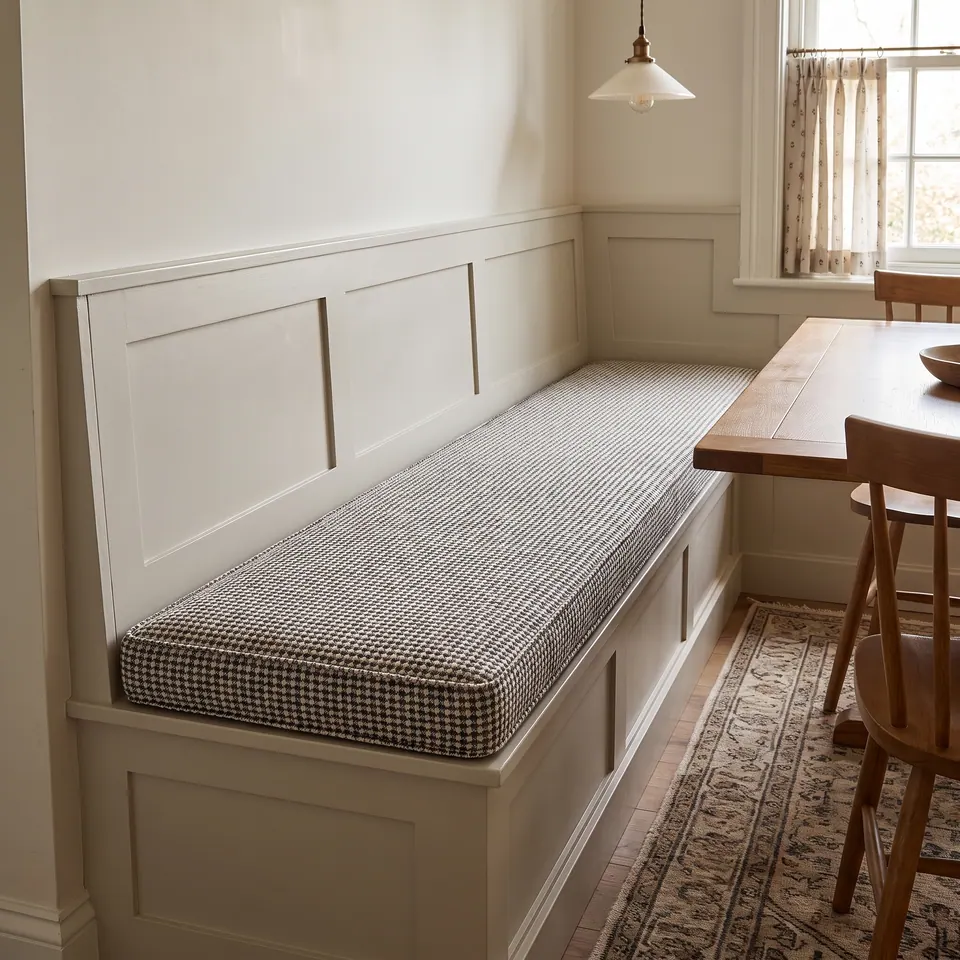
The Cutting Table · compared on the table
What thickness should a dining bench or breakfast nook cushion be?
Also asked as:How many inches would you suggest for a dining bench?The bench will be well used. What thickness?
Every family table has one seat everybody wants. Get the cushion thickness right and that seat still slides under the tabletop.

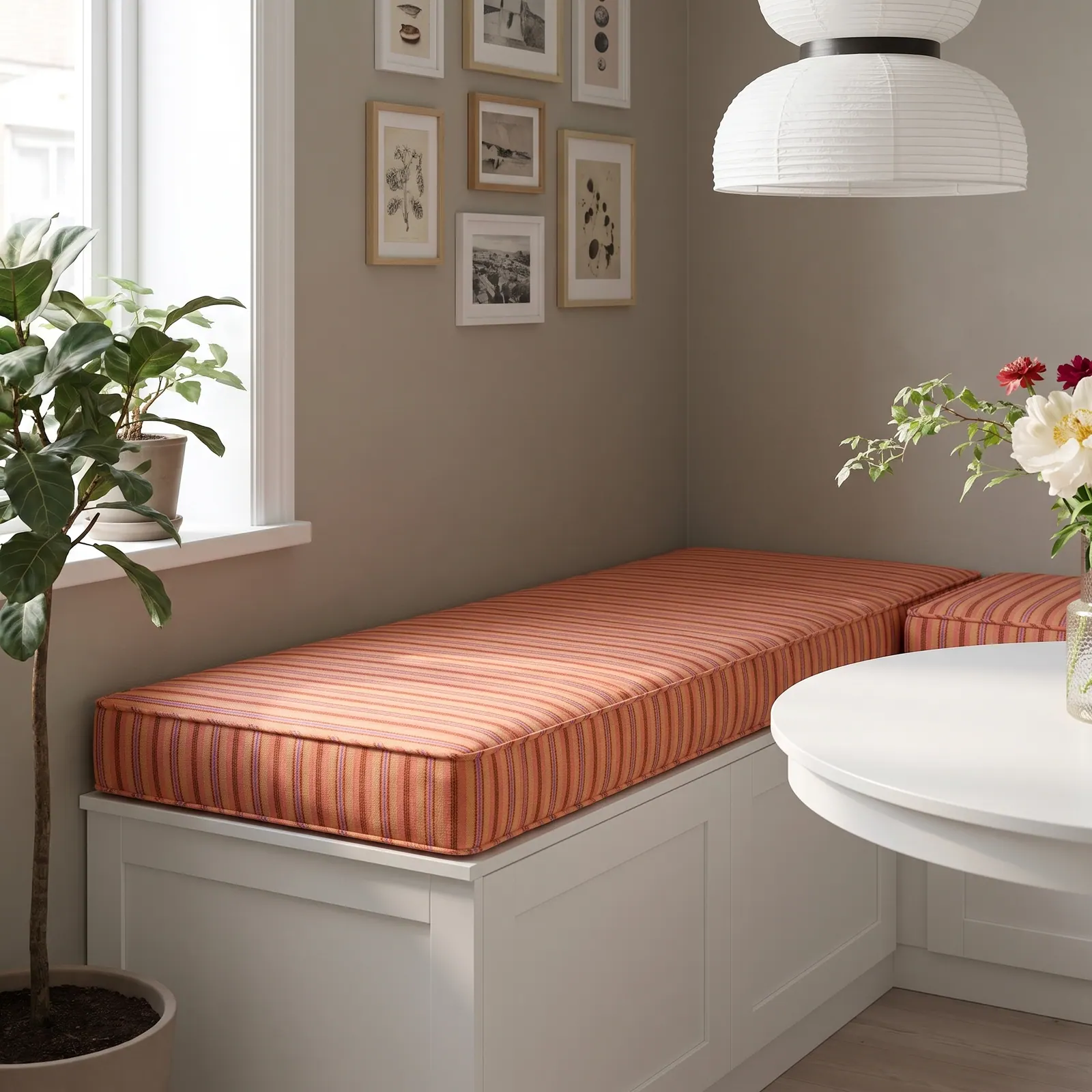 Save
The quick answer
For a dining bench or breakfast nook used every day, choose a cushion 3 or 4 in (7.5-10 cm) thick; most buyers pick one of those. The firm 32-density foam compresses little, so 3 in gives solid support without raising the seat much and 4 in feels plusher. If the bench is already at seat height, go thinner, down to the 2 in (5 cm) minimum.
Get a quote for a banquette cushion
Thickness by bench, at a glance
| Thickness | How it sits | Best for |
|---|---|---|
| 2 in (5 cm) | The minimum; adds the least height | A bench already at seat height, like one about 17 in (43 cm) tall |
| 3 in (7.5 cm) | Solid support, little added height | Everyday breakfast nooks and L-shaped benches |
| 4 in (10 cm) | Plusher look and feel | Banquettes with room to spare under the table |
| 5 in (12.5 cm) | Deep and soft-looking | Deep, lounge-style seats rather than dining |
Key facts
- 3 or 4 in (7.5-10 cm) is recommended for a daily-use dining bench, and most buyers choose one of those.
- The 32 high-density foam is medium-hard and compresses little.
- 3 in gives solid support without adding much seat height; 4 in looks and feels plusher.
- For an L-shaped bench, 3 in was recommended over 2 in.
- On a bench already about 17 in (43 cm) high, a 2 in (5 cm) cushion was chosen to keep the table comfortable.
- Thickness runs from a 2 in (5 cm) minimum to 5 in (12.5 cm) for deep, lounge-style seats.

Have it made
Have Rosa’s workshop cut this for you
Every good cushion I know started with a long porch chat. This is the short version: leave your number and the workshop will call. — Rosa
Leave your details and the workshop will call you to confirm measurements, fabric, foam and piping. No prices, dates or payment on this page: it is a request, not an order.
Why firm foam changes the math
Here's what folks miss at the kitchen table, neighbor. Soft foam squashes, so a thick soft cushion ends up thin under you. The workshop's 32 high-density foam is medium-hard and barely gives, which means the thickness you order is close to the height you add.
That's why 3 in is plenty for a banquette cushion that sees breakfast, homework and Sunday supper. Go to 4 in if you like a plusher look and the table allows it. The banquette thickness and table height Pattern walks through the knee-room math.
The bench that was already tall enough
A buyer wrote to the workshop about a dining bench that already stood about 17 in (43 cm) off the floor. The standard 4 in cushion would have pushed everybody too close to the tabletop, so they settled on 2 in (5 cm). Because the foam is firm, 2 in still sat like a real seat, not a pad. Another buyer's nook bench was high too, and the workshop made that seat 3 in with a removable cover. Two kitchens, one lesson: measure the bench before you fall for a thickness.
Check these two heights first
- Floor to the top of the bench.
- Floor to the underside of the tabletop.
- Add the cushion thickness to the bench; firm foam won't sink much, so that's close to your new seat height.
- Run the numbers through the seat height calculator before you pick.
For a breakfast nook used every day, 3 or 4 in of firm foam is the everyday answer; go to 2 in only if the bench is already at seat height.
Rosa
Buyer questions
- A common question
What thickness do you recommend for a dining bench or nook we use every day?
The workshop's answer3 or 4 inches, and most customers pick one of those. The foam is firm 32-density, so even 3 inches gives solid support without raising the seat much; 4 inches looks and feels plusher.
- A common question
What thickness should I pick for an L-shaped bench?
The workshop's answer3 in (7.5 cm) rather than 2 in. Options run from 2 to 5 in (5 to 12.5 cm); 2 in is the minimum and 5 in is a standard option for deep lounge-style seats.
- A common question
Is 2 inches a normal thickness for banquette seating?
The workshop's answerThe standard is 4 in (10 cm), but the shop will make 2 in (5 cm) if you prefer. All covers are zippered and washable, and a soft fabric or velvet is recommended for everyday dining use.
- A common question
My cushion is too thick for the table. Can I swap in thinner foam?
The workshop's answerNot in the same cover; covers are sewn to one foam thickness and a thinner insert will sag. Reorder the same size and fabric with the thinner option, such as 2 in instead of 4 in.
Questions buyers ask next
Does a thicker cushion mean more comfort at the table?
Not always. The firm 32-density foam compresses little, so extra thickness mostly adds height. On a bench that already sits at dining height, a thicker cushion can push you too close to the tabletop, and 3 in often works better than 4 in.
What if the thickness I want isn't one of the options?
Yes. Pick the nearest thickness option and write the exact thickness you want in the personalization note. Thicker foam costs more, so going up an inch changes the quote.
Is 5 in too thick for a dining bench?
Usually, yes. 5 in (12.5 cm) is offered for deep, lounge-style seats. On a dining bench or breakfast nook it adds a lot of height, so most buyers stay at 3 or 4 in.