Concept Sketches · 8 scenes
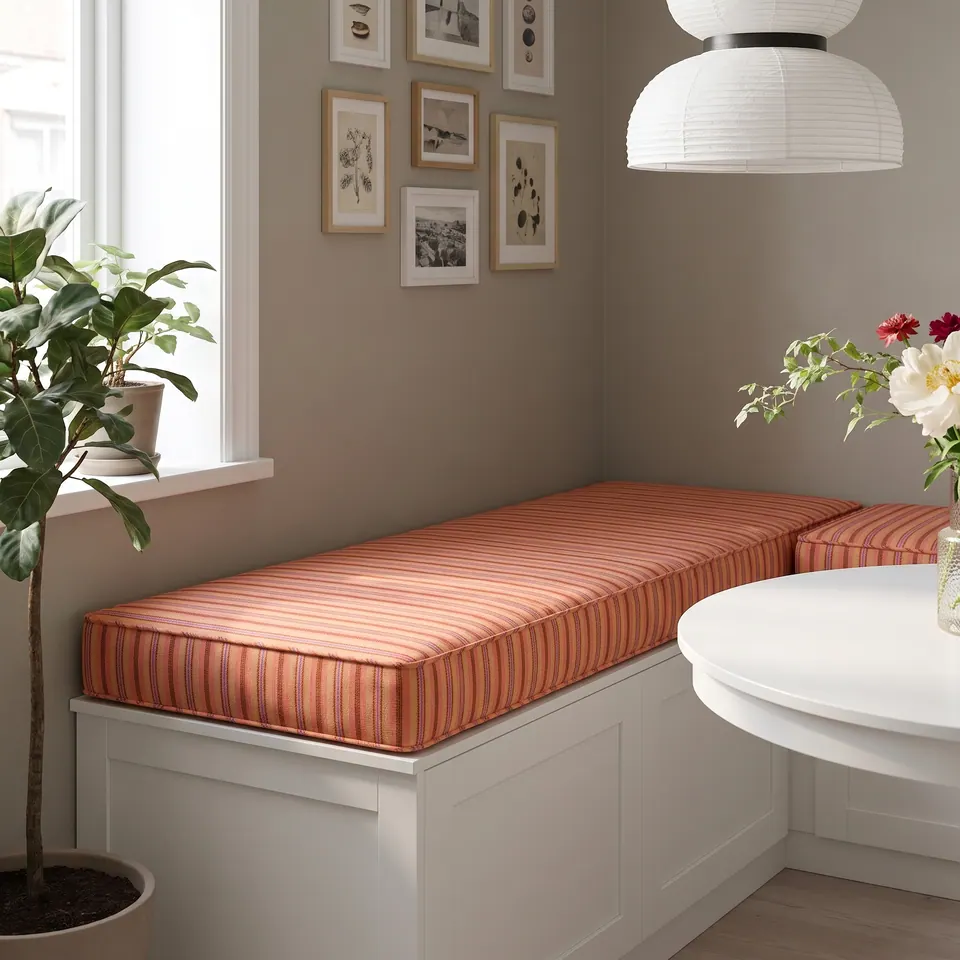
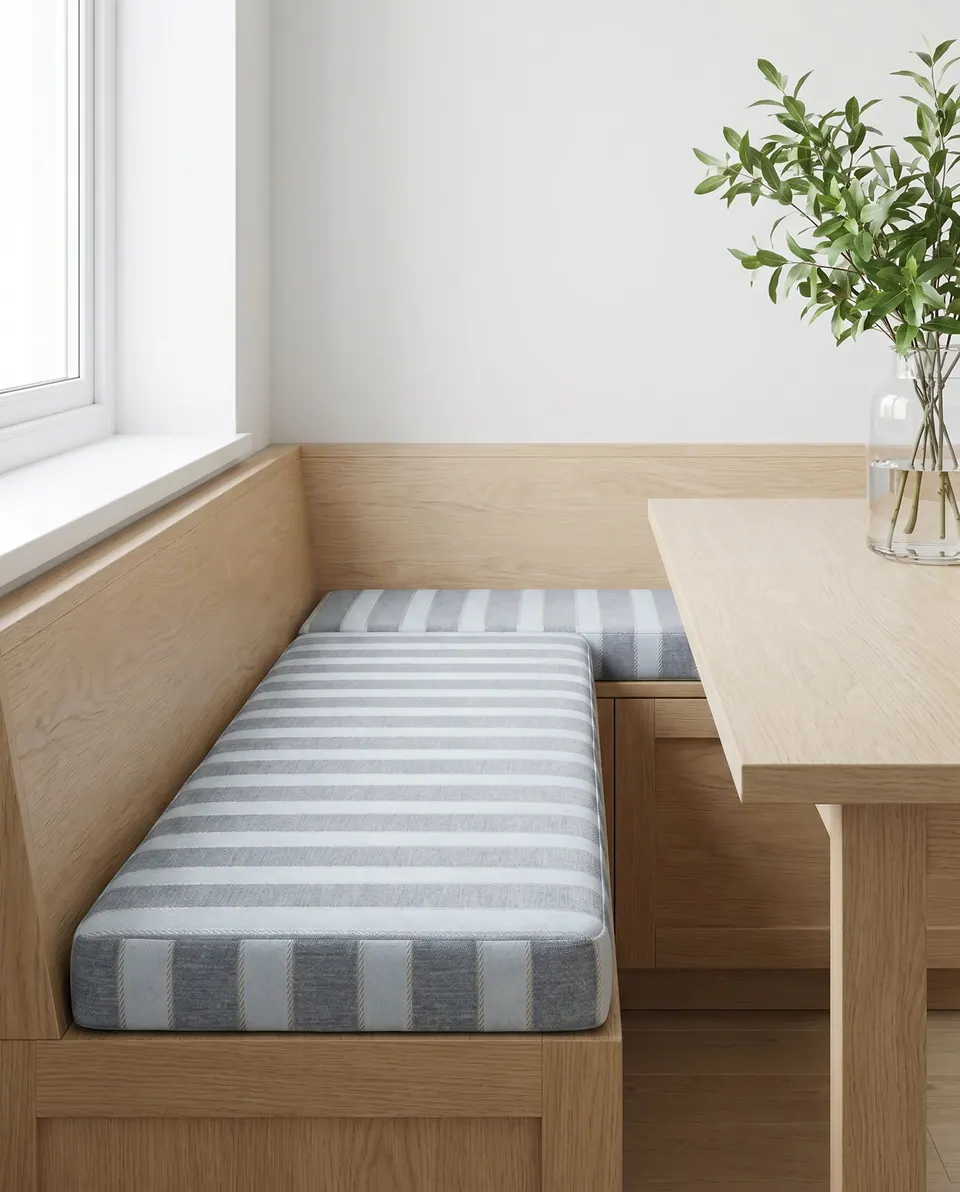
Breakfast nooks with an angled end, cushioned properly
Hardly any nook is a clean L, and the cushions have to forgive every wall that isn't square. Eight real nooks, each with its drawing and the one checklist item that saved it.

 Save
The quick answer
Breakfast nook cushions for an angled nook are made as rectangles for the straight runs and a trapezoid for the angled end, each with its own measured drawing. For daily meals, 3 in (7.5 cm) of firm foam supports without lifting the seat too high; beside a table, 2 to 3 in keeps the table height right. Keep every piece one thickness so the piping lines up.
The nook is back, and it is rarely an L
Hardly any breakfast nook is a clean L. One end kicks out to clear a door, a corner is rounded off, a run stops where the radiator used to be, and the breakfast nook cushion still has to meet the table at the right height.
Here is my checklist, and I learned most of it the hard way:
- Which piece takes the angle. Straight runs stay rectangles; only the angled end becomes a trapezoid cushion.
- The table sets the thickness. Choose foam from the table height down, never from comfort up.
- One thickness, one piping line. Every piece the same height, so the welt runs level across each join.
- Fabric for whoever eats there. Kids and dogs have breakfast too, which is what performance and pet-friendly fabrics are for.
Right, then. Eight real nooks follow, each with its drawing and the item that mattered. Straight-run basics live on the banquette cushions hub, and the rest of the room on kitchen nook cushions. What angle does the end of your nook make?
Eight nooks, eight drawings
01A past project
An everyday dining bench: two rectangles and one trapezoid
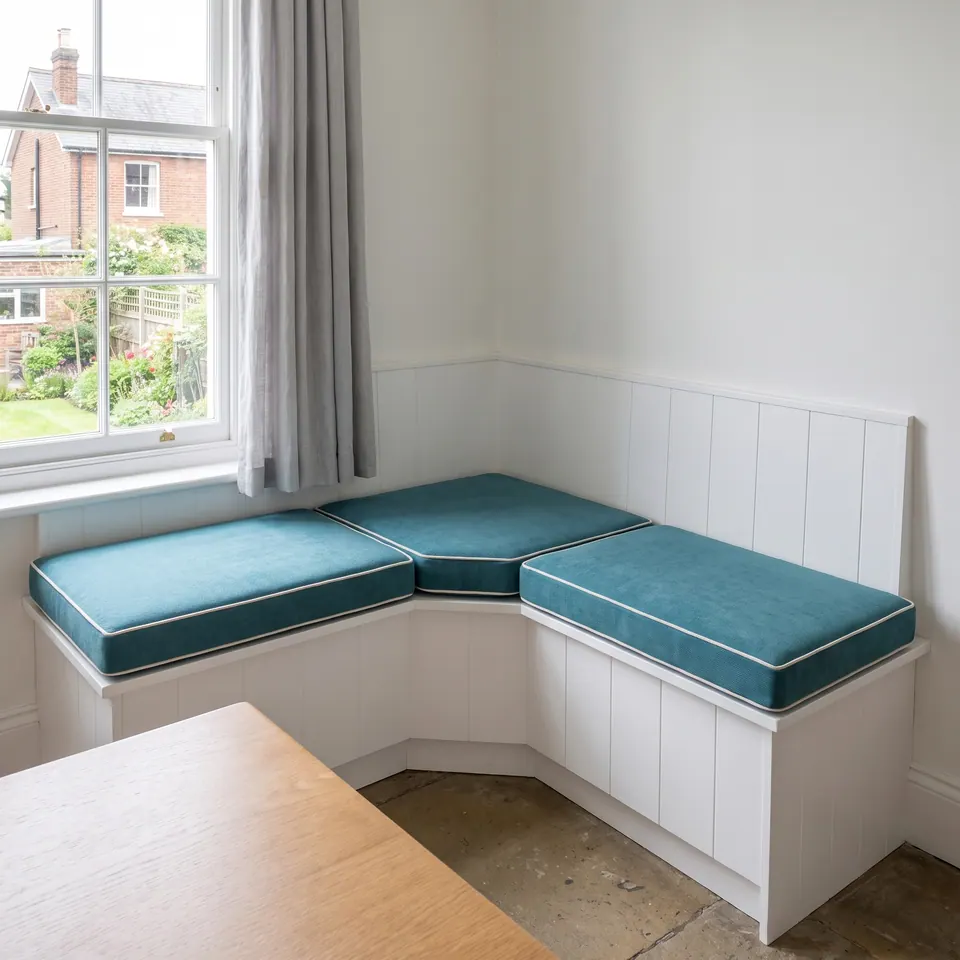
A buyer wrote in with a drawing of a dining bench used every day, one end angled: two rectangles and one trapezoid. She asked for close-ups of four linen colors and was warned that close-ups look darker than the fabric does in daylight. She chose a linen body with a darker linen piping and 3 in (7.5 cm) of firm 32-density foam.
The takeaway: Only the angled end needs the custom-shape route; the straight runs stay plain rectangles.
02A past project
Three 24 x 36 in cushions and a trapezoid with four different sides
A buyer in the US asked for four dining bench cushions, all 3 in (7.5 cm) thick: three at 24 x 36 in (61 x 91 cm) and one trapezoid. The trapezoid came with every side listed: 41 in (104 cm) on top, 21 in (53 cm) on the bottom, and sides of 9 in (23 cm) and 24 in (61 cm).
The takeaway: List every side of the odd piece, not just top and bottom; the two slanted sides are rarely equal.
03A past project
Kids, dogs and a 126 in trapezoid banquette
A family in the US with kids and dogs had a trapezoid banquette about 88.5 in (225 cm) on top, 126 in (320 cm) at the bottom, 26.5 in (67 cm) on each slant and 19.25 in (49 cm) deep. The depth didn't add up at first, so the shape was redrawn from a paper sketch, and the back pillows were split into two 44 x 12.5 in (112 x 32 cm) and two 26 x 12.5 in (66 x 32 cm). Later the 4 in (10 cm) seat felt too thick, so a new 2 in (5 cm) cushion was made with its own cover in a pet-friendly fabric.
The takeaway: To go thinner, order a new cushion with its own cover; thinner foam in the old cover goes baggy.
04A past project
Rounded ends and a curved joint, measured in one unit
A buyer in the US had a corner nook bench with rounded ends and a curved joint between two runs, drawn on paper with measurements in both inches and centimeters. The cushions arrived too long. Measured again on the bench, the runs came to 65 in (165 cm) and 53 in (134.5 cm), and the buyer asked for a thinner 2 in (5 cm) cushion because the seat sat too high.
The takeaway: Confirm every run in one unit on the drawing, and settle the final seat height before choosing thickness.
05A past project
An angled built-in where the radiator used to be
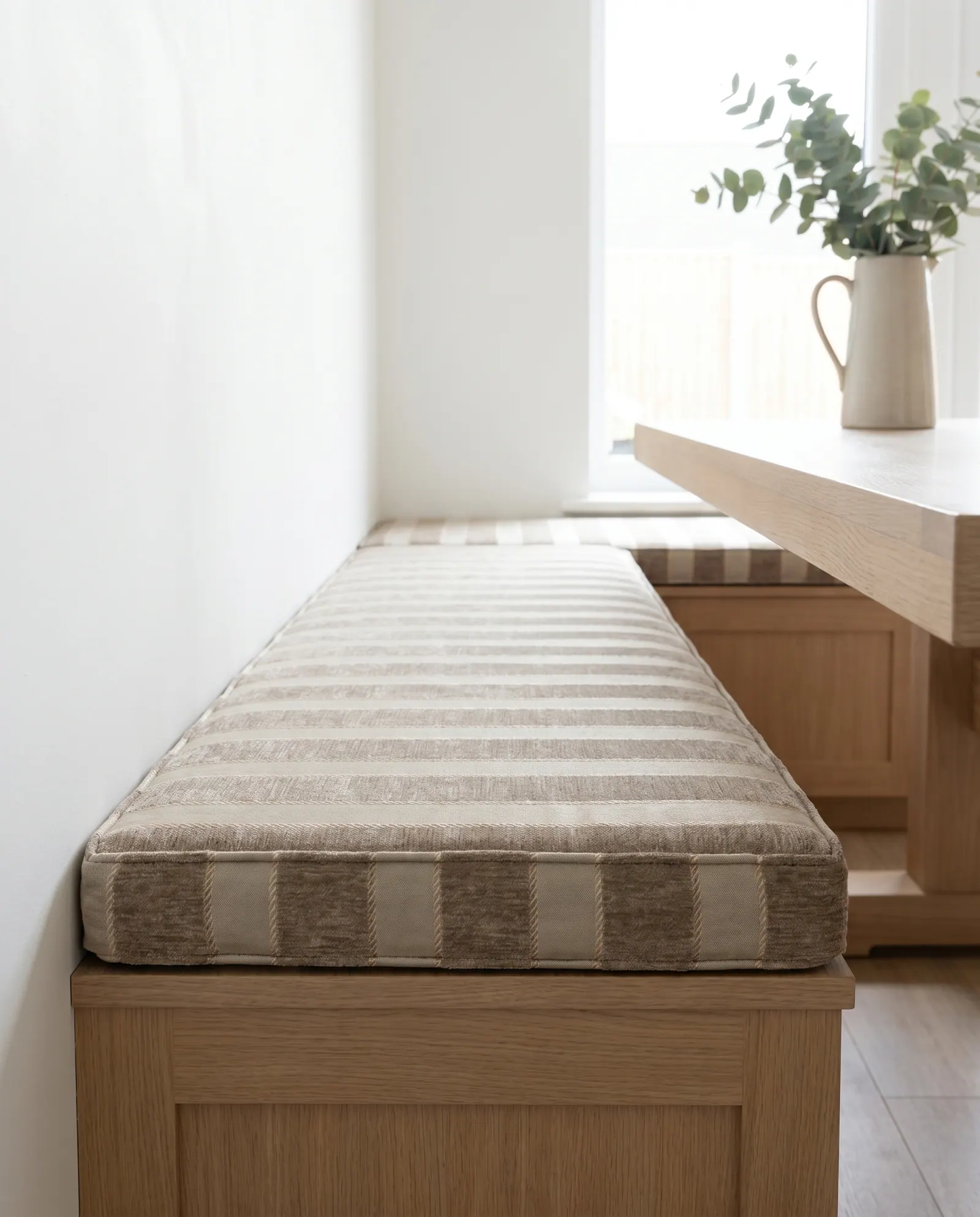
A returning buyer wrote to the workshop about a new built-in dining bench that comes out at an angle, replacing a radiator. She had loved her first striped cushion and wanted a match, so the workshop sent a measuring diagram and she filled it in. Because the bench is on show, she asked for no handle and no label, added a 31.5 x 23.5 in (80 x 60 cm) cushion, and switched to a black and white stripe before production.
The takeaway: Adding a piece to an earlier set? Ask for the maker's measuring diagram and fill in every line.
06A past project
A 110 in angled bench, a toddler, a dog and a housewarming
A buyer in the US needed one large angled-top bench cushion before a housewarming: 110 in (279 cm) at the front, 55 in (140 cm) at the back, 31.75 in (81 cm) deep, with 38.5 in (98 cm) angled sides, 5 in (13 cm) corners and an extra 3.5 in (9 cm) angled segment. With a small dog and a toddler at the table, we steered them from 100% cotton stripes toward washable linen-look, soft and velvet ranges. The bench sits beside the dining table, so they chose a thinner seat.
The takeaway: Beside a dining table, work backward from the seat height you want, then choose thickness.
07A past project
Two corner cushions that wanted to meet on a diagonal
One buyer wrote in wanting two corner cushions to meet on a diagonal. That makes both of them trapezoids, which cost more and can fit worse, so the workshop kept them rectangles: 62.5 x 16.5 in (159 x 42 cm) and 45.9 x 16.5 in (117 x 42 cm), 3 in (7.5 cm) thick. Only one of the two orders had a non-slip base, so the workshop made both non-slip, and after close-ups the buyer went to a black stripe.
The takeaway: At a 90° corner, butt one long rectangle against one short one; save the miter for corners that aren't square.
08A past project
A three-sided nook measured to the eighth of an inch
A homeowner in the US needed French-style tufted linen cushions for a three-sided kitchen nook: runs of 65.125 in (165 cm), 56.25 in (143 cm) and 91 in (231 cm), all 17 in (43 cm) deep. They sent a photo, considered matching back cushions, and chose a dried-rose linen. Each seat was priced as its own cushion on one custom order.
The takeaway: Send a photo of the nook with the numbers; it lets the maker check each run against the room.
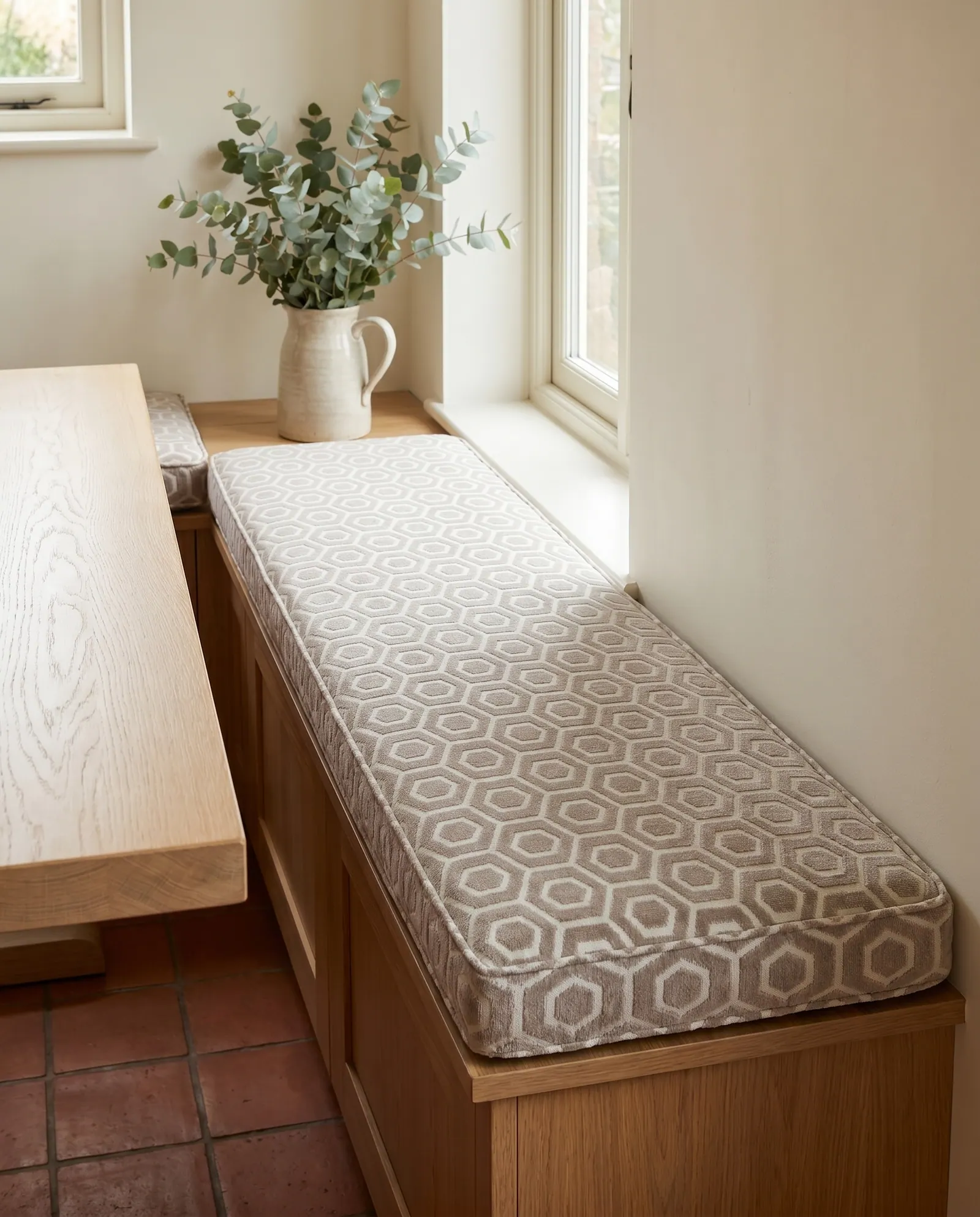
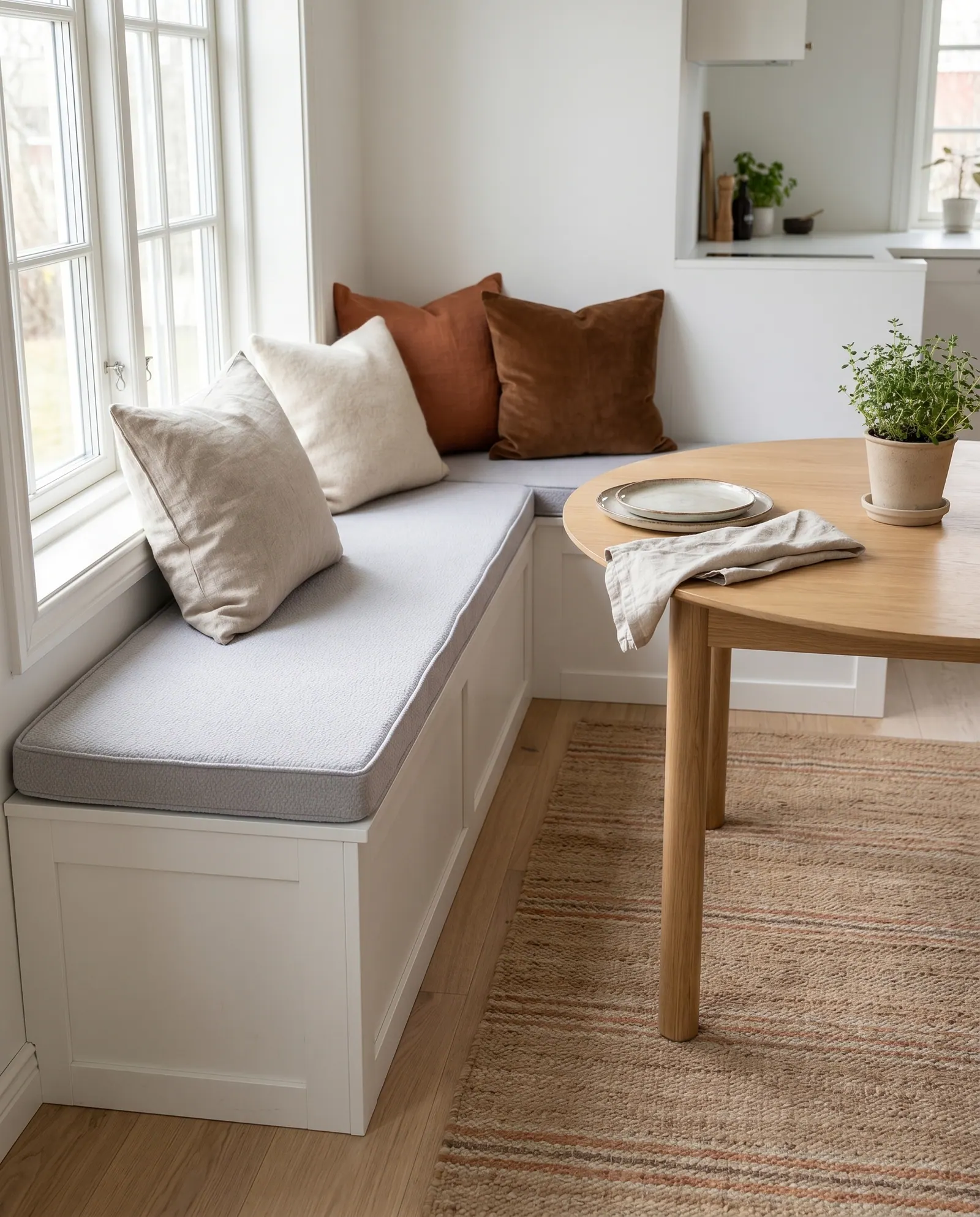
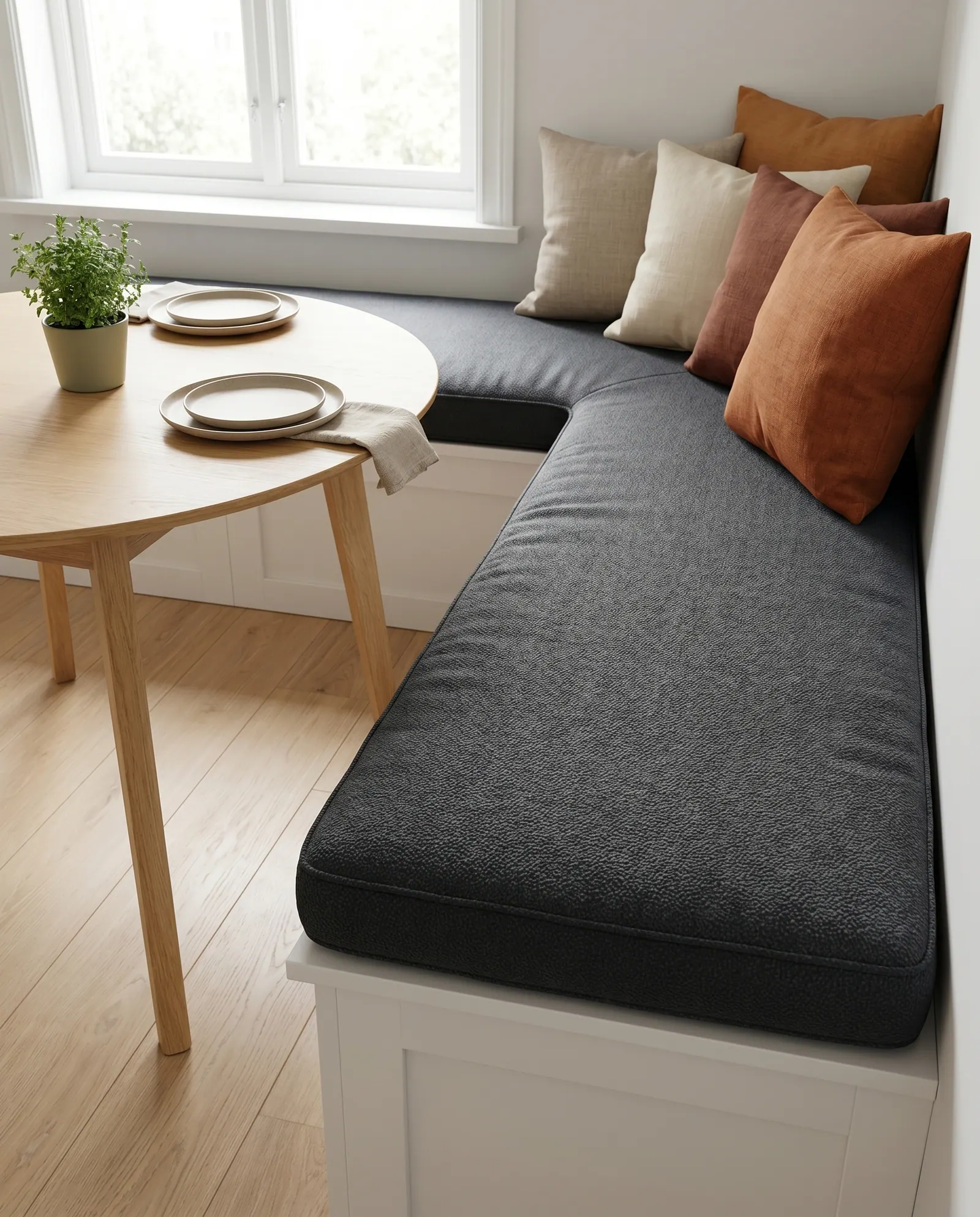
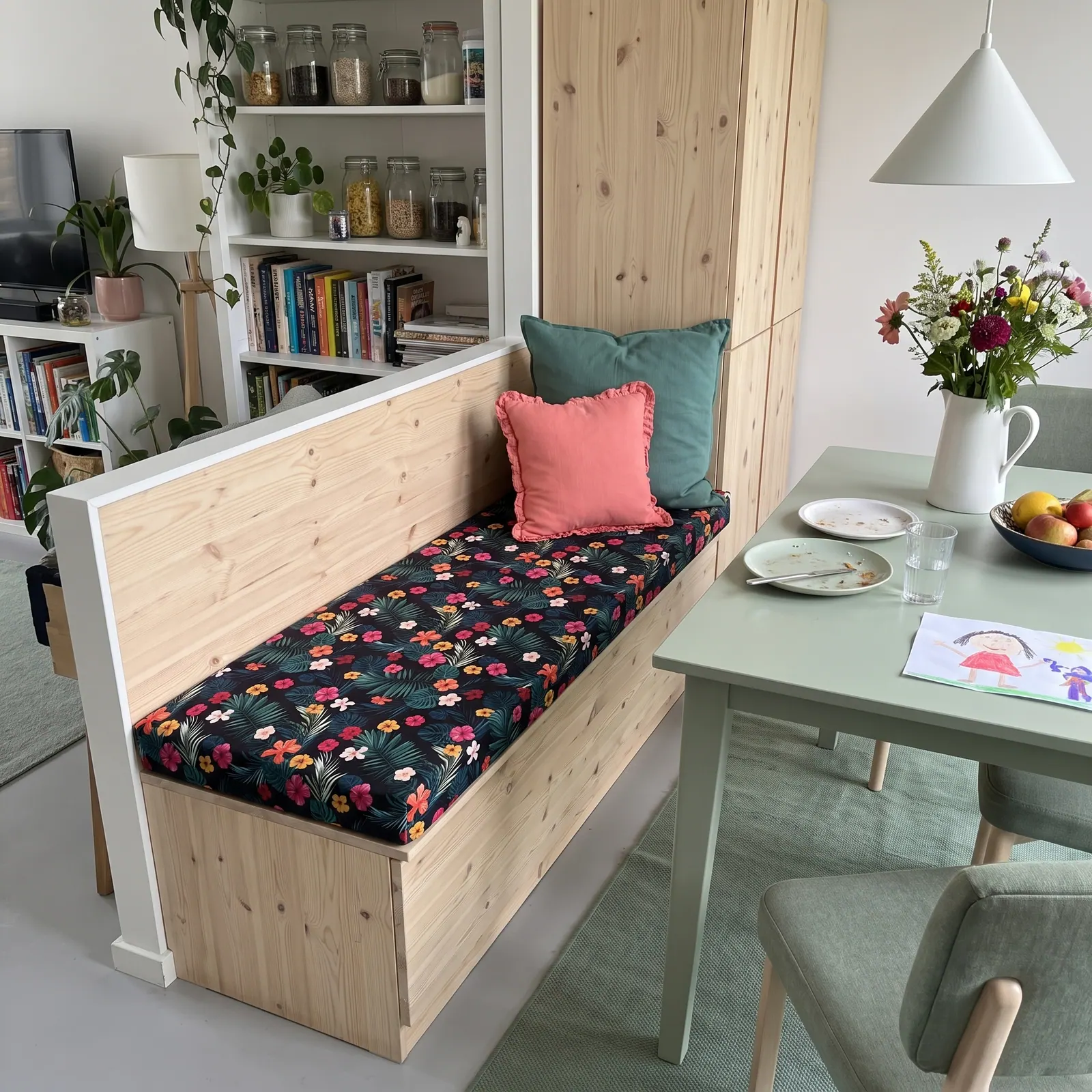
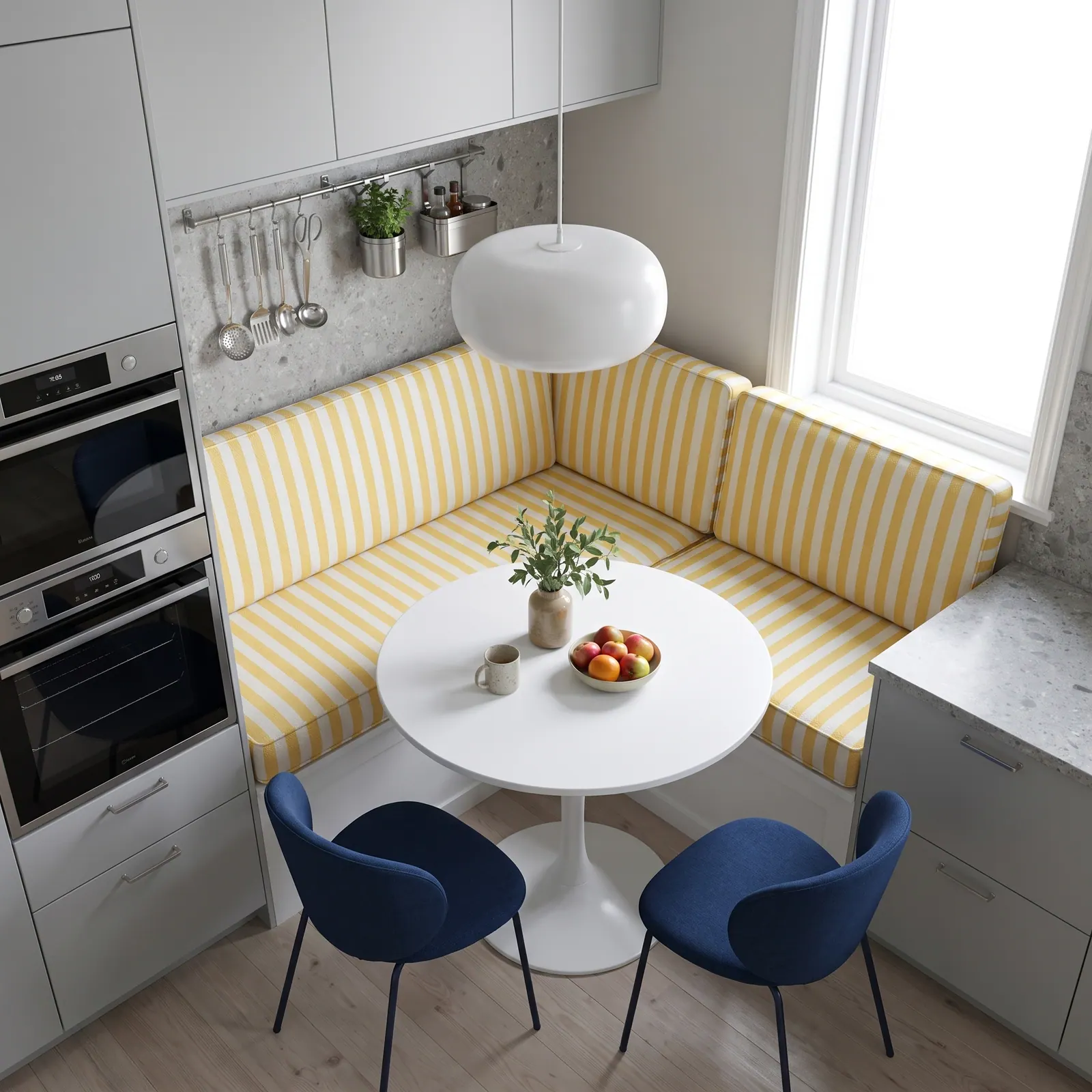
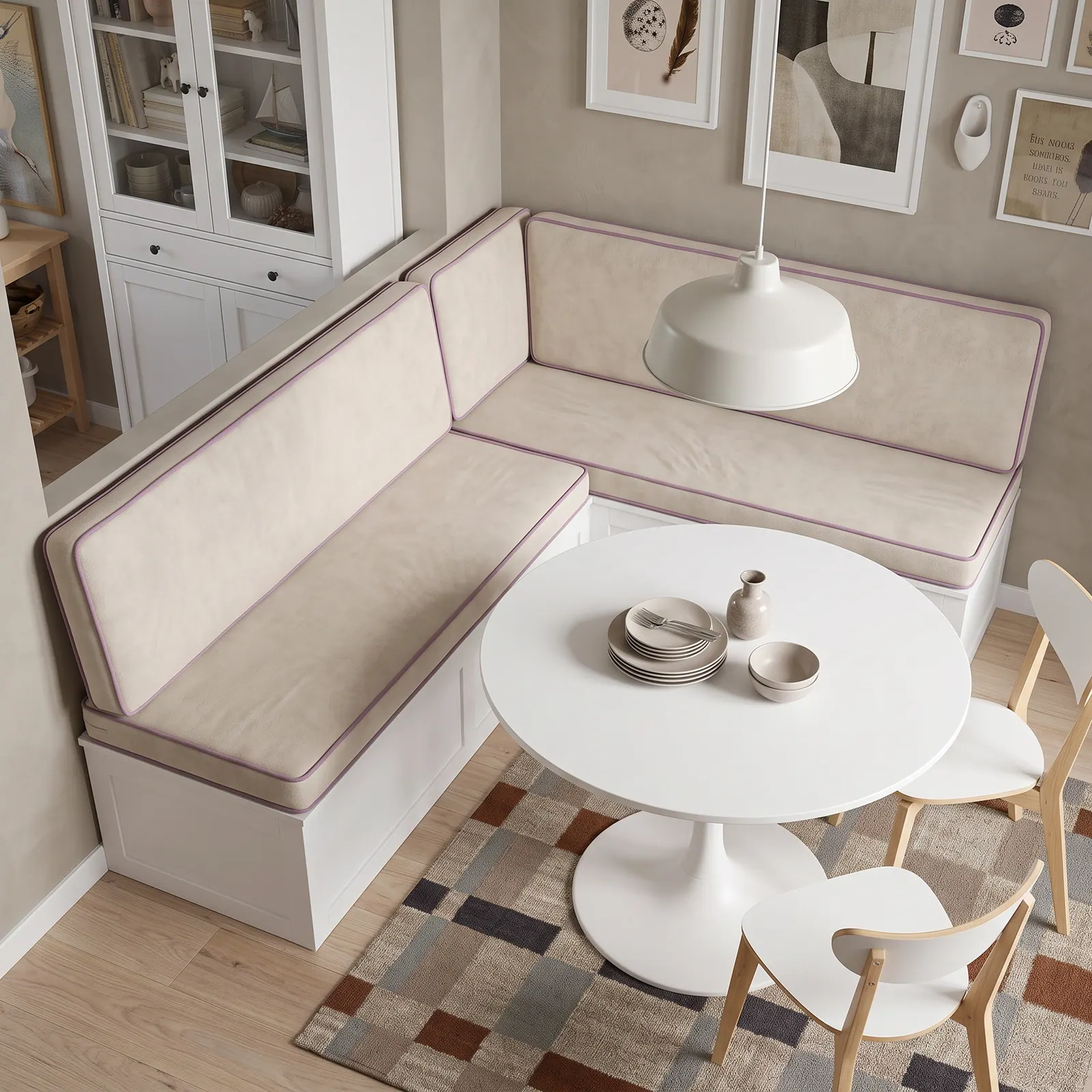
Which piece takes the angle
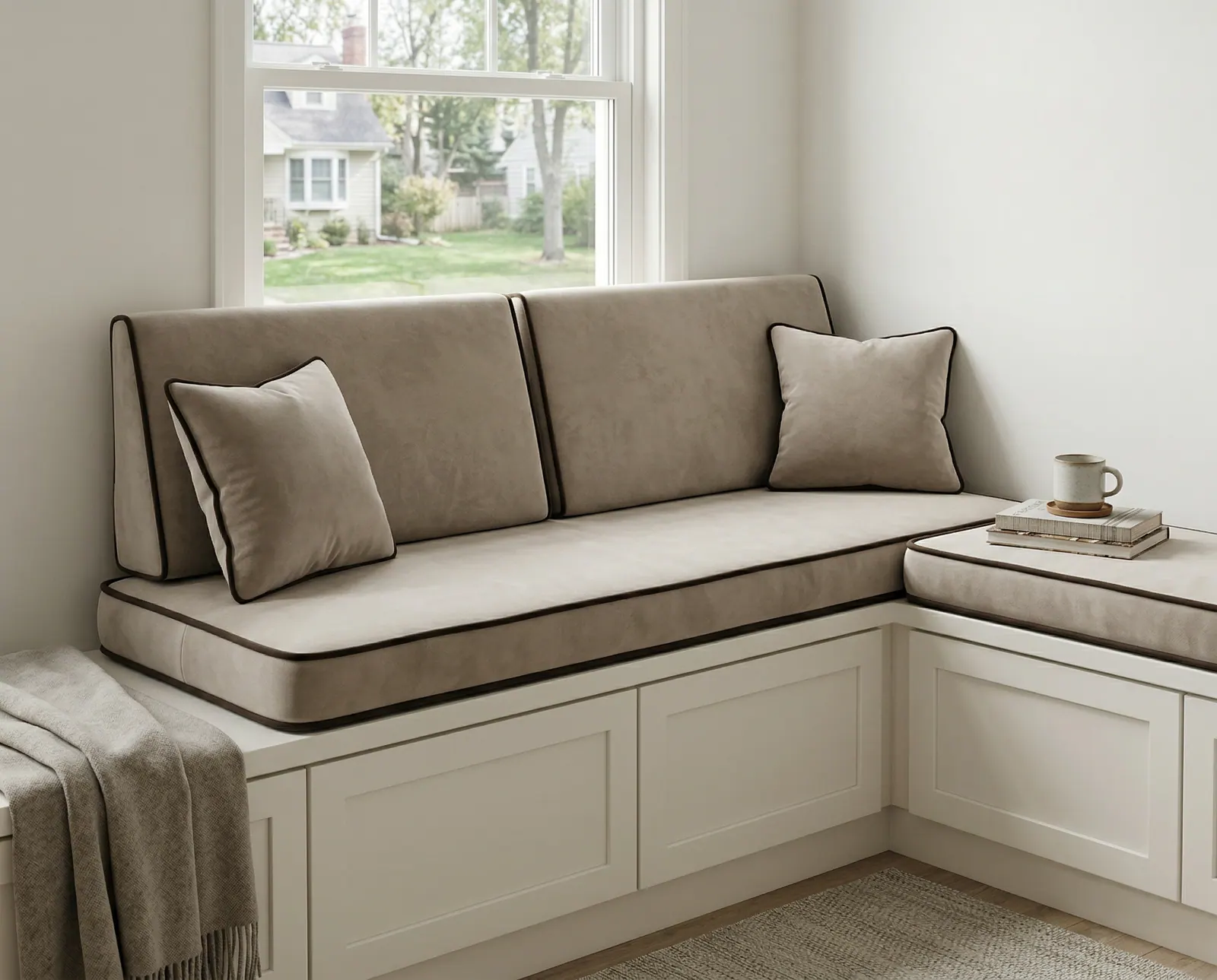
Measure first, dear, and argue with the carpenter later. Most angled nooks sort into four shapes. The L-shaped cushion corner joint Pattern covers the square corner, the trapezoid cushion calculator checks that slanted sides and depth add up, and the seat height calculator settles thickness against your table.
| Nook shape | How to split it | How to order | From the sketches |
|---|---|---|---|
| Square 90° corner | One long and one short rectangle, butted at the corner | Rectangle sizes, exact inches in the order note | 62.5 x 16.5 in and 45.9 x 16.5 in, 3 in thick |
| One end kicks out at an angle | Rectangles for straight runs, a trapezoid for the angled end | Custom-shape route with a drawing, every edge measured | Two rectangles plus one trapezoid, 3 in thick |
| A corner that isn't 90°, or a mitered join | Both corner pieces become trapezoids | Custom-shape route; costs more and fits less forgivingly | Two corner cushions kept as rectangles instead |
| Rounded ends or a curved joint | Shaped pieces cut from a paper drawing | Every run in one unit; approve the redrawn diagram | Runs of 65 in (165 cm) and 53 in (134.5 cm) |
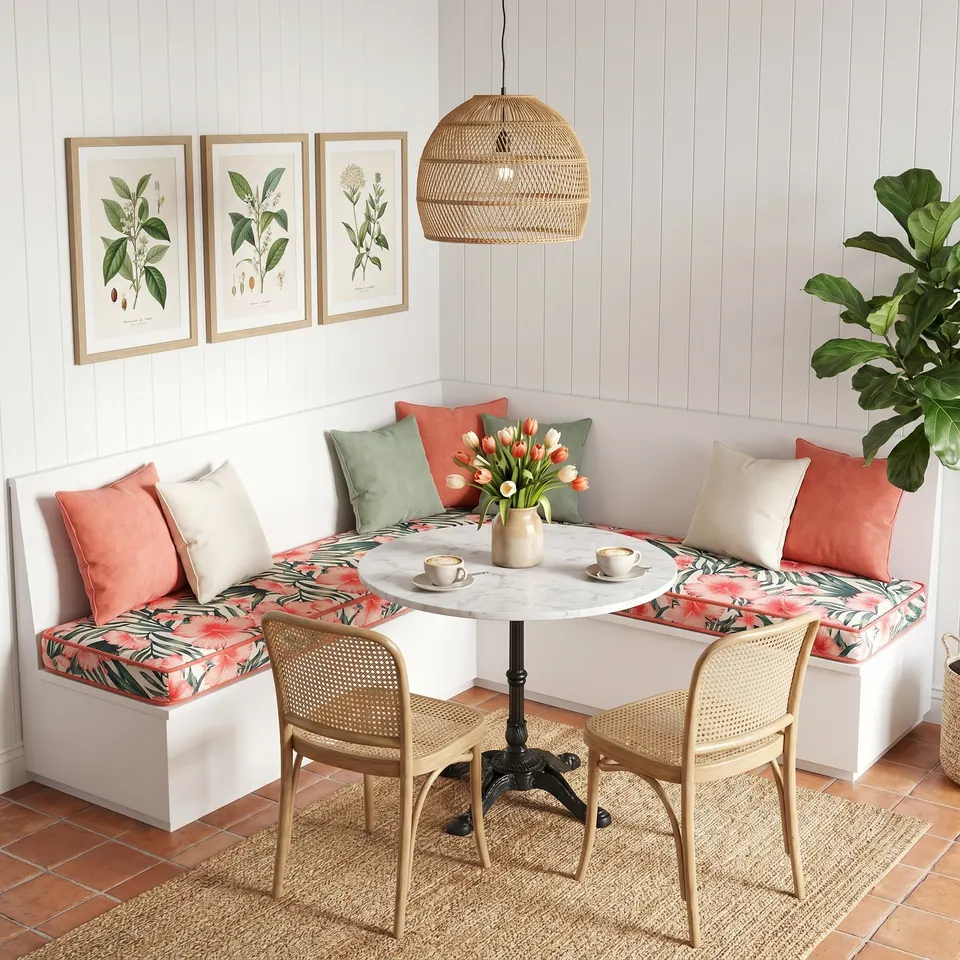
Breakfast nook cushions only need a trapezoid where the bench turns an angle: straight runs stay rectangles, and each shape gets its own drawing.
Maggie
Nook questions
- A common question
My nook bench turns its corner at an angle. How should the cushions be divided?
The workshop's answerAt an ordinary 90° corner, one long and one short rectangle butted together is simplest, costs nothing extra and fits most reliably. Cutting both ends on a diagonal turns them into trapezoids, which cost more and may not fit as well. If the corner itself isn't 90°, say 120°, the pieces are trapezoids: order them through the custom-shape route with a drawing of every edge, including the angled cut. For a corner with an angled middle section, the workshop proposed two rectangles plus a trapezoid.
- A common question
One end of my bench is angled. Can I order the cushion as a normal rectangle?
The workshop's answerNo. Any cushion that isn't a rectangle, whether angled, notched, curved or stepped, goes through the separate custom-shape route. Choose the size range by the longest length and the deepest depth; that only sets the price bracket. Upload a drawing with a measurement on every edge, plus a photo of the seat, and put thickness and fabric code in the order note. The cushion is cut to the drawing, and a clear paper sketch is fine.
- A common question
What do you need from me to make a trapezoid seat?
The workshop's answerEvery edge: front, back, both angled sides and any small clipped corners, plus the depth. Measure the depth straight from the back line to the front, and measure each angled side separately from corner to corner, because those sides differ from the depth. Mark cut-outs, include the thickness, and send a labeled drawing with a photo of the space. Very long trapezoids, around 79 in (2 m) or more on the long side, may be suggested in two pieces.
- A common question
What measurements do you need for an L-shaped nook with back cushions?
The workshop's answerSend a sketch or photo with the end-to-end length of each leg of the L, the seat depth and thickness, and say whether any part is angled and whether you want backrests. Outside and inside dimensions of the L also work, and we plan and confirm the two-piece split. Backs can run along one side only. Standard thickness is 4 in (10 cm), and we confirm your units before quoting.

Have it made
Have an idea like this made — ask Maggie’s workshop
Numbers first, fabric second, piping last. Jot down what you have, and the workshop will go down the list with you, item by item. — Maggie
Leave your details and the workshop will call you to confirm measurements, fabric, foam and piping. No prices, dates or payment on this page: it is a request, not an order.
Questions buyers ask next
How thick should breakfast nook cushions be for everyday meals?
For daily dining, 3 in (7.5 cm) of firm 32-density foam is the usual choice, and 4 in (10 cm) is the standard. Where the bench sits beside a table or already runs high, buyers go to 2 to 3 in (5 to 7.5 cm) so the seat still meets the table.
If the nook seat feels too high, can I swap in thinner foam?
Better to replace the cushion with its own cover, because thinner foam inside the original cover leaves it baggy. One family went from a 4 in (10 cm) seat to a new 2 in (5 cm) cushion in a pet-friendly fabric, cover and all.
Which fabrics stand up to kids and dogs at a breakfast table?
Pet-friendly performance fabrics, including a smooth leather-like weave, suit busy nooks. For a family with a dog and a toddler we steered away from 100% cotton stripes toward washable linen-look, soft and velvet ranges. Zippered covers come off and wash at 86°F (30°C).
Will nook cushions slide around on a painted bench?
They can. A non-slip base on each piece helps, and when one buyer's two corner cushions were ordered with non-slip on only one, both were made non-slip so they sat alike. Fabric ties sewn into the seams can also fix a cushion to the bench.