A Reading by MaggieBanquette & Kitchen Nook Cushions
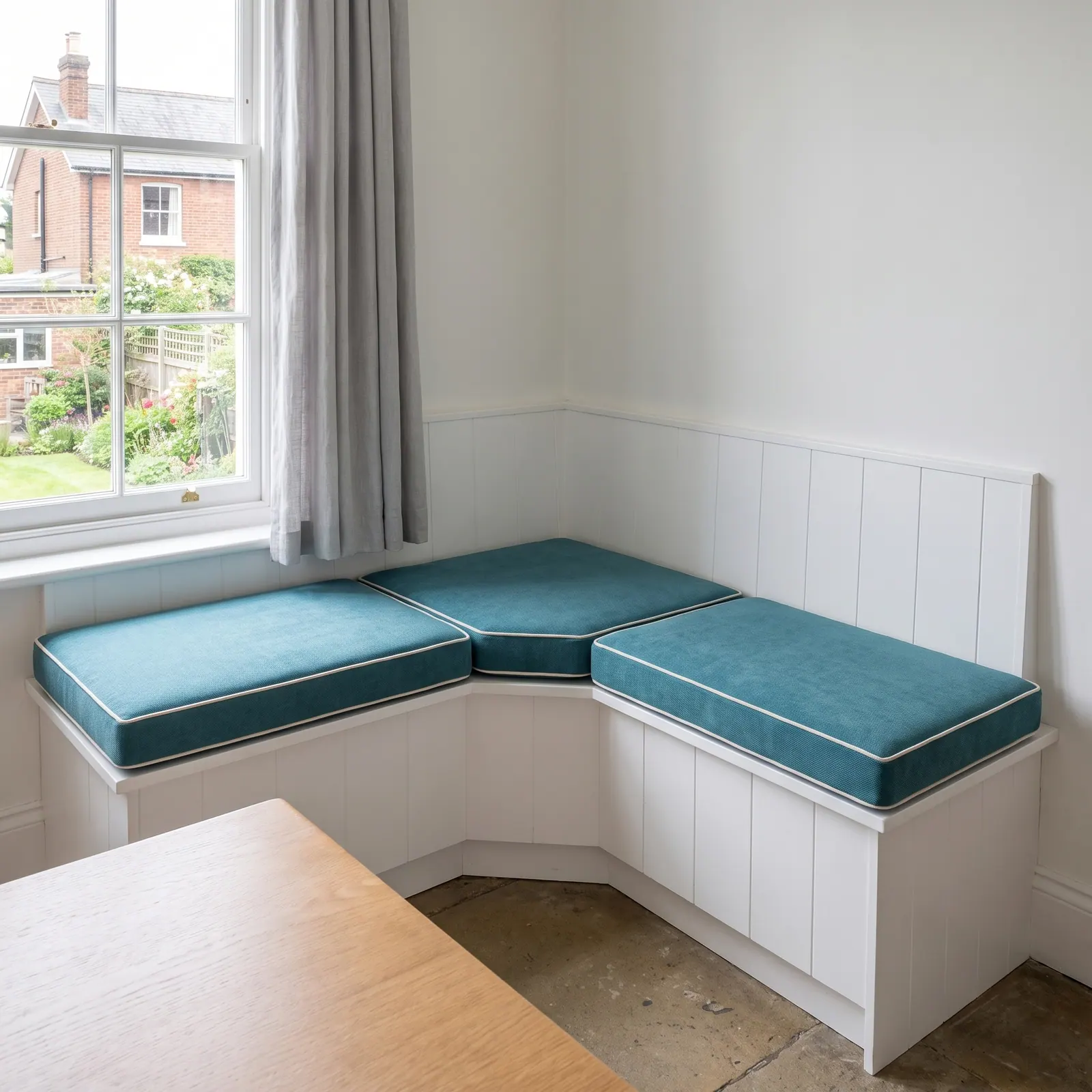
Teal corner banquette cushions, and why every piece wears its own ivory welt
Maggie takes a kitchen-nook L apart piece by piece and settles the welt question: self, contrast or none.

 Save
The quick answer
On a banquette cushion made in pieces, contrast piping on every piece makes the joins look deliberate, while self piping lets them read as gaps. This teal L-shaped set uses ivory piping on two rectangles and a clipped corner piece, and the ivory repeats the white paneling. Standard thickness is 4 in (10 cm), thinner or thicker on request.
The cushion, cut open
Cover fabric. A removable, zippered cover. Machine wash at 86°F (30°C) on a gentle cycle and air dry.
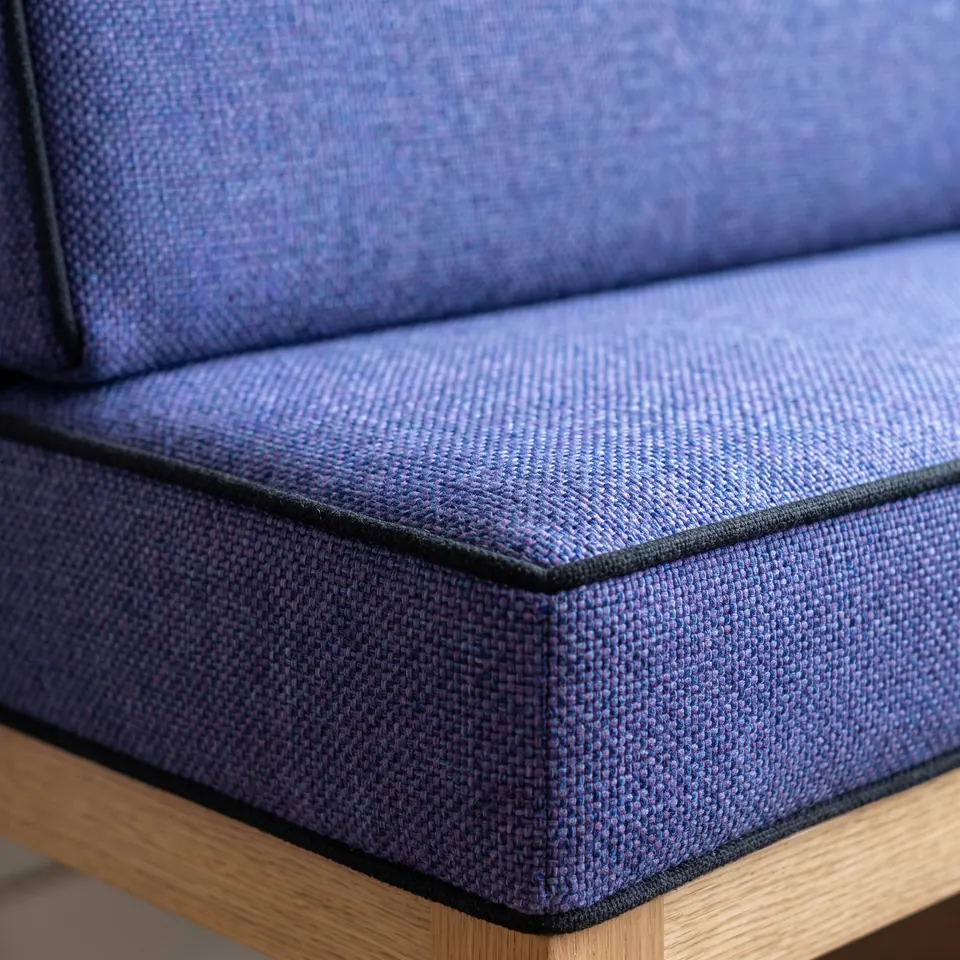
Piping. A fabric-covered cord sewn into the seams. It sits on the seam line, so it does not change the size.
Fiber wrap. Polyester fiber (Dacron) batting around the foam: it fills the cover out and softens the edges.
Foam core. About 2.0 lb/ft³ (32 kg/m³) high-resilience foam, firm to medium-firm, cut to the ordered size.
Zipper. Along the back band, as hidden as possible. The zipper side faces down or toward the wall.
Base panel. The underside of the cover. A non-slip fabric backing can cover the whole of it instead.
Pinned by Maggie: the corner, taken apart
Five pins, from the clipped corner piece to the oak table that proves the seat depth.
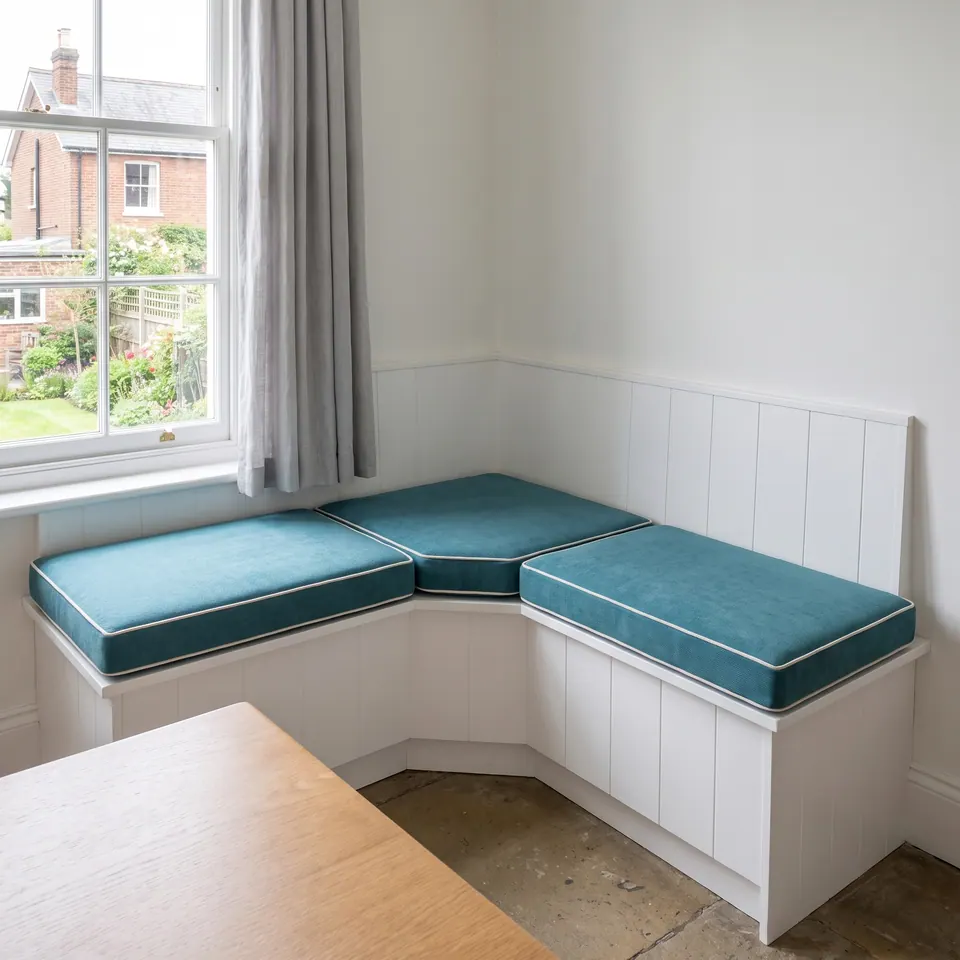
- Clipped corner piece
A separate angled piece avoids bunching where one long cushion would bend.
- Left rectangle
Straight runs stay simple rectangles that lift out for cleaning.
- Right rectangle
Each piece has its own ivory piping, so the joins look deliberate.
- Linen curtain
Pale gray linen softens the white joinery without competing with the teal.
- Oak table
Shows the seat depth working at dining height.
- Clipped corner pieceA separate angled piece avoids bunching where one long cushion would bend.
- Left rectangleStraight runs stay simple rectangles that lift out for cleaning.
- Right rectangleEach piece has its own ivory piping, so the joins look deliberate.
- Linen curtainPale gray linen softens the white joinery without competing with the teal.
- Oak tableShows the seat depth working at dining height.
Why every piece wears its own ivory welt
Right, then. Three box cushions on a white tongue-and-groove L: a left rectangle, a right rectangle and a clipped corner piece between them. The corner is its own cushion because one long piece bent around an L bunches at the inside angle. Cut it separately and the straight runs stay simple rectangles that lift out for cleaning.
Now the welt, which is the whole story of this photo. Each piece carries its own ivory piping all the way round. Where two teal cushions meet, you see two ivory lines side by side, so the join looks drawn on purpose. In self piping the same joins would read as gaps, and on a bench split in three, gaps are what the eye goes hunting for.
Ivory also picks out the top edge from across the kitchen, and it repeats the white paneling below, so the contrast comes from the room rather than from nowhere. A navy or black welt would have added a third color and cut the bench into outlines.
The props earn their places. A pale gray linen curtain softens the white joinery without competing with the teal. The oak table corner in the foreground shows the seat depth working at dining height. The sash window frames the greens of the yard outside, and teal answers them. The stone flag floor stays cool and plain, which keeps the nook in honest overcast daylight.
More split benches are among our banquette cushions and kitchen nook cushions. The teal is one of the linen-look fabrics, and the piping Pattern sets the three choices side by side. Where does your bench turn its corner, dear?
Self, contrast or none: piping on a split corner banquette
| Piping | What the line does | Where it earns its keep |
|---|---|---|
| Self piping | Firms the edge in the same color; the outline stays quiet | One-piece seats and busy prints |
| Contrast piping | Draws every edge and every join as a line | Seats split into pieces, like this L |
| No piping | Edges soften; the cushion reads as a block of color | Relaxed looks where a crisp outline isn't wanted |
Ten measurements, a corner split and one light beige
A family building a kitchen bench wrote to the workshop wanting light beige that would survive messy little children. The bench was an L with 45-degree front corners, and they sent ten measurements lettered A to J, including a 100 3/8 in (255 cm) run, a 75 5/8 in (192 cm) run and two 5 3/8 in (13.5 cm) angled corners. The workshop quoted it as two cushions, split at the corner.
They had a paint reference for the walls and hovered between two linen-looks, L02 and L08. Close-up photos and short videos of both swatches settled it: L02 was the better light beige, and yes, machine washable under 86°F (30°C).
Then they were leaving on vacation. The workshop held the order and timed it to arrive after they got home. Two cushions or three, as in the photo, the rule holds: split at the corner, and judge a neutral against the paint, not the screen. The L-shaped corner joint Pattern shows the options.
On the cutting table: the teal L
| Cushion | Three-piece L-shaped kitchen banquette set |
|---|---|
| Pieces | Left rectangle, right rectangle, clipped corner piece |
| Fabric | Teal linen-look (codes 929 / 910) |
| Piping | Ivory contrast piping on every piece |
| Edge | Box edge |
| Thickness | Standard 4 in (10 cm); thinner or thicker on request |
| Base | White tongue-and-groove built-in bench |
| Best for | Kitchen nooks and L-shaped dining banquettes |

Have it made
Have this made — ask Maggie’s workshop
Numbers first, fabric second, piping last. Jot down what you have, and the workshop will go down the list with you, item by item. — Maggie
Leave your details and the workshop will call you to confirm measurements, fabric, foam and piping. No prices, dates or payment on this page: it is a request, not an order.
Buyer questions: sizes, shapes and thickness
- A common question
My banquette size isn't in the drop-down. How do I order something like 26 x 80 x 3 in?
The workshop's answerChoose the closest option, 24 x 80 in here, and type your exact size and fabric in the personalization box at checkout; production works from that box. The workshop can also add a size to the listing. Ordering several cushions? Add each as its own cart item with its own size, or the order has to be redone.
- A common question
Can you make a cushion for a bench that isn't a plain rectangle?
The workshop's answerYes, all the time. Order through the custom-shape listing, choose the size range by your longest and deepest measurements, then upload a drawing with every measurement written on it, plus thickness and fabric code. The cushion is cut exactly to the drawing, and you can message the drawing first to have it checked.
- A common question
Ten centimeters is too much for our bench. Can you go thinner?
The workshop's answerYes. The standard is 4 in (10 cm), but real orders have gone as thin as 1.5 in and as thick as 6 in, with 3 in, 2 in (5 cm) and 3 in (7.5 cm) in between. Write the thickness in the personalization box.
On a banquette split into pieces, contrast piping on every cushion turns each join into a drawn line instead of a gap.
Maggie
Questions buyers ask next
On a split kitchen banquette, when does contrast piping beat self piping?
When the bench is made in pieces and you want the joins to look deliberate. Contrast piping outlines every piece, so two lines meet at each join. Pick a color already in the room, as ivory repeats white paneling here.
Why use a separate corner piece on an L-shaped banquette?
One long cushion bent round an inside corner bunches at the angle. A clipped corner piece keeps the two straight runs as simple rectangles, each removable for cleaning.
How do I choose between two similar beige swatches?
Compare close-up photos of both against your paint reference in daylight. One family chose between two linen-looks this way and found one was clearly the better light beige.
Can a linen-look banquette cushion go in the washing machine?
The light beige linen-look one family chose was confirmed machine washable under 86°F (30°C). Check the care note for your own fabric code before washing.
Stitch straight — Maggie