Entryway and mudroom bench cushions that stay put by the door
The bench by the front door gets boots, backpacks, grocery bags and the dog's leash, often in the same minute. Here is how to size its cushion, dress it, and keep it from wandering off the edge.
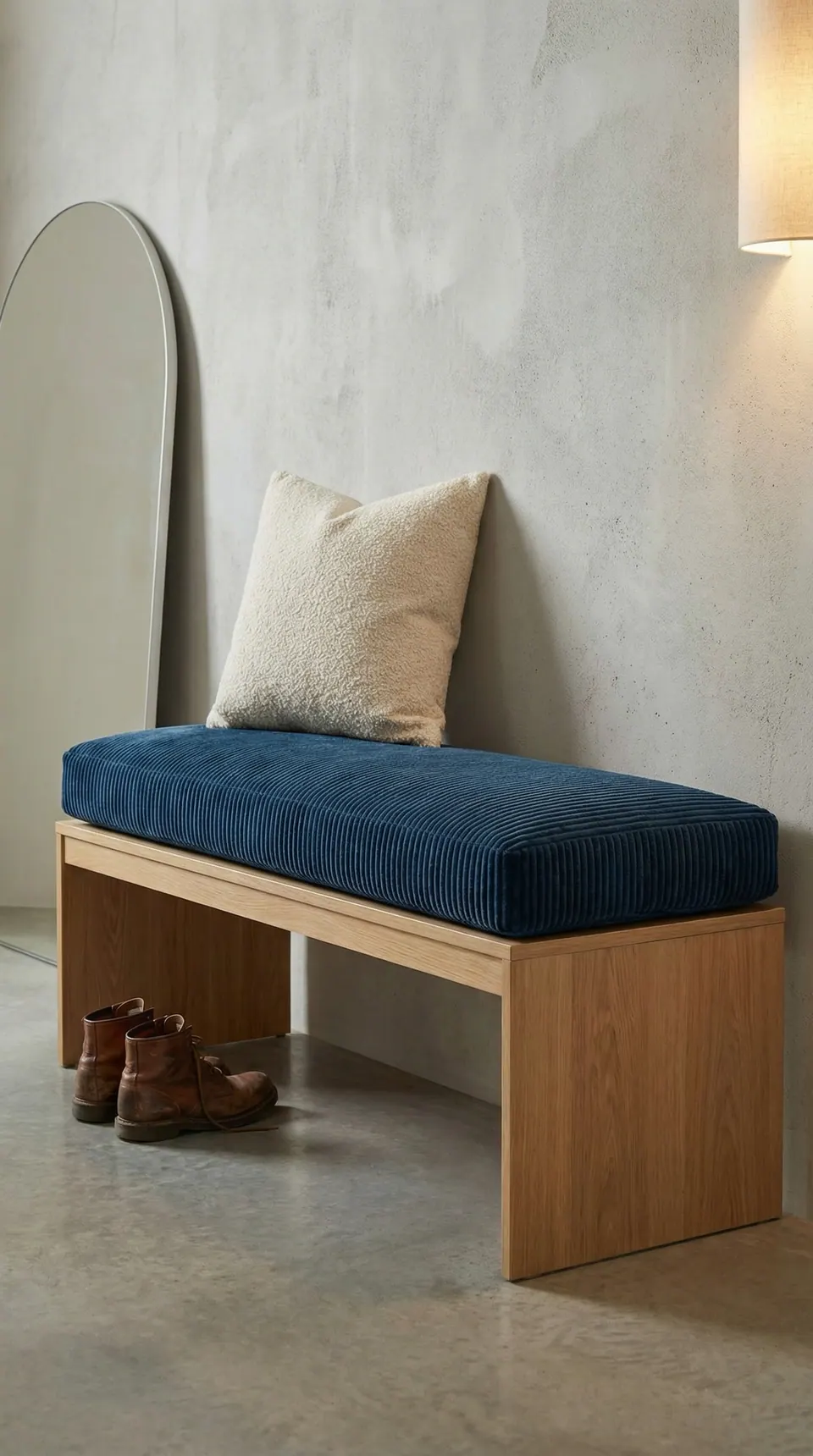
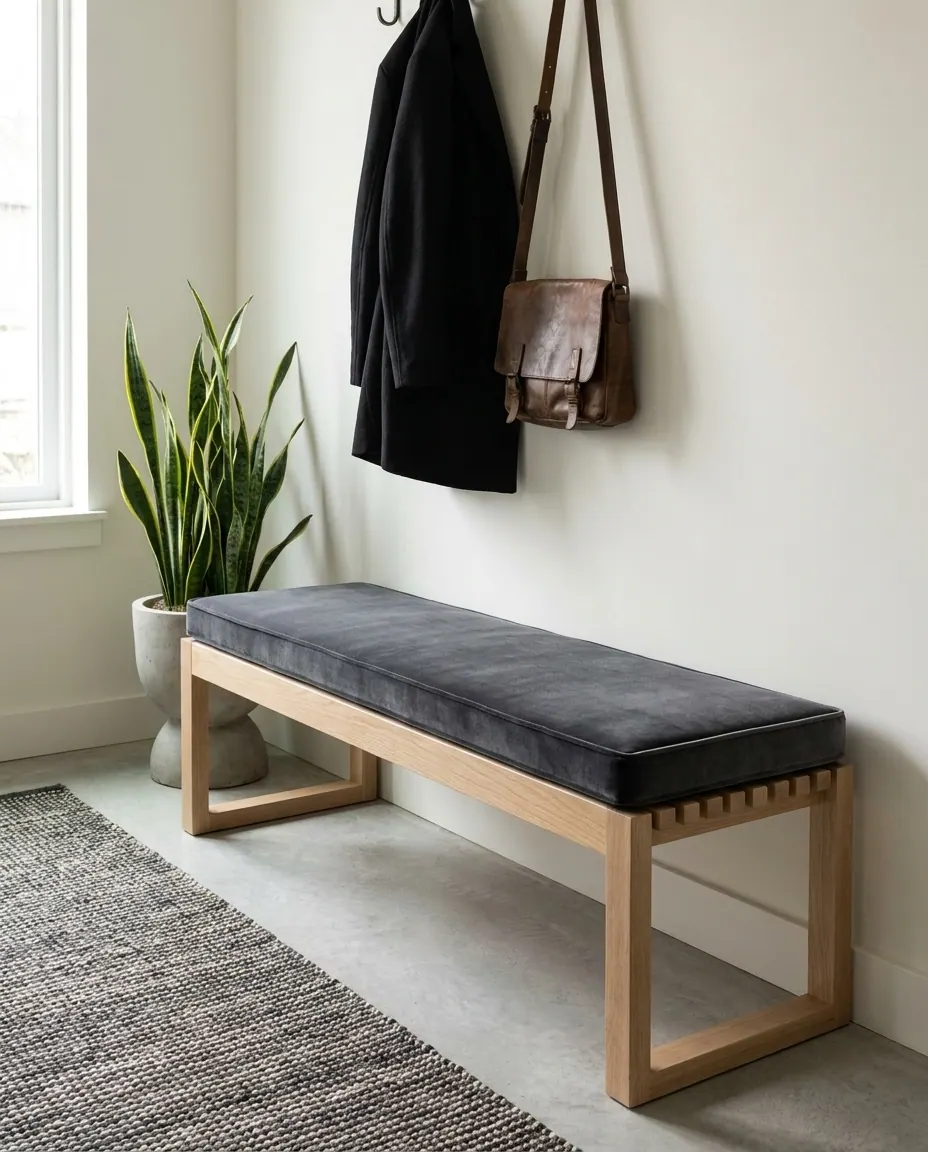
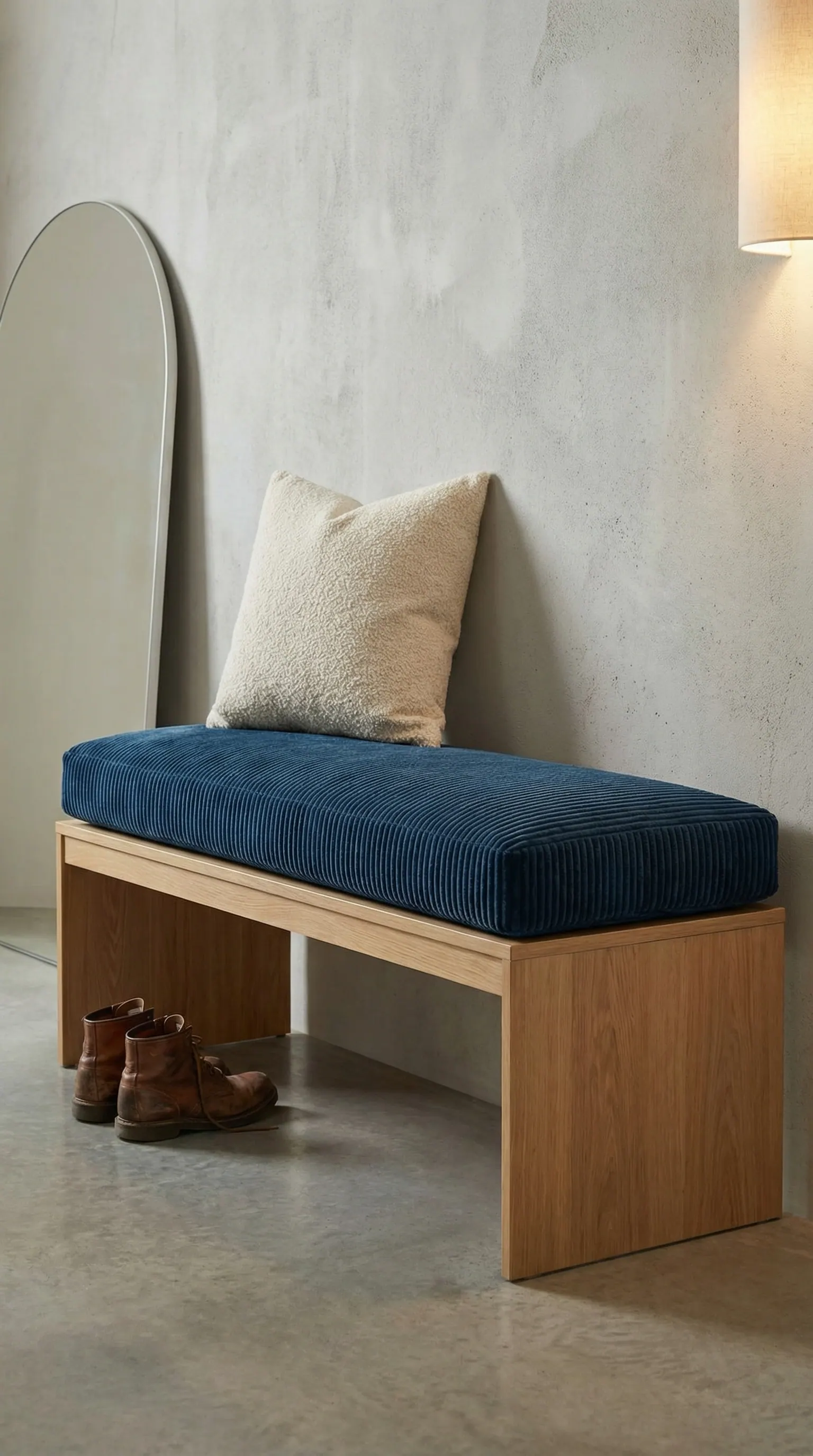
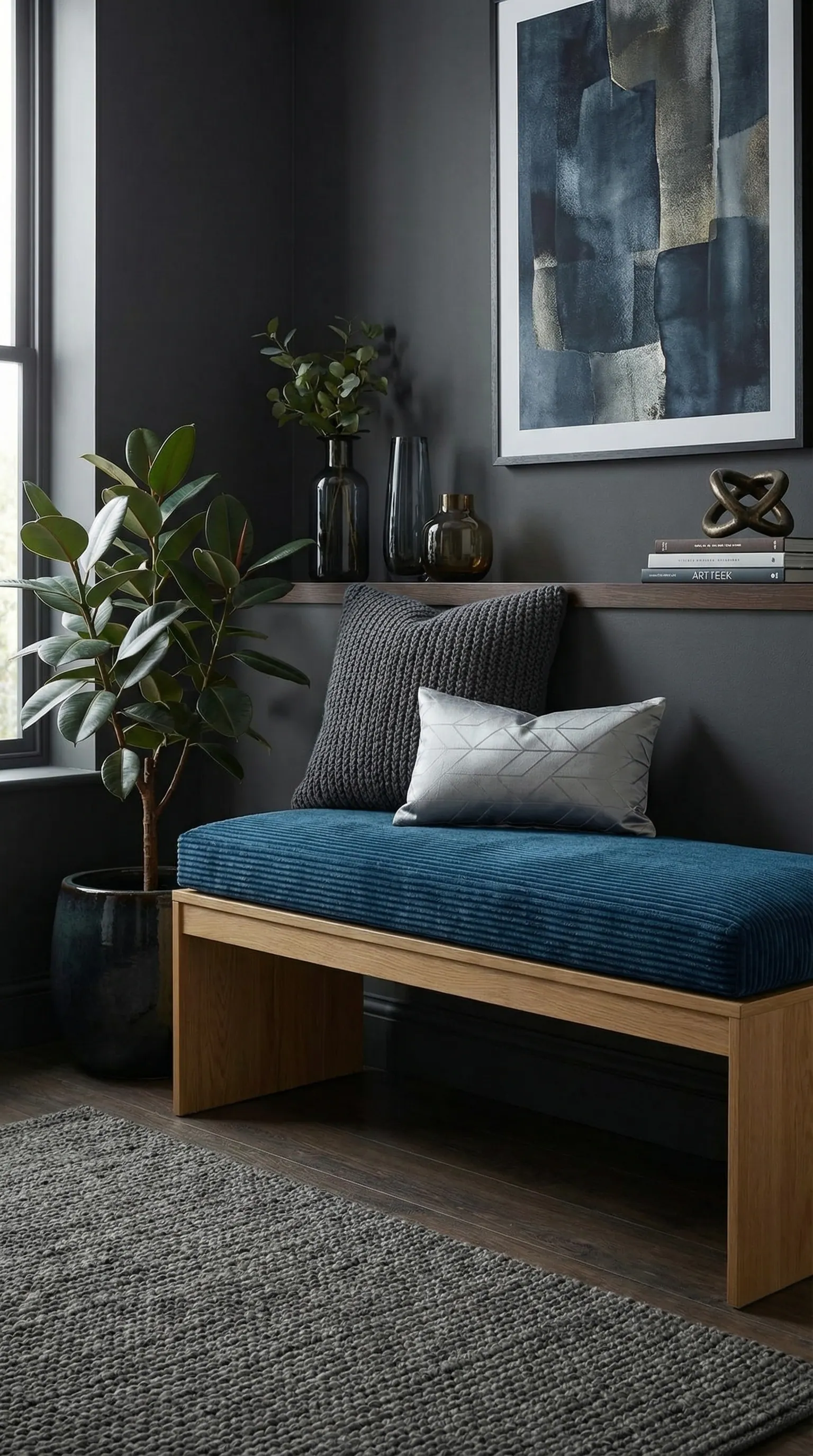
SaveA navy cord pad and a boucle pillow make an oak entry bench a comfortable place to pull on boots.
The quick answer
An entryway bench cushion is a firm seat pad cut to a mudroom or hallway bench, usually 4 in (10 cm) thick with a zippered, removable cover. Measure the bench top's length and depth, not the old cushion, and ask in the order note for ties or a non-slip base, because neither is added unless you request it.
Every one is cut to your measurements. The number is how many readings the atelier has published for that shape.
Sizes & measuring
Sizing the bench by the door
Measure the bench top itself, to the nearest 1/4 in. Old cushions shrink, slump and fib.
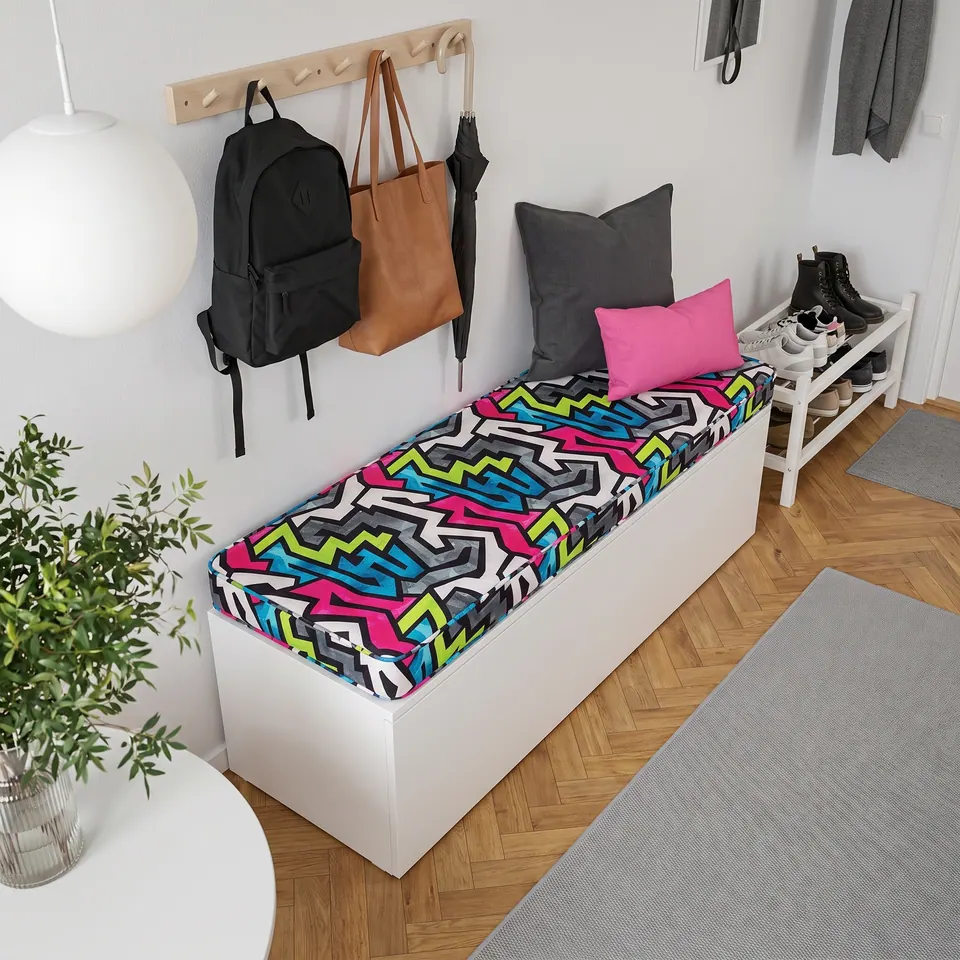
How to measure Seen from above, the cushion fills the frame: measure length and depth inside it, wood to wood. Seen from the front: the thickness you want.
Length
End to end along the back edge; wall to wall if the bench sits in an alcove
Depth
Front edge to the wall or back rail
Standard thickness
4 in (10 cm), the thickness in most listing photos and the one most buyers keep
Thinnest foam
2 in (5 cm); 1 in (2.5 cm) only without piping; about 1 1/4 in (3 cm) can take piping
Front overhang
Up to about 2 in (5 cm) past the front edge when an inner support wrap is added
Lift-up lids
Split the cushion at each lid break and add ties
Backrest
A separate piece at its own size, softer than the seat unless you ask for equal firmness
Cover
Zippered and fully removable at no extra cost, zipper on the back edge or the underside
Nobody sits on an entryway bench for long, and that is exactly why it wears out first: dozens of short visits a week, most of them in outdoor shoes.
An entryway bench cushion is the seat pad on a mudroom cubby bench, a slim hallway bench, a paneled seat tucked under the stairs, or even a slatted radiator cover pressed into service. It needs a firm top so you can sit, tie a lace and stand again, and a cover that comes off when the rain comes in with the family.
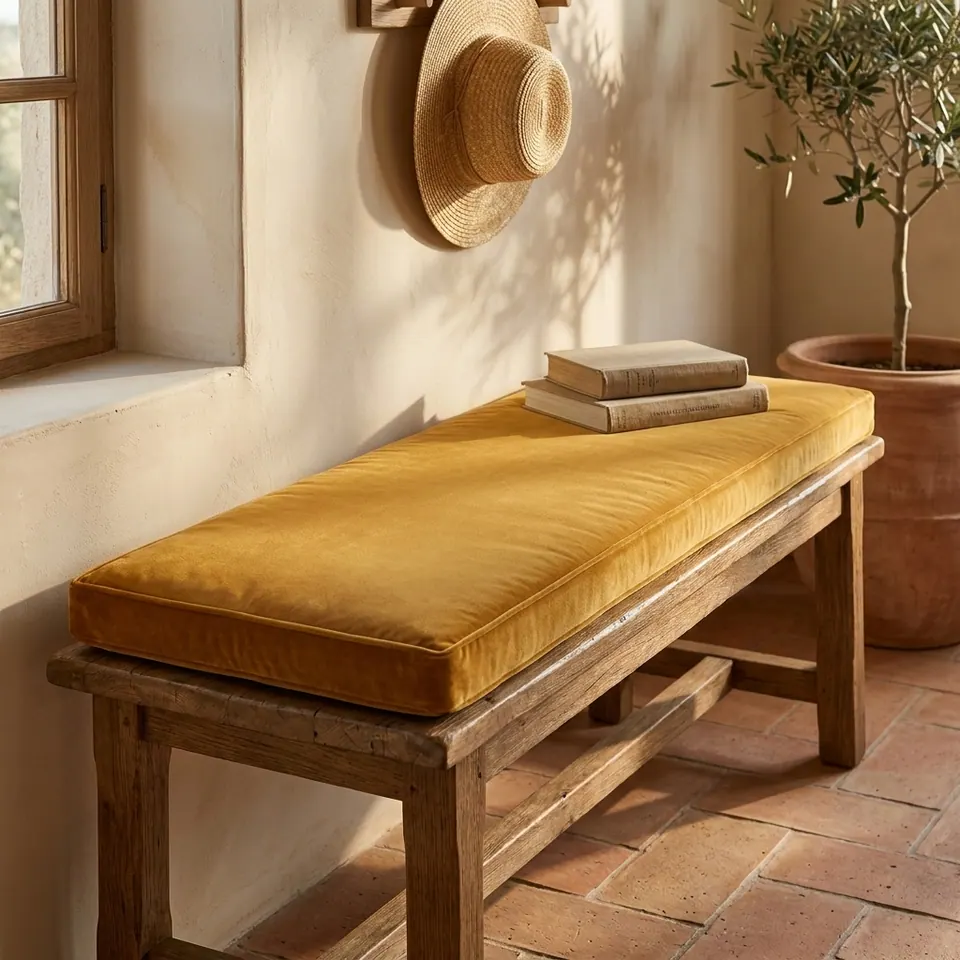
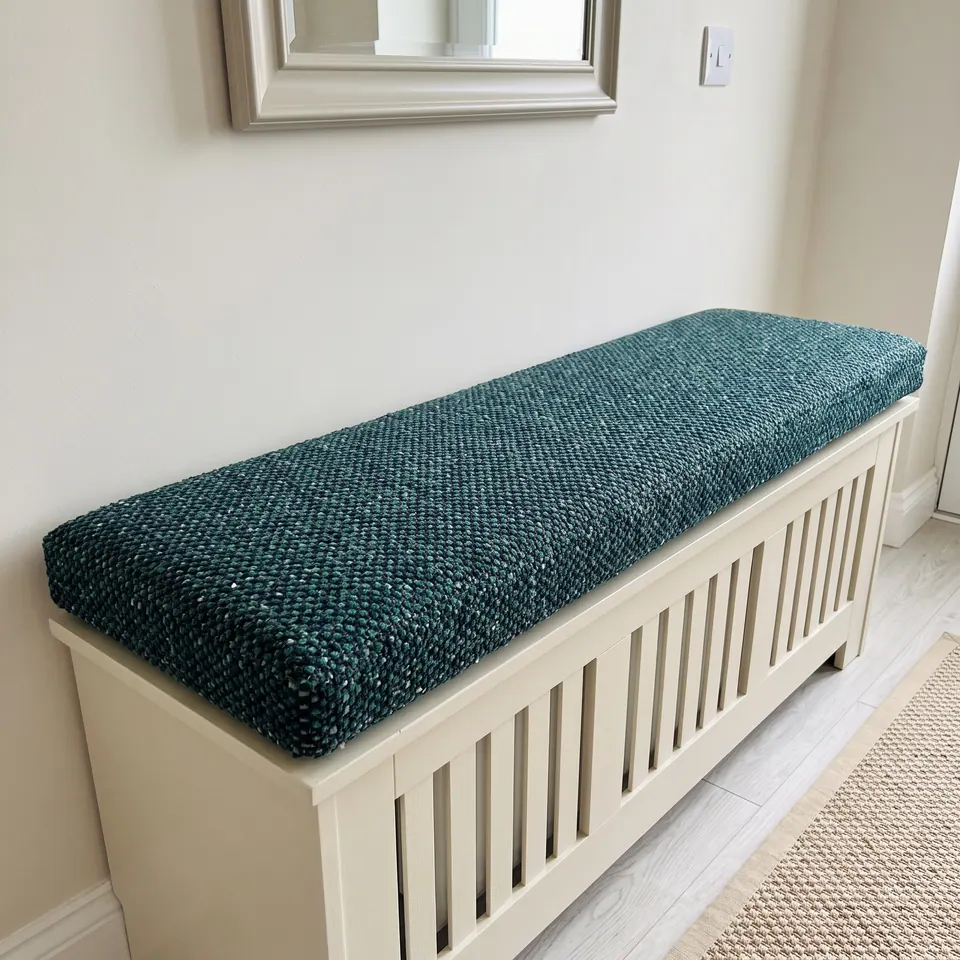
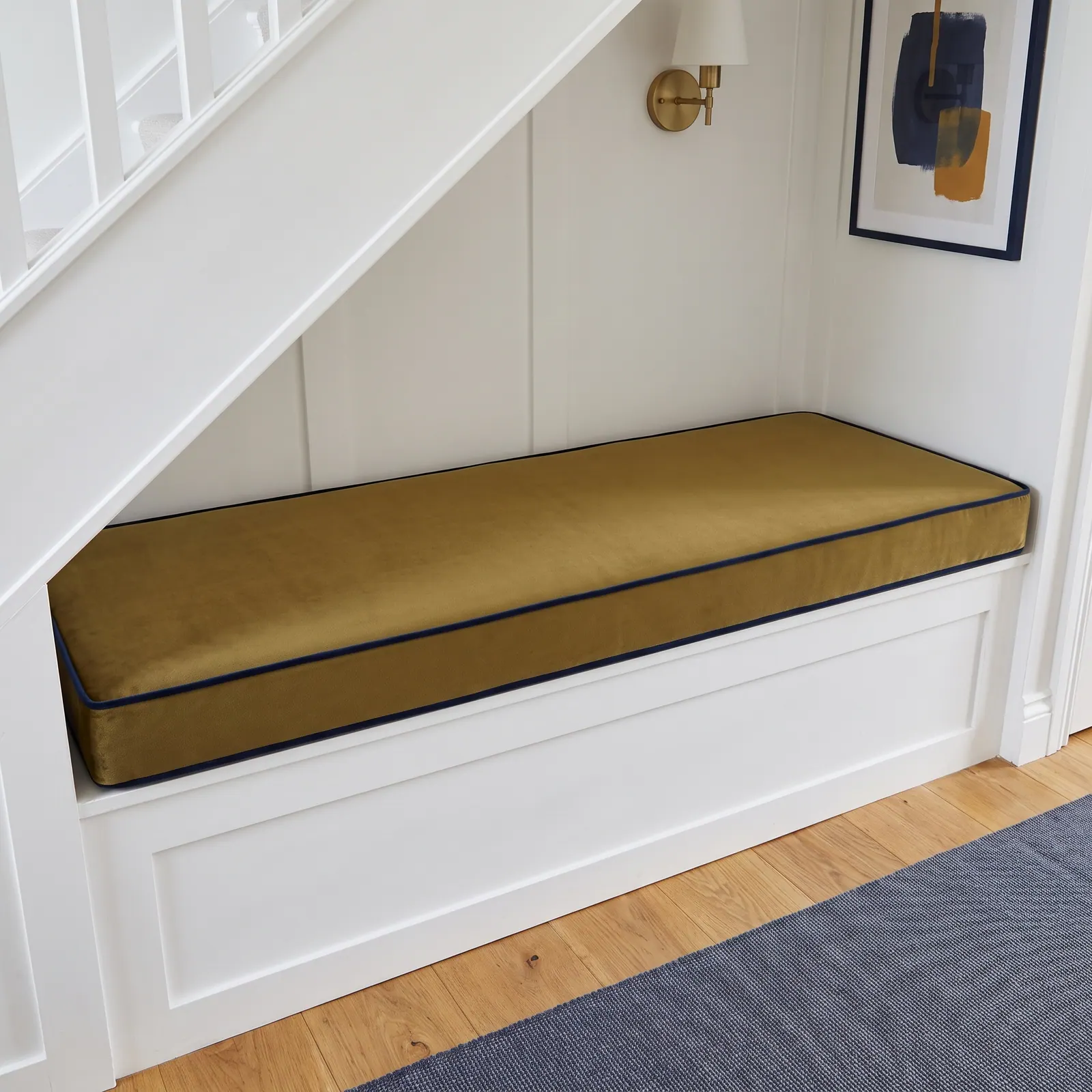
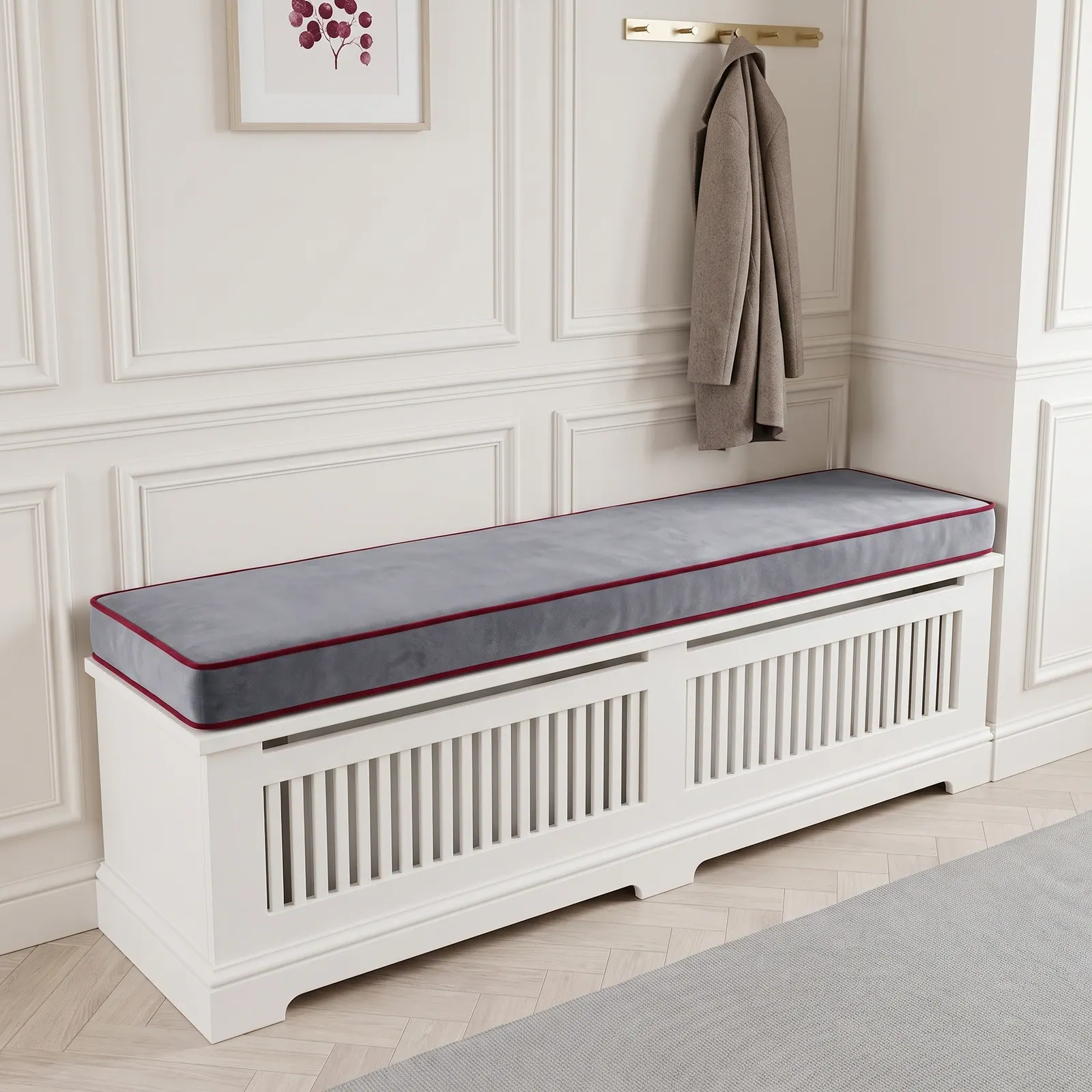
Most entry benches are plain rectangles, and a box cushion suits them: flat top, straight sides, piping to draw the line. Look at the mustard-gold velvet under-stairs seat with deep navy piping, or the cool gray velvet radiator seat piped in cranberry. Contrast piping is how a small hall seat earns its keep as decoration.
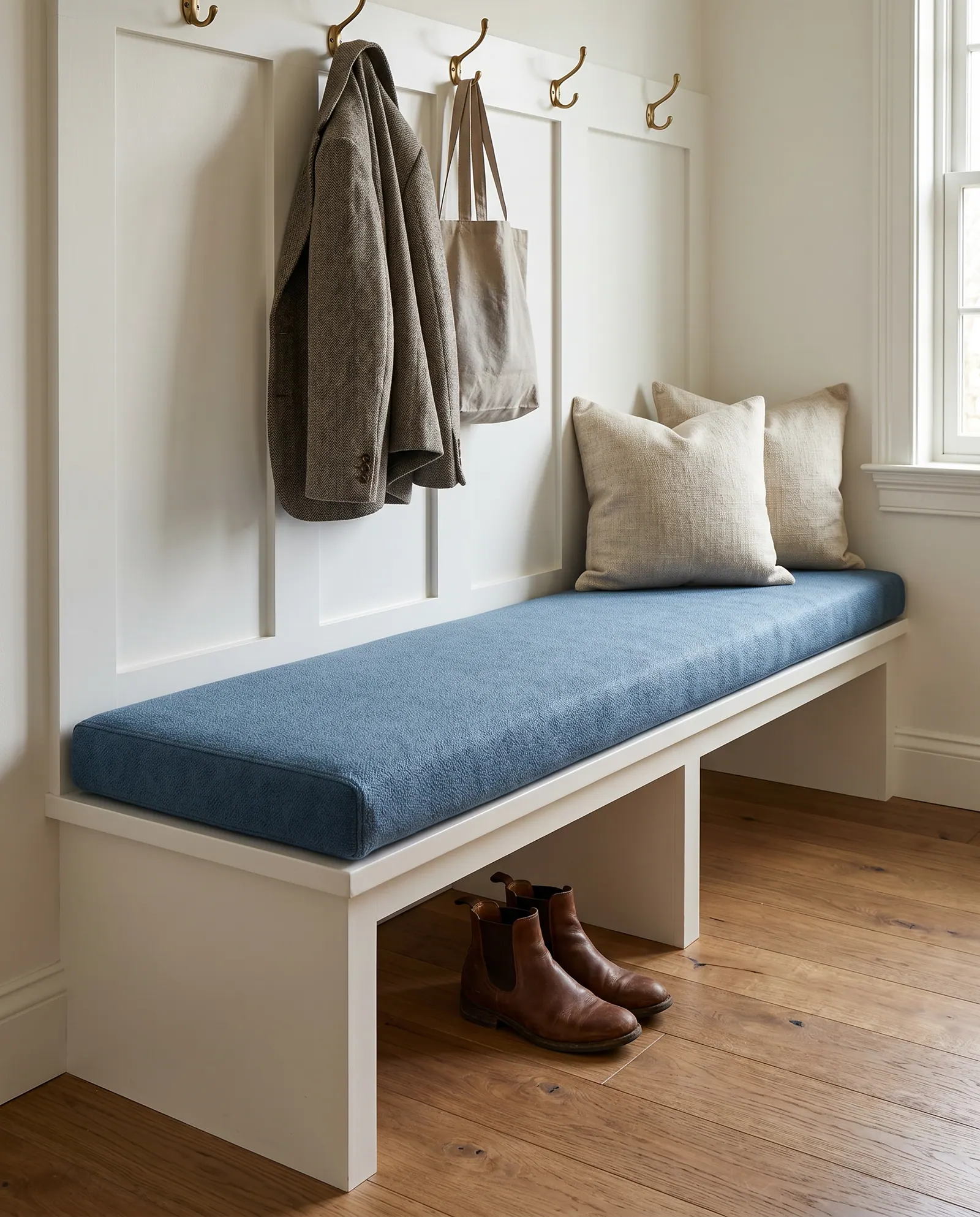
A bullnose edge, rounded along the front like the denim blue cushion under a row of brass hooks, gives a softer front where you sit to pull on boots.
Benches rounded at one end are made too. Mark where the curve starts and ends and how deep it runs, or trace the end onto paper and photograph the template beside a tape measure; a curve is never guessed from numbers alone. Rounded corners and oval seats shows the method.
Fabric chosen for the worst day in March
Pick the fabric for sleet and muddy paws, not for the best day in June.
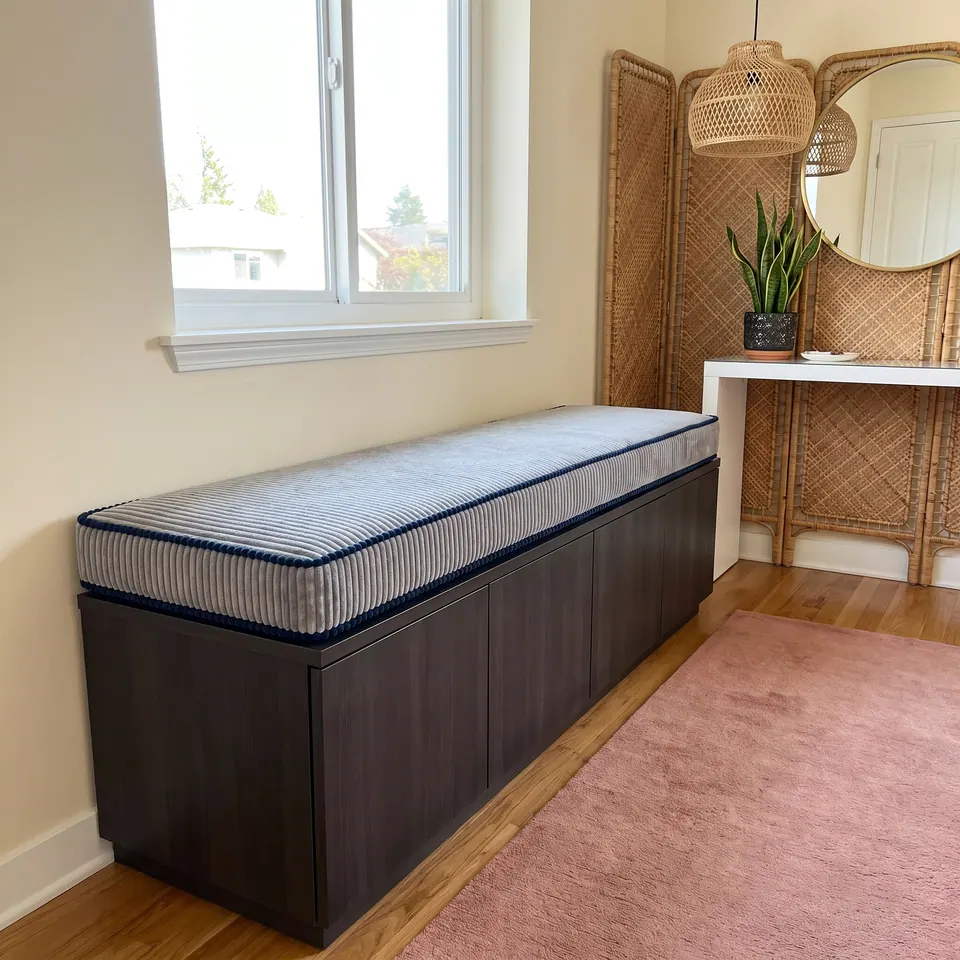
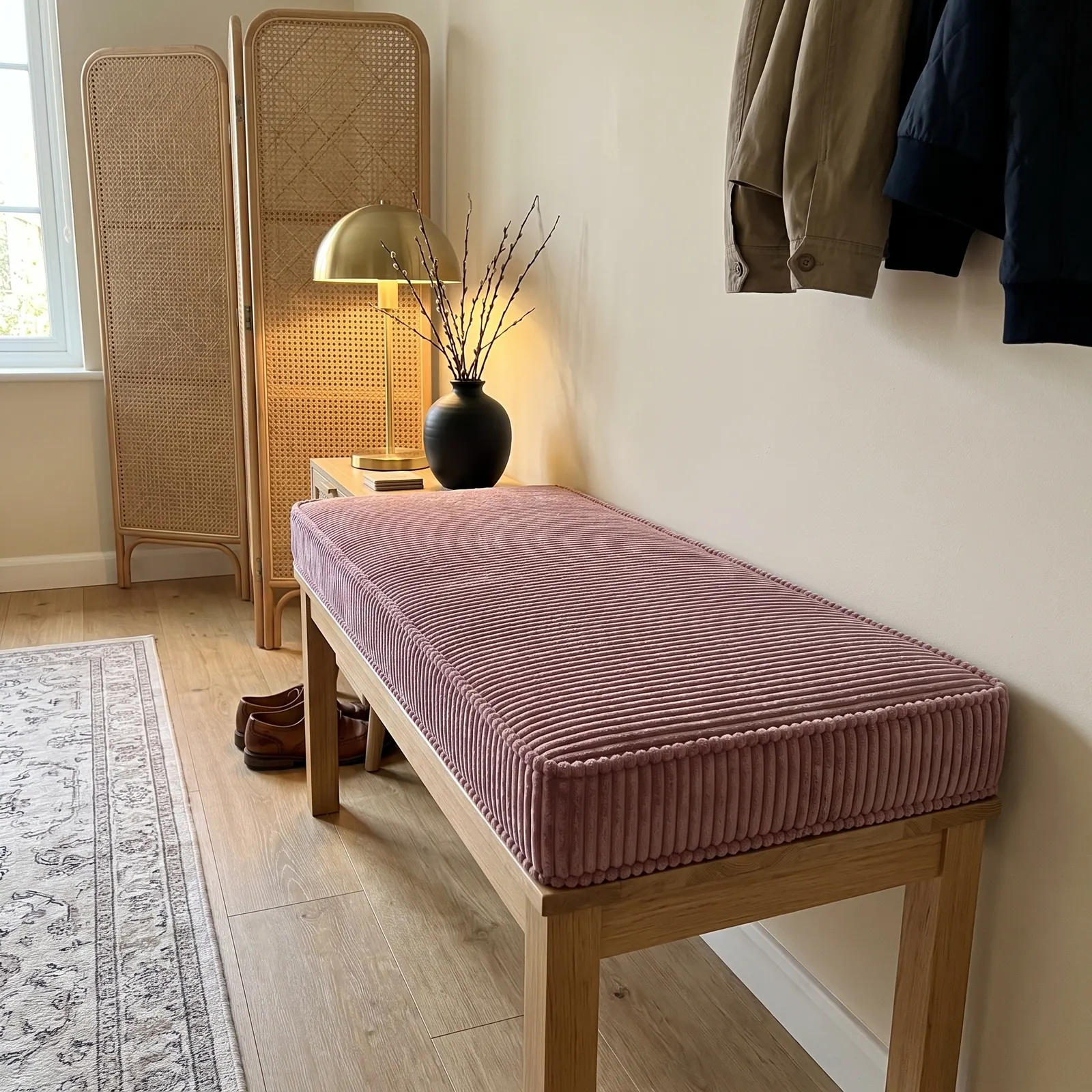
Corduroy: navy on an oak slab bench, petrol teal against a charcoal wall, dusty pink wide wale beside a cane screen.
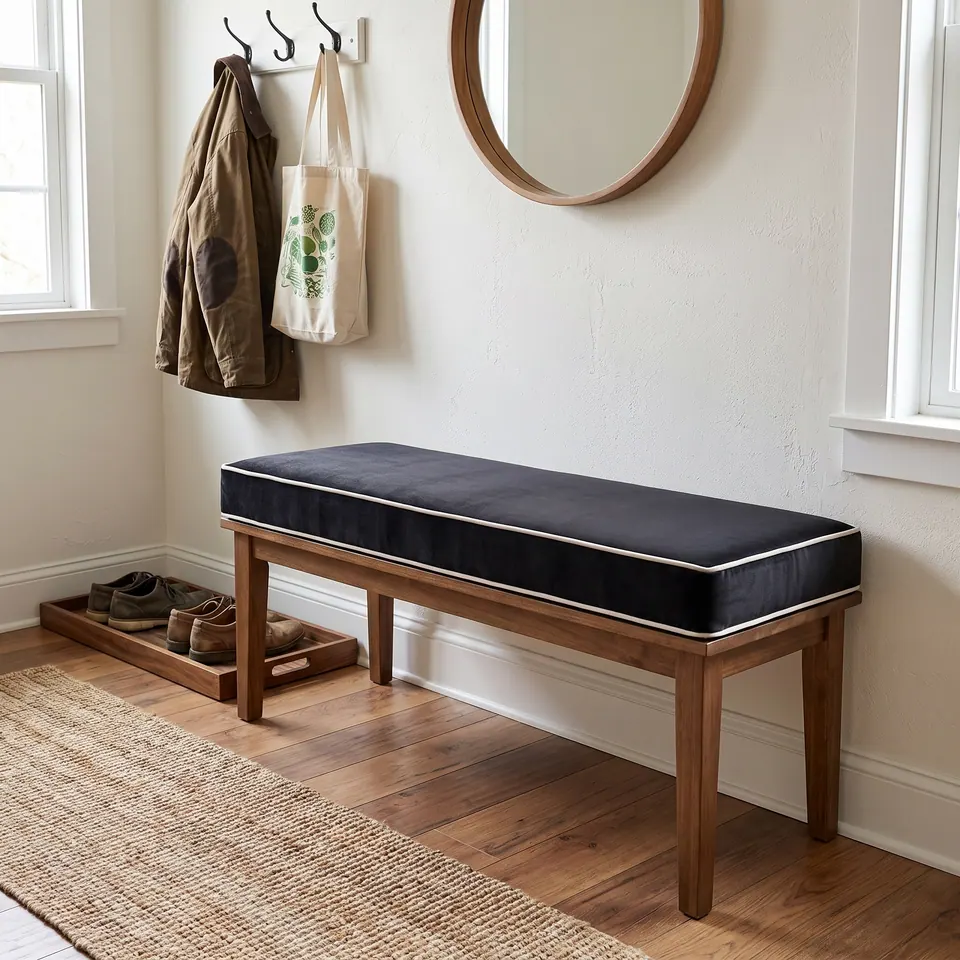
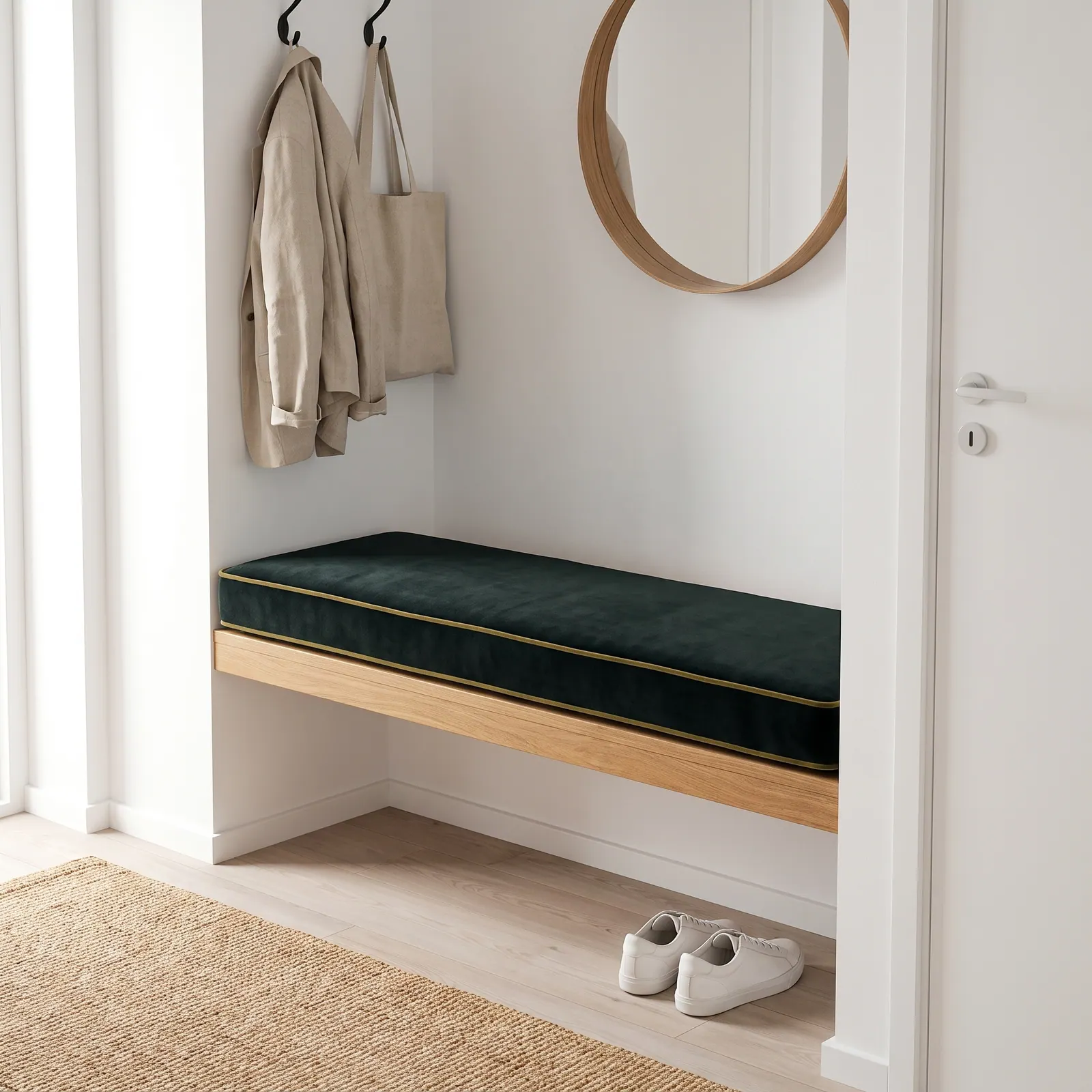
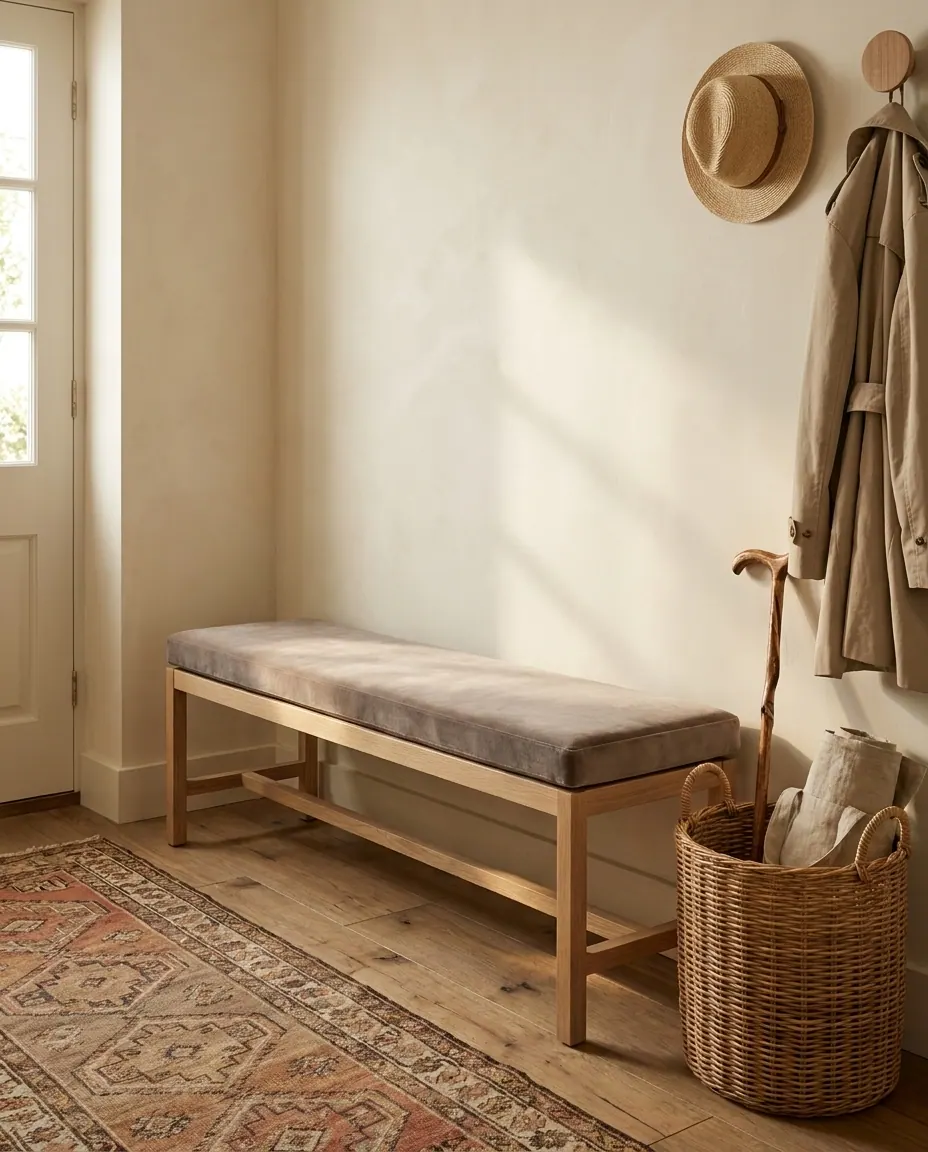
Velvet: bottle green with olive-gold piping on a floating oak bench, mushroom taupe by the coat pegs. Handsome, but it shows where somebody sat.
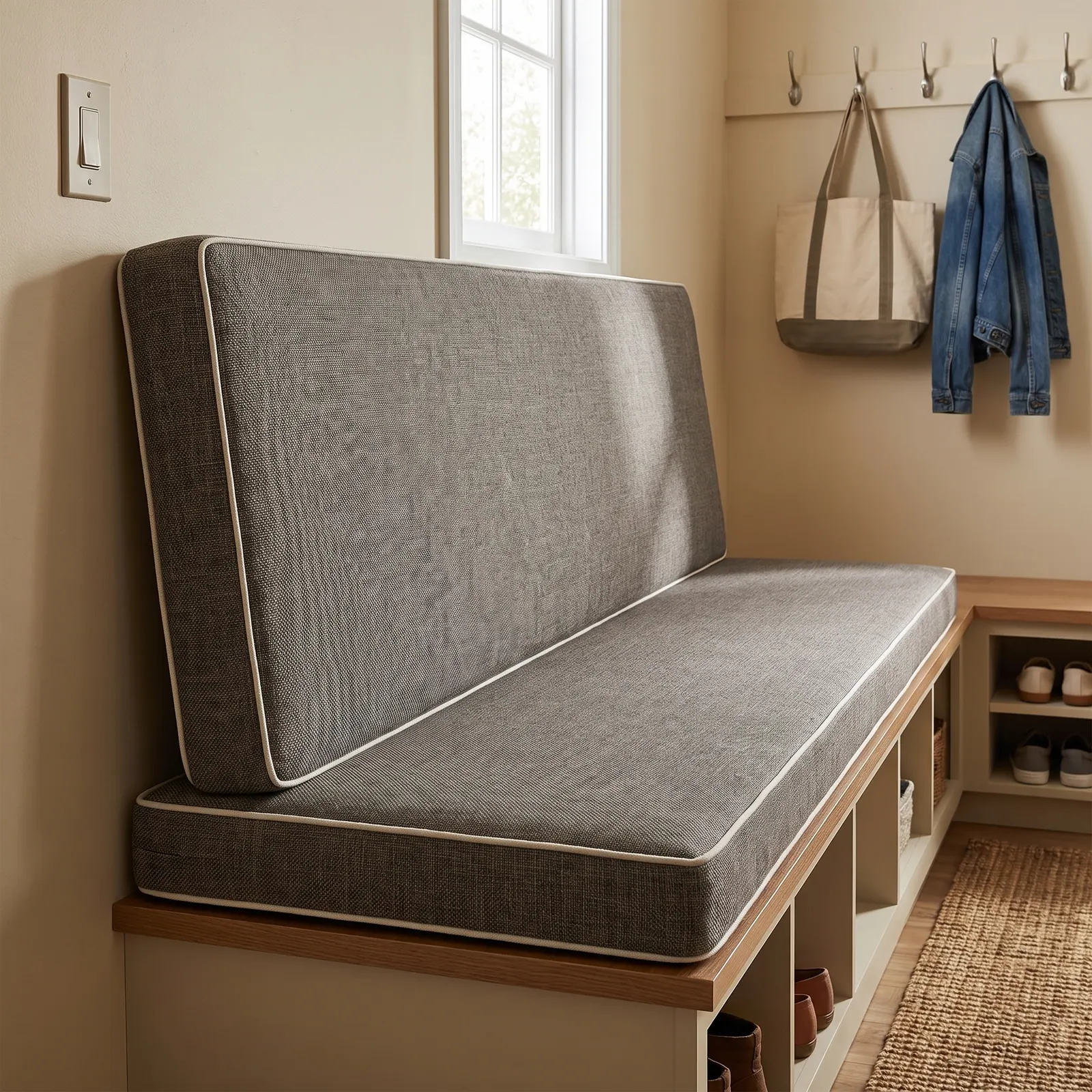
Linen-look weaves: the dark taupe mudroom seat with its tall ivory-piped backrest.
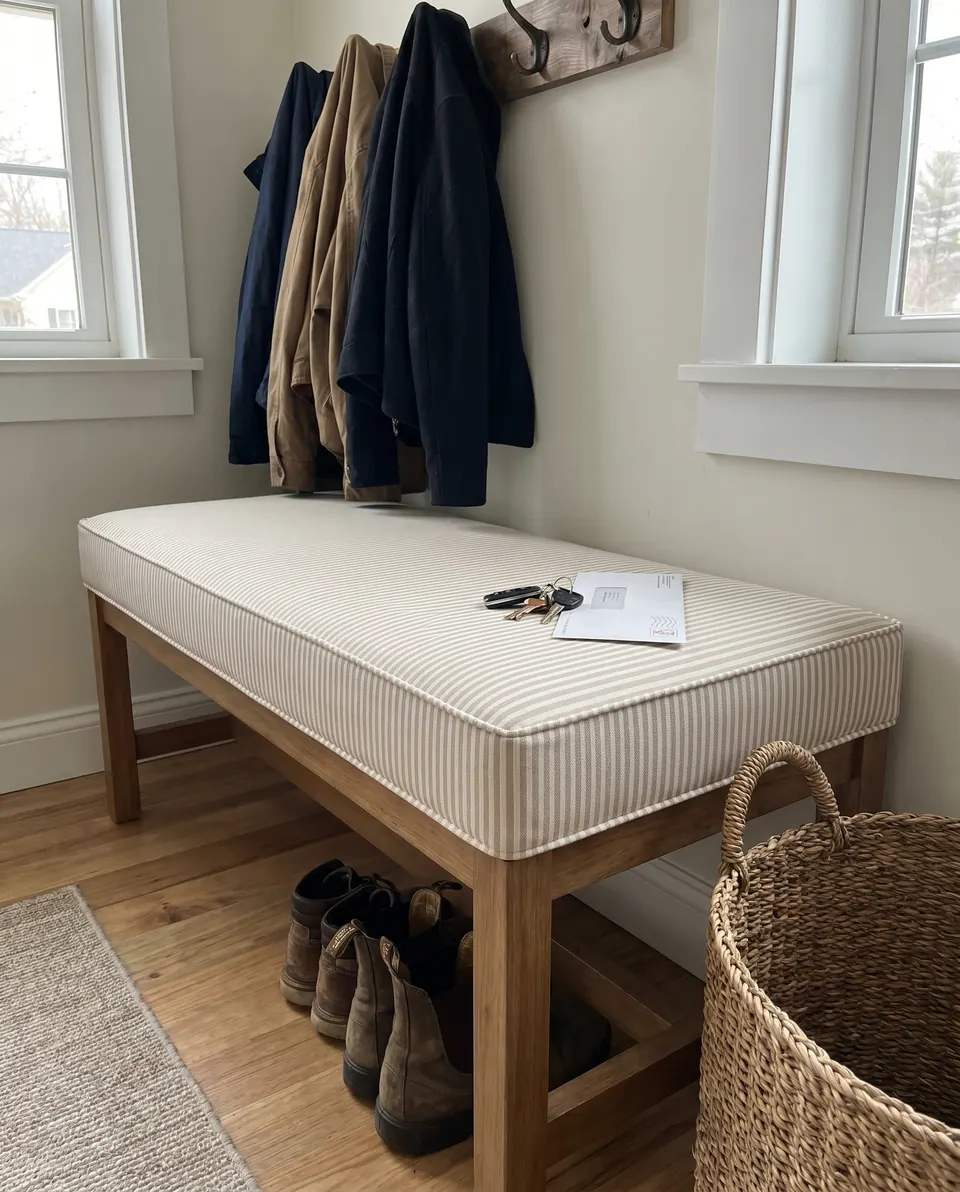
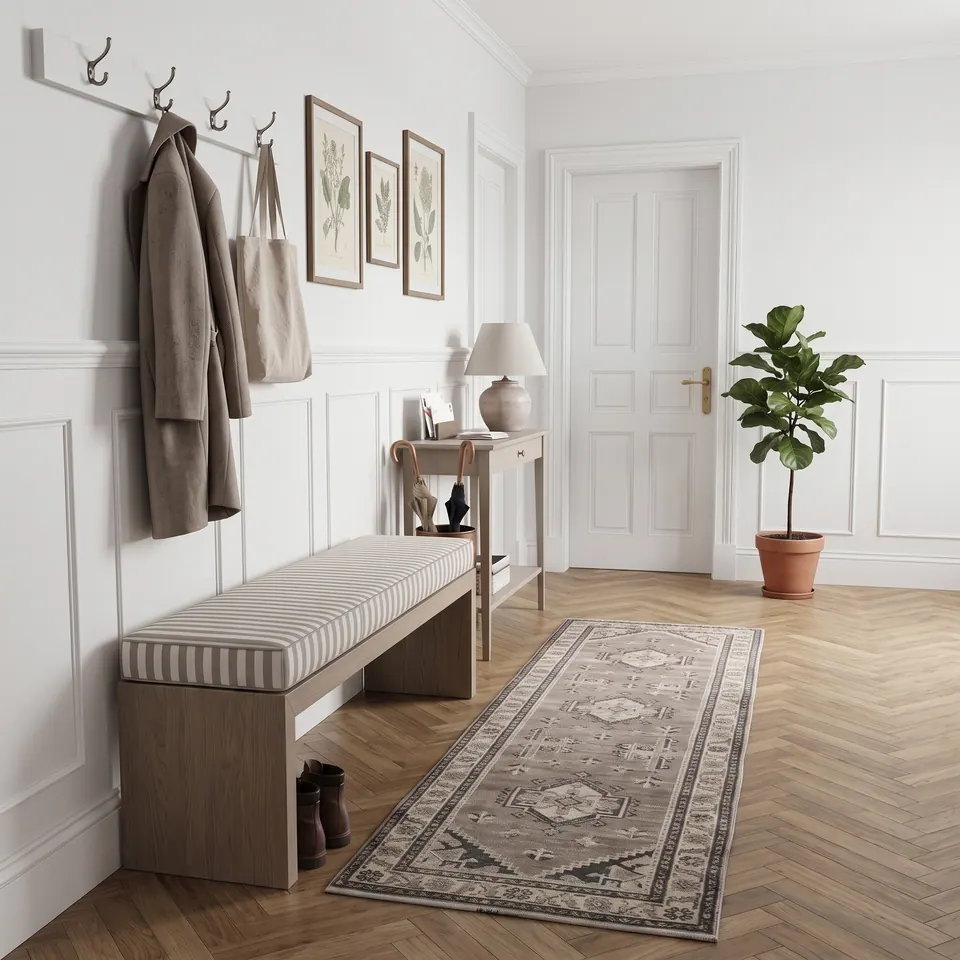
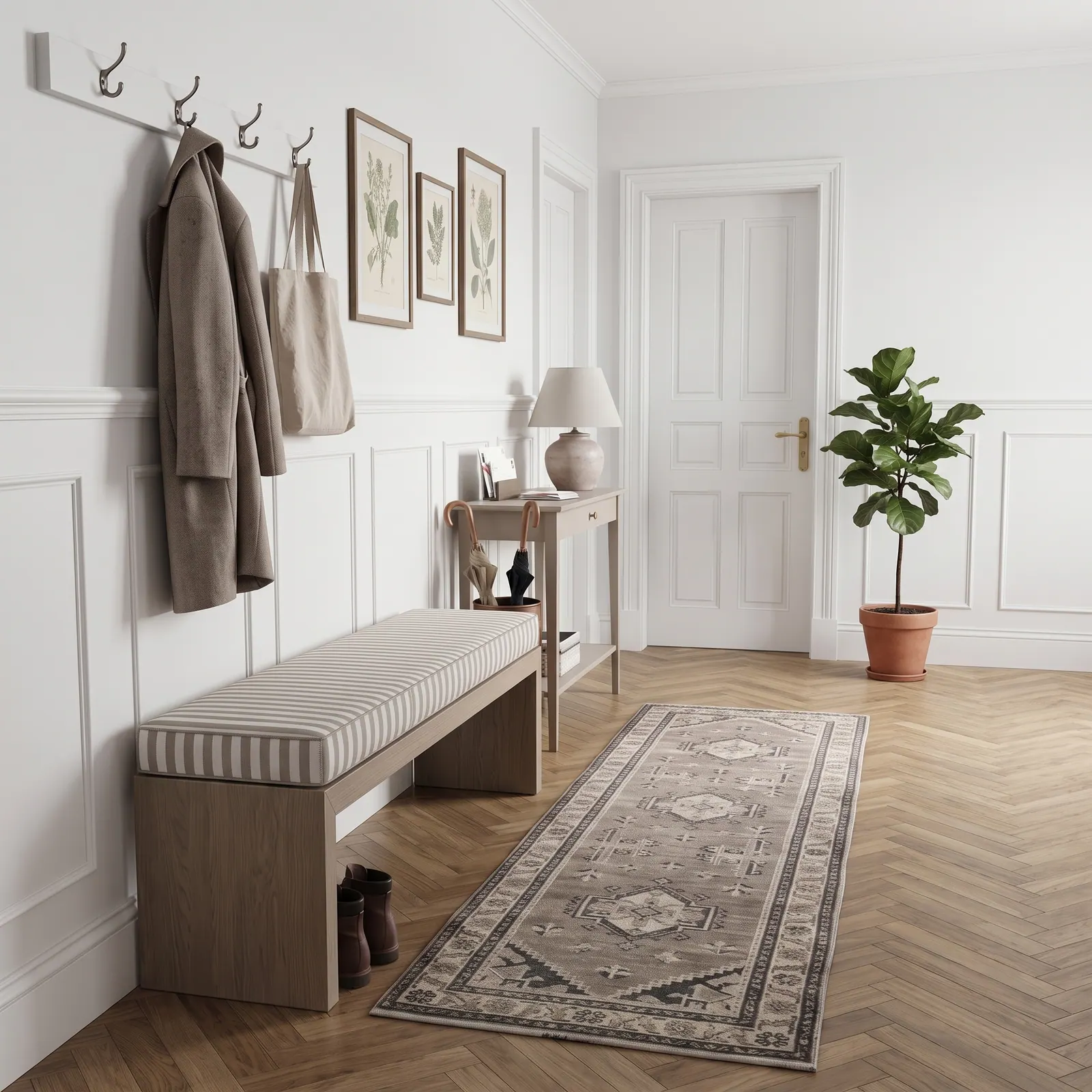
Striped cotton and ticking: the taupe wide stripe on a long oak bench. The roll is about 55 in (140 cm) wide, so stripes on a long cushion run front to back by default, and a very long striped piece needs a seam.
Because the cover unzips, a muddy one comes off for cleaning; how to wash cushion covers covers temperature and drying.
The count is how many published readings use each family. Open a family for its swatch book, care notes and neighbors.
Firm enough to sit down and lace a boot
The standard is 4 in (10 cm) of foam, and on most entry benches it is right: real body to sit on without turning a tall bench into a perch. Firmness runs about 6 to 7 on a 1 to 10 scale, and high-density foam gives the flat, structured look of the navy corduroy seat in the photograph above.
If the bench is already tall, go thinner, 2 or 3 in (5 or 7.5 cm), and check the result in the seat height calculator first. If you add a backrest, like the tall box back on the taupe mudroom seat, remember it is a separate piece and softer than the seat by default. Ask for equal firmness if you plan to lean on it hard.
A real project
Fifty-four inches where fifty-seven were ordered
Measure the bench, not the cushion you used to have. I say it to everyone, and I have been on the wrong end of a tape measure myself.
A buyer wrote in about a cushion that arrived at 54 in when the order said 57 in (137 cm against 145 cm). The workshop asked for one thing: a photo with a tape measure running the full length. It showed the mistake was the workshop's, so the workshop remade the piece at no cost, and the short one did not have to come back.
Only the part that didn't fit was remade, and the piping color could be changed on the replacement. A partial refund was on the table too, for a buyer who would rather keep the short one on a smaller bench.
Measured
57 in ordered, 54 in delivered (145 cm vs 137 cm)
What it taught
A photo with a tape measure along the full length settles a size question.
Mistakes I see at the front door
Assuming ties come with the cushion. They are not standard; ask in the order note, with their position, length and color.
Typing a request for straps into the size box, where it gets missed. Send a message after ordering to confirm every add-on.
Approving the pre-dispatch photo without looking for the small extras: ties, straps, the non-slip base.
Cutting a cushion exactly to a narrow bench and leaving it loose. Order a non-slip base or ties for shallow benches.
Laying one long cushion across a lift-up lid. Split it at each lid break and add ties.
Measuring the old cushion instead of the bench.
Photographs from the workbench
Open any photograph large; each one has its own link and a Save button.
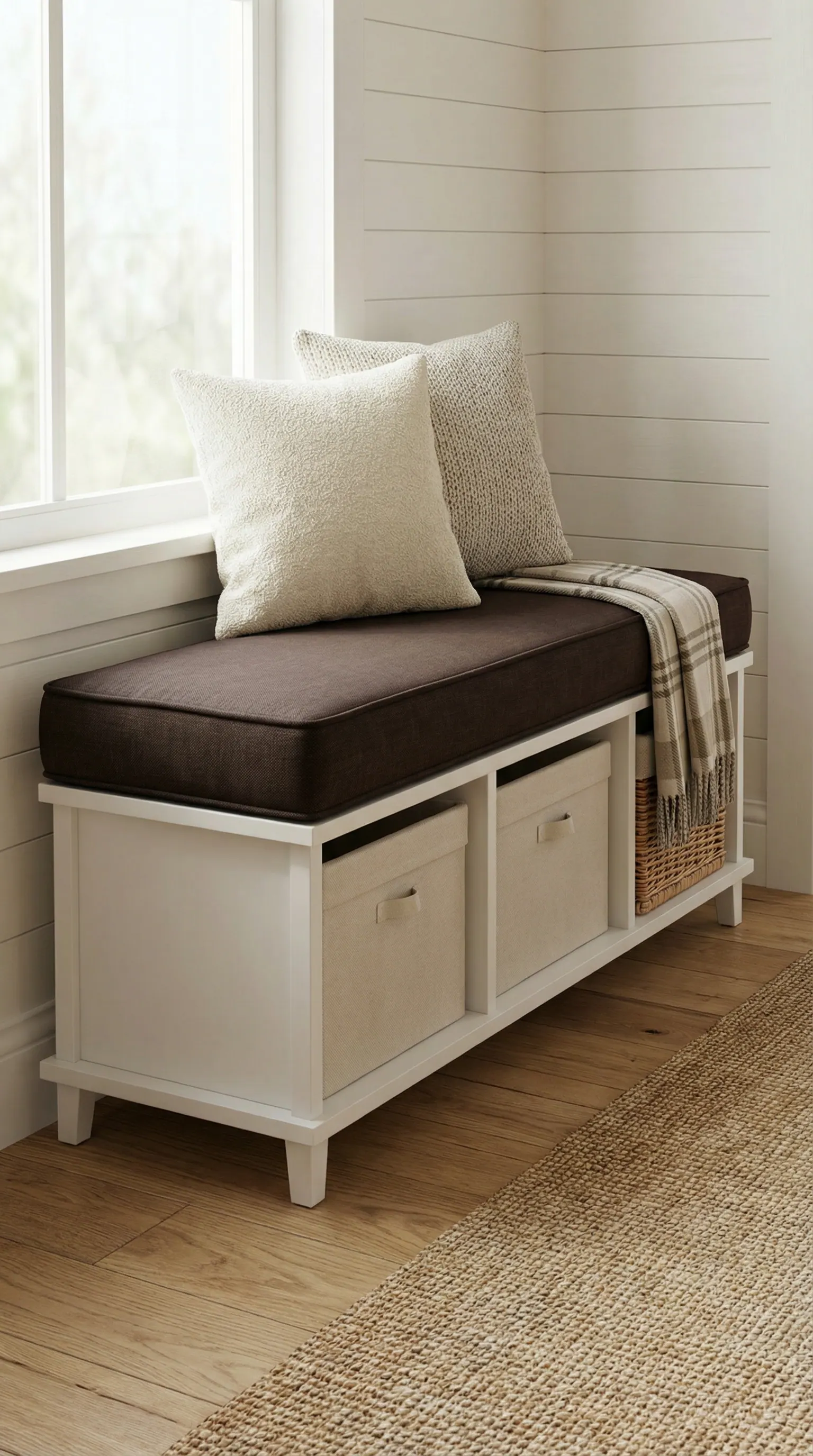
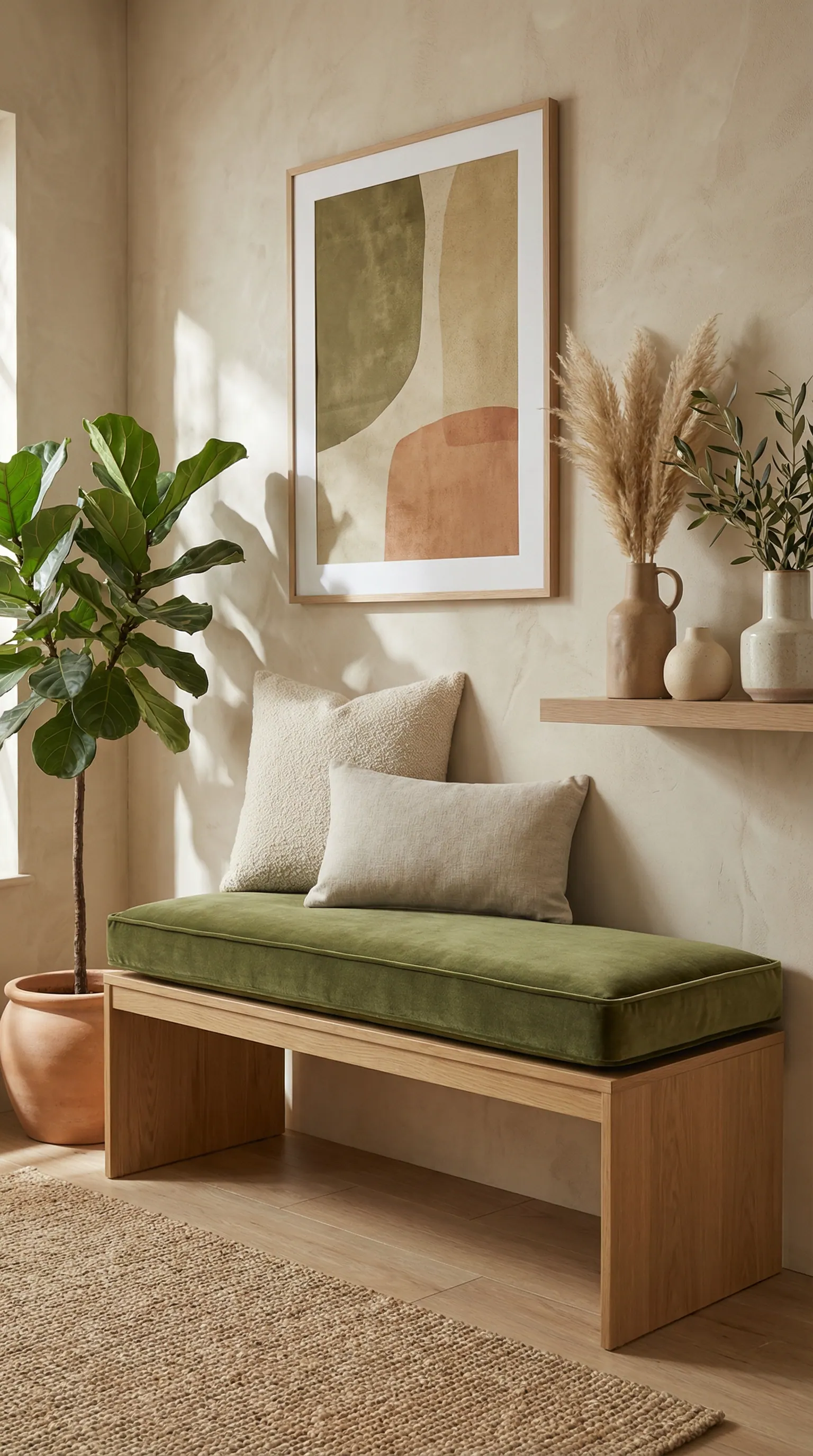
SaveA deep chocolate seat on a white cubby bench, softened by cream bouclé and knit pillows and a beige tartan throw against shiplap.SaveMustard gold velvet with deep navy piping turns the dead space under the stairs into a proper seat for pulling on boots.SaveA near-black green velvet cushion on a floating oak plank, its olive-gold piping matched to the wood and the mirror frame.SaveTeal cord bridges the dark wall and the pale oak, picking its color straight from the abstract canvas above.SaveA plush pink cushion softens a narrow hall bench, and the brass lamp makes the corner glow.SaveA soft taupe cushion turns a slim oak hall bench into a place to sit and pull on boots.SaveAn olive velvet cushion softens a plain oak bench, its color pulled straight from the abstract print above.SaveA built-in entry bench with shoe cubbies below gets a thick taupe seat and a tall leaning backrest, both outlined in ivory piping.SaveA denim blue bullnose cushion softens a white mudroom bench. The rounded front edge is easy on legs when you sit to pull on boots.SaveA radiator cover becomes a hall seat with a full-length gray velvet cushion, its cranberry piping borrowed from the print above.SaveWide taupe stripes run front to back and down the gusset on a long hall bench, finished with self piping.
Ties and a non-slip base are never standard on an entryway bench cushion. Put them in the order note, in writing, or the cushion arrives without them.
Dressing the bench, and what to open before you order
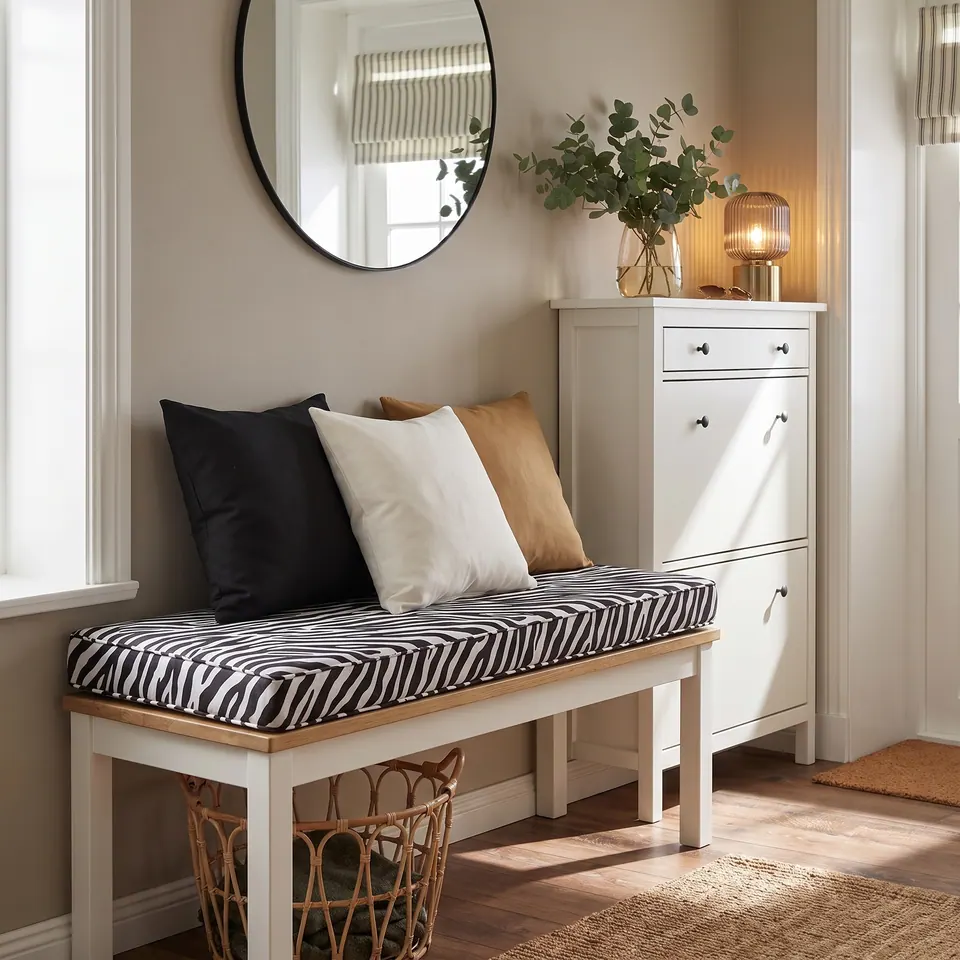
An entry bench is seen three seconds at a time, so give it one strong line: a solid seat with contrast piping, one textured pillow, a wicker basket underneath for gloves. The chocolate brown seat on a white cubby bench carries bouclé pillows and a tartan throw, and that is about the limit before it becomes a place to pile coats.
What lands on your bench first when you come in: bags, boots or the dog?
A hall tree or shoe bench hides its seat between two uprights, with cubbies or a rack below and hooks above, so the cushion is measured on the seat board alone. Take the width wood to wood between the side panels at the front and at the back, because uprights are rarely perfectly square, and the depth from the back panel to the front edge. Note any lip the cushion has to sit inside and any trim that narrows the seat. Slatted tops take ties at the back corners; solid tops hold better with a non-slip base. Hall trees that come in two widths look best when both cushions are ordered together in one fabric, since pieces made in one order match, while a cushion added later can come from a different dye batch. Thickness for a bench people perch on to pull on boots is usually 2 to 3 in.
Buyer questions
A common question
One end of my hall bench is rounded. How do I show you the shape?
The workshop's answer
Rounded ends are made, but a curve isn't read from numbers alone. Either sketch it with the total length and depth, the straight length before the curve starts, and where the curve starts, ends and how deep it runs, or trace the end onto wrapping paper, cut it out and photograph it flat next to a tape measure. The template method works best for tricky curves.
A common question
We close on a new-build house next month. Can the bench cushion wait until we're in?
The workshop's answer
It has been done: add 'please deliver on or after [date]' to the order note or send a message. Past orders were held or timed to arrive close to that date, and one for a new-build address was held until the buyer had moved in. Carrier transit varies, so an exact delivery day can't be promised.
A common question
I realized my bench depth was wrong right after I paid. Can it still be changed?
The workshop's answer
Usually, if you message quickly. Dimensions have been corrected after checkout, as when one piece was updated to 75 x 38 x 8 in. Once a custom piece is finished it generally can't be altered, so send the final sizes, and a drawing if the shape is unusual, as early as possible.
A common question
I ordered the cushion by mistake. Can I cancel?
The workshop's answer
Before production starts, yes: message the workshop right away. Past accidental orders were canceled and refunded, and the refund took a few days to show. You may be asked why first: if size, color or space is the worry, a custom size or color is offered instead, but the order was canceled on request when the buyer still wanted that.
A common question
Do I have to ship back a cushion that came in the wrong size?
The workshop's answer
Not in past cases where the workshop made the error; the buyer kept or discarded the wrong one. Send a photo with a tape measure along the full dimension. Past remakes covered only the non-fitting parts, the piping color could switch on the replacement, a partial refund was the alternative, and remakes shipped by FedEx with tracking.
A common question
My mudroom bench turns a corner. What measurements do you need?
The workshop's answer
The end-to-end length of each leg of the L, the depth and thickness, and a sketch or photo, plus whether any part is angled and whether you want backrests. Outside and inside L dimensions also work; the workshop then plans the split into two pieces and confirms it, and the units, before quoting.
Have it made
Have your entryway bench cushion made — ask Maggie’s workshop
Have the tape measure handy when they call. Old cushions shrink and sag; the seat underneath does not. — Maggie
Leave your details and the workshop will call you to confirm measurements, fabric, foam and piping. No prices, dates or payment on this page: it is a request, not an order.
Fabric · Foam · Pipingwhat the workshop will confirm with you
Usually the standard 4 in (10 cm), which is what most listing photos show and most buyers keep. For a bench that already sits high, go thinner; 2 in (5 cm) is the thinnest standard foam, and anything as thin as 1 in must be made without piping.
Is a non-slip base sticky, and will it mark a wood bench?
No. It replaces the whole bottom panel with a grippy fabric that holds by friction. It is not adhesive or rubber and leaves no residue on wood. There is no border-only version, it costs extra, and a newer washable version adds to the lead time, so ask how much.
Where does the zipper go on a bench cushion cover?
On the back edge facing the wall or on the underside; you choose. On bench covers it often wraps around two corners in an L so the foam slides out easily. Every foam cushion has a zippered, fully removable cover at no extra cost.
Can a hallway bench cushion hang over the front edge?
Yes, by up to about 2 in (5 cm) when an inner support wrap is added, so the overhang holds its shape. Give the bench's own depth and state the overhang you want in the order note rather than adding it into the depth yourself.
Can I add a back cushion to an entry bench?
Yes, as a separate piece at its own size, with 'backrest' written in the note. Backrests are softer than seats by default but can be made equally firm, and double piping gives a back cushion enough structure to stay upright without straps.
Can the ties go anywhere I like?
Yes. Fabric ties can be sewn into the seams at the corners or along the back, in any position, to fix the cushion to the bench or tie a backrest to the seat. Give their position, length and color in the order note.
Can you make a cushion for a hall tree or shoe storage bench?
Yes. Measure the seat board itself, wood to wood between the side panels or the hall tree's uprights, at the front and at the back; ignore the shoe cubbies below. Note any lip or molding the cushion has to sit inside. On an open slatted top, ask for ties at the back corners; on a solid top, a non-slip base keeps the cushion from creeping.
My hall bench has two sections of different widths. Will both cushions match?
Order both sizes together. Each size is its own order line, but pieces in one order are made together, which is the surest route to a match. A cushion added months later can come from a different dye batch and look a shade off, so if a second section might follow, buy it now or order a swatch of your code before you reorder.
Stitch straight — Maggie
Share this atlas entry
Readings
Photographs read by the masters: mudroom & entryway bench cushions
Real cushions made for real rooms, each read for proportion, fabric and fit.

 Save
 Save
 Save
 Save
 Save
 Save
 Save
 Save
 Save
 Save
 Save
 Save