Concept Sketches · 8 scenes
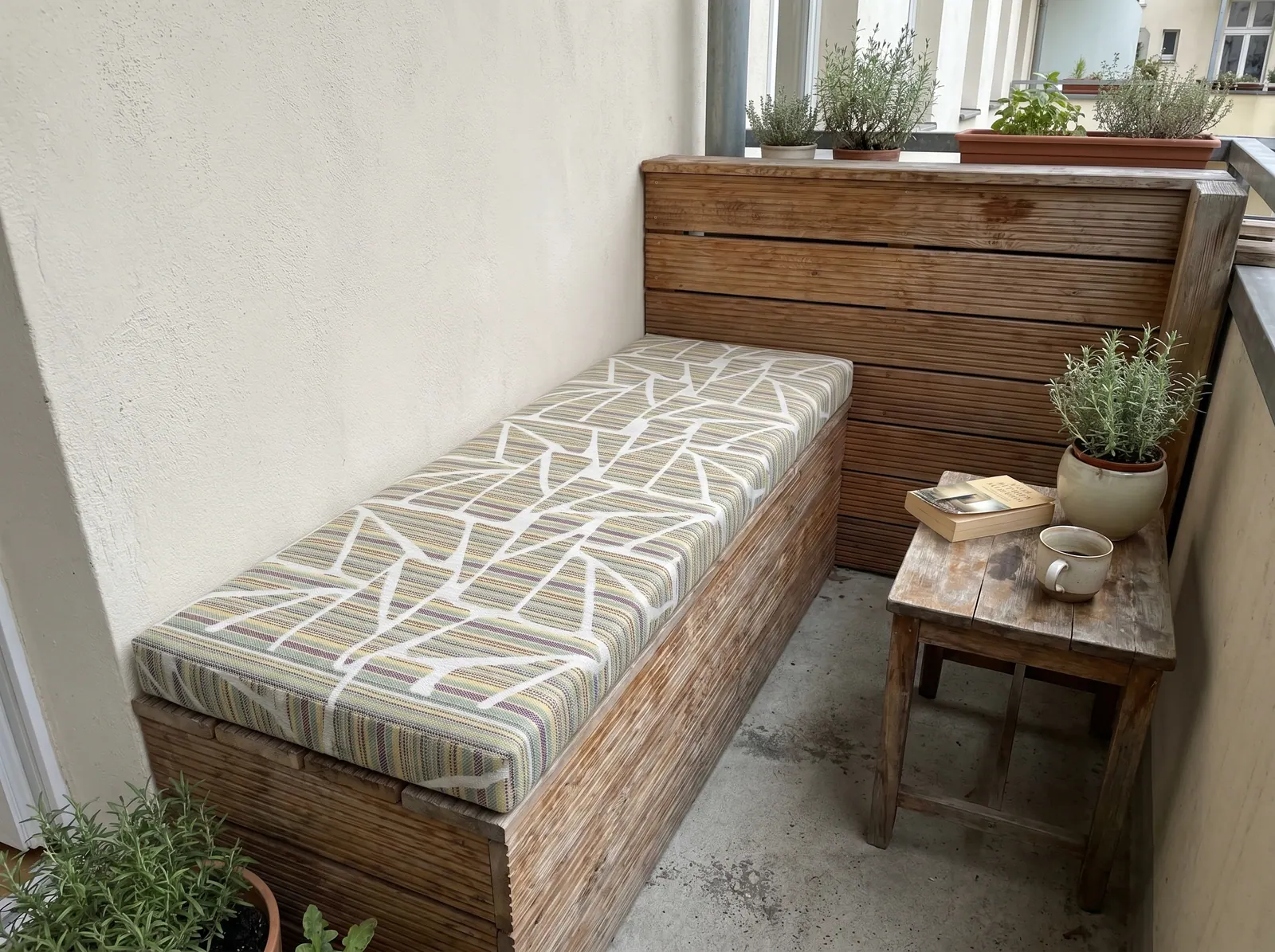
Alcove bench cushions for hallway niches and three-sided spaces
Two walls and a back leave no room for guessing. Eight niches from past orders, with the arithmetic that let each cushion drop in.

 Save
The quick answer
An alcove bench cushion should be ordered a few millimeters under the smallest measurement of the space, so it drops between the walls without forcing. Measure width at the front, middle and back and use the smallest, check that steps add up to the long edge, average tapers under 3/4 in (2 cm), and send true sizes, never shrunken ones.
A quarter inch too big never drops in
A cushion 1/4 in (6 mm) too big never drops into a bench walled on three sides. One an inch too small leaves a gap you look at every morning on the way out the door.
That is the whole problem with an alcove bench cushion: the walls won't move, so the numbers have to be right. Hallway niches, entry benches between two walls, window ledges and stepped built-ins all ask the same of you. Give true sizes, measure more than once, and let the numbers close before anything is cut. Round down millimeters, never inches.
The eight niches below are past orders. Sketch yours in the bench cushion builder, or start from the mudroom and entryway bench cushions hub. For a hall that sees boots and leashes, look at performance and pet-friendly fabrics or linen-look fabrics. What does your niche measure at the back wall, partner?
Eight alcove bench cushions and their measurements
01A past project
The laser said 24.29 in
A buyer wrote in with an entry bench enclosed on three sides, measured with a laser at 24.29 x 76.81 in (61.7 x 195.1 cm). A cushion even slightly large would not fit between the sides. The workshop said to order 24.2 x 76.8 in (61.5 x 195 cm), and explained that handmade cushions vary slightly and every piece is checked before it ships.
The takeaway: Round down a few millimeters, not inches: enough to drop in, not enough to leave a gap.
02A past project
A window ledge, rounded down
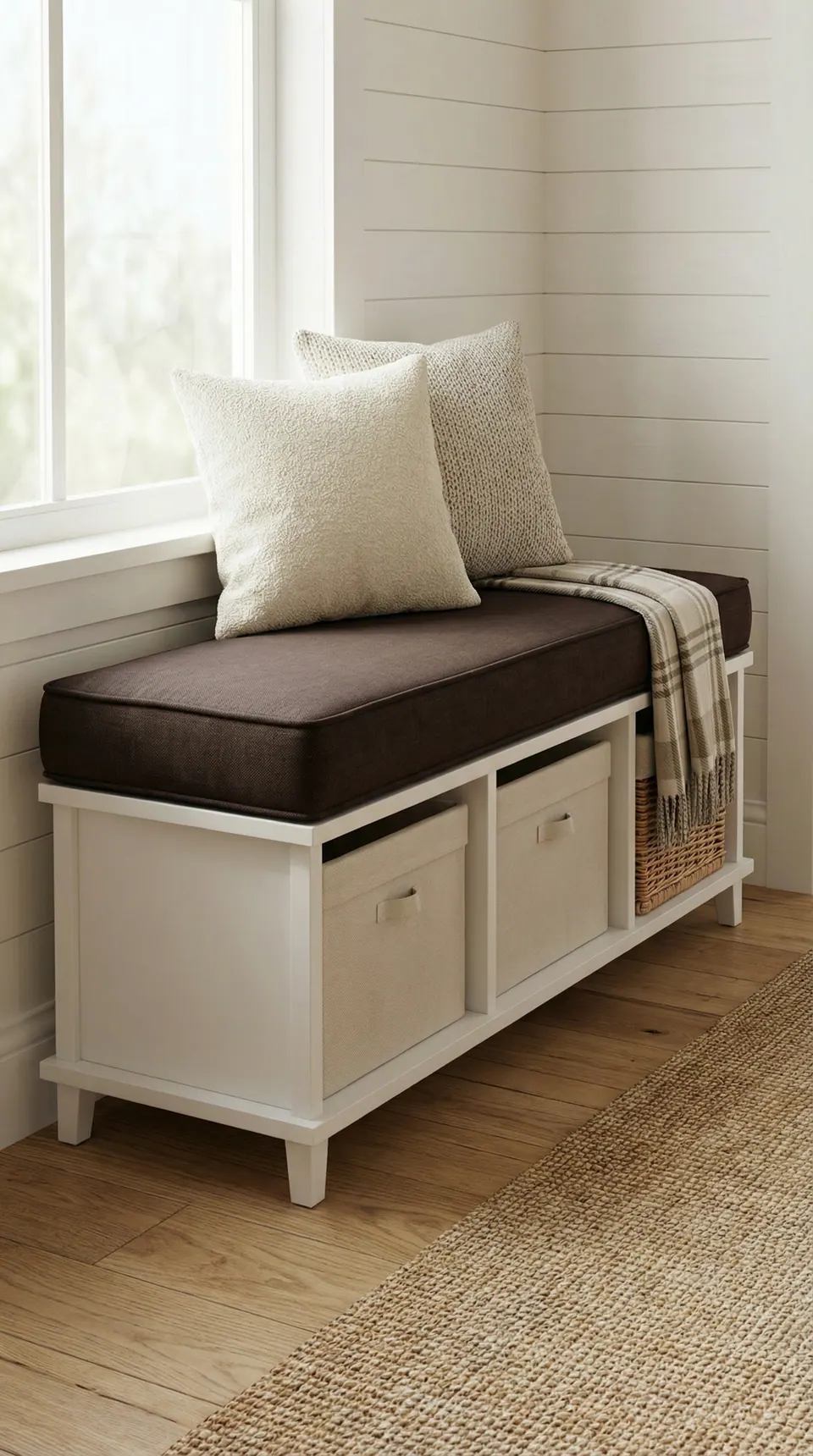
A buyer wrote to the workshop with a window ledge measured at 38 3/4 x 25 3/4 in (98.4 x 65.4 cm) and asked which size to order. The workshop added a 38 x 25 in (96.5 x 63.5 cm) option so the cushion sits inside the ledge. She expected about 5 in (13 cm) of height; the workshop confirmed it would be 4 in (10 cm).
The takeaway: Round a ledge size down so the cushion sits inside it, and confirm thickness as its own number.
03A past project
Don't shrink the nook
A buyer messaged the workshop about a small bench nook, 15 5/8 x 36 in (40 x 91 cm), wanting a tufted cushion with the piping of the workshop's plain version. The workshop asked for the exact space and said not to make it smaller, because sewing allowances are handled in the workshop. The workshop also warned that tufting buttons are stitched through, so a tufted cover can't come off to be washed.
The takeaway: Send the space, not your guess at the cushion, and choose between tufting and a removable cover before you order.
04A past project
A trapezoid between moldings that wouldn't close
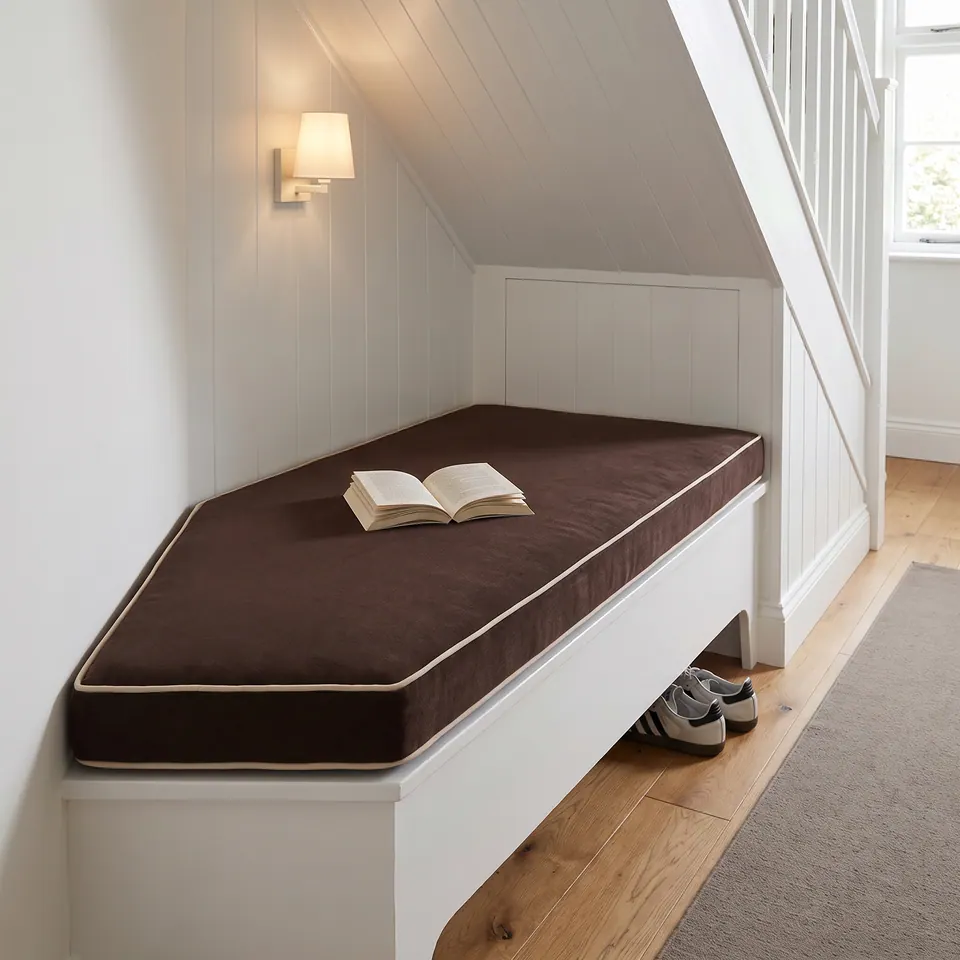
A buyer in the US sent a trapezoid bench as C 68 in (173 cm), D 40 in (102 cm), 17.25 in (44 cm) deep, with one slant of 21 in (53 cm); those numbers imply slants of about 22 1/4 in. She had shrunk some sizes to clear the wall moldings. Re-measured true, it was C 72.5 in (184 cm), D 40 in, 17.5 in (44.5 cm) deep with two 24 in (61 cm) slants, and that closes: half of 32.5 is 16.25, and √(16.25² + 17.5²) ≈ 23.9 in.
The takeaway: Give the maker true sizes and let them allow for the moldings; a shrunken trapezoid stops adding up.
05A past project
The strip beside a child's bed
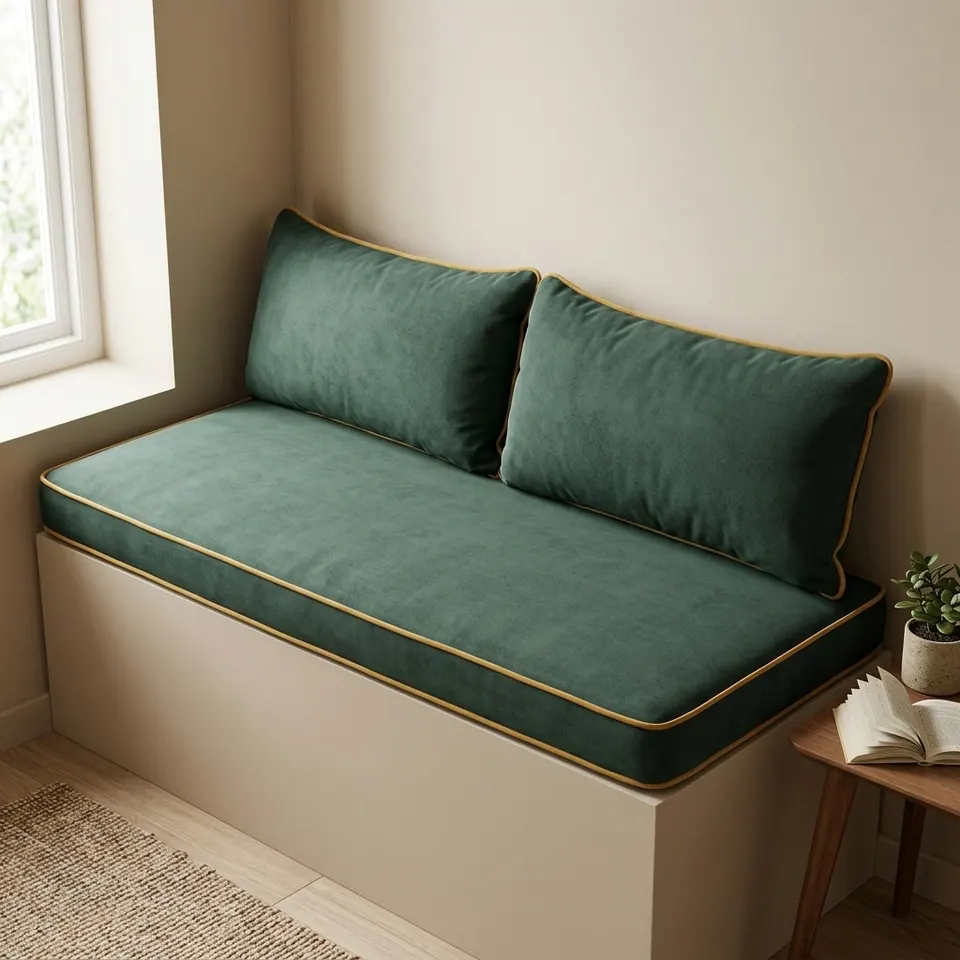
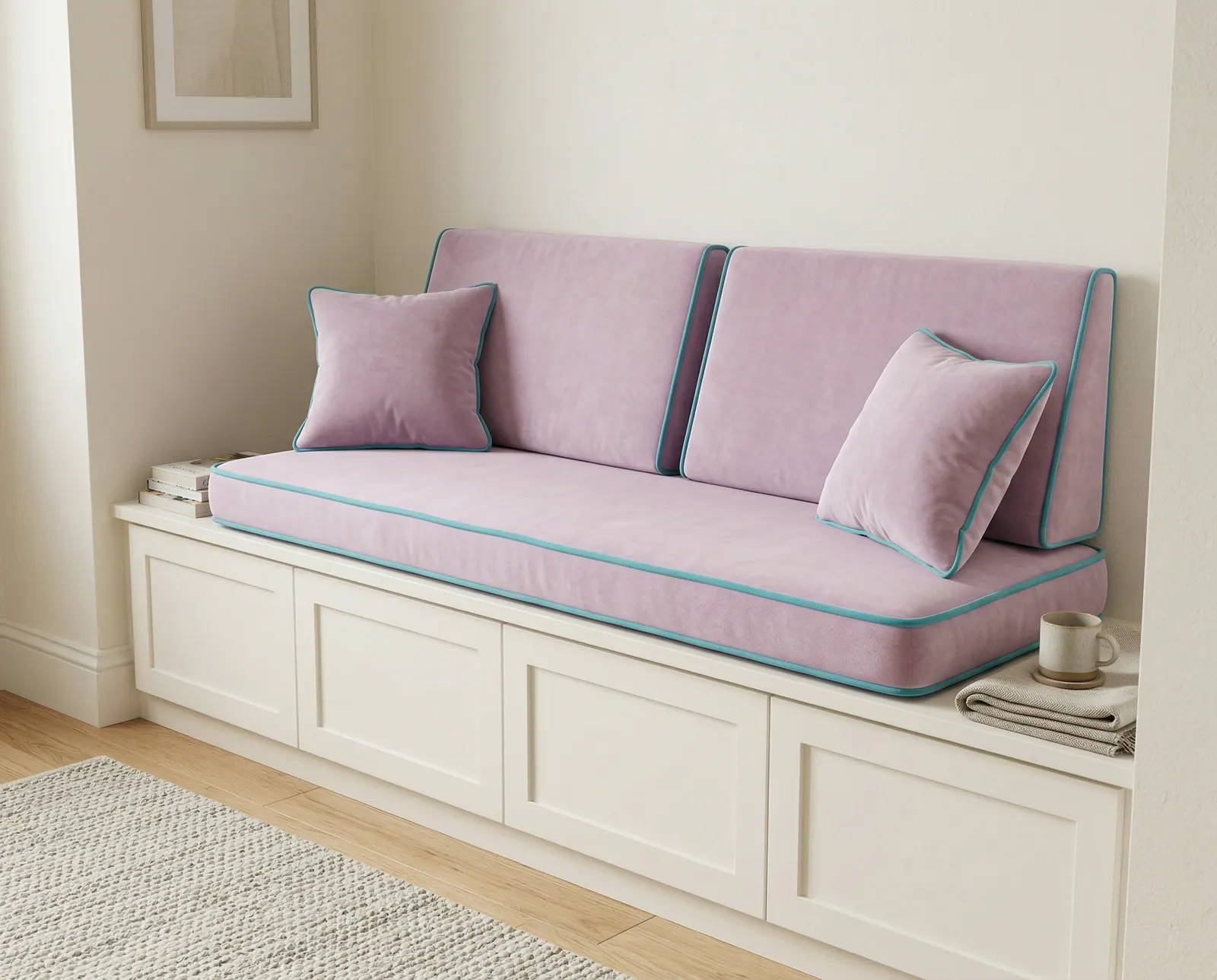
A parent wrote to the workshop because pillows kept falling into the gap between a child's mattress and the wall. The workshop set the piece at about 4 in (10 cm) thick to fill the gap and about 17 in (43 cm) high so it stays below a light switch, with a non-slip base. Two pieces went out in linen with velvet piping in two colors, one a teal green, and both fit.
The takeaway: Thickness equals the gap; height is set by the lowest obstacle on the wall.
06A past project
One end 16.3 in, the other 16.9 in
A buyer wrote to the workshop with a bench 16.3 in (41.5 cm) deep at one end and 16.9 in (43 cm) at the other, 40.9 in (104 cm) long. With those ends, both 40.9 in sides can't be kept at once. The workshop made a plain 40.9 x 16.5 in (104 x 42 cm) rectangle instead of a trapezoid, and the buyer agreed.
The takeaway: Under about 3/4 in (2 cm) of taper, average the two depths and order a rectangle.
07A past project
A stepped bench that came up 2 in short
A buyer got in touch with a stepped bench, narrower at the back. On the drawing, 31 in (79 cm) plus two 2 in (5 cm) steps made 35 in (89 cm), not the stated 37 in (94 cm) bottom edge, though the 11.5 in and 13.25 in (29 and 34 cm) sides matched. The drawing was corrected before ordering, and the cushion went in at 37 in long and 24.75 in (63 cm) deep.
The takeaway: Add your edges before you send: the steps plus the short edge must equal the long edge.
08A past project
Two benches, 2 in thick, every step drawn
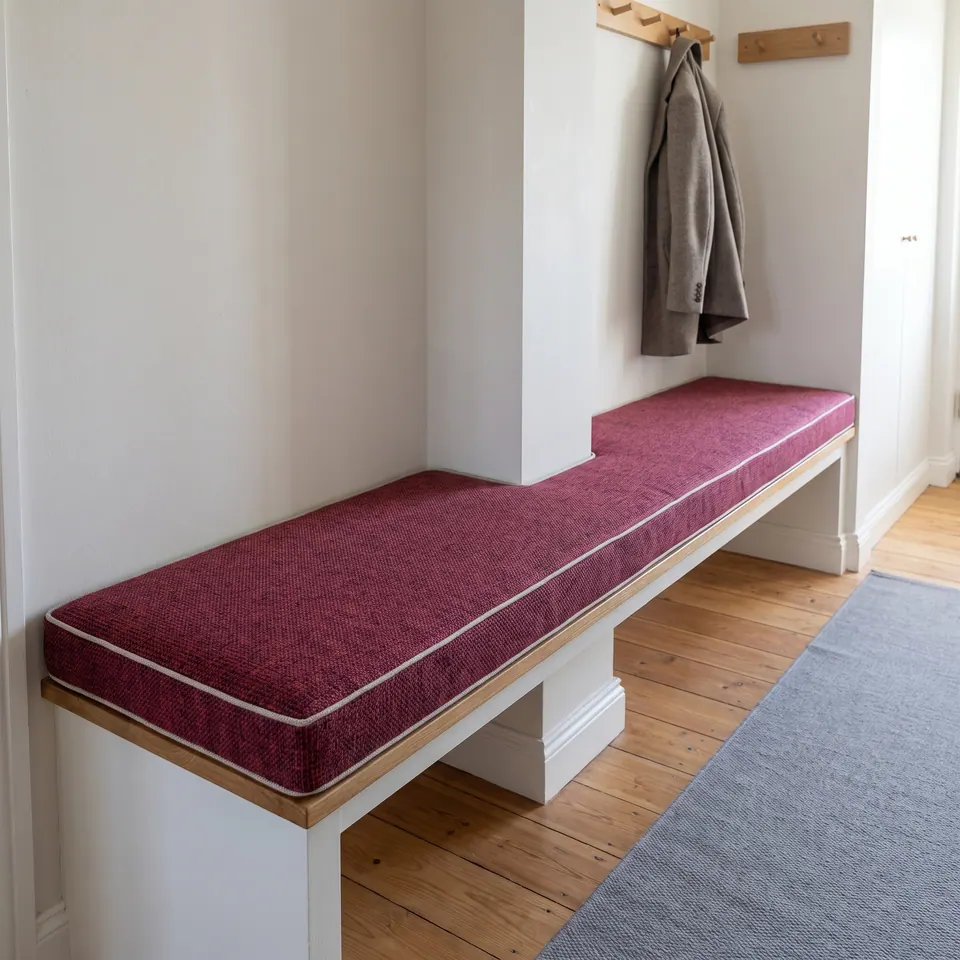
One buyer wrote in needing two 2 in (5 cm) bench cushions: a straight one about 86.6 x 18.5 in (220 x 47 cm) and a stepped one about 75.4 in (191.5 cm) at its longest. The stepped side ran as a 54.1 x 16.3 in (137.5 x 41.5 cm) section, then a 21.3 x 14.4 in (54 x 36.7 cm) section, length by depth. The workshop asked for a drawing with every size, reviewed it and quoted.
The takeaway: Draw each width change as its own segment; 54.1 + 21.3 = 75.4 in is the check that lets the quote go out.
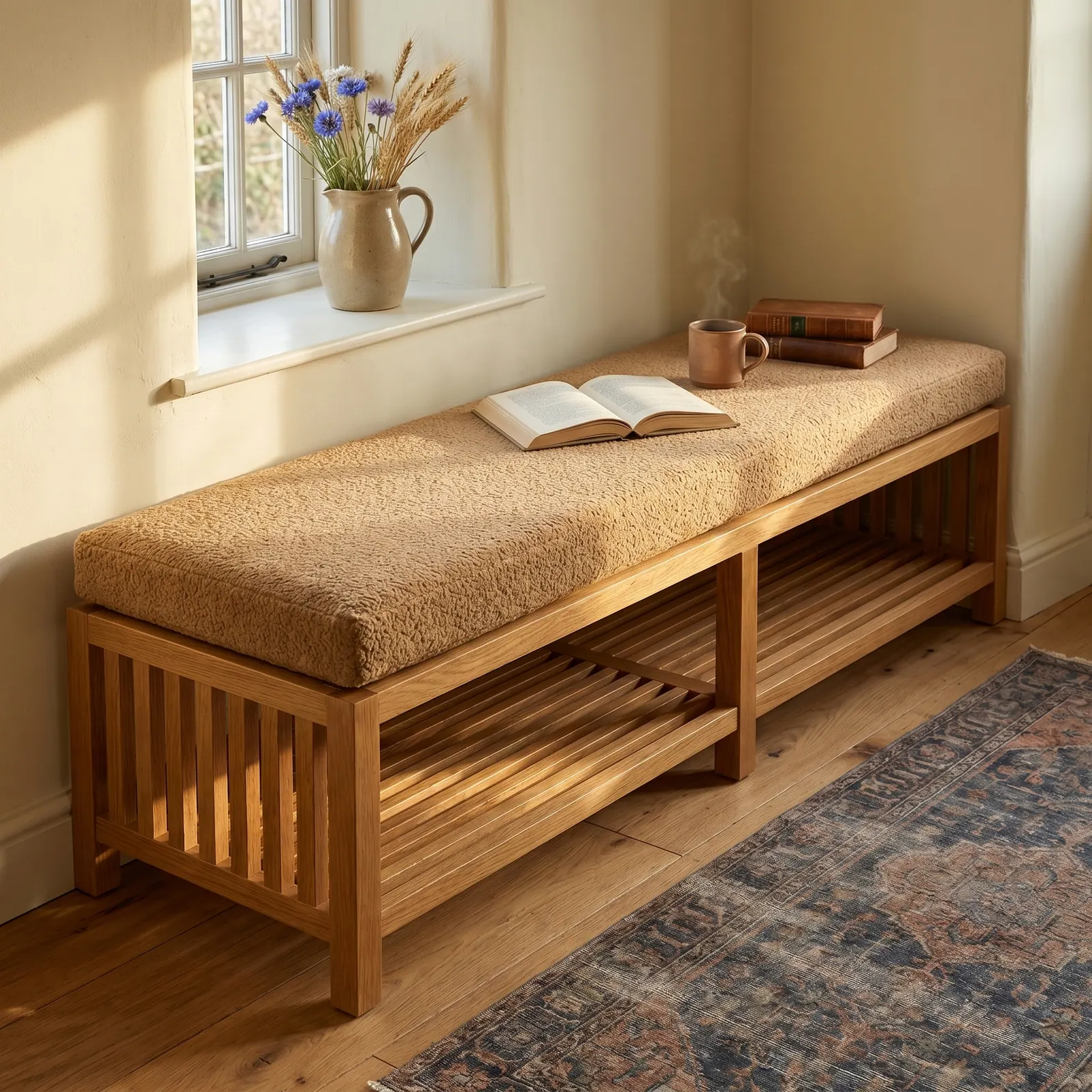
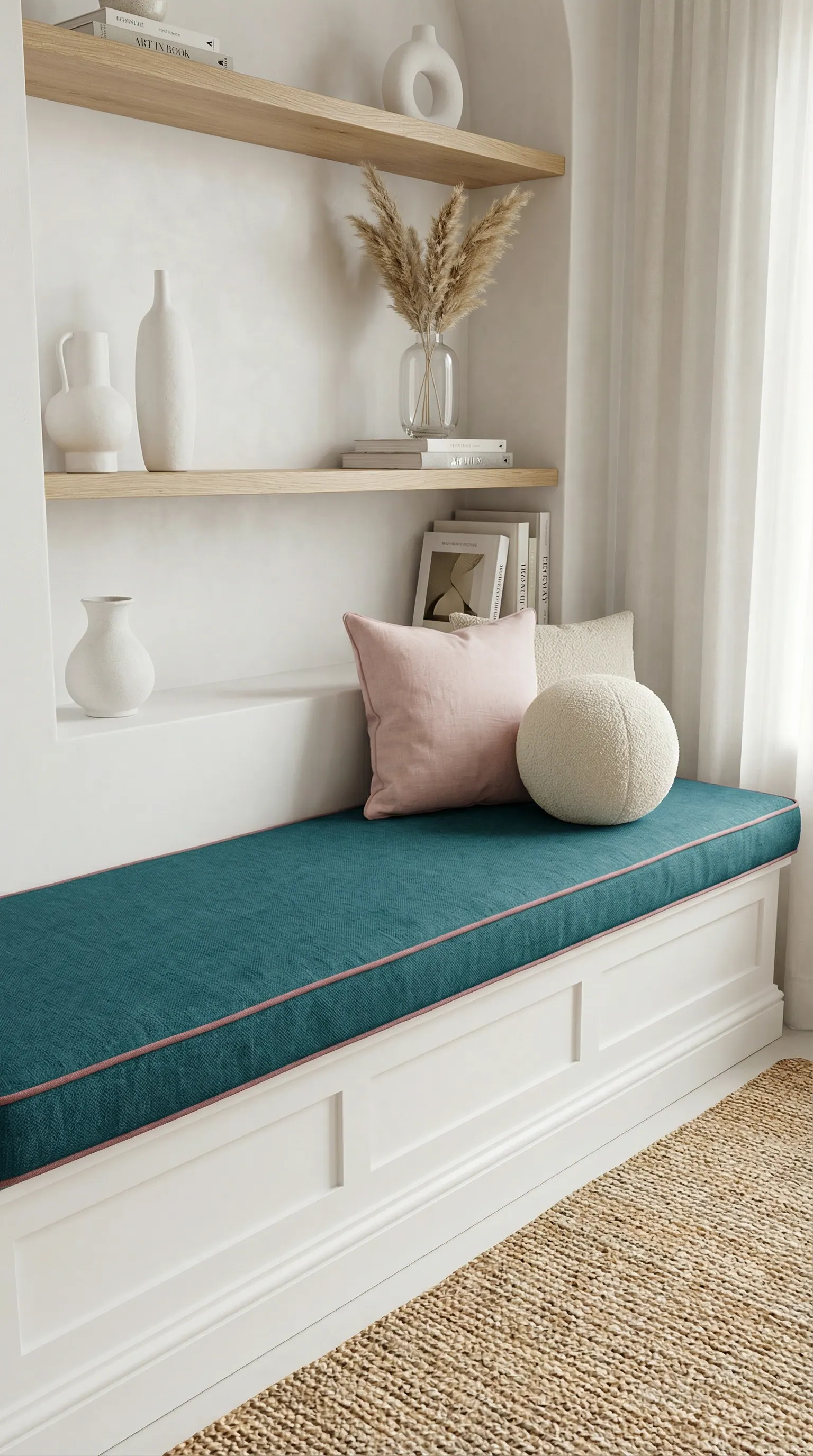
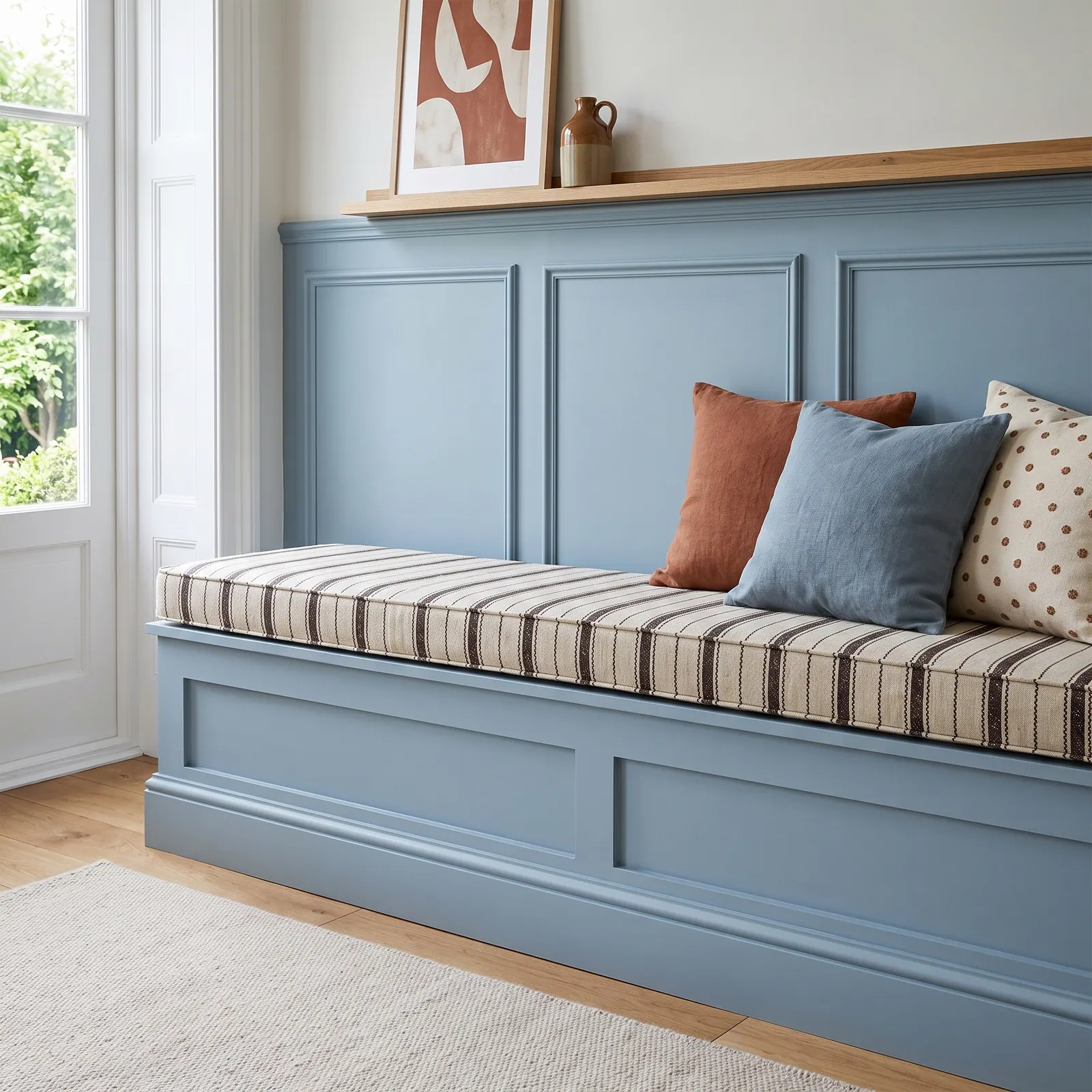
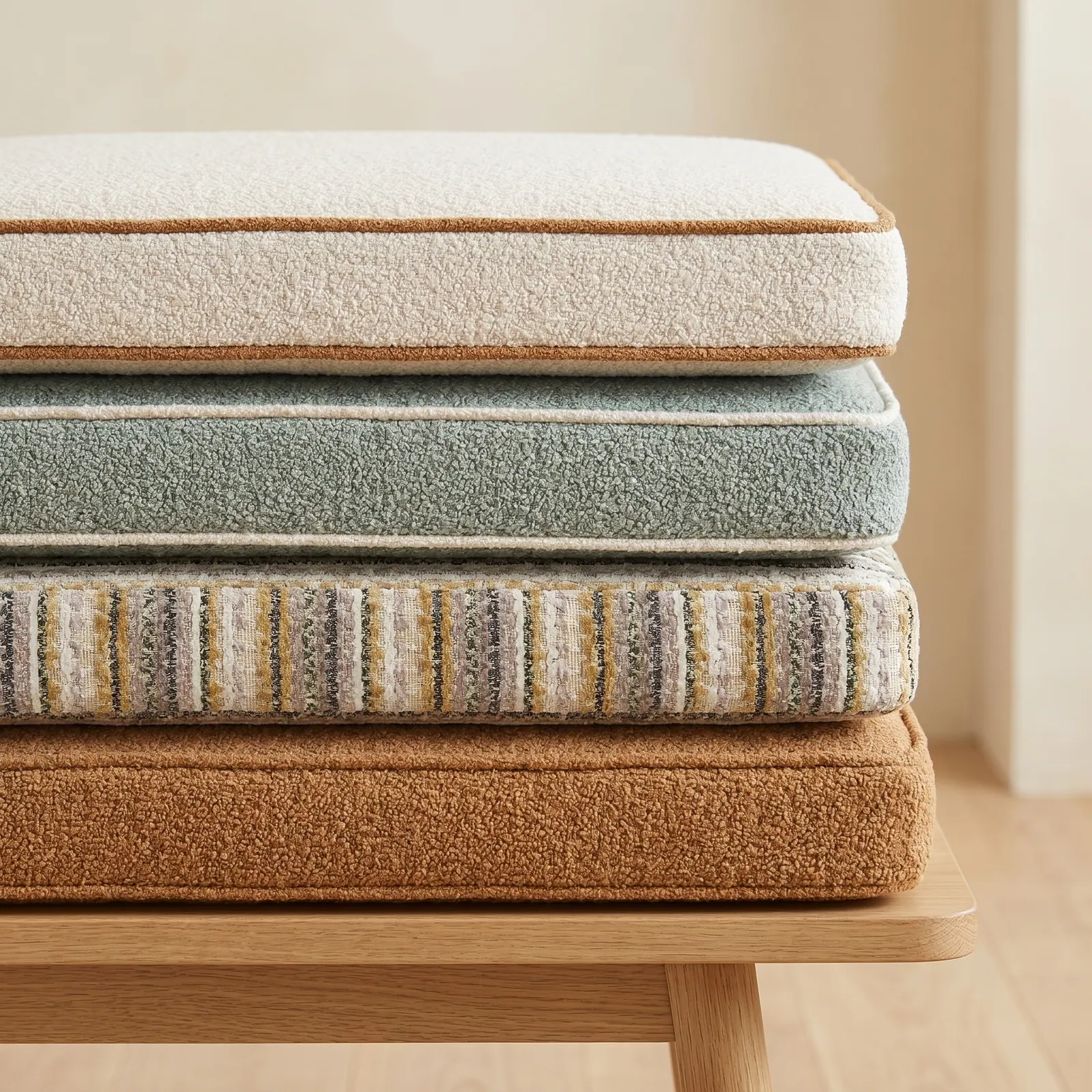

Measuring a three-sided niche in five moves
- Measure the width at the front, the middle and the back wall. Write all three down and use the smallest.
- Measure the length at both ends the same way. Old walls are rarely square, so add both diagonals as a check.
- Measure depth straight at 90 degrees. An angled side is always longer than the depth; if yours isn't, measure again.
- Add it up: the short edge plus every step must equal the long edge.
- Send true sizes, a photo and a drawing with every edge labeled, then approve the maker's scale drawing before anything is cut.
Which rule fits which niche
Angles are just lengths in disguise, so run odd shapes through the trapezoid cushion calculator and read how to draw a custom shape before you order. For a deep niche, check the seat height calculator and how to measure a bench.
| The niche | Order it as | Sizes from past orders |
|---|---|---|
| Bench walled on three sides | The smallest reading, rounded down a few millimeters | 24.29 x 76.81 in space, 24.2 x 76.8 in cushion |
| Window ledge | Rounded down to sit inside; thickness confirmed separately | 38 3/4 x 25 3/4 in ledge, 38 x 25 x 4 in cushion |
| Open-front nook | The true size; the workshop handles sewing allowances | 15 5/8 x 36 in (40 x 91 cm) nook |
| Bench tapering under 3/4 in (2 cm) | One rectangle at the average depth | 16.3 and 16.9 in ends, 16.5 in cushion |
| Trapezoid between moldings | True edges on a custom-shape drawing | Slants 24 in, C 72.5 in, D 40 in, 17.5 in deep |
| Stepped bench | A drawing with every width change | 54.1 + 21.3 = 75.4 in |
An alcove bench cushion is cut to the smallest of three width readings, rounded down a few millimeters, so it drops in without a fight.
Nate
Niche and alcove questions
- A common question
My bench needs 18.5 x 51.25 inches and that size isn't in the dropdown. How do I order it?
The workshop's answerPick the dropdown range that covers your widest and deepest measurement; it only sets the price. Then type the exact size, thickness and fabric code in the personalization note, which is what the cushion is actually cut from. Half and quarter inches such as 18.5 x 51.25 in (47 x 130 cm) are fine, and so are centimeters. For a trapezoid or unusual seat, upload a drawing with the measurements marked.
- A common question
My bench isn't a rectangle. How do I order a cushion for a stepped or angled shape?
The workshop's answerUse the custom-shape listing, not the rectangle one. Choose the size range by the longest length and the deepest depth; that only sets the price bracket. Upload a drawing with a measurement on every edge plus a photo of the seat, and put thickness and fabric code in the personalization note. The cushion is cut to the drawing, not the totals, and a paper sketch is fine.
- A common question
What's the best way to send measurements for an odd-shaped bench area?
The workshop's answerSend a photo of the space and a hand sketch with every side measured and labeled A, B, C and so on. Mention any trim or wood that sticks out, and give the narrowest and widest points if the space is uneven. The workshop asks about any missing side, checks which is length and which is width, and waits for your OK on its own drawing before production.
- A common question
My bench has legs and a post in the way. Can the cushion be notched around them?
The workshop's answerYes. Mark each notch's width, depth and position along the edge, and add a few wide-angle photos. The workshop redraws it as a template for you to confirm before cutting. If the notches sit on the back edge, say so, because the zipper runs along the back. Ties are an optional extra; give each one's position and length.

Have it made
Have an idea like this made — ask Nate’s workshop
Precision starts on the phone. Give the workshop your measurements and they will read them back to you, edge by edge. — Nate
Leave your details and the workshop will call you to confirm measurements, fabric, foam and piping. No prices, dates or payment on this page: it is a request, not an order.
Questions buyers ask next
How much smaller than the alcove should I order the cushion?
Only a few millimeters, and only when the bench is walled in on three sides: a 24.29 x 76.81 in (61.7 x 195.1 cm) space was ordered at 24.2 x 76.8 in (61.5 x 195 cm). Otherwise send the true size; the workshop handles sewing allowances. See custom size tolerance.
Will an exact-fit niche cushion slide around?
It can, because a cushion cut exactly to a narrow seat has little to grip. Order a non-slip base or ties at the corners, and on a lift-up storage lid split the cushion at each lid break and add ties. The non-slip and ties guide has the details.
Can I check the finished size before the cushion ships?
Yes. Every cushion is measured after sewing, and every order is photographed before it ships. You can ask for those photos, including ones showing the measurements of a custom shape, which is worth doing for any alcove where 1/4 in matters.
Can an alcove bench cushion be tufted and still have a removable cover?
No. Tufting buttons are stitched through the foam, so a tufted cover can't come off or go in the wash. A plain cushion has a zippered, fully removable cover, with the zipper hidden on the back edge against the wall or on the underside.