 Save
A Reading by NateBench Cushions
Chocolate brown on white shiplap: the color story of an entryway bench cushion
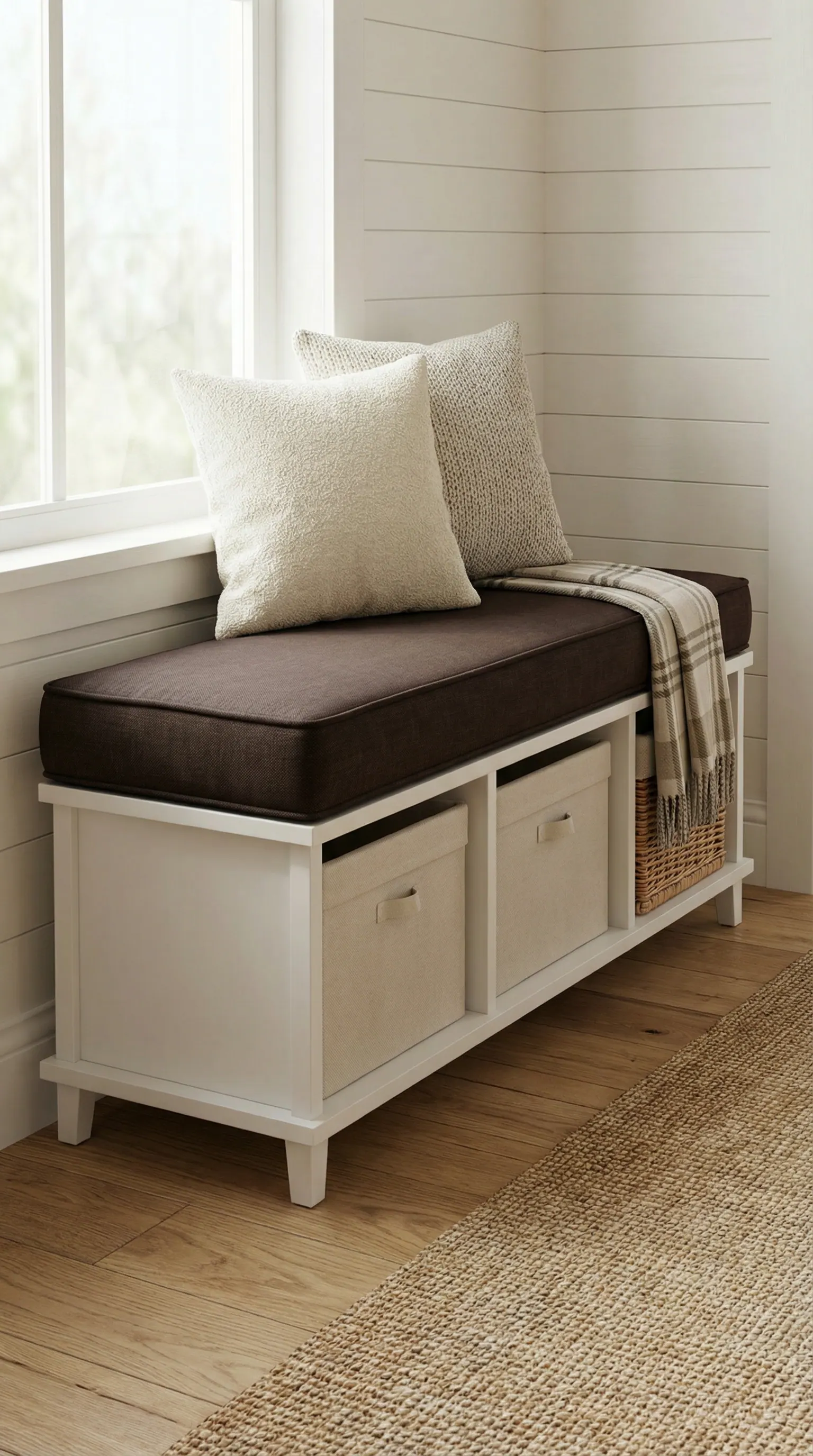
Dark seat, pale wall, three creams and a basket. Nate breaks the palette of one farmhouse entry into values you can measure and copy.

Swatch strip measured from the photograph
- camel#96836b29%
- sand#ad9e8924%
- dark walnut#55422e21%
- chalk#f0f2ec13%
- oatmeal#c9c5b912%
The quick answer
A chocolate brown entryway bench cushion suits a white cubby bench because the darkest color in the room goes where the traffic is: it frames the bench and hides scuffs from shoes, bags and damp coats. Keep the edge in self piping, then add cream and oatmeal textures so the dark seat reads soft rather than heavy.
Swatch strip: seven colors from one entryway
- Chocolate seat#4B2F24Darkest value in the room; it takes the traffic.
- Cream bouclé#EEE7DAThe strongest texture contrast against the brown.
- Oatmeal knit#D9CCB6One step darker than the bouclé; bridges cream and brown.
- Beige tartan#C9B596Carries the brown into a lighter pattern.
- White shiplap#F4F2EDThe field every other color is measured against.
- Wicker basket#A9824FWarm mid-tone linking the throw to the seat.
- Jute rug#BFA27ARepeats the basket at floor level.
Value first, hue second: why the darkest color takes the seat
Run this photo through a grayscale filter and the design is obvious. The white shiplap and the cubby frame sit at the light end, the chocolate seat at the dark end, and the creams, tartan and wicker fill the steps between. That spread is why the bench reads from the front door.
The rule behind it is simple: the surface with the most traffic gets the darkest value. Shoes, grocery bags, wet coats, a dog's front paws. A chocolate cushion absorbs all of it between washes, and a linen-look fabric with a visible slub breaks up marks even further.
Self piping keeps the box edge tidy. A pale cord would outline every scuff; a matching one draws the silhouette and nothing else.
Then texture, because a dark rectangle alone looks like a lid. The cream bouclé pillow gives the strongest contrast in the scene. The oatmeal chunky knit sits one step darker, so the eye walks from cream to brown instead of jumping. The beige tartan throw with its fringe carries the brown into a lighter pattern and hangs toward the wicker basket, which ties the whole bench to the jute rug. The canvas cubby bins repeat the white of the wall. The window supplies soft daylight, the only light worth judging a brown by; screen color versus daylight explains why.
What is the darkest color already in your entry? Put it on the seat. More brown rooms are collected under brown and mushroom cushions, and every bench shape lives under bench cushions.
Pinned by Nate: five marks on a farmhouse cubby bench
Five pins, from the chocolate seat top to the canvas cubby bins that ask for a grippy underside.
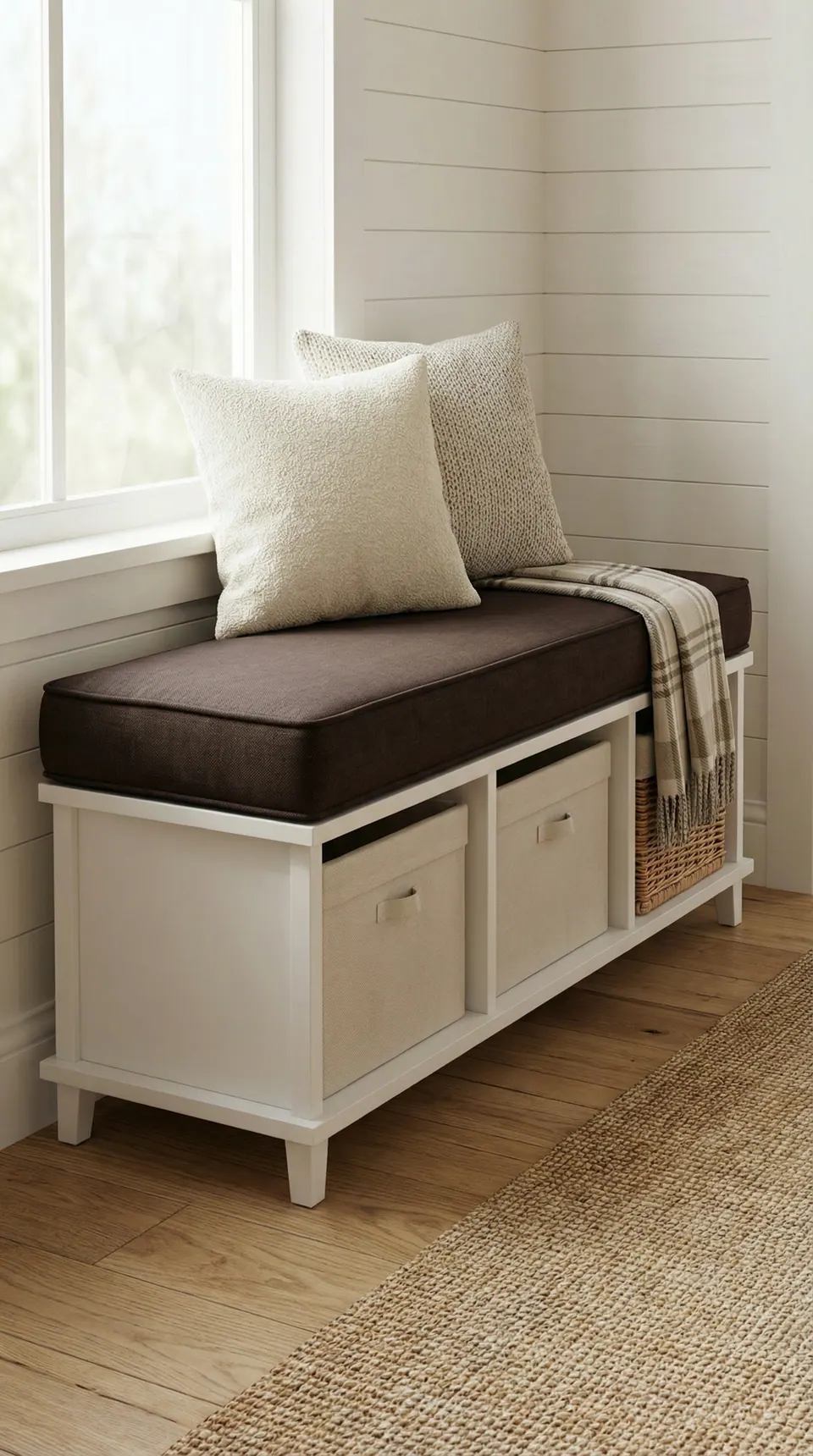
- Chocolate seat top
A dark brown seat hides scuffs from shoes and bags in a busy entry.
- Self-piped box edge
Self piping gives a tidy edge that won't show dirt the way a pale cord would.
- Cream bouclé pillow
Pale bouclé against dark brown is the scene's strongest texture contrast.
- Tartan throw
A beige check throw carries the brown into a softer, lighter pattern.
- Canvas cubby bins
Over open cubbies a non-slip base helps the cushion stay put on painted wood.
- Chocolate seat topA dark brown seat hides scuffs from shoes and bags in a busy entry.
- Self-piped box edgeSelf piping gives a tidy edge that won't show dirt the way a pale cord would.
- Cream bouclé pillowPale bouclé against dark brown is the scene's strongest texture contrast.
- Tartan throwA beige check throw carries the brown into a softer, lighter pattern.
- Canvas cubby binsOver open cubbies a non-slip base helps the cushion stay put on painted wood.
One inch was too thin; two inches sat right
A buyer messaged the workshop wanting a 1 in (2.5 cm) cushion for a trapezoid window seat, thin enough to slide under a windowsill lip. The workshop drew a sketch and warned that 1 in is too thin to sit on. After re-measuring, the buyer chose 2 in (5 cm): 83 7/8 in (213 cm) along the front, 51 in (129.5 cm) at the back, 16 3/4 in (42.5 cm) deep, with sides of 23 3/8 in (59.5 cm) and 22 7/8 in (58 cm).
For a pink and green room, the workshop suggested two linen colors to test against the walls. Same method as this entry, partner: start from what the room already holds, then choose the cushion.
And 2 in is the practical floor for a seat; below that you are sitting on plywood with a cover on it. Measure twice; the fabric remembers. Window seat cushion thickness has the full table, and odd shapes start in the trapezoid cushions section of the Atlas.
Buyer questions: a half inch, a price and two teddy sofas
- A common question
My new cushion measures about half an inch wider than I ordered. Is that normal?
The workshop's answerInch orders are converted to the nearest centimeter, so 29 1/2 x 111 1/4 in became 29½ x 111½ in (75 x 283 cm). Handmade cushions carry a tolerance of a little under ±0.5 in (about ±1 cm), most noticeable on long pieces where foam and fabric behave slightly differently. Edges also relax a touch with use.
- A common question
The quote came in higher than I expected. Is there any room on the price?
The workshop's answerListing prices are already discounted, but custom quotes often come down for a first order, a bulk order, or when you share your budget. It is always worth asking.
- A common question
Could two teddy sofas be turned into one L-shaped sectional?
The workshop's answerYes. Order two teddy sofas and the workshop swaps two of the corner backrests for straight ones, turning the pair into a corner sofa. It has built that layout before.
On the cutting table: the cubby-bench cushion
| Product | Entryway cubby-bench cushion |
|---|---|
| Fabric | Chocolate brown linen-look weave |
| Piping | Self piping |
| Edge | Box edge |
| Thickness | 2 in (5 cm) minimum for sitting; 4 in (10 cm) standard |
| Underside | Non-slip base advised over open cubbies on painted wood |
| Tolerance | A little under ±0.5 in (about ±1 cm) |
| Pair with | Cream bouclé, oatmeal knit, beige tartan |
| Best for | White shiplap entries and farmhouse mudrooms |

Have it made
Have this made — ask Nate’s workshop
Precision starts on the phone. Give the workshop your measurements and they will read them back to you, edge by edge. — Nate
Leave your details and the workshop will call you to confirm measurements, fabric, foam and piping. No prices, dates or payment on this page: it is a request, not an order.
An entryway bench cushion should wear the darkest color in the room: chocolate brown on a white cubby bench hides shoe scuffs and still frames the bench.
Nate
Questions buyers ask next
Which cushion colors hide dirt best by the front door?
Mid-to-dark values: chocolate, charcoal, deep olive or a busy print. Linen-look weaves with a visible slub hide more than flat solids do. Keep the piping in the same color so the edge doesn't outline every scuff.
Will a dark bench cushion make a small entry feel smaller?
Not if the walls and the bench frame stay light. A dark seat on white shiplap reads as a frame, not a mass. Add one or two pale textured pillows so the brown has contrast and the bench looks inviting.
What is the thinnest cushion that is still comfortable to sit on?
About 2 in (5 cm) is the practical minimum for sitting. Thinner pads slip under tight spots such as a sill lip but bottom out as soon as someone sits. For daily seating, the standard 4 in (10 cm) is more comfortable.
± 1/4 in — Nate