A Reading by NateBench Cushions
Notebook: a custom bench cushion with two depths and a chimney in the way
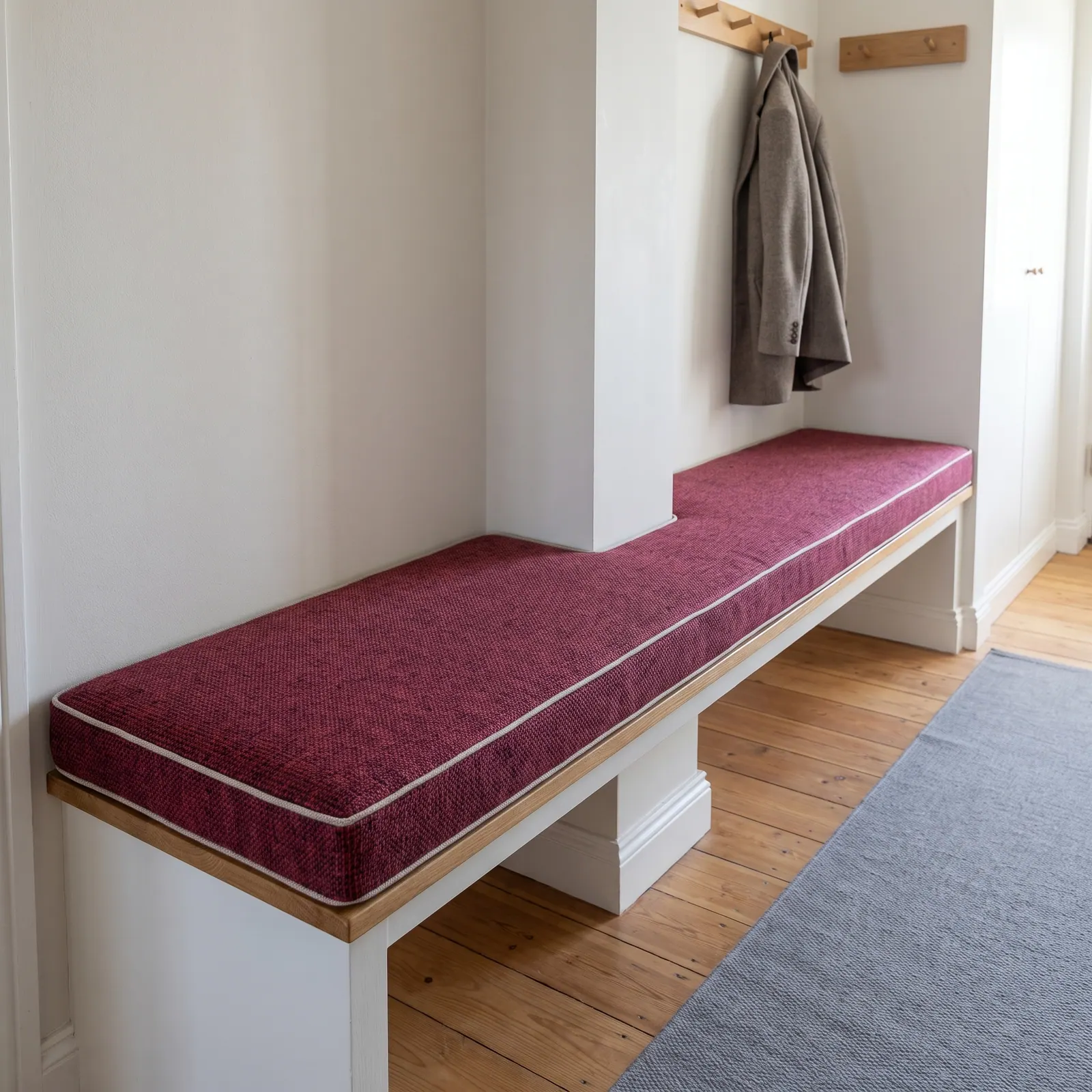
Most of the sitting on this hallway bench happens at one end. The cushion knows it: it gets deeper right where the coats hang.

 Save
The quick answer
A stepped bench cushion is one continuous cushion cut to two depths, shallow in front of an obstacle like a chimney breast and deeper in the recess beyond. To order one, send the full length, both depths and the exact distance of the step from one end. Put the deeper section where people actually sit, lace shoes or linger.
Field notes: two depths, one step, one cushion
The cushion on this hallway bench changes depth partway along, and that single step is the whole design. In front of the chimney breast it is shallow. Past the breast, where the wall steps back into the recess, it gets deeper. One continuous custom bench cushion, two depths.
Look at where the coat hangs. The oak pegs sit above the deep end, and that is no accident. The deep end is where people actually sit: to pull off boots, to wait for a ride, to finish a phone call with one arm in a sleeve. The shallow run in front of the chimney is a perch, a shelf for a bag or a pair of gloves.
That is the comfort rule for any long bench, partner. Give the depth to the spot where people linger, and let the rest be a shelf. Lingering needs room for the thighs; a bag doesn't. What does your bench measure at its deepest point?
Now the finish. The cherry burgundy is a linen-look basket weave, one strong note in a pale hall. The oatmeal piping matches the plaster, so the step reads as a planned corner, not a patch. The white plinth legs are set back from the front edge, which leaves toe room for shoes under the bench. The gray flatweave runner cools the red against the pine boards.
More long shapes live in bench cushions and the mudroom and entryway set; the weave comes from the linen-look family.
Pinned by Nate: five marks on the hall bench
Five pins, from the step at the chimney breast to the set-back plinth legs and the gray runner.
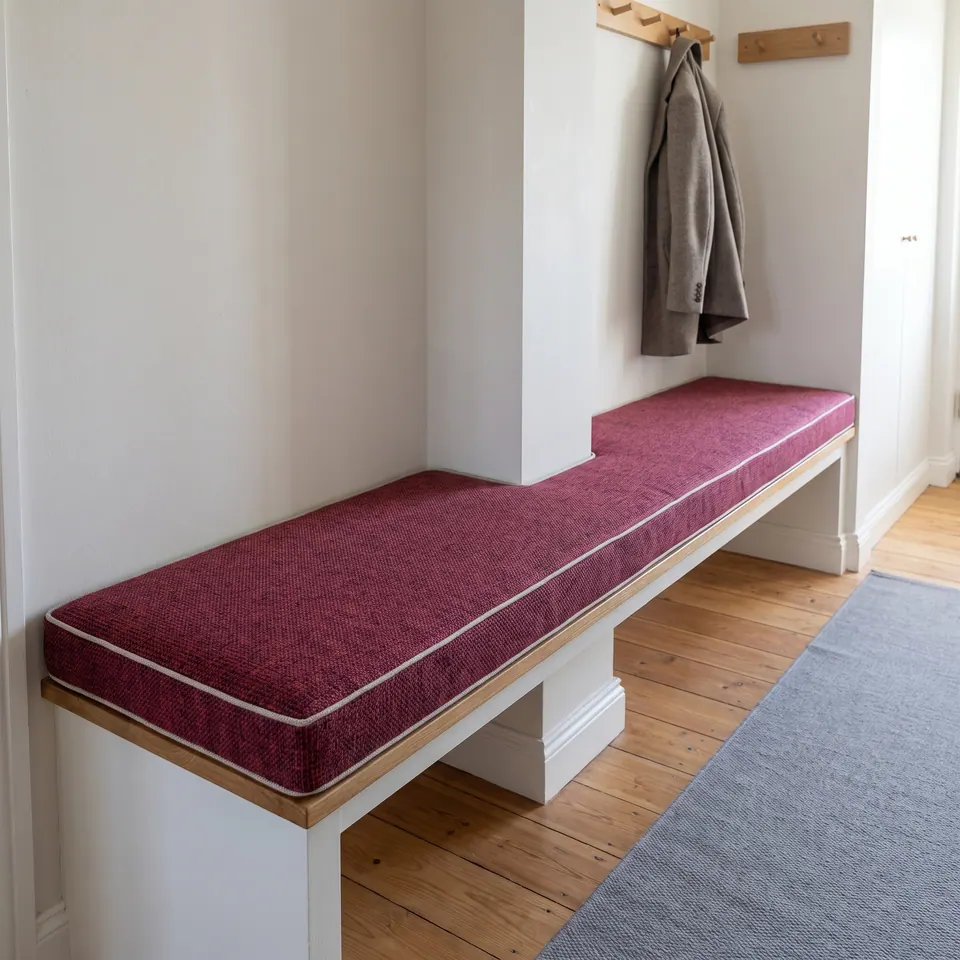
- Step at chimney breast
The cushion gets deeper past the chimney breast, following the recess behind it.
- Oatmeal piping
A pale welt outlines the step and matches the plaster walls.
- Coat on peg rail
Pegs above the deep end mark where people actually sit to change shoes.
- White plinth legs
Legs set back from the front leave room for feet and shoes underneath.
- Gray runner
A cool runner balances the warm red and the pine boards.
- Step at chimney breastThe cushion gets deeper past the chimney breast, following the recess behind it.
- Oatmeal pipingA pale welt outlines the step and matches the plaster walls.
- Coat on peg railPegs above the deep end mark where people actually sit to change shoes.
- White plinth legsLegs set back from the front leave room for feet and shoes underneath.
- Gray runnerA cool runner balances the warm red and the pine boards.
Measuring a stepped bench in four readings
Full length, end to end
Run the tape along the back of the bench top from one end to the other. Write it to the nearest 1/8 in.
Shallow depth
Measure from the face of the chimney breast to the front edge of the bench top.
Deep depth
Measure from the back wall of the recess to the front edge. Check whether the front edge runs straight or steps too; if both step, measure both.
Step position, from a named end
Measure from the left end to the step and write 'from left end' beside it. A step placed from the wrong end gives you a mirror image of the bench.
29 1/2 in on the bench, 29 1/8 in on the order
A buyer wrote to the workshop with two small benches, 29 1/2 x 13 3/4 in (75 x 35 cm) and 19 3/4 x 13 3/4 in (50 x 35 cm), and one worry: the standard 2 in (5 cm) cushion looked too thick for them.
Thin is possible, with a catch. After seeing sample photos, they learned that 3/4 in (2 cm) can only be made without piping. They settled on 1 1/8 in (3 cm) with piping, a linen with dark brown welt, and ordered 29 1/8 x 13 3/8 in (74 x 34 cm) and 19 1/4 x 13 3/8 in (49 x 34 cm): 3/8 in (1 cm) under the bench in both directions.
The short cushion arrived 15 in (38 cm) long instead of 19 1/4 in (49 cm). They measured it on arrival, and the shop remade it right away. Two lessons for the notebook: very thin pads trade away piping, and a tape measure belongs next to the box cutter on delivery day. The size tolerance notes explain what normal variation looks like, and one piece or two covers the long runs.
Buyer questions: long runs, grip and a west window
- A common question
My bench is almost 10 feet long. Will the cushion come as one piece or two?
The workshop's answerYour call. A bench of about 117 3/4 in (299 cm) can be made as one single cushion or split into two; just state your preference when you order. For kitchen benches, send a photo and the measurements, and the shop will advise whether one piece or several makes more sense.
- A common question
What does the non-slip base option actually do, and are there different kinds?
The workshop's answerIt replaces the underside of the cover with a grippy non-slip fabric, so the cushion stays put on the bench or chair. It is sewn into the cover, not a separate mat, and there are no sub-options. You select it in the personalization when you order.
- A common question
Will an indoor fabric fade on a window seat that gets the afternoon sun from the west?
The workshop's answerThe indoor fabrics have some UV resistance, but they are not outdoor fabrics. Very strong, long-lasting direct sun can fade the color a little over time. A west-facing window is generally fine.
On the cutting table: the chimney-step bench
| Product | Custom bench cushion, one continuous piece |
|---|---|
| Shape | Stepped: shallow at the chimney breast, deeper in the recess |
| Fabric | Cherry burgundy linen-look basket weave |
| Piping | Oatmeal contrast welt, matched to the plaster |
| Edge | Box edge |
| Order data | Full length, both depths, step position from a named end |
| Setting | Hallway with oak peg rails, plinth legs and pine floorboards |
| Best for | Entryways where people sit to change shoes and linger |

Have it made
Have this made — ask Nate’s workshop
Send the numbers in inches: length × depth × thickness, plus any angle. The workshop checks them with you, because foam has no undo button. — Nate
Leave your details and the workshop will call you to confirm measurements, fabric, foam and piping. No prices, dates or payment on this page: it is a request, not an order.
On a hallway bench cushion, give the extra depth to the end under the coat pegs. That is where people sit to change shoes and linger.
Nate
Questions buyers ask next
How do I order a bench cushion that changes depth partway along?
Send the full length, the shallow depth, the deep depth and the distance from one named end to the step. A quick sketch with those four numbers written on it removes any guessing about which way the step faces.
Can a very thin bench pad still have piping?
Only down to a point. In one order, a 3/4 in (2 cm) pad could only be made without piping, so the buyer chose 1 1/8 in (3 cm) with piping instead. Very thin pads trade the welt for slimness.
Which end of a hallway bench needs the most depth?
The end where people sit to change shoes, usually under the coat pegs. The rest of the bench can stay shallower, since bags, gloves and mail don't need room for thighs.
What should I check when a custom cushion arrives?
Measure length, depth and thickness before the packaging goes out, and compare them with your order. One buyer found a short cushion at 15 in (38 cm) instead of 19 1/4 in (49 cm), and the shop remade it right away.
± 1/4 in — Nate
More photographs to read
 Save
 Save
 Save
 Save
 Save
 Save