The Pattern Room · a measuring pattern
Standard cushion sizes, and when yours isn't one of them
Stores sell cushions in three or four lengths. Benches get built in every length there is. This is the reference table I keep pinned above the cutting table, and the rule for the day your seat lands between two rows.

 Save
The quick answer
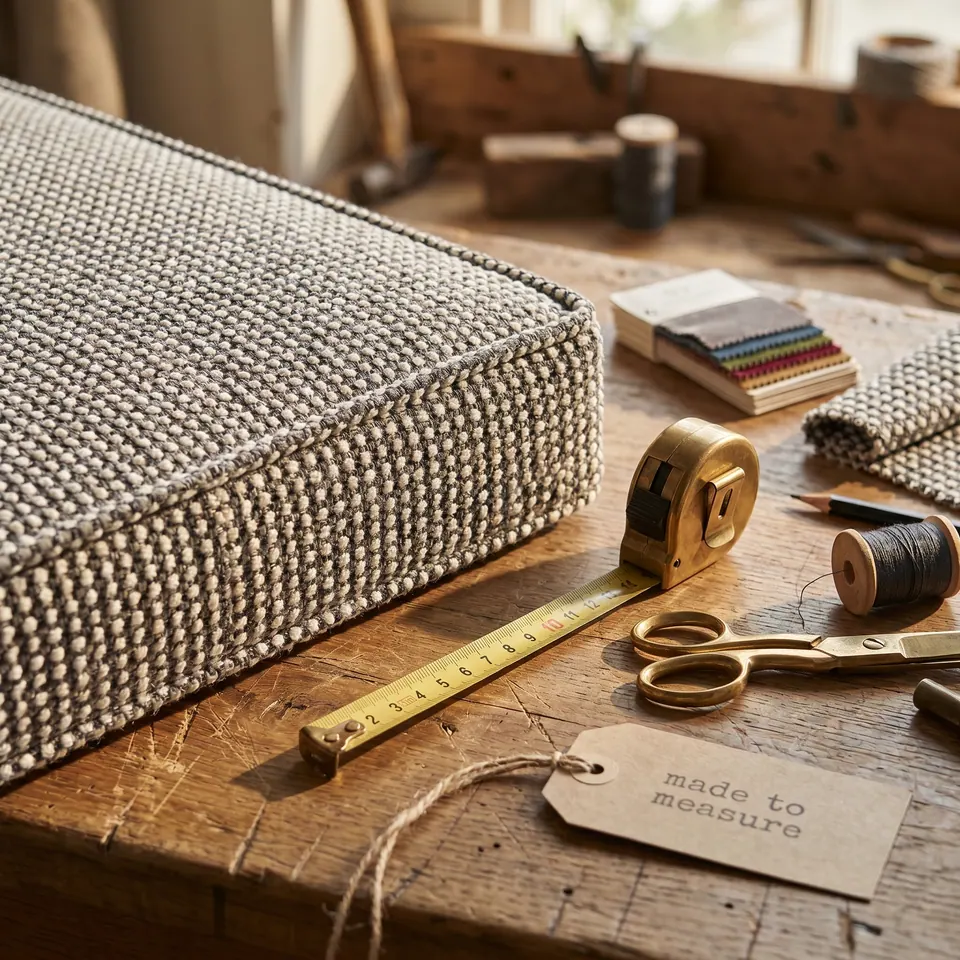
Standard cushion sizes are store conventions rather than rules: US chair pads run about 15 to 18 in square, twin daybed mattresses 38 x 75 in (97 x 191 cm), chaise cushions about 72 to 75 x 22 to 24 in, and porch swing pads about 45 or 55 in long. For made to measure, measure the seat wood to wood and send exact inches.
Three lengths on the shelf, one bench in your kitchen
One catalog sells banquette cushions in exactly three lengths, 30, 48 and 60 in (76, 122 and 152 cm), plus a corner piece. Another store makes its bench cushion to order in exactly one size. Good cushions, both. Neither has met your bench.
So a steady share of custom orders opens the same way: a stock number in one hand, a tape measure in the other, and a gap between the two. Sizing is one of the questions we get most.
The chart below collects the standard cushion sizes US stores and published size guides commonly use. Treat it as a sanity check, not a spec. What does your bench measure, wood to wood?
Common cushion sizes in US stores, seat by seat
| Seat | Common in US stores | Measure this instead |
|---|---|---|
| Dining chair pad | About 16 to 18 in (41 to 46 cm) square | Front width, back width between the posts, depth down the middle |
| Kitchen chair pad | About 15 to 17 in (38 to 43 cm) square | The same three numbers, plus any taper |
| Cube-shelf bench, 2 cubes | About 30 1/4 x 15 3/8 in (77 x 39 cm) | The finished top, to the nearest 1/8 in |
| Cube-shelf bench, 3 cubes | About 44 x 15 3/8 in (112 x 39 cm) | The top, not the catalog title |
| Cube-shelf bench, 4 cubes in a row | About 57 3/4 x 15 3/8 in (147 x 39 cm) | The top; one buyer's measured 57 5/8 in |
| Porch swing, 2-seat frame, about 48 in (122 cm) | Stock seat pad about 45 x 17 in (114 x 43 cm) | Inside the arms, front edge and back |
| Porch swing, 3-seat frame, about 60 in (152 cm) | Stock seat pad about 55 x 17 in (140 x 43 cm); one custom guide gives 58 to 60 in (147 to 152 cm) for a 5 ft swing | Inside the arms, plus depth to the back slats |
| Chaise lounge | About 72 to 75 x 22 to 24 in (183 to 191 x 56 to 61 cm), most 3 to 4 in (7.5 to 10 cm) thick | Overall length and width, plus foot end to hinge |
| Twin daybed | 38 x 75 in (97 x 191 cm) mattress | The mattress itself, all three numbers |
| Hemnes-style daybed (US) | Two twin mattresses of 38 1/4 x 74 1/2 in (97 x 189 cm) | Each mattress, and the stack height |
Figures from published US size guides and store listings, for reference. They are not workshop specs, and not a promise that your furniture matches them.
On the cutting table: US mattress sizes, twin to California king
| Twin | 38 x 75 in (97 x 191 cm) |
|---|---|
| Full | 54 x 75 in (137 x 191 cm) |
| Queen | 60 x 80 in (152 x 203 cm) |
| King | 76 x 80 in (193 x 203 cm) |
| California king | 72 x 84 in (183 x 213 cm) |
| Thickness | No standard. Twins measured for the workshop ran 8 to 12 1/2 in (20 to 32 cm) |
Why a 5 ft swing doesn't automatically take a 60 in cushion
A furniture size names the frame. The cushion lives inside it.
Porch swings show this best. One swing maker's 4 ft and 5 ft swings take seat pads of 45 x 17 x 2 in and 55 x 17 x 2 in (114 x 43 x 5 and 140 x 43 x 5 cm). A custom maker's guide says a 5 ft swing takes about 58 to 60 in (147 to 152 cm). Both can be right, because arms and naming differ by maker. That is a spread of up to 5 in (13 cm) on one "standard" swing; the porch swing cushion sizes guide covers depth and backs.
Chaises do it too. Published guides put chaise frames at 73 to 80 in (185 to 203 cm) long, and the cushion must fold where the frame folds, so the foot-to-hinge distance matters as much as length. The chaise cushion guide covers the hinge.
Then mattresses. "Twin" is printed as 38 x 75 in. Twins buyers measured for the workshop came in at 39 x 75, 38 x 74 and 39 x 75 in. Close is not equal, and a fitted cover notices. Sets and shapes live in the daybed cushions hub.
From tape to order in six steps
Measure wood to wood
Run the tape along the front edge of the seat, end to end: wood to wood, arm to arm, wall to wall. Then along the back edge. Old cushions shrink and round their corners, so measure the seat, not the pad you are replacing. The bench measuring guide shows where the tape goes.
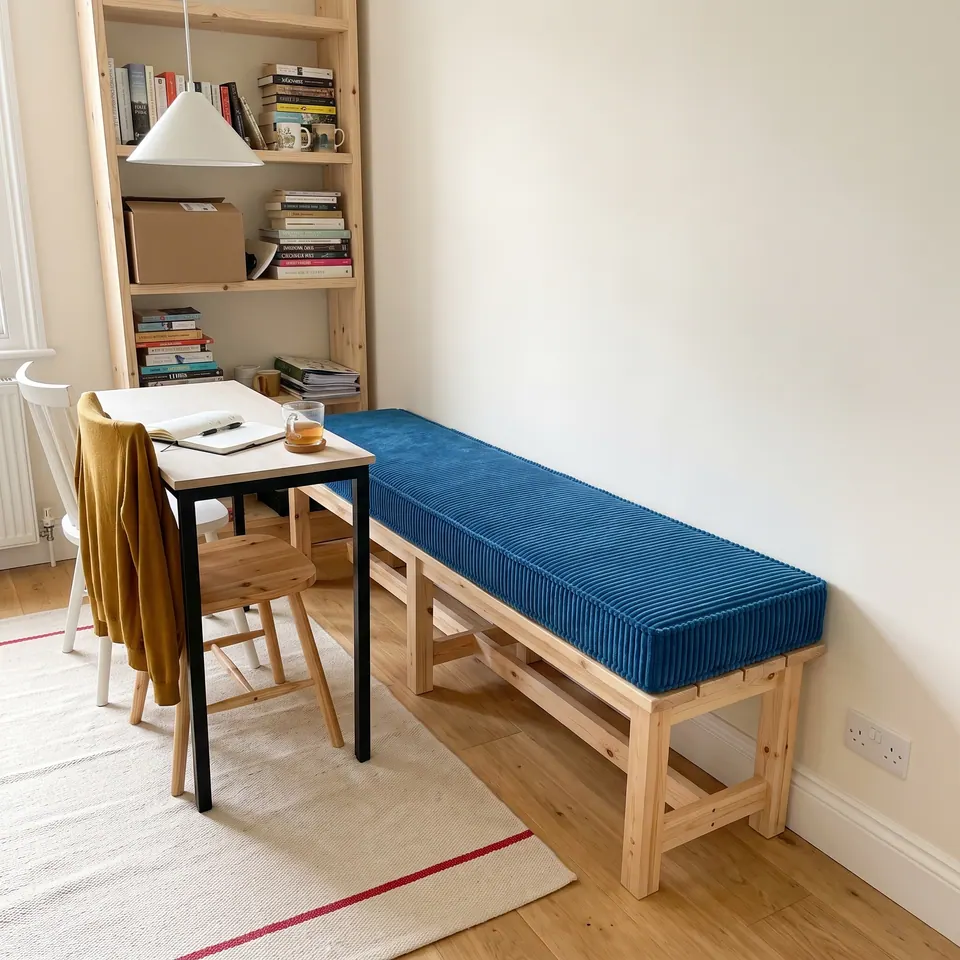
Pattern sheet A 48 x 21 in bench seat measured inside the frame, with a 3 in cushion on top. Take the depth at both ends
Measure from the front edge straight back to the wall or backrest, at the left end and the right. If they differ by more than 1/4 in (6 mm), write both down: the seat is not a rectangle. On a size menu, "width" means this depth.
Add the one extra number your seat needs
Chair pads: the back width between the posts, or the diameter on a round seat. Porch swings: the width inside the arms, front and back. Chaises: foot end to hinge. Daybeds: the mattress thickness.
 Save
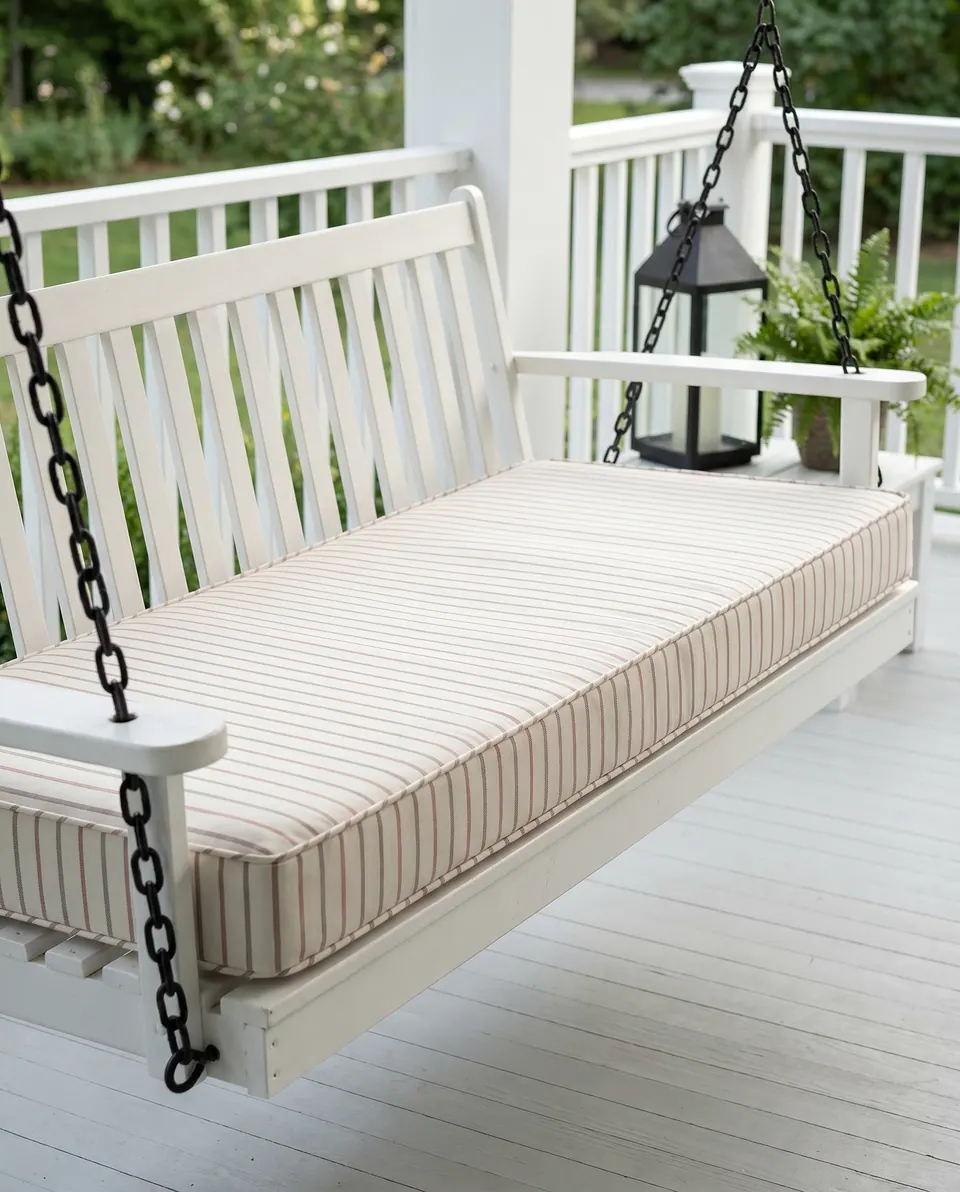
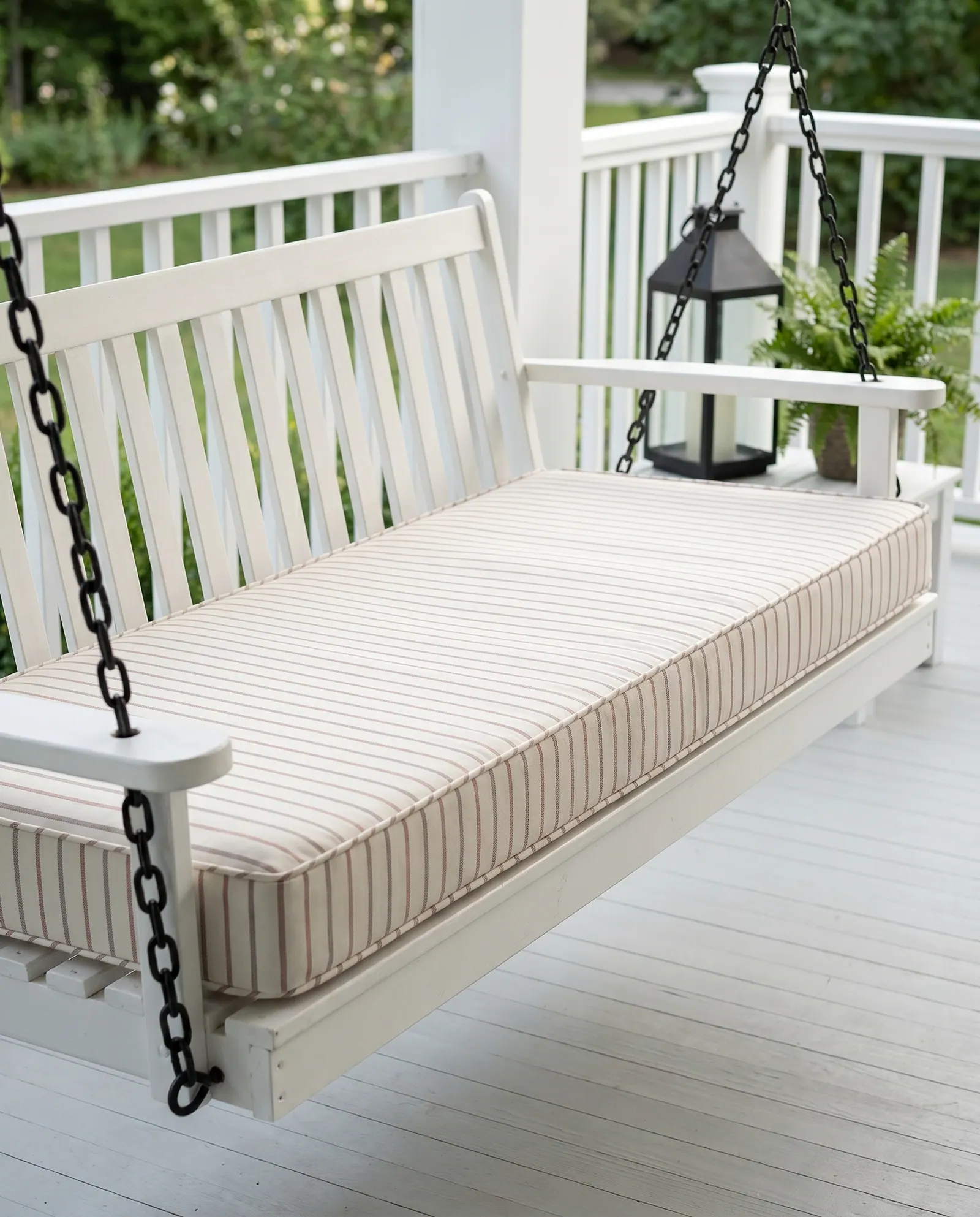
A thick pinstripe pad on a white porch swing, framed by black chains and a lantern; the stripe is quiet enough for a traditional porch. Label all three numbers, with the unit
Length is the long side, left to right. Depth is front to back. Thickness is how tall the cushion stands. Write it out: 60 in across x 20 in deep x 3 in thick. Cube-shelf builds sit in the Kallax cushion hub.
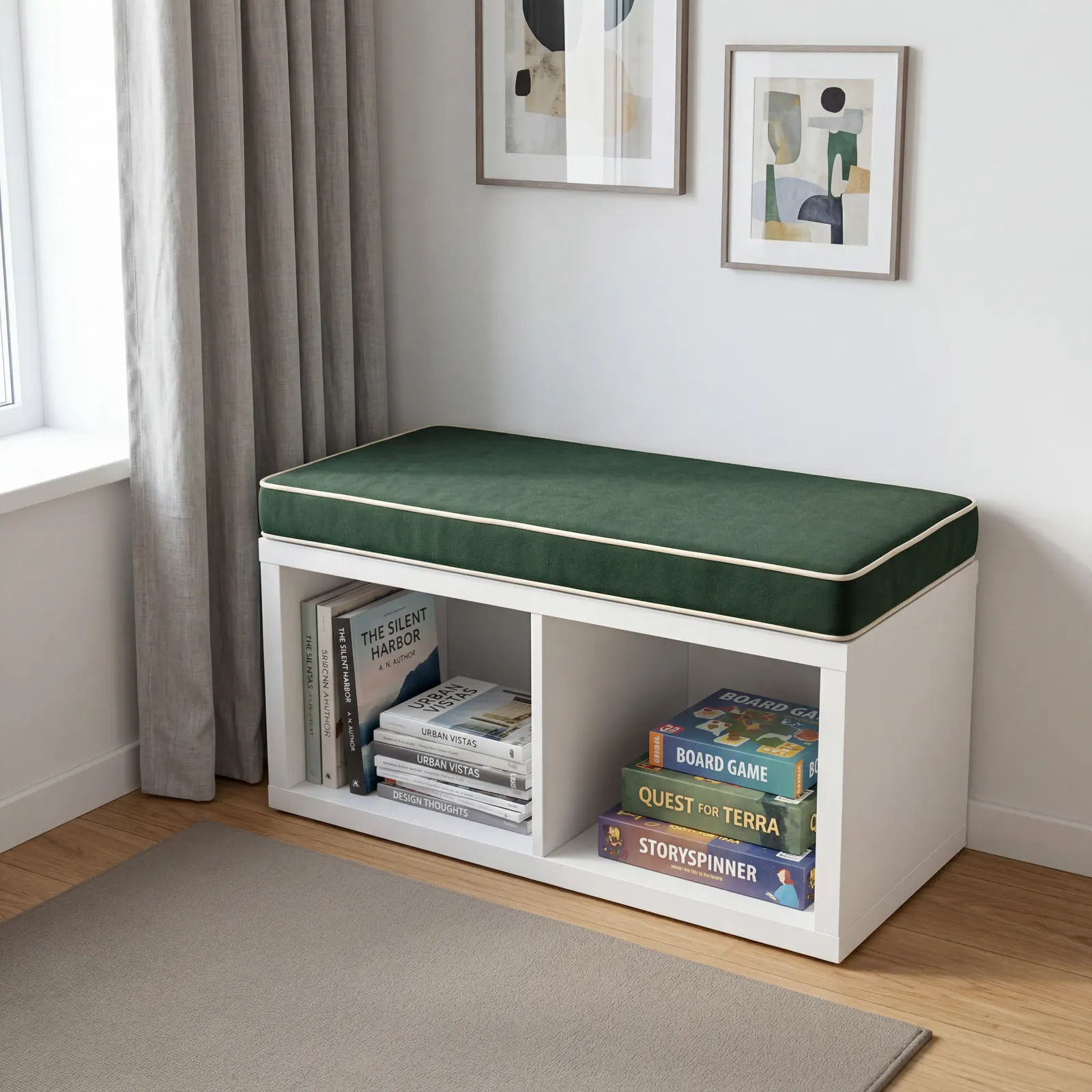
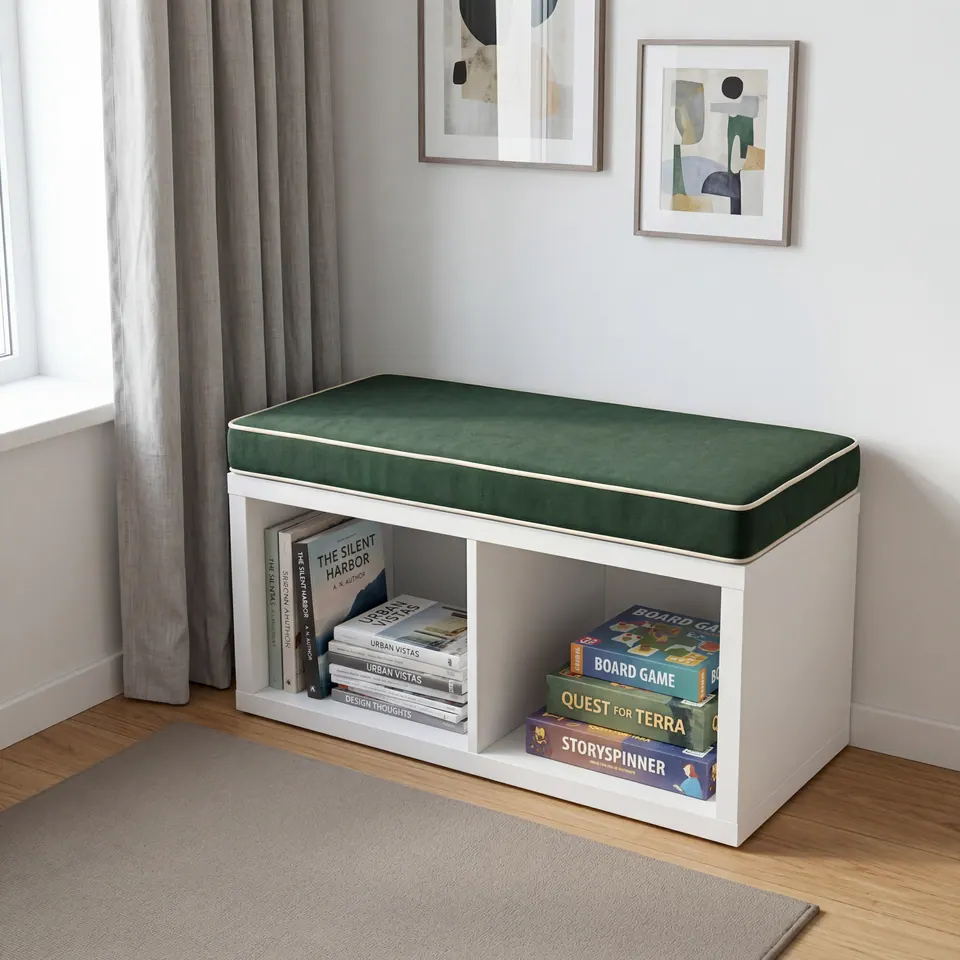 Save
A made-to-fit pad turns a two-cube shelf into seating while the cubes keep books and board games within reach. Send the true size, fractions and all
Subtract nothing, partner. The workshop cuts to the numbers you write and handles fitting allowances in production. Fractions such as 57 5/8 x 15 3/8 in are fine, and piping sits on the seams without changing the size. A handmade cushion then lands within about 1/2 to 1 in (1.3 to 2.5 cm); the size tolerance guide explains why.
Pick the bracket, write the size, one cushion per line
On a size menu, choose the range that holds your longest and deepest numbers, or the next one up. That sets the price. Your exact size goes in the personalization note, and that is what gets cut. Each cushion is its own cart line. Details in sizes not on the menu; preview proportions in the bench cushion builder.
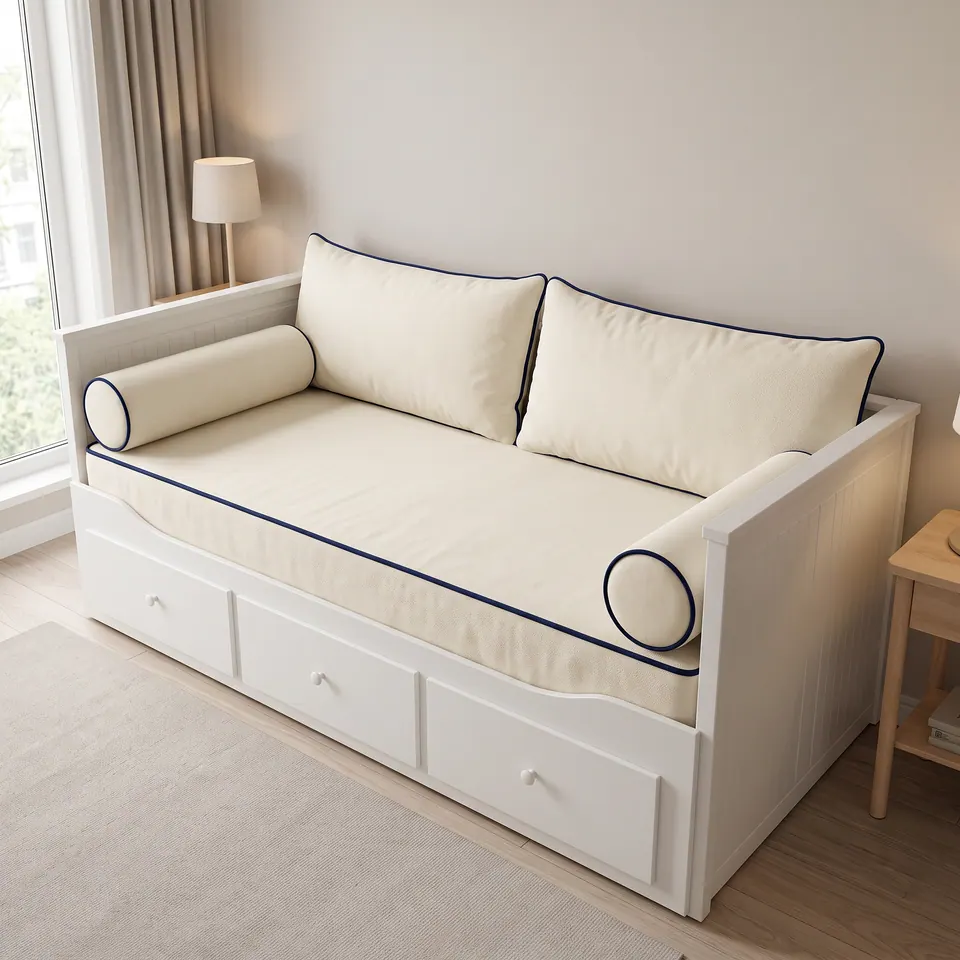 Save
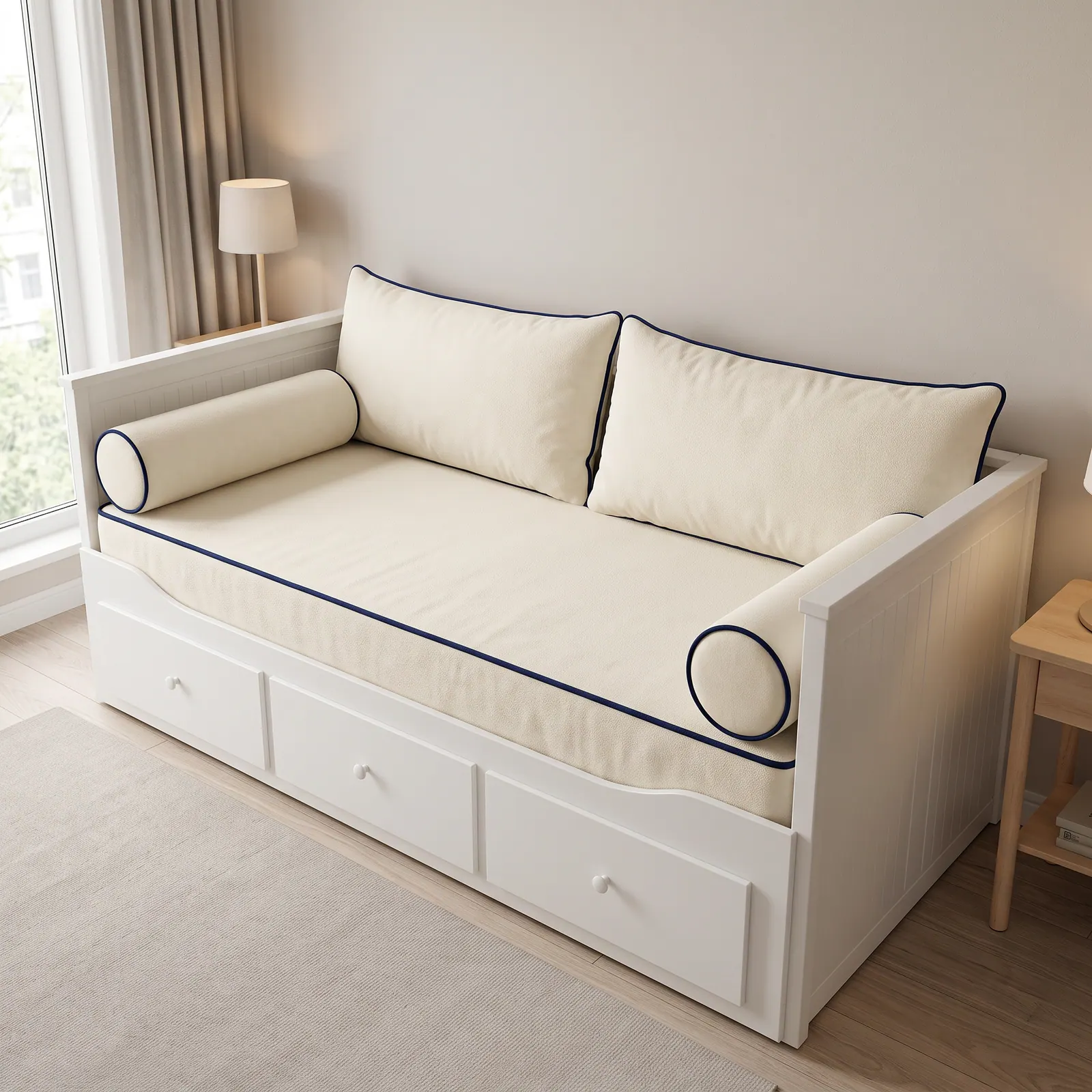
A cream linen-look set with navy contrast piping dresses a white Hemnes daybed for a guest bedroom. The piping outlines each piece so the bed reads as a sofa during the day.

Have it made
Measured it? Have Nate’s workshop make it
Send the numbers in inches: length × depth × thickness, plus any angle. The workshop checks them with you, because foam has no undo button. — Nate
Leave your details and the workshop will call you to confirm measurements, fabric, foam and piping. No prices, dates or payment on this page: it is a request, not an order.
Three twins, three different sizes
"Twin" is a family name, not a measurement.
A buyer in the US wanted a green corduroy fitted cover for a twin daybed used as a sofa. The mattress measured 39 x 75 x 11.5 in. They also wanted a long back cushion firm enough to sit upright against, and the workshop suggested foam filling for structure rather than loose fiber.
Another buyer in the US sent two twins for covers only: 74 x 38 x 10 in and 74 x 38 x 8 in. Each size went in as its own order, and "cover only, no foam" in the note kept the price straight.
A third wanted one 12 in thick cushion, 75 x 38 in, for a twin daybed used as a couch. The workshop first suggested two 38 x 38 in pieces. The buyer didn't want a split down the middle, so it was made in one piece.
The chart said 38 x 75 in three times. The tape said 39 x 75, 38 x 74 and 38 x 75.
Where stock numbers sneak into a custom order
- Ordering the swing's name instead of the space inside its arms.
- Measuring the old cushion, which has shrunk or sagged since the day it fit.
- Knocking off half an inch to be safe. The workshop adds its own allowances.
- Copying a catalog title. A cube shelf's listed size is its standing width and height, not the seat.
- Swapping length and width. On a size menu, width is the depth.
- Typing two cushions' sizes on one cart line. Production pauses until it is sorted out.
- Leaving "total run" or "per piece" unsaid on a long seat that will be split.
A standard size is somebody else's bench. Measure yours wood to wood and send the inches.
Nate
Buyer questions: sizes between the rows
- A common question
My bench size isn't in the dropdown. How do I order it?
The workshop's answerPick the size option your measurements fall into, usually the next size up, because the dropdown only sets the price. Type the exact dimensions, thickness, fabric code and piping code in the personalization box. The workshop cuts to that size, fractions included: a 17 x 52 in cushion went through the 18 x 52 option, and 22.5 x 36 in through 24 x 36. Add each cushion as its own cart item.
- A common question
Should I knock half an inch off so the cushion fits the bench?
The workshop's answerNo. Send the true size of the space, end to end, and subtract nothing. The workshop makes the cushion to the numbers you write and doesn't shorten them; the production team handles any fitting allowance. Piping sits on the seams, so a 48 x 21 in bench gets a 48 x 21 in cushion.
- A common question
Which number is the length and which is the width?
The workshop's answerLength is the long side, left to right across the front. Width is the short side, front edge to back, which is the seat depth. Thickness is how tall the cushion stands. A 105 x 29 in sill goes in the 101-105 in length range and the 27-29 in width range, with the exact size in the note. If in doubt, label it: 20 in deep x 60 in across.
- A common question
My twin daybed mattress isn't exactly 38 x 75. Can you make a cover to fit it?
The workshop's answerYes. Daybed covers are made to your mattress, twin, full or queen. Enter its length, width and height in the personalization box, measured once the daybed has arrived and the mattress sits in it. Twin covers on record include 39 x 75 x 12.5 in and 39 x 75 x 8 in. A trundle's second mattress needs its own cover.
- A common question
My chair pad is smaller than your smallest size. Can you still make it?
The workshop's answerYes. Choose the smallest option and write your real size in the personalization box, such as 11 in wide when the list starts at 12. The pad is cut to your numbers, but the price can't drop below the smallest option, because shipping is a large part of a small cushion's cost. Several small cushions ordered together earn a discount.
Standard sizes, briefly
Is there a standard size for a bench cushion?
Not really. Stores sell fixed runs, such as 30, 48 and 60 in banquette pieces, or one stock size per product. Benches vary by fractions of an inch, so a made-to-measure bench cushion starts from the seat's own length, depth and the thickness you choose.
Are all twin daybed mattresses 38 x 75 inches?
On paper, yes: a US twin is 38 x 75 in (97 x 191 cm), and a Hemnes-style daybed takes 38 1/4 x 74 1/2 in. In practice, twins measured for the workshop ran 38 to 39 in wide and 74 to 75 in long, so measure yours, thickness included.
How long should the cushion be for a 5 ft porch swing?
It depends on the arms. One swing maker's 5 ft swing takes a 55 x 17 in (140 x 43 cm) pad, while a custom maker's guide suggests about 58 to 60 in. Measure inside the arms at the front and the back, and send both numbers if they differ.
How thick is a standard chaise lounge cushion?
Published US guides put most chaise cushions at 3 to 4 in (7.5 to 10 cm), with plush ones at 6 to 8 in. The workshop's standard options are 2, 3, 4 and 5 in, with in-between sizes written in the note and thicker builds on request.