The Pattern Room · a measuring pattern
Measuring a chaise lounge or sunbed cushion, hinge point included
A lounger cushion fails at the fold before it fails anywhere else. Measure it the way the weather will use it: full length, full width, then the exact spot where the back lifts.
 Save
The quick answer
Measure a chaise lounge cushion by its overall length and width, then foot to hinge, so the cushion bends with the frame. Most loungers run about 72 to 80 in long and 20 to 30 in wide (183 to 203 x 51 to 76 cm). 3 to 4 in of foam is most common, 4 to 6 in for a plusher seat, with ties at the hinge.
Why the hinge matters more than the length
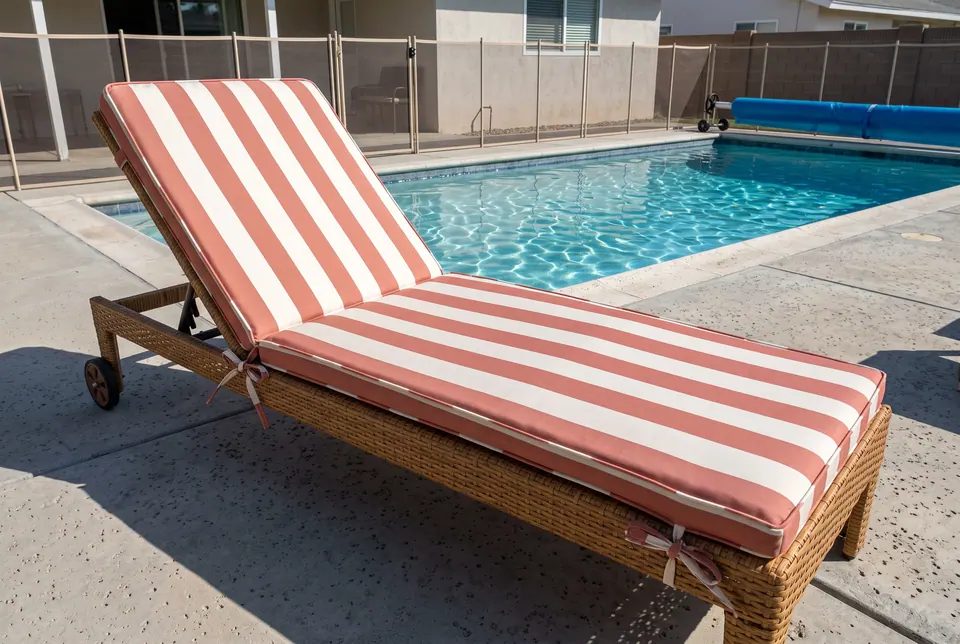
A lounger is two pieces of furniture pretending to be one, friend. The seat stays flat; the back lifts. A cushion that ignores the fold bunches at the hinge and creeps off the foot.
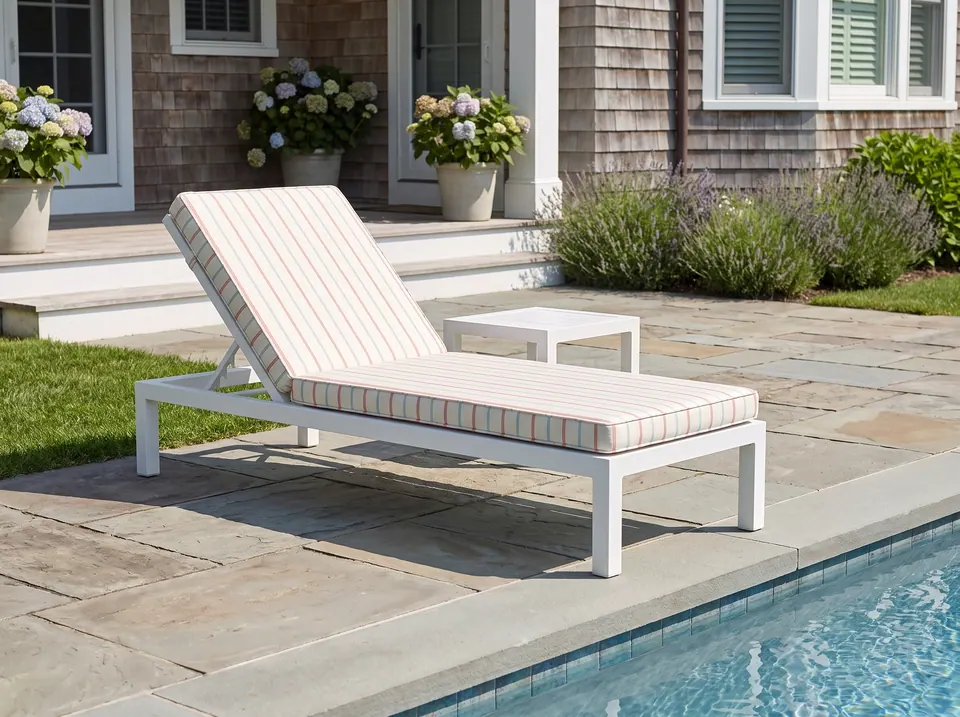
Published guides put most chaise loungers at about 72 to 80 in long and 20 to 30 in wide (183 to 203 x 51 to 76 cm), with a seat section of 42 to 50 in; stock pads often come 72 x 22 in. Plenty of frames don't match stock, so plenty of custom orders are outdoor daybeds, double chaises and pool loungers in odd sizes. The chaise and sunbed cushions collection has the photographs; this Pattern has the tape measure.
Measuring a sunbed cushion, step by step
Lay the frame flat and measure the full length
Put the back all the way down. Measure foot to head along the center, inside any rails the cushion sits between, then the width at the foot, middle and head, since some frames taper. Work to the nearest 1/8 in in one unit, and type the numbers out; photos of a tape get misread.
Find the hinge, measured from the foot
Raise the back and find the pivot. Foot to hinge is the seat section; hinge to head is the back. On many loungers the seat runs about 42 to 50 in (107 to 127 cm) and the back makes up the rest, but take your own, and say which end you measured from.
Choose one long cushion or a seat plus a back
One long piece is simplest, and the foam can fold or roll for storage without creasing. A separate seat and back can each have their own thickness or fabric. If you split, split on the hinge line, and label each piece's thickness.
Pick a thickness for lounging, not perching
A 2 in (5 cm) cushion on an outdoor lounge chair compresses to almost nothing under body weight. Published guides call 3 to 4 in (7.5 to 10 cm) the most common chaise thickness; go 4 to 6 in (10 to 15 cm) for a plusher seat. The workshop quotes outdoor cushions at 4 in (10 cm) unless told otherwise and makes 6 in (15 cm) on request.
Put ties where the wind gets under
A gust lifts the head of a lounger cushion first. Ties are sewn into the seams on request, in any position: on the hinge line so the cushion bends with the frame, and at the head so the back stays down. Write their position, length and color on the order; see cushion tie placement.
Use outdoor fabric, and skip the tufts
The workshop's outdoor fabrics are woven, water- and UV-resistant cloth, not vinyl. Keep the cushion non-tufted, because tufting lets water in even through outdoor fabric. Self piping reinforces the edges; a 6 in outdoor cushion has also been made with ties and no piping at all.
Send a photo, a sketch and every number
Send a photo of the lounger and a sketch with the overall length and width, the foot-to-hinge distance, each piece's thickness, tie positions and piping. Say whether your sizes are finished sizes. Each outdoor set is quoted from those numbers.
Have it made
Measured it? Have Callum’s workshop make it
Short list: size, sun hours, how fast it has to dry. The workshop goes through it with you. — Callum
Leave your details and the workshop will call you to confirm measurements, fabric, foam and piping. No prices, dates or payment on this page: it is a request, not an order.
One long cushion or a separate seat and back
| One long cushion | Separate seat and back | |
|---|---|---|
| At the hinge | Bends across the fold; ties on the hinge line hold it there | The split sits on the hinge line |
| Thickness | One thickness end to end | Can differ, like a 48 x 24 x 5 in seat with a 48 x 18 x 3 in back |
| Fabric | One fabric | Two fabrics possible, a pattern back over a plain seat |
| Storage | Folds or rolls without creasing | Two smaller pieces to stack |
| On the order | Length, width, thickness and foot-to-hinge distance | Each piece's size and thickness, labeled seat and back |
The outdoor daybed with two near-identical pieces
A buyer messaged the workshop about an outdoor daybed. The seat was first given as 70 3/4 x 31 1/2 in (180 x 80 cm), then corrected to a base of 88 1/2 x 25 1/2 in (225 x 65 cm) and a tall back of 88 1/2 x 25 1/4 in (225 x 64 cm), needed by early July.
Two cushions less than half an inch apart are easy to swap on a cutting table. Before cutting, the workshop asked for a separate thickness for each piece, written against its name.
- What it taught
- When seat and back are nearly the same size, label each piece's thickness.
Lounger mistakes worth avoiding
- Ties requested in the size box. They are added only on request, and a note among the dimensions gets missed; write them out and check the photo sent before shipping.
- Nothing to grip on a smooth frame. Order ties, or a non-slip base where the cushion sits on a solid top, and ask whether that backing is washable.
- Indoor fabric in the open. Say indoor or outdoor first, so the color search starts on the right chart.
- Measuring a vacuum-packed cushion on day one. Give it 48 to 72 hours out of the package before judging the thickness.
Drying, storing and the first frost
Standard foam that gets soaked holds water for days. After a downpour, stand the cushion on its long edge where air moves, cover unzipped if it's wet through. The workshop recommends a fabric protectant spray, and dry-fast foam is the other route for cushions that live outside.
In the off-season, store cushions indoors, dry, with air around them, never sealed in plastic. Bring them in before the first frost and they'll forgive you everything. The full routine is in outdoor cushion care.
On an outdoor lounger, a 2 in cushion compresses to almost nothing under full body weight; 3 to 4 in is the usual chaise pad, and 4 to 6 in the plush one.
Callum
Chaise lounge dimensions from published guides
| Measurement | Typical range | How to use it |
|---|---|---|
| Overall frame length | 73 to 80 in | Measure your frame, not a stock pad |
| Frame width | 20 to 30 in | About 20 in suits small spaces |
| Seat length (foot to hinge) | 42 to 50 in | Sets where the cushion bends |
| Seat height off the ground | 11 to 13 in | Add the cushion thickness |
| Cushion thickness | Most 3 to 4 in; plush 6 to 8 in | Thicker sits higher |
Buyer questions
- A common question
Can you make cushions for an outdoor daybed or a double chaise lounge?
The workshop's answerYes. Seat and back cushions for outdoor daybeds and double chaises are made to your sizes, for example a 51 1/2 x 35 in back with a 51 1/2 x 49 in seat. Order through the outdoor listing, choose from its fabric charts, and state the seat and back thickness separately in the notes.
- A common question
Can the lounger cushion by my pool be tufted?
The workshop's answerThe tufted shapes can be made in outdoor fabric, but tufting lets water inside even then. Where a cushion gets wet, by a pool or a fire pit, the workshop recommends a non-tufted, foam-filled cushion in outdoor fabric. Zippered outdoor versions are made without tufting.
- A common question
Does the outdoor fabric feel plasticky?
The workshop's answerNo. It isn't a coated or vinyl fabric; it feels like proper cloth, not a tarp. It is firmer and less velvety than indoor upholstery, closer to a good sun-lounger cushion, and comfort feedback from buyers has been consistently good.
- A common question
My loungers sit on a covered porch. Do I still need outdoor fabric?
The workshop's answerUnder a closed roof where rain and direct sun don't reach, the regular fabrics are fine, though they aren't waterproof. For a screened porch that sees pollen, dust and humidity, or any open-air spot, the workshop recommends outdoor fabric and can send samples first.
Questions buyers ask next
What is the standard size of a chaise lounge cushion?
Published guides put most chaise loungers at about 72 to 80 in long and 20 to 30 in wide (183 to 203 x 51 to 76 cm), with a 42 to 50 in seat section, and stock pads are often 72 x 22 in. Frames vary, especially built-in and double loungers, so measure yours flat and note the hinge.
How thick should a sun lounger cushion be?
3 to 4 in (7.5 to 10 cm) is the most common chaise thickness; for a plusher seat, 4 to 6 in (10 to 15 cm). Very thin outdoor pads flatten under body weight. The workshop quotes outdoor cushions at 4 in unless you ask otherwise and makes 6 in on request.
Where should ties go on a chaise cushion?
On the hinge line, so the cushion bends with the frame, and at the head end, so wind can't lift the back. Corner ties along a long side work too. Ties are added only on request, so give each one's position, length and color in writing.
Can I keep my lounger foam and replace only the covers?
Yes, if the foam is still good. One buyer with two lounger pads, 75 1/2 x 23 5/8 x 2 in and 74 3/4 x 19 3/4 x 2 in (192 x 60 x 5 and 190 x 50 x 5 cm), ordered covers only, which cut the cost of the set by roughly a quarter.
Where is the hinge point on a chaise lounge measured from?
From the foot end of the frame to the fold where the back tilts up. That distance tells the maker where the cushion must bend, or where a separate seat and back should meet. On a split-back lounger, measure the seat as one piece and each back section separately, and include any gap at the fold in the total length.
How high off the ground does a chaise lounge seat sit?
Low. Outdoor chaise frames typically put the seat about 11 to 13 in off the ground, and the cushion adds its thickness on top. Most chaise cushions are 3 to 4 in thick, so expect a finished seat of roughly 14 to 17 in. A thicker, plusher cushion raises that further, which is worth checking if getting up from low seats is hard.