The Pattern Room · a measuring pattern
Measuring wicker and patio furniture for replacement cushions
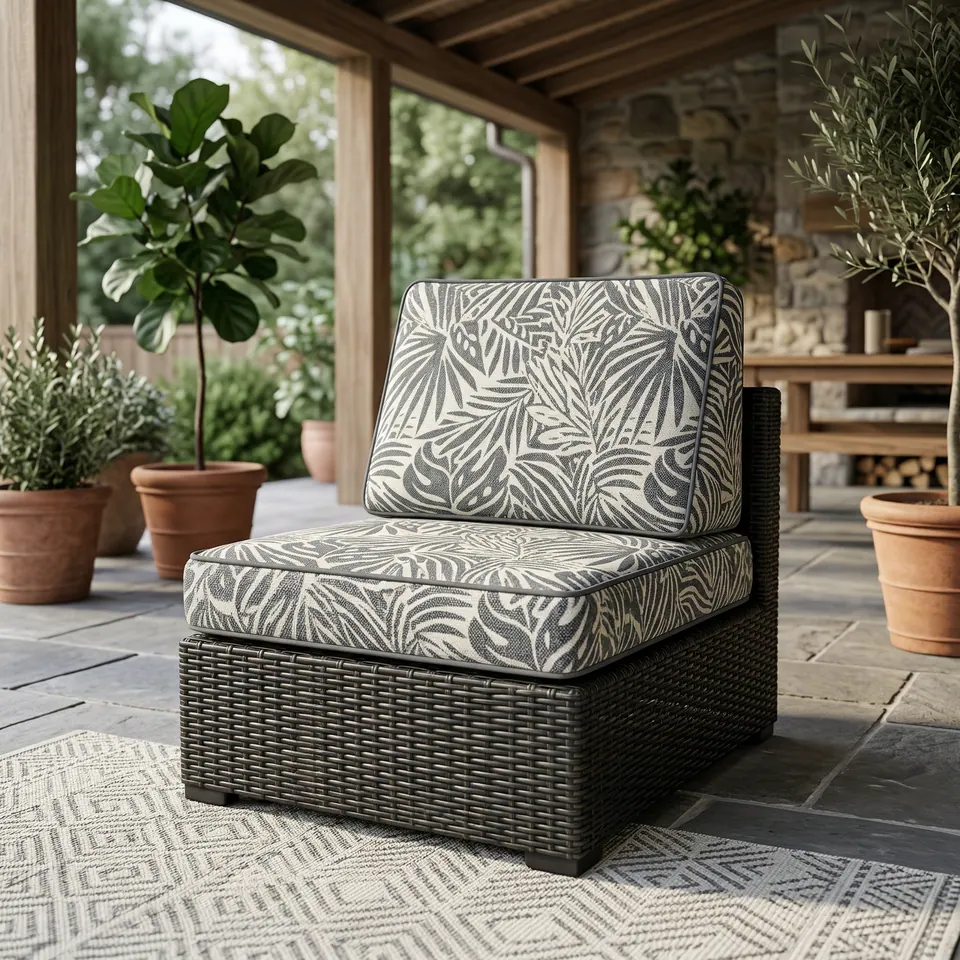
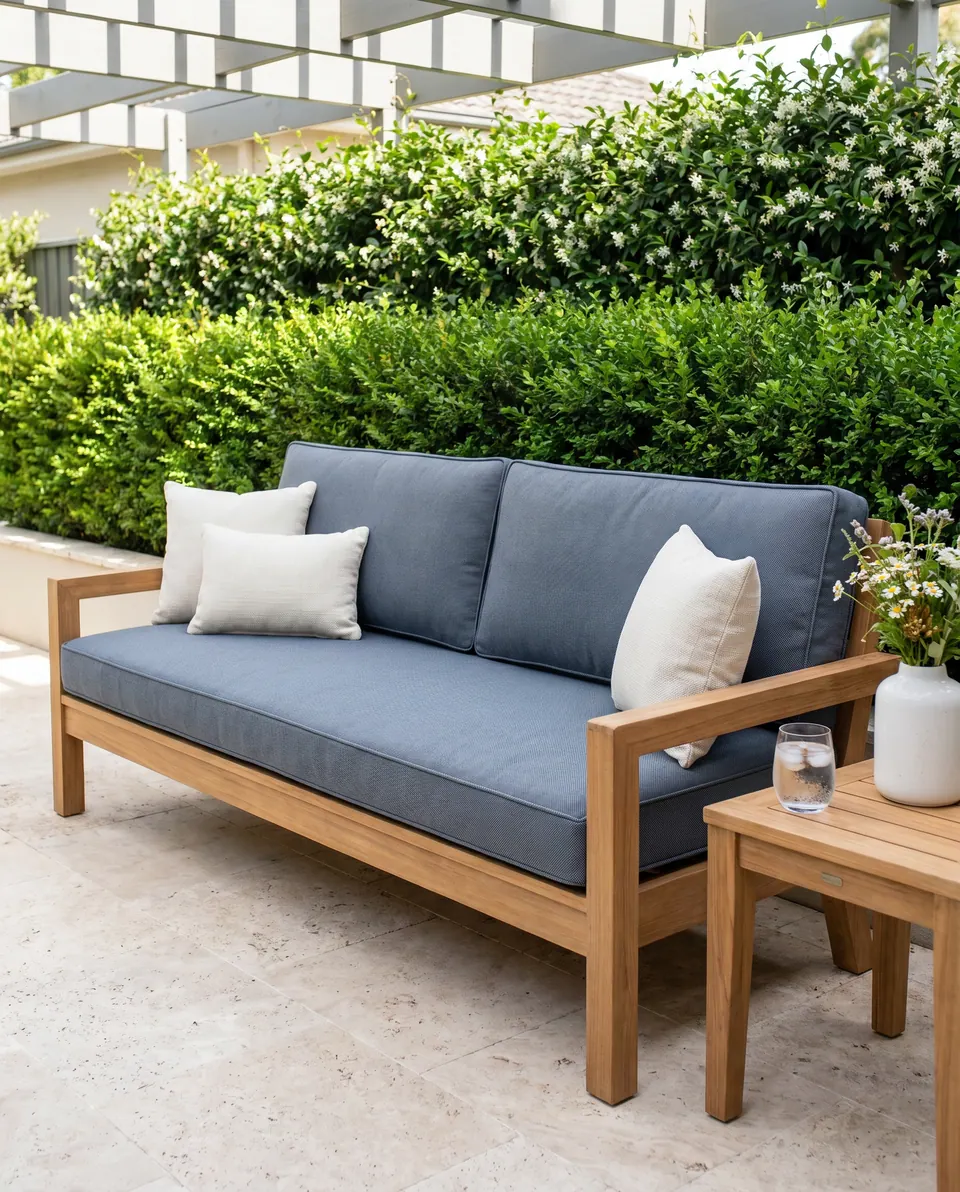
The frame is usually fine. It's the cushions that gave up. Measure the frame, judge the foam, and replace only what the weather actually wore out.
 Save
The quick answer
To order patio furniture replacement cushions, measure the frame's seat opening and back rather than the tired old cushion, then check whether the inserts still spring back. Sound foam only needs new zippered covers cut to the bare insert's length, width and thickness. Flattened foam needs full replacements in water-resistant outdoor fabric, with ties for slick wicker and rattan frames.
Measure the frame, not the tired cushion
The old cushion is the worst tape measure on your patio. It has been sat flat, baked, rained on and hauled indoors more times than anyone counted.
Patio furniture replacement cushions start with the frame. Wicker, rattan or aluminum, the seat opening hasn't moved since the day it was built. Measure that. Then look hard at the inserts inside the old covers. Sound foam needs only new covers. Foam that stays down when you press it needs replacing.
One exception. If the old cushions still fit the way you like, their sizes are a fair starting point. If they never fit, or you want them thicker, go by the frame.
The outdoor cushions and patio and porch cushions in the Atlas show these sets done right.
Reading a patio set for new cushions, in eight steps
Photograph every piece
Shoot each chair, sofa and bench square-on and from the side. Photos plus the inside frame sizes let the workshop plan the whole set: every seat, every back, and how they meet.
Measure the seat opening inside the frame
Width at the front and at the back, because many wicker seats taper. Depth from the front edge straight back to the frame, at 90 degrees. An angled side always reads longer than the true depth.
Measure the back as its own piece
Take the width and the height you want the back cushion to cover. Seat-and-back pairs are quoted together, for example a 48 x 24 x 5 in (122 x 61 x 13 cm) seat with a 48 x 18 x 3 in (122 x 46 x 7.5 cm) back.
Trace rounded wicker fronts
Curved fronts and rounded corners need their shape, not just their size. Note how far from each corner the curve begins. For a curved wicker chair, the workshop draws a template from your photos for you to confirm before anything is cut. The rounded corner Pattern covers the method.
Squeeze the old inserts
Unzip a cover and press the foam. If it springs back and still fills the frame, keep it and order covers only. Then measure the bare insert, never the old cover: length, width and thickness. On a boxed edge, measure the side panel seam to seam.
Settle the thickness
Outdoor cushions can be made in any thickness, 6 in (15 cm) included. You can still change it before production; one lounge set dropped from about 6 in to 5 in (15 to 13 cm) after the plan was drawn.
Ask for ties in writing
Rattan and wicker are slick, and a cushion walks. Ties are added only on request, so write their position, length and color, for example at the two corners of one long side. Then message after ordering to confirm them.
Number the pieces and check the drawing
Label every cushion on a sketch: seat 1, back 1, and so on. When the plan comes back, check every length on it, not just the overall shape. One outdoor cushion arrived 23 in (58 cm) short because the approved drawing already showed it that way.

Have it made
Measured it? Have Callum’s workshop make it
Sun, rain, salt. Say which of them your cushion will meet, and the workshop will plan around it. — Callum
Leave your details and the workshop will call you to confirm measurements, fabric, foam and piping. No prices, dates or payment on this page: it is a request, not an order.
Covers only or full replacement: read your inserts
| Covers only | Full replacement | |
|---|---|---|
| The foam is | Springy, square, still fills the frame | Flattened, crumbling or shrunk from the frame |
| You measure | The bare insert: length, width, thickness | The frame's seat opening and back |
| You send | Insert sizes, a labeled drawing, photos | Frame sizes, photos, the thickness you want |
| You get back | Zippered covers, no foam | New foam in new zippered covers |
| Say it plainly | 'Covers only' in every message | 'With foam' in every message |
Ten inserts with good years left in them
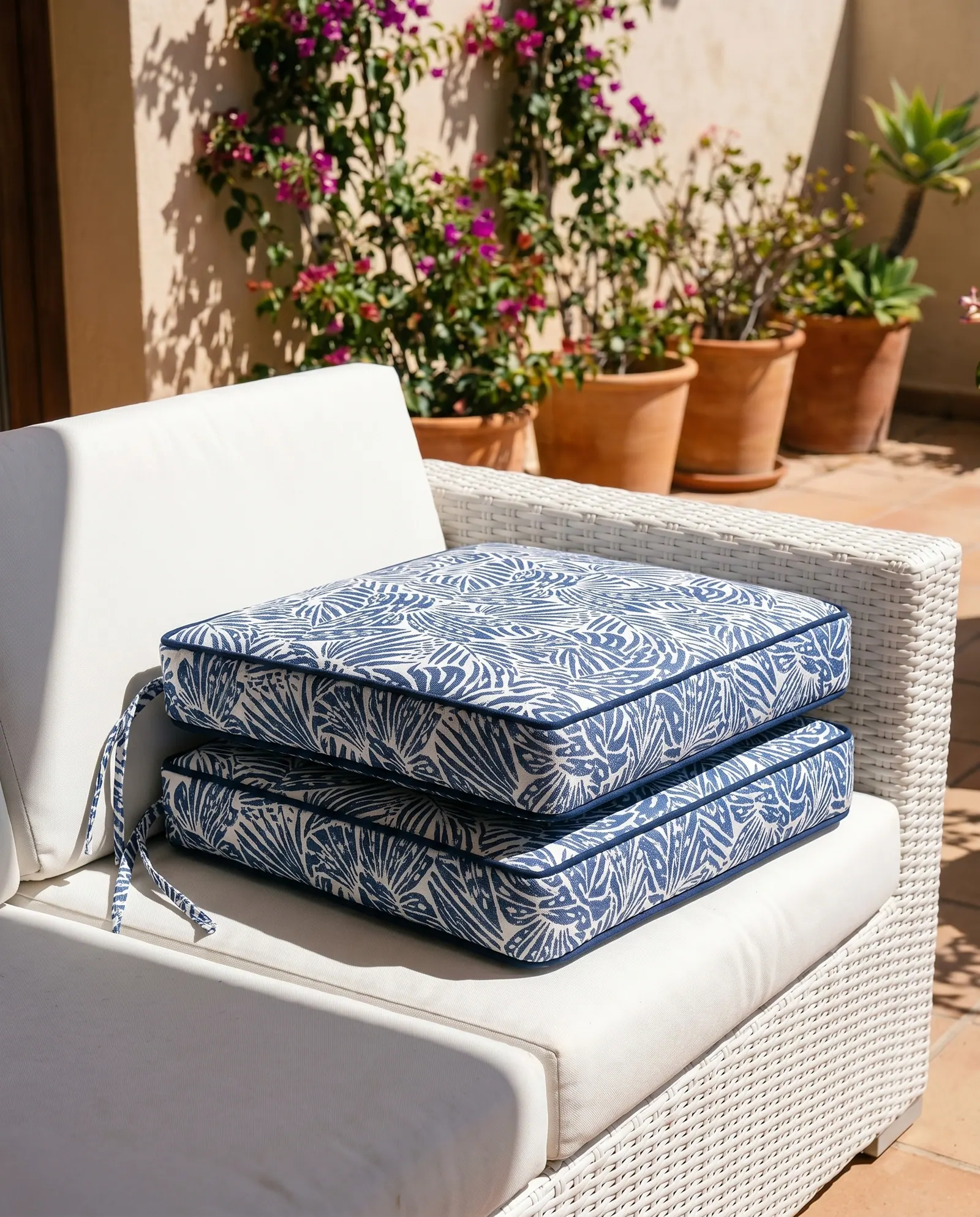
A buyer in the US wrote to the workshop about an outdoor sectional with benches. The foam was staying. The covers were going. They wanted ten new covers, with piping and zippers, for the inserts they already had.
Seven measured 25 x 15.5 x 4.25 in (64 x 39 x 11 cm). Two large ones measured 76.5 x 30.5 x 5.5 in (194 x 77 x 14 cm), with rounded back corners. One was 47 x 15 x 5.5 in (119 x 38 x 14 cm).
They had measured the boxed side panel seam to seam, which is right, and wanted the same full, tailored look as before. The workshop took the 5.5 in panel as given. Then it asked what a cutter needs: how far from each corner the curve on the big cushions begins, what size the bolsters were, and whether the throw pillows and bolsters needed inserts.
The lesson travels to any patio. Measure the panel seam to seam and let a full insert crown the top. Don't enlarge the panel to make room. That's how a cover bags.
Why an open patio wants outdoor fabric
Rain doesn't negotiate. An open patio gets sun, showers, pollen and dew, and indoor fabric wasn't built for any of it. Linen, velvet and chenille belong inside; chenille especially struggles through humid summers.
The workshop's outdoor range runs to close to 200 fabrics on four or five charts. They're woven cloth, not vinyl, and they're water-resistant, UV-resistant and fade-resistant. Water-resistant means they shed showers and spills. It doesn't mean sealed. Store the cushions indoors through the long off-season.
Two construction choices help outside. Self piping, in the same fabric, reinforces the edges. And skip tufting where cushions get wet; tufts let water in even through outdoor fabric. A plain, foam-filled cushion is the one for the pool deck.
A patio under a solid roof, where rain and direct sun never reach, is another matter. The covered porch Pattern sorts that out, and the outdoor fabrics in the Swatch Library show the range.
Mistakes that come back every spring
- Measuring the old cover instead of the bare insert. Covers stretch and foam compresses; measure what goes inside.
- Leaving the thickness off. A cover cut without the insert height either won't zip or bags.
- Forgetting to say 'covers only' or 'with foam'. Put it in every request.
- Giving a soft fiber insert its exact size. Soft fiber inserts need about 1 in (2.5 cm) more than the cover.
- Typing ties into the size box. Add-ons there get overlooked; put them in a message, then check the photo before it ships.
- Ordering indoor fabric for an open patio. Tell the maker indoor or outdoor first, so the color search starts in the right chart.
One cushion first, then the rest of the set
For a big set, order one cushion first and check it on the frame. In one patio order, that test piece took about 5 days to make. Small price for certainty before the rest of the set is cut.
Very long pieces, from about 75 to 142 in (1.9 to 3.6 m), may run past the longest single piece the workshop cuts. They're made in sections, and you choose where the joins fall. The foam folds or rolls for winter storage without damage.
Covers come off and wash at 86°F (30°C) on a delicate cycle. The foam stays out of the machine. The winter storage Pattern has the seasonal routine, and the patio set refresh Concept Sketch shows how other owners handled theirs.
So, friend: what's under your old covers? Foam that springs back, or foam that stays down? That answer decides the whole order.
Patio furniture replacement cushions start at the frame: measure the seat opening's width at the front and at the back, because many wicker seats taper.
Callum
What to measure, piece by piece
| Patio piece | Measure | Watch for |
|---|---|---|
| Deep-seat chair or sofa | Width inside the arms along the front, depth front center to back frame | Back height = frame height minus seat thickness |
| Dining chair | Front width, back width, depth | Ties at the back posts |
| Chaise lounge | Length, width, foot-to-hinge distance | Split backs measured per section |
| Swing or glider | Inside the arms at the slats | The label size is not the seat size |
| Bench | Inside the arms, front and back; depth | Curved backs need a template |
| Ottoman | Top length and width, or diameter | Any lip the cushion sits inside |
Buyer questions: weather, tufts and thickness
- A common question
Are your outdoor cushions truly waterproof, or only water resistant?
The workshop's answerThey're made from a separate water-repellent outdoor fabric range with its own color chart, sent on request. In practice it's water-resistant rather than sealed: it handles rain showers and spills well, and outdoor seats and backs get outdoor-suitable inserts. For a bigger patio project you can order one cushion first to check the fit. Store the cushions indoors in the long off-season.
- A common question
Our patio is covered. Will regular indoor cushions be fine out there?
The workshop's answerYes, under a closed roof where rain and direct sun don't reach, the regular fabrics are fine, though they aren't waterproof. The workshop checks that the area really is covered first. For a screened porch with pollen, dust and humidity, or any open-air spot, it recommends outdoor fabric and can send samples first. Seats, backrests and bolsters can all be made in it.
- A common question
If tufted cushions are made in outdoor fabric, can they sit out on the patio?
The workshop's answerThe tufted shapes can be made in outdoor fabrics, but tufting lets water inside even then. For spots that get wet, such as by a pool or a fire pit, the workshop recommends a non-tufted, foam-filled cushion in outdoor fabric. Its zippered outdoor versions are made without tufting.
- A common question
Could my outdoor cushions be 6 inches thick, with ties and no piping?
The workshop's answerYes. Outdoor cushions are made to any size and thickness, 6 in included, in the water-resistant outdoor range, and they're washable. Piping can be skipped and ties added where you want them, for example at the two corners of a long side. Seat-and-back pairs, such as a 48 x 24 x 5 in seat with a 48 x 18 x 3 in back, are quoted together.
- A common question
What's the difference between all your outdoor fabric charts?
The workshop's answerThere are close to 200 outdoor fabrics on four to five charts. All are water-, UV- and fade-resistant woven cloth, not vinyl or a plastic finish, and all are the same quality. The charts differ only in texture, color tone and pattern. Outdoor orders can include foam, a non-slip base and piping in any color from the range, and close-ups are available for any code.
Before the new cushions go out
Should I measure the old cushions or the patio frame?
If the current cushions fit the way you like, send their sizes. If they never fit well, or you want a different thickness, measure the frame's seat opening and back instead. For covers only, measure the bare foam insert, not the old cover, and include its thickness.
Can I order just covers for foam I already own?
Yes. Zippered covers are made from the exact length, width and thickness of your inserts, with no foam included and no need to send the old cushions. The workshop double-checks that you really want covers only, and shaped pieces need a drawing with measurements plus a photo.
Do rattan and wicker cushions need ties?
They help on slick frames. Ties aren't standard and are added only on request, so list their position, length and color in a message after ordering. A non-slip base also holds a thin cushion; one buyer's 2 in (5 cm) outdoor bench cushion stayed put with one.
How thick should replacement patio seat cushions be?
Outdoor cushions come in 2, 3, 4 and 5 in (5, 7.5, 10 and 13 cm), and 6 in (15 cm) is possible. If you liked the old seat height, match the old thickness. Thickness can still change before production, as one lounge set did from about 6 in to 5 in.
How do I measure deep-seat patio chairs for new cushions?
Take the seat width along the front edge inside the arms, the depth from the front center to the back frame, and the back height, which is the backrest frame height minus the seat cushion's thickness. Measure the frame rather than worn cushions, to the nearest 1/4 in. Deep-seat cushions are usually 4 to 6 in thick, with 5 in the most common.
Can I order a single outdoor chair pad instead of a whole set?
Yes. Each cushion is its own order line at its own size, so one chair pad, a seat without a back, or a back without a seat are all fine. If more pieces might follow, order them together: pieces made in one order match best, and one shipment costs less than several added later.