The Pattern Room · a measuring pattern
Adirondack chair cushions that follow the slope of the seat
An Adirondack chair leans back before you do. Measure it the way it leans, along the slats, and the cushion stays where you put it.
 Save
The quick answer
Measure Adirondack chair cushions along the slats, not across the floor, taking six numbers: seat width at front and back, seat depth along the slope, back width at bottom and top, and back height from the seat to the top slat. Ask for ties at the crease and the top slat, and keep the seat about 2 to 4 in thick.
The chair leans back before you do
An Adirondack chair was built for a view and a long afternoon. It was never built for a cushion. The seat slopes down toward the back, the back reclines, and the wide flat arms sit where the maker set them for bare wood. That is why Adirondack chair cushions bought by catalog size creep forward or bunch in the crease.
The fix is in how you hold the tape. Lay it on the wood and follow the slats: along the seat, then up the back. A tape held level in the air measures the shadow of the chair, not the chair.
Seat pad only, seat and back as two pieces, or one long cushion from seat to top slat: all three start with the same six numbers. The wider family lives under outdoor cushions and deep seating cushions.
Six measurements, taken along the slats
Use a soft sewing tape, or a string you lay on the wood and then measure flat. Write each number to the nearest 1/4 in and label it. Numbers without labels are just weather reports.
Seat width at the front
Measure across the front edge of the seat, inside the arms, from the outer edge of one slat to the outer edge of the other. On most Adirondacks this is the widest part of the seat.
Pattern sheet Front width, back width and depth are three separate numbers. Ties go at the back corners, where the seat meets the back slats. Seat width at the back
Measure again where the seat slats meet the back slats. Many Adirondack seats are narrower here, which makes the seat a slight trapezoid. The workshop asks for exactly this on a tapered seat: the depth plus the front and rear widths, measured on the chair itself, not copied from a product page.
Seat depth along the slope
Lay the tape on the slats from the front edge down to where the back begins. Take it at the center and at each side. A buyer wrote to the workshop about outdoor chairs whose seats curved at the front: 18.5 in (470 mm) deep at the center, about 17 3/8 in (440 mm) at the sides, 18.5 in across the front and about 15 3/8 in (390 mm) across the back, 2 in (50 mm) thick. The workshop asked for the numbers typed out, then drew a template with a curved front for approval before cutting.
Back width at the bottom and at the top
Adirondack back slats fan out. Measure across them just above the seat, then again where you want the back cushion to stop. A back that is wider at the top is a shaped piece, so it goes on the custom-shape listing with a drawing, not on the rectangle listing.
 Save
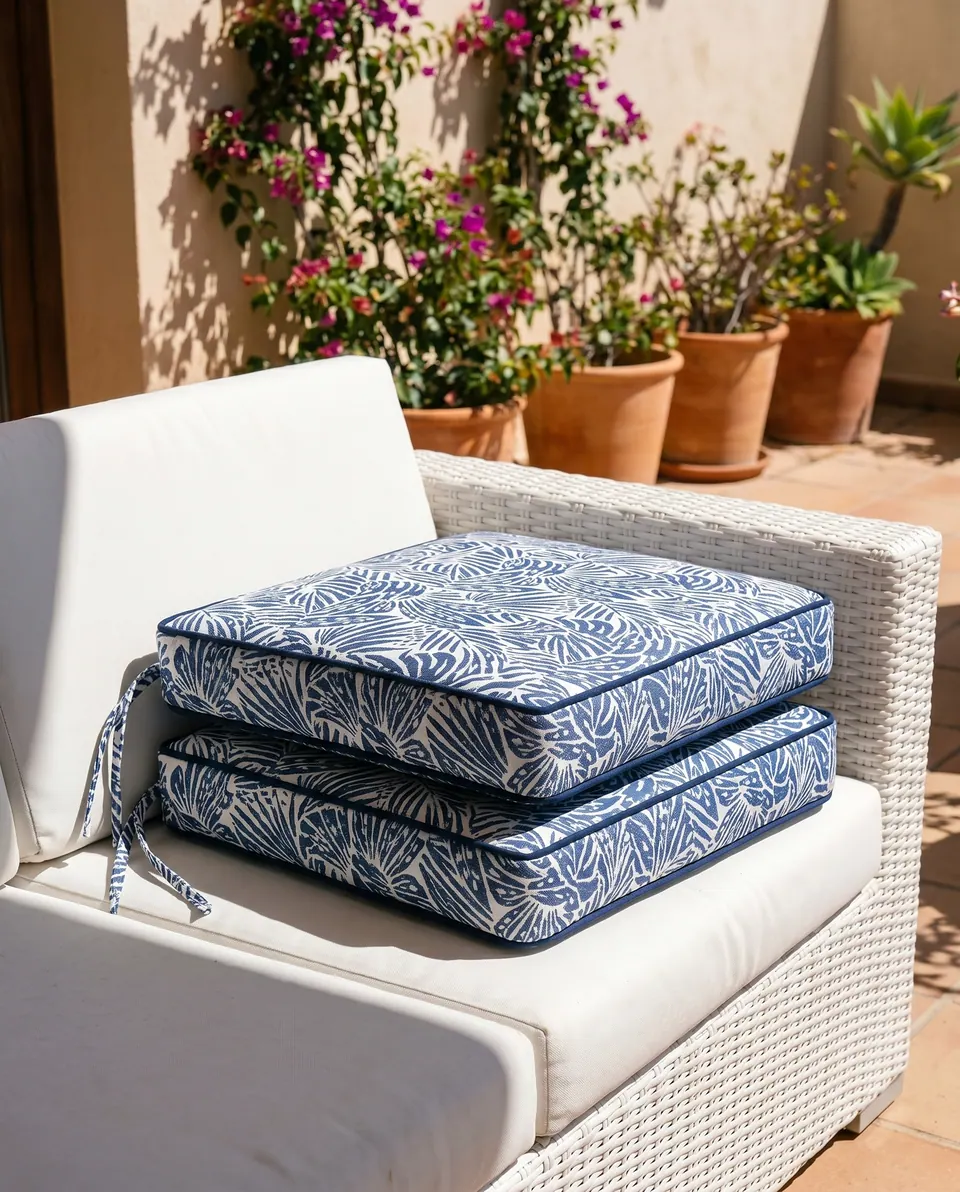
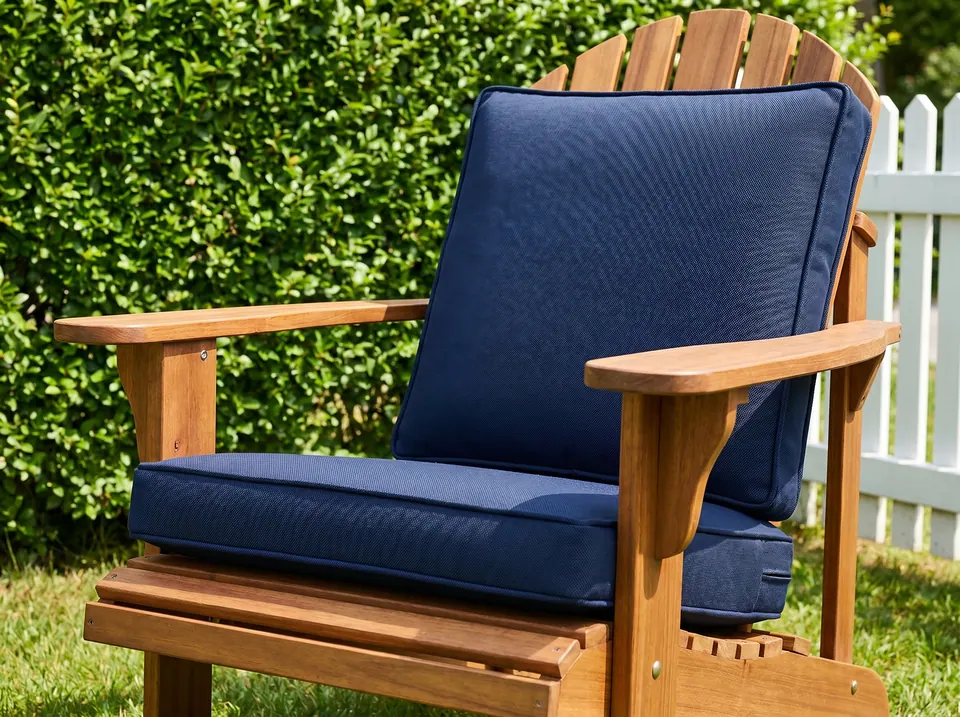
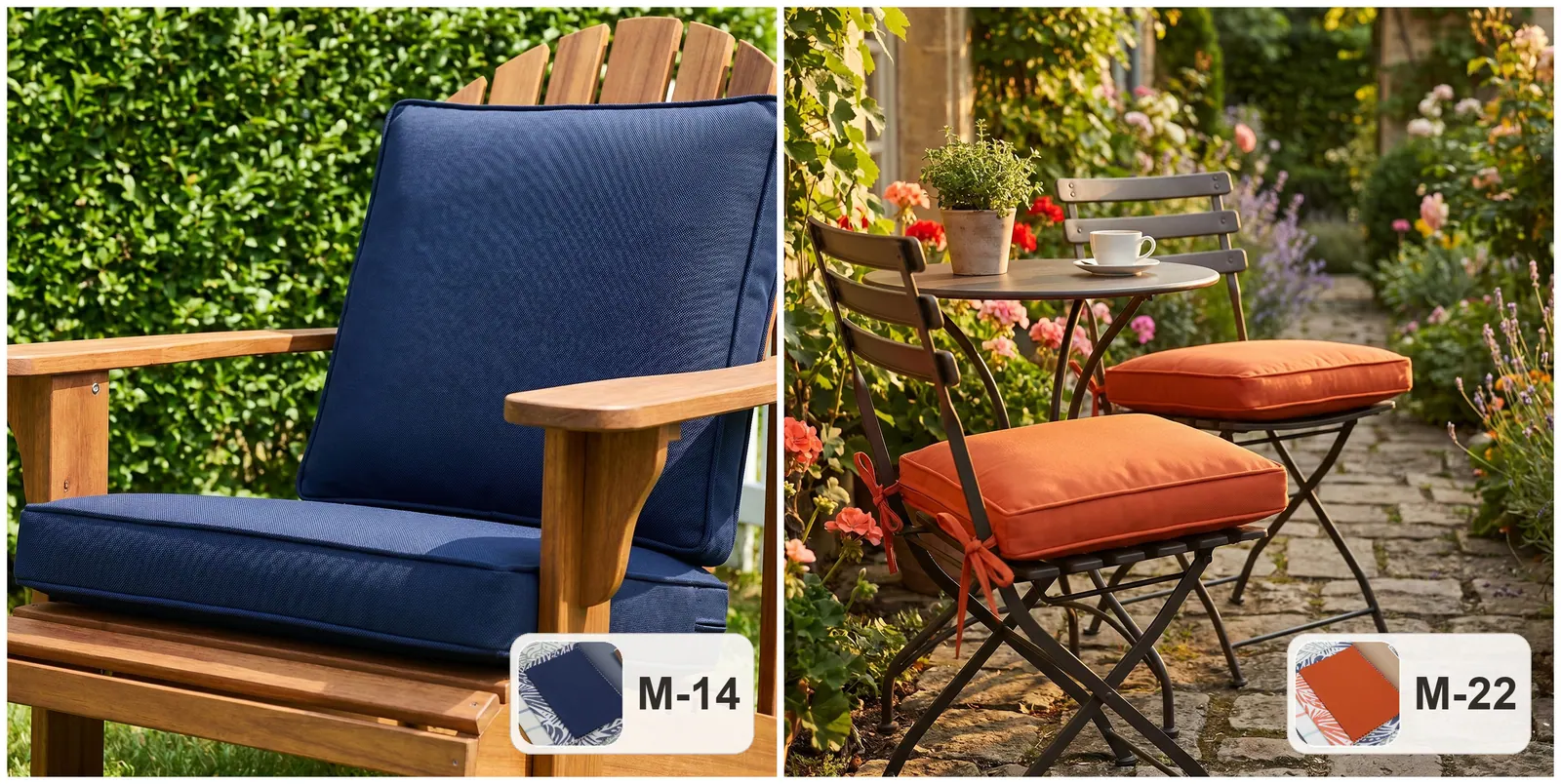
A navy seat and back cushion set fits the sloped seat and tall fan back of a classic Adirondack chair. Back height, measured up the slats
Run the tape from the crease where seat meets back, up the slats to the top slat or to wherever you want the cushion to end. If the back cushion will stand on the seat cushion, take the seat thickness off: back height is the slat run minus the seat thickness.
Pattern sheet Drawn upright for clarity. On an Adirondack, run the tape along the reclined slats. 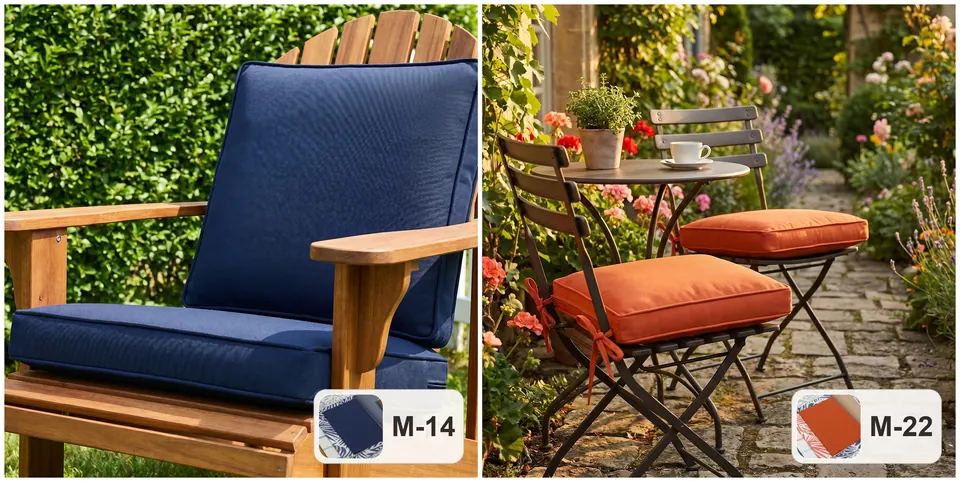 Save
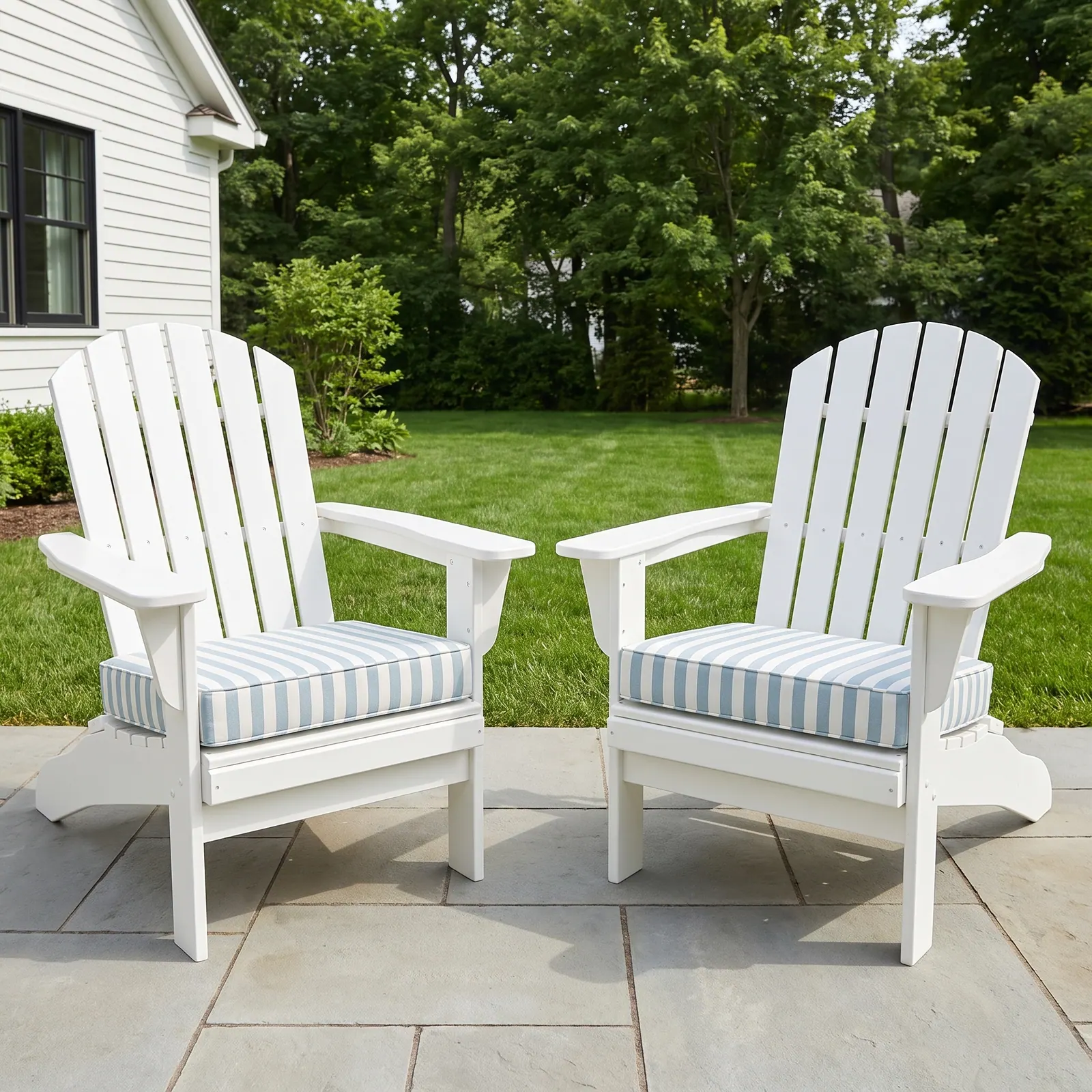
A deep navy seat-and-back set softens a slatted Adirondack chair, while burnt orange tie-on pads warm a black bistro pair on a garden path. Mark the tie points
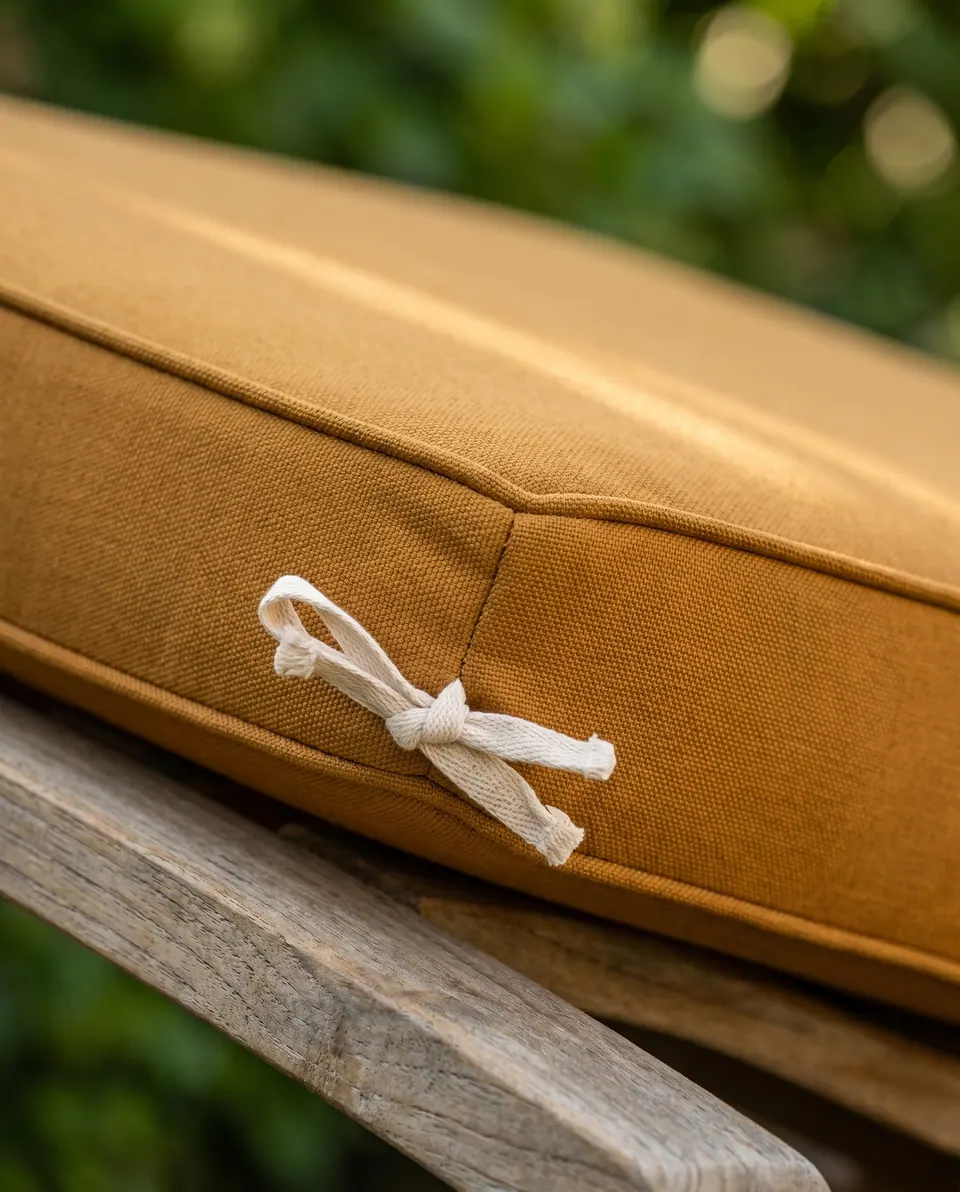
Find where a tie can wrap: the gap at the crease between the last seat slat and the first back slat, and the top slat or the gap just below it. Measure each spot from a named corner and write it down. Ties are sewn in only when you ask. The tie placement Pattern shows the usual spots.
 Save
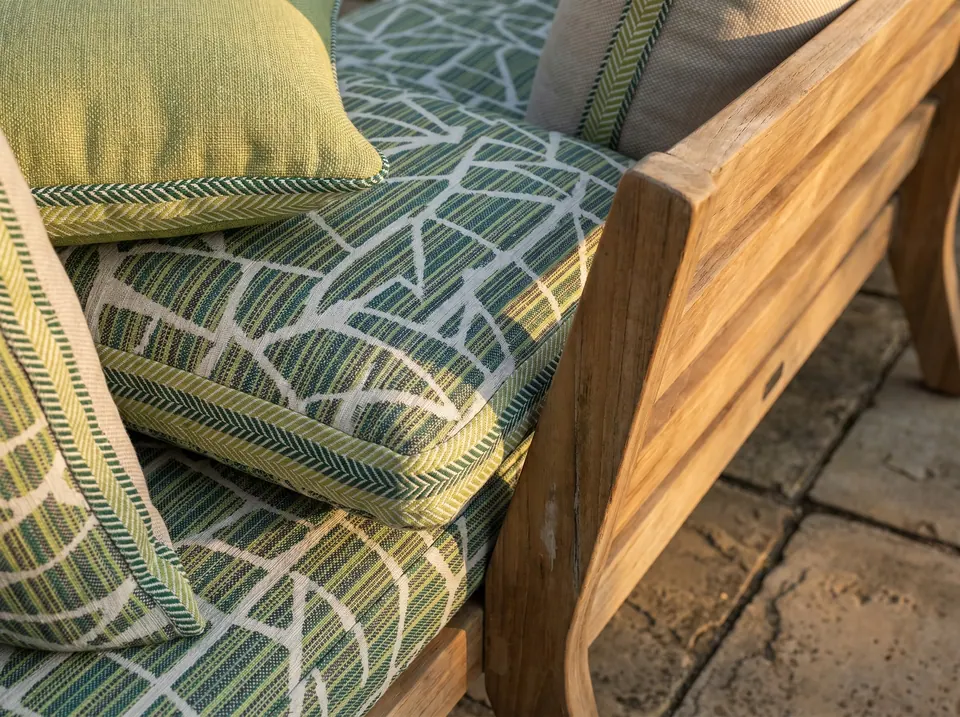
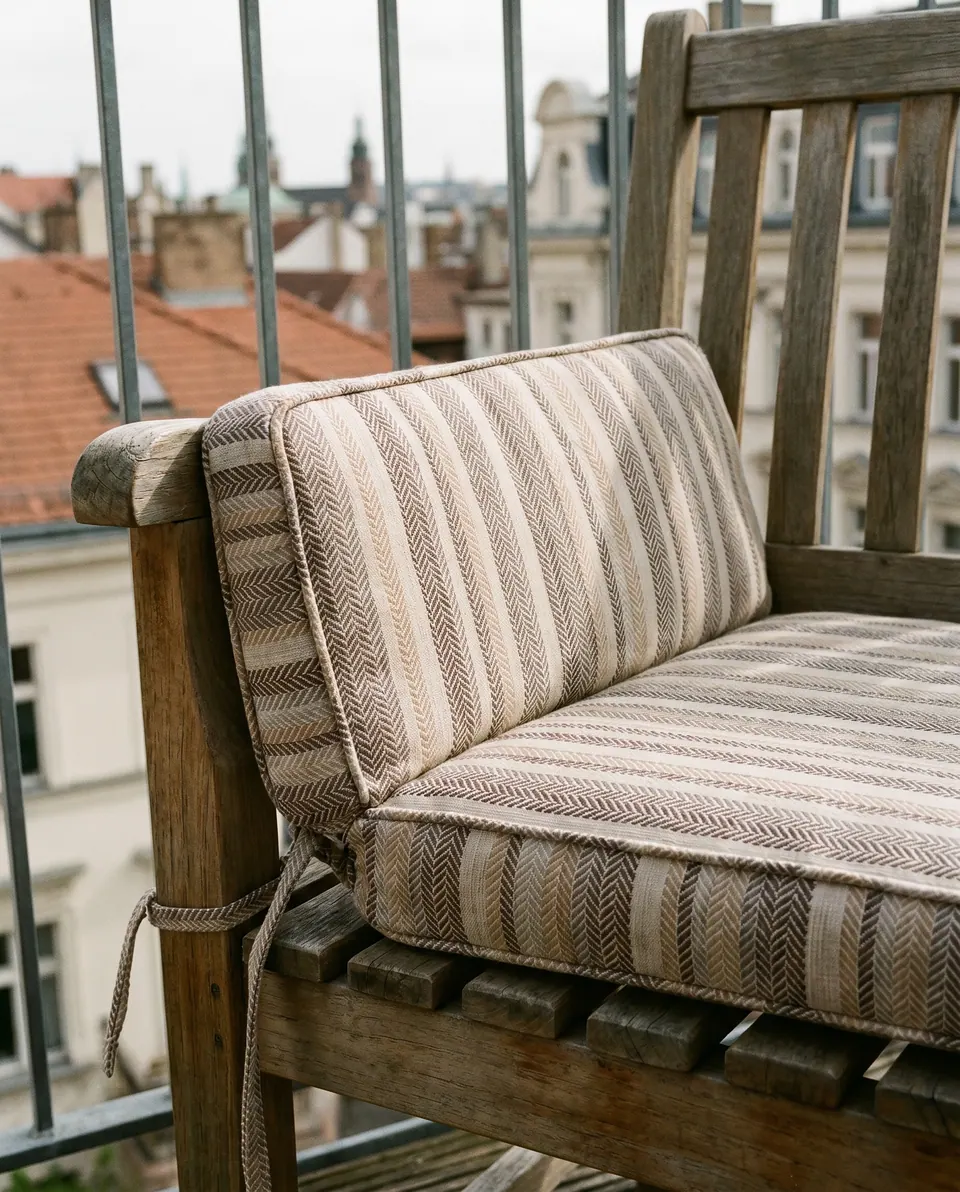
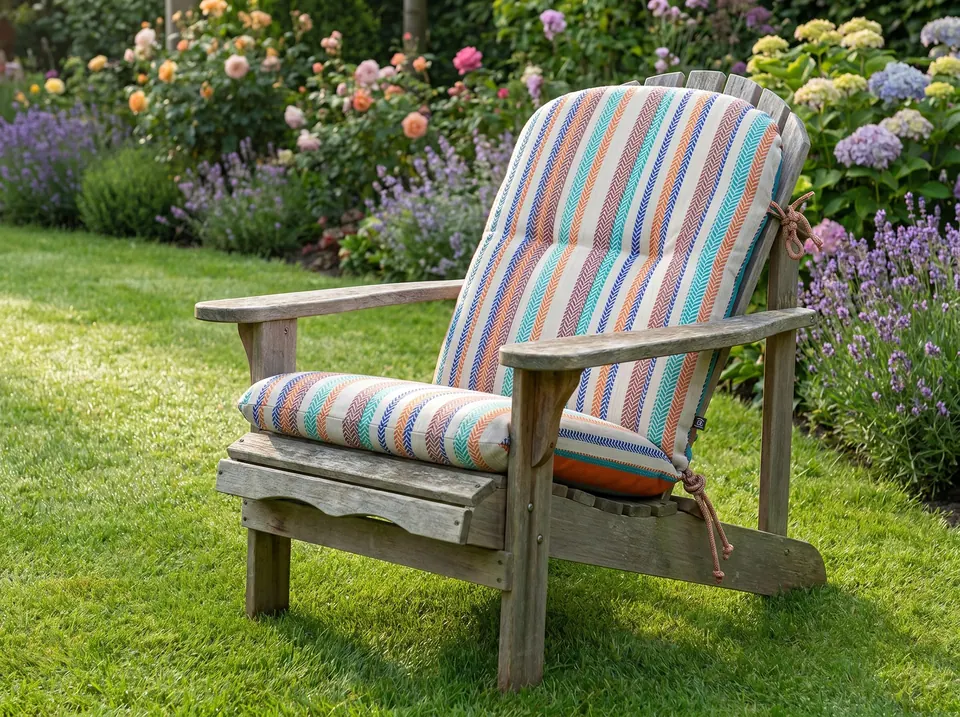
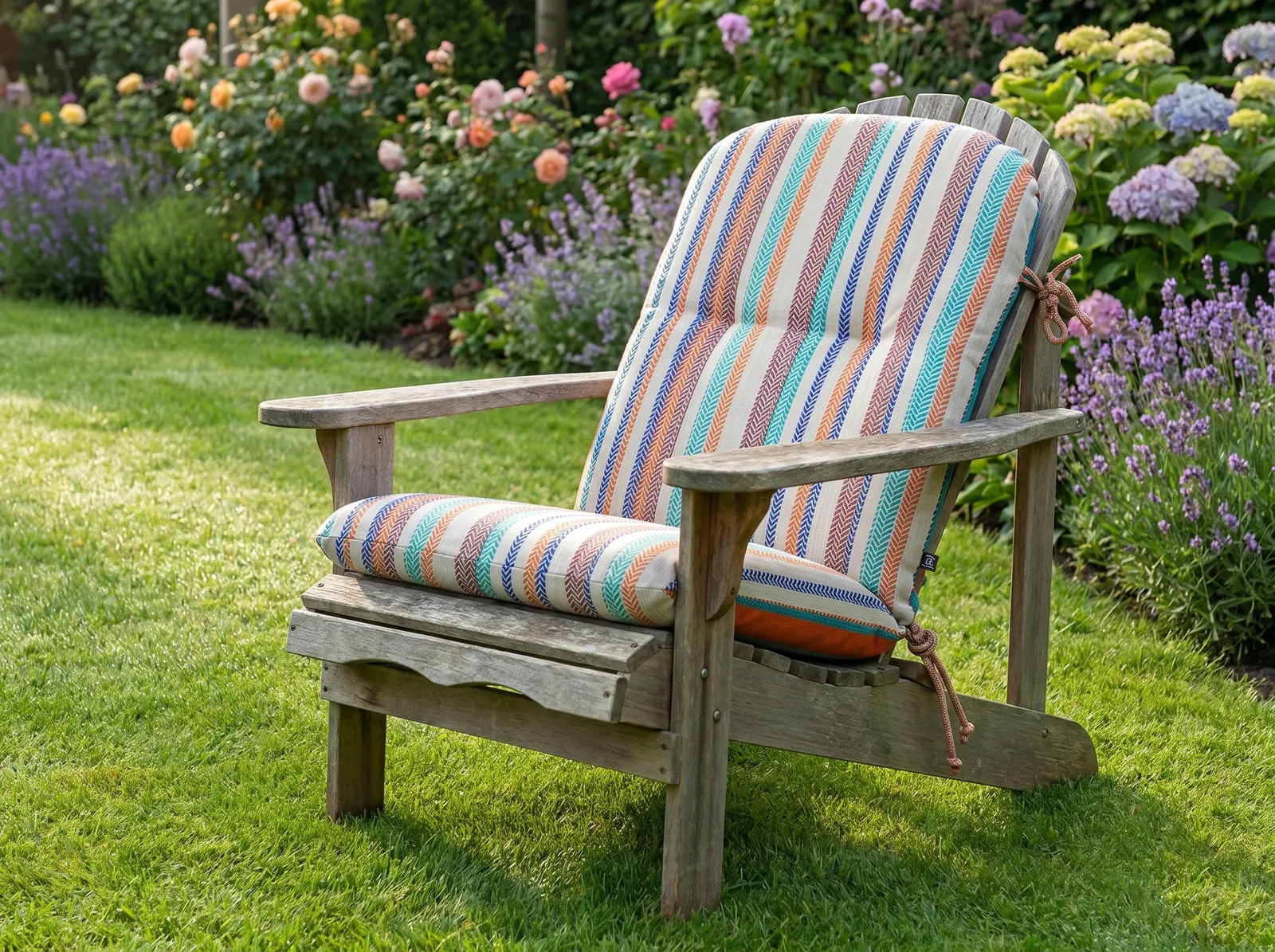
A high-back cushion in a bright herringbone stripe follows the steep recline of a weathered Adirondack chair. Photograph the chair and type the numbers
Take one photo straight on and one from the side, tape in the shot, then type every number on a simple sketch. The workshop redraws seat and back as a clean diagram and waits for your approval before cutting. The chair cushion builder previews a tapered seat with a back tied at the top.
Have it made
Measured it? Have Callum’s workshop make it
Short list: size, sun hours, how fast it has to dry. The workshop goes through it with you. — Callum
Leave your details and the workshop will call you to confirm measurements, fabric, foam and piping. No prices, dates or payment on this page: it is a request, not an order.
Seat pad, two pieces, or one long cushion
| Build | What it covers | Ties | Worth knowing |
|---|---|---|---|
| Seat pad only | The seat; the slatted back stays bare | Two at the back corners, into the crease | The simplest fit. Ready-made seat pads run near 20 in wide and 18.5 in deep; yours may not. |
| Seat plus a separate back | Seat and most of the fanned back | Seat at the back corners; back at the top slat | Each piece is its own cushion and its own item. Write 'backrest' in the note. |
| Two pieces tied together | Seat and back, joined at the crease | Ties join back to seat, plus a pair at the top | Ties can tie a backrest to a seat. Give their positions in writing. |
| One long cushion, seat to top slat | The whole chair in one run | At the top and near the crease | Ready-made ones run about 44 to 50 in long. Ask the workshop how the fold would be built before you order. |
Whichever build you choose, a matching back can be added later by quoting the fabric code from the first order.
Thick enough to sit on, thin enough for the arms
Outdoor makers cut Adirondack cushions from about 2 to 4 in thick, the thinner end firmer and 4 in on the plush side. For garden armchairs the workshop has recommended a 3 to 4 in (8 to 10 cm) seat of 32-density HR foam wrapped in polyester wadding, with ties at the back corners. Its standard seat is 4 in (10 cm).
Here is what the catalogs skip. Every inch of seat cushion lifts you an inch against those wide flat arms. Stack folded towels to 2 in, then to 4 in, sit, and notice where your elbows land before you choose.
The back is its own decision. A back cushion can be firm foam like the seat, structured and upright, or a soft filled pillow that is plumper and more relaxed. On a steep recline, a wedge that is thicker at the bottom fills the crease where seat meets back.
So what does your chair measure across the back of the seat, friend: the same as the front, or less?
A windy yard, two wedge backs and a request for straps
A buyer in the US wrote to the workshop from a windy spot. The order was two seat cushions at 33 x 30 x 4 in (84 x 76 x 10 cm) and two backs at 32 x 13 in (81 x 33 cm), thicker at the bottom like a wedge, in outdoor fabric. They wanted ties or hook-and-loop straps so nothing ended up across the lawn.
Ties are the workshop's usual answer, along with a non-slip bottom. Hook-and-loop tabs and snap fasteners aren't made. A two-sided strip, one side sewn under the cushion and the other fixed to the frame, has been added on request at extra cost.
On a windy yard I'd put two ties at the back corners of each seat and two at the top of each back. A tall back catches a gust like a sail, so it wants holding first.
- Measured
- Seats 2 x 33 x 30 x 4 in; wedge backs 2 x 32 x 13 in
- What it taught
- Wedge backs make a reclined seat comfortable, and ties at the crease and the top keep the set where you left it.
Rain, sun and the first frost
A lawn chair needs outdoor fabric. The workshop's outdoor range is water-repellent and UV-resistant, with zippered covers that come off for washing; see outdoor acrylic. It sheds a shower. It is not sealed.
Rain doesn't negotiate, and the foam matters as much as the cover. Standard seat foam holds water once it gets in. Quick-dry reticulated foam lets it drain, and it suits cushions that sit out through weekly rain, but it isn't the workshop's standard, so ask before you order. The dry-fast foam Pattern says when to insist.
For everyone else: stand the cushions on edge under the roof when a storm is coming, and bring them indoors for winter. The outdoor cushion care Pattern covers the season from spring rain to first frost.
Where Adirondack orders go sideways
- Measuring the chair, not the seat. Overall width, depth and height describe the frame. Measure between the arms, along the slats.
- Stopping the depth where the old pad stopped. One buyer's depth would have left a gap at the front; the workshop caught it in the tape photos.
- One listing, two pieces expected. A cushion listing covers one piece. One buyer needing a seat and a back ended up with three payments and a refund to untangle.
- Ties typed into the size box. Requests there get missed. Put count, position and length in the personalization note, then check the photo taken before shipping.
- Approving the drawing at a glance. One approved schematic had a piece 23 in shorter than the buyer intended. Check every length.
- A pair with two stripe directions. On matching chairs, ask for the stripe to run the same way on both so they read as a set.
An Adirondack seat slopes and its back reclines, so measure along the slats: seat front, seat back, depth, back bottom, back top and height.
Callum Reid
Buyer questions: tapered seats, backs and ties
- A common question
How do I measure a chair seat that's wider at the front than the back?
The workshop's answerMeasure the seat itself, not a product page: the depth plus the front and rear widths, for example 21 in deep, 19 in at the back and 20.5 in at the front. Shaped seats also need the widest width and the depth at left, center and right. The shop sends a sketch to confirm before cutting.
- A common question
Can the back cushion match the seat, and does it have to be firm?
The workshop's answerBackrests are made to any size in the same fabric as the seat. They can be firm foam like the seat, which stays structured and upright, or a soft filled pillow that is plumper and more relaxed. A matching back can also be added later by quoting your original fabric code.
- A common question
Can I choose exactly where the ties go?
The workshop's answerYes. Ties can be sewn onto any made-to-measure cushion, on the corners, along the back edge or on one side. Write how many you want and where in the personalization box, plus a length if they must wrap a frame. They're sewn into the seam and never added unless you ask.
- A common question
Is there an extra charge for ties?
The workshop's answerIt depends on the order. Ties are often sewn on free, for example on the two back corners of a bench cushion or the back of chair pads; on others there's a small per-cushion charge, paid through a separate link. Put the request in with your exact size so it's in the quote before production.
- A common question
Which of my numbers is the length and which is the width?
The workshop's answerLength is the long side, measured left to right across the front. Width is the short side, front to back, the same as the seat depth. Thickness is how tall the cushion stands. If in doubt, label them, for example '20 in deep x 60 in across'.
Adirondack cushion questions, answered short
How long is a one-piece Adirondack cushion?
Ready-made one-piece cushions run about 44 to 50 in (112 to 127 cm) long and 19 to 20 in (48 to 51 cm) wide. Chairs differ, so measure the seat run along the slats and the back run up to the top slat, then add the two.
Do Adirondack cushions need a non-slip bottom as well as ties?
The sloped seat pushes a cushion forward, which is why makers use ties, non-skid backing or straps. Ties at the crease and the top usually do it. If you want a non-slip bottom too, ask whether the backing is washable before you order.
Can I order the seat pads now and the backs next summer?
Yes. Keep the fabric code from the first order and quote it when you add the backs; each back is made at its own size in the same fabric. Measure the back height with the seat cushion in place, so its thickness comes off.
Should Adirondack cushions stay out overnight?
Under a porch roof, yes. Under open sky, bring them in or stand them on edge under cover when rain is due: the fabric is water-repellent, but standard seat foam holds water once it gets in. Store them indoors over winter.