The Pattern Room · a measuring pattern
Outdoor chair cushions: measuring patio chairs for seats and backs
Patio chairs spend the summer in sun, wind and the odd downpour. Here is how to measure them for cushions that fit, stay put and come through the season in good shape.
 Save
The quick answer
To order outdoor chair cushions, measure the width between the armrests, the seat depth and the back-cushion height you want, with the chairs standing where they will live. The workshop suggests a 3 to 4 in (8 to 10 cm) seat of 32-density foam wrapped in polyester wadding, ties at the back corners on request, and water-repellent outdoor fabric, stored indoors off-season.
The catalog size is the one number that won't fit
The overall size printed in a patio catalog is the one number that won't fit your cushion. It counts the arms, the frame and the curl of the legs. The cushion lives inside all that.
Outdoor chair cushions are cut to the seat you actually sit on: a pad for a dining chair, a seat and back for an armchair, a round for a rope-woven seat. The workshop makes them to measure in outdoor fabric, with ties where the frame can hold them. Benches and swings live under patio and porch cushions, and every outdoor shape under outdoor cushions.
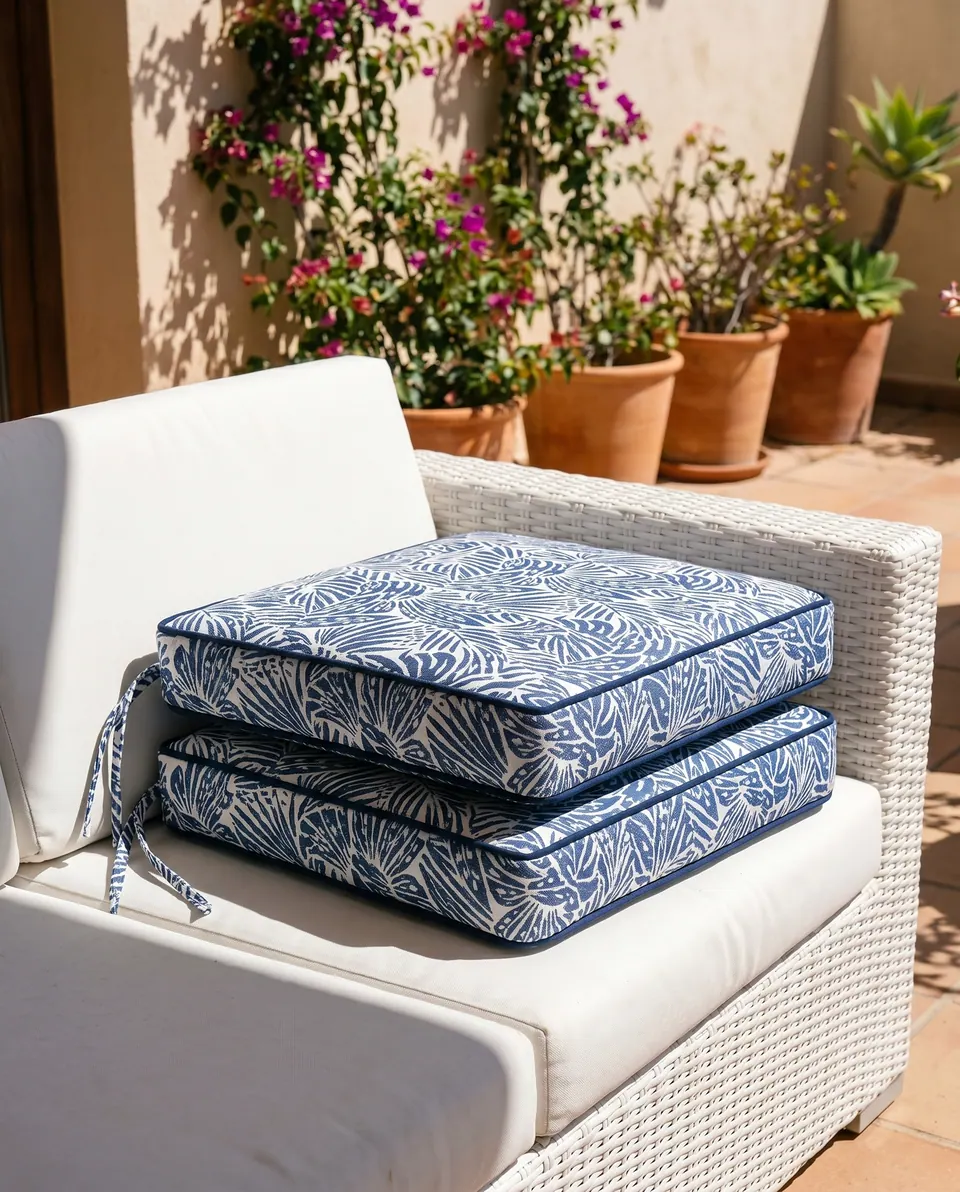
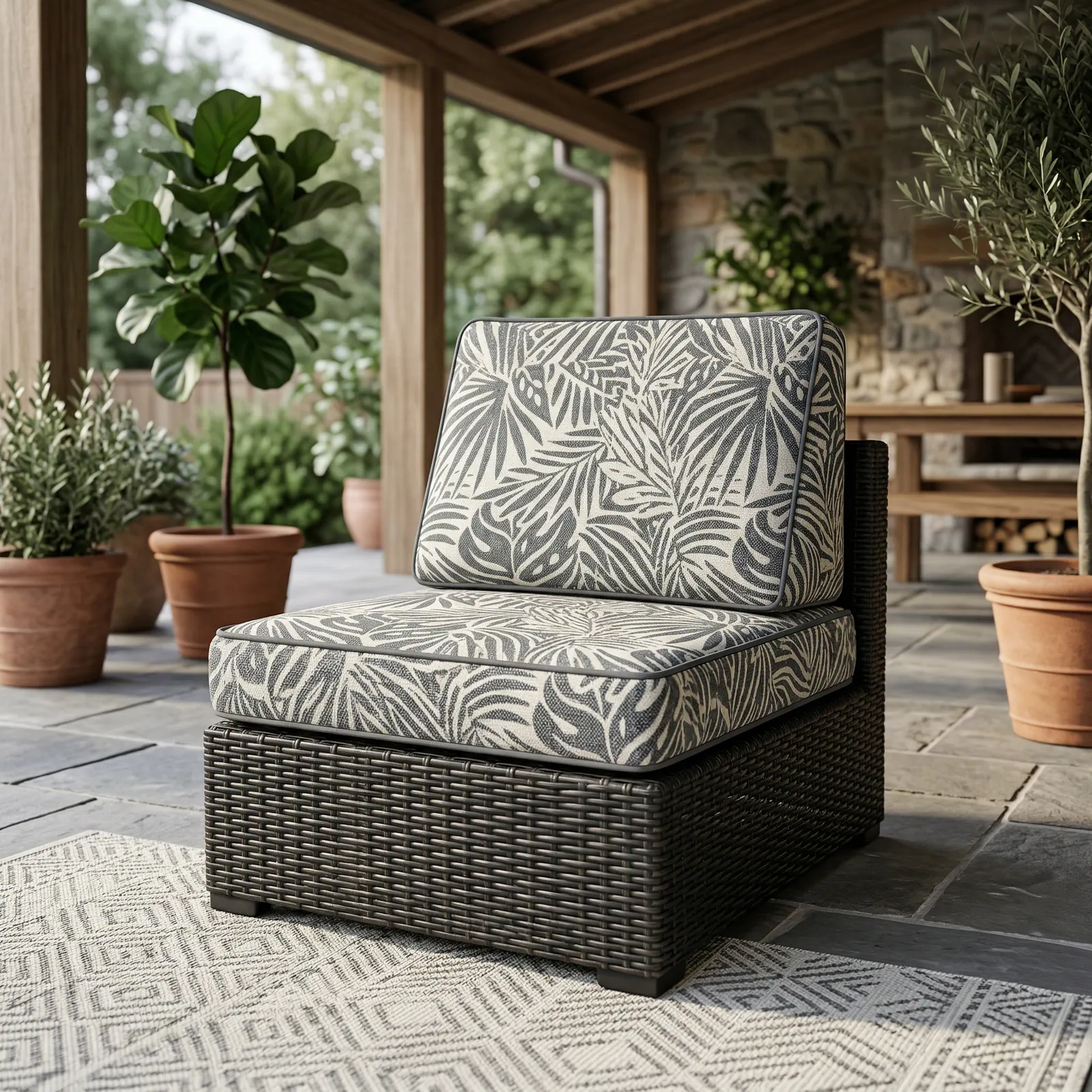
The charcoal palm-leaf set at the top of this page sits on a dark rattan armless chair under a porch roof. The print is placed so a full leaf spray lands on the back cushion, and charcoal piping frames both pieces. Covered, and out of the worst of the weather. Good choice.
On the cutting table: a patio chair seat and back
| Seat thickness | 3 to 4 in (8 to 10 cm) |
|---|---|
| Foam | 32-density (32 kg/m³, about 2.0 lb/ft³) high-resilience foam wrapped in polyester wadding |
| Back cushion | Height measured up from the top of the seat cushion; a standard back is 16 in (40 cm) tall and 4 in (10 cm) thick |
| Ties | Back corners, on request; they can be inset to meet the chair's braces |
| Fabric | Outdoor range: polyester-based with a water-repellent, UV-resistant finish |
| Cover | Zippered and removable for washing |
| Edge | Boxed, piped or plain; keep tufting indoors |
| Not standard | Quick-dry foam and a mesh drainage bottom |
| Order | Seat and back as a pair, quoted together |
Measuring a patio chair for cushions, in eight steps
Set the chairs where they'll live
Measure after delivery, with the chairs assembled and standing on the patio. One buyer asked the workshop for cushions before the chairs arrived, with only the catalog's overall size to go on. The workshop asked them to wait and measure the real thing.
Measure between the armrests
Take the width inside arm to inside arm, at seat level. If the seat is wider at the front, give the front and back widths separately. On an armless chair, measure the seat edge to edge.
Measure the seat depth
Run the tape from the front edge of the seat to the back frame, straight, at a right angle to the front. The back cushion will stand on the seat and take some of that depth, so on a shallow chair ask for a slimmer back.
Decide the back height
Measure up from where the top of the seat cushion will be, not from the bare seat. Or take the frame height and subtract the seat thickness: a 21 in (53 cm) back frame with a 4 in (10 cm) seat wants a 17 in (43 cm) back. The back cushion height Pattern has more.
Trace anything curved
Horseshoe, barrel-back and rounded seats need a drawing or a tracing. Lay paper on the seat, trace the edge, write the widest width and the depth on it, and photograph it flat from above with a tape measure beside it. No need to mail it. The paper template Pattern shows how.
Mark the ties
Ties are sewn on only when you ask, often at no charge. Write how many and where: two at the back corners suits most chairs, and they can be inset, say 4.5 in (11.5 cm) from each back corner, to line up with the braces. Ask for long ties in windy spots. Chair-by-chair positions are in the tie placement Pattern.
Order the nearest size, write the real one
Pick the dropdown range that covers your widest and deepest numbers; it only sets the price. Type the exact size, thickness and outdoor fabric code in the personalization box. Fractions are fine. Identical chairs go through the quantity field; different sizes get a custom order link. The chair cushion builder helps you check the numbers first.
Check every length on the drawing
The workshop sends a drawing of your numbers before cutting. Read each edge, not just the shape. One outdoor cushion arrived 23 in (58 cm) shorter than the buyer meant because a length on an approved drawing went unchecked.
Have it made
Measured it? Have Callum’s workshop make it
Tell them where it lives. Porch, deck or boat: the weather picks the fabric and the foam before anyone else does. — Callum
Leave your details and the workshop will call you to confirm measurements, fabric, foam and piping. No prices, dates or payment on this page: it is a request, not an order.
Outdoor chair cushions, chair by chair
| Chair | What to send | Thickness to start from | How it stays put |
|---|---|---|---|
| Dining or bistro chair | Front and back width, depth, both side edges | 2 to 3 in (5 to 7.5 cm), per published guides | Ties at the back posts |
| Patio armchair | Width between the arms, seat depth, back height wanted | 3 to 4 in (8 to 10 cm), the workshop's suggestion | Ties at the back corners |
| Rattan or wicker with a curved front | A traced template, or a top-down photo with a tape | Under 3 in (7.5 cm) on one real rattan seat | Long ties around the frame |
| Rope-woven round seat | Diameter edge to edge, measured both ways | Your call; say how it will be used | Ties or a loop |
| Deep-seat lounge chair | Seat depth, often 24 in (61 cm) or more, and back height | 4 to 5 in (10 to 13 cm), per published guides | Ties at the back corners |
A rattan armchair, and the back that needed a second look
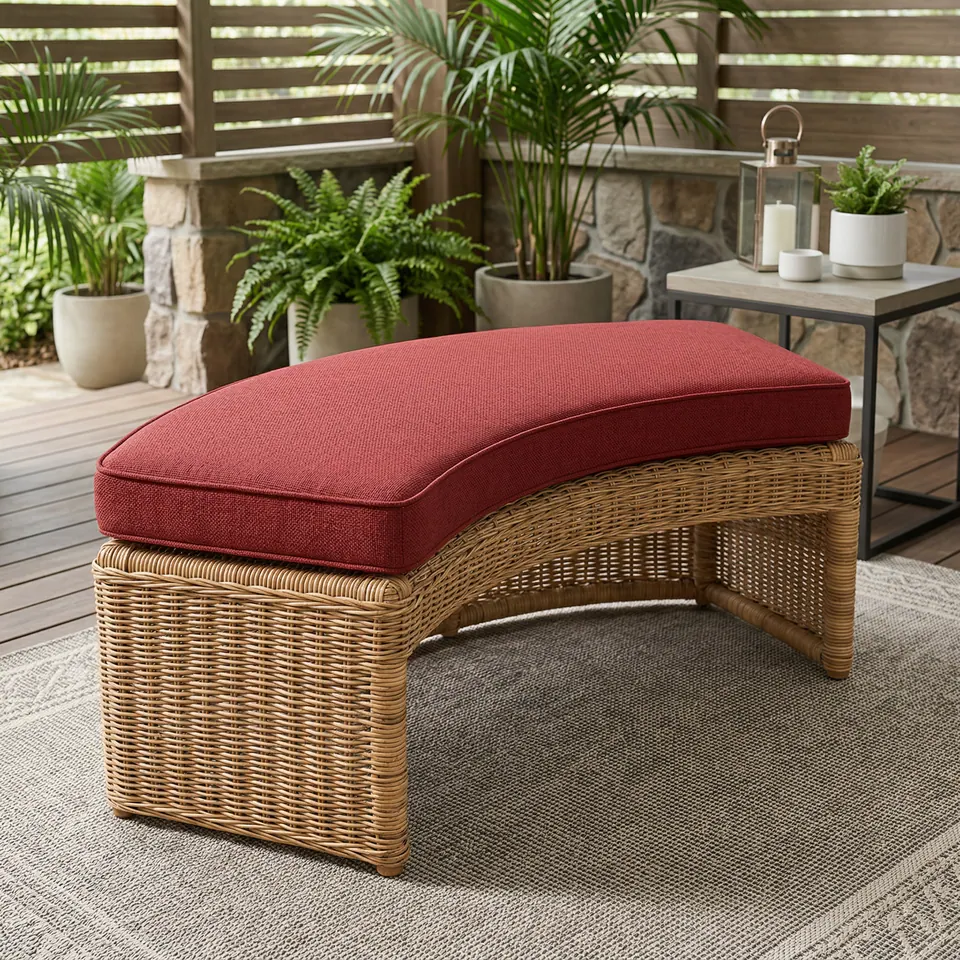
A buyer in the US sent the workshop a classic rattan armchair with a U-shaped seat: a little wider at the front, curved at the back edges. Measured, the seat came to 24 in (61 cm) deep and 21.25 in (54 cm) wide, and they wanted it under 3 in (7.5 cm) thick. Straightforward, the workshop said.
The back cushion was another story. A cushion pressed against a curved rattan frame has nowhere to hide a wrong guess. So before promising anything, the workshop asked for the back's measurements and a straight-on photo of the curve.
That's the forecast for curved chairs, friend. Seat pads are fair skies. Backs against a curve are where the squalls hide.
- What it taught
- Seat pads on curved chairs are easy; back cushions pressed against a curve carry the real fit risk.
Water-repellent fabric, and what it asks of you
Rain doesn't negotiate. The workshop's outdoor range is polyester-based with a water-repellent, UV-resistant finish, and it sheds showers and spills well. It is water-repellent, not sealed: water still finds needle holes and zippers, and the foam inside is standard seat foam, not quick-dry, with no mesh drainage bottom as standard. The full story is in water-repellent vs waterproof, and fibers are compared in acrylic, olefin or polyester.
So these cushions are happiest under a porch roof, or brought in when a storm is forecast. After a soaking, stand them on edge to drain. Before the first frost, clean them, dry them right through and store them indoors; one outdoor fabric maker estimates off-season storage often doubles a cushion's life. The routine is in outdoor cushion care and winter storage.
Keep outdoor chair cushions plain, too. Button tufting lets water in, even in outdoor fabric. And leave indoor velvet and linen indoors; order from the outdoor charts, where any color and piping combination is possible. How many hours of direct sun does your patio get by noon?
Where patio chair cushion orders go wrong
- Ordering from the catalog's overall chair size instead of measuring between the arms.
- Assuming ties come standard. They are sewn on only when you ask.
- Typing the tie request into the size box, where it can be overlooked. Use the personalization note, then confirm by message.
- Buying one seat cushion and expecting the back to come with it. Each piece is its own item.
- Choosing indoor fabric for an open patio. Orders like that have had to be canceled and placed again from the outdoor range.
- Leaving cushions out through a wet winter. The foam isn't quick-dry.
- Approving a drawing by its shape alone. Read every length.
Outdoor chair cushions are water-repellent, not waterproof. Bring them in before a storm, and stand them on edge to drain after rain.
Callum
Buyer questions: patio chairs
- A common question
Can you make tie-on pads for our outdoor dining chairs?
The workshop's answerYes. Chair pads are made to your seat measurements with ties at the back, which you can select at checkout on the chair cushion listing. For shaped seats, send a photo of the chair and a simple diagram with every edge measured, both sides as well as front and back, plus the quantity and thickness. Round seats work too, such as a 12 in (30 cm) pad 4 in (10 cm) thick with a zip cover and ties or a loop.
- A common question
The chair cushion listing only shows indoor fabrics. Can I still get it in outdoor fabric?
The workshop's answerYes. Most cushions can be made in outdoor-rated fabric. Pick a code from the outdoor charts, which the workshop also sends on request, and write it in the personalization box of the listing you order from, or order straight from the outdoor listing. That is how chair pads end up matching an outdoor bench: every piece in the same outdoor fabric.
- A common question
Will these cushions survive the rain, or are they only water resistant?
The workshop's answerThe outdoor range is its own fabric line with its own color chart, and in practice it is water-repellent rather than sealed: it handles showers and spills well and stands up to the weather. For a bigger patio order you can order one cushion first to check the fit; in one case that took about 5 days to make and 3 to 4 days to arrive. Store cushions indoors during long off-season stretches.
- A common question
My chair seat isn't a size in the dropdown. How do I order the exact measurement?
The workshop's answerChoose the dropdown range that covers your widest and deepest numbers; it only sets the price. Then type the exact size, thickness and fabric code in the personalization box, which is what the cushion is made from. Half and quarter inches are fine, and so are centimeters. For identical chairs, set the quantity; if sizes differ, send each one and the workshop creates a custom order link.
- A common question
How do I measure a horseshoe or barrel-back chair seat?
The workshop's answerMake a paper template: lay paper on the seat, trace the edge, cut it out and write the widest width and the front-to-back depth on it, then photograph it flat from above with a tape measure in view. Without a template, send the width and depth, where the curve starts and ends on each side, how deep it runs, and a top-down photo of the whole seat. The craftsmen check the shape and confirm with you before you order.
- A common question
Can you put hook-and-loop strips on instead of ties?
The workshop's answerTies or a non-slip bottom are the usual ways to stop a cushion moving, and the workshop normally suggests one of those. Hook-and-loop tabs and snaps aren't made. A two-sided hook-and-loop strip has been added on request, one side sewn under the cushion and the other sent to fix to the furniture, at extra cost. Ask in the personalization box and wait for confirmation.
Patio chair cushion questions, answered short
Is a patio dining chair pad thinner than an armchair seat cushion?
Usually, yes. Published guides put outdoor dining chair pads at 2 to 3 in (5 to 7.5 cm), slim enough to keep you at table height. For patio armchairs you sit back in, the workshop suggests 3 to 4 in (8 to 10 cm) of 32-density foam wrapped in polyester wadding.
Can I order a patio chair seat cushion without a back?
Yes. Each cushion is its own item, so a seat pad alone is fine. If you want both, order them as a pair so the workshop quotes them together and cuts them at the same time. A seat never includes a back unless you add one.
Do outdoor chair cushions need piping?
No. Piping is included at no extra cost and can match or contrast, but outdoor cushions can be made without it for the same price. On a printed fabric, a piping color taken from the darkest ink in the print frames the seat neatly.
Will ties hold a cushion on a windy balcony?
Ties are your best defense. Ask for them at the back corners, or for longer ties on exposed spots such as high balconies and beach houses, and knot them around the uprights. A cushion cut too small will still shift, so start with honest measurements.