A Reading by NateBench Cushions
Terracotta bouclé on a walnut bench: a custom bench cushion, layer by layer and season by season
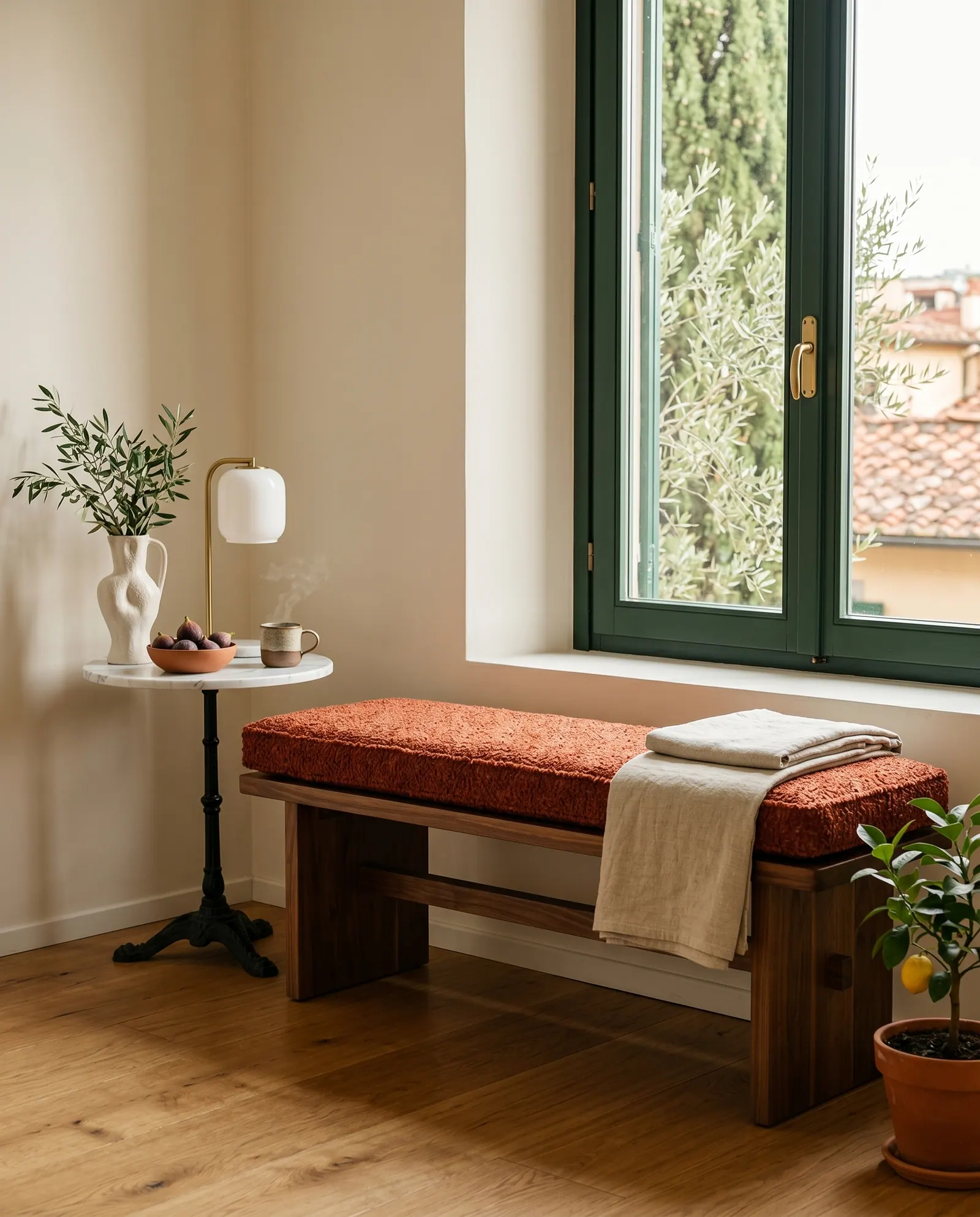
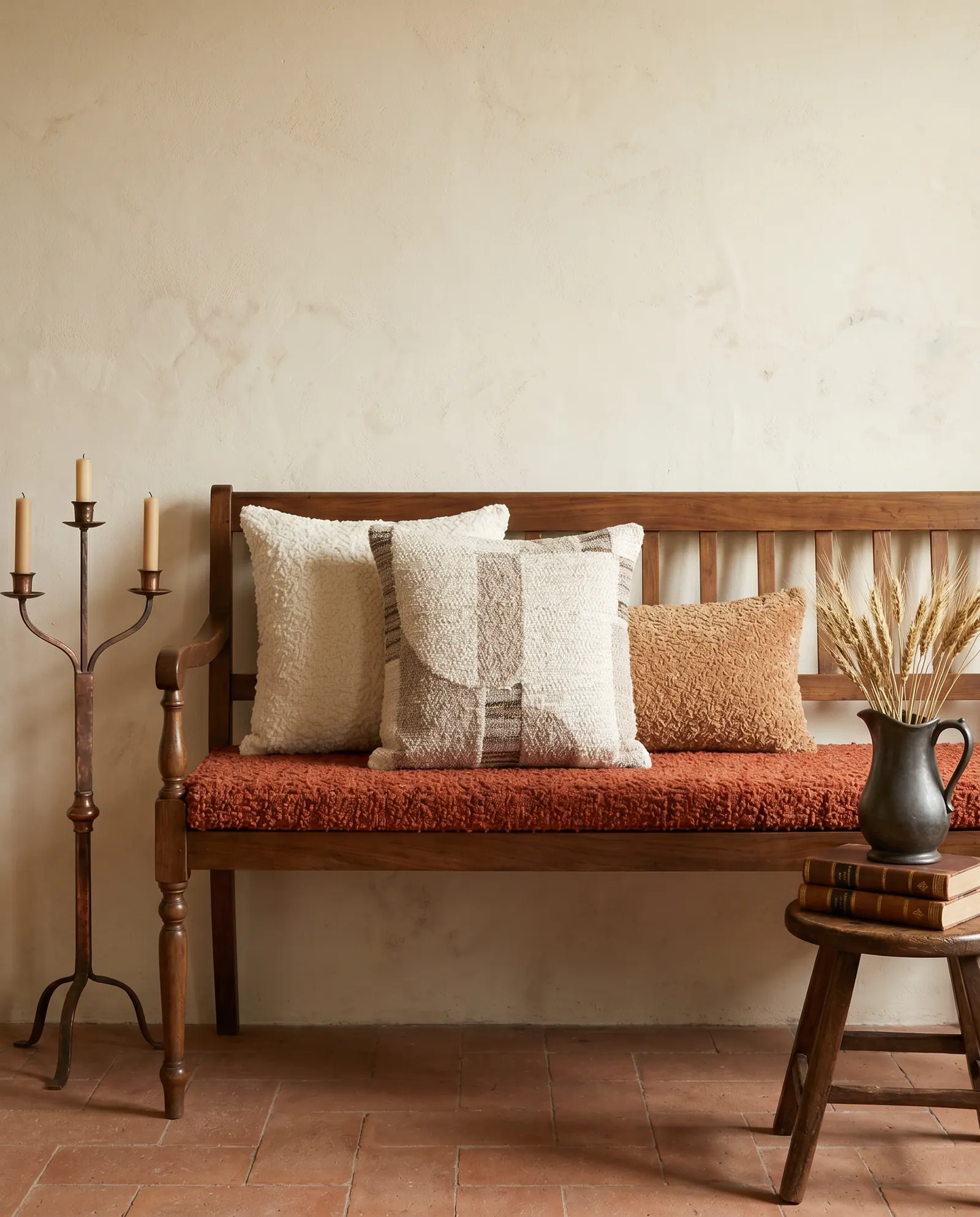
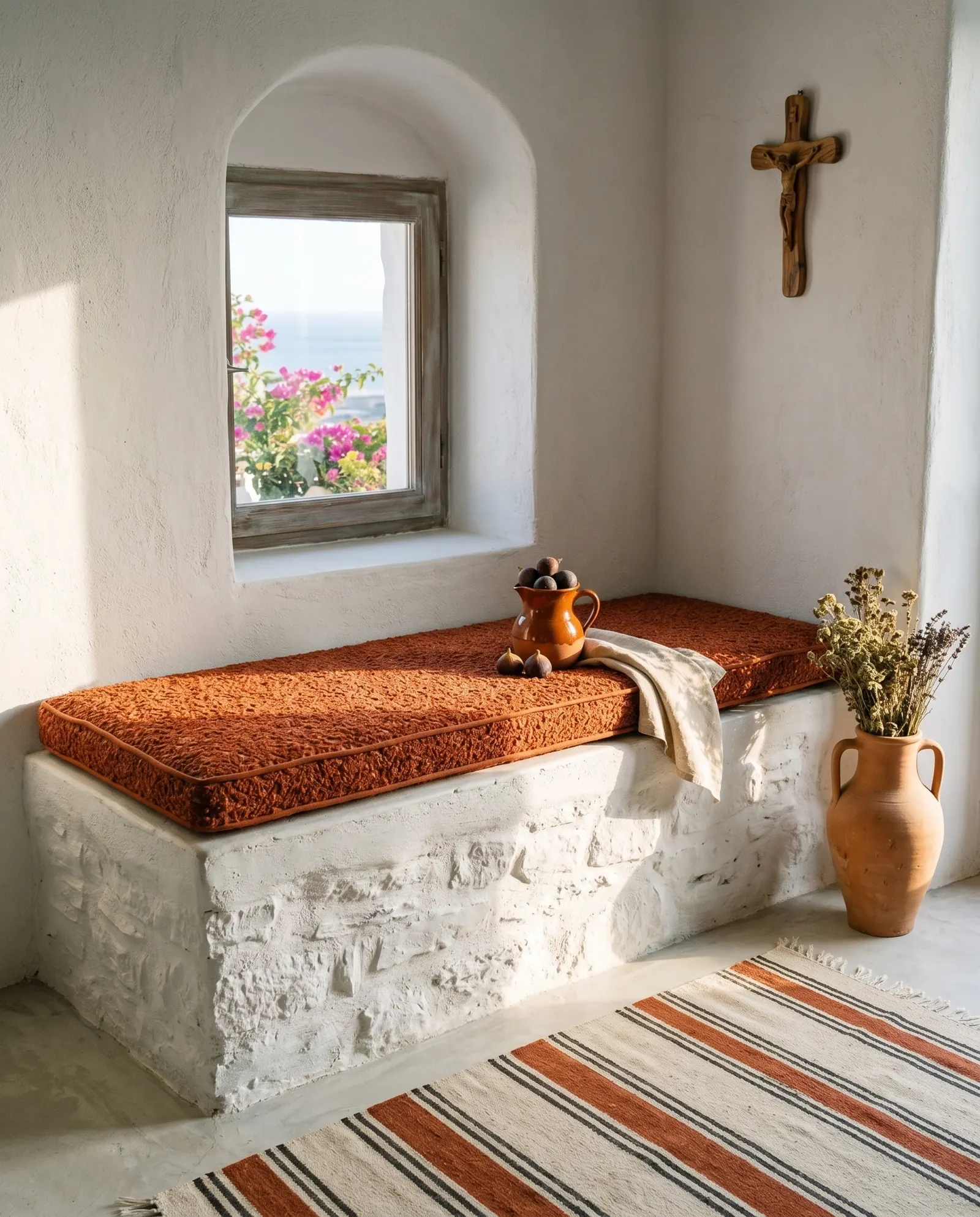
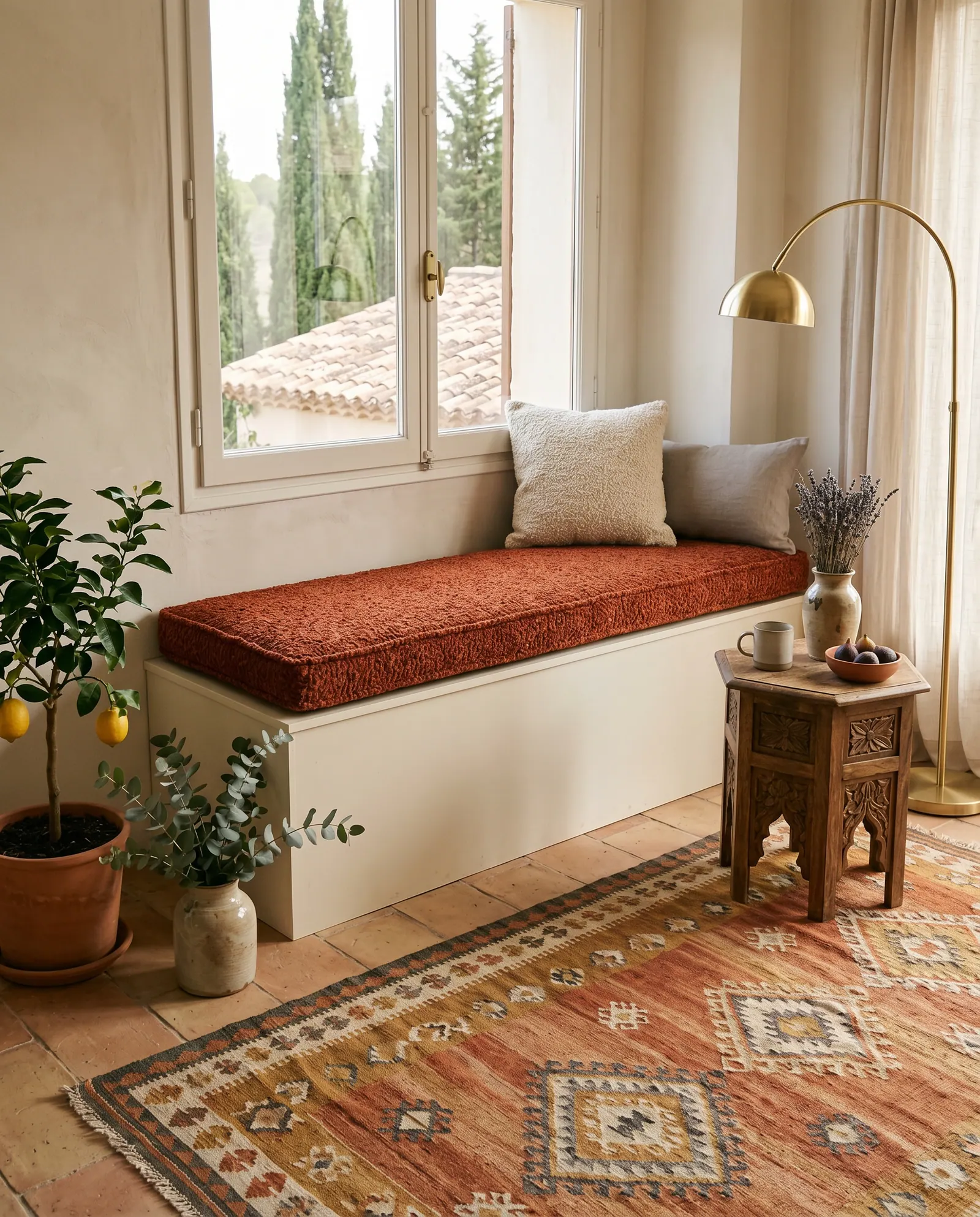
No piping, one boxed edge, a nubby rust-red cover and a window that changes all year. I took this bench apart on paper to see what each season asks of it.

 Save
The quick answer
A terracotta bouclé custom bench cushion suits all four seasons indoors if you plan for sun in summer, spills in fall and dry heat in winter. Turn it end to end so one end doesn't take all the window light, blot spills without rubbing the loops, and keep a linen throw on hand for bare-leg months.
The cushion, cut open
Cover fabric. A removable, zippered cover. Machine wash at 86°F (30°C) on a gentle cycle and air dry.
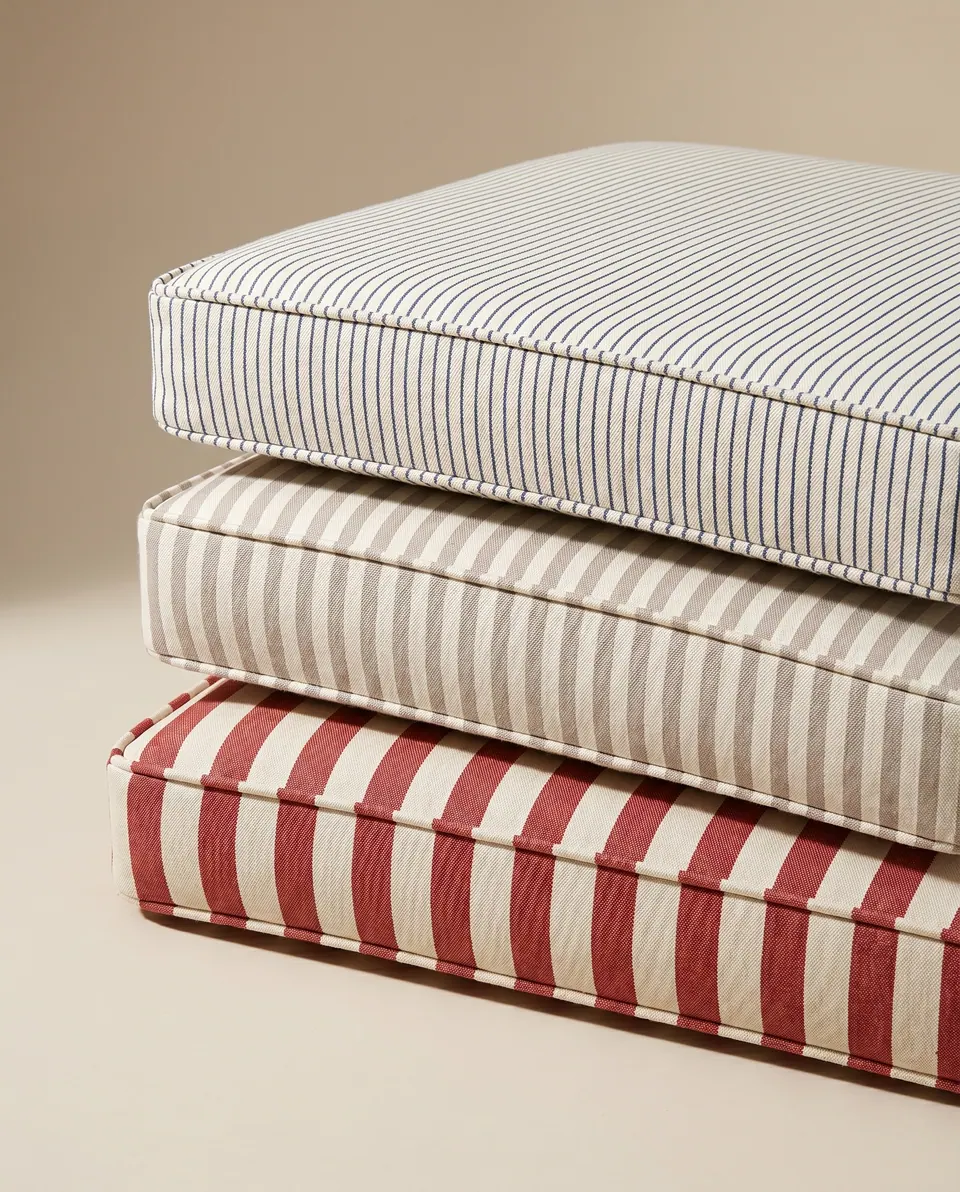
Piping. A fabric-covered cord sewn into the seams. It sits on the seam line, so it does not change the size.
Fiber wrap. Polyester fiber (Dacron) batting around the foam: it fills the cover out and softens the edges.
Foam core. About 2.0 lb/ft³ (32 kg/m³) high-resilience foam, firm to medium-firm, cut to the ordered size.
Zipper. Along the back band, as hidden as possible. The zipper side faces down or toward the wall.
Base panel. The underside of the cover. A non-slip fabric backing can cover the whole of it instead.
Pinned by Nate: five parts of a clay-and-olive corner
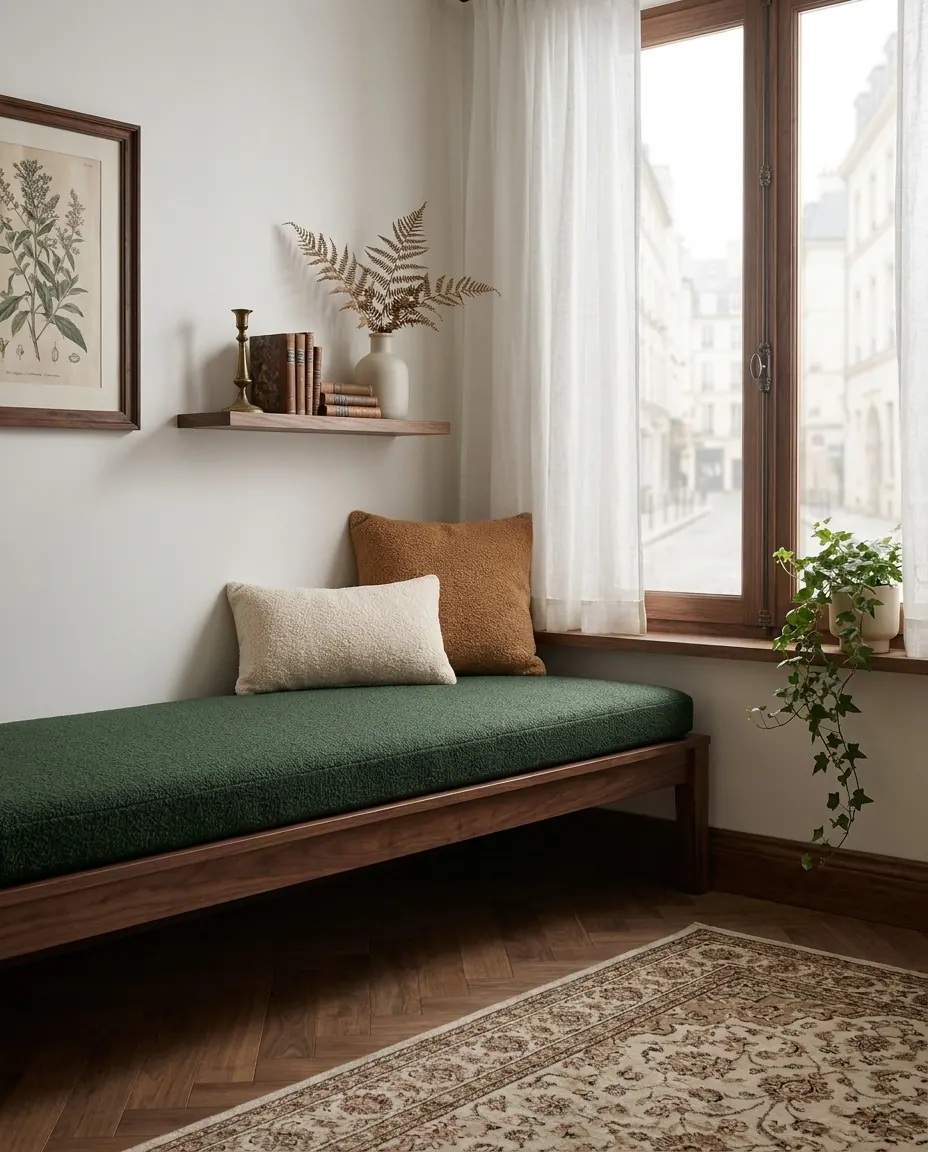
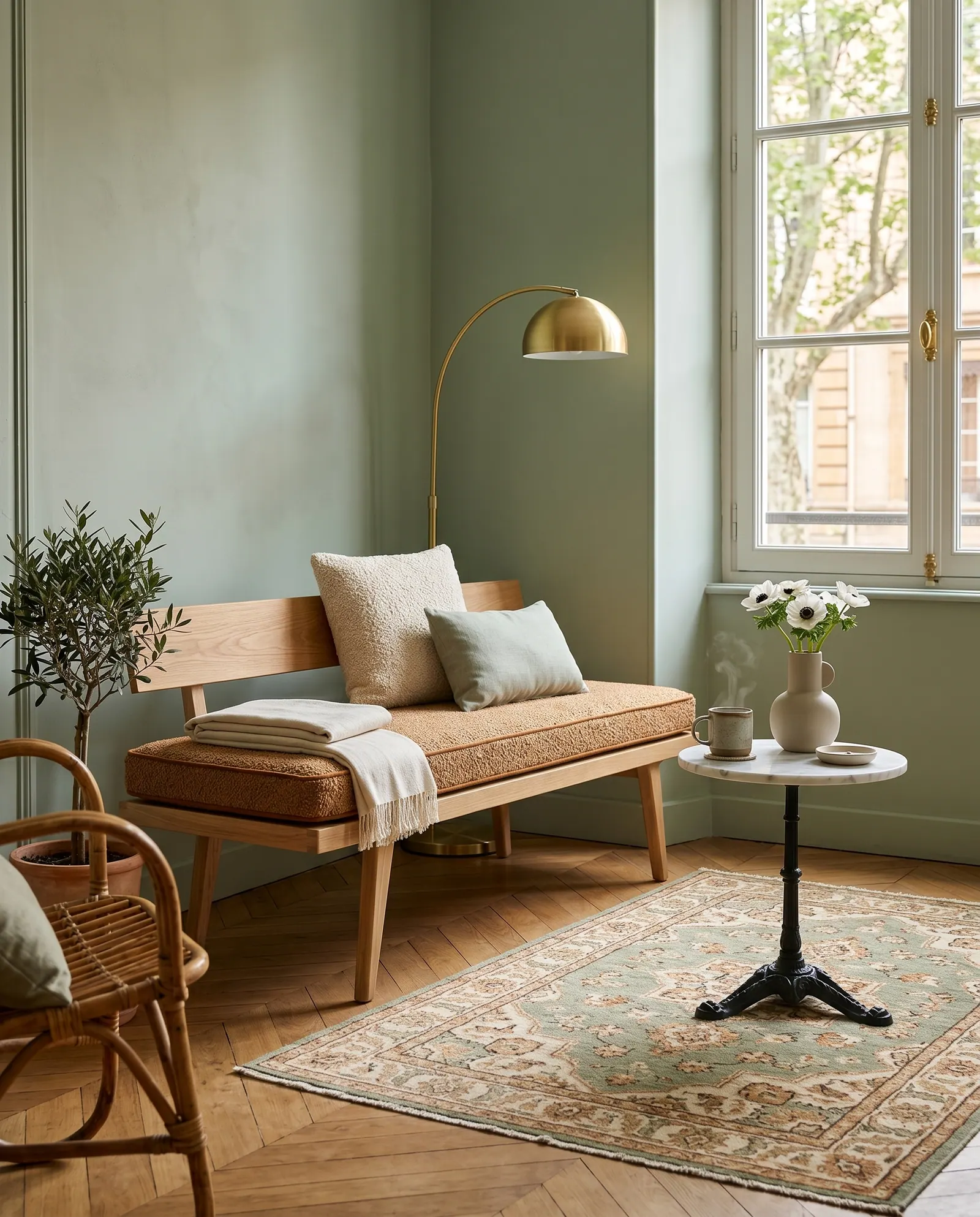
Five pins mark the terracotta bouclé, the folded linen, the marble bistro table, the olive branches and the lemon tree at the far end.
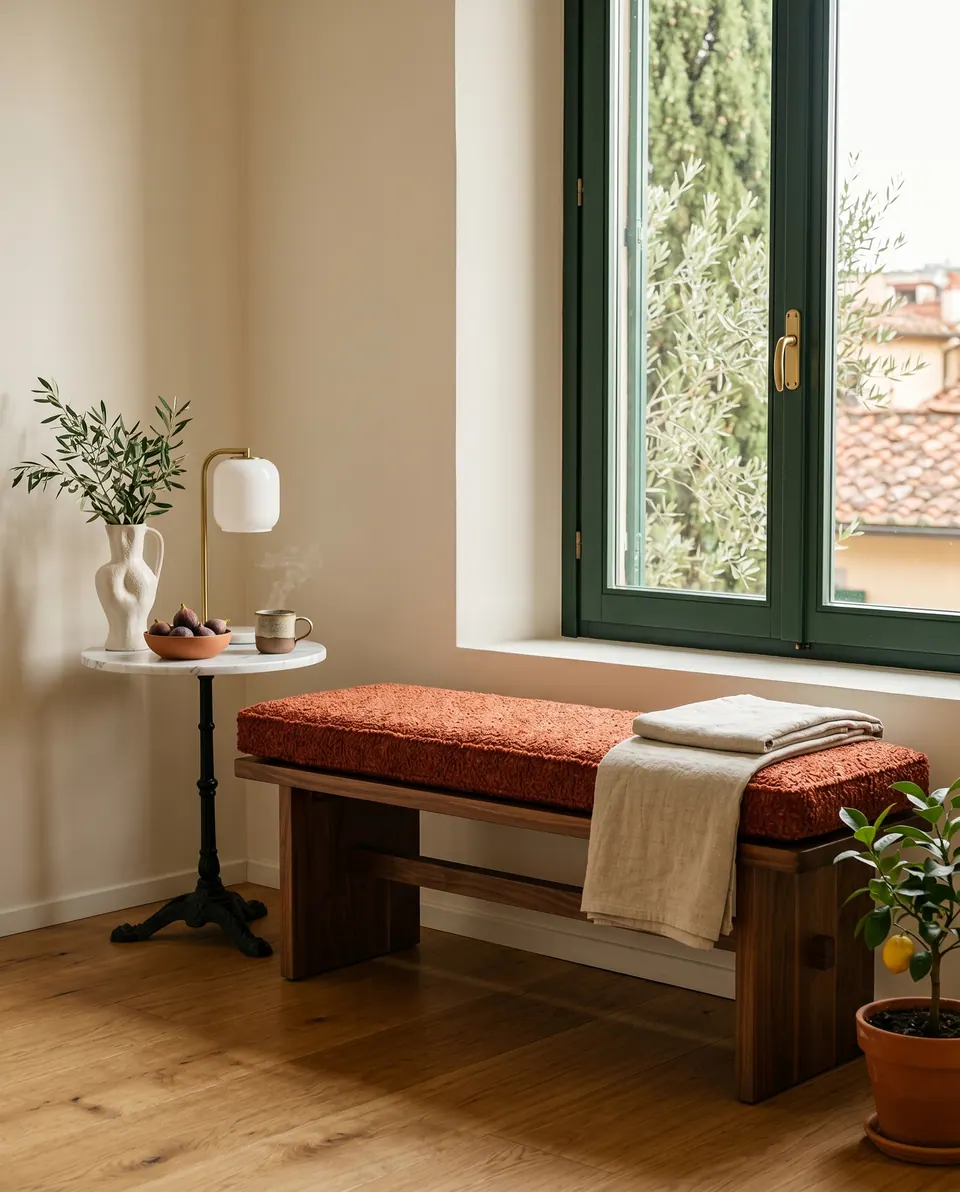
- Terracotta bouclé
Rust-red loops against a green frame is the classic terracotta-and-olive pairing.
- Folded linen
Natural linen laid over one end signals the seat is for use and softens the strong color.
- Marble bistro table
A cool marble top next to warm bouclé keeps the corner from feeling heavy.
- Olive branches
Silver-green leaves repeat the window frame color inside the room.
- Lemon tree
A living plant at the far end balances the lamp and table on the other side.
- Terracotta boucléRust-red loops against a green frame is the classic terracotta-and-olive pairing.
- Folded linenNatural linen laid over one end signals the seat is for use and softens the strong color.
- Marble bistro tableA cool marble top next to warm bouclé keeps the corner from feeling heavy.
- Olive branchesSilver-green leaves repeat the window frame color inside the room.
- Lemon treeA living plant at the far end balances the lamp and table on the other side.
Cross-section: cover, edge, core and what stands around it
Let's section this cushion the way I used to section a car seat, partner: cover, edge, core, surroundings.
Cover. Terracotta bouclé, a looped, pebbly yarn in rust red. The loops scatter light, so the color reads softer and warmer than the same dye would on a flat weave. Against the green window frame it makes the old Mediterranean pair, clay and olive, which is most of why the room feels settled.
Edge. A box edge with no piping. On bouclé that's the right call: a welt would cut a hard line through the texture, while an unpiped seam lets the pebbles run straight round the edge as one surface. The top sits square on the walnut bench, so the dark wood frames the rust.
Core. Hidden, but it shows in the silhouette: flat top, straight sides, no crowning. That's firm foam doing its job. If you want a softer sit, a 3/4 in (2 cm) layer of batting over the foam has been added for buyers who asked.
Surroundings. A folded natural linen throw across one end says the seat is for use and cools the strong color. A marble bistro table on a cast-iron base keeps the corner from feeling heavy: cool stone beside warm loops. A white opal lamp on a brass arm is the only metal, and I'd keep it that way. Figs, a stoneware mug, olive branches and a lemon tree in a terracotta pot repeat the palette; the tree balances the table.
The copyable formula is warm bouclé, one living green plant, one brass accent. See more bench cushions, the bouclé and teddy family and our notes on loops and snags. Which side of the house is your bench on?
Four seasons at one green window
| Season | What the room does | What the cushion needs |
|---|---|---|
| Spring | Windows open; dust and pollen settle | Lift the loops with a soft upholstery brush and skip the beater bar |
| Summer | Hard late-morning sun on one end | Turn it end to end every few weeks; lay the linen throw down for bare legs |
| Fall | Figs, mugs and longer sits | Blot spills at once; press, don't rub, so the loops don't fuzz |
| Winter | Heating on, lamp on by late afternoon | Keep the bench clear of radiators; rust reads deepest under the opal lamp |
Two 6 in bolsters that turned a bench into a sofa
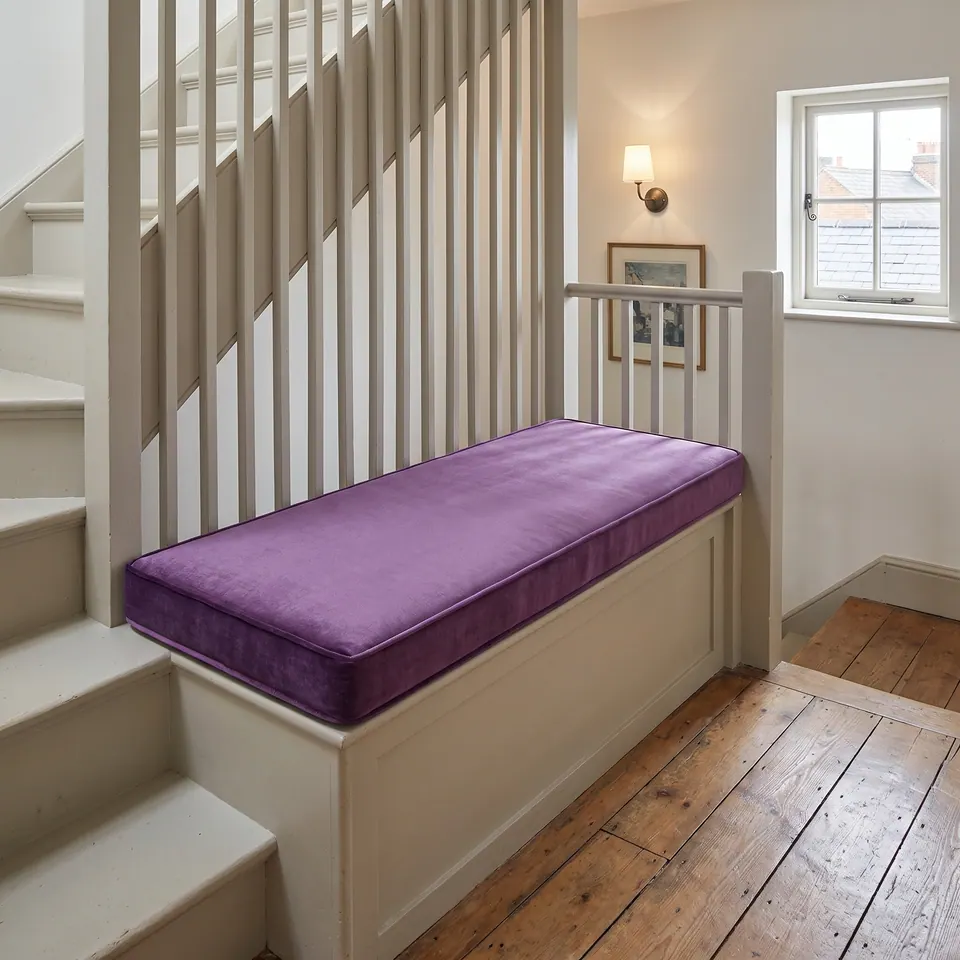
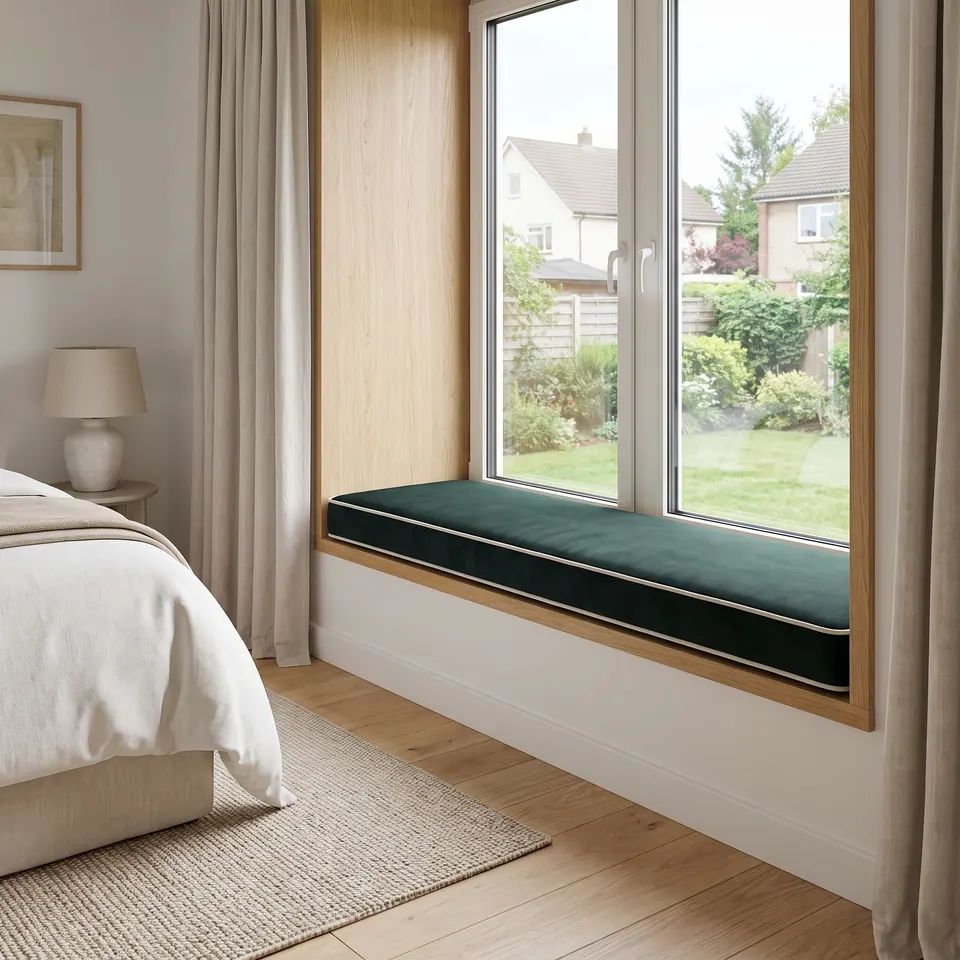
A buyer in the US wanted a light green velvet for a bench. The velvet range she liked had only one green on its chart, P65, so she settled on P56 with P58 piping.
She also wanted cylinder cushions at each end of the bench to act as armrests. The workshop made two bolsters 17.7 in (45 cm) long and 6 in (15 cm) in diameter, in the same fabric and piping, through a custom link added after the seat cushion order.
Engineering note: a 6 in cylinder is a small part, but at each end of a bench it does what a sofa arm does. It stops the slide and gives an elbow a place to land. In winter, when people curl up for longer, that matters more. For sizing your own, see our Pattern on bolster diameter and length.
Buyer questions: curved ends, backrests sold alone and a stuck listing
- A common question
Can a bench cushion be made with a rounded or curved end?
The workshop's answerYes, curved-edge custom shapes can be made. Send a simple sketch with the measurements marked, showing where the curve starts and where it ends; the workshop won't interpret a curve from numbers alone. Once the shape is confirmed, order through the custom-shape listing, choosing the range by the longest length and the width, and upload the sketch.
- A common question
Can I buy just the straight backrest pillows for a floor sofa?
The workshop's answerYes, backrest pieces are sold separately. The straight backrest is 39 3/8 in long, 15 3/8 in deep and 15 3/8 in high (100 x 39 x 39 cm). That's about the size of similar floor sofas from other makers, so it can replace or add to those.
- A common question
The listing won't let me order the sizes I need. What's wrong?
The workshop's answerSome size options were temporarily out of stock. The workshop updated the stock so the order could go through, and confirmed the buyer had picked the right size blocks.
On the cutting table: the clay-and-olive bench
| Product | Bench cushion, rectangle, box edge |
|---|---|
| Fabric | Bouclé in terracotta |
| Piping | None: the looped texture runs round the edge |
| Softer top | 3/4 in (2 cm) batting layer over the foam, on request |
| End bolsters | 6 in (15 cm) diameter x 17.7 in (45 cm), as armrests |
| Curved ends | Sketch marking where each curve starts and ends |
| Seasonal care | Turn end to end in sunny months; blot, don't rub |
| Best for | Warm-palette living rooms with one green accent |

Have it made
Have this made — ask Nate’s workshop
Precision starts on the phone. Give the workshop your measurements and they will read them back to you, edge by edge. — Nate
Leave your details and the workshop will call you to confirm measurements, fabric, foam and piping. No prices, dates or payment on this page: it is a request, not an order.
On a bouclé bench cushion, skip the piping: an unpiped box edge lets the loops run round the corner as one surface, where a welt would cut a hard line.
Nate
Questions buyers ask next
Is bouclé too warm for a bench cushion in summer?
The looped surface does feel warmer against bare legs than linen or cotton. A folded linen throw laid across the seat in the hottest months handles that, and it comes off again in fall, when the texture feels welcome.
Does a bouclé cushion need piping to keep a clean edge?
No. A well-sewn box edge holds its shape from the foam and the seam, not the welt. On a looped fabric, leaving the piping off keeps the texture continuous, and the edge still reads crisp against dark wood.
How do bolsters at the ends of a bench work as armrests?
A bolster at each end gives an elbow somewhere to rest and stops you sliding off the end. One buyer in the US ordered two at 6 in (15 cm) in diameter and 17.7 in (45 cm) long, in the seat fabric and piping.
± 1/4 in — Nate
More photographs to read
 Save
 Save
 Save
 Save
 Save
 Save