The Cutting Table · a common question
Which is firmer for stacking cushions or a headboard: foam or fiber fill?
Also asked as:Foam filled or quilted?I want to stack them on top of each other
Stack three pillows and you get a slope. Stack three foam blocks and you get furniture, partner. The difference is structural, not cosmetic.

The quick answer
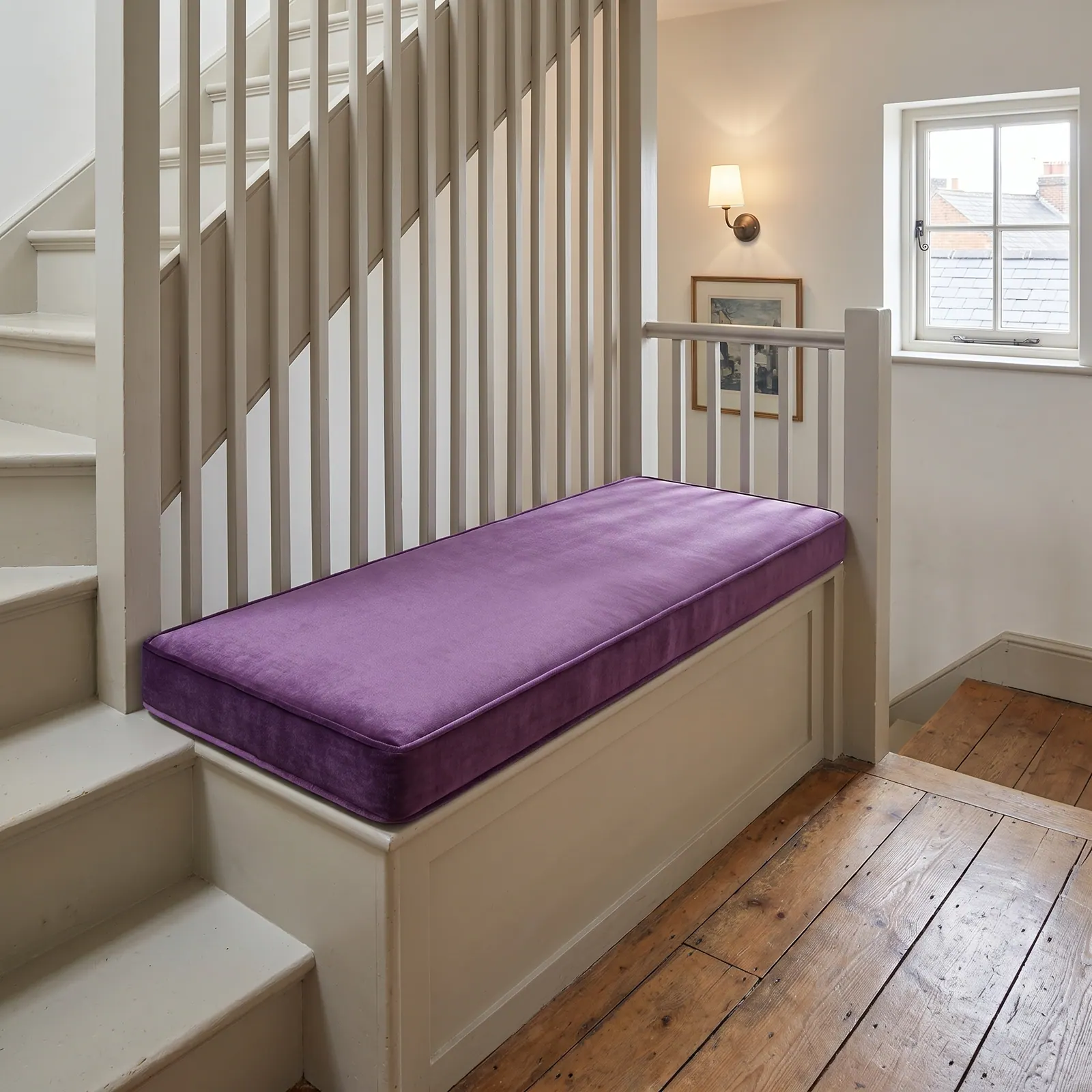
Foam is firmer than fiber fill: it makes a solid block that stacks and keeps its edges, which is why stacked Mah Jong-style floor cushions are foam-filled. Silicone fiber fill is softer and pillow-like, as in quilted French-mattress cushions. For a 60 in (152 cm) wide, 2 in (5 cm) deep headboard insert, fiber comes out very soft and foam firm.
 Save
Key facts
- Foam gives a firmer, more solid block than fiber fill, so it stacks better.
- Stacked modular floor cushions are foam-filled.
- A foam cushion is a high-density foam insert inside a zippered cover.
- A quilted French-mattress cushion is filled with silicone balls instead of foam.
- The workshop asks which filling you want before production starts.
- For a headboard insert, silicone fiber gives a very soft result and foam a firm one.
- Matching back cushions, such as 29 1/2 x 15 3/4 in (75 x 40 cm) for 29 1/2 x 29 1/2 in (75 x 75 cm) seats, can be made in the same fabric.

Have it made
Have Nate’s workshop cut this for you
Send the numbers in inches: length × depth × thickness, plus any angle. The workshop checks them with you, because foam has no undo button. — Nate
Leave your details and the workshop will call you to confirm measurements, fabric, foam and piping. No prices, dates or payment on this page: it is a request, not an order.
Foam block vs fiber fill, line by line
| Foam insert | Silicone fiber fill | |
|---|---|---|
| Feel | Firm, solid block | Soft, pillow-like |
| Stacking | Yes Stacks well | Stacks less neatly |
| Build | High-density insert in a zippered cover | Silicone balls in a quilted French-mattress cover |
| Headboard insert | Firm | Very soft |
| Want it softer? | 28-density foam instead of 32, or a 3/4 in (2 cm) wadding layer | Already soft |
Why a stack wants foam
A stack is a structure. Every cushion is the foundation for the one above it, so it has to hold its edges under load. A high-density foam block does; fiber moves toward wherever the weight isn't. Angles are just lengths in disguise, and a stack only stays square if its lengths stay put.
The quilted French-mattress cushion earns its place elsewhere: a soft, lounging seat. The workshop asks which one you want before it cuts, so nothing gets decided by default. For the full comparison of fills, see high-density foam vs memory foam, latex and fiber; to dial in firmness, try the foam firmness finder. Inserts on their own are under foam inserts.
How many cushions high is your stack going to be?
Specifying a headboard insert
Measure the cover's inside
Width and depth. One queen headboard cover called for 60 in (152 cm) wide and 2 in (5 cm) deep.
Pick the feel
Foam for a firm board, silicone fiber for a very soft one.
Ask about natural fill
None was offered for that headboard, though seats, backrests and pillows have been cotton-filled on custom orders.
Confirm before production
The workshop asks which filling you want before it starts.
A 60 in wide, 2 in deep headboard insert filled with silicone fiber comes out very soft; the same insert in foam comes out firm.
Nate
Buyer questions
- A common question
What's the difference between a foam cushion and the quilted French mattress style?
The workshop's answerThe foam version is a high-density foam insert inside a zippered cover. The quilted French-mattress style is filled with silicone balls. The workshop asks which you want before production begins.
- A common question
For floor cushions I plan to stack, is foam better than pillow filling?
The workshop's answerBoth are made, but foam gives a firmer, more solid block that stacks well, which is why stacked modular sets are foam. Matching backs, such as 29 1/2 x 15 3/4 in (75 x 40 cm) for 29 1/2 in (75 cm) square seats, come in the same fabric.
- A common question
Can you fill a queen headboard cover, 60 in wide and 2 in deep, with something natural?
The workshop's answerThe insert can be silicone fiber, which is very soft, or foam, for a firm result. A natural filler wasn't offered for that headboard.
- A common question
Can I get something plusher than your firm foam?
The workshop's answerYes. Ask for 28-density foam instead of the standard 32 for a slightly sink-in feel, or add a 3/4 in (2 cm) wadding layer.
Questions buyers ask next
How dense is the standard cushion foam in US units?
The standard 32 kg/m³ foam is about 2.0 lb/ft³, above the usual 1.8 lb/ft³ high-density threshold. It's high-resilience cold foam at roughly ILD 42, firm enough that adults don't sink through, though no official ILD certificate is issued.
Can a cushion be filled with cotton instead of polyester fiber?
Yes, through a custom order: seat cushions, backrests and pillows can be cotton or organic-cotton filled. Natural fibers cost a little more, and the quote shows the difference. Flax or linen stuffing isn't offered.
Can I pair a firm foam seat with a softer back?
Yes. Foam backs hold their shape and stay put when wedge-shaped; pillow-style backs are softer and more relaxed. A firm foam seat with a softer filled back is an option the workshop offers.