A Reading by NateBench Cushions
Eight velvet bench cushions stacked in a workroom, taken apart layer by layer
Nate reads a stack of eight velvet box cushions the way he reads a drawing: top panel, pile, welt, gusset, foam. Then he writes down what velvet asks of you in wear and care.

 Save
The quick answer
A velvet bench cushion is a box: top and bottom panels, an upright side gusset, piping at both seams, and foam cut to the cover's exact depth so the gusset stands without ripples. Velvet's pile catches light, so the color shifts with the angle, and it shows pressure marks with use. Order swatches and judge them in your own window light.
The cushion, cut open
Cover fabric. A removable, zippered cover. Machine wash at 86°F (30°C) on a gentle cycle and air dry.
Piping. A fabric-covered cord sewn into the seams. It sits on the seam line, so it does not change the size.
Fiber wrap. Polyester fiber (Dacron) batting around the foam: it fills the cover out and softens the edges.
Foam core. About 2.0 lb/ft³ (32 kg/m³) high-resilience foam, firm to medium-firm, cut to the ordered size.
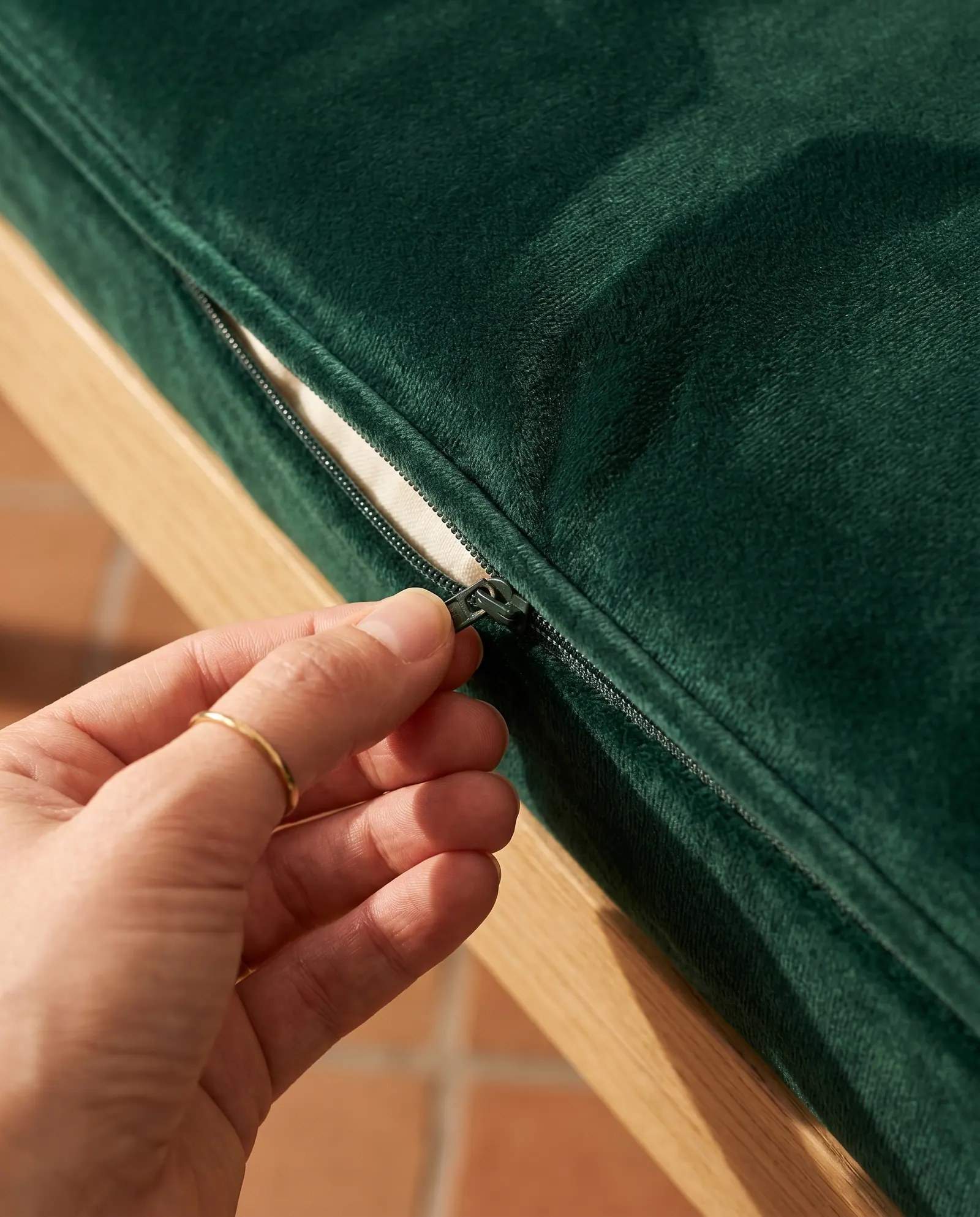
Zipper. Along the back band, as hidden as possible. The zipper side faces down or toward the wall.
Base panel. The underside of the cover. A non-slip fabric backing can cover the whole of it instead.
A velvet box cushion in cross-section, top to bottom
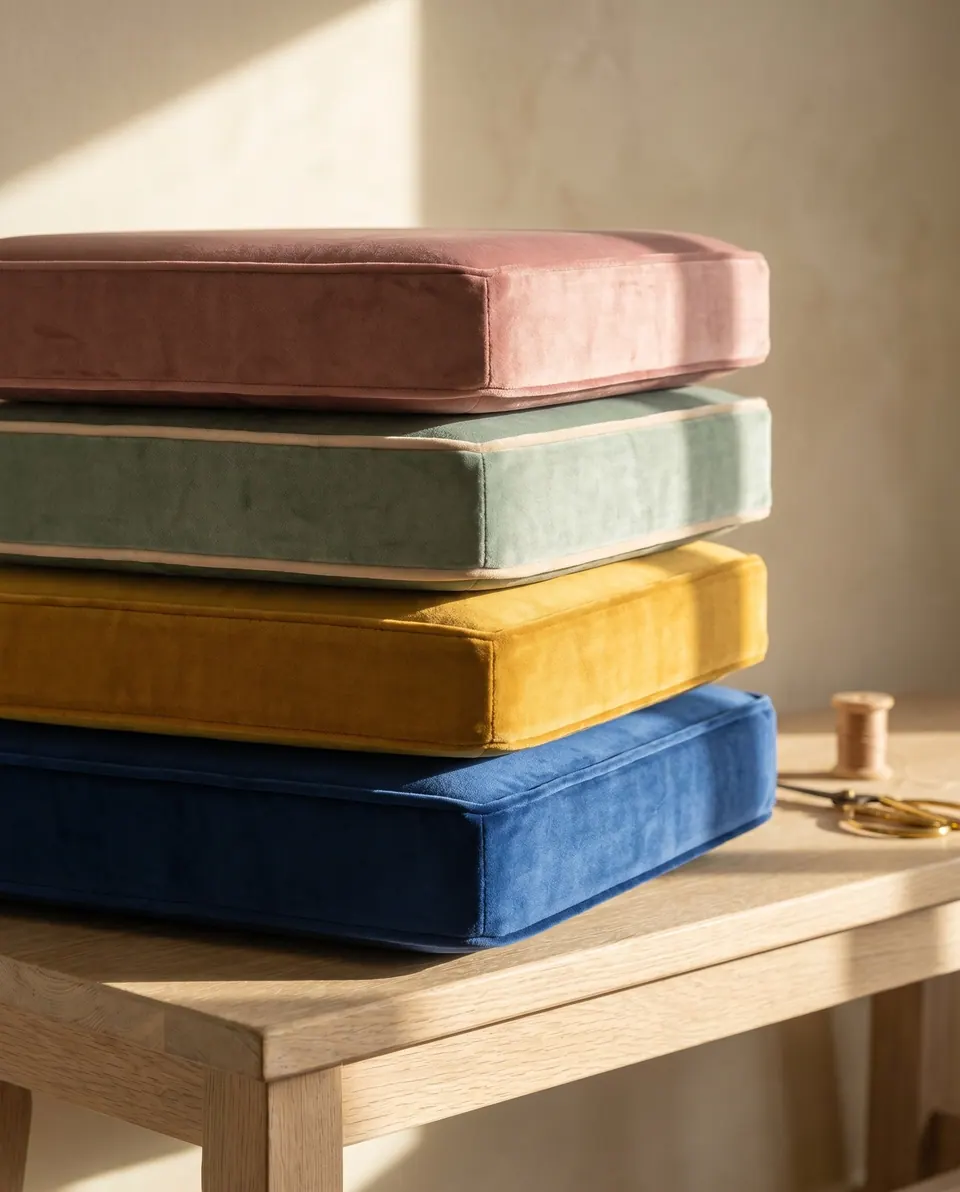
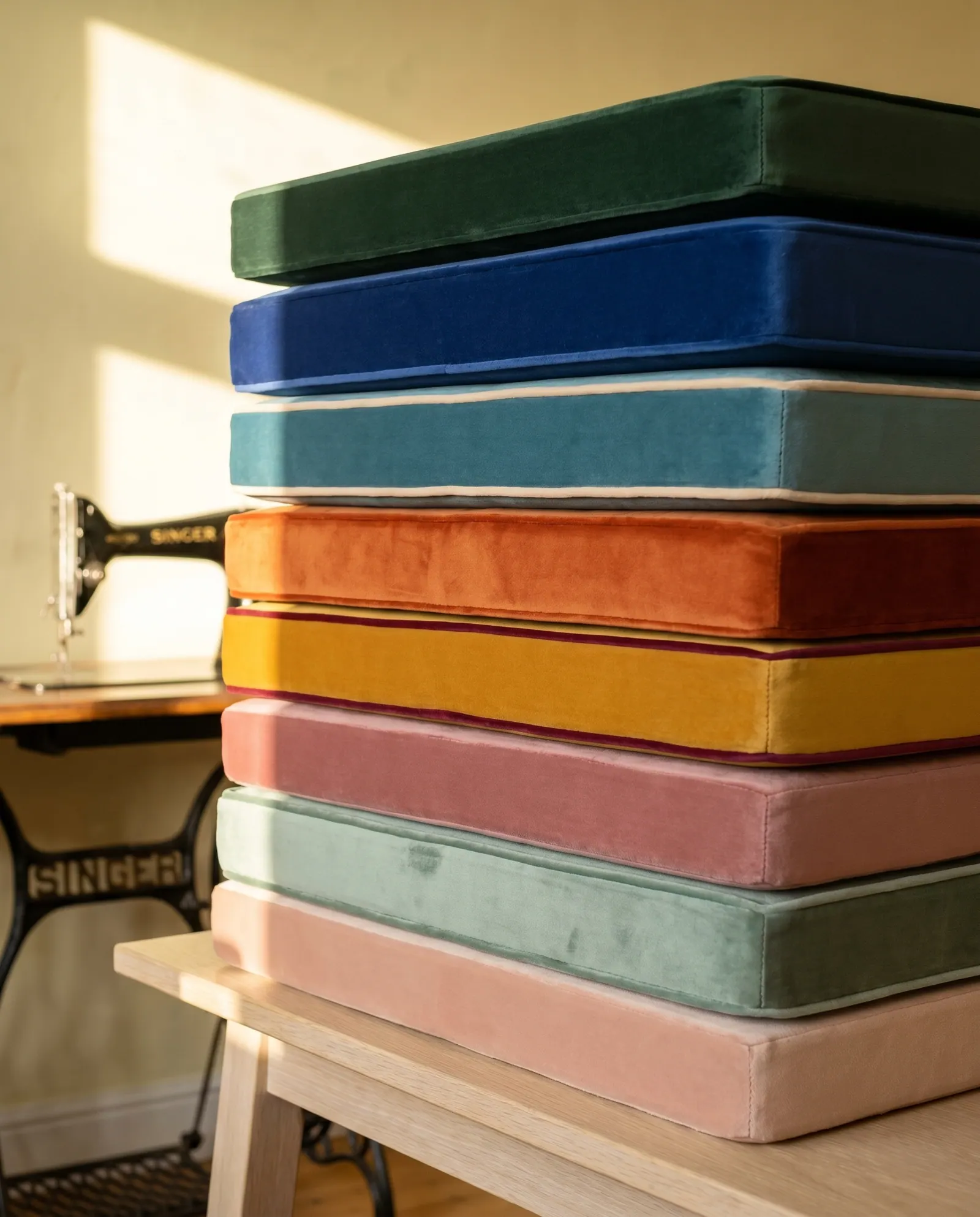
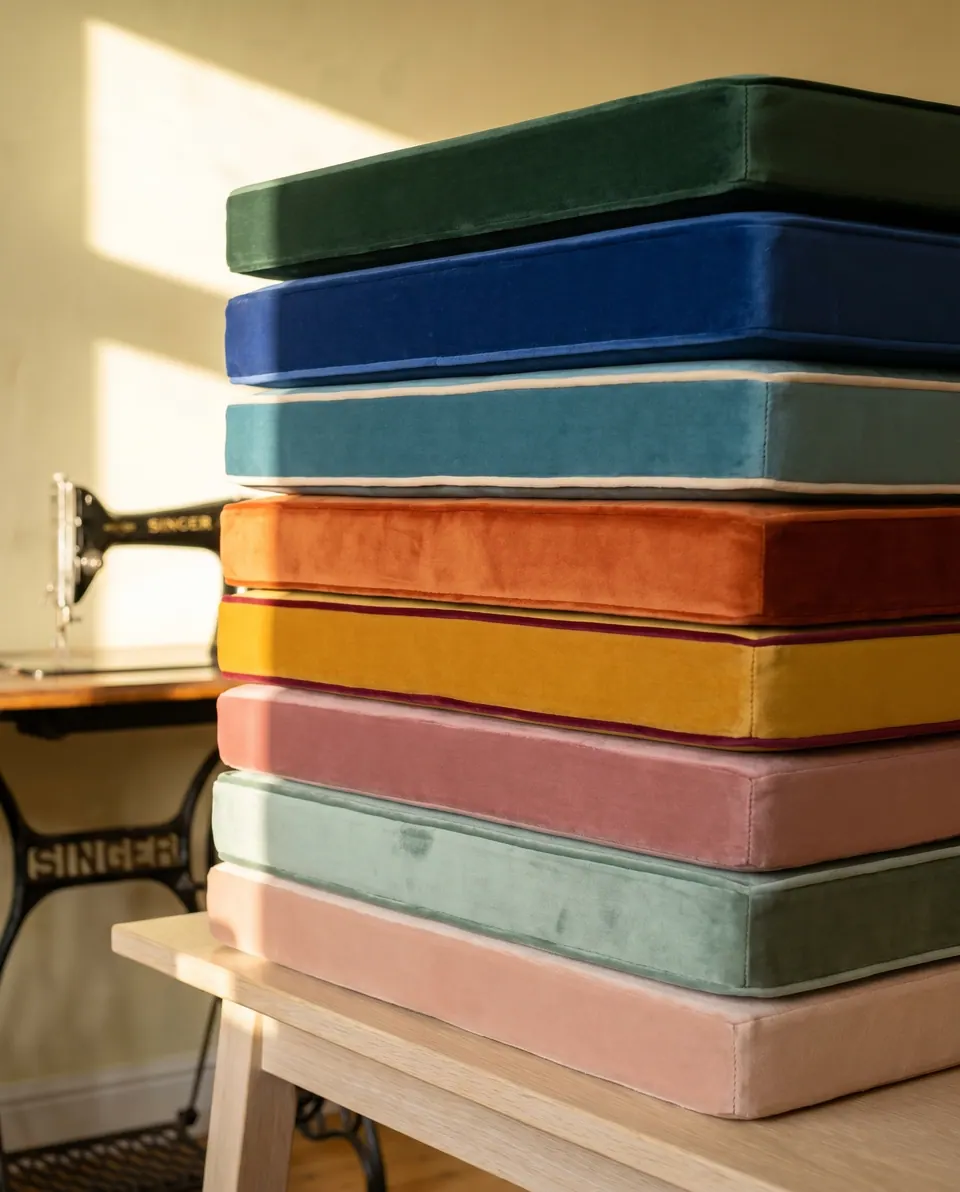
Stack eight cushions on a bench in raking afternoon sun and you get a better lesson than any spec sheet. Here's the drawing, layer by layer, partner.
- Top panel, pile up. Velvet is a cut pile: short fibers standing on end. When low sun hits them from the side, you see sheen, and the color moves with the angle. That's why the bottle green on top looks deepest; the strongest sheen lands where the light arrives first.
- Piping at both seams. Each cushion carries a welt on the top and bottom edge of the gusset. Most are self-piped. Two are not: a thin ivory welt on the teal, and burgundy on the mustard. Warm on warm reads richer than white would.
- Gusset. The side wall. On the sage cushion it stands dead upright, no ripples. That tells you the foam was cut to the exact depth of the cover. Foam shorter than the cover lets the gusset wave; foam taller than the cover makes the top dome.
- Foam. You can't see it, but you can read it. Eight cushions of one depth stack into neat stripes instead of a heap of loaves.
The colors run cool, then hot, then soft: bottle green, royal blue, teal, burnt orange, mustard, dusty pink, sage and blush. The cast-iron treadle machine and the bare oak bench keep the picture about work, one cushion at a time. The full range sits in the velvet swatch notes, and box edge versus knife edge explains why the gusset matters.
Which color would you put on top of your stack?
Five pins on the velvet stack
Five pins mark the parts of a velvet box cushion you can read from across the room: sheen, welt, gusset and the machine that sewed them.
- Bottle green top cushion
The deepest color sits on top, so the strongest sheen lands where the light hits first.
- Ivory piping on teal
A thin ivory welt on both edges outlines the gusset and shows how contrast piping sharpens a thick box cushion.
- Burgundy piping on mustard
Burgundy on mustard is a warm-on-warm contrast that looks richer than white piping would.
- Straight sage gusset
The side wall stands upright with no ripples, which tells you the foam is cut to the exact depth of the cover.
- Treadle sewing machine
The old machine in the background says workroom-made, one cushion at a time.
- Bottle green top cushionThe deepest color sits on top, so the strongest sheen lands where the light hits first.
- Ivory piping on tealA thin ivory welt on both edges outlines the gusset and shows how contrast piping sharpens a thick box cushion.
- Burgundy piping on mustardBurgundy on mustard is a warm-on-warm contrast that looks richer than white piping would.
- Straight sage gussetThe side wall stands upright with no ripples, which tells you the foam is cut to the exact depth of the cover.
- Treadle sewing machineThe old machine in the background says workroom-made, one cushion at a time.
Velvet's hand, written down
- Feel: soft and warm, with a direction. Stroke the pile one way and it lightens; the other way and it darkens.
- Light: sheen changes with the viewing angle, so a stack, or one long bench, shows bands of color.
- Wear: the pile shows pressure marks where people sit. That comes with the cloth; it is not damage.
- Washing: a zippered velvet cover, even one with a non-slip base, goes in the machine at 86°F (30°C) on delicate, with no tumble drying.
- Choosing: stack real swatches in your own window light and keep the one that still looks right at dusk.
Four cushions, three color pairs, one checkout
A buyer ordered four velvet bench cushions, each 12 x 33 in (30 x 84 cm), in three pairings: two in olive green, color 123, with light lilac piping, 116; one in dusty mauve, 117, with mustard piping, 111; and one in mustard, 111, with pale pink piping, 115.
Same size, same depth, four different faces. That's the stack in this photograph in miniature, and it works for the same reason: identical geometry lets the colors do the talking.
One snag. The first checkout had a quantity of one. The workshop caught it and asked for three more to be added before anything went into production. Measure twice; the fabric remembers. Colors can vary across pieces, but the quantity has to match the count. The bench cushions hub has more mixed sets.
Buyer questions: your own fabric, one quote's shipping line and a busy kitchen bench
- A common question
Would you make my cushion from fabric I buy somewhere else, and how much should I get?
The workshop's answerYes, your own fabric is accepted, though shipping it to the workshop adds time, and the workshop can also suggest similar fabrics from its range. For a 60 x 14 in (152 x 36 cm) cushion with piping, cut from a 45 in (114 cm) wide bolt, about 2¾ yd (2.5 m) is enough.
- A common question
For a 24 x 64 inch beige cushion, is shipping added on top of the quote?
The workshop's answerNot on that quote: it was the total, with fees and shipping in it, and processing and delivery together took 10 to 12 days. Each quote states its own shipping cost, so read that line on yours before you pay.
- A common question
My kitchen bench gets sat on every day. Will the cushion hold its shape?
The workshop's answerTufted cushions keep their shape under heavy use. A single long cushion, for example 90 x 24 in (229 x 61 cm), can be made so separate pieces don't shift around.
On the cutting table: the eight-cushion stack
| Pieces | Eight velvet box cushions, stacked |
|---|---|
| Colors | Bottle green, royal blue, teal, burnt orange, mustard, dusty pink, sage, blush |
| Piping | Self piping on six; ivory on teal, burgundy on mustard |
| Edge | Box edge with a straight, upright gusset |
| Foam | Cut to the cover's exact depth |
| Hand | Soft cut pile with a sheen that shifts with the light |
| Wear | Pressure marks show where people sit |
| Cover care | Zippered velvet: 86°F (30°C) delicate, no tumble dry |
| Best for | Benches, window seats and mixed-color sets |

Have it made
Have this made — ask Nate’s workshop
Every edge and both diagonals, to the nearest 1/4 in. If the numbers do not close, the workshop will say so on the call. — Nate
Leave your details and the workshop will call you to confirm measurements, fabric, foam and piping. No prices, dates or payment on this page: it is a request, not an order.
A velvet box cushion with a straight gusset tells you the foam was cut to the cover's exact depth; ripples in the side wall mean it wasn't.
Nate
Questions buyers ask next
Why does the gusset of a velvet box cushion look darker than its top?
Because of the pile. Velvet's short fibers reflect light differently depending on the angle, so the top panel and the side wall, or two cushions side by side, can look lighter or darker. That is sheen, not a dye mismatch.
Why do some box cushions have wavy sides?
Usually the foam and the cover don't match in depth. When the foam is cut to the exact depth of the cover, the gusset stands straight and upright, like the sage cushion in this stack.
Can contrast piping vary across a matching set of velvet cushions?
Yes. Contrast works well warm on warm or light on deep, like burgundy on mustard or ivory on teal. Keep the sizes identical so the set still reads as one, and self-pipe the rest.
Are pressure marks in velvet a defect?
No. They are the pile bending where people sit, and they come with the fabric. If a perfectly even surface matters more to you than warmth and sheen, a flat weave is the calmer choice.
± 1/4 in — Nate
More velvet, more color, more bench cushions
 Save
 Save
 Save
 Save
 Save
 Save