The Pattern Room · a measuring pattern
Velvet bench cushions: how the pile behaves and how to care for it
Velvet remembers. It remembers the box it traveled in, the hand that brushed it and the way you sat down last night. Here is how to read that memory, and how to keep a velvet bench cushion looking the way it did the day it was cut.

 Save
The quick answer
Care for a velvet bench cushion by brushing the pile, steaming from a distance and washing the zippered cover at 86°F (30°C) on a gentle cycle. The workshop's velvet is a short, tight-pile polyester, so shading, pressure marks and a two-tone look from pile direction are normal, not defects. Blot spills with a dry cloth, air-dry covers, and never press an iron onto the pile.
Why a new velvet cushion looks wrong for a few days
The first thing a new velvet bench cushion does is look wrong. It comes out of the box flatter and paler than the swatch, sometimes with a square mark where the packing pressed. Give it three or four days.
Velvet is woven as a double cloth and sliced apart by a knife, and that cut makes the pile: short fibers standing on end. The workshop's is a synthetic performance velvet, polyester or a poly-cotton blend, never cotton, with a short, tight pile. Polyester has a kind of shape memory, so the pile springs back where a cotton velvet would crush and hold a water mark. More on the cloth in the velvet swatch library and under pile.
One fabric, two shades: reading the nap
Pile has a direction, the way a hound's coat does. Brushed one way it catches light and reads pale; brushed the other way it swallows light and reads deep. So a backrest can look a shade darker than the seat beside it, and a panel cut with the pile running the other way stands out like a cowlick.
Buyers write to the workshop about it often. One ordered an off-white and wrote that it was plainly beige. Another found a backrest far darker than the two seat pieces next to it. Same roll, same fabric, different direction and light. The fix starts with a brush, not a return. More in color on screen vs daylight and under nap.
Caring for velvet, from the box to the wash
Unpack it and let the pile breathe
Take the cushion out of its packaging the day it arrives and lay it flat. On the workshop's velvet, marks from vacuum compression settle within 3 to 4 days (about 72 hours), and creases fade within about a week. Don't judge the color until then; the first 72 hours have a Pattern of their own.
Brush every piece in the same direction
Use a soft clothes brush and stroke each piece the same way: seat, back and bolsters alike. Give the pile a few days to lift. Start every shade worry right here.
Compare pieces side by side, in daylight
Look at the pieces together in daylight, from the same angle. Then brush one the other way and look again. If a panel still reads different, photograph it in that light and send it to the workshop; where a panel really was cut the wrong way, ask it to confirm in writing how it will put that cover right.
Lift pressure marks with steam held at a distance
Pressure marks and bruising where someone sat are normal and usually recover within hours. For a stubborn one, hold a steamer above the pile without touching it, then brush once dry. Never press an iron onto velvet; polyester pile can melt and flatten under a hot plate.
Blot spills, don't rub
The workshop's velvet has no stain-repellent coating. What it has is a tight pile that lets marks lift off readily, and a cover that comes off. Blot a spill at once with a dry white cloth. Never rub.
Wash the zippered cover at 86°F (30°C)
Unzip the cover, turn it inside out and machine wash at 86°F (30°C) or lower on a gentle cycle, mild detergent, no bleach. The fabric is pre-shrunk. A button-tufted cushion is the exception: its cover does not come off, so it gets spot cleaning only; see tufted cushion care.
Air-dry, then brush the pile back up
Skip the tumble dryer and let the cover air-dry. Wet pile clumps, and that is fine. Once fully dry, brush against the nap and then with it, and the pile stands up again.

Have it made
Measured it? Have Harlan’s workshop make it
Old upholsterers will tell you the real cutting happens in the conversation, long before the shears come out. Tell the workshop what you sit on, and they will talk it through with you. — Harlan
Leave your details and the workshop will call you to confirm measurements, fabric, foam and piping. No prices, dates or payment on this page: it is a request, not an order.
A velvet bench with bolsters for arms
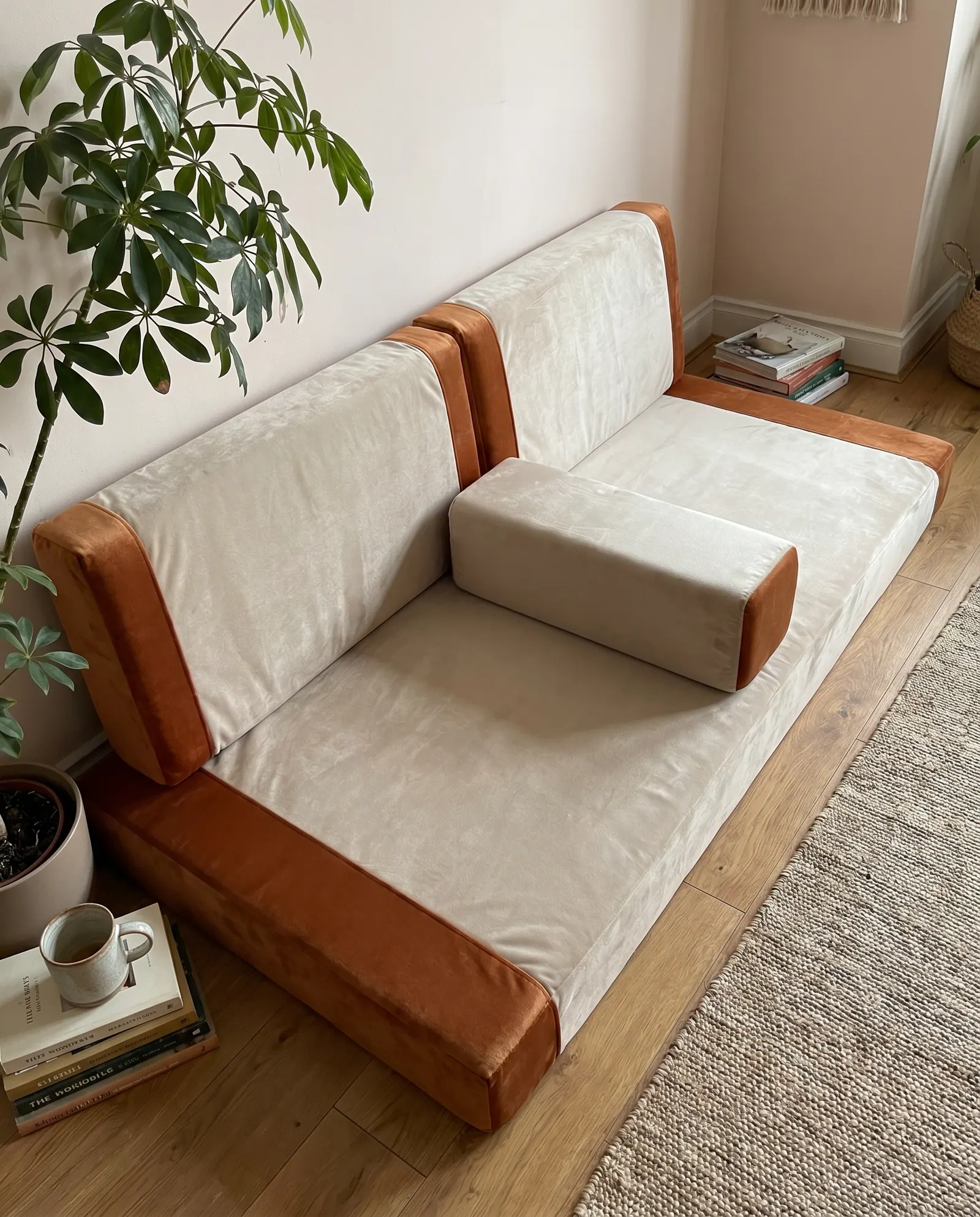
A buyer in the US wanted a light green velvet for her bench. That chart had only one green, so she chose another velvet with a contrasting piping, and then asked for something I have always liked: a round cushion at each end of the bench, to rest an arm on.
The workshop made two bolsters 17.7 in (45 cm) long and 6 in (15 cm) across, in the same velvet and piping as the seat, added right after the seat cushion order. That is the way to do it. Pieces cut from the same roll and brushed the same way read as one piece of furniture; every dye batch shifts a little, and bolsters ordered a year later may never quite catch the light the same.
Velvet mistakes that come back to the workshop
- Judging the color the day the box opens, before the pile has lifted and the packing marks have settled.
- Comparing a backrest and a seat from different angles or under different lamps.
- Pressing a hot iron onto the pile instead of steaming from a distance.
- Putting velvet where rain or damp can reach it; it is indoor-only and not water-resistant.
- Ordering button tufting and expecting to wash the cover.
- Adding new covers to an old set and expecting a perfect match; used covers read slightly lighter.
How velvet ages on a bench you use every day
An entry bench takes boots, bags and the dog's opinion. A bench at the foot of the bed takes a folded quilt and a sit-down to pull on socks. Velvet handles both better than people expect: it stands up to daily wear from children, and it is one of the two fabrics the workshop points families to first.
What changes with the years is the light, not the strength. A cover washed and brushed for a few seasons reads slightly lighter than a new one. That is age, not damage, my friend.
Before you order, look at your velvet swatch from both directions in daylight, and write in your order note that every panel should be cut with the pile running the same way. Sizes and shapes live in the bench cushions and living room cushions atlases. Which way does your pile run when you sit down?
Velvet pressure marks from the shipping box settle within 3 to 4 days, so brush the pile and let it breathe before judging the color.
Harlan
Velvet bench cushions at a glance
- Fabric: polyester velvet with a short, tight, non-shiny pile
- Edge: plain box edge with a hidden zipper, or tufted with buttons and no zipper
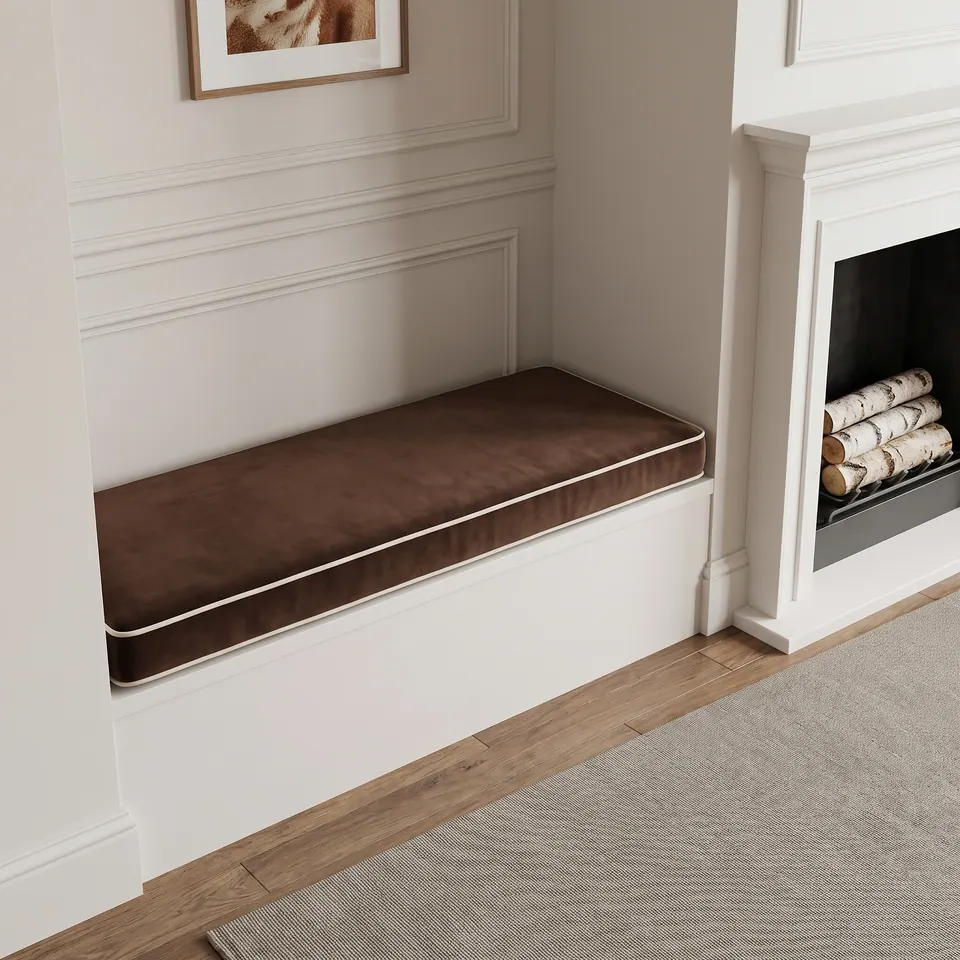
- Piping: same color or any contrast code, at no extra cost
- Thickness: 2, 3, 4 or 5 in; many velvet bench buyers choose 3 in (7.5 cm)
- Care: zip-off cover, 86°F (30°C) gentle wash; tufted pieces spot-clean only
- Where not: indoor only; velvet isn't water-resistant
- Before ordering: ask for a close-up photo of the code in daylight
Buyer questions
- A common question
My velvet backrest looks darker than the seat cushions. Did you use a different fabric?
The workshop's answerAlmost certainly not. Velvet has a directional pile, so the same fabric reads lighter or darker with brushing direction, viewing angle and light; that is how an off-white can look beige. Brush the pile the other way and look in daylight. If photos still show a clear difference, send them; in one case the workshop sent new covers.
- A common question
Can velvet covers really go in the washing machine?
The workshop's answerYes. They unzip and machine wash at 86°F (30°C) maximum on a gentle cycle, like every other fabric the workshop uses. Blot spills quickly with a dry cloth; the velvet has no stain-repellent coating, so the washable cover is its protection.
- A common question
Is your velvet cotton or polyester?
The workshop's answerSynthetic: polyester or a poly-cotton blend, not cotton, linen or silk. It resists crushing, wear and wrinkles better than cotton velvet. For natural fiber, choose the 100% linen range or a cotton-linen fabric.
- A common question
Is the velvet shiny or matte, and how long is the pile?
The workshop's answerThe pile is short and tight and feels smooth. Its sheen has been described both as a slight gloss and as not shiny, which tells you how much it changes with the light. Ask for real-life photos of your color; for very little sheen, look at linen.
- A common question
Can you show me my velvet next to the piping color before I order?
The workshop's answerYes. The workshop photographs the swatches side by side in as many combinations as you need, in different light if asked. Close-ups come out a little darker than daylight, so physical samples are the surest check.
Velvet questions, answered plainly
Can a velvet bench cushion go in a mudroom or on a porch?
Velvet is indoor-only and not water-resistant, so keep it away from rain, damp and dripping boots. A dry entryway is fine; where rain or damp can reach, choose an outdoor-rated fabric.
Is velvet a sensible fabric for a family with small children?
Yes. It is one of the two ranges the workshop recommends for young children, alongside a wipe-clean microfiber. Marks lift off the tight pile readily, and the zippered cover washes at 86°F (30°C).
How do I get creases out of a velvet cover?
Wait first: creases from vacuum packing fade within about a week. For anything left, steam from a distance without touching the pile, then brush once dry. Never press an iron onto the velvet.
Will a velvet cover shrink in the wash?
The fabric is pre-shrunk. Keep to 86°F (30°C) or lower on a gentle cycle, inside out, with no bleach and no tumble dryer, and let it air-dry.
Should a velvet bench cushion be tufted or plain?
Plain, if you want to wash it. A tufted velvet cushion has buttons sewn through the filling, so its cover is closed for good and can only be spot-cleaned. A plain velvet cushion gets a hidden zipper and a cover that machine washes at 86°F (30°C) on a gentle cycle, with piping in the same or a contrast color.
How do I lift crushed velvet pile?
Wait until the fabric is completely dry, then brush it with a soft brush, first against the direction of the pile and then with it. Steam held just above the surface, never pressed on, helps stubborn marks. Crushing from shipping or from sitting is normal on velvet and eases with use and a little brushing.