The Pattern Room · a side-by-side pattern
What a custom cushion costs, explained by what goes into it
No price list here, and that's deliberate. Prices move with sales and fabric runs; the arithmetic underneath them doesn't. Here is that arithmetic, driver by driver.

 Save
The quick answer
A custom cushion's cost is set mainly by its size, then by thickness above the standard 2 to 5 in (5 to 12.5 cm), a non-rectangular shape, fabric type, hand tufting and add-ons such as a non-slip base or ties. Piping and a hidden zipper are included. A quote is one number for cover and foam or filling, with the shipping cost stated alongside.
Same footprint, four times the price
Here's a pair of past quotes that explains more than any price list. One footprint, about 40 x 21 in (101 x 53 cm). At 2 in (5 cm) thick it was one price. At about 20 in (50 cm) thick it cost more than four times as much. Same length, same width. A different cushion.
That's why this Pattern carries no dollar figures. Prices move with sales and fabric runs. The drivers underneath them don't, and once you know the drivers you can predict roughly where a quote will land before you ask for one.
"How much?" turns up again and again, so here is the engineering version. For which door to knock on (an online maker, a local upholsterer or your own sewing machine), see the channel comparison. This page stays inside one quote.
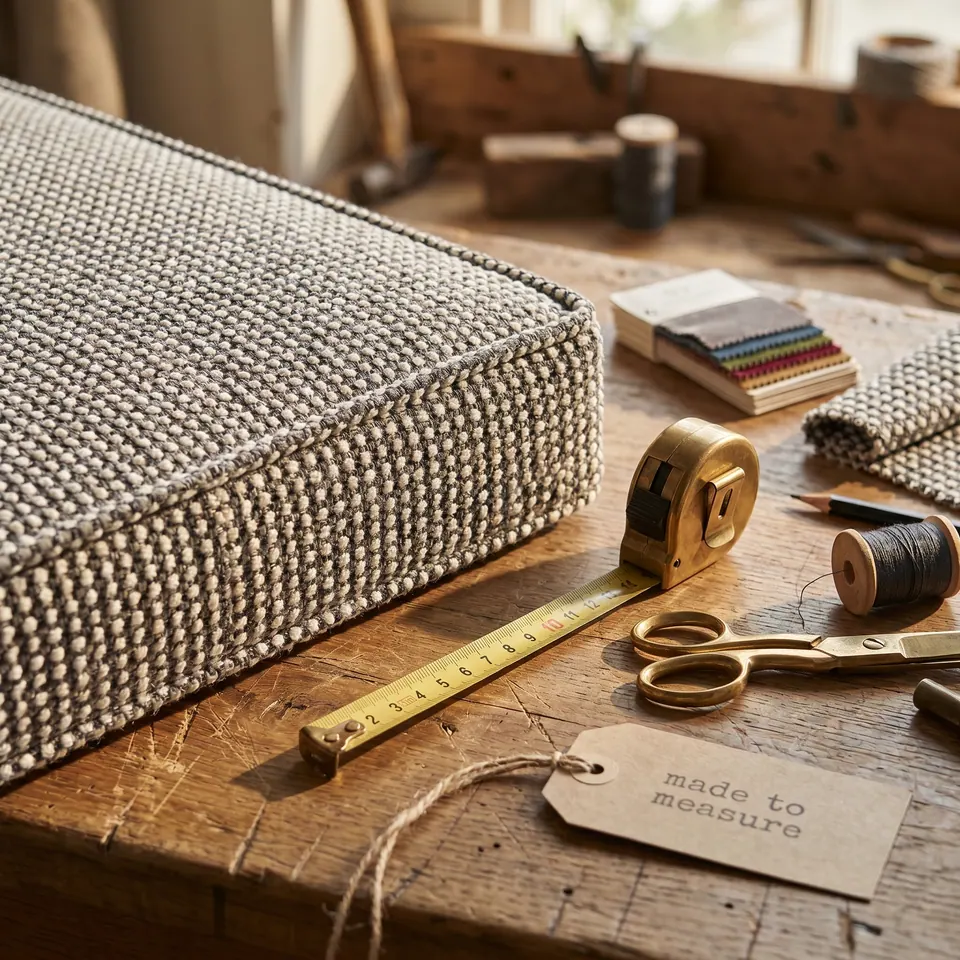
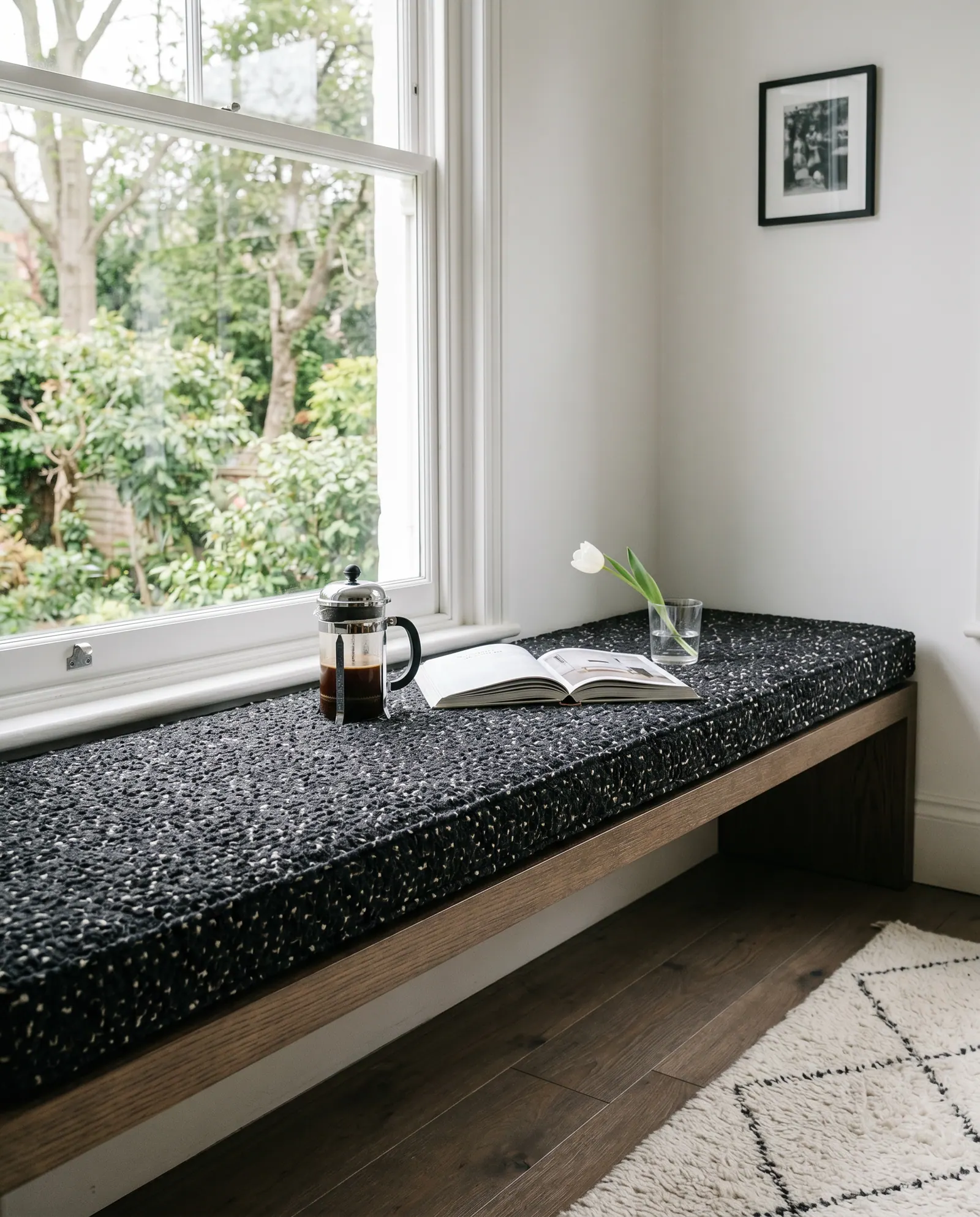
The salt-and-pepper bouclé seat at the top is the baseline case: a plain rectangle, box edge, self piping. Every driver below is a step away from that.
The price-driver table
| Driver | What moves the price | What you control |
|---|---|---|
| Size (length x depth) | Climbs with area, but not one-for-one. Cutting, sewing and the zipper are fixed work, so twice the area usually costs well under twice as much. | Exact measurements. A few inches over a size option is usually absorbed. |
| Small pieces | Carry a baseline. Each pad is still cut and sewn by hand. | Order the set together; several pieces are quoted below the sum of singles. |
| Thickness | Small effect from 2 to 5 in (5 to 12.5 cm). Above that it's a surcharge: a 24 in (61 cm) square velvet cushion listed at twice the price at 12 in (30 cm) as at 6 in (15 cm). | Check the finished seat height before paying for foam you'll sit too high on. |
| Shape | Angled sides, rounded corners and curves take longer to cut and sew. A rounded-corner cover is priced like a trapezoid. | A simple notch costs nothing extra, and there is no template charge. |
| Fabric | Most chart fabrics price alike; velvet and linen quote the same. Pure natural fibers and outdoor fabrics are where the fabric line can move. | Ask for a more affordable grade if a quote needs trimming. |
| Filling | Standard foam is in the quote. Cotton or organic cotton fill costs extra; latex carries a large surcharge. | Stay with the standard foam unless you have a reason not to. |
| Tufting | Done fully by hand, so it's one of the bigger add-ons in a quote. | An untufted, foam-filled version is the cheaper route. |
| Non-slip base and ties | Small add-ons. The base scales with cushion size; ties are sometimes free. | Ask for them on the order, with positions. |
| Back and arms | A seat, one back cushion and two armrests come to roughly 1.8 times the seat alone. | Order the seat only if the back is already there. |
| Piping and zipper | Included. The cover comes off on a hidden zipper. | Nothing. Don't pay extra for these. |
Key facts
- Price climbs with surface area, but not one-for-one: cutting, sewing and the zipper are fixed work.
- Within 2 to 5 in (5 to 12.5 cm), thickness moves the price much less than length and width; thicker builds carry a surcharge.
- Angled sides and rounded corners cost more in labor, not fabric; a simple notch adds nothing and there is no template charge.
- Hand tufting is one of the bigger add-ons, because every tuft is done by hand.
- Piping and a zippered, removable cover are included at no extra cost.
- A seat with one back cushion and two armrests comes to roughly 1.8 times the seat alone.
- In past cases workshop errors were remade; buyer measuring mistakes and change of mind were not covered.
What one custom cushion quote covers
- The cover, cut and sewn to your size, with a hidden zipper so it comes off.
- The foam or filling, with solid foam wrapped in polyester fiber wadding before it goes in.
- Piping, in the cover's own color or a contrast from the chart.
- Shipping cost and delivery timing: ask the workshop to state both in the quote.
- Any discount that applies, shown in the figure rather than promised later.
- For shaped pieces, a sketch to approve before anything is cut.
- A measurement check after sewing and photos before shipping. Ask to see them.
Getting a quote you can hold someone to
Measure to 1/8 in, three numbers
Length, depth and thickness, taken from the seat, not from the old cushion. Photograph the tape and type the numbers out too. Tolerance is kindness to your future self: a typo becomes a cushion.
Draw anything that isn't a rectangle
For a trapezoid that means the front, back, depth and both angled sides, lettered A to E, plus any notch. A drawing with every side written on it is what gets priced, and what gets cut. The custom shape drawing Pattern shows the format.
Name the fabric and piping by code
Codes, not "the blue one". Fabric rarely changes the number, but a code saves a second round of messages and a wrong guess.
List every extra in the same message
Ties with their positions, a non-slip base, a back cushion at its own size. Extras typed into the size box get overlooked; a separate line doesn't.
Ask for the whole set as one total
Several sizes quoted together usually come in below the sum of single listings. On a listing, the size dropdown only sets the price bracket; the cushion is made to the size you write. Or send everything through the quote page.
Pick the right size option, or expect a top-up
If your written size runs well past the option you paid for, production pauses and the difference comes as a separate payment link, often rounded down in your favor. A gap of about 3 to 5 in is usually absorbed.

Have it made
Measured it? Have Nate’s workshop make it
Send the numbers in inches: length × depth × thickness, plus any angle. The workshop checks them with you, because foam has no undo button. — Nate
Leave your details and the workshop will call you to confirm measurements, fabric, foam and piping. No prices, dates or payment on this page: it is a request, not an order.
Three ways to buy, three ways the price is built
| Route | How the price is built | What to add before you compare |
|---|---|---|
| Independent upholsterer | Often labor plus new foam and batting per cushion, with the fabric bought separately | The fabric, at your yardage |
| Online maker, like this workshop | One quote: cover, foam or filling, with the shipping cost stated; swatches and a drawing to approve | Shipping, unless the quote's shipping line already covers it. Read that line. |
| Do it yourself | Materials only: foam, fabric, zipper, cord, and your hours | Can you sew a removable cover? One reported DIY window seat, foam wrapped over plywood, came in only a little under a custom quote and has no cover to unzip. |
Why custom sizes are final sale, and what to ask when a cushion arrives wrong
Elsewhere you'll see it in plain type: custom orders can't be returned. The reason is geometry, not stubbornness. A cushion cut to 57 in (145 cm) fits one bench in the world.
Here the line sits in the same place, with one difference that matters. If the workshop got it wrong (the wrong size, reversed colors, a broken zipper, an open seam, the zipper on the wrong side, piping you didn't ask for, a missing part), past fixes came without asking for the piece back: a remake, a new cover or a replacement part, and sometimes a partial refund for a buyer who'd rather keep it. Photograph it the day the box opens and send the photos to the workshop.
What isn't covered: your own measuring mistakes and a change of mind. A made-to-order cushion that matches the order isn't returnable for preference. Goodwill has stretched to a remake at partial cost or a partial refund, but budget as if it won't, partner. That's why step one gets its own line. The remake Pattern walks through how a fix works.
What's your trickiest measurement: the length, or an angle?
One cushion or two? Same area, different answers
On one daybed, the workshop priced the seat two ways: one 74 x 36 in (188 x 91 cm) cushion, or two 36.5 in (93 cm) squares. Same area, within an inch. The pair came in about 20% below the single piece.
You'd think that settles it. It doesn't. A long piped banquette split into three came out about 6% cheaper. A window seat split in two didn't move at all. And three separate cushions for one storage bench listed a little above a single piece until they were offered as a set.
Thickness behaves the same way. Taking a seven-cushion corduroy set from 3 to 4 in (7.5 to 10 cm) raised the quote about 11%; the same change on a storage bench set changed nothing.
The lesson: price follows total surface first, then labor, and the rest is case by case. Torn between two layouts? Ask for both in one message, and sketch them first in the bench cushion builder.
A cushion's price follows the square inches first, the labor second, and the fabric a distant third.
Nate
Buyer questions: what buyers asked about price
- A common question
How is a custom-size bench cushion priced?
The workshop's answerBy size. Choose the size range that covers your length and width plus your thickness, and the price appears; the checkout shows the shipping cost before you pay. Price climbs with surface area but not one-for-one, because cutting, sewing and the zipper are a fixed part of the work. For several cushions or odd shapes, send the sizes and the workshop replies with one total that states the shipping cost.
- A common question
Does the price include the foam and the shipping?
The workshop's answerThe foam insert and the cover, yes: the price for your size covers both, and custom quotes are built the same way. For shipping, read the line in the checkout or quote before you pay; some past custom quotes had express shipping built in.
- A common question
Why do angled sides and rounded corners raise a cushion's price?
The workshop's answerLabor, not fabric. Every piece is handmade, and angled sides or rounded corners take noticeably longer to cut and sew, so rounded-corner covers are priced like trapezoids even though they use less fabric. A simple notch is different: it was charged the same as the rectangle.
- A common question
Can I get one quote for several cushions in different sizes?
The workshop's answerYes. Send every size, quantity and fabric and the workshop quotes the lot as one total, often below the sum of the listing prices. Thickness still changes the quote, and a whole house of window seats can be quoted at once and ordered one room at a time.
- A common question
My cushion arrived the wrong size. Do I pay for the remake?
The workshop's answerStep one: send a photo with a tape measure along the full dimension. If the workshop made the error, say so with the photo. In past cases only the parts that didn't fit were remade, the wrong one didn't have to come back, and a partial refund was offered to buyers who'd rather keep the piece.
Price questions, answered without a price list
Does the fabric I pick change what a custom cushion costs?
Usually not much. Custom cushions are priced mainly by size, so the same cushion quotes the same in velvet or linen. When a quote needs bringing down, switching to a more affordable velvet grade and a lower-density foam cut one plain bench cushion quote by about 14%.
Why doesn't a small chair pad cost much less than a big one?
Because some of the cost doesn't shrink with the pad: each small pad is still cut, sewn and zipped by hand, so there is a baseline price. Ordering several pads together is where the per-piece number drops.
How much cheaper is ordering covers only, without foam?
It varies more than people expect. Most of the work is in the custom cover itself, so leaving out the foam trims a quote without halving it, and on small pieces it barely moves the number. In past quotes, covers-only came to at least roughly half of the full-cushion price, and sometimes close to all of it.
What does adding a back cushion and armrests do to a seat quote?
It raises it well above the seat alone, because every piece is cut, sewn and filled separately. Adding only a matching backrest raised one banquette quote by about 30%. Ask for the seat alone and the full set in one message, and compare the two figures side by side.