The Cushion Atlas · Chairs, swings & rockers
Custom seat cushions for any seat: three numbers, one thickness, one fabric
Most people type 'seat cushion' before they know what their seat is called. That is fine. Name the seat, take three numbers, pick one thickness. Anything that isn't a rectangle gets a drawing.

- 4photographs
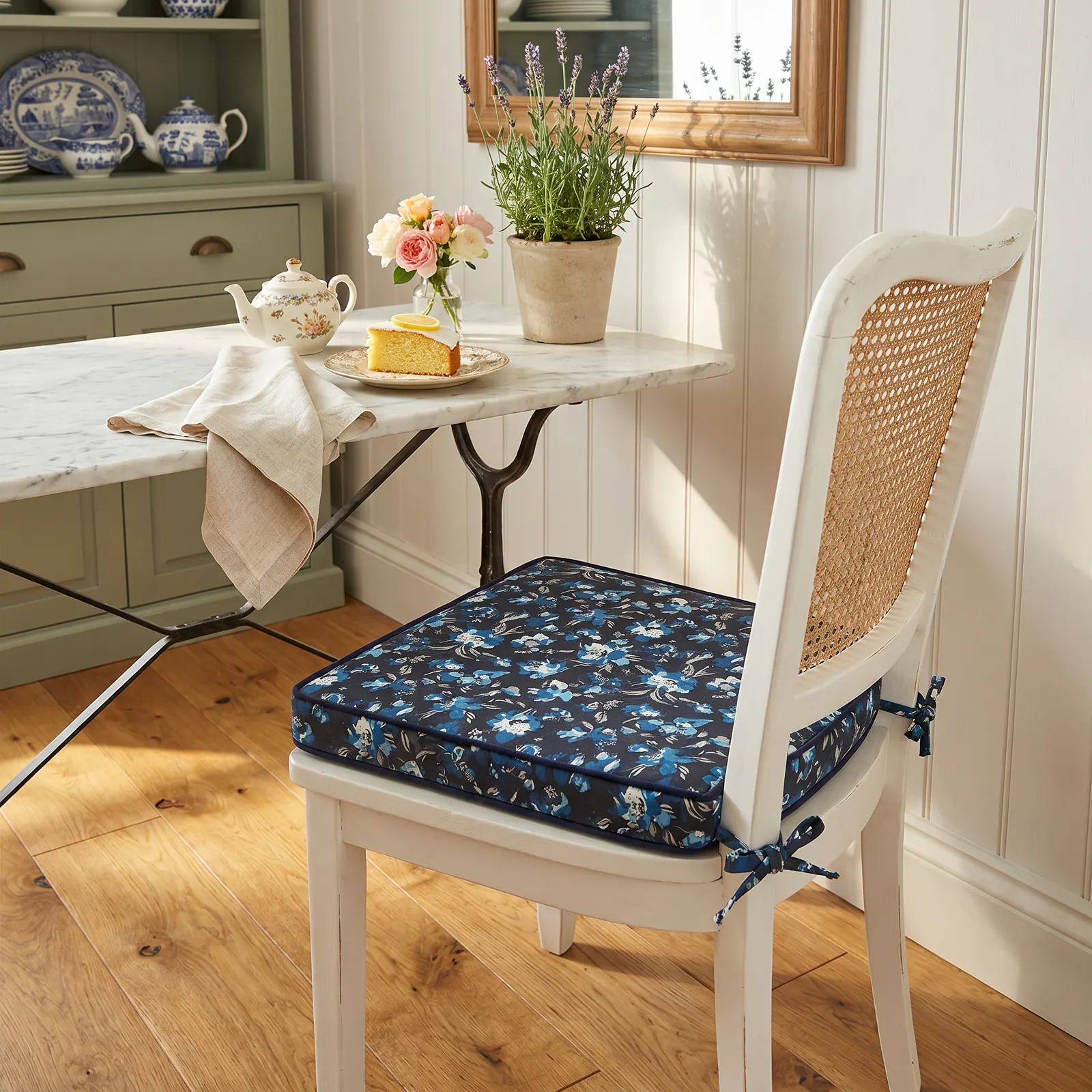 Save
The quick answer
A custom seat cushion is cut from three measurements, the width at the front, the width at the back and the depth, plus one thickness. Standard thicknesses are 2, 3, 4 and 5 in (5, 7.5, 10 and 12.5 cm); 4 in (10 cm) is the listing standard, and most buyers settle on 3 or 4 in. Curved, notched or horseshoe seats need a drawing or a paper template.
Shapes to choose from
- Custom Seat
- Chair pad88 readings
- Bench394 readings
- Window seat261 readings
- Rocker & glider2 readings
- Piano bench3 readings
- Trapezoid18 readings
- Sofa
Every one is cut to your measurements. The number is how many readings the atelier has published for that shape.
Sizes & measuring
On the cutting table: what a seat cushion needs
Measure the seat itself. An old cushion has already been sat into a new shape.
| Front width | Edge to edge across the front of the seat |
|---|---|
| Back width | Across the back edge, between the posts or spindles if the chair has them |
| Depth | Front edge to back edge, straight, at 90° to the front |
| Thickness | 2, 3, 4 or 5 in (5, 7.5, 10 or 12.5 cm) as standard; thinner or thicker made to order |
| Most chosen | 3 or 4 in; 4 in (10 cm) is the listing standard |
| Foam | Firm 32-density foam, about 2.0 lb/ft³ (32 kg/m³), wrapped in polyester fiber |
| Zipper | Standard, along the back edge |
| Ties | On request, usually at the back corners and often at no charge; placed where you specify |
| Units | Inches or centimeters; fractions such as 57 5/8 in are fine |
| Handmade tolerance | Roughly ±1/2 to 1 in (1 to 2 cm) |
| Odd shapes | A drawing with every edge measured, or a paper template |
Fabrics that work
- VelvetDense pile, deep color
- Linen-Look WeavesWoven texture, easy care
- Performance & Pet-Friendly WeavesTight weaves for busy homes
- Outdoor Acrylic & Solution-DyedMade for sun and weather
Open a family for its swatch book, care notes and neighbors.
One word, a dozen different seats
'Seat cushion' is the phrase people type first. It covers a rattan armchair 21.25 in (54 cm) wide, a spindle-back dining chair, a 77 in (196 cm) quilt box and a window seat between two walls. Same word, different geometry.
So a custom seat cushion starts with a name, not a tape measure. Tell the workshop what the seat is: dining chair, stool, bench, window seat, armchair or built-in. The name decides where the ties go, whether there are posts to clear and whether a drawing is needed.
Then three numbers and one thickness. Width at the front. Width at the back. Depth. That is the whole system, partner. Everything else is an edge case, and edge cases are where I earn my coffee.
Thickness: 2 to 5 in, and why a 2 in pad holds up
The listing photos show 4 in (10 cm), and 4 in is the standard. Most buyers settle on 3 or 4 in. The menu runs 2, 3, 4 and 5 in, and real orders have gone thinner and thicker: 1.5 in for a tight spot, 8 or 9 in for floor seating.
Foam suppliers advise at least 2 in of firm foam on a dining seat so you don't bottom out. That depends on the foam, and here every thickness uses firm 32-density foam wrapped in polyester fiber. A 2 in chair pad compresses only slightly, which keeps you at a sensible height at the table.
Thinner generally costs the same as standard; thicker foam raises the quote. If the seat also has to meet a table, run your numbers through the seat height calculator or read how cushion thickness changes seat height. Tolerance is kindness to your future self, and so is checking knee room before the foam is cut. Why most buyers pick 3 or 4 in has the long version.
Measuring any seat in six moves
Name the seat
Dining chair, stool, bench, window seat, armchair or built-in. Write it at the top of your sketch; it tells the maker what the cushion has to clear.
Measure the front width
Edge to edge across the front, where your knees are. Record it to the nearest 1/4 in.
Measure the back width
Across the back edge, between the posts or spindles if there are any. On many dining chairs this number is smaller than the front, which is why the chair pad measurements Pattern asks for both.
Measure the depth, straight
From the front edge to the back, at 90° to the front. An angled side is always longer than the depth. If yours comes out shorter, one of the numbers is wrong.
Draw anything that isn't a rectangle
Tapered, horseshoe and barrel-back seats need a drawing with width, depth and where each curve starts. A paper template traced on the seat is the surest drawing of all. On a rattan armchair 24 in (61 cm) deep and 21.25 in (54 cm) wide, the seat pad was easy; the back cushion pressed against the curve was the real risk, so the workshop asked for a straight-on photo of it first.
Mark the extras
Ties and where they go, notches with their width, depth and position, and the zipper side. In an older house, add both diagonals so the drawing can be checked. Drawing a custom shape shows the layout.
Ties, grip, and the Velcro question
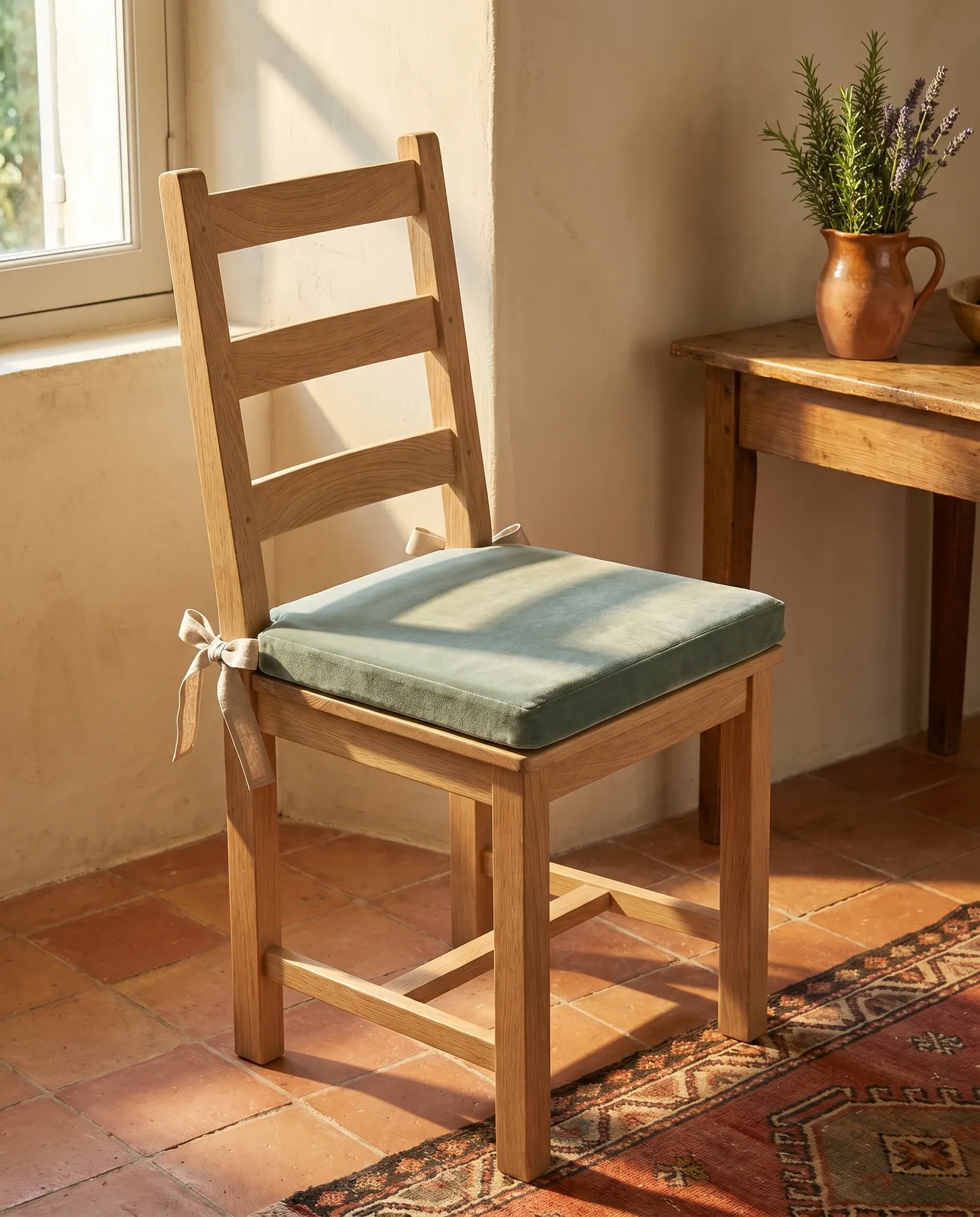
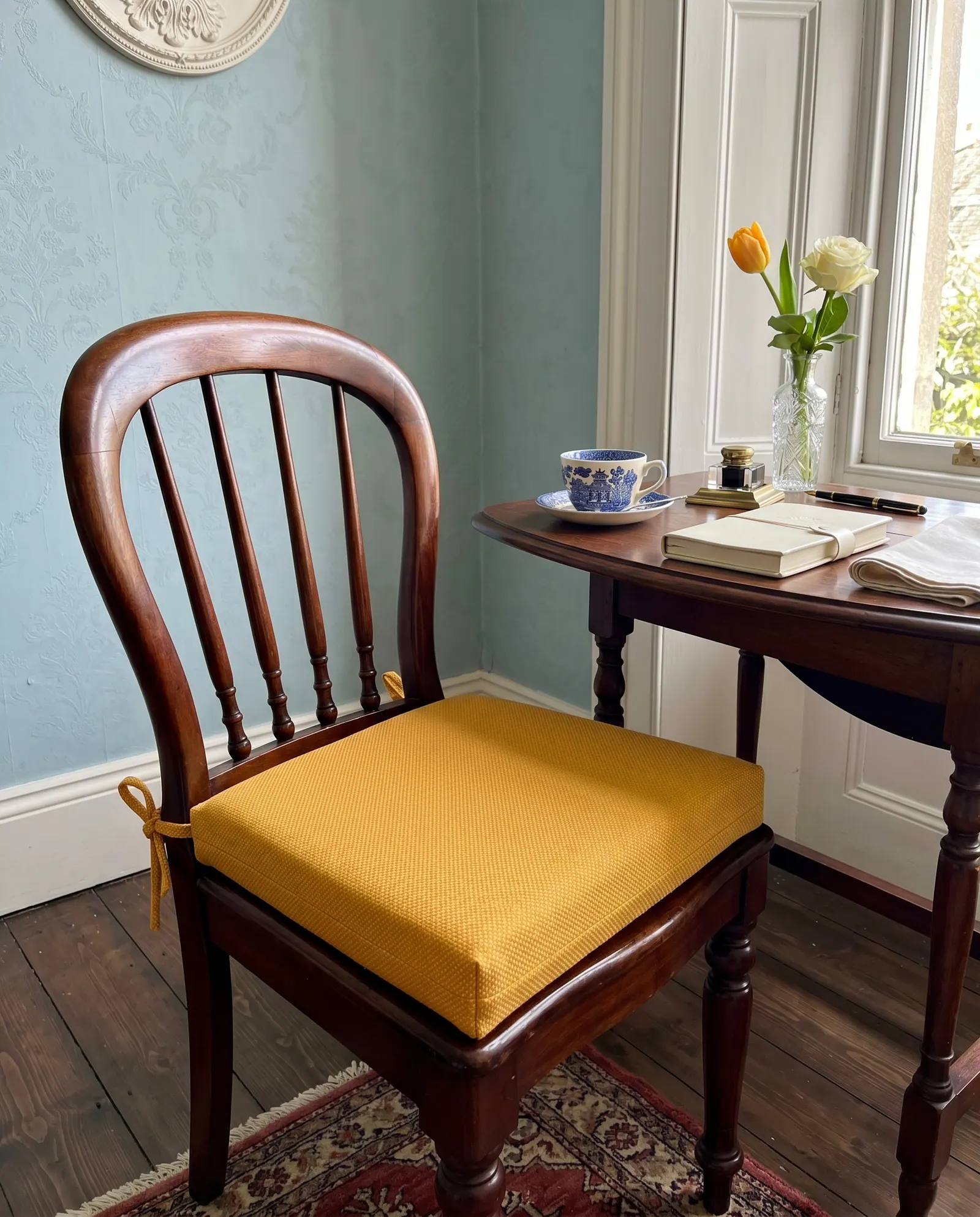
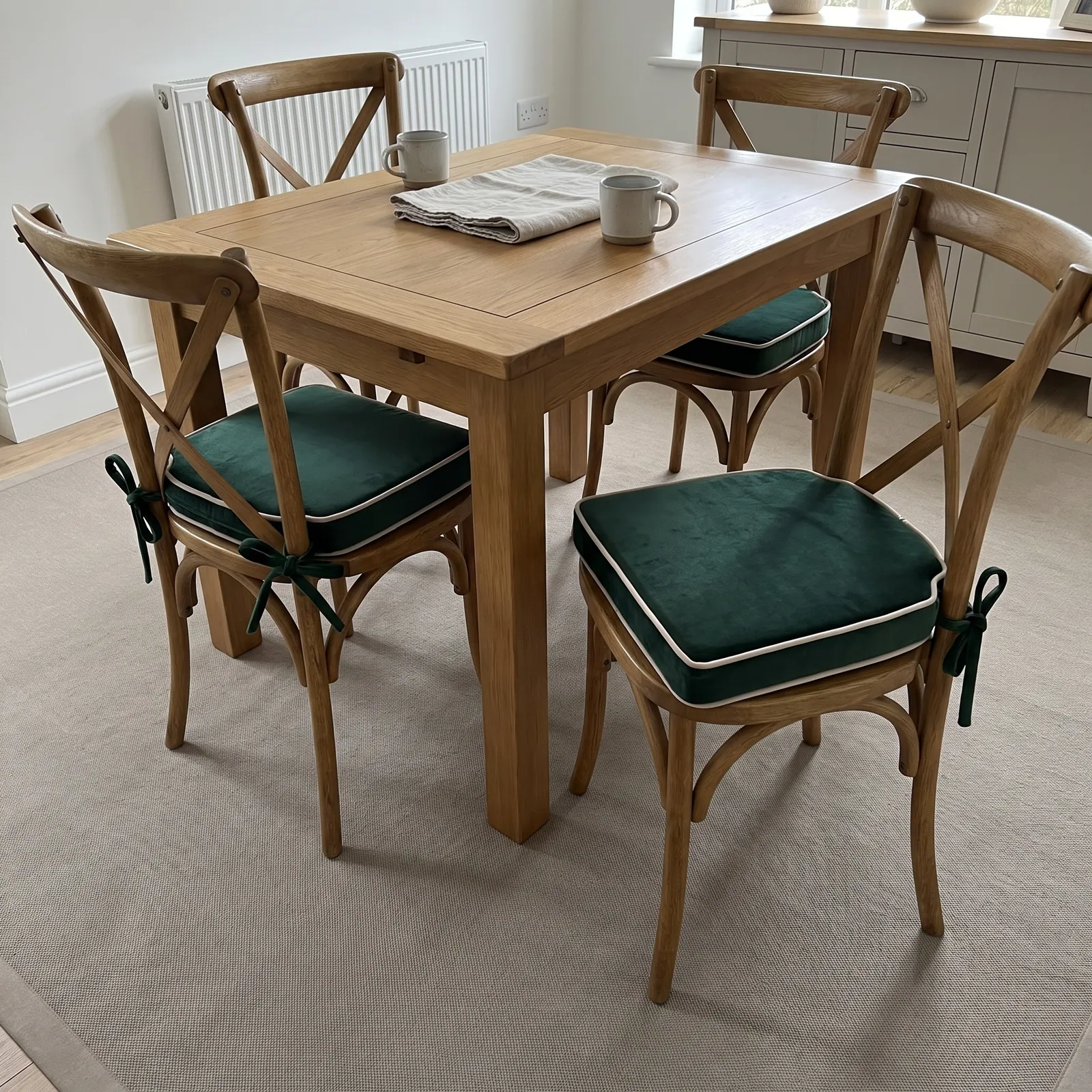
Ties are not standard. They are added on request, usually at the back corners and often at no charge, and they can be inset wherever you ask. Say where each tie goes and how long it should be. The photographs show the classic placement at the back posts: navy floral on a white cane-back, eucalyptus velvet on an oak ladder-back, mustard on a Victorian spindle-back, forest green velvet on four bentwood cross-backs. Tie placement for chairs and swings goes chair by chair.
A non-slip bottom is the other standard answer to a sliding cushion. Velcro tabs and snap fasteners are not made; a two-sided Velcro strip has been added on request at extra cost. Most buyers end up with ties or a non-slip base, and Velcro vs ties compares them.
One habit saves a remake. Put the tie request in writing, with position, length and color, not squeezed into the size box where it gets overlooked. Then check the photo before dispatch for the small extras.
A 77 in quilt box and four hinges
A returning buyer in the US, happy with an earlier patio swing cushion, came back with a 77 in (196 cm) quilt box. Hinged lid, so the cushion had to tie on without fouling the hardware.
She sent four hinge positions: 8 5/8, 29, 48 and 68 1/4 in. Good numbers. The workshop still asked two questions: which end she had measured from, and how wide each hinge was, with photos. Measured from the wrong end, every tie lands in the wrong place, and the hinges will not care how neat the stitching is.
The ties went on the hinge side only, added free. That is the whole trick with lids: record each position from a named end, and the ties clear the metal. More on lids in cushions for hinged storage benches.
- Measured
- 77 in (196 cm) long; hinges at 8 5/8, 29, 48 and 68 1/4 in
- What it taught
- For hinged lids, record hinge positions from a named end so the ties clear the hardware.
Which page fits your seat
| Your seat | Usual shape and fastening | Read next |
|---|---|---|
| Dining or kitchen chair | Pad, often wider at the front; ties at the back posts | Dining chair cushions, chair pad measurements |
| Bar or counter stool | Small round or square pad with ties | Bistro chair and bar stool cushions |
| Entry, storage or dining bench | Rectangle; split at lid hinges | Bench cushions |
| Window seat or built-in | Rectangle or trapezoid between walls | Window seat cushions |
| Rocking chair | Shaped seat, often with a back pad | Rocking chair cushions |
| Armchair or accent chair | Tapered, horseshoe or barrel-back; drawing needed | Accent chair seat cushions |
| Piano bench | Narrow rectangle | Piano bench cushions |
| Angled, notched or bay seat | Trapezoid or custom shape from a drawing | Trapezoid cushions, trapezoid calculator |
| Sofa or couch seat | Box cushion sized to an existing frame | Sofa and couch cushions |
One published size table puts dining chair seats at about 16 to 18 in and bar stools at 12 to 15 in. Useful for a sanity check; measure yours anyway.
Photographs from the workbench
Open any photograph large; each one has its own link and a Save button.
 Save
 Save
 Save
Mistakes that end in a remake
- Trusting the dropdown size. It only sets the price bracket; the cushion is cut to the exact size you write in the personalization box.
- Calling a slanted side the depth. Measure depth at 90° to the front; the angled edge is always longer.
- Sending numbers that don't close. On a stepped or notched seat, the steps plus the short edge must equal the long edge.
- Skipping the drawing on a gentle curve. Subtle U-shapes can come out looking almost square; draw the curve and mark where it starts.
- Hiding the tie request in the size box. Put ties in the order note, with position, length and color.
- Forgetting what the cushion must clear. Mark each notch's width, depth and position, and each hinge from a named end.
- Treating a frame as a suggestion. If the cushion sits inside a ledge, say the size is a hard maximum; handmade cushions vary by about 1/2 to 1 in.
A seat cushion is three numbers and one thickness: front width, back width, depth. Anything that isn't a rectangle gets a drawing.
Nate Kowalski
Buyer questions: sizes, shapes and staying put
- A common question
My chair size isn't in the dropdown. How do I order it?
The workshop's answerChoose the size bracket your measurements fall into, or the closest one, usually the next size up; the dropdown only sets the price. Then type the exact dimensions, thickness, fabric code and piping code into the personalization box, for example '36 x 11.5 x 2 in, Main: 111, Piping: 133'. The cushion is cut to what you write, and fractions like 57 5/8 x 15 3/8 in are fine. Ordering several? Add each size to the cart as its own item, and message after checkout if you'd like the details double-checked.
- A common question
Four inches is too tall for my chairs. Can the pads be thinner, or a bench cushion thicker?
The workshop's answerYes, thickness is fully custom. Orders have gone as thin as 3/4 in (2 cm), 1 in, 1.5 in and 2 in, and as thick as 5, 6, 8 and 9 in, with floor cushions at about 6, 8 and 10 in (15, 20 and 25 cm). Select the nearest option and write the exact thickness in the personalization box or order note. Thinner usually costs the same as the 4 in (10 cm) standard; thicker foam raises the quote.
- A common question
My seat is tapered with rounded back corners. How do I order a shape that isn't a rectangle?
The workshop's answerUse the custom-shape listing, not the rectangle one. Pick the size range by the longest length and the deepest depth; that only sets the price bracket. At checkout, upload a drawing with a measurement on every edge, plus a photo of the seat if you have one, and put the thickness and fabric code in the personalization box. The cushion is cut exactly to the drawing. A simple paper sketch is fine, and if you're unsure, message the drawing first and the makers will say which options to select.
- A common question
Can the cushion be notched around the legs or posts of my bench?
The workshop's answerYes. Mark each notch's width, depth and position along the edge and add a few wide-angle photos. The workshop redraws it as a standard template, often in centimeters, and asks you to confirm before cutting. Leg notches go through the custom-shape listing. Ties are an optional extra, so say where each one goes and how long it should be. If the notches sit on the back edge, mention it, because that is where the zipper runs.
- A common question
Could you use Velcro instead of ties to keep my seat cushion in place?
The workshop's answerTies or a non-slip bottom are the usual answer, and Velcro tabs and snap fasteners aren't made. A two-sided Velcro strip has been added on request: one side sewn under the cushion, the matching side sent to you to fix to the seat. It costs extra, so some buyers fit their own. Write the request in the personalization box with your fabric and piping codes and wait for confirmation; for a banquette, a photo of the bench helps.

Have it made
Have your seat cushion made — ask Nate’s workshop
Send the numbers in inches: length × depth × thickness, plus any angle. The workshop checks them with you, because foam has no undo button. — Nate
Leave your details and the workshop will call you to confirm measurements, fabric, foam and piping. No prices, dates or payment on this page: it is a request, not an order.
Seat cushion questions, measured
What foam is inside a custom seat cushion?
Firm 32-density polyurethane foam, about 2.0 lb/ft³ (32 kg/m³), wrapped in a layer of polyester fiber. The same foam is used at every thickness, which is why even a 2 in (5 cm) chair pad compresses only slightly under body weight.
What makes one custom seat cushion quote higher than another?
Size, thickness, shape, fabric and extras. A bigger area and thicker foam cost more, non-rectangles cost more than rectangles, natural fibers and outdoor fabric cost more than the standard charts, and tufting or add-ons such as non-slip bases and ties add to it. Piping and the zipper are included.
Which edge of a seat cushion does the zipper go on?
The back edge, as standard, so it faces the chair back or the wall. If your cushion has notches on that edge, around posts or a frame, say so when you order, because the notches and the zipper share the same side.
± 1/4 in — Nate
The Pattern Room
Patterns and sketches
- The Pattern RoomAccent chair and sofa chair seat cushions, replaced to the old shape
- The Pattern RoomStandard cushion sizes, and when yours isn't one of them
- The Pattern RoomBar stool cushions sized to round, square and saddle seats
- The Pattern RoomMade to measure or off the shelf? A fair test for your seat