The Pattern Room · a measuring pattern
Accent chair and sofa chair seat cushions, replaced to the old shape
The seat is the first part of a good armchair to give out, and the easiest part to bring back. Here's how to measure it so the new one sits where the old one did.
 Save
The quick answer
To replace an accent chair seat cushion, measure the width between the arms at the back and the front, the seat depth, and the old cushion's thickness, and send a photo of the chair. The standard is 4 in (10 cm), with 5 and 6 in (13 and 15 cm) offered for armchairs. Tapered, rounded and T-shaped seats are ordered as shaped cushions.
The seat gives out long before the frame does
Every armchair I ever loved went the same way: the frame stayed handsome and the seat sank into a saucer. An accent chair seat cushion takes every sit-down, every nap and every cat, so it wears out first. Replace it and the whole chair comes back.
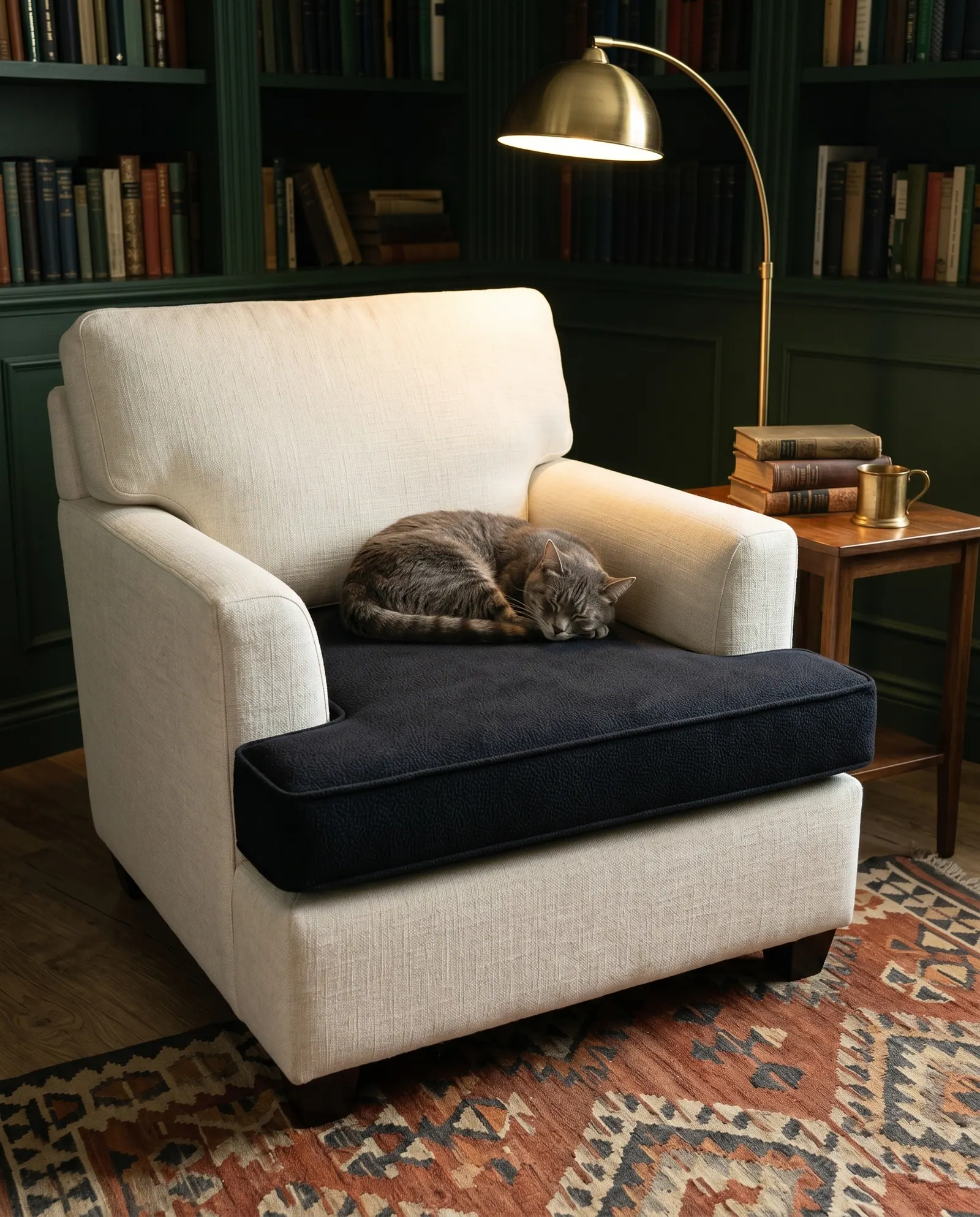
In these photos, one cream armchair in a green library got a black T-cushion and another got a sage one. Kids and dogs are the real quality control, and in both pictures a tabby has already claimed the new seat.
A sofa chair cushion starts with your numbers, not a catalog size. The custom seat cushions hub covers the shapes; this Pattern covers the measuring.
Which seat is sitting in your chair?
| Seat shape | How you can tell | How it gets ordered |
|---|---|---|
| Square or rectangle | Back and front widths match; one armchair was 22 x 22 in (56 x 56 cm) for seat and back | Rectangular cushion, exact size in the order note |
| Tapered | Wider at the front: one pair of chairs was 19 in (48 cm) at the back, 20 1/2 in (52 cm) at the front, 21 in (53 cm) deep | Shaped cushion from a measured sketch |
| Rounded front | The front edge bows out past the sides | Shaped cushion, with a photo of the old cushion and every number on it |
| T-shaped | The front corners reach out around the arms | Traced from the old cushion on paper |
| Curved rattan or wicker frame | The back edge follows the frame | Seat pad is simple; the back needs measurements and a straight-on photo first |
Measuring an armchair for a new seat, step by step
Take the old cushion out and look at it
Square, narrower at the back, rounded at the front, or a T around the arms? That answer decides how you order.
Measure between the arms, back and front
Measure the width between the armrests at seat level twice: against the back, then at the front edge. Most old chair seats are tapered, and one width hides that.
Pattern sheet A tapered armchair seat: 19 in (48 cm) across the back, 20 1/2 in (52 cm) across the front, 21 in (53 cm) deep. Measure the seat depth
Measure from the back of the seat to the front edge, on the chair itself; a cushion that has sagged for years can mislead you. On a curved front, measure at each side and the center.
Measure the old cushion's thickness
Stand a ruler beside it before it goes to the curb. Thickness is part of how the chair feels and where your elbows meet the arms.
Trace a T-shaped seat on paper
Lay the old T-cushion on kraft paper and trace it. Check the arithmetic: the front width across the ears equals the back width plus both ears, and the full depth equals the depth behind the ears plus the ear depth.
Measure the back cushion from the seat up
For a loose back cushion, measure the height you want from the top of the seat cushion, not the seat deck, and its width.
Photograph it with the numbers on it
Write every measurement on the paper or a note beside the old cushion, photograph it flat, and add a photo of the whole chair. The chair's overall size is not enough.
Order seat and back as two cushions
They're separate items: add each at its own size with its thickness in the note, or ask for a quote per chair from your photos.

Have it made
Measured it? Have Rosa’s workshop make it
Every good cushion I know started with a long porch chat. This is the short version: leave your number and the workshop will call. — Rosa
Leave your details and the workshop will call you to confirm measurements, fabric, foam and piping. No prices, dates or payment on this page: it is a request, not an order.
The nursery armchair cushion that kept its five inches
A parent in the US was turning an old armchair into the nursery chair. She measured the old cushions at about 5 in (13 cm) thick and asked for a 20 x 22 x 5 in (51 x 56 x 13 cm) seat and a 21 x 27 x 5 in (53 x 69 x 13 cm) back, filled with fiber and silicone clusters rather than a foam block. Then she ordered swatches to see the colors in her own light.
What I love, neighbor, is that she measured the thickness before she looked at a single color. Five inches was how that chair felt, and she kept it.
- Measured
- Seat 20 x 22 x 5 in; back 21 x 27 x 5 in
- What it taught
- Measure the thickness of the cushions you are replacing; comfort depends on it.
Four inches or six, and how firm
One buyer sent photos of an armchair with a 22 x 22 in (56 x 56 cm) seat and a matching back, and the workshop copied both in charcoal linen that fit perfectly. The choice was 4 in or 6 in (10 or 15 cm): thinner foam quotes lower, and same-color piping adds nothing.
The standard seat is 4 in of firm 32-density foam (32 kg/m³, about 2 lb/ft³) wrapped in polyester fiber, which holds its shape instead of collapsing. The foam density Pattern converts the numbers.
A back can be thinner than the seat, such as a 4 in seat with a 2 or 3 in back, but keep foam backs at 2 in (5 cm) or more; back cushions thinner than the seat explains why. Want a feather layer over the foam? Ask the workshop before you order.
A rounded front, measured the right way
A buyer wrote in about two armchairs with seats narrower at the back and rounded at the front. She photographed the old cushion with every number on it: 18 7/8 in (48 cm) across the back, 16 7/8 in (43 cm) down each side, a curved 22 in (56 cm) front reaching 20 in (51 cm) deep at the center, 4 3/4 in (12 cm) thick.
She first ordered it as a plain rectangle, so the shop canceled with a full refund and had her reorder it as a shaped cushion, which is cut and priced differently. Her old cushion was the best template she could have sent.
Cushion already gone? The team can work out sizes from the chair itself. The paper template Pattern covers the tracing.
Where armchair cushion replacement orders go sideways
- Sending the chair's overall size instead of the seat between the arms.
- Measuring a tapered seat only across the front.
- Ordering a shaped seat as a plain rectangle, then starting over.
- Guessing a back cushion for a curved rattan frame from numbers alone.
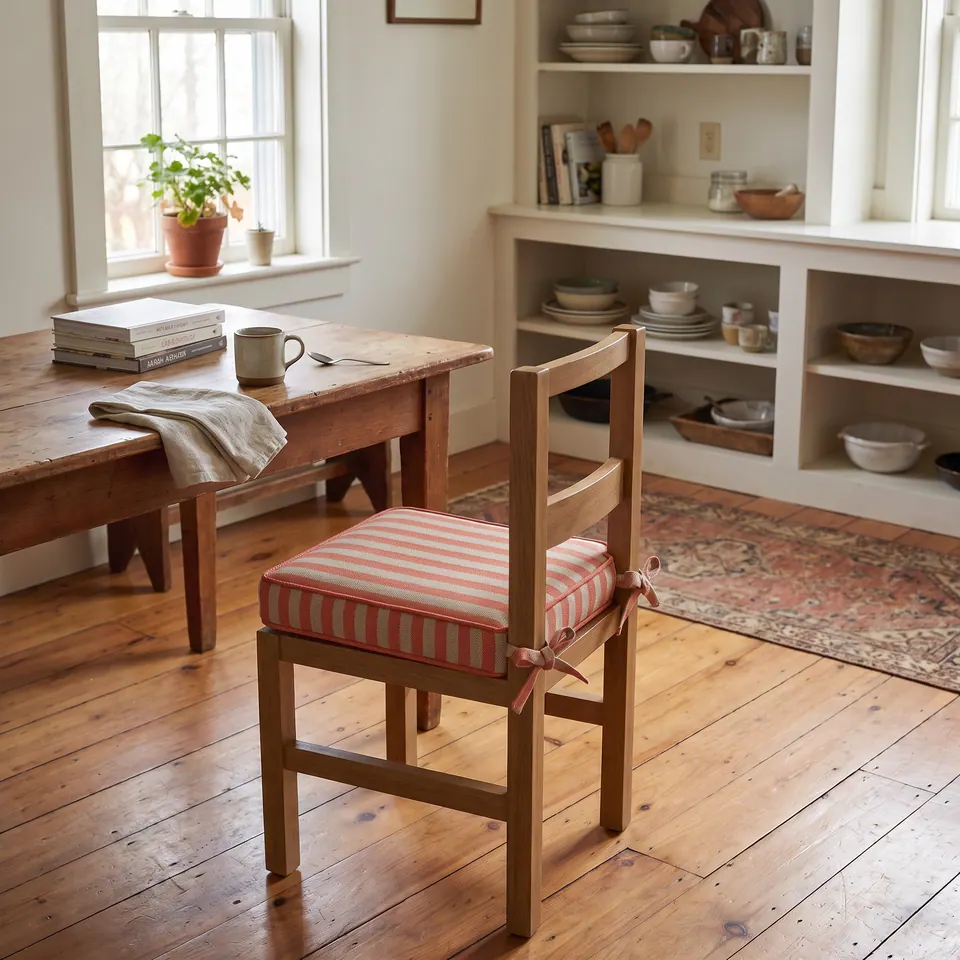
- Expecting ties by default. They're sewn in only on request, so ask in writing.
What gets made, and where other chairs go
This workshop makes the seat and back cushions that lift out of an armchair. It doesn't make fitted slipcovers for upholstered chairs or rebuild rigid upholstery; what isn't made spells that out.
Sofas follow the same logic in replacement sofa seat cushions, and patio chairs have their own Pattern in outdoor chair cushions. Decide thickness, ties and piping in the chair cushion builder, and see dining chair cushions for the smaller seats.
So tell me: what shape is the cushion in your favorite chair right now?
An armchair is only as good as its seat cushion. Measure between the arms at the back and the front, and keep the old cushion until the new one arrives.
Rosa
Buyer questions: armchair seats and backs
- A common question
Can you copy the seat and back cushions on my armchair?
The workshop's answerYes. Send photos of the chair with the seat and back cushion measurements and the workshop replicates them, quoted per chair, with the shipping cost on the quote. A 4 in cushion costs less than a 6 in one, and same-color piping has come at no extra charge.
- A common question
I only know the chair's overall size. Is that enough?
The workshop's answerNot for a good fit. Measure the width between the armrests, the seat depth and the back-cushion height you want, and send them with a photo of the chair. Boxed cushions with piping are no problem, and ties at the back corners hold them in place.
- A common question
Can the back cushion be thinner than the seat?
The workshop's answerYes. Write each cushion's thickness in personalization, for example a 4 in seat with a 2 or 3 in back. Keep a foam back at 2 in (5 cm) or more; thinner foam flattens quickly against a backrest.
- A common question
How do I give you a seat that curves at the front?
The workshop's answerNot with numbers alone. Sketch where each curve starts and ends and how deep it runs, or trace the seat on paper and photograph the cut-out flat beside a tape measure. The shape is confirmed before production.
Questions buyers ask next
Can an armchair cushion be made if the old one is already thrown away?
Yes. The team can work out sizes from the chair itself: measure between the arms at the back and the front and from back to front, and send photos of the empty seat. For a T-shaped or curved seat, trace the seat onto paper.
Is an armchair back cushion priced with the seat cushion?
No. Seat and back are separate items: add the back at its own size and write 'backrest' in the note, or ask for a quote per chair from your photos.
How do I keep a new armchair seat cushion from sliding forward?
Ask for ties or a non-slip base when you order. Ties are sewn in on request wherever you name, and a non-slip base can cover the whole underside, as it did on one pair of rounded-front seats.
Can a T-cushion for an armchair have piping?
Yes. Both chairs in these photos have self piping, which outlines the T and keeps the corners around the arms crisp. Matching piping costs nothing extra.