CushionGuide

A Reading by MaggieDining Chair Cushions & Pads

A green graphic-stripe box cushion on a rattan armchair, and how to choose a box, knife, rounded or angled edge

Edges are chosen by the seat underneath, not by the picture on your phone. One rattan armchair, one deep box, and the reasons in order.

The quick answer

A rattan armchair with an open spindle seat needs a box-edge chair cushion about 3 in (8 cm) deep, because a thin knife-edge pad rides on every spindle. Pipe a busy pattern in its darkest shade, as the forest green cord does here. Save ties for flat, slippery seats, and choose rounded or angled corners to follow the chair's own outline.

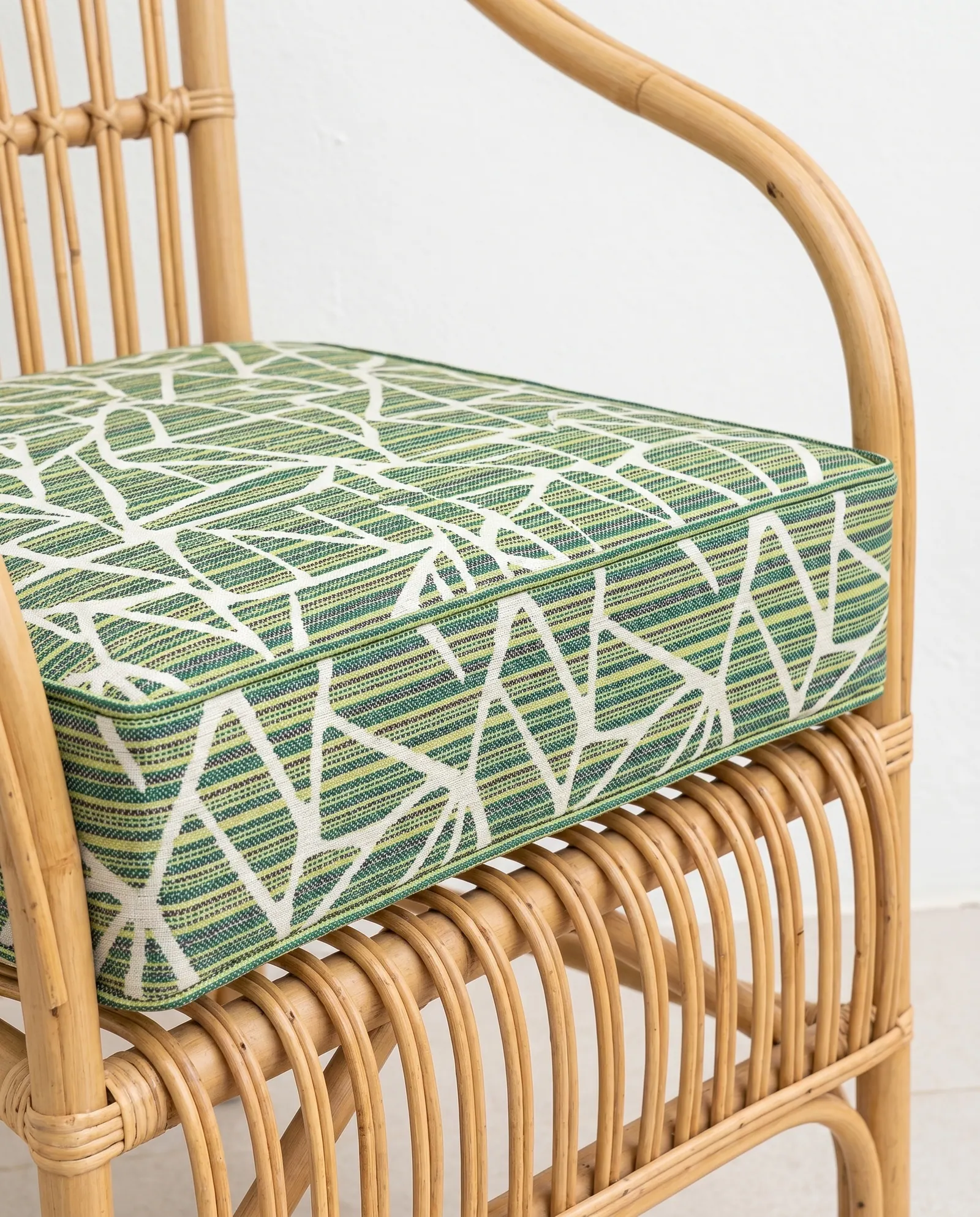
Thick green striped outdoor box cushion with white branching lines and dark green piping on a rattan armchairSave
A thick box cushion in a multi-green woven stripe overlaid with white branch lines, finished with dark green piping.
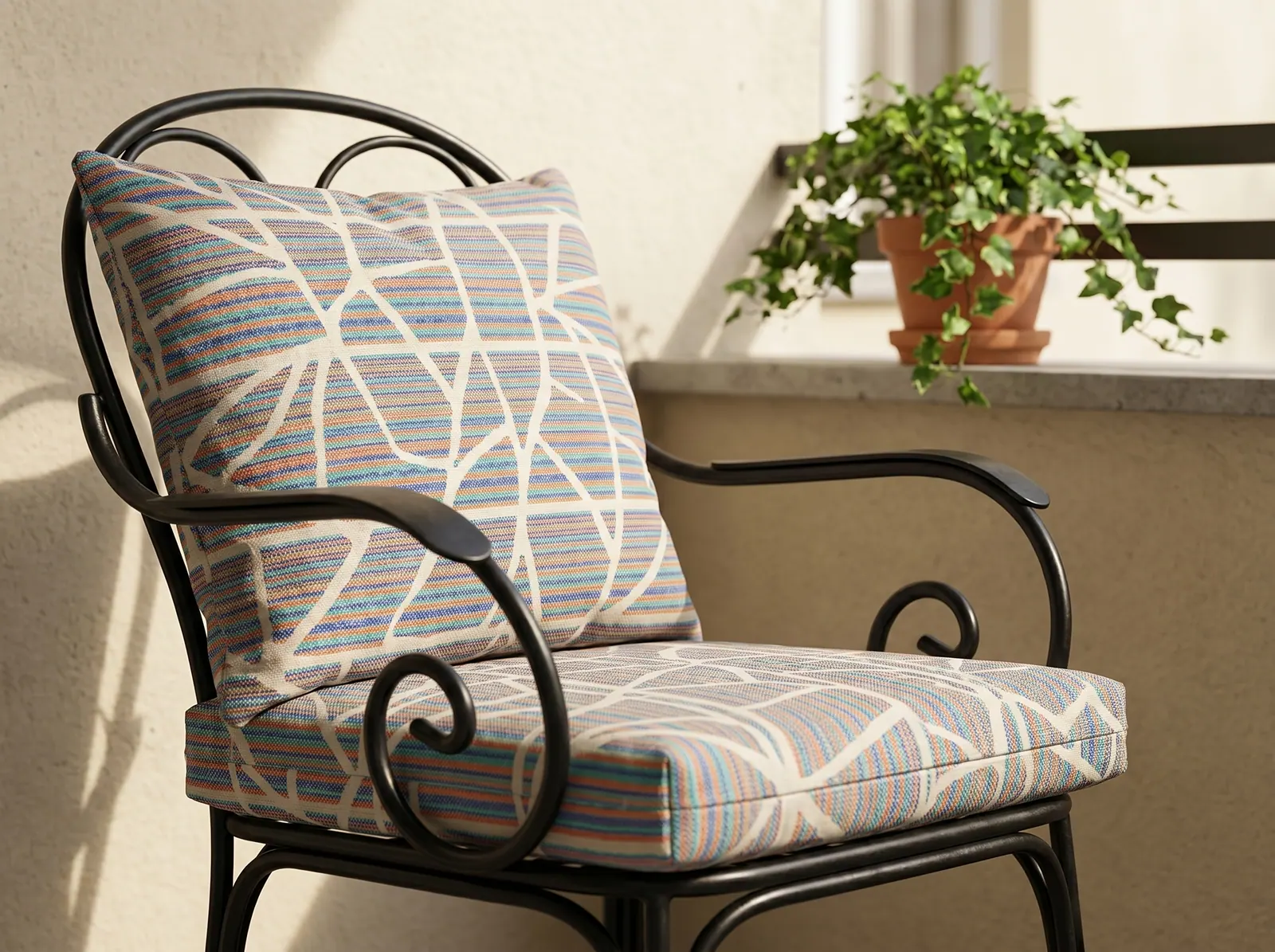
Pastel multi-stripe seat and back cushions with white branch lines on a black wrought-iron armchair with trailing ivySave
Pastel stripes crossed with white branch lines cushion a scrolled black iron armchair on a sunny balcony.
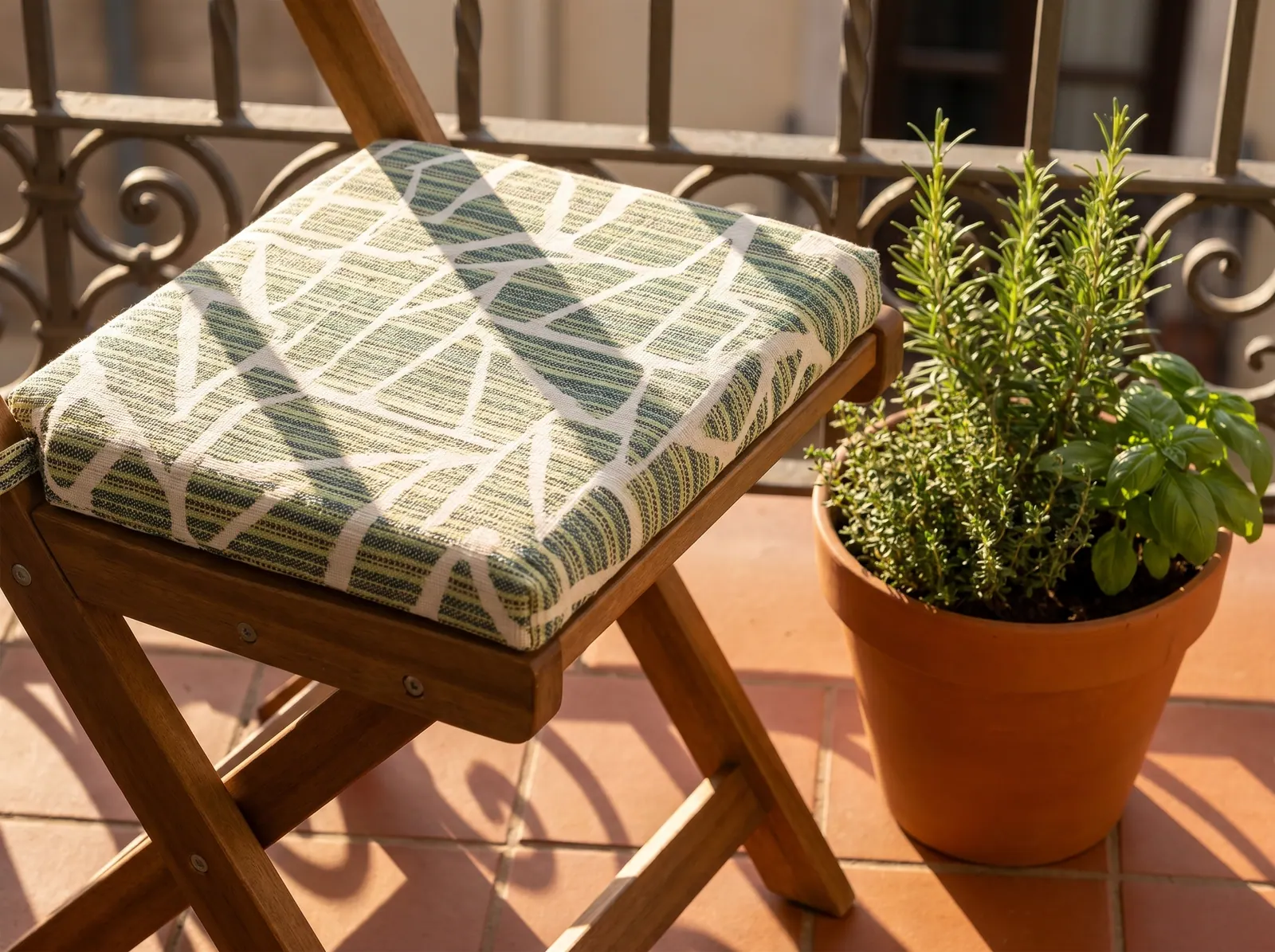
Green striped box seat pad with white leaf-vein lines on a folding wooden chair beside rosemary on a sunny balconySave
A square box pad softens a folding wooden balcony chair, with the leaf-vein pattern echoing the rosemary beside it.
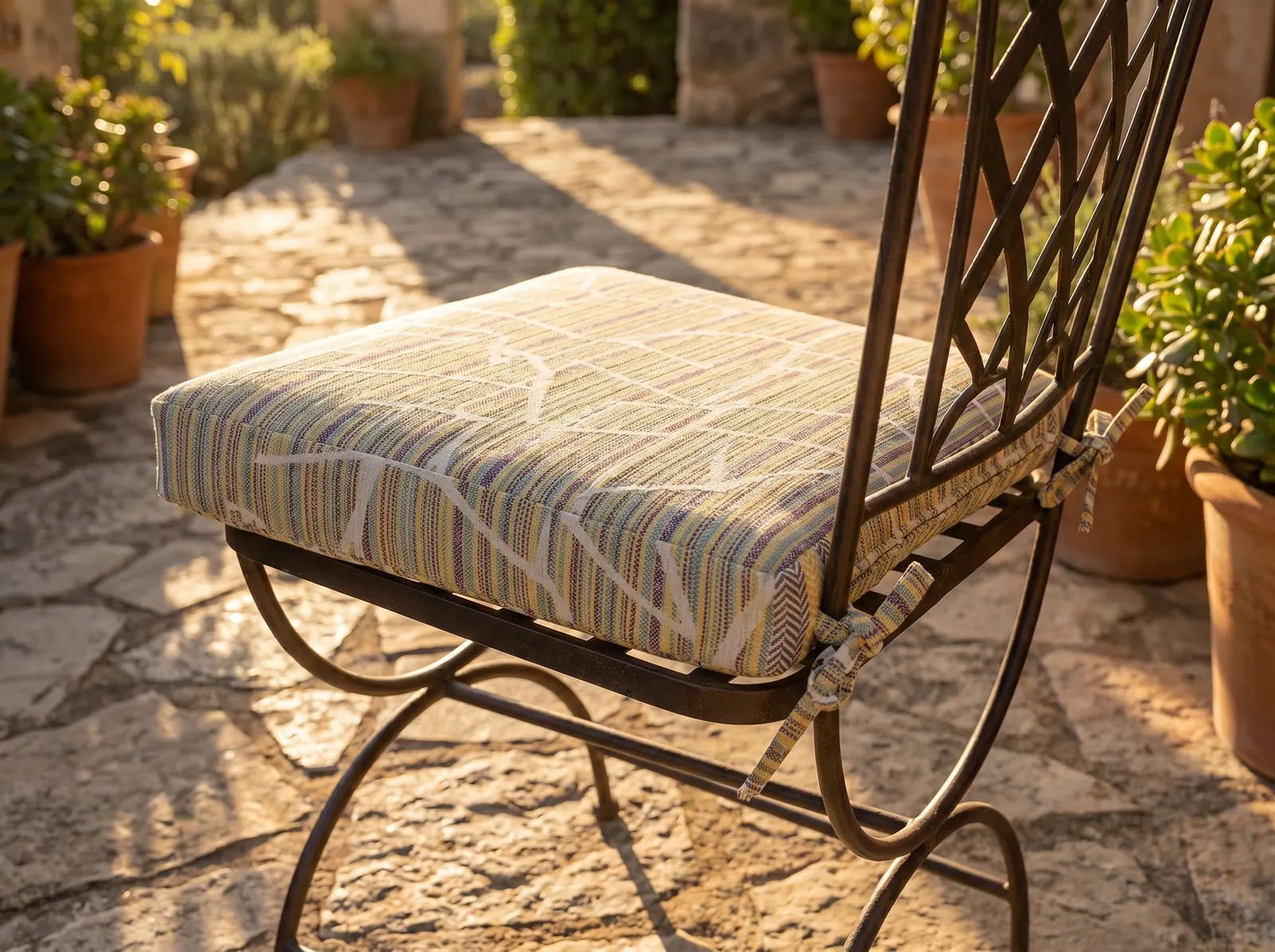
Pastel striped seat pad with white line pattern tied to a lattice-back wrought-iron chair on a sunny flagstone terraceSave
A boxed pastel pad with self-fabric ties softens a lattice-back wrought-iron chair on a sunlit terrace.
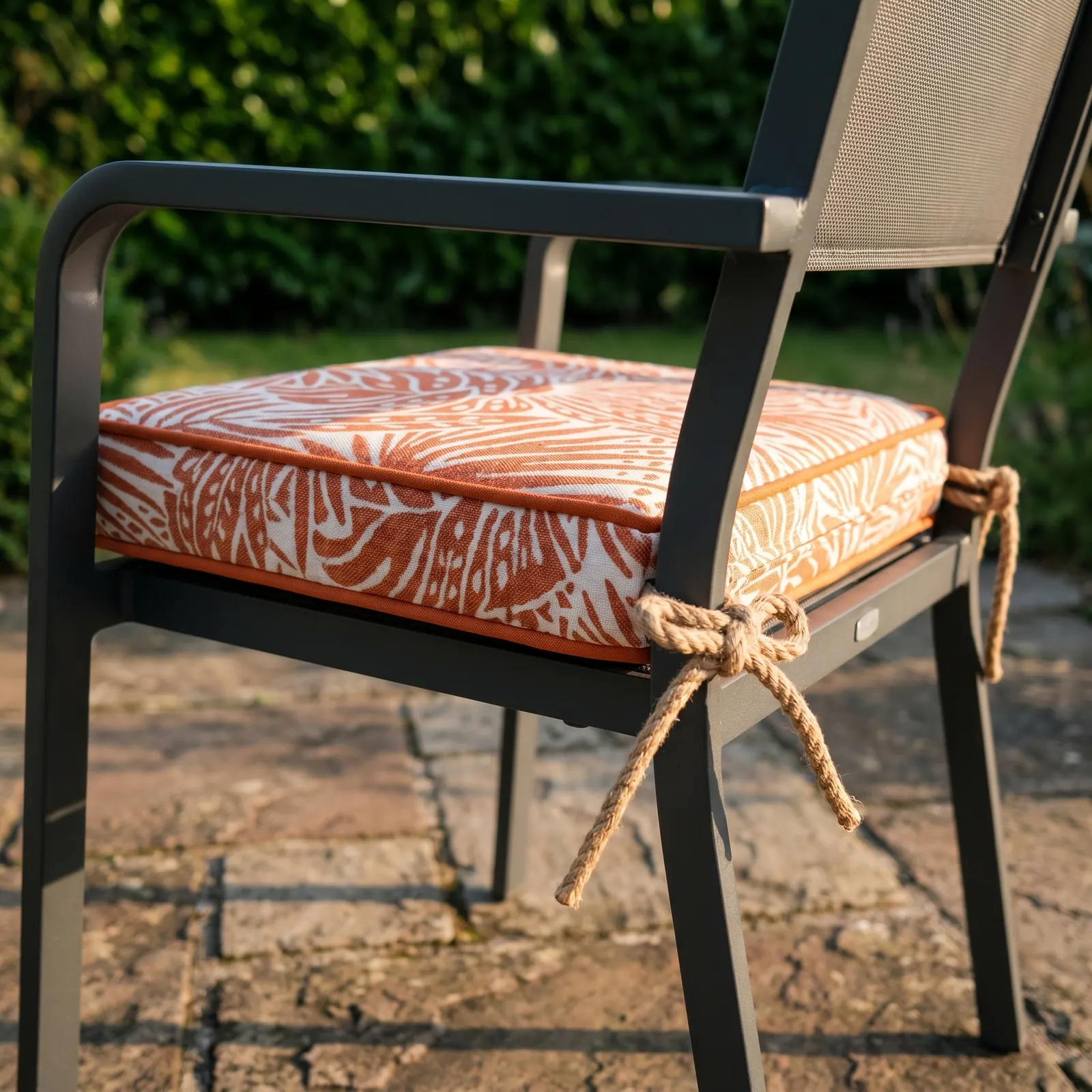
Burnt orange and white palm-leaf box chair pad with orange piping, tied with jute rope bows to a charcoal patio armchairSave
Jute rope stands in for fabric ties on this orange palm-print pad, echoing the warm brick patio below.
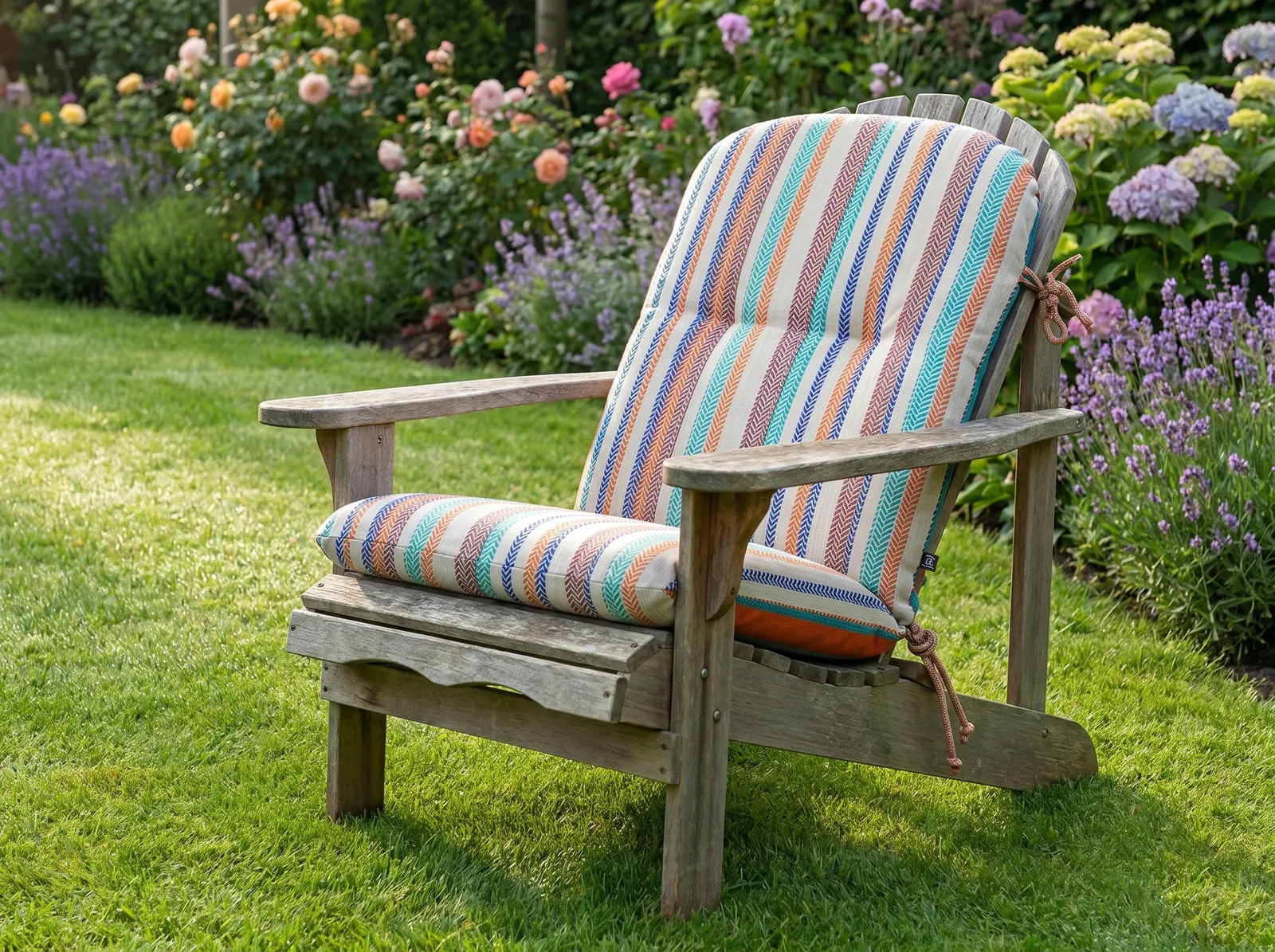
Multicolored herringbone striped high-back cushion with roll pillow and rope ties on an Adirondack chair on a lawnSave
A high-back cushion in a bright herringbone stripe follows the steep recline of a weathered Adirondack chair.
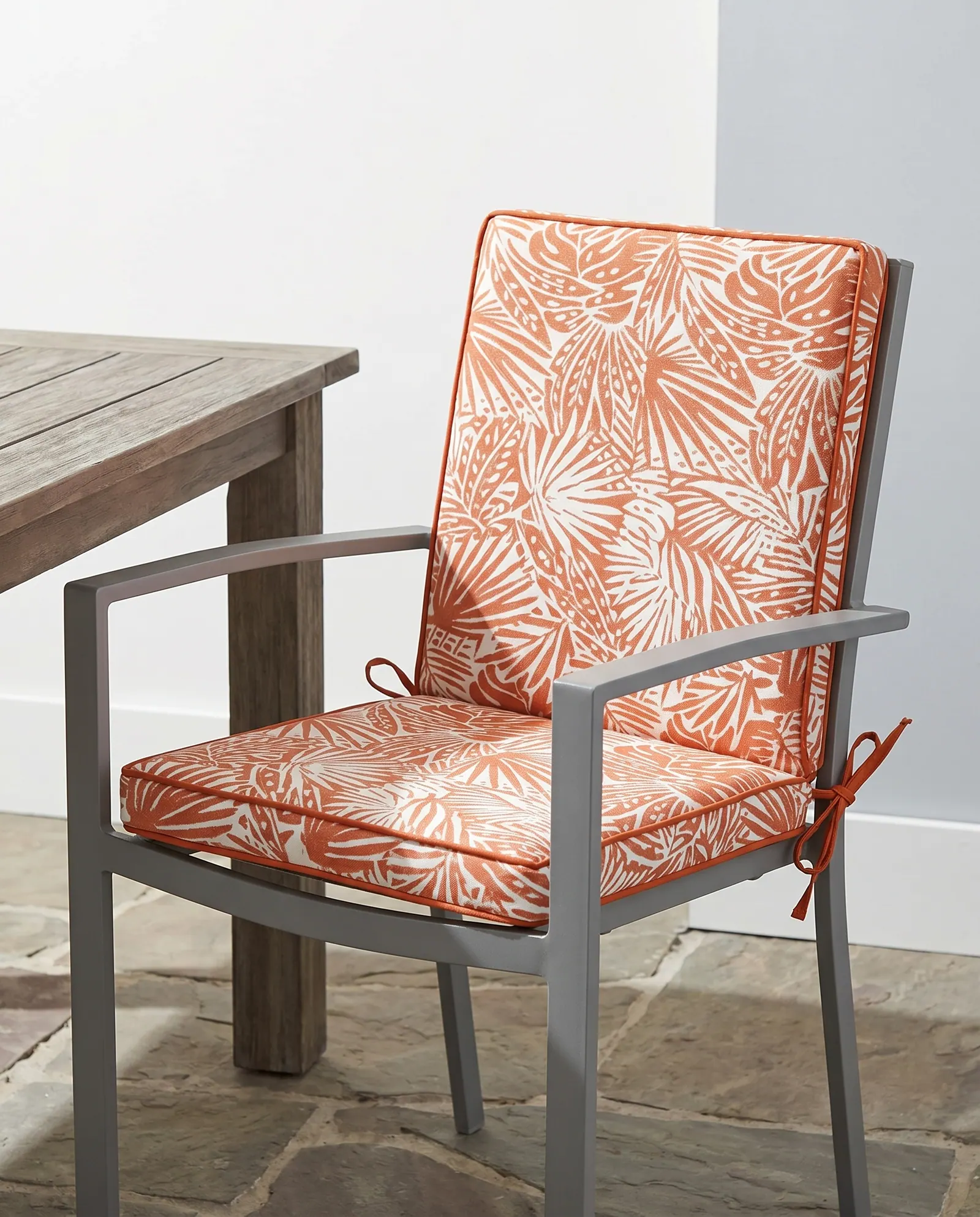
Orange and white palm-print seat and back cushions with orange piping and ties on a gray aluminum chair by a teak tableSave
Separate seat and back cushions, each with its own ties, fit a modern outdoor dining chair with an open back.

Pinned by Maggie: stripe, cord, box and cane

Five pins, top to bottom, from the branch-line stripe to the springy cane underneath.
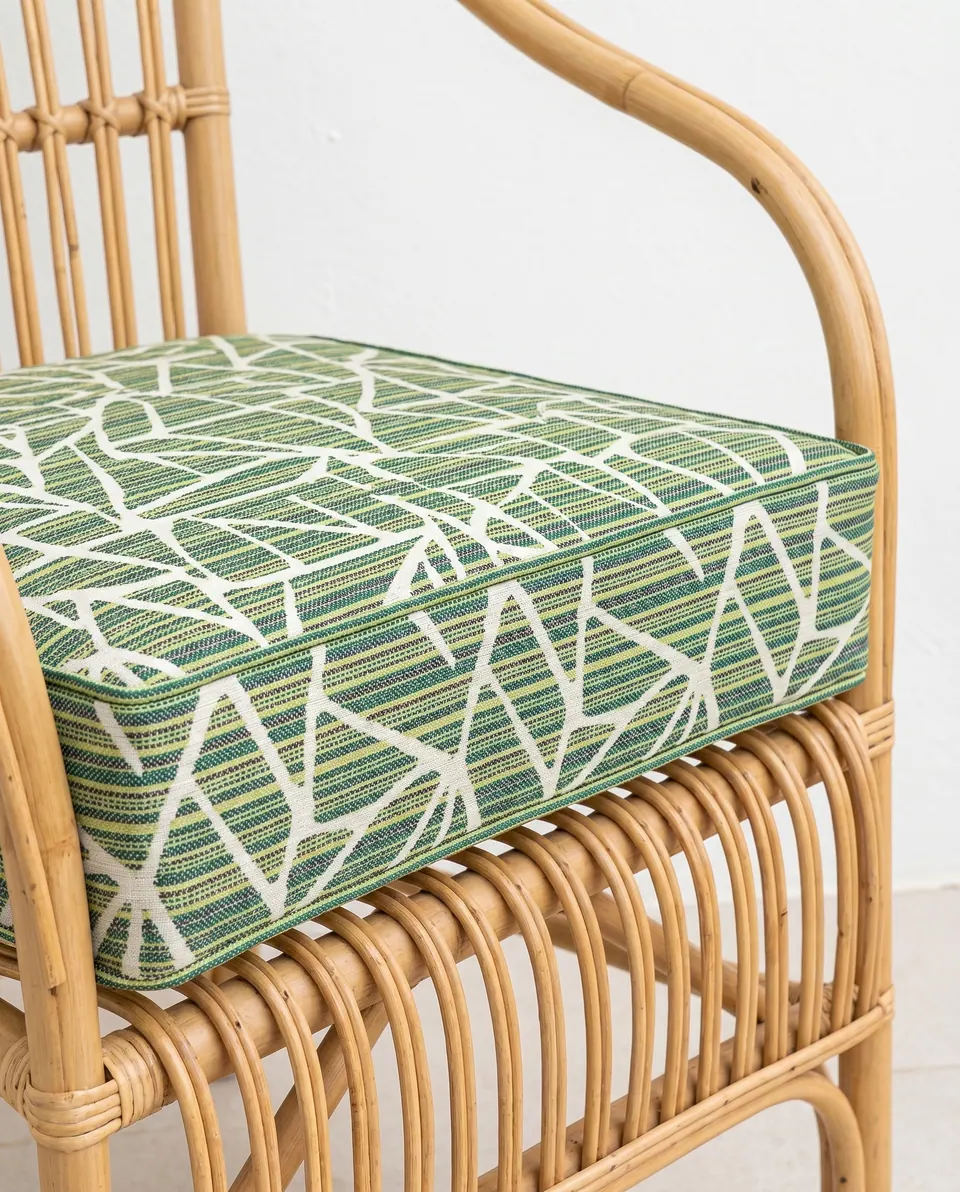
Pinned: Thick green striped outdoor box cushion with white branching lines and dark green piping on a rattan armchair
  1. Branch-line top

    White branch lines sit over a multi-green woven stripe for depth.

  2. Dark green piping

    Piping taken from the deepest stripe frames the busy pattern.

  3. Deep boxing strip

    A deep box hides the springy spindles and evens out the seat.

  4. Rattan spindles

    Open cane below shows why a firm, thick cushion is needed.

  5. Rattan arm curve

    Pale cane keeps the green reading fresh rather than heavy.

  1. Branch-line topWhite branch lines sit over a multi-green woven stripe for depth.
  2. Dark green pipingPiping taken from the deepest stripe frames the busy pattern.
  3. Deep boxing stripA deep box hides the springy spindles and evens out the seat.
  4. Rattan spindlesOpen cane below shows why a firm, thick cushion is needed.
  5. Rattan arm curvePale cane keeps the green reading fresh rather than heavy.

Box, knife, rounded or angled: four edges for one chair

EdgeHow it looksWhere it earns its keep
BoxA straight side wall with a seam, often piped, at top and bottomOpen rattan and spindle seats, and anywhere depth must hide what is underneath
KnifeTwo panels sewn at one seam, thinning toward the edgeFlat, solid seats where a slim pad is enough
Rounded cornersFront or all corners curved to follow the frameChairs with curved fronts; trace the curve on paper
AngledA trapezoid, wider at the front than the backTapered seats; measure front width, back width and depth

Why this rattan chair got a box, and a deep one

Before you shop for a chair cushion with ties, look at what the cushion will sit on. This is a natural bent-rattan armchair with an open spindle seat, and spindles are springy, uneven and unkind to a thin pad. So the cushion here is a box, cut deep, close to 3 in (8 cm), to hide the spindles and even out the sit. A knife-edge pad would ride every one of them.

The fabric is a multi-green woven stripe from the outdoor acrylic family, with white branch lines drawn over it for depth. It is busy, and busy needs a frame. The forest green piping is taken from the deepest stripe in the weave, so it outlines the pattern without adding a new color. A straight welt is a kind of honesty, and a box cushion gives you two of them, top and bottom, for the eye to check.

The pale cane of the arms keeps all that green fresh instead of heavy. The plain white plaster wall behind gives the stripe nothing to argue with, and the even studio daylight shows the weave as it is.

The gallery runs the edge question outdoors: a butter and lilac seat pad on a wrought-iron chair, a teal-piped cushion on a weathered teak bench, green leaf cushions finished with herringbone welting, blue and sand stripes on an A-frame swing. Each edge follows the seat beneath it.

Ties earn their place on flat, slick seats where a cushion slides; none show here, where the deep box and the chair's arms do the settling. Tie placement for chairs and swings has the details, box edge versus knife edge has the long answer, and the chair cushion builder lets you try edges on screen. What is under your chair cushion, dear: slats, spindles or solid wood?

A real project

A 13 3/4-inch cushion for a stone stool

A buyer got in touch wanting a single square cushion, 13.75 x 13.75 in (35 x 35 cm) and 2 to 3 in (5 to 8 cm) thick, for a stone stool, in either a linen (L-07) or a velvet (915).

Small, simple, square, and still not cheap, which surprised the buyer. The workshop explained that shipping dominates the cost of small sizes, so they can't be listed at a small price. The lowest price it could give for one piece, shipping included, was ordered through the smallest listing size with the exact measurement written in a note.

The arithmetic is plain: a lone small cushion carries a shipping-driven minimum, and several pieces share it. If you have four stools, ask about four. The dining chair cushions show sets, the outdoor acrylic pages show the cloth, and dining chair pad measurements come before any tape measure.

Buyer questions: tall covers, shaped seats and barstools

  1. A common question

    Can you make a replacement cover for an ottoman cushion that's 25.5 x 25.5 x 12 in (65 x 65 x 31 cm)?

    The workshop's answer

    Yes, as a custom order, because covers that tall aren't standard. Covers up to 6 in (15 cm) high fall within the standard sizes and cost less for the same footprint.

  2. A common question

    Could you make a custom seat pad shaped to fit my rocking chair?

    The workshop's answer

    The shop asked for the seat width, depth and thickness, a photo and a drawing of the shape, then reviewed them with its craftsmen. It declined: a pad that must fit a shaped seat exactly is too risky to make from measurements alone without the chair in the workshop. Simple rectangular cushions for the same buyer were quoted as usual.

  3. A common question

    Can you make small square barstool covers, without the cushions inside?

    The workshop's answer

    Yes. Covers about 14 x 14 in (36 x 36 cm) can be made without foam in a chosen fabric, such as T-318. Just say how many you need.

On the cutting table: the rattan armchair seat

CushionBox seat cushion for a bent-rattan armchair
FabricOutdoor acrylic (660): multi-green woven stripe with white branch lines
ThicknessClose to 3 in (8 cm), deep enough to hide the spindles
EdgeBox, with a deep boxing strip
PipingForest green, taken from the deepest stripe
ChairNatural bent rattan with an open spindle seat
BackdropPlain white plaster wall, even daylight
Small singlesShipping sets a minimum price; several pieces share it
Best forVintage rattan, sunroom and covered porch chairs

Order this cushion

Have it made

Have this made — ask Maggie’s workshop

I once cut a lovely cushion two inches short, and I have not forgotten it. That is why the workshop goes over your measurements with you on the phone. — Maggie

Leave your details and the workshop will call you to confirm measurements, fabric, foam and piping. No prices, dates or payment on this page: it is a request, not an order.

Fabric · Foam · Pipingwhat the workshop will confirm with you

Fabric
Outdoor acrylic (660): multi-green woven stripe with white branch lines
Foam
The core: its density and thickness set the feel.
Piping
Forest green, taken from the deepest stripe
Only for this request: no marketing calls or texts. Outside the US, add the country code.
In inches: length × depth × thickness, plus any angles or cut corners.

* Required. A member of the workshop team will call you to talk it through; nothing is charged and nothing is made until you have agreed on every detail with them.

We use these details only to answer this request and make your cushion: your name and contact details, the cushion details and photos you send, the page you came from and the ad or link that brought you, if any. The workshop that makes the cushions receives them. We don't sell them or share them for advertising, and we delete requests after 24 months. Privacy notice for requests.

Nothing is made or charged until you approve the details.

Want to pick the shape and add photos? Use the full quote form

On an open rattan seat, a box cushion close to 3 in (8 cm) deep hides the spindles. A knife-edge pad would ride every one of them.

Maggie

Questions buyers ask next

What is the difference between a box-edge and a knife-edge chair cushion?

A box cushion has a straight side wall between its top and bottom panels, so it holds a crisp, even thickness. A knife-edge cushion is two panels sewn at one seam and thins toward the edge. Box suits open or uneven seats; knife suits flat, solid ones.

When does a chair cushion need ties?

When it sits on a flat, smooth seat and slides as people sit down, or on a chair that gets moved often. Ties usually go at the back corners and wrap the back uprights, where they hold the cushion without showing from the front.

Why does one small cushion cost more than its size suggests?

Shipping dominates the cost of small sizes, so a single small cushion carries a minimum price no matter how little fabric it uses. Ordering several at once spreads that cost across the pieces.

How do I measure a chair seat with rounded front corners?

Measure the width at the front and at the back and the depth from front to back, then lay paper on the seat and trace the curve. A photo of the seat with the tracing and numbers on it helps the workshop check the shape.

Stitch straight — Maggie