The Cushion Atlas · Benches, window seats & banquettes
Piano bench cushions, cut thin and made to stay put
At a piano, every inch of cushion shows up at the keys, so this is the one seat where the fabric waits its turn. Here's how to choose thickness, fit and grip first.

- 3readings
- 12photographs
 Save
The quick answer
A piano bench cushion is a firm, thin pad cut to the bench top, and its thickness matters more than its fabric because every inch raises the player at the keys. Measure the lid itself and keep the cushion thin: 2 in (5 cm) is the thinnest standard foam, and 1 in pads are made without piping. Add ties or a non-slip base so it doesn't slide.
Shapes to choose from
- Bench394 readings
- Window seat261 readings
- Bay window43 readings
- Trapezoid18 readings
- Banquette51 readings
- L-shaped48 readings
- U-shaped2 readings
- Piano bench3 readings
- Seat & back3 readings
- Window Seat
Every one is cut to your measurements. The number is how many readings the atelier has published for that shape.
Sizes & measuring
Sizing a piano bench cushion
Measure the lid itself, not the old pad on top of it. Pads flatten and slide; lids don't.
| Top size | Edge to edge on the lid, to the nearest 1/4 in; a common bench top is about 14 x 30 in (36 x 76 cm) |
|---|---|
| Standard thickness | 4 in (10 cm) for seat cushions in general; at a piano, thinner usually suits |
| Thin options | 2 in (5 cm) is the thinnest standard foam; about 1 1/4 in (3 cm) can still be piped; 1 in (2.5 cm) only without piping |
| Foam | High-density polyurethane, about 2.0 lb/ft³ (32 kg/m³), medium-firm, roughly 6 to 7 on a 1-to-10 scale |
| Edges | Box edge with piping, or plain; rounded ends from a traced paper template |
| Cover | Zippered and fully removable; zipper on the back edge or underside, your choice |
| Staying put | Ties sewn into the seams at the corners or back, or a non-slip base |
| Overhang | Up to about 2 in over the front edge with an inner support wrap |
A small cushion with a big job at the keys
Every inch of foam you add to a piano bench lifts the player's hands about an inch higher over the keys, give or take the squish. That's why the piano bench is the one seat in the house where the thinner cushion so often wins.
Pull up a chair and I'll tell you who these are for: the child practicing scales after supper, the grown-up who finally took lessons again, the grandmother whose walnut bench has been hard as a church pew for years. A piano bench cushion is a made-to-measure pad cut to the bench top, firm enough to sit square on and thin enough to keep the wrists where the teacher wants them. It follows the same rules as any bench cushion, with less room for error. The glossary entry for piano bench has the short version.
Edges, rounded ends and lids that lift
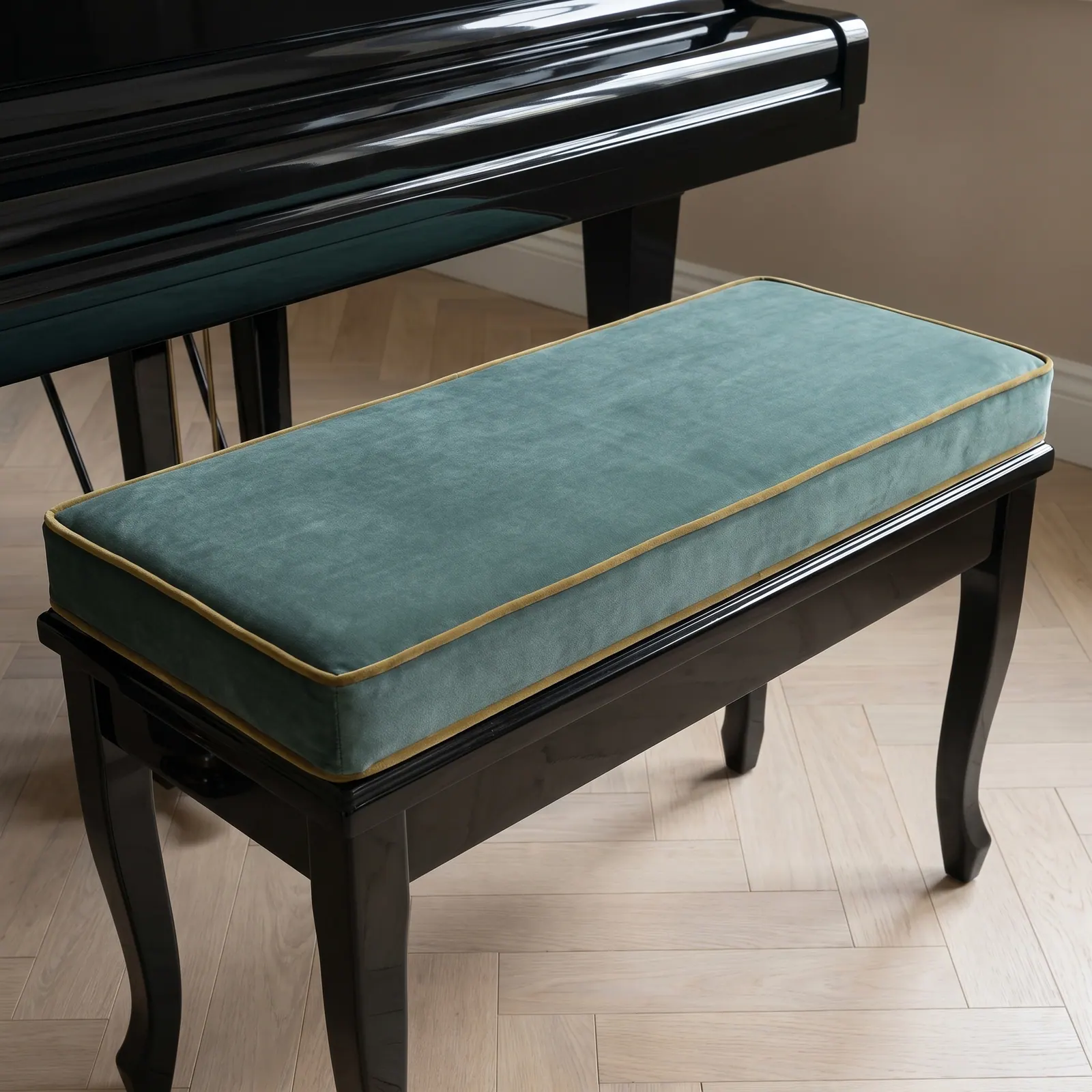
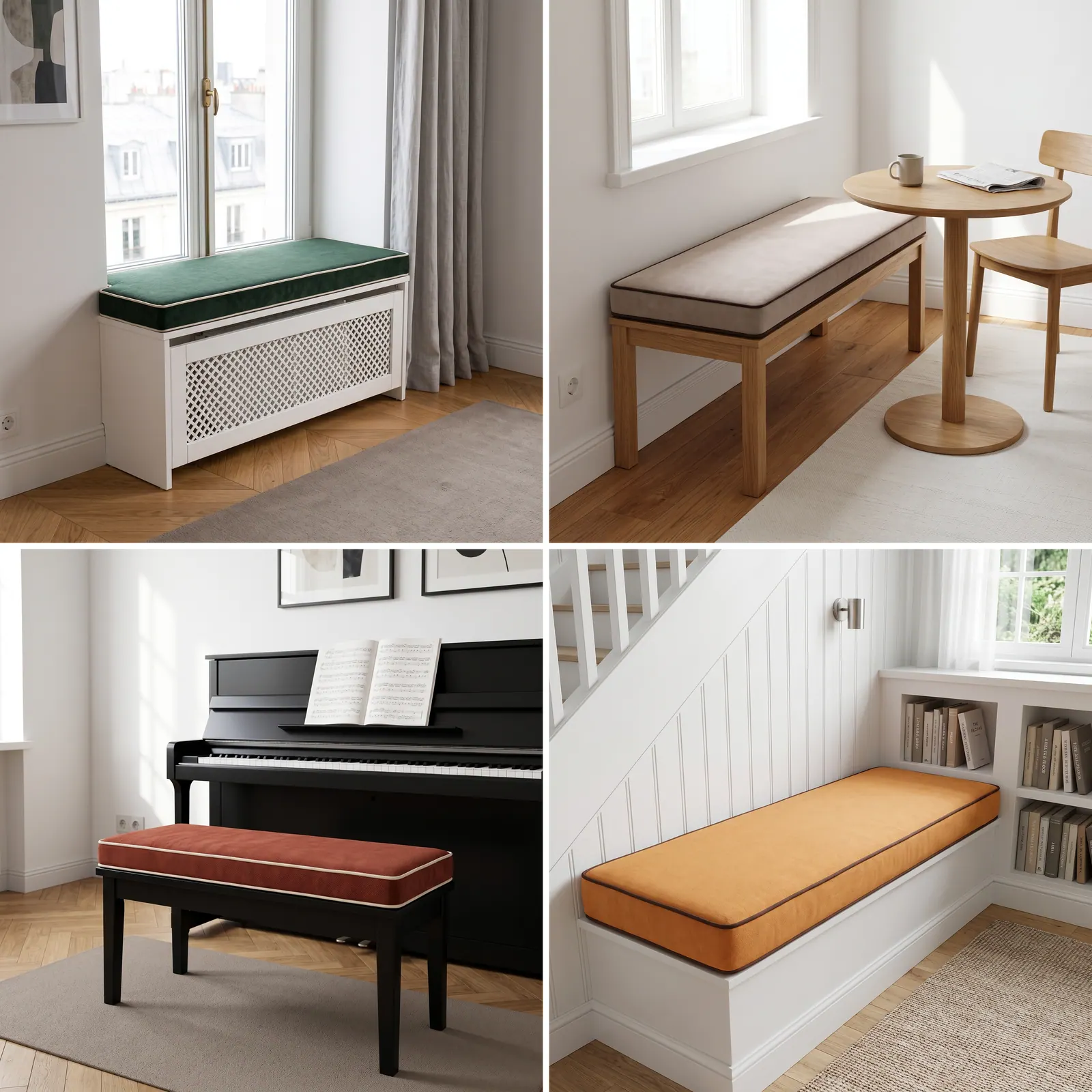
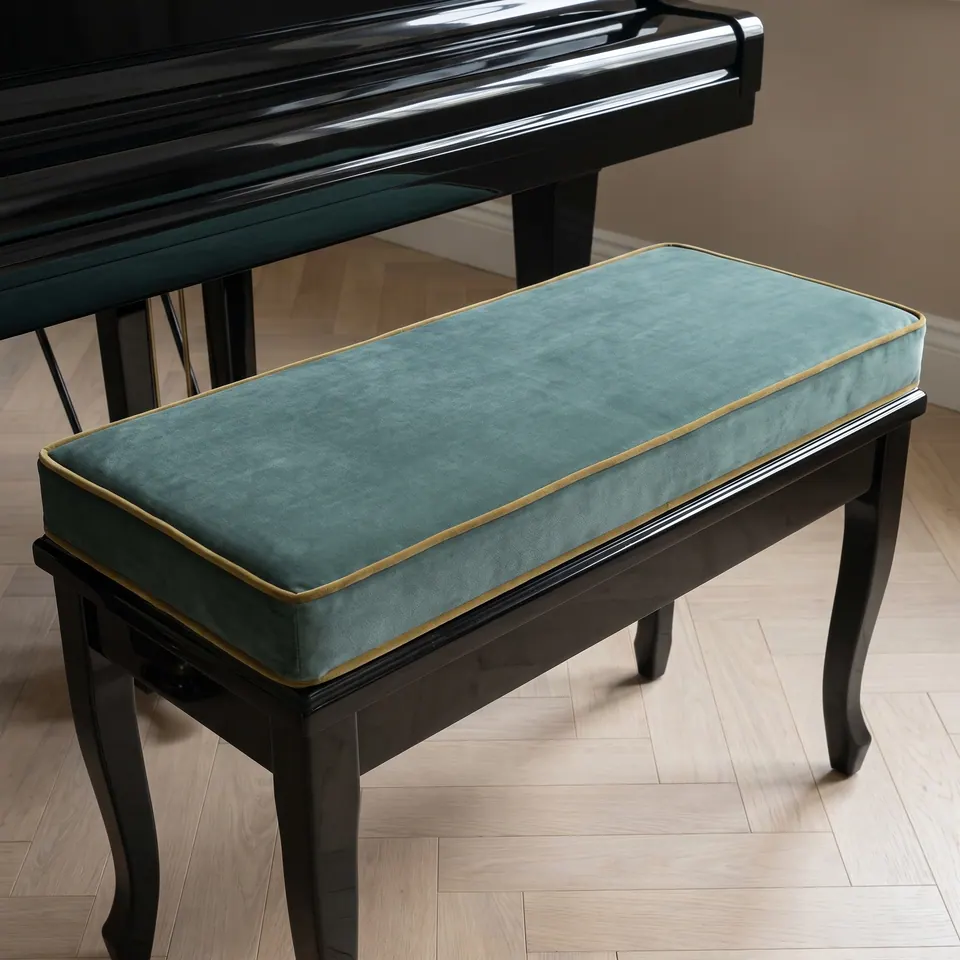
The box edge with piping is the tailored choice, and on a black lacquered bench a contrast welt draws the outline like a pen line. A plain, unpiped edge reads quieter, and it is the only option on a 1 in pad. See box edge or knife edge.
Some benches have rounded ends or a curved front. Don't describe a curve in numbers alone: lay wrapping paper on the lid, trace the shape, cut it out and photograph it flat beside a tape measure. Rounded corners and oval seats walks through it.
If the lid lifts for sheet music, the cushion has to stay put while it opens. On a solid lidded box a non-slip base usually does better than ties, since ties need a rail or a leg to knot around; storage bench cushions covers hinged tops. Tufting looks lovely in a parlor, but tufted cushions have no foam core and can't be made as thin as 1 in.
Fabrics for the music corner
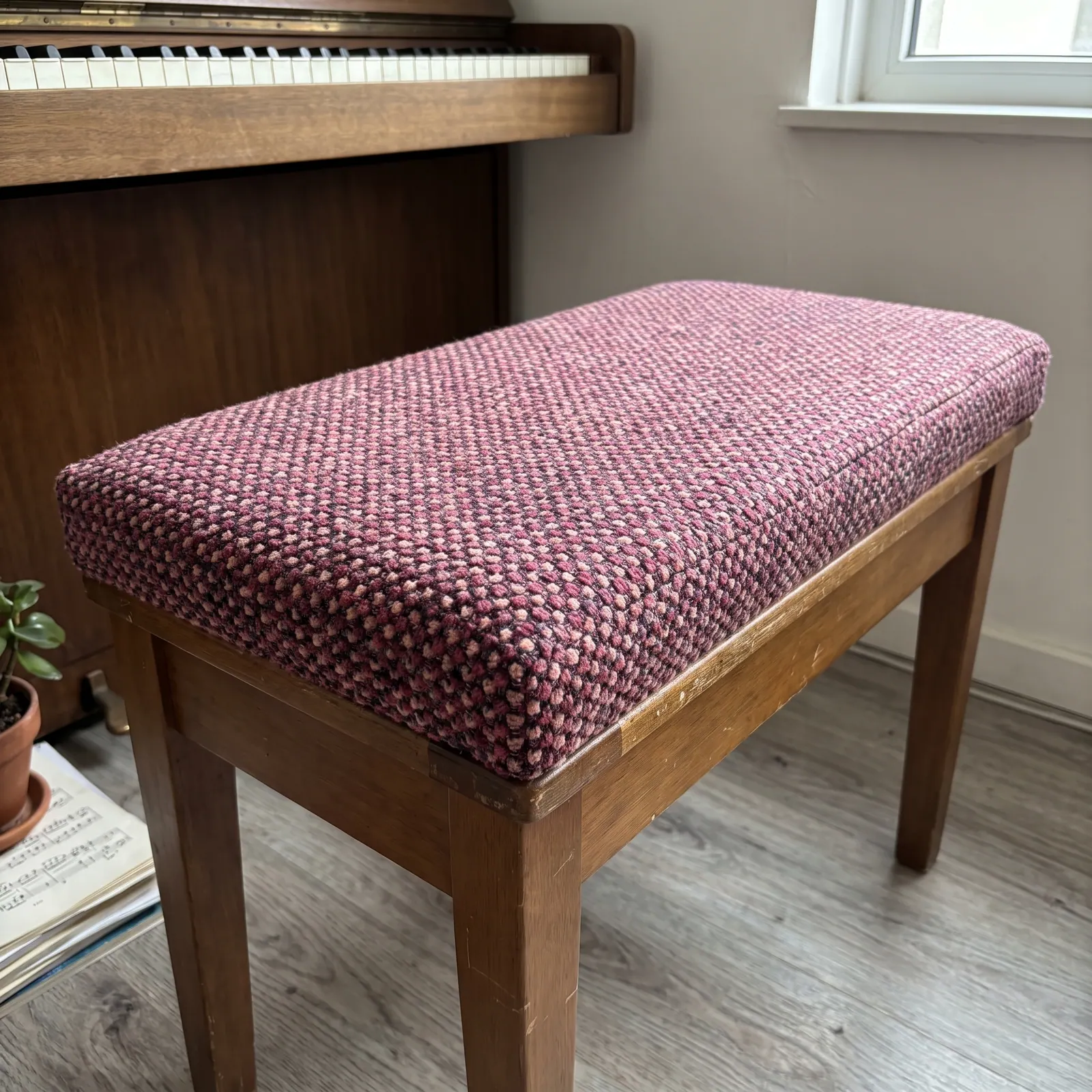
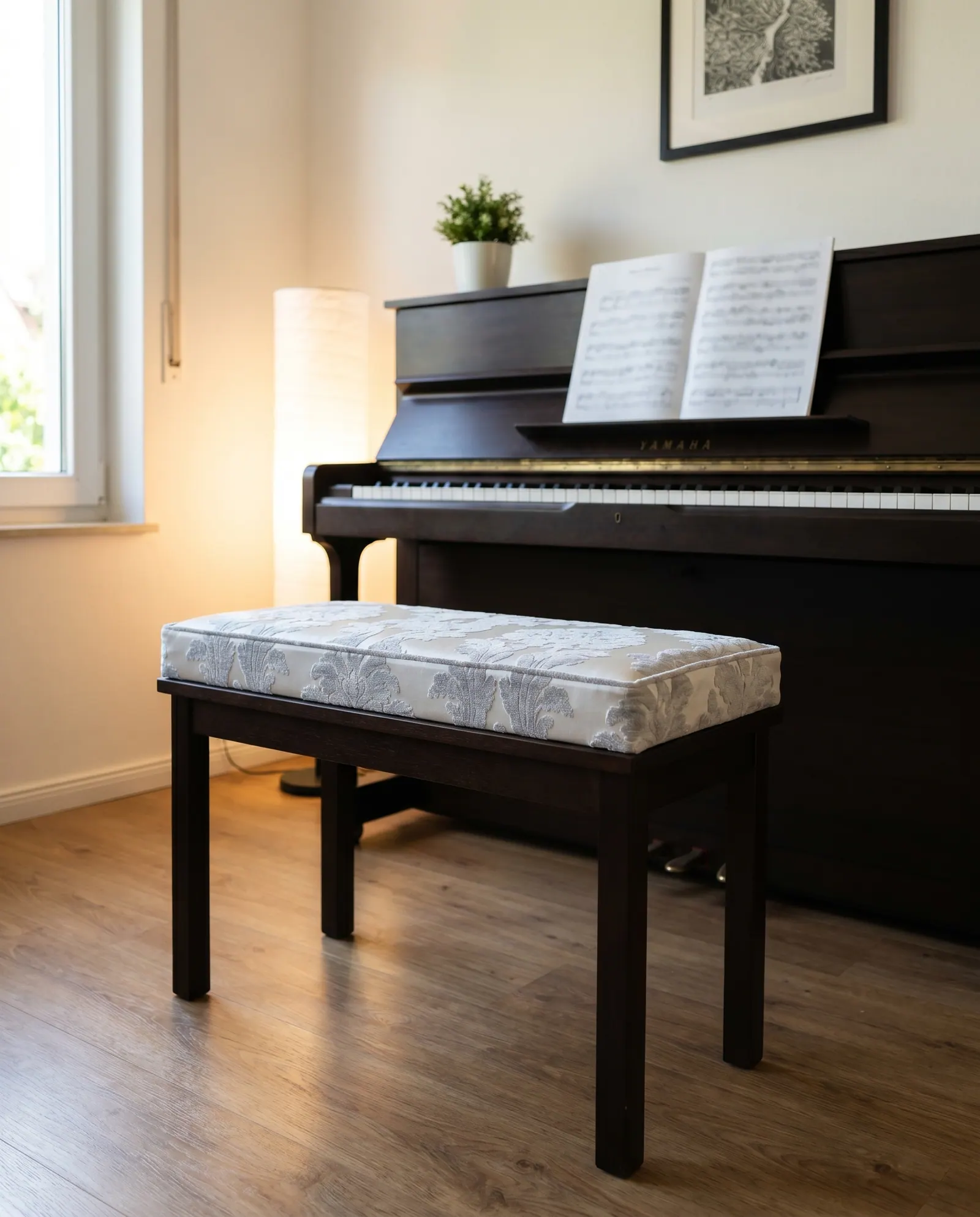
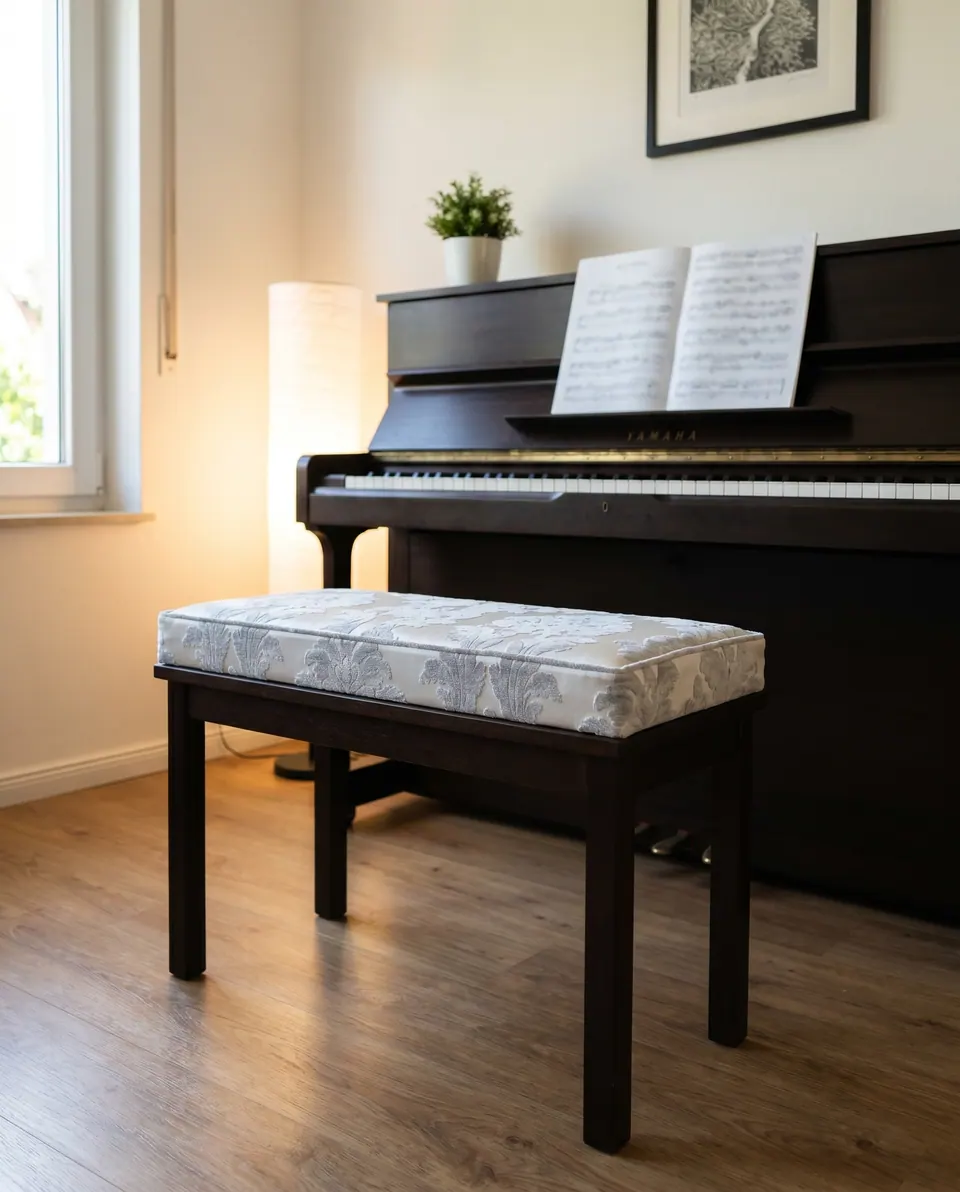
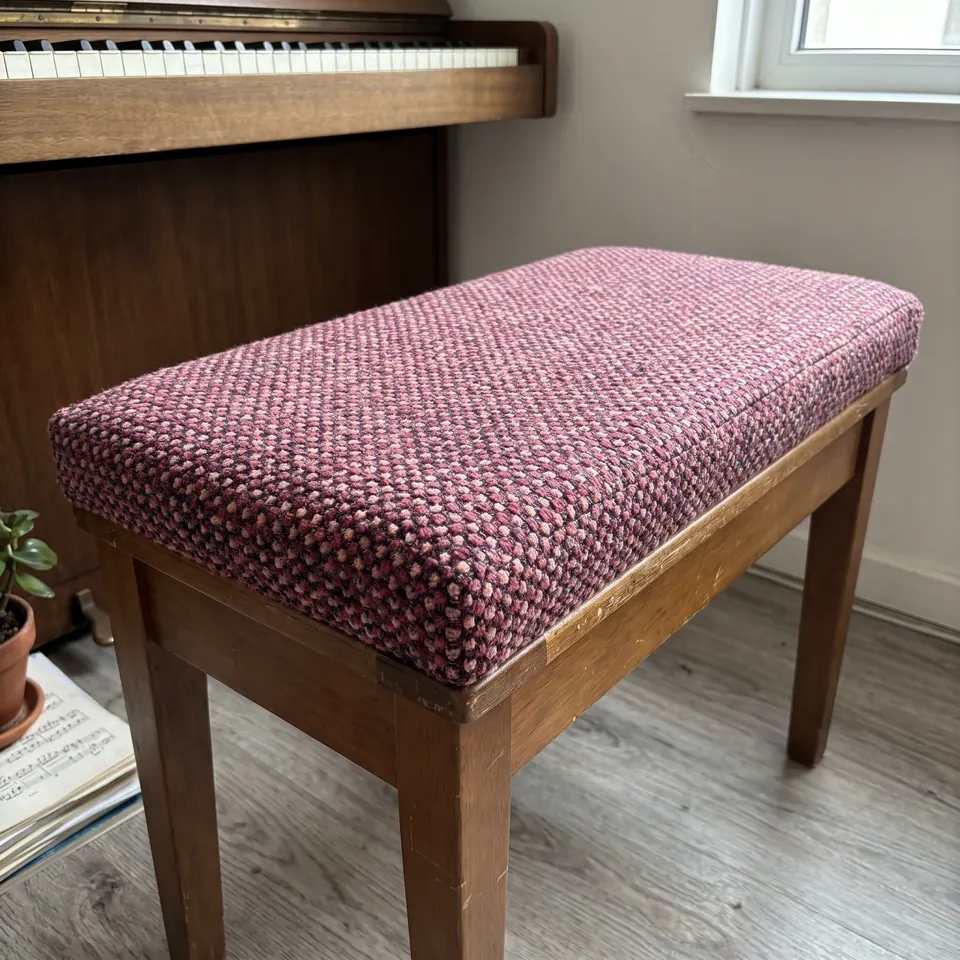
The three benches in our gallery make the case for choosing fabric against the piano's finish. A raspberry and mauve nubby weave warms a walnut bench beside an upright; a silver-gray and ivory damask sits on a black bench in the glow of a paper floor lamp; a teal-green velvet with mustard-gold piping answers a black lacquered grand on pale herringbone oak.
- Velvet for deep color and a soft hand; read velvet bench cushion care first.
- Jacquard and damask for pattern that suits a formal room.
- Performance and pet-friendly weaves when small students practice with snacks nearby: tight, washable, mid-tone, with a zip-off cover.
One color warning, neighbor: sunlight and camera angle can shift a tone on screen, so compare swatches in daylight. Screen vs swatch explains why.
Open a swatch family
- Velvet1 reading
- Jacquard & Damask2 readings
- Performance & Pet-Friendly WeavesTight weaves for busy homes
- Linen-Look WeavesWoven texture, easy care
The count is how many published readings use each family. Open a family for its swatch book, care notes and neighbors.
Foam, thickness and playing height
Standard foam is high-density, high-resilience polyurethane of about 2.0 lb/ft³ (32 kg/m³), medium-firm, and it holds a flat top for years without going lumpy. That flat top matters at a piano. A player shifts and pedals, and a soft, domed cushion rocks with every move.
Thickness decides everything else. Bench height plus the compressed cushion is the height the player sits at, and a teacher will spot an extra inch before you do. If a child and a grown-up share the bench, think about who plays most. Who practices at your piano, and how tall do they sit? Check the numbers in the seat height calculator, then read piano bench cushions: size, thickness and playing height. Torn on firmness? The foam firmness finder will settle it.
The bench that wanted hook-and-loop
A buyer wrote in wanting velcro instead of ties to hold a bench cushion in place. The workshop's first answer was the usual one: ties or a non-slip bottom, because velcro tabs and snap fasteners aren't made.
When a buyer still wants velcro, it has been done: a two-sided strip, one side sewn under the cushion and the matching side sent along to fix to the bench. The request goes in the personalization box with the fabric code and piping choice, and you wait for confirmation before counting on it. The strips cost extra, which is why some buyers fit their own.
On a piano bench I'd start where the workshop did, with a non-slip base, and save the strip for a bench that truly won't behave.
- Measured
- two-sided strip: one side sewn under the cushion, one side for the bench
- What it taught
- Ask for ties or a non-slip base first; if you want hook-and-loop, write it in the personalization box and wait for confirmation.
Piano bench mistakes worth skipping
- Keeping the standard 4 in without checking playing height. Measure the bench, add the cushion, and see where the wrists land.
- Typing a request for ties into the size box, where it gets overlooked. Write ties with their position, length and color in the order note, and confirm by message.
- Cutting a cushion exactly to a narrow, polished lid with nothing to grip. Ask for ties or a non-slip base up front.
- Approving the pre-dispatch photo without looking for the small extras, like ties or a non-slip bottom.
- Choosing a non-slip base without asking whether that backing is washable.
Photographs from the workbench
Open any photograph large; each one has its own link and a Save button.
 Save
 Save
 Save
 Save
 Save
 Save
 Save
 Save
 Save
 Save
 Save
A 4 in piano bench cushion lifts the player about 4 in at the keys, less the squish. Choose the thickness first and the fabric second.
Rosa
Styling the piano corner, and tools before you order
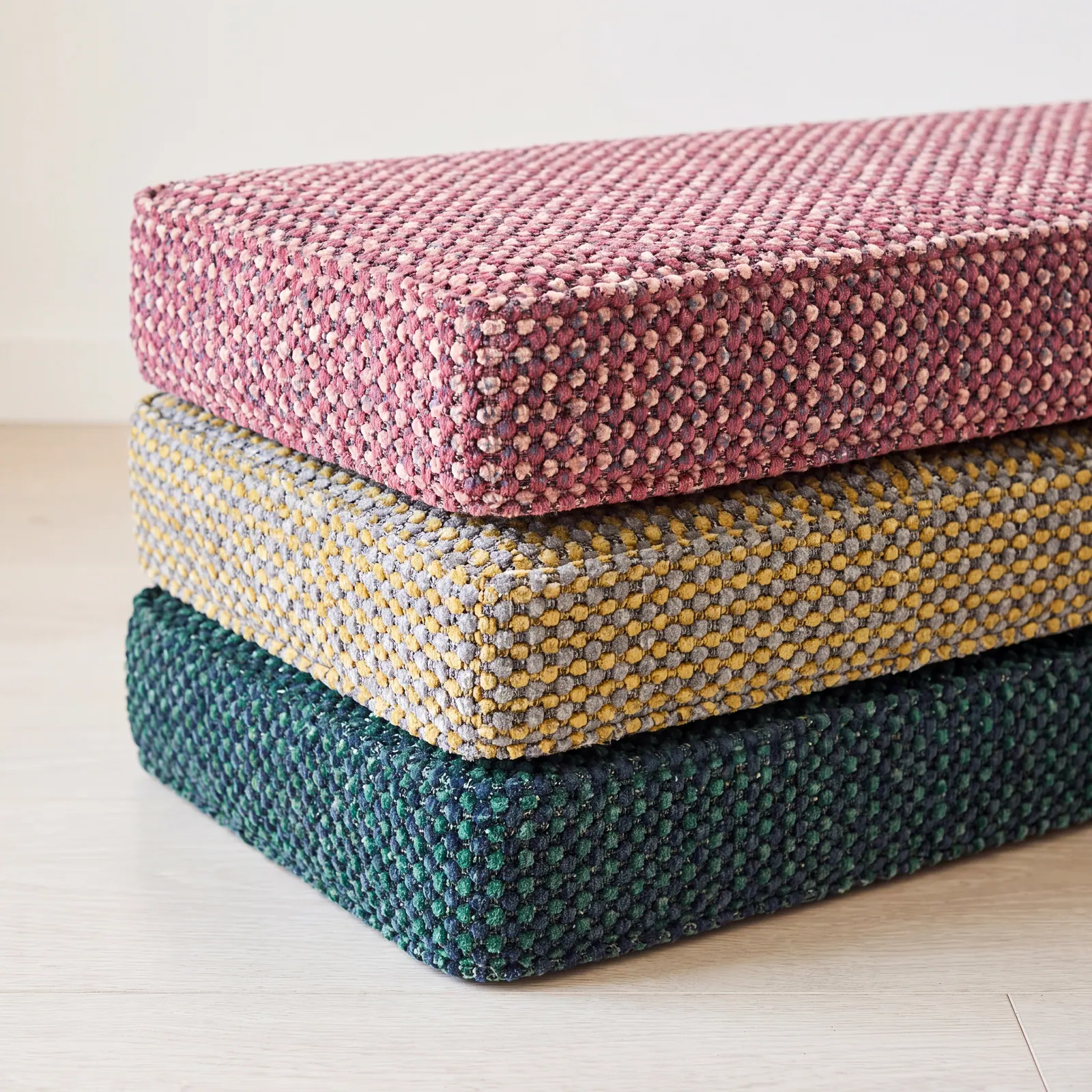
Treat the bench as part of the instrument. Pull the piping color from something already there: the brass pedals, a lamp, the gold lettering above the keys. Keep pillows off a piano bench altogether; they belong on the sofa across the room. One nubby weave stacked in three colorways, raspberry, mustard-gray and green-navy, shows how the same cloth can go traditional or bold.
Before you order, try the shape, thickness and piping in the 3D bench cushion builder, and read ties, non-slip base or velcro if your bench top is smooth. The rest of the room has its own notes under living room cushions.
Buyer questions
- A common question
How dense is the foam in your custom bench cushions?
The workshop's answerHigh-density, high-resilience polyurethane cold foam of about 2.0 lb/ft³ (32 kg/m³), with a medium-firm feel. That's firmer and longer-lasting than the 1.75 lb/ft³ (28 kg/m³) foam often specified, and it holds its shape for years without going lumpy. Every custom cushion gets it as standard, so there's no foam grade to pick unless you want something softer.
- A common question
Could you put velcro on the bottom instead of ties so it stays put?
The workshop's answerTies and a non-slip bottom are the standard ways to stop a cushion moving, and the workshop usually suggests one of those; velcro tabs and snap fasteners aren't made. Two-sided velcro strips have been added on request at extra cost, one side sewn under the cushion and the other sent to fix to the bench. Write the request in the personalization box with your fabric and piping codes, and wait for confirmation.
- A common question
My bench has a rounded end. How do I measure the curve?
The workshop's answerThe workshop won't guess a curve from numbers alone. Either sketch it with the total width and depth, the straight length of each edge before the curve, where each curve starts and ends, and how deep it runs; or, for tricky curves, trace the seat onto wrapping paper, cut it out and photograph it flat beside a tape measure. Each cushion needs its own drawing, and the shape is confirmed before production.
- A common question
What should I send to get a quote on a custom cushion?
The workshop's answerThe exact length x width x thickness, the fabric or listing you like (a link or screenshot helps), and for any non-rectangular shape a simple drawing with every side written on it. Photos of the seat help too, and it can all go in the workshop's message thread. The workshop checks the shape, then replies with a total that states whether shipping is included, and names the listing option or creates a custom purchase link.
- A common question
We're moving next month. Can the cushion arrive after we're in the new house?
The workshop's answerOften, yes: past buyers ordered early and wrote 'please deliver on or after' with their date in the personalization box or order note, and the workshop held the finished order or timed production so it landed close to that date, shipping straight to the new address. Transit time varies, so an exact day can't be promised; for UPS deliveries you can also reschedule or hold the delivery yourself.
- A common question
I placed an order by mistake. Can it be canceled?
The workshop's answerUsually, yes: accidental orders are canceled and refunded if you write before production starts, and the refund can take a few days to show. The workshop usually asks why first: if size, color or space is the problem, it can make a custom size or color instead, and if timing is the issue it may offer a later ship date. If you still want to cancel, it cancels on request.

Have it made
Have your piano bench cushion made — ask Rosa’s workshop
Tell the workshop who sits there: grandkids, the dog, a cup of coffee at six. The right fabric and foam follow from the people. — Rosa
Leave your details and the workshop will call you to confirm measurements, fabric, foam and piping. No prices, dates or payment on this page: it is a request, not an order.
More piano bench questions
Can a piano bench cushion be thinner than 2 inches?
Yes, with one trade-off. Cushions of 1 in (2.5 cm) are made without piping, while about 1 1/4 in (3 cm) can still take piping. The thinnest standard foam cushion is 2 in (5 cm).
Will a non-slip base mark a wooden piano bench?
No. The non-slip base replaces the whole bottom panel with a grippy fabric that holds by friction. It isn't adhesive or rubber, leaves no residue and is safe on wood. It's chosen in personalization at extra cost, and a newer washable version adds time, so ask how much.
Where does the zipper go on a piano bench cushion?
Hidden on the back edge or on the underside, whichever you choose. Every foam cushion has a zippered, fully removable cover at no extra cost, and on bench covers the zipper often wraps around two corners so the insert slides out easily.
Can I have a tufted cushion on a piano bench?
You can, but mind the height. Tufted cushions have no foam core; they're packed tightly with siliconized fiber and deliberately overfilled so they stay firm, and they can't be made as thin as 1 in. Tufted bench cushions are 4 in thick as standard.
How do I clean a piano bench cushion cover?
Unzip it and machine wash it on a gentle cycle at 86°F (30°C), which is also the first thing the workshop suggests for a stain. Every foam cushion's cover comes fully off, so the foam insert stays out of the machine.
How many ties does a piano bench cushion need?
Stock pads often come with three pairs: one at each end and one in the middle, tied under the lid. On a made-to-measure pad, mark where your bench's legs or lid edges are and how many ties you want. On a lift-top bench, keep ties to the hinge side so the lid still opens, or choose a non-slip base instead.
Porch light's on — Rosa
Readings
Photographs read by the masters: piano bench cushions
Real cushions made for real rooms, each read for proportion, fabric and fit.
The Pattern Room