The Pattern Room · a measuring pattern
Piano bench cushions: sizing the top and choosing a thickness for playing
On a piano bench, an inch of foam decides where the wrists meet the keys. Measure the lid, choose the thickness with care, and tie it down if the lid lifts.

 Save
The quick answer
A piano bench cushion should match the bench top, most often 14 x 30 in, and stay thin, 1 to 3 in, because every inch of foam raises the player's forearms against the keys. Most adults do well at 1 to 2 in; children often need a 2 to 3 in booster. Measure the lid itself, and add ties on the hinge side if the lid lifts.
An inch of foam moves the pianist
Put a 4 in bench cushion on a piano bench and you haven't padded the player; you've moved them. Every inch of foam lifts the forearms an inch against the keys.
That's why, neighbor, a piano bench cushion runs thin: usually 1 to 3 in (2.5 to 7.5 cm), with 2 to 3 in boosters for children. The workshop's standard for benches is 4 in (10 cm), so a piano needs its own conversation.
Piano benches rarely come up by name. Thin pads and lift-up lids come up constantly, and those two questions are most of the job. Finished examples sit in the piano bench cushion Atlas.
On the cutting table: common piano bench tops
| Most common top | 14 x 30 in (36 x 76 cm) |
|---|---|
| Small bench | 12 3/4 x 25 in (32 x 64 cm) |
| Large or duet bench | 15 1/2 x 32 in (39 x 81 cm) |
| Typical pad | 1 to 3 in (2.5 to 7.5 cm) thick |
| Children's booster | 2 to 3 in (5 to 7.5 cm) thick |
| Thinnest standard foam | 2 in (5 cm); 1.5 in and 1 in made to order |
| Fastening | ties on the hinge side, or a non-slip base |
Measuring a piano bench in eight steps
Clear the lid and measure the top
Lift off the music and the old pad, and measure the wood itself, left to right, then front to back. Most tops are 14 x 30 in, but trust your tape over the common size.
Pattern sheet The most common piano bench top, 14 x 30 in (36 x 76 cm), with a 2 in (5 cm) pad: length left to right, depth front to back, thickness last. Write the exact numbers down
Don't shave anything off. The workshop cuts to your figures, and its production team handles any fitting allowance. Piping sits on the seams, so a 14 x 30 in top gets a 14 x 30 in pad.
Look hard at the corners
For softened corners, give each edge as if the corners were square, then mark where each curve begins along both edges, or trace a corner beside a tape measure. The rounded corner Pattern shows how.
Measure the playing height
Floor to bench top, plus the cushion, is the new seat height. Foam settles a little: a 3 in pad can sit nearer 2.5 in once it's broken in.
Choose the thickness
For most adults, 1 to 2 in keeps the bench near the height it was built for; a child who sits low may want a 2 to 3 in booster. The workshop's thinnest standard foam is 2 in (5 cm), the minimum it recommends for seating, and 1.5 in and 1 in pads are made to order.
Decide on piping
Piping works down to about 1 1/8 in (3 cm), and a 1.5 in pad has been made with contrast piping. Pads of 1 in or 3/4 in (2 cm) are made without it, and tufting can't go that thin. The piping Pattern compares the options.
Fix it to the bench
If the lid lifts for music storage, ask for ties on the hinge side only, with each hinge's position from a named end, its width and a photo. One buyer in the US gave four hinge positions along a 77 in quilt box, 8 5/8, 29, 48 and 68 1/4 in, and the workshop still asked which end she'd measured from.
Put every extra in writing
Write the size, thickness, fabric, piping and ties with their position in the order note, then check the photo before dispatch. That's where a missing tie gets caught.

Have it made
Measured it? Have Rosa’s workshop make it
Tell the workshop who sits there: grandkids, the dog, a cup of coffee at six. The right fabric and foam follow from the people. — Rosa
Leave your details and the workshop will call you to confirm measurements, fabric, foam and piping. No prices, dates or payment on this page: it is a request, not an order.
Try the height before you order
The seat height calculator adds the bench and the pad for you. Put in the bench height, try 1, 2 and 3 in, and see where the player sits. The thickness and seat height Pattern works the sum on paper.
A cedar chest, a bevel and a straight answer
A buyer in the US wrote to the workshop about a family cedar chest she used as a seat. She wanted a tie-on cushion, but the hinges left no room for ties.
So the cushion was sized to the inside of the lid's bevel, 42 x 18 in (107 x 46 cm), not the outer lid at 44 1/4 x 19 in. The workshop told her plainly that a non-slip base helps while someone sits but can't stop a cushion sliding when the lid lifts. She skipped it to protect the antique finish, and chose a linen with self-piping.
A piano bench with a music compartment is the same puzzle in a smaller box. If you'll lift that lid every lesson, only hinge-side ties will hold. The hinged lid Pattern has the rest.
Where piano bench pads go wrong
- Ordering the 4 in bench default. On a piano it lifts the player too high.
- Typing "ties" into the size box, where it gets overlooked. Ask for them in a message, with position, length and color.
- Trusting a non-slip base on a lid that lifts. It steadies a seated player, not an opening lid.
- Choosing a pale, delicate cloth for a practice bench. Kids and dogs are the real quality control.
- Waving through the pre-dispatch photo, when small extras are easiest to fix.
Cloth and foam for a bench that gets played every day
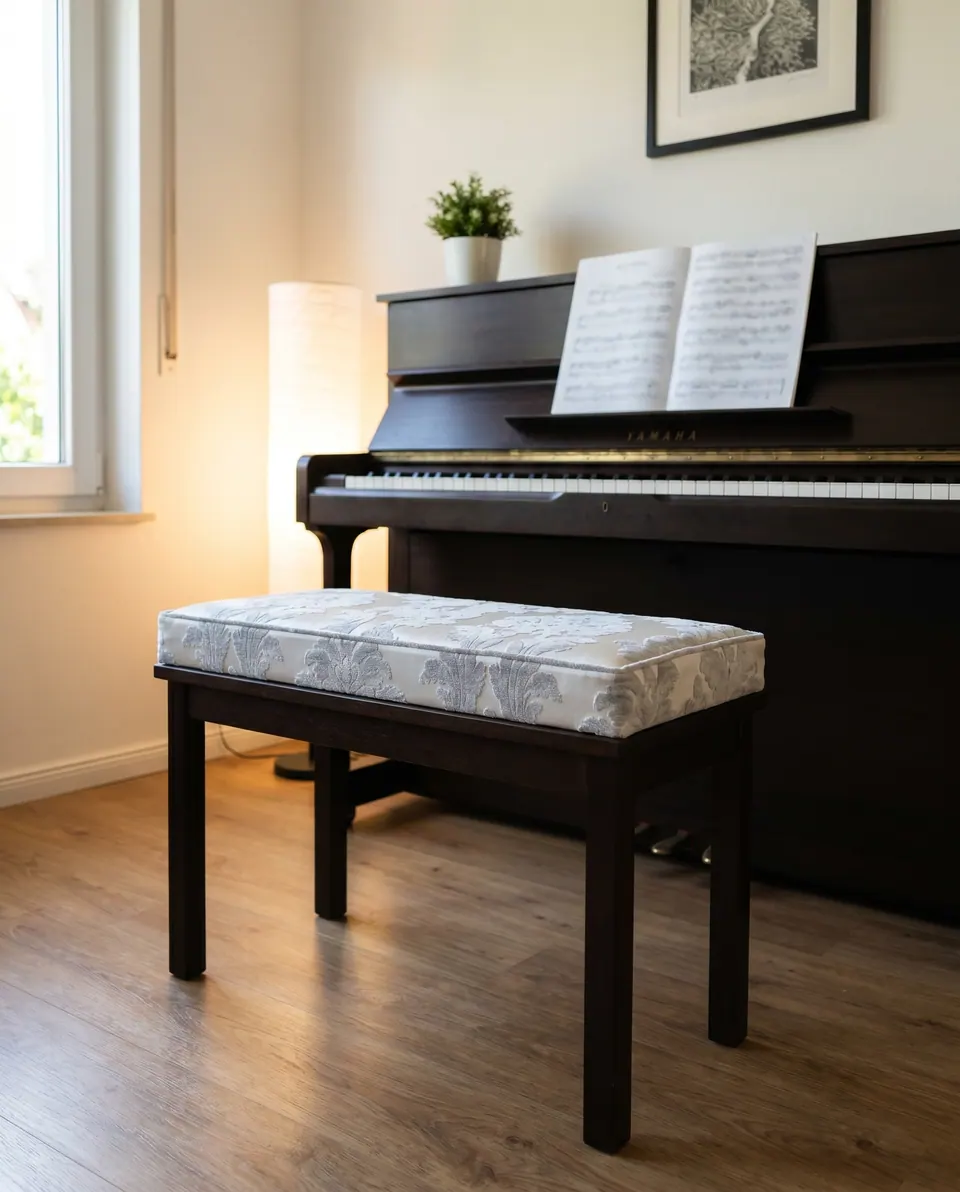
Piano bench pads are traditionally covered in suede-look cloth, cotton-poly or tapestry; the tapestry look lives in the workshop's jacquard and damask family. For a practice bench, pick a tight, washable weave in a mid-tone. High-density foam keeps the top flat so it won't wobble under pedaling, and the zippered cover comes off for washing.
What does your bench measure, and who plays on it most?
A non-slip base keeps a piano bench pad still while someone sits, but only ties on the hinge side keep it on a lid that lifts.
Rosa
Buyer questions: thin pads and lift-up lids
- A common question
Is 2 inches too thick for my bench? Could you make a pad only 1 inch thick?
The workshop's answerThe thinnest standard option is 2 in (5 cm), and that's the minimum the workshop recommends for seating. Thinner pads are made to order: 1.5 in has been made with contrast piping and about 1 1/8 in (3 cm) can still take piping, but 3/4 in (2 cm) and 1 in pads are made without piping.
- A common question
My bench seat lifts up for storage. How do I keep the cushion on when I open it?
The workshop's answerAsk for ties on the hinge side only, and give each hinge's position measured from a named end, its width and a photo so the ties miss the hardware. If ties won't work, the cushion can be sized to sit inside the lid's bevel with a non-slip base. That holds it in normal use, but it can still slide off when the lid lifts.
- A common question
Should I take a little off my measurements so the pad isn't too tight?
The workshop's answerNo. Give the exact size of the top, end to end, and don't subtract anything, not even half an inch. The workshop cuts to the numbers you write, and its production team handles any fitting allowance. Piping sits on the seams, so it doesn't change the size either.
- A common question
The top of my bench has rounded corners. What measurements do you need?
The workshop's answerGive each edge's full length as if the corners were square, then mark how far from each corner the curve begins, along both edges. Or trace a corner on paper and photograph it next to a tape measure. The workshop sends a template to confirm and asks before cutting if anything is missing.
Piano bench cushion questions
What size is a standard piano bench cushion?
The most common bench top is 14 x 30 in (36 x 76 cm). Smaller benches run about 12 3/4 x 25 in and larger ones about 15 1/2 x 32 in, so measure your own top before you order.
How thick should a cushion on a piano bench be?
Thin. Pads on piano benches usually run 1 to 3 in, because the cushion raises the player by roughly its own thickness. Most adults are comfortable at 1 to 2 in, while a child who sits low at the keys may need a 2 to 3 in booster.
Does a thicker piano bench pad cost more than a thin one?
Not within the standard range. At the workshop, 2, 3, 4 and 5 in (5, 7.5, 10 and 12.5 cm) cushions have cost the same, and thinner custom pads usually do too. Only extra-thick builds beyond that range have been quoted higher, because foam volume drives the price.
What fabric suits a piano bench cushion?
Piano bench pads are usually covered in suede-look fabric, cotton-poly or tapestry. For a bench a child practices on daily, choose a tight, washable weave in a mid-tone with a zip-off cover, so small spills and pencil marks come out.
How much will a piano bench cushion raise me?
Nearly its full thickness. One piano bench maker says a player sinks only about 1/4 in into its pad, so a 2 in cushion lifts you roughly 1 3/4 in. Sit at the keys on a folded towel of the planned thickness and check your forearms before ordering; the thinnest standard foam is 2 in, and thinner pads are made without piping.